Skier's Thumb | UCL Injury | Stener Lesion | Pinch Grip Stability
- Stener lesion: UCL stump flips superficial to adductor aponeurosis - aponeurosis blocks healing - MANDATORY surgery
- Test in 30° flexion to isolate proper collateral ligament (main stabiliser). Extension tests accessory UCL + volar plate
- Instability criteria: greater than 30° laxity OR greater than 15° difference to normal side OR no firm endpoint
- X-ray FIRST before stress testing - may have avulsion fracture that stress could displace
- Chronic cases (greater than 6 weeks): Primary repair not possible - requires tendon graft reconstruction or MCP fusion
- “Gamekeeper's = chronic (Scottish rabbit neck-wringing), Skier's = acute (ski pole strap)
- “Palpable mass proximal to MCP = Stener lesion clinically
- “Complete tear conservative treatment failure rate is high because most have Stener lesion
- “Protect radial sensory nerve during surgical repair - runs in surgical field
Gamekeeper's Thumb
Overview
The ulnar collateral ligament (UCL) of the thumb metacarpophalangeal (MCP) joint is injured by forced abduction, and treatment aims to restore a stable joint and pinch grip strength and to prevent chronic instability with CMC arthritis.
Two names. Skier's thumb is the acute, traumatic injury. Gamekeeper's thumb is the chronic, attritional one, named after Scottish gamekeepers who killed rabbits by wringing their necks and so loaded the thumb with repetitive valgus stress.
Who and how. It is a common sports injury, seen in skiing, rugby and AFL. The ski pole strap is the classically described mechanism; a fall on the outstretched thumb with forced abduction does the same.
- Skier's Thumb (Acute)
- Single traumatic event
- Gamekeeper's Thumb (Chronic)
- Repetitive stress
- Skier's Thumb (Acute)
- Acute pain, swelling
- Gamekeeper's Thumb (Chronic)
- Gradual weakness, instability
- Skier's Thumb (Acute)
- Repair if Stener lesion
- Gamekeeper's Thumb (Chronic)
- Reconstruction or fusion
The critical pathology is the Stener lesion, set out under Pathophysiology: the finding that makes surgery mandatory.
Anatomy
Two components, two positions. The UCL has a proper and an accessory part, and the position of the joint decides which is under tension. The proper collateral ligament (PCL) is dorsal and taut in flexion; it is the principal restraint to valgus stress at the MCP joint and the main stabiliser. The accessory collateral ligament (ACL) is volar, taut in extension, and blends with the volar plate, which also tightens in extension but is not a primary stabiliser.
The adductor aponeurosis. The adductor pollicis aponeurosis lies superficial to both components and over the UCL's insertion on the base of the proximal phalanx. In a complete tear the UCL stump can flip outside it.
Why the test position matters. Stressing the joint at 30° of flexion isolates the proper collateral ligament and relaxes the accessory ligament and volar plate, which makes it the more specific test for a UCL injury. Stressing in full extension tests the accessory UCL and volar plate as well.
Pathophysiology
Mechanism. Forced radial deviation (abduction) and hyperextension of the MCP joint load the UCL beyond its tensile limit. It fails most often at its distal insertion on the proximal phalanx, either as a midsubstance or avulsion tear of the soft tissue or as a bony avulsion of the ulnar base of the proximal phalanx. The ski-pole strap forcing the thumb sideways produces the acute injury; repetitive attritional valgus loading produces the chronic one.
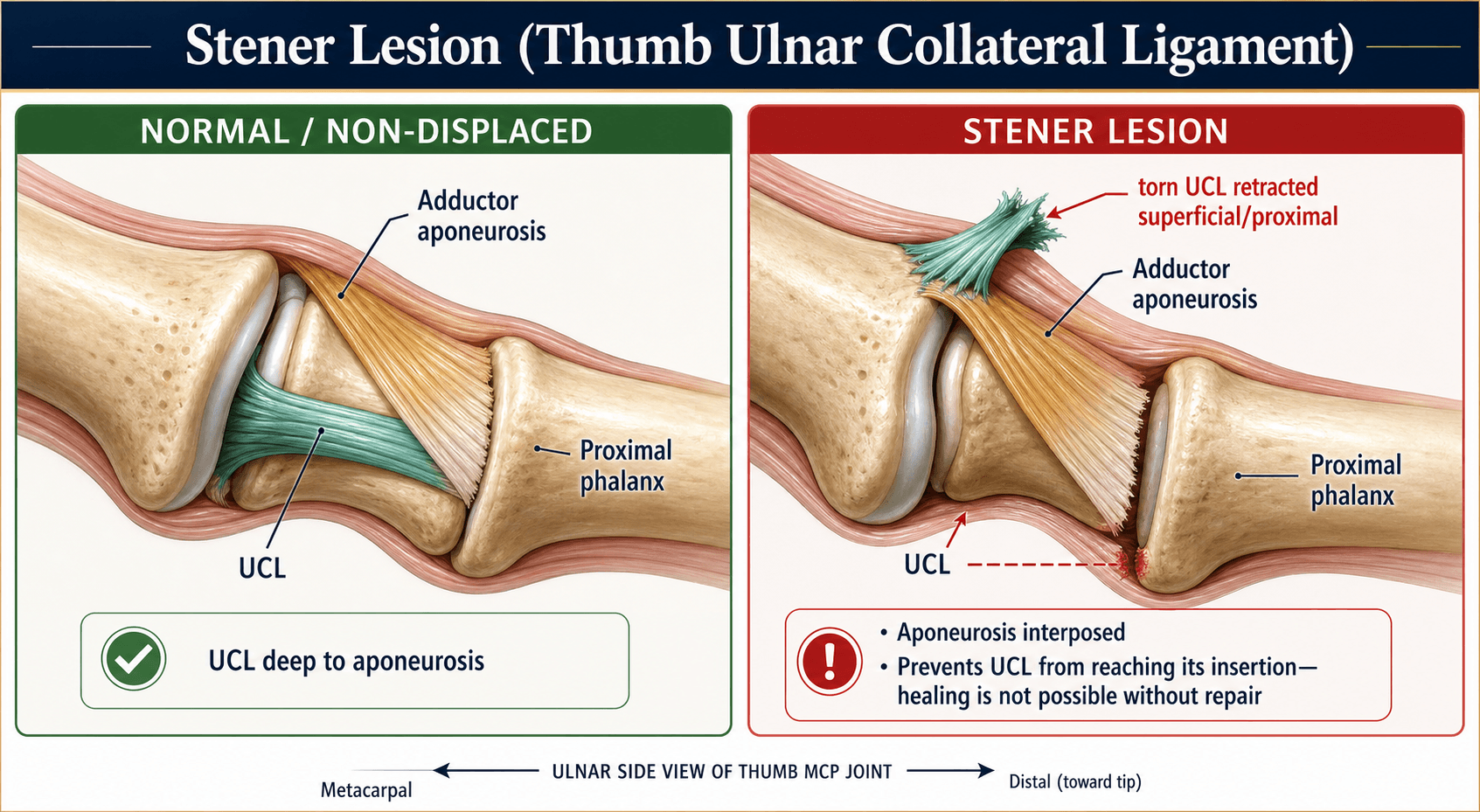
The Stener lesion. When the UCL avulses distally, the retracted free stump can flip and come to lie superficial to the aponeurosis while its bony footprint stays deep to it. The interposed aponeurosis physically separates ligament from bone, so the ligament cannot heal in continuity with cast treatment or immobilisation, and operative retrieval and repair are required. Stener described the interposition in 1962.
How often. A Stener lesion is quoted in approximately 80% of complete UCL ruptures. That figure comes from operative series, which are enriched for severe injury, so the true proportion among all complete ruptures, including those judged stable and never explored, is not known.
Associated injuries. A bony avulsion leaves a fragment at the base of the proximal phalanx, and a displaced avulsion often has a Stener lesion as well. Check the radial collateral ligament and the volar plate for a combined injury.
Natural history. A complete tear left untreated progresses to chronic instability, weak key pinch and eventual MCP osteoarthritis. The chronically unstable thumb shows a recognisable pattern:
- Unable to perform key pinch
- Compensatory MCP hyperextension
- CMC joint overload
- Progressive MCP arthritis
Classification
UCL injuries are graded on the stress examination: how far the joint opens, and whether it stops at a firm endpoint.
- Injury
- Microscopic tears, ligament intact
- Laxity
- Less than 15°
- Endpoint
- Firm
- Injury
- Partial disruption of ligament fibres
- Laxity
- 15-30°
- Endpoint
- Present
- Injury
- Complete rupture of the UCL
- Laxity
- Greater than 30°, or greater than 15° difference to the normal side
- Endpoint
- Absent
The complete tear. Any one of more than 30° of laxity, more than 15° of difference from the normal side, or the absence of a firm endpoint indicates a complete tear. A Stener lesion is likely in a Grade III injury.
Clinical Assessment
History. Ask about the mechanism (a fall on the abducted thumb, a ski pole, a ball), the time since injury, weakness of pinch grip and previous injuries.
Inspection and palpation. Look for swelling and bruising over the ulnar side of the MCP joint. A palpable mass proximal to the joint is the Stener lesion felt clinically.
Stress testing. The examination is done in a fixed order:
- Radiograph first. Stressing a non-displaced avulsion fracture can displace it, so rule out a bony avulsion before stressing the joint, and if a fracture is present do not stress test vigorously.
- Test the normal side first, because laxity varies.
- Apply valgus stress in 30° flexion for the proper UCL, then in full extension for the accessory UCL and volar plate.
- Compare both the absolute laxity and the quality of the endpoint, soft or firm, with the normal thumb; more than 15° of asymmetry is significant.
A soft endpoint is more specific for a tear than the absolute degree of angulation.
Suspecting a Stener lesion. A palpable mass proximal to the joint together with significant laxity should raise the suspicion, and a suspected Stener lesion is confirmed with ultrasound or MRI.
Investigations
Radiographs. AP, lateral and oblique views of the thumb in all cases. Look for an avulsion fracture at the base of the proximal phalanx and for subluxation or dislocation of the joint.
Stress radiographs. Valgus stress views, compared with the normal side, quantify the laxity as the degree of opening.
Ultrasound. Ultrasound confirms a Stener lesion and assesses the integrity of the ligament. It is dynamic, compares the two sides in real time and is cost-effective; it is operator dependent but effective. The pooled meta-analyses in the evidence section put its sensitivity for the Stener lesion at about 95% and support it as the first-line test, with MRI for equivocal scans.
MRI. MRI sensitivity for the Stener lesion is greater than 90%, and it shows the position of the ligament:
- Stener lesion: the UCL superficial to the adductor aponeurosis
- Complete tear: fluid between the ligament ends
- Avulsion: a bone fragment with the ligament attached
Radial Collateral Ligament (RCL) Injury - The Contrast Diagnosis
Radial collateral ligament (RCL) injury is the examiner's favourite contrast to gamekeeper's thumb, and checking the RCL is part of any thumb MCP examination - so it deserves setting out in its own right.
How common. RCL injuries are considerably less common than UCL injuries - most series report the ulnar side is injured several times more often, so the RCL accounts for only a minority of thumb MCP collateral injuries.
Mechanism and testing. The RCL fails with forced adduction (ulnar/varus deviation) of the thumb MCP joint - the mirror image of the abduction load that tears the UCL. It is assessed with varus (radial-deviation) stress in full extension and in 30° flexion, compared with the normal side; the same laxity thresholds and endpoint-quality principles used for the UCL apply.
The key anatomical contrast (why there is usually no "Stener" on the radial side). The adductor pollicis aponeurosis lies on the ulnar side, which is why a torn UCL can flip superficial to it and become trapped. On the radial side there is no equivalent broad aponeurosis reliably interposing, so a fixed Stener-type interposition is uncommon; a "reverse Stener" is described but is the exception, not the rule. Displacement blocking healing is therefore less characteristic of RCL tears, though complete tears still produce instability.
Deformity pattern - a clinical discriminator. Chronic RCL insufficiency produces volar and ulnar subluxation of the proximal phalanx with a dorsoradial prominence of the metacarpal head, and a supination/rotational deformity - a pattern distinct from the ulnar-sided instability of a UCL injury.
Management mirrors UCL principles: partial or stable injuries are immobilised; complete, displaced, or grossly unstable tears are repaired; chronic irreparable injuries are reconstructed (the Baek et al. figure-of-eight series on this page included 9 RCL reconstructions alongside 7 UCL) or treated by MCP arthrodesis if the joint is arthritic.
If asked "what if the injury were on the other side?", say: RCL injury is much rarer, tested with varus (radial-deviation) stress, and rarely forms a true Stener lesion because the adductor aponeurosis is an ulnar-sided structure. The tell-tale is a chronic volar-ulnar subluxation with dorsoradial metacarpal-head prominence and rotational deformity, and management follows the same repair-versus-reconstruct-versus-fuse ladder.
Differential Diagnosis
A swollen, painful thumb MCP joint after a fall has several mimics. The key is to distinguish UCL injury from radial-sided, bony, and joint pathology, because each changes management.
- Distinguishing Features
- Ulnar-sided tenderness, valgus laxity, weak key pinch
- Key Discriminator
- Laxity greater on ulnar stress in 30° flexion
- Distinguishing Features
- Radial-sided tenderness, varus laxity, ulnar deviation deformity
- Key Discriminator
- Instability on varus (radial) stress
- Distinguishing Features
- Bony fragment on radiograph at ulnar base
- Key Discriminator
- Visible fracture - X-ray before stress
- Distinguishing Features
- Hyperextension deformity, dorsal subluxation
- Key Discriminator
- Loss of joint congruity on lateral X-ray
- Distinguishing Features
- Pain at thumb base (CMC), not MCP
- Key Discriminator
- Tenderness and fracture at thumb base
- Distinguishing Features
- Chronic basal thumb pain, grind test positive
- Key Discriminator
- Pain at CMC not MCP; degenerative X-ray
Management
The grade of the injury and the presence of a Stener lesion decide treatment.
Non-operative. Grade I and II injuries without a Stener lesion, and non-displaced avulsion fractures, are immobilised and followed up with repeat stress testing.
- Treatment
- Splint
- Duration
- 2-3 weeks
- Treatment
- Thumb spica cast
- Duration
- 4-6 weeks
- Treatment
- Thumb spica cast or splint
- Duration
- 4-6 weeks
- Treatment
- Surgical repair
- Duration
- Anchor fixation
- Treatment
- ORIF or anchor repair
- Duration
- 4-6 weeks immobilisation
Surgical indications.
- A Stener lesion, suspected clinically from a palpable lump with instability: an absolute indication
- Complete rupture without a firm endpoint (greater than 30° laxity)
- Displaced avulsion fracture
- Chronic instability
The complete tear without a Stener lesion. Complete tears are usually treated surgically because most have a Stener lesion, and conservative treatment of complete tears has a high failure rate. When imaging shows the stump is not displaced, practice varies and no randomised trial settles it (see Controversies).
Surgical Technique
Acute repair. The repair restores the ligament to its footprint:
- Dorsoulnar, S-shaped incision.
- Identify and protect the branches of the superficial radial (radial sensory) nerve, which run in the surgical field.
- Find the stump superficial to the adductor and incise the adductor aponeurosis (hood) to retrieve it and reduce it back to bone.
- Repair it to its footprint at the base of the proximal phalanx with a suture anchor (2.0-2.4mm, such as a Mitek anchor).
- Close the aponeurosis if possible.
The chronic injury. Primary repair is not possible after 6 weeks. If the joint is not arthritic the ligament is reconstructed with a palmaris longus tendon graft in a figure-of-8 configuration through bone tunnels. If it is arthritic, the MCP joint is fused in 15-20° of flexion; silicone arthroplasty is rarely used.
Suture-Tape (Internal Brace) Augmentation
Concept. A strong non-absorbable suture tape is anchored with knotless anchors spanning the repair, typically from the metacarpal head or neck to the ulnar base of the proximal phalanx, so that it lies alongside the reattached UCL. It acts as a load-sharing "internal brace" or ligament seat-belt that augments the primary anchor repair. It does not replace the native ligament, which still heals to its footprint.
Rationale. The tape carries part of the valgus load during healing, reducing repair-site gapping under early stress. The intended benefit is earlier protected mobilisation and faster return to sport or work than a repair left to heal in a cast, which matters for high-demand athletes.
Evidence status. Cadaveric biomechanical work suggests augmented constructs tolerate higher load with less gapping than suture-anchor repair alone, and early clinical case series report reliable stability with accelerated rehabilitation. There is, however, no high-quality randomised comparison against conventional anchor repair, and patient-reported superiority is unproven. In the viva, present it as an adjunct that may permit earlier motion, biomechanically supported but not yet proven superior to standard suture-anchor repair.
Cautions. The tape has limits and costs of its own:
- It must not be over-tensioned: an overconstrained MCP joint loses flexion and can stiffen.
- It adds implant cost and a second set of anchors.
- It is an adjunct, not a shortcut. A Stener lesion must still be reduced by releasing and repairing the adductor aponeurosis; augmentation over an unreduced stump does not restore anatomy.
Complications
Missed Stener lesion. This is the most important complication. It leads to chronic instability with a weak pinch grip and pain, and needs reconstruction or fusion.
After surgery. Complications of the repair, with their treatment:
- Radial sensory nerve injury, with neuroma, from the dissection: desensitisation or excision
- Stiffness from prolonged immobilisation: hand therapy
- Re-rupture
- Anchor failure
MCP arthritis. Chronic instability ends in MCP arthritis, which is fused if severe.
Postoperative Care
Rehabilitation. The protocol moves from protecting the repair to restoring motion and then strength:
- 0-6 weeks, protect the repair. Thumb spica cast or splint for 4-6 weeks, including the IP joint initially; elevation to reduce swelling; active finger range of motion.
- 6-10 weeks, restore motion. Transition to a removable splint, active range-of-motion exercises and hand therapy referral, avoiding stress on the repair.
- 10-12 weeks, strengthen. Progressive pinch strengthening, functional activities and return to light work.
- 12 weeks onwards. Return to sport and work, and full activity.
Return to sport. Contact sport resumes at 12-16 weeks and skiing at a minimum of 12 weeks, avoiding the pole strap initially; full activities resume at 16 weeks. A protective splint may be worn for sport at first, with the thumb buddy-taped to the index finger during the transition.
Outcomes
Acute repair. Acute repair gives a stable joint and strong pinch, and return to full function is expected; stiffness is the main concern.
Non-operative treatment. Appropriately selected Grade I-II injuries do well provided there is no Stener lesion. Undertreatment risks late instability.
Chronic reconstruction and fusion. Reconstruction is less predictable than acute repair and may leave some residual laxity. Fusion gives excellent pain relief at the cost of MCP motion.
- Good/Excellent
- Greater than 90%
- Main Concern
- Stiffness
- Good/Excellent
- 85-90%
- Main Concern
- Ensure no Stener
- Good/Excellent
- 80-85%
- Main Concern
- Residual laxity
- Good/Excellent
- Pain relief excellent
- Main Concern
- Loss of MCP motion
Prognosis. Outcome depends on the time to surgery (acute does better than chronic), the presence of a Stener lesion, associated arthritis (fusion may be needed), and the patient's demands and compliance. The functional goals are a stable MCP joint, pinch strength 80% of the contralateral side, and pain-free function.
US vs MRI for Stener Lesion - Meta-analysis
- Systematic review and meta-analysis: 9 ultrasound studies (315 thumbs) and 6 MRI studies (107 thumbs)
- Pooled ultrasound sensitivity 95%, specificity 94% for Stener lesion
- Pooled MRI sensitivity 93%, specificity 98% for Stener lesion
- All included studies were high risk of bias - imaging supports, never replaces, examination
Original Stener Lesion Description
- Classic anatomical description of UCL displacement
- Torn UCL stump flips superficial to adductor aponeurosis
- Aponeurosis blocks ligament-to-bone contact (interposition)
- Healing impossible without surgical retrieval of ligament
Chronic UCL Reconstruction - Free Tendon Graft
- 16 figure-of-eight collateral ligament reconstructions with palmaris longus autograft (7 UCL, 9 RCL), mean 12 months post-injury
- Radial/ulnar deviation laxity improved from 19.3° to 5.3°
- Key pinch improved from 49% to 82% and grip strength from 81% to 87% of contralateral
- Glickel functional grade: 9 excellent, 7 good (all 16 good or excellent)
Ultrasound Criteria for Displaced UCL Tear
- 26 surgically proven UCL tears (17 displaced full-thickness, 7 non-displaced, 2 partial)
- Two ultrasound criteria present in all displaced tears: non-visualisation of the UCL and a heterogeneous mass-like area proximal to the first MCP joint
- Applying these criteria gave 100% sensitivity, specificity and accuracy in differentiating displaced from non-displaced tears
- Displaced (Stener) tears most commonly lay proximal to the adductor aponeurosis
Ultrasound Accuracy for UCL Injury - Meta-analysis
- Systematic review and meta-analysis of 17 studies, 593 UCL injuries
- Ultrasound for Stener lesion: pooled sensitivity 0.96 (95% CI 0.89-0.99), specificity 0.90 (95% CI 0.81-0.94)
- Area under the curve 0.98 for Stener diagnosis - excellent accuracy
- Accuracy lower for non-displaced complete ruptures (sensitivity 0.81)
Collateral Ligament Injuries - Review & Diagnostic Criteria
- Complete tear diagnosed when the proximal phalanx angulates 30° to 35° on the metacarpal head in extension or 30° of flexion
- Lack of a firm endpoint or angulation greater than 15° versus the contralateral thumb also indicates complete tear
- Partial injuries managed nonsurgically; complete tears usually managed surgically
- Chronic injury options: repair, free tendon graft reconstruction, or MCP arthrodesis
Guidelines, Registries & Global Practice
Global Epidemiology & Burden
- Thumb UCL injury is among the most common ligamentous hand injuries and greatly outnumbers radial collateral ligament injury, though no source cited on this page quantifies the ratio.
- A bony avulsion from the ulnar base of the proximal phalanx accompanies a substantial minority of cases; no cited source here gives a proportion, and it matters clinically only in that a displaced fragment changes the operation from ligament repair to fragment fixation.
- A Stener lesion is present in a majority of complete ruptures in the frequently quoted operative series, but note the circularity: those denominators come from thumbs selected for surgical exploration, which are enriched for severe injury. The true proportion among all complete ruptures - including those judged stable and never explored - is not known.
Side-by-Side Guideline & Consensus Comparison
- Position on Stener / complete tear
- Complete tears usually operative; partial tears nonoperative
- Imaging emphasis
- Stress testing primary; imaging adjunct
- Position on Stener / complete tear
- Surgical repair for Stener / unstable complete tear
- Imaging emphasis
- Ultrasound first-line, MRI if equivocal
- Position on Stener / complete tear
- Anatomical repair / suture-anchor to footprint; ORIF for large displaced avulsion
- Imaging emphasis
- Radiograph mandatory before stress
- Position on Stener / complete tear
- Early surgery for complete instability; reconstruction for chronic
- Imaging emphasis
- Dynamic US increasingly standard
There are no randomised trials comparing surgery with immobilisation for complete tears; recommendations rest on anatomical reasoning (the Stener interposition) and consistent case-series outcomes. There is no dedicated implant registry for thumb UCL surgery (unlike arthroplasty registries such as NJR, AJRR or AOANJRR).
Controversies & Areas of Uncertainty
- Surgery vs immobilisation for complete tears without a confirmed Stener lesion. No RCT exists. Many surgeons trial cast immobilisation when imaging shows the stump is reduced (no Stener), reserving repair for failure; others repair all complete tears in high-demand patients to avoid chronic instability.
- Threshold laxity for "complete tear." Commonly quoted figures (greater than 30°, or 30-35° absolute, or greater than 15° side-to-side difference) vary between sources; endpoint quality (soft vs firm) is arguably more reliable than the absolute angle and should be assessed against the normal side.
- First-line imaging - ultrasound vs MRI. Meta-analytic data show ultrasound is highly accurate for Stener lesions and is increasingly the first-line test, but it is operator-dependent; MRI remains the fallback for equivocal scans.
- Management of small bony avulsions. Fragments too small to fix reliably (often quoted as under 3 mm or comminuted) are usually excised with suture-anchor repair of the ligament rather than ORIF; the size threshold for fixation is not standardised.
- Augmentation / internal brace. Suture-tape augmentation to allow earlier mobilisation is increasingly used, but high-level comparative evidence against conventional anchor repair is limited.
MCQ Practice Points
Q: What is the difference between gamekeeper's thumb and skier's thumb?
A: Gamekeeper's thumb: Chronic attritional injury to the ulnar collateral ligament (UCL) of thumb MCP joint, originally described in Scottish gamekeepers who killed rabbits by neck wringing. Skier's thumb: Acute UCL injury from forced thumb abduction/hyperextension (e.g., ski pole strap, ball handling). Both involve the UCL proper and accessory UCL. The clinical presentation and treatment principles are similar; The distinction is historical/mechanism-based.
Q: What is a Stener lesion and why is it clinically important?
A: Stener lesion: Displaced UCL rupture where the torn ligament end lies superficial to (on top of) the adductor pollicis aponeurosis, preventing healing to bone. Occurs in complete UCL ruptures - the aponeurosis interposes between the ligament and its insertion. Clinical importance: Stener lesions cannot heal with conservative treatment as the ligament cannot reattach to bone. Requires surgical repair. Present in approximately 80% of complete UCL ruptures. Diagnosed by palpable mass at MCP ulnar aspect or MRI.
Q: How do you clinically assess UCL integrity and what constitutes instability?
A: Stress testing: Apply valgus stress to thumb MCP in 30° flexion (tests UCL proper) and full extension (tests accessory UCL). Compare to uninjured side. Instability criteria: Greater than 30° of radial deviation or greater than 15° difference from uninjured side indicates complete rupture. Endpoint: Absent firm endpoint suggests complete tear. Test with local anesthesia if pain limits examination. Caution: Excessive stress may convert partial to complete tear or displace Stener lesion.
Q: What imaging is recommended for suspected UCL injury?
A: Radiographs: AP, lateral, oblique views. Look for: Avulsion fracture at proximal phalanx base (may be rotated/displaced); Joint subluxation. Stress radiographs: Valgus stress views comparing both thumbs (under anesthesia if needed). MRI: Gold standard for soft tissue assessment; Identifies Stener lesion, ligament tears, associated injuries. Ultrasound: Operator-dependent but can assess ligament continuity and Stener lesion dynamically. Imaging helps determine surgical vs. conservative treatment.
Q: What is the treatment algorithm for UCL injuries?
A: Partial tears / Stable (less than 30° deviation): Thumb spica cast/splint 4-6 weeks, then progressive ROM. Complete tears without Stener lesion: May trial immobilization but high failure rate; Often proceed to repair. Complete tears with Stener lesion: Surgical repair required - direct ligament repair with suture anchors; Avulsion fractures fixed if large enough. Chronic injuries: Ligament reconstruction (palmaris longus tendon graft) if direct repair not possible. Post-op: Immobilization 4-6 weeks, then therapy.
Exam Viva Scenarios
Practise clinical reasoning and management decisions out loud
“A 30-year-old skier presents with a painful thumb after falling on his ski pole. X-ray is normal. On examination, he has tenderness over the ulnar aspect of the MCPJ and 45 degrees of valgus laxity in flexion (compared to 15 on normal side). There is no end point. How do you manage this?”
“A 25-year-old rugby player presents 3 days after injuring his thumb during a tackle. X-rays show a small (2mm) minimally displaced bony fragment at the ulnar base of the proximal phalanx. Clinical examination shows 25 degrees of laxity in 30 degrees flexion (15 degrees on normal side) with a soft endpoint. He asks whether he needs surgery. How would you counsel him?”
“A 45-year-old manual laborer presents with chronic thumb MCP instability 2 years after an untreated UCL injury. He has weakness in pinch grip affecting his work. X-rays show moderate MCP joint arthritis with joint space narrowing and osteophytes. Clinical exam shows 40 degrees of valgus laxity with no endpoint. He is frustrated his initial injury was missed and wants definitive treatment. What are your options and what would you recommend?”
Anatomy
- Proper UCL: Flexion stabiliser
- Accessory UCL: Extension stabiliser
- Stener: Stump superficial to adductor
Testing Criteria
- Greater than 30 degrees laxity
- Greater than 15 degrees difference side-to-side
- No end point
Management Rules
- Partial: Cast 6w
- Complete/Stener: Surgery
- Fx non-displaced: Cast
- Fx displaced: Surgery
Evidence Base
Key Studies
- Stener (1962): Described interposition of adductor aponeurosis
- Established the anatomical basis for surgical treatment
- Miller (2008): MRI sensitivity greater than 90% for Stener lesion
- Clinical exam alone may miss Stener lesion
- Key Finding
- Aponeurosis blocks healing
- Clinical Impact
- Surgery for Stener lesion
- Key Finding
- MRI greater than 90% for Stener
- Clinical Impact
- Get imaging if complete tear
- Key Finding
- Reconstruction techniques
- Clinical Impact
- Options for chronic cases
References
- Stener B. Displacement of the ruptured ulnar collateral ligament of the metacarpophalangeal joint of the thumb. J Bone Joint Surg Br. 1962;44-B:869-879. (Landmark anatomical description - predates PubMed indexing.)
- Tang P. Collateral ligament injuries of the thumb metacarpophalangeal joint. J Am Acad Orthop Surg. 2011;19(5):287-296. PMID 21536628. doi:10.5435/00124635-201105000-00006
- Qamhawi Z, Shah K, Kiernan G, Furniss D, Teh J, Azzopardi C. Diagnostic accuracy of ultrasound and MRI in detecting Stener lesions of the thumb: systematic review and meta-analysis. J Hand Surg Eur Vol. 2021;46(9):946-953. PMID 33596684. doi:10.1177/1753193421993015
- Raheman FJ, Rojoa DM, Dhingra M, Siddiqui S, Macdonald CR. The role of ultrasonography in the assessment of UCL injury of the thumb - a diagnostic test accuracy meta-analysis. J Plast Surg Hand Surg. 2020;55(2):83-95. PMID 33156740. doi:10.1080/2000656X.2020.1838295
- Melville D, Jacobson JA, Haase S, Brandon C, Brigido MK, Fessell D. Ultrasound of displaced ulnar collateral ligament tears of the thumb: the Stener lesion revisited. Skeletal Radiol. 2012;42(5):667-673. PMID 23001117. doi:10.1007/s00256-012-1519-x
- Baek JH, Lee JH, Ku KH. Novel figure-of-eight reconstruction with free tendon graft for unrepairable collateral ligament of the thumb MCP joint. Hand Surg Rehabil. 2024;43(3):101696. PMID 38657737. doi:10.1016/j.hansur.2024.101696
- Başar H, Başar B, Kaplan T, Erol B, Tetik C. Comparison of results after surgical repair of acute and chronic ulnar collateral ligament injury of the thumb. Chir Main. 2014;33(6):384-389. PMID 25458468. doi:10.1016/j.main.2014.10.003