Comprehensive Ankle and Foot Assessment
- Mortise view: 15-20° internal rotation shows ankle mortise without overlap. Assesses syndesmosis.
- Ottawa Rules: Clinical decision rule for ankle/foot X-ray - reduces unnecessary imaging.
- Bohler angle: 20-40° normal. Less than 20° suggests calcaneal fracture with posterior facet depression.
- Lisfranc alignment: On AP WB, medial border of 2nd MT aligns with medial border of middle cuneiform.
- OCD stability on MRI: Fluid signal around fragment indicates instability.
- “Tibiofibular clear space greater than 6mm on mortise SUGGESTS syndesmotic injury - but a normal measurement does not exclude it, because static films miss occult instability and the incisura shape varies widely.
- “Weight-bearing views increase Lisfranc injury detection sensitivity significantly.
- “Gissane angle (crucial angle) 120-145° - flattening suggests calcaneal fracture.
- “Medial malleolus fracture alone is rare - look for associated lateral injury.
- “Maisonneuve fracture: Proximal fibula fracture with medial ankle injury - high syndesmosis injury.
Overview & Imaging Principles
The ankle and foot are among the most frequently imaged regions in orthopaedic and emergency practice. Effective interpretation depends less on technology and more on a disciplined search pattern, knowledge of normal measurements, and selecting the right modality for the clinical question. Plain radiography remains the universal first-line investigation worldwide because it is cheap, fast, low-dose and available in every resource setting; CT and MRI are problem-solving tools layered on top.
Why a fixed search pattern. Subtle injuries - Lisfranc, Maisonneuve, talar dome lesions - are the commonest medico-legal misses. A fixed search pattern (ABCS: alignment, bone, cartilage, soft tissue) defeats "satisfaction of search" after the first obvious finding, and measurements convert subjective impressions into reproducible decisions, operate or not. Always correlate the film with the clinical question and the point of maximal tenderness.
Choosing the modality. X-ray first, then problem-solve up the modality ladder. The radiograph gives bone, alignment and gross arthritis; each step above it answers a question the plain film could not:
- Weight-bearing radiograph - unmasks dynamic instability (Lisfranc, syndesmosis, flatfoot) and arthritis
- CT - bone architecture, articular comminution, occult or complex fractures, tarsal coalition and occult bony bridges
- MRI - cartilage, marrow (osteochondral lesions, bone bruise), ligament including the Lisfranc ligament, tendon, occult stress fracture, infection and tumour
- Ultrasound - dynamic soft tissue (tendon, tendon subluxation, fascia), guided injection, no ionising radiation
- The other side - compare the contralateral limb when alignment is borderline
The Ottawa Ankle Rules formalise this: radiographs are only indicated with malleolar or midfoot pain plus either bone tenderness at specified points or inability to bear weight for four steps. Applied correctly they are close to 100% sensitive for clinically significant fracture and reduce radiography by roughly a third (Stiell, JAMA 1993).
Ankle Radiograph Interpretation
Ankle: Standard Views
- Technique
- Beam perpendicular to ankle
- Key Assessment
- Distal tibial plafond, medial malleolus
- Technique
- 15-20° internal rotation
- Key Assessment
- Syndesmosis, talar dome, mortise congruity
- Technique
- True lateral
- Key Assessment
- Anterior/posterior malleoli, talus, calcaneus
- Technique
- Forced inversion/eversion/ER
- Key Assessment
- Ligamentous instability (when indicated)
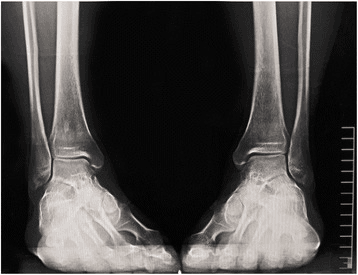
Read alignment before the fracture lines. Compare talar centring, the medial and superior clear spaces, distal tibiofibular overlap and side-to-side symmetry before calling subtle widening or shift.
Key Measurements
On the mortise view. Four measurements:
- Medial clear space - less than 4mm, compared with the superior joint space; talar tilt suggests deltoid injury
- Tibiofibular clear space - less than 6mm (syndesmosis)
- Tibiofibular overlap - greater than 6mm on the AP, greater than 1mm on the mortise
- Talar tilt - an asymmetric joint space suggests instability
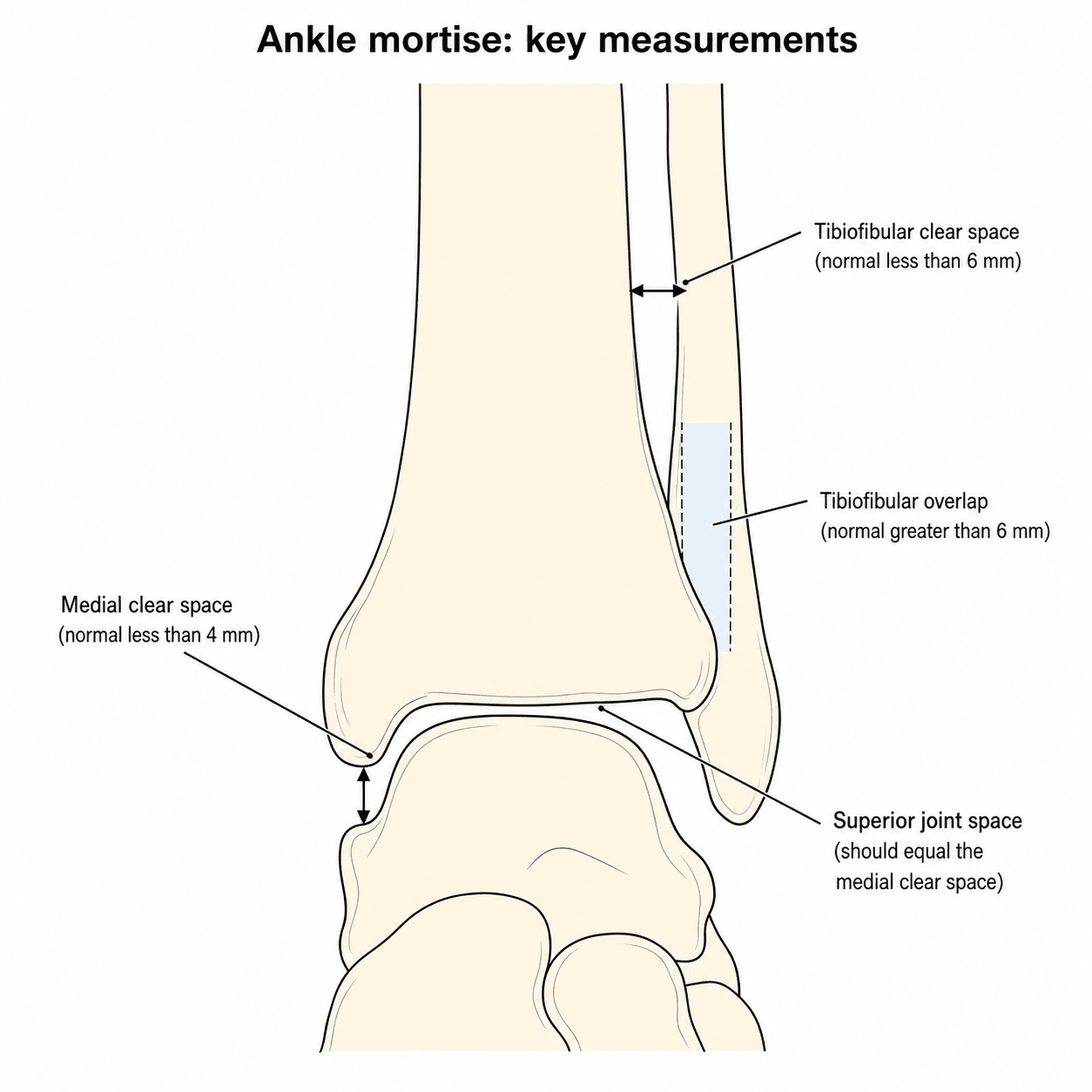
On the lateral view. The anterior talofibular distance is a joint effusion sign, the talar dome is checked for osteochondral lesions, and the calcaneus is measured by its Bohler and Gissane angles, covered with the calcaneal fractures below.
Ankle Fracture Classification
Weber/AO. The classification is the level of the fibular fracture relative to the syndesmosis:
- Type A - below the syndesmosis; the syndesmosis is intact and the injury is usually stable
- Type B - at the level of the syndesmosis; the syndesmosis may be injured, so assess the mortise for widening
- Type C - above the syndesmosis; the syndesmosis is disrupted and the injury is unstable, often requiring fixation
Whatever the level, always assess the medial side and the syndesmosis. A medial malleolar fracture alone is rare, so look for the associated lateral injury.
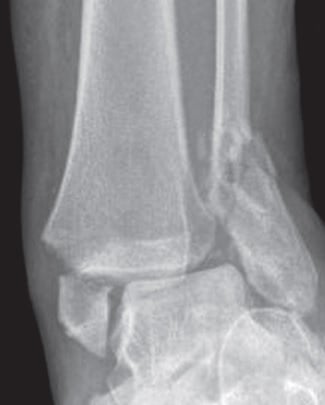
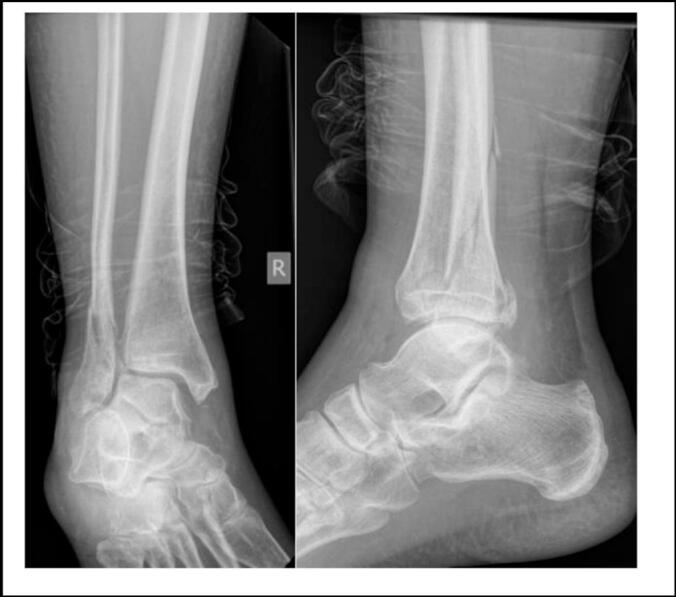
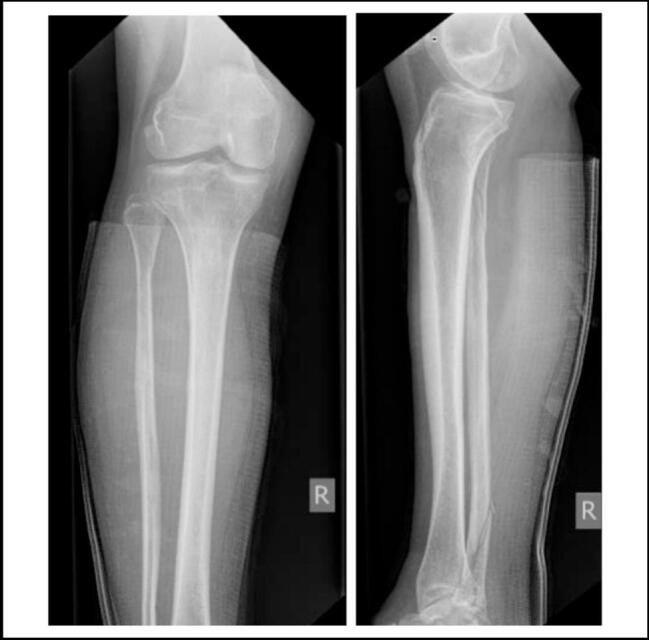
The Maisonneuve injury. A proximal fibular fracture with a medial ankle injury is a high syndesmotic injury, and the ankle films may show only its distal consequences: medial-sided injury, syndesmotic widening or posterior malleolar involvement. A deceptively small ankle abnormality, or a medial malleolar fracture or deltoid widening with a "normal" fibula at the ankle, should prompt dedicated views of the entire fibula; the fracture is at the fibular neck. Image the whole fibula when medial ankle tenderness, syndesmotic signs or an external-rotation mechanism is present despite an apparently minor ankle film.
CT of Ankle and Foot
Indications
When to ask for CT. The primary indications:
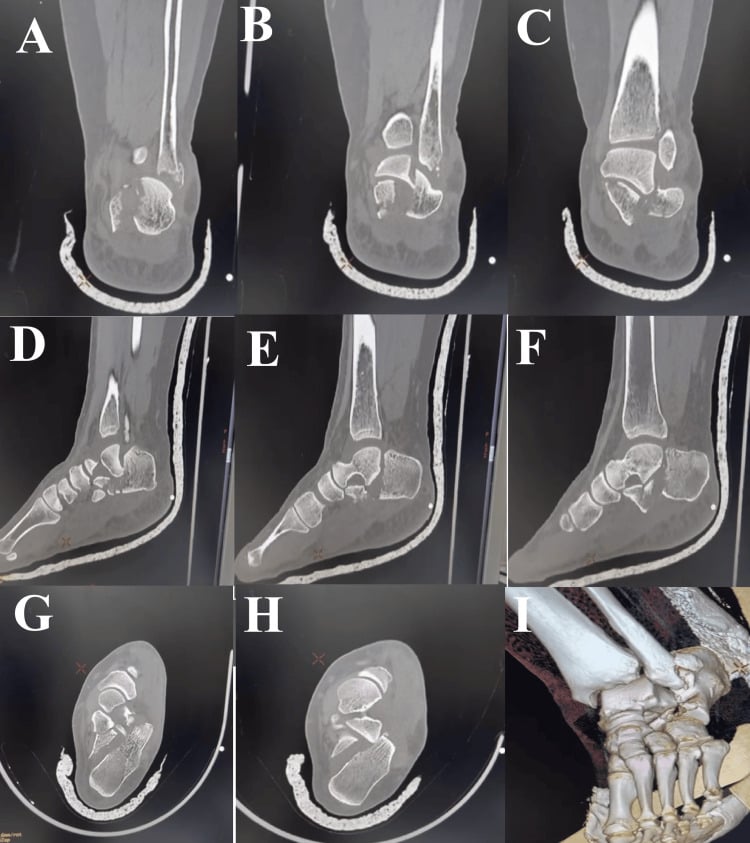
- Calcaneal fractures (Sanders classification)
- Pilon fractures
- Talus fractures
- Lisfranc injury, if weight-bearing X-rays are equivocal
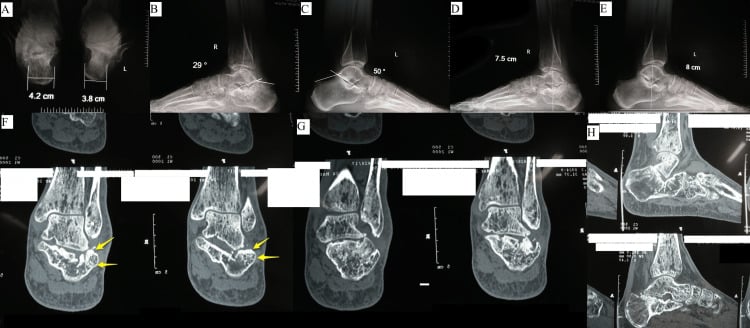
- Tarsal coalitions
- Complex midfoot fractures
What CT adds. Superior bone detail, 3D reconstruction for surgical planning, fragment size and displacement, the articular surface and subtalar joint involvement. The radiographs establish alignment and fracture pattern; CT resolves the articular morphology and fragment geometry that determine reduction strategy and fixation planning.
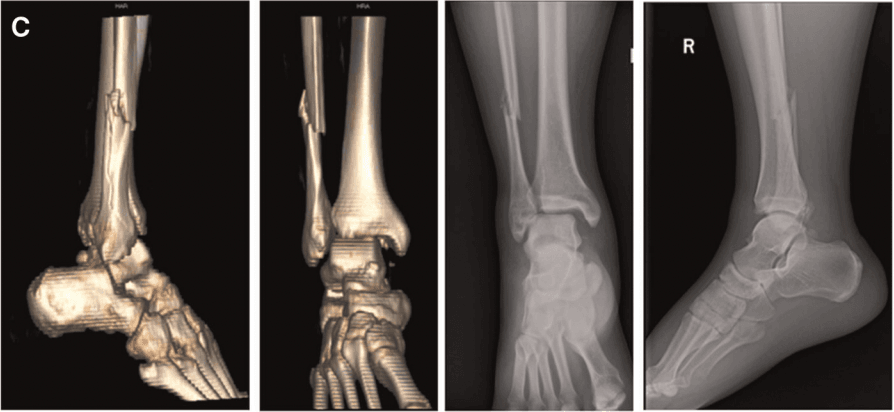
Sanders Classification (Calcaneal Fractures)
- Fracture Lines
- Non-displaced (less than 2mm)
- Prognosis
- Good, non-operative
- Fracture Lines
- 2 fragments (1 fracture line)
- Prognosis
- Fair, operative if displaced
- Fracture Lines
- 3 fragments (2 fracture lines)
- Prognosis
- Guarded, operative
- Fracture Lines
- 4+ fragments (highly comminuted)
- Prognosis
- Poor, may need fusion
Tarsal coalition. Thin-slice multiplanar CT defines the site and extent of a coalition and the degeneration in the adjacent joints when resection or arthrodesis is being considered.
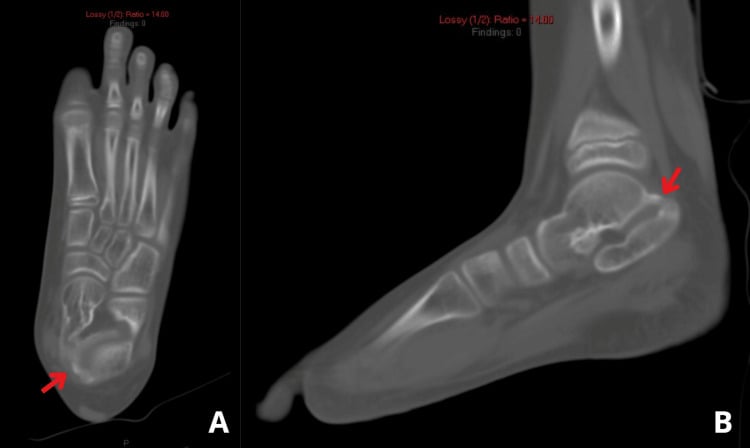
Talar Neck Fracture: Hawkins Classification and the Hawkins Sign
A suspected talar neck fracture is one of the clearest indications for CT, and the Hawkins classification and the Hawkins sign are the two high-yield imaging points. Both exist for the same anatomical reason: the talus has no muscular attachments and a largely retrograde, intra-osseous blood supply, so displacement tears the vessels entering from the neck and the body is left to survive on what remains. That is why AVN risk rises with each Hawkins type - the classification is really a count of how many blood-supply routes the displacement has destroyed.
- Displacement
- Non-displaced
- Approximate AVN risk
- Low (around 0-15%)
- Displacement
- Displaced with subtalar (talocalcaneal) subluxation/dislocation
- Approximate AVN risk
- Intermediate (around 20-50%)
- Displacement
- Displaced with subtalar AND tibiotalar (ankle) dislocation
- Approximate AVN risk
- High (around 50-90%)
- Displacement
- Type III plus talonavicular dislocation/subluxation
- Approximate AVN risk
- Highest (approaching 100%)
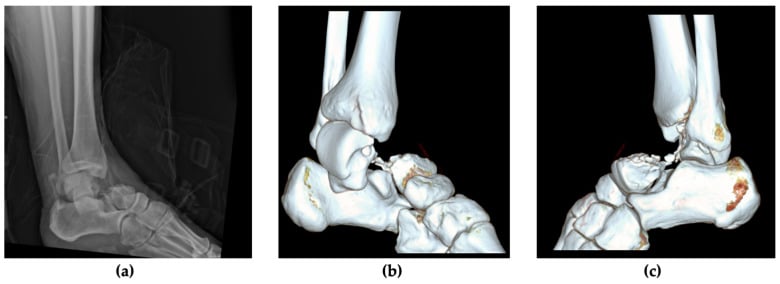
The Hawkins sign. A subchondral lucency, a radiolucent band in the talar dome, on an AP or mortise ankle radiograph at about 6-8 weeks. It reflects subchondral osteopenia from disuse hyperaemia in a talus with an intact blood supply, so a present Hawkins sign predicts a viable talus and AVN is unlikely. Its absence, a persistently sclerotic or dense dome, is concerning for AVN, although MRI is the definitive test for established osteonecrosis.
MRI of Ankle and Foot
Sequences
- Best For
- Anatomy, marrow, OCD
- Key Findings
- Low signal = marrow replacement
- Best For
- Oedema, fluid, ligaments
- Key Findings
- Bone bruise, soft tissue injury
- Best For
- Tendons, ligaments, cartilage
- Key Findings
- Tendon tears, ligament injury
- Best For
- Cartilage, OCD
- Key Findings
- Cartilage detail, fragment stability
Osteochondral Lesions of Talus (OLT)
Location. The classic teaching is posteromedial (inversion injury) as most common, with anterolateral second, and it is still what most examiners expect you to say. But know that it is contested: mapping operatively treated symptomatic lesions onto a nine-zone grid on MRI put the commonest lesions centrally (central-lateral, then central-medial), not at the two classic corners (Orr, Foot Ankle Int 2012). The likely reason is that the two-corner teaching came from describing lesions loosely by quadrant, whereas a zone grid measures where the lesion actually sits.
What has held up. Medial lesions are consistently the larger and deeper ones, which is the part of the classic teaching that survives and the part that matters surgically. The safer formulation is therefore to describe a talar dome lesion by zone and size rather than by one of two fixed locations, which is also what the operative plan depends on: medial lesions may need a medial malleolar osteotomy, whereas lateral lesions are often accessible arthroscopically.
Stability. MRI signs of instability:
- Fluid signal (T2 bright) surrounding the fragment
- A fluid-filled cleft between fragment and parent bone
- A cyst beneath the lesion
- A displaced fragment
A stable lesion shows no surrounding fluid, a low-signal rim of fibrous attachment, and the fragment in situ.
Staging. Examiners also want the staging systems, and the Orr evidence is reported in Hepple stages, so they need defining:
- Stages
- I subchondral compression; II partially detached fragment; III completely detached but undisplaced (in situ); IV displaced loose fragment
- Concept
- The classic radiographic staging of progressive detachment
- Stages
- I cartilage only; IIa subchondral fracture with oedema, IIb without oedema; III detached but undisplaced; IV displaced; V subchondral cyst
- Concept
- Adds marrow/cartilage detail and the subchondral-cyst stage
- Stages
- I intact roof with cyst; II cyst communicating with the surface; III non-displaced fragment with lucency; IV displaced fragment
- Concept
- CT-based, emphasising cyst-surface communication and fragment position
All three describe the same progression from intact cartilage to a detached, displaced or cystic lesion. The higher stages - a detached or displaced fragment (Berndt-Harty III-IV) or a subchondral cyst (Hepple V) - correspond to the instability signs above, and they are the ones that push management toward surgery.
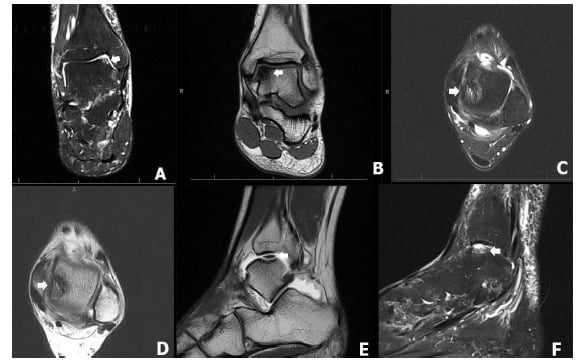
Tendon Assessment
By compartment. Axial MRI localises tendon pathology by compartment: the anterior extensors, the posteromedial flexors, the posterolateral peroneals and the Achilles. Follow each tendon across sequential slices; fluid, sheath distension and oedema must be distinguished from magic-angle signal and partial-volume artefact.
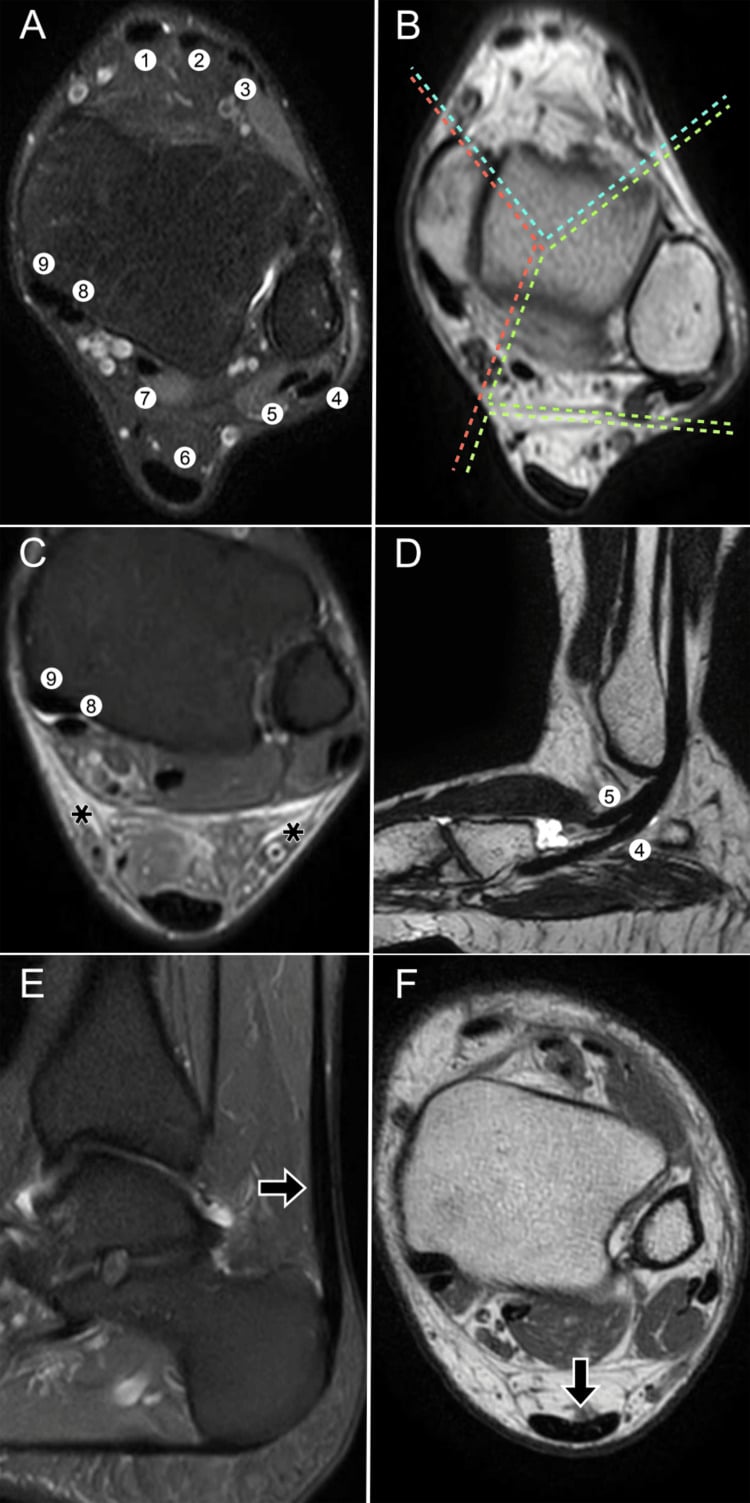
- Location
- Posterior, superficial
- Common Pathology
- Tendinopathy, rupture (2-6cm from insertion)
- Location
- Posteromedial
- Common Pathology
- Tendinopathy, tears (acquired flatfoot)
- Location
- Posterolateral
- Common Pathology
- Tears, split peroneus brevis, subluxation
- Location
- Anterior
- Common Pathology
- Rupture (drop foot)
Ultrasound for the superficial tendons. It adds dynamic assessment and side-to-side comparison, but the operator must follow the tendon in two planes to avoid anisotropy.
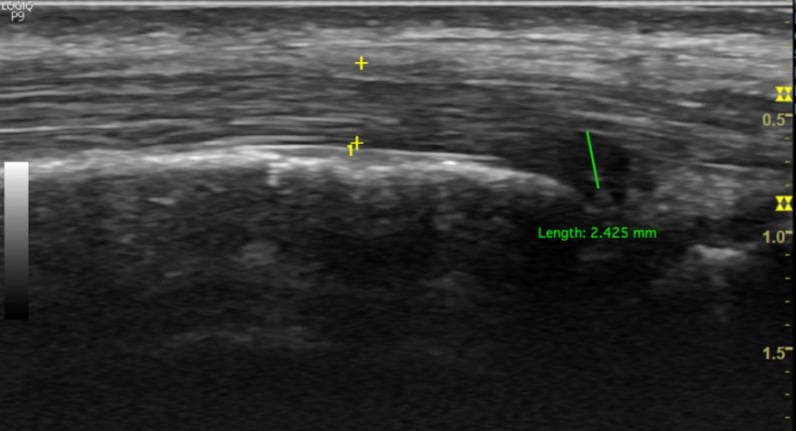
The Achilles. Normal is low signal and approximately 6mm thick. Tendinopathy thickens it to greater than 8mm with increased T2 signal and fusiform swelling, but the fibres stay intact. Rupture is complete discontinuity, a gap filled with fluid or haemorrhage (T2 bright), and retraction of the tendon ends.
Plantar Fascia
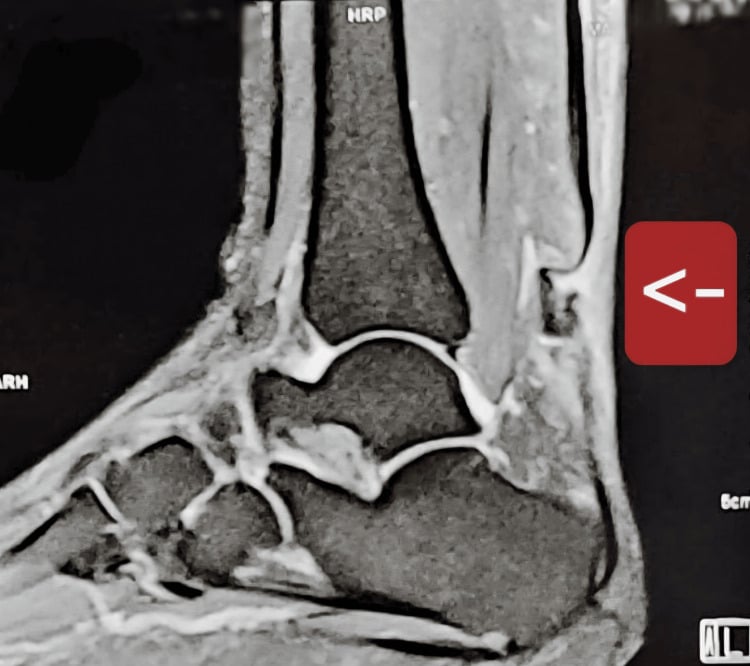
Normal and inflamed. The normal fascia is less than 4mm thick at the calcaneal insertion and low in signal. Plantar fasciitis thickens it to greater than 4mm with increased T2/STIR signal and periplantar oedema, and there may be calcaneal marrow oedema at the insertion.
Rupture. Discontinuity with surrounding fluid or haemorrhage, associated with prior steroid injection or fluoroquinolone use.
Systematic Approach: Interpretation Framework
A reproducible interpretation framework is what separates a consultant-level review from a checklist of "looks normal". Pair a fixed search pattern (ABCS) with the modality ladder so the right next test is requested rather than reflexively ordering CT or MRI.
ABCSAnkle X-ray Systematic Review
Hook:Always Be Checking Systematically
The reporting sequence. Seven steps, in order:
- Confirm - correct patient, side, projection adequacy, weight-bearing status
- Alignment - mortise congruity, talar shift or tilt, syndesmosis, Lisfranc and Chopart lines, hindfoot axis
- Bone - trace every cortex: malleoli, plafond, talus, calcaneus, navicular, cuboid, cuneiforms, all five metatarsals and their bases (especially the 2nd and 5th)
- Cartilage and joints - tibiotalar, subtalar, talonavicular, calcaneocuboid and TMT joint spaces; osteophytes; erosions
- Soft tissue - effusion, focal swelling, Achilles contour, Kager fat pad, calcification or foreign body
- Measure - medial clear space, tibiofibular clear space and overlap, Bohler and Gissane angles, Meary angle for the arch
- Decide the next test from the modality ladder, not by reflex
Differential Diagnosis & Imaging Pitfalls
Many ankle and foot complaints share overlapping radiographic features. The table structures the high-yield differentials and the imaging discriminator that resolves each.
- Key Differentials
- ATFL tear vs fibular avulsion vs OLT vs peroneal tear
- Discriminating Imaging Finding
- Mortise X-ray for avulsion/talar dome; MRI for ligament/cartilage and bone bruise pattern
- Key Differentials
- Tibialis posterior dysfunction vs deltoid injury vs medial OLT
- Discriminating Imaging Finding
- MRI: tendon signal/thickening and flatfoot alignment vs marrow oedema of talar dome
- Key Differentials
- Lisfranc injury vs cuboid/navicular stress fracture vs midfoot OA
- Discriminating Imaging Finding
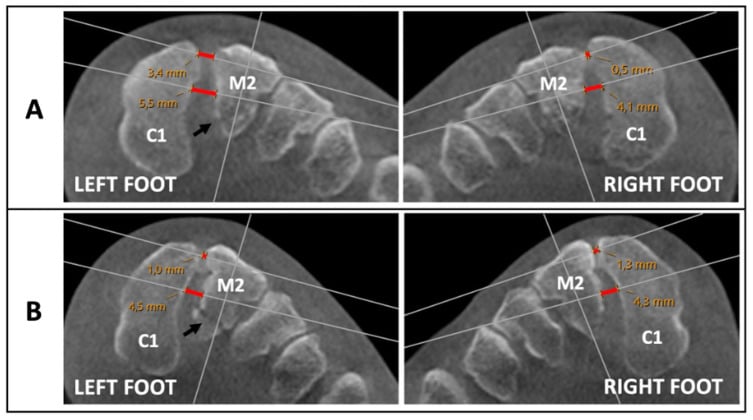
- Weight-bearing AP/oblique then CT/MRI; fleck sign and C1-M2 diastasis point to Lisfranc
- Key Differentials
- Calcaneal fracture vs talar fracture vs lumbar burst (associated)
- Discriminating Imaging Finding
- Lateral X-ray Bohler angle then CT Sanders; screen spine given axial-load mechanism
- Key Differentials
- Plantar fasciitis vs calcaneal stress fracture vs Baxter nerve entrapment
- Discriminating Imaging Finding
- MRI/US: fascia thickening over 4mm vs calcaneal marrow oedema/fracture line
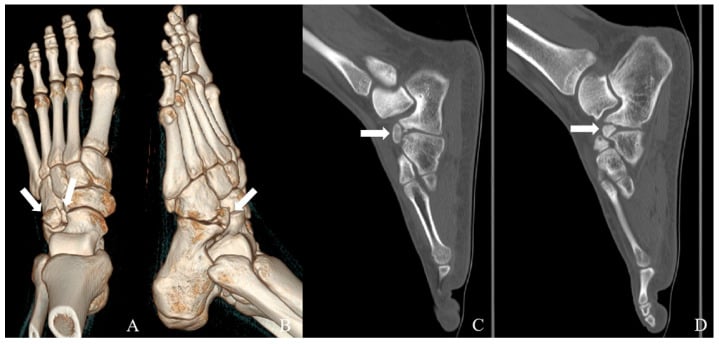
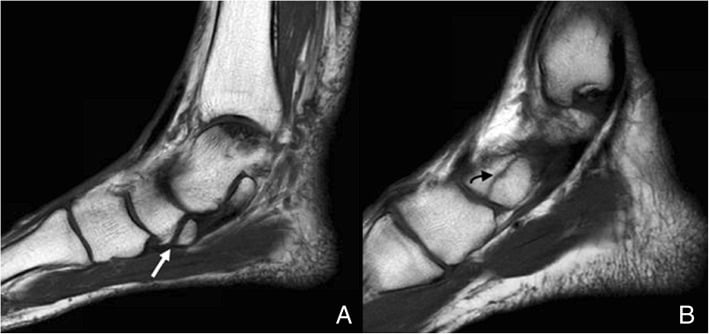
Normal variants that mimic fractures. An os trigonum, an accessory navicular and a bipartite sesamoid are normal variants, so look for corticated margins. Smooth, complete cortication and no bony continuity favour an accessory ossicle over an acute fracture, and correlation with the timing of trauma, oedema and focal tenderness prevents overcalling an incidental variant.
Guidelines, Registries & Global Practice
Global Epidemiology
- Ankle sprains are among the most common musculoskeletal injuries globally, with lateral ligament sprains predominating
- Ankle fractures are a high-incidence fracture in adults, rising with an ageing, osteoporotic population
- Calcaneal fractures account for the majority of tarsal fractures and typically follow axial load (fall from height, road trauma)
- Lisfranc injuries are frequently missed at first presentation, a recognised source of long-term disability and litigation
- Plain radiography dominates first-line imaging in every health system
- Decision rules (Ottawa) reduce unnecessary radiographs by roughly a third where implemented
- MRI and CT access varies widely between high- and limited-resource settings, shaping pathways
Side-by-Side Guideline Comparison
- First-Line
- Radiograph for acute trauma; apply Ottawa Rules
- Advanced Imaging Stance
- MRI for chronic pain, OLT, tendon/ligament, occult fracture; CT for complex bone injury
- First-Line
- Radiograph guided by clinical assessment
- Advanced Imaging Stance
- Targeted CT for complex intra-articular fractures; MRI for soft-tissue/occult injury; emphasis on avoiding unnecessary imaging
- First-Line
- Radiograph + classification (Weber/AO, Sanders)
- Advanced Imaging Stance
- CT routine for pilon, calcaneal, talar and complex midfoot fractures to plan reduction and fixation
- First-Line
- Radiograph first; standardised measurements
- Advanced Imaging Stance
- Growing role for weight-bearing CT in instability and deformity assessment
High- vs Limited-Resource Practice Variation
High-resource settings: ready access to CT and MRI lowers the threshold for advanced imaging; weight-bearing CT and standardised reporting are expanding; sub-specialty musculoskeletal radiology input is common.
Limited-resource settings: plain radiography (often with bilateral comparison and stress/weight-bearing views) carries most diagnostic load; clinical decision rules are especially valuable to ration scarce imaging; ultrasound is a cost-effective, radiation-free tool for tendon and fascia pathology where MRI is unavailable.
Universal principle: the imaging pathway should answer a specific clinical question and change management - not generate findings of uncertain significance. This holds regardless of resource level.
Key Exam Points & Practice Pearls
- Medial clear space less than 4mm; tibiofibular clear space less than 6mm
- Tibiofibular overlap over 6mm (AP), over 1mm (mortise)
- Bohler angle 20-40 degrees; Gissane angle 120-145 degrees
- Normal Achilles under 6mm; plantar fascia under 4mm at insertion
- Greater than 2mm diastasis between 1st and 2nd metatarsal bases is abnormal
- "Normal" film with clinical suspicion: request weight-bearing/contralateral views
- High fibular fracture: exclude Maisonneuve and syndesmotic injury
- Fall from height with heel pain: CT for Sanders type and screen the spine
- Lateral talar dome lesion on mortise view: proceed to MRI for stability
- Always state the modality you would request next and why
Controversies & Areas of Uncertainty
How much imaging for the syndesmosis? Static radiographic measurements (clear space, overlap) miss occult instability, and the fibular incisura is highly variable in shape and depth, so absolute numbers can mislead. Bilateral or post-fixation CT is increasingly used to detect malreduction, with the uninjured side as the reference (Liu, J Foot Ankle Surg 2018). Intra-operative dynamic stress and weight-bearing CT remain active research areas.
Weight-bearing CT. Cone-beam WBCT provides 3D imaging under physiological load and is gaining traction for subtle Lisfranc and syndesmotic instability, hindfoot alignment and arthritis, but availability is limited and validated thresholds are still maturing.
MRI versus arthroscopy for OLT. MRI is the non-invasive standard for staging stability, but it can over- or under-estimate cartilage status versus arthroscopy. CT arthrography or diagnostic arthroscopy may be needed when MRI and symptoms disagree.
Clinical Imaging: Foot, Calcaneus & Lisfranc
Foot: Standard Views
- Assessment
- Forefoot, tarsometatarsal joints
- Key Findings
- Lisfranc alignment, MT fractures
- Assessment
- Cuboid, lateral cuneiforms, 4th/5th MT bases
- Key Findings
- Calcaneocuboid, lateral Lisfranc
- Assessment
- Arches, calcaneus, talus
- Key Findings
- Flatfoot, coalitions, Bohler angle
- Assessment
- Sesamoids under 1st MT head
- Key Findings
- Sesamoid fracture, position
Lisfranc Injury Assessment
Normal alignment on the weight-bearing AP. The medial border of the 2nd metatarsal aligns with the medial border of the middle cuneiform, and the medial border of the 4th metatarsal with the medial border of the cuboid. The signs of injury are subtle:
- Fleck sign - a flake of bone avulsed at the 2nd metatarsal base, a Lisfranc injury until proven otherwise
- Widening between the 1st and 2nd metatarsal bases greater than 2mm
- Loss of alignment on any view
- Subtle dorsal subluxation on the lateral
Non-weight-bearing X-rays frequently miss Lisfranc injuries. Always request weight-bearing AP, lateral, and oblique views when Lisfranc injury is suspected. If the patient cannot weight-bear, CT or MRI may be needed to assess the joint. Compare to the contralateral foot if in doubt.
Calcaneal Fracture Assessment
The lateral view. Two angles are measured on it:
- Bohler angle, 20-40° - formed by lines from the anterior process to the posterior facet and from the posterior facet to the posterior tuberosity; less than 20° suggests posterior facet depression
- Gissane (crucial) angle, 120-145° - the angle between the posterior facet and the calcaneal body; altered with intra-articular fractures
CT is essential for the Sanders classification, for posterior facet involvement and for surgical planning; the classification itself is in the CT section below.
Clinical Decision Scenarios
Practise clinical reasoning and management decisions out loud
“How do you assess ankle stability on plain radiographs, and what measurements indicate syndesmotic injury?”
“A patient has midfoot pain after a fall. X-rays are 'normal'. What imaging findings would suggest a Lisfranc injury, and what further imaging would you request?”
“Describe the MRI assessment of an osteochondral lesion of the talus and how you determine if it is stable or unstable.”
Key Ankle Measurements
- Medial clear space: Less than 4mm
- Tibiofibular clear space: Less than 6mm
- Tibiofibular overlap: Greater than 6mm (AP), greater than 1mm (mortise)
- Weber C = above syndesmosis = unstable
Calcaneal Fracture
- Bohler angle: 20-40° (less than 20° = depression)
- Gissane angle: 120-145°
- Sanders classification on CT (I-IV)
- Type IV = comminuted = poor prognosis
Lisfranc Injury
- WEIGHT-BEARING views essential
- 2nd MT medial border = middle cuneiform medial border
- Fleck sign = avulsion at 2nd MT base
- Greater than 2mm between 1st and 2nd MT = abnormal
OLT Stability (MRI)
- Unstable: Fluid around fragment, cysts, displacement
- Stable: No fluid, low signal rim, in situ
- Posteromedial is the classic answer; zone-grid data favour central - describe by zone and size
- Cartilage integrity affects prognosis
Evidence Base & Landmark Literature
Ottawa Ankle Rules - Refinement & Prospective Validation
- 1485 adults studied across validation and refinement stages
- Refined rules 100% sensitive for malleolar and midfoot fractures
- Potential 30-34% reduction in radiographs ordered
- Near-zero fracture probability when the rule is negative
ACR Appropriateness Criteria - Acute Trauma to the Ankle / Chronic Ankle Pain
- Radiographs are the appropriate initial study for acute ankle trauma, guided by the Ottawa Rules
- MRI without contrast usually appropriate for chronic pain, osteochondral lesion, tendon/ligament injury and occult fracture
- CT preferred for complex or occult bony injury and surgical planning