From Alignment Assessment to MRI Cord Evaluation
Radiography: Screening tool, alignment assessment, degenerative changes
CT: Gold standard for fracture characterisation, canal compromise, 3D reconstruction
MRI: Gold standard for soft tissue pathology — disc, cord, infection, tumour, ligaments
CT Myelography: Alternative to MRI when contraindicated — shows cord compression
Bone Scan/SPECT-CT: Facet joint disease, spondylolysis activity, metastatic screening
Key: Radiographs screen, CT characterises fractures, MRI evaluates soft tissues and cord
- Systematic spine radiograph reading follows ABCD: Alignment (3 smooth lines), Bones (vertebral body height/shape), Cartilage/Disc (disc space height), Soft tissues (prevertebral swelling).
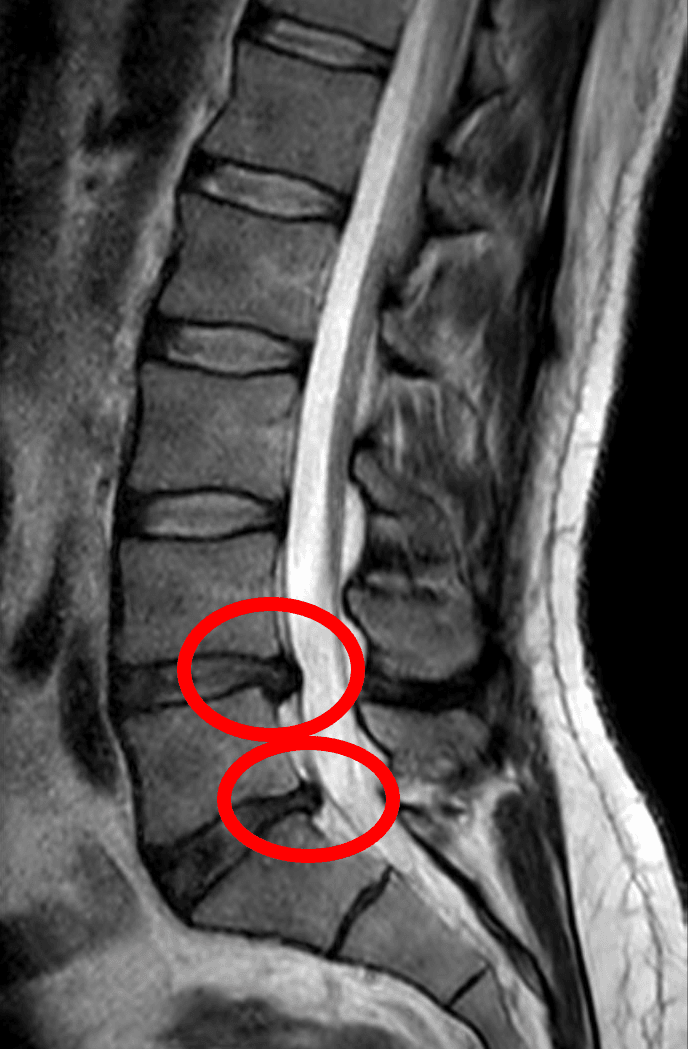
- MRI is the gold standard for disc herniation, cord compression, cauda equina syndrome, infection, and tumour assessment.
- CT is the gold standard for fracture characterisation — it reveals fracture lines, posterior column involvement, and canal compromise that radiographs miss.
- Cervical spine clearance: NEXUS or the Canadian C-Spine Rule decide whether imaging is needed - but they are not equivalent. Head to head the CCR was 99.4% sensitive against NEXUS at 90.7%, and more specific too; NEXUS is simpler because it needs no range-of-motion testing.
- Red flags requiring urgent MRI: cauda equina symptoms, progressive neurological deficit, suspected cord compression, suspected spinal infection, suspected metastatic disease.
- “Prevertebral soft tissue swelling on lateral cervical radiograph: more than 7mm at C2 or more than 21mm at C6 = significant (suspect fracture/haematoma/abscess).
- “Jefferson fracture (C1 burst): combined bilateral lateral mass overhang over 7mm on the open-mouth view (the Rule of Spence) SUGGESTS transverse ligament rupture. Treat it as a screening threshold, not a verdict - it under-calls the injury, and MRI images the transverse ligament directly.
- “Hangman fracture (C2 pars): bilateral C2 pedicle fracture — paradoxically often STABLE because the canal enlarges (spinal cord spared).
- “TLICS score guides management: less than 4 = conservative, 4 = borderline, more than 4 = surgical. Components: morphology + posterior ligamentous complex + neurological status.
- “Cord signal change in myelopathy is INCREASED T2 signal within the cord (high signal replacing the normal uniform cord), not loss of it. And isolated T2 hyperintensity is a weaker prognostic marker than its reputation - what actually predicts a poor surgical outcome is T1 LOW signal combined with T2 high, multilevel involvement, and a high signal-intensity ratio.
Overview
Spine imaging answers four kinds of question: acute trauma (fracture and dislocation), degenerative disease (disc herniation and stenosis), infection (discitis and osteomyelitis) and neoplasia (metastases and primary tumours). The modalities sit in a hierarchy that the rest of this page follows: radiographs screen and show alignment, CT characterises fractures, and MRI shows the soft tissues and the cord.
Trauma. The pathway runs in three steps:
- Apply NEXUS or the Canadian C-Spine Rule to decide whether imaging is needed at all
- If it is, CT is now the primary modality for cervical spine clearance in major trauma, replacing radiographs
- If there is a neurological deficit, add MRI for the cord, the discs and the ligaments
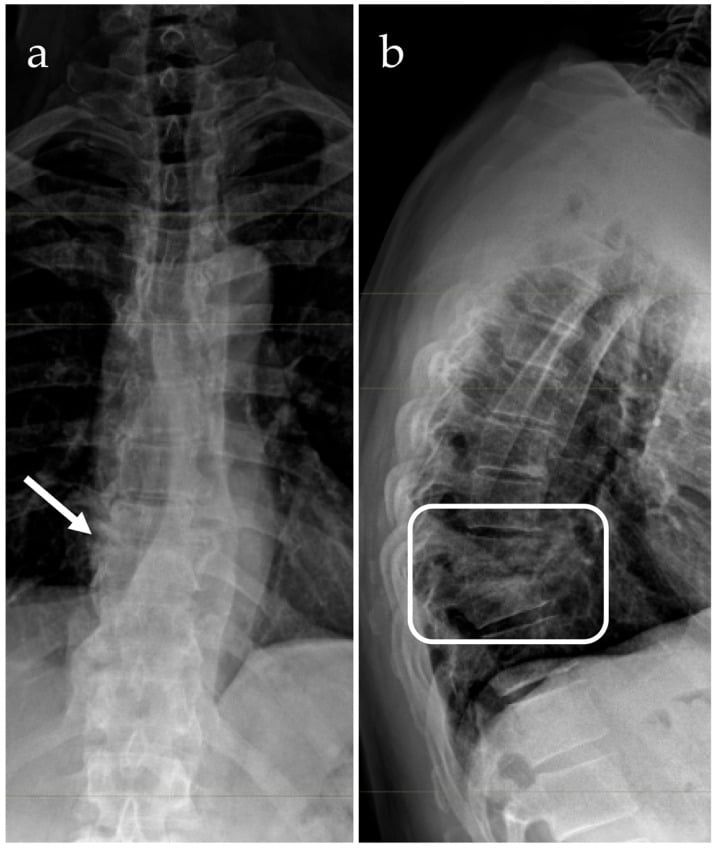
Degenerative disease and deformity. Radiographs show alignment and deformity, and MRI assesses the disc, canal and foramina if surgical decision-making is required. Deformity is imaged with full-length standing radiographs, the scoliosis series, for coronal and sagittal balance.
Red flags. Cauda equina syndrome, myelopathy, infection and metastatic disease need urgent MRI. The triggers, and what each scan should show, are set out under Choosing the Right Investigation.
Reading the Spine Radiograph
Read every spine radiograph in the same order. ABCD is the sequence: alignment first, then the bones, then the discs and facets, then the dens and the soft tissues. On the lateral cervical view the alignment step is where subluxation and fracture-dislocation declare themselves, so it is drawn out below.
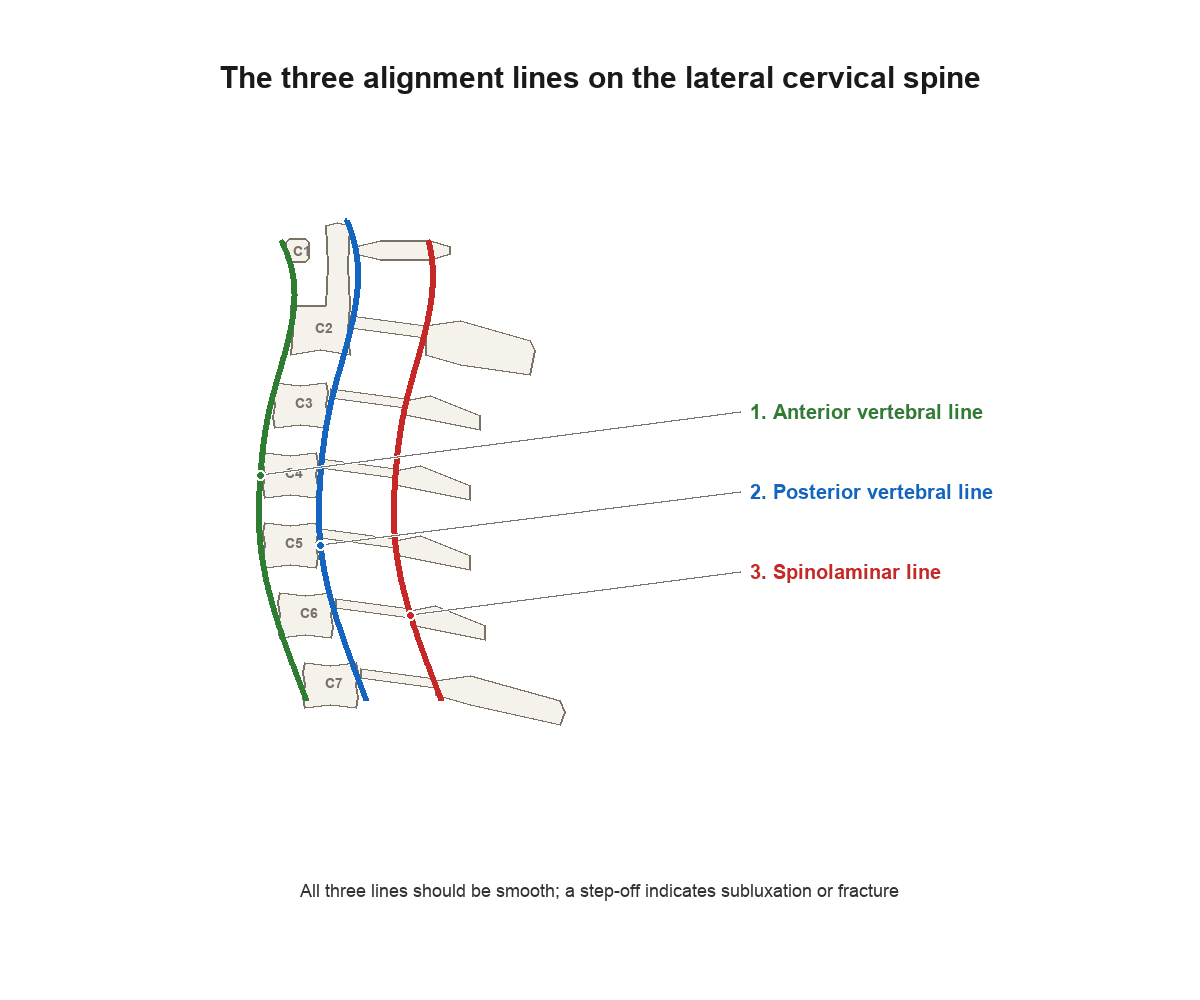
ABCDSystematic Spine Radiograph Reading
Hook:ABCD: the systematic approach for spine radiographs — Alignment, Bones, Cartilage/Discs, Dens/Soft tissues.
The lateral must reach C7-T1. Failure to visualise the cervicothoracic junction is the most common cause of a missed cervical fracture. If C7-T1 cannot be seen on the lateral radiograph, a swimmer's view or a CT is required.
Choosing the Right Investigation
The clinical question chooses the modality. The table gives the first-line study and what to add for each of the presentations that recur.
- First-Line Imaging
- CT (primary modality in major trauma). NEXUS/CCR for clinical clearance
- Advanced Imaging
- MRI if neurological deficit, cord compression suspected, or ligamentous injury assessment
- First-Line Imaging
- AP + lateral radiographs. CT for any suspected fracture
- Advanced Imaging
- CT for TLICS scoring (morphology, posterior ligament complex). MRI for cord/conus assessment and posterior ligament integrity
- First-Line Imaging
- Radiographs (usually normal or degenerative)
- Advanced Imaging
- MRI: gold standard for disc morphology, nerve root compression, canal stenosis. CT myelography if MRI contraindicated
- First-Line Imaging
- Radiographs (disc space narrowing, endplate irregularity — often delayed)
- Advanced Imaging
- MRI with contrast: gold standard. Shows disc signal change, endplate destruction, paraspinal/epidural abscess. Blood cultures + CRP/ESR
- First-Line Imaging
- Radiographs (may show lytic/blastic lesions, pedicle destruction)
- Advanced Imaging
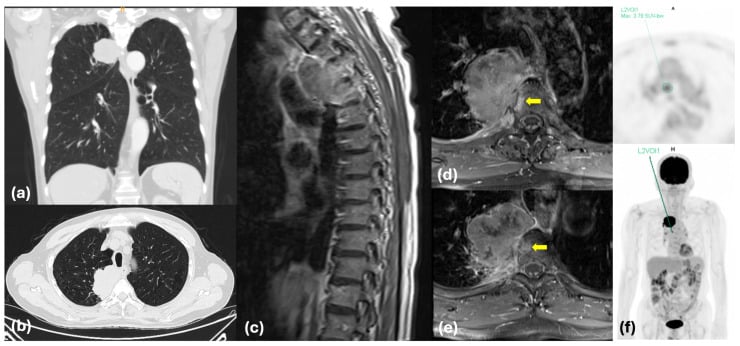
- Whole-spine MRI: gold standard for metastatic screening. STIR sequence detects marrow infiltration. CT for stability assessment
- First-Line Imaging
- Do NOT delay for radiographs
- Advanced Imaging
- URGENT MRI (within hours): sagittal and axial T2 for compression identification. This is a surgical emergency
Red flags. Five presentations demand urgent MRI:
CRAMSRed Flags Requiring Urgent Spine MRI
Hook:CRAMS: these five scenarios demand URGENT MRI — delay risks permanent neurological damage.
Differential Diagnosis
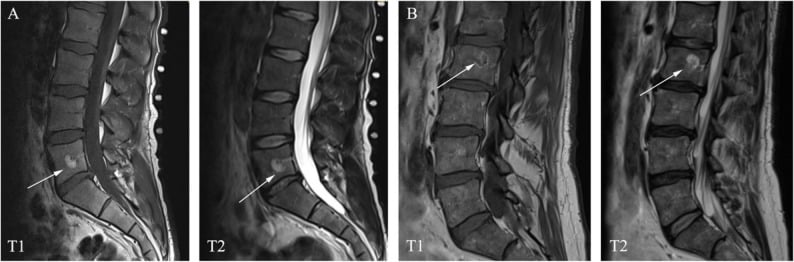
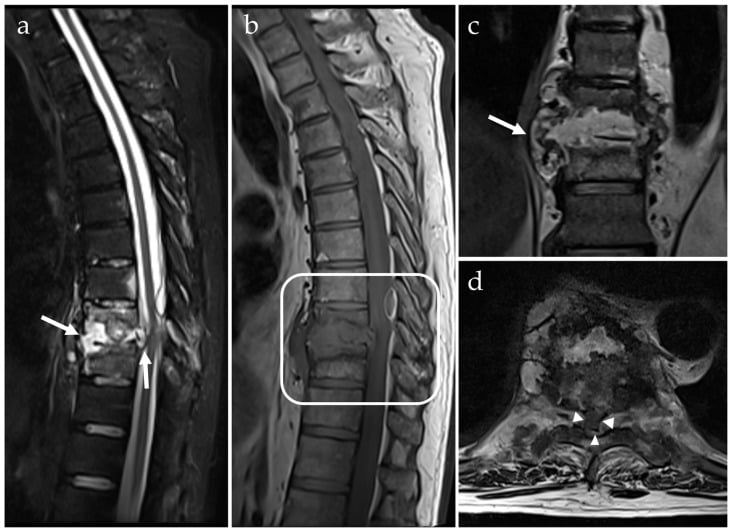
Two patterns recur: distinguishing the cause of a vertebral collapse, and distinguishing the cause of an aggressive disc-level signal change. The MRI features in the table separate the look-alikes.
- Osteoporotic Fracture
- Band-like oedema, preserved marrow elsewhere; reconstitutes over weeks
- Metastatic / Myeloma
- Complete/convex marrow replacement, often multifocal, pedicle involvement (winking owl)
- Infection (Discitis-Osteomyelitis)
- Confluent endplate signal crossing the disc space
- Osteoporotic Fracture
- Preserved
- Metastatic / Myeloma
- Typically preserved (tumour spares the disc)
- Infection (Discitis-Osteomyelitis)
- Destroyed early — disc is the epicentre
- Osteoporotic Fracture
- Retropulsed but concave fragment
- Metastatic / Myeloma
- Convex posterior bulge, epidural soft-tissue mass
- Infection (Discitis-Osteomyelitis)
- Epidural phlegmon/abscess, paraspinal collection
- Osteoporotic Fracture
- Minimal/linear
- Metastatic / Myeloma
- Solid enhancing soft tissue
- Infection (Discitis-Osteomyelitis)
- Rim-enhancing abscess, marked endplate enhancement
- Osteoporotic Fracture
- Older, low-energy, osteoporosis
- Metastatic / Myeloma
- Known primary, night pain, weight loss
- Infection (Discitis-Osteomyelitis)
- Fever, raised CRP/ESR, IVDU/bacteraemia
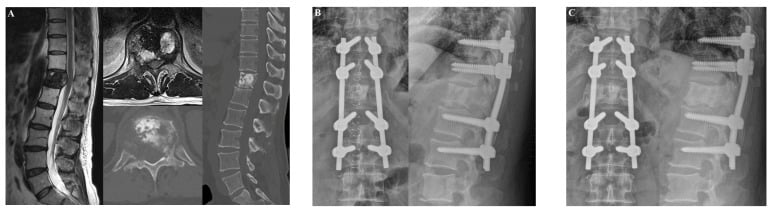
Metastatic Spine: Bilsky ESCC Grade and SINS
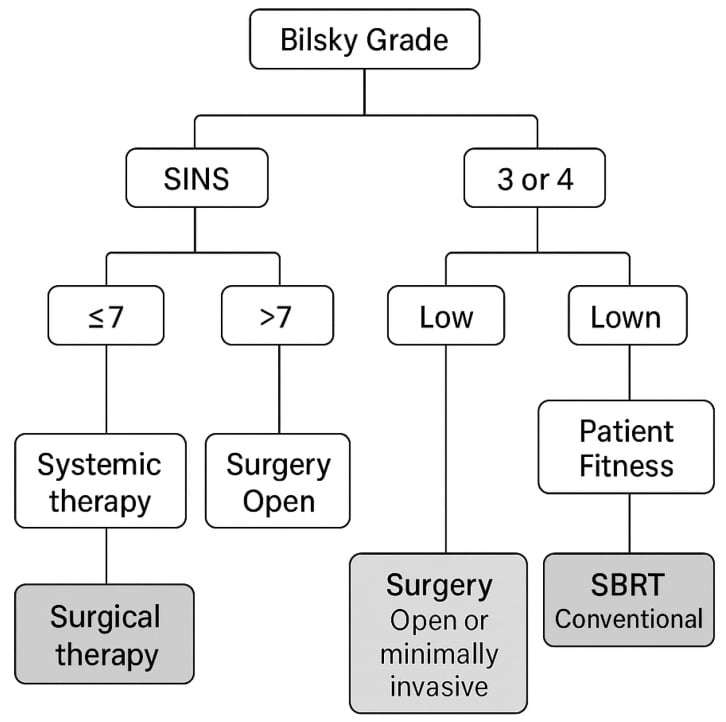
Once metastatic disease is identified, two scores translate the images into a management decision and are favourite viva probes: the Bilsky epidural spinal cord compression (ESCC) grade answers how much cord compression there is, and the Spinal Instability Neoplastic Score (SINS) answers how unstable the spine is. They are complementary: one drives decompression, the other drives stabilisation.
- Axial T2 appearance
- Bone-only disease; no epidural extension
- Axial T2 appearance
- Epidural impingement, thecal sac indentation but no deformation
- Axial T2 appearance
- Thecal sac deformed, cord not abutted
- Axial T2 appearance
- Thecal sac deformed, cord abutted but not compressed
- Axial T2 appearance
- Cord compression but CSF still visible around the cord
- Axial T2 appearance
- Cord compression with NO CSF visible around the cord
SINS. The Spinal Instability Neoplastic Score sums six components:
- Location: the junctional levels (occiput-C2, C7-T2, T11-L1, L5-S1) score highest
- Mechanical or postural pain
- Bone lesion quality: lytic scores worst
- Spinal alignment: deformity or subluxation
- Vertebral body collapse
- Posterolateral element involvement
The total runs from 0 to 18: 0-6 is stable, 7-12 is indeterminate or potentially unstable, where surgical consultation is advised, and 13-18 is unstable. A high SINS flags the need for stabilisation regardless of the neurological picture.
How the two scores combine. High-grade epidural compression (Bilsky 2-3) with a radioresistant tumour favours surgical decompression, "separation surgery", before radiotherapy, whereas low-grade compression (Bilsky 0-1) of a radiosensitive tumour may be managed with radiotherapy alone. An unstable SINS (13-18) argues for stabilisation even when the cord is not yet compressed. This Bilsky-plus-SINS pairing, alongside the NOMS framework (Neurological, Oncological, Mechanical, Systemic), is the modern decision scaffold for metastatic spine disease.
Clinical Applications
The lateral view. Alignment is read along the three lines described above. The atlantodental interval should be less than 3mm in adults and less than 5mm in children; an increased interval suggests transverse ligament disruption or an odontoid fracture. Pavlov's ratio, the sagittal canal diameter divided by the vertebral body width on the lateral radiograph, judges the canal: a ratio under 0.8 indicates canal stenosis.
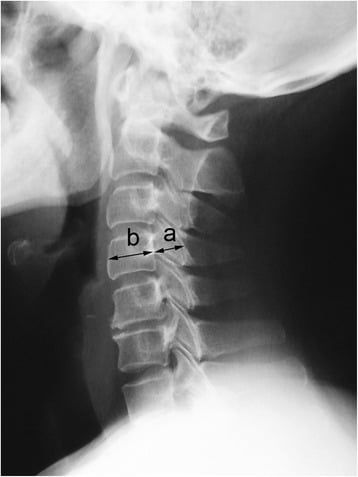
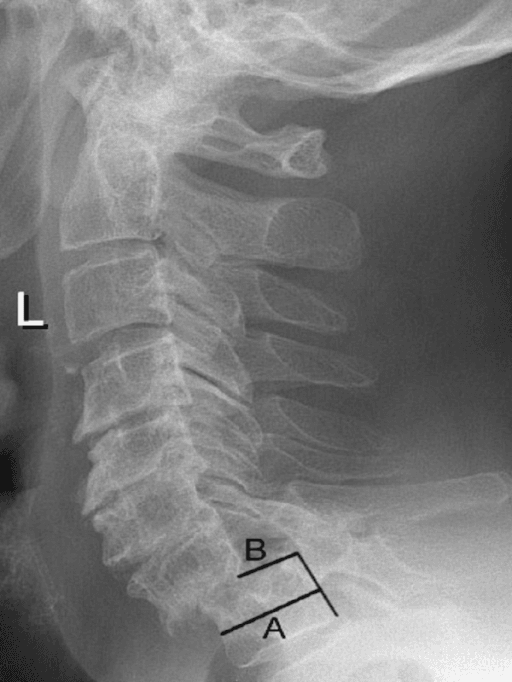
Prevertebral soft tissue. Measured on the lateral radiograph, the shadow should be less than 7mm at C2 (or less than one-third of the vertebral body width) and less than 21mm at C6 (or less than one full vertebral body width). Widening suggests haematoma from a fracture, an abscess, or retropharyngeal pathology.
Three fractures to know.
- Jefferson fracture (C1 burst): best seen on the AP open-mouth view. Combined lateral mass overhang of more than 7mm (the Rule of Spence) suggests transverse ligament rupture; treat it as a screening threshold rather than a verdict, because it under-calls the injury and MRI images the transverse ligament directly
- Hangman fracture (C2 pars): bilateral C2 pedicle fractures, often neurologically intact because the canal enlarges
- Odontoid fractures (Anderson-D'Alonzo): Type I through the tip (rare); Type II through the base, the most common and with the highest nonunion risk; Type III extending into the C2 body
CT has replaced the radiograph. In major trauma CT is the primary imaging modality for cervical spine clearance. Pooled sensitivity for a cervical fracture is 98% for CT against 52% for plain radiographs: radiographs miss about half of all fractures, and miss them disproportionately at the two junctions, C1-C2 and C7-T1, where injuries are least forgiving. MRI is added when there is a neurological deficit, suspected ligamentous injury, or persistent clinical concern despite a normal CT.
Deciding whether to image at all. NEXUS and the Canadian C-Spine Rule both decide whether an alert, stable blunt-trauma patient needs imaging, and they are usually quoted together as if equivalent. They are not: head to head, the Canadian C-Spine Rule was 99.4% sensitive against NEXUS at 90.7% for clinically important injury, and it was also the more specific of the two (45.1% against 36.8%), so it both missed fewer injuries and cancelled more scans. A rule at 90.7% sensitivity misses roughly one clinically important injury in ten.
NSAIDNEXUS Criteria for Cervical Spine Clearance
Hook:NSAID: if ALL five criteria are met, cervical spine can be cleared clinically WITHOUT imaging.
The Canadian C-Spine Rule runs as three sequential questions:
- Is there any high-risk factor that mandates imaging? Age 65 or over, a dangerous mechanism (fall from over one metre or five stairs, axial load to the head, high-speed or rollover motor-vehicle collision, ejection, bicycle or motorised recreational-vehicle collision), or paraesthesiae in the extremities. If yes, image and stop here.
- Is there any low-risk factor that makes safe assessment of range of motion possible? Simple rear-end collision, sitting position in the emergency department, ambulatory at any time, delayed onset of neck pain, or absence of midline cervical tenderness. If none is present, image.
- Can the patient actively rotate the neck 45 degrees to left and right? If yes, no imaging. If not, image.
The trade-off. Step 3 requires actively moving an injured neck, which is why the rule is confined to alert (GCS 15) patients and why physicians in the validation study omitted the range-of-motion step in about 10% of cases, producing an indeterminate result. NEXUS is the simpler rule because it needs no range-of-motion testing. Neither rule applies to penetrating trauma, GCS under 15, or children under 16.
Spondylolysis and the Pars Defect
A defect of the pars interarticularis (spondylolysis) is the commonest structural cause of low back pain in adolescents and young athletes, especially in hyperextension sports, and the usual cause of isthmic spondylolisthesis. It most often affects L5, in over 85% of cases. Its imaging deserves separate treatment because the modality you choose answers two different questions: is there a defect, and is it active and so likely to heal?
- Role
- Classic teaching view
- Key finding
- The 'Scottie dog' - the pars is the dog's NECK; a defect appears as a collar or a broken neck (decapitated Scottie dog)
- Role
- Detect and grade listhesis
- Key finding
- Anterolisthesis graded by Meyerding (I-IV); flexion-extension films assess dynamic instability
- Role
- Best bony definition
- Key finding
- Directly shows the pars defect, its margins (corticated chronic vs sharp acute), and any contralateral defect
- Role
- Activity and acuity
- Key finding
- Increased uptake (SPECT) or marrow/pars oedema (MRI STIR) indicates an ACTIVE, metabolically hot lesion with the best chance of bony healing; a cold, well-corticated defect is established and unlikely to unite
Why activity matters. MRI is increasingly first-line in young patients, since it carries no ionising radiation: a stress reaction with pars oedema but no frank defect can heal with activity restriction or bracing, whereas an established, corticated defect will not. SPECT-CT remains useful where MRI is equivocal. Grading the listhesis (Meyerding) and checking for a high-grade slip or dysplastic posterior elements guides the need for surgical stabilisation.
Guidelines, Registries & Global Practice
Spine imaging selection is remarkably consistent across major guideline bodies: clinical decision rules first, CT for fracture characterisation, MRI for cord and soft-tissue pathology. Where guidelines genuinely differ is in the threshold for advanced imaging and the recommended timing of MRI for red-flag presentations.
Global Epidemiology
- Low back pain is the single leading cause of years lived with disability worldwide (Global Burden of Disease), yet the overwhelming majority of acute episodes are non-specific and require no imaging.
- Clinically important cervical spine injury occurs in roughly 2 percent of alert, stable blunt-trauma patients who present for assessment.
- Cauda equina syndrome is rare (incidence on the order of a few per 100,000 per year) but accounts for a disproportionate share of spinal medicolegal claims, almost always for delayed diagnosis.
Side-by-Side Guideline Comparison
- Cervical Trauma Clearance
- CT cervical spine first-line in moderate/high-risk blunt trauma; clinical clearance (NEXUS or CCR) in low risk
- Low Back Pain / Red Flags
- No imaging for non-specific acute LBP without red flags; MRI reserved for neurological deficit, suspected infection, malignancy or CES
- Cervical Trauma Clearance
- NICE NG41 trauma: CT for adults with high-risk factors; MRI added for neurology or suspected ligamentous/cord injury
- Low Back Pain / Red Flags
- NICE NG59: do not image routinely; urgent MRI for suspected CES, metastatic cord compression or infection (whole-spine MRI within 1 week, or emergently for CES)
- Cervical Trauma Clearance
- AO Spine subaxial and upper-cervical classifications standardise CT-based morphology; MRI for discoligamentous complex
- Low Back Pain / Red Flags
- AO Spine thoracolumbar classification (CT morphology + neurology + modifiers) for fracture decision-making
- Cervical Trauma Clearance
- CT-led clearance in major trauma consistent with US/UK; MRI for obtunded patients with persistent concern
- Low Back Pain / Red Flags
- Emphasis on red-flag triage and stewardship to limit low-value spinal MRI
Registry and Audit Evidence
- Spinal trauma is captured in national and regional trauma registries (e.g. the UK Trauma Audit and Research Network and equivalent systems), which have tracked the shift from radiograph-led to CT-led cervical clearance and the reduction in missed injuries.
- Spinal cord injury registries inform the link between timing of decompression and neurological recovery, reinforcing early MRI and surgery in compressive deficits.
High- vs Limited-Resource Practice Variation
- In high-resource settings, multidetector CT and MRI are available around the clock, so CT-led clearance and urgent MRI for red flags are achievable targets.
- In limited-resource settings, MRI access may be delayed or absent; plain radiography and CT myelography retain a larger role, and clinical decision rules (NEXUS, CCR) become even more valuable to ration imaging safely.
- Regardless of setting, the principles are universal: apply a validated rule before imaging, use CT to characterise bony injury, and obtain MRI urgently when cord or cauda equina compromise is suspected.
Controversies & Areas of Uncertainty
Clearing the obtunded cervical spine. In the obtunded or intubated patient with a normal high-quality CT, the role of additional MRI remains debated. Some protocols clear the collar on a negative CT alone, citing the high negative predictive value of modern CT; others mandate MRI to exclude a purely ligamentous injury. The balance is between a rare missed unstable ligamentous injury and the harms of prolonged collar use and transfer for MRI.
Timing of cauda equina decompression. The 48-hour threshold from pooled data is widely quoted, but it does not justify deliberate delay. Many surgeons and medicolegal standards expect decompression as soon as feasible, ideally overnight. The distinction between incomplete CES (CES-I) and CES with retention (CES-R) influences urgency and prognosis more than any single time cut-off.
Incidental MRI findings. Disc bulges, protrusions, Modic changes and mild stenosis are highly prevalent in asymptomatic adults and increase with age. Over-reporting drives unnecessary intervention, so imaging must always be correlated with the clinical syndrome and the relevant nerve root, not treated as a stand-alone diagnosis.
Cord signal change. Increased T2 signal within the cord, high signal replacing the normal uniform cord, indicates myelopathy. As a prognostic marker, though, isolated T2 hyperintensity is weaker than once assumed: combined T1 hypointensity with T2 hyperintensity, multilevel signal change, and a high signal-intensity ratio carry the worst prognosis, while clinical severity and duration remain the dominant drivers of outcome.
Clinical Decision Scenarios
Practise clinical reasoning and management decisions out loud
“A 30-year-old man is brought to the emergency department after a motorcycle accident. He is alert, GCS 15, and complains of neck pain. He has no neurological deficit.”
“A 45-year-old woman presents with a 4-week history of progressive bilateral leg weakness, urinary retention, and saddle anaesthesia. Back pain has been present for 6 months.”
“An examiner shows you an MRI of the lumbar spine and asks you to describe your systematic assessment.”
“A 68-year-old man with a history of prostate cancer presents with 3 weeks of progressive thoracic back pain, now with bilateral leg weakness and a sensory level at the umbilicus. He is febrile at 38.2 degrees with a raised CRP.”
ABCD Systematic Reading
- Alignment: 3 smooth lines on lateral (anterior, posterior vertebral, spinolaminar)
- Bones: vertebral body height, pedicles (winking owl = metastasis), cortices
- Cartilage/Disc: disc space height, facet joints, interspinous distance
- Dens/Soft tissues: odontoid fracture, prevertebral width (C2: less than 7mm, C6: less than 21mm)
Red Flags for Urgent MRI (CRAMS)
- Cauda equina syndrome (bladder/bowel dysfunction, saddle anaesthesia)
- Rapidly progressive neurological deficit
- Abscess/infection (fever + back pain + raised inflammatory markers)
- Metastatic disease (cancer history + night pain + weight loss)
- Spinal cord compression/myelopathy (UMN signs)
Clearing the Cervical Spine
- CCR 99.4% sensitive vs NEXUS 90.7% — and CCR is MORE specific too (45.1% vs 36.8%)
- CCR step 1 high-risk (image now): age 65+, dangerous mechanism, extremity paraesthesiae
- CCR step 2 low-risk (allows ROM testing): simple rear-end, sitting up, ambulatory, delayed neck pain, no midline tenderness
- CCR step 3: can actively rotate 45 degrees each way? Yes = no imaging
- Neither rule applies to penetrating trauma, GCS under 15, or under-16s
- CT 98% sensitive vs radiographs 52% — a normal C-spine film in major trauma means almost nothing
Key Cervical Fractures
- Jefferson (C1 burst): lateral mass overhang more than 7mm suggests transverse ligament rupture (a screening threshold, not a verdict)
- Hangman (C2 pars): bilateral C2 pedicle fx — often neurologically intact
- Odontoid: Type II (base) = highest nonunion risk
- ADI more than 3mm (adults) or more than 5mm (children) = transverse ligament disruption
TLICS Score
- Morphology: compression(1), burst(2), translational(3), distraction(4)
- PLC: intact(0), suspected(2), injured(3)
- Neuro: intact(0), root(2), cord incomplete(3), complete(2), cauda equina(3)
- Total: less than 4 = conservative, more than 4 = surgical
Evidence Base
Canadian C-Spine Rule vs NEXUS
- The Canadian C-Spine Rule (CCR) had higher sensitivity (99.4%) than NEXUS (90.7%) for clinically important cervical spine injury.
- CCR was more specific (45.1% vs 36.8%), reducing unnecessary imaging more effectively.
- Both rules were validated for adult blunt trauma patients with GCS 15.
CT vs Radiography for Cervical Spine Clearance
- Pooled sensitivity for cervical fracture was 98% (95% CI 96-99) for CT compared to 52% (95% CI 47-56) for plain radiographs across seven studies.
- The authors recommended CT as the initial screening test in high-risk patients with significantly depressed mental status.
- They found insufficient evidence to replace radiography with CT in lower-risk patients who still require imaging.
SLIC: Subaxial Cervical Spine Injury Classification
- The Subaxial Injury Classification (SLIC) scores subaxial (C3-C7) cervical injuries on three axes: injury morphology, discoligamentous complex integrity, and neurological status.
- Like TLICS, the composite score guides operative versus non-operative care: less than 4 non-operative, equal to 4 surgeon discretion, more than 4 operative.
- The accompanying algorithm directs surgical approach — burst and distraction injuries usually anterior, severe translation/rotation injuries posterior or combined.
These three describe a single pathway with a decision at each step, and the numbers matter at every one. First, whether to image at all: the two rules are not equivalent, and quoting them as a pair obscures a nine-point sensitivity gap. Second, what to image with: at 52% sensitivity, a normal cervical radiograph in significant trauma carries almost no information — it is close to a coin toss, and the fractures it misses cluster at the junctions. Third, what to do about what you find: SLIC and TLICS both make the discoligamentous complex the pivot, which is why an indeterminate posterior ligamentous complex is worth two points and why the MRI that resolves it can move a patient from conservative care to theatre on its own.