Computed Tomography for Orthopaedic Surgeons
Air: -1000 HU (black)
Fat: -50 to -100 HU (dark grey)
Water: 0 HU (reference grey)
Soft tissue/muscle: +40 to +80 HU (grey)
Cancellous bone: +300 to +500 HU (light grey)
Cortical bone: +800 to +1200 HU (white)
Metal: +3000 HU (bright white with artefact)
Key: The Hounsfield Unit is a linear transformation of the attenuation coefficient normalised to water — this is the fundamental unit of CT imaging
- CT uses a rotating X-ray tube and detector array to acquire cross-sectional images, eliminating superimposition.
- Hounsfield Units (HU) quantify tissue density: water = 0, air = -1000, dense bone = +1000, metal = +3000.
- CT of the axial skeleton delivers roughly 5-15 times the effective dose of a plain radiographic series of the SAME region, and several hundred times that of a single chest radiograph - quote whichever comparator you name, because the two differ by more than an order of magnitude.
- Multiplanar reconstruction (MPR) and 3D volume rendering are generated from axial data without additional radiation.
- Window and level settings determine which HU range is displayed — bone window and soft tissue window show different pathology.
- “CT is the gold standard for complex fracture characterisation, especially acetabular fractures, tibial plateau, and calcaneus.
- “Dual-energy CT can differentiate urate crystals (gout) from calcium — increasingly used in crystal arthropathy diagnosis.
- “Get the terminology right: CT reduces metal artefact with reconstruction ALGORITHMS (O-MAR, iMAR, SEMAR); a metal artefact reduction SEQUENCE (MARS, MAVRIC, SEMAC) is an MRI technique. Neither eliminates artefact completely.
- “CT angiography is essential in knee dislocation to exclude popliteal artery injury before reduction.
- “Always justify CT with clear clinical indication — the ALARA principle applies with even greater urgency given high doses.
CT principles are examined in both physics viva stations and clinical decision-making scenarios. You must understand: Hounsfield Units and their derivation, window/level settings, radiation dose compared to plain radiography, specific orthopaedic indications (acetabular fractures, tibial plateau fractures, spinal injuries), and the role of 3D reconstructions in preoperative planning. A common viva trap is failing to mention the significantly higher radiation dose compared to plain radiography when discussing CT indications.
Overview
Computed tomography removes the superimposition that limits plain radiography. Because every slice is a cross-section, fracture geometry, articular surface congruity, fragment displacement and the relationship of bone to the surrounding soft tissues can be seen directly in all three planes, and its spatial resolution for cortical bone (0.5-1mm) far exceeds MRI. When precise bony anatomy is the question, CT is the modality of choice.
What it is for. In orthopaedic practice CT characterises complex fractures, above all intra-articular ones, plans the operation, checks reduction and implant position afterwards, judges union and nonunion, stages tumours and evaluates spinal pathology. Acquisition takes seconds, a single dataset yields multiplanar reformats and 3D renderings, subtle non-displaced fractures missed by plain radiography are shown, and CT angiography provides vascular assessment in dislocations. Each of these is developed in the sections that follow.
What it costs. The major disadvantage is radiation dose, 2-20 mSv depending on the region, and it is worth being precise about the size of the difference because the two comparisons in common use do not agree. A CT of the pelvis (6-10 mSv) delivers roughly ten times the effective dose of an AP pelvic radiograph (around 0.7 mSv), but around 300-500 times that of a single chest radiograph (0.02 mSv). The very large multiples quoted in the literature are almost always against a chest film; against a radiographic series of the same region the factor is nearer 5-15. Both statements are true, and a candidate who names the comparator when quoting the number will not be caught out. Either way the absolute dose is high enough that clinical justification and dose optimisation matter for every CT requested.
The other limitations. Orthopaedic implants produce significant metal artefact through beam hardening and photon starvation. Soft tissue contrast is limited compared with MRI, so ligaments, cartilage and bone marrow oedema cannot be reliably evaluated. CT costs significantly more than plain radiography, it is not portable, so the patient must travel to the scanner, and iodinated contrast carries risks of allergy and nephrotoxicity.
CT Physics and Acquisition
Data Acquisition
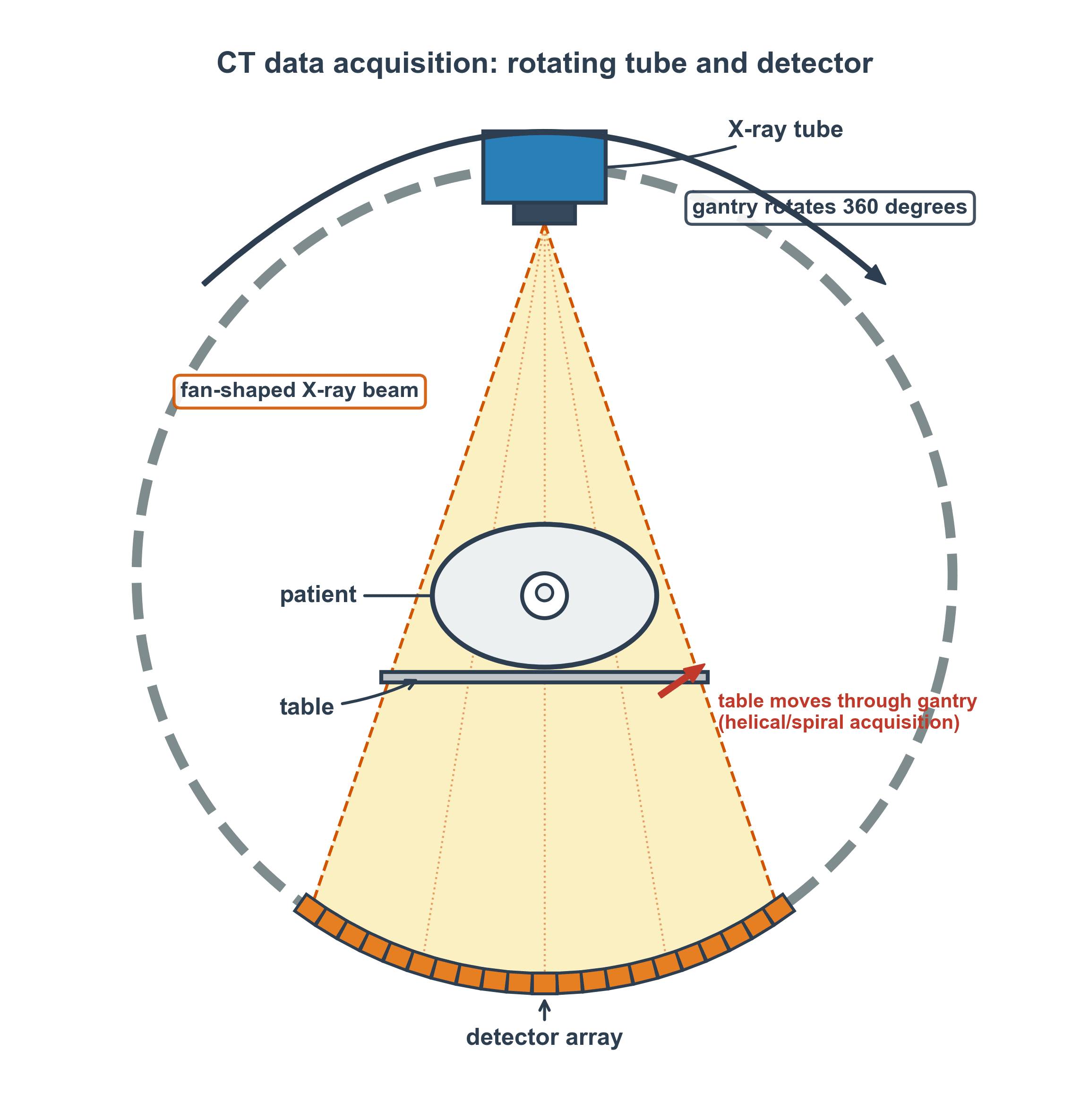
The gantry. An X-ray tube is mounted on a rotating gantry opposite a detector array. The tube rotates continuously around the patient, 360 degrees in approximately 0.3-0.5 seconds on modern scanners, emitting a fan-shaped or cone-shaped beam; the tissues attenuate (absorb and scatter) the beam to varying degrees, and the detectors on the opposite side measure the intensity of the transmitted beam at thousands of angles around the patient.
Multi-detector CT. Modern scanners (MDCT) carry 64 to 320 detector rows and acquire multiple slices per rotation. That dramatically reduces scan time and gives isotropic voxel resolution, equal resolution in all three planes, which is what high-quality multiplanar reconstruction depends on.
Helical Acquisition and Pitch
Helical scanning. Modern CT is acquired helically (spiral): the table moves continuously while the tube rotates, so the X-ray focus traces a helix relative to the patient and a whole volume is acquired in one breath-hold or pass. The single most examined acquisition parameter is pitch:
Pitch = table travel per gantry rotation / total nominal beam width (collimation)
- Pitch = 1: the table advances exactly one beam-width per rotation (contiguous acquisition)
- Pitch over 1: the table moves faster than the beam width; faster coverage and (all else equal) lower dose, but interpolation gaps can reduce z-axis resolution and increase helical (windmill) artefact
- Pitch under 1: overlapping acquisition; higher z-axis resolution and better for fine detail, at the cost of higher dose
Choosing it. High pitch is chosen to freeze motion (polytrauma, paediatric or uncooperative patients) and low pitch for high-resolution work. Pitch is the trade-off between speed and coverage, dose, and z-axis resolution. Many scanners automatically adjust tube current with pitch to hold image quality constant, so always interpret pitch alongside the displayed CTDIvol rather than in isolation.
Hounsfield Units
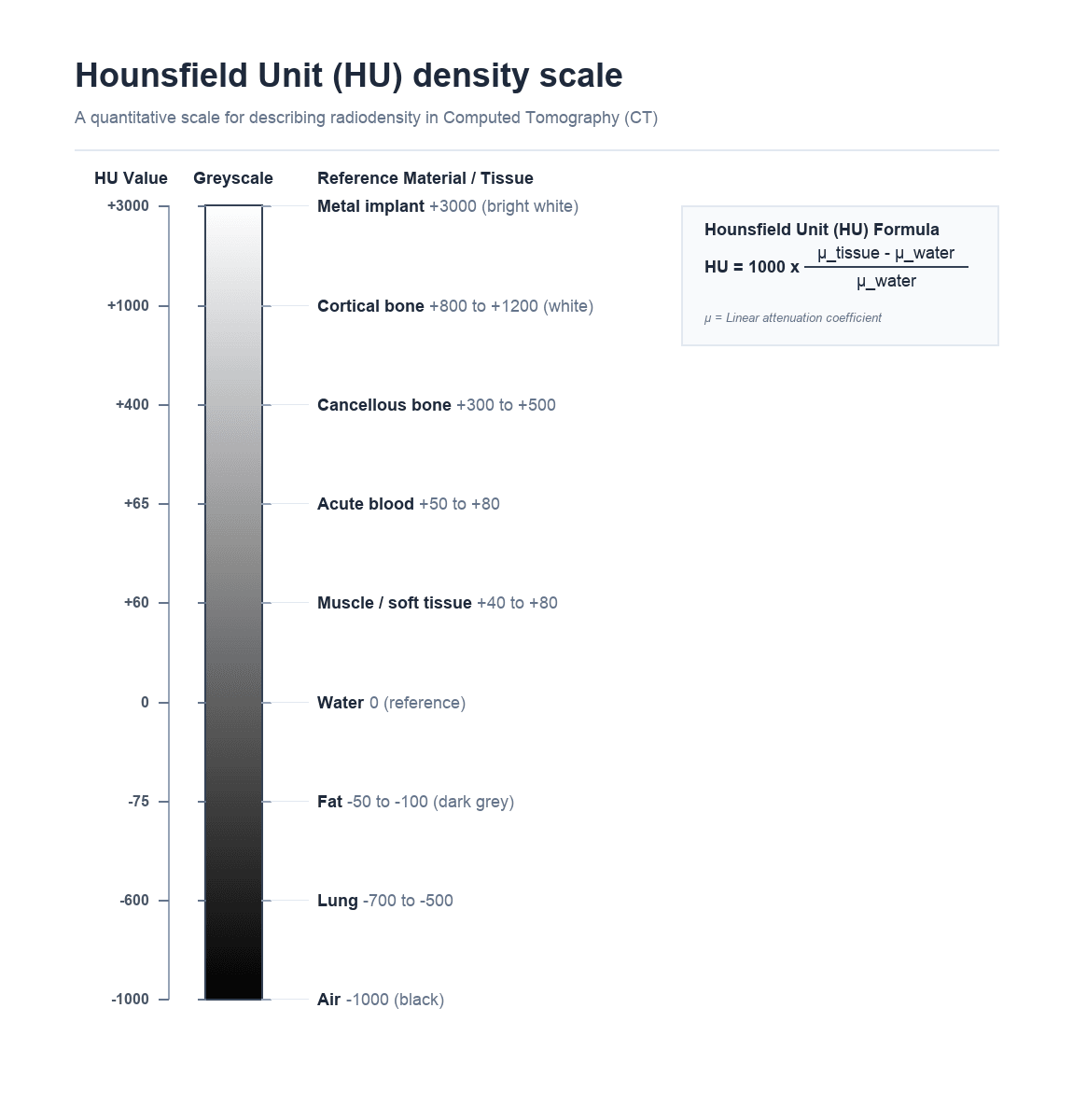
The unit. The fundamental unit of CT imaging is the Hounsfield Unit (HU), named after Sir Godfrey Hounsfield who developed clinical CT. It is a linear transformation of the X-ray attenuation coefficient, normalised to water:
HU = 1000 × (μ tissue - μ water) / μ water
where μ is the linear attenuation coefficient. The normalisation gives water a value of exactly 0 HU and air approximately -1000 HU, a standardised scale across all CT scanners. Low values appear dark and high values white, which is why bone and metal are bright and fat and air are dark on the greyscale image.
- HU Range
- -1000
- Clinical Significance
- Reference lower bound; appears black on all windows
- HU Range
- -700 to -500
- Clinical Significance
- Low density due to air content; lung windows needed
- HU Range
- -50 to -100
- Clinical Significance
- Negative HU distinguishes fat from water — key for lipoma vs other tumours and for marrow assessment
- HU Range
- 0
- Clinical Significance
- Calibration reference point of the Hounsfield scale
- HU Range
- +40 to +80
- Clinical Significance
- Standard soft tissue density; visible on soft tissue windows
- HU Range
- +50 to +80
- Clinical Significance
- Fresh blood is slightly denser than muscle — useful for identifying acute haematoma
- HU Range
- +300 to +500
- Clinical Significance
- Trabecular bone; density reflects mineralisation status
- HU Range
- +800 to +1200
- Clinical Significance
- Dense cortical bone; visible on bone windows
- HU Range
- +3000 or more
- Clinical Significance
- Extremely dense; causes beam hardening and streak artefact
The Hounsfield Unit as a Bone Density Measurement
The free measurement. Because the HU is a calibrated, absolute quantity rather than a relative greyscale, every CT that includes the trunk already contains a bone density measurement that nobody requested. A region of interest in the trabecular bone of the L1 vertebral body on any routine abdominal or lumbar CT gives a number that tracks DXA-defined osteoporosis closely: an L1 attenuation of 160 HU or less is around 90% sensitive, 110 HU or less is more than 90% specific, and the negative predictive value is 99% above 200 HU. This is opportunistic screening, and it costs nothing: no extra scan, no extra dose, no extra appointment.
Who it helps. The applications are immediate: a patient booked for spinal instrumentation, a periprosthetic fracture being planned for revision rather than fixation, or an elderly patient whose staging CT shows L1 at 90 HU and who therefore needs bone-health assessment before anything is screwed into their skeleton. It also catches the group DXA misses. In the source cohort, over half of the patients with a moderate or severe vertebral fracture had a non-osteoporotic T-score, and almost all of those had L1 attenuation of 145 HU or less.
Two caveats. Intravenous contrast raises measured attenuation, so thresholds derived from unenhanced scans cannot be applied directly to a portal-venous study, and values shift with kVp and with scanner calibration. Quote the threshold with the protocol it came from.
Window and Level Settings
Why windows exist. A CT dataset contains a far wider range of HU values than a monitor can display (typically 256 grey levels). Window width sets the range of HU values displayed, and window level (centre) sets the midpoint of that range.
- Width (HU)
- 2000-4000
- Level (HU)
- +300 to +500
- What It Shows
- Cortical detail, fracture lines, implant position, calcification
- Width (HU)
- 250-400
- Level (HU)
- +40 to +60
- What It Shows
- Muscle, haematoma, soft tissue masses, fluid collections
- Width (HU)
- 1500-2000
- Level (HU)
- -600
- What It Shows
- Air-containing structures, pneumothorax
- Width (HU)
- 80-100
- Level (HU)
- +35 to +40
- What It Shows
- Intracranial pathology (relevant for polytrauma assessment)
Windowing changes the display, not the data. It selects which portion of the Hounsfield scale reaches the screen, nothing more. The same dataset can be viewed on bone windows to assess a fracture and on soft tissue windows to assess a haematoma without rescanning the patient.
Image Reconstruction
Reconstruction Algorithms
Raw CT data (the sinogram) must be mathematically reconstructed into cross-sectional images. Two main approaches exist.
How it works. Filtered back projection (FBP) is the traditional algorithm, in use since the development of clinical CT. It projects the measured attenuation data back through the image matrix along the original ray paths, with mathematical filtering to remove blurring. It is computationally fast and produces consistent, well-understood image characteristics.
The kernel. Convolution kernels (reconstruction filters) are applied during FBP:
- Soft tissue (smooth) kernel: reduces noise but lowers spatial resolution; used for soft tissue assessment
- Bone (sharp) kernel: maximises spatial resolution at the cost of increased noise; essential for fracture detection
- Lung kernel: optimised for high-contrast air-tissue interfaces
The dose penalty. FBP is dose-inefficient: reducing the radiation dose increases image noise, and there is a minimum dose below which diagnostic quality is lost. The relationship worth memorising is that image noise varies with the inverse square root of the tube current-time product: halving the mAs (and therefore the dose) raises noise by about 40%, and quartering it doubles noise. That fixed penalty is what iterative and deep-learning reconstruction were built to break, and it is why FBP sets the floor below which dose cannot be reduced without losing the fracture line.
Multiplanar Reconstruction and 3D Rendering
No extra dose. Multiplanar reconstructions (MPR) and 3D volume-rendered images are generated from the original axial dataset without any additional radiation to the patient, which is one of the most powerful features of CT for orthopaedic surgery.
Multiplanar reconstruction. Coronal, sagittal and oblique reformats are generated from the isotropic axial data. They are essential for tibial plateau fractures (the coronal view for split and depression), for acetabular fracture classification (coronal and sagittal) and for spinal alignment. Quality depends on slice thickness: thinner axial slices (0.5-1mm) produce better reformats than thick slices (3-5mm).
3D volume rendering. Surface reconstructions give an intuitive global view of a complex fracture pattern and are invaluable for planning acetabular fractures, complex periarticular fractures and deformity correction surgery. Overlying structures can be digitally subtracted, showing only the posterior column of the acetabulum for example, and the surgeon can rotate the model to understand the fracture geometry from any angle. Increasingly the same data are 3D-printed as patient-specific fracture models for preoperative planning.
Systematic Approach
Everything above, the Hounsfield scale, the windows, the reformats and the artefacts, exists to be applied in the same order on every scan. A fixed sequence is what stops the eye stopping at the first fracture it finds.
- What to Assess
- Confirm correct region scanned, check for incidental findings at scan margins
- Key Questions
- Is the entire region of interest captured? Are there additional pathologies at the scan boundaries?
- What to Assess
- Scan systematically through cortical bone in all three planes (axial, coronal, sagittal)
- Key Questions
- Are all cortical surfaces intact? Any fracture lines, cortical breaks, or periosteal reaction?
- What to Assess
- Assess joint surface congruity in the plane perpendicular to the articular surface
- Key Questions
- Any step, gap, or depression? Quantify displacement in millimetres. Any intra-articular fragments?
- What to Assess
- Axes, rotation, angulation, subluxation
- Key Questions
- Is the joint congruent? Any rotational malalignment? Measure specific angles as needed.
- What to Assess
- Haematomas, effusions, soft tissue swelling, vascular injury, gas
- Key Questions
- Any expanding haematoma? Joint effusion? Soft tissue gas (open fracture)? Vascular contrast extravasation?
- What to Assess
- Global fracture pattern, fragment relationships, preoperative planning
- Key Questions
- What is the overall fracture geometry? Which surgical approach best addresses all major fragments?
Both windows, every time. The common pitfall is to find the fracture on bone windows and miss the expanding haematoma, vascular injury or compartmental swelling that only the soft tissue windows show. In spinal trauma the canal is assessed on soft tissue windows for retropulsed fragments and epidural haematoma.
Orthopaedic Applications
Choosing CT vs Other Modalities
A frequent viva theme is justifying CT over an alternative. The clinical question, whether it is bone geometry, soft tissue, marrow or vascular, should drive the choice of modality, not habit.
- First Choice
- CT
- Why / When CT Instead
- Best modality — quantifies step, gap, depression and fragment number for surgical planning
- First Choice
- MRI
- Why / When CT Instead
- CT has poor soft-tissue contrast; reserve CT arthrography for when MRI is contraindicated or unavailable
- First Choice
- MRI
- Why / When CT Instead
- CT can miss non-displaced fractures; dual-energy virtual non-calcium CT is a sensitive but less specific alternative when MRI is not available
- First Choice
- CT angiography
- Why / When CT Instead
- Fast, accurate exclusion of popliteal/limb arterial injury before or after reduction
- First Choice
- Joint aspiration; DECT adjunct
- Why / When CT Instead
- Dual-energy CT non-invasively maps urate when aspiration is negative or not feasible
- First Choice
- MRI (or US)
- Why / When CT Instead
- MRI superior for marrow and soft-tissue extent; CT used when MRI contraindicated or for gas/foreign body
- First Choice
- Plain radiography
- Why / When CT Instead
- Always first-line — CT only when films are insufficient for the decision at hand
CT in Fracture Assessment
CT is most valuable when plain radiographs suggest a complex fracture that requires detailed characterisation for surgical planning: the intra-articular fractures of the acetabulum, tibial plateau, calcaneus, distal humerus and pilon. It quantifies the step, gap and depression that plain films only suggest.
Acetabular fractures. CT is considered mandatory for all acetabular fractures. It changes the Letournel-Judet classification in up to 40% of cases compared with plain films alone, and reveals column involvement, wall fragments, marginal impaction (the gull sign), intra-articular fragments, femoral head injury and the dome arc measurements.
Tibial plateau fractures. CT quantifies the depth of articular depression (greater than 2-3mm is a common surgical threshold), identifies split fragments, reveals posterior column involvement that is often missed on plain films, and helps plan the surgical approach.
Calcaneal fractures. Coronal reformats demonstrate the posterior facet depression, calcaneocuboid joint involvement and the position of the sustentaculum tali fragment, and the sagittal plane allows measurement of the Bohler angle.
Pilon fractures. CT defines the articular injury pattern, identifies the number and position of the articular fragments, and guides the surgical approach.
Spinal injuries. CT is the primary investigation for thoracolumbar burst fractures, assessing canal compromise, posterior element fractures and vertebral body comminution. It is the gold standard for characterising bony spinal injury; MRI is for the cord and the ligaments.
When you scan matters as much as whether you scan. For a pilon, a high-energy tibial plateau, or a fracture-dislocation, the CT should be obtained after a spanning external fixator has been applied, not before. Ligamentotaxis pulls the major fragments out to something approaching their anatomical position, so the post-fixator CT shows the fracture in the configuration you will actually operate on and reveals the true articular fragment boundaries; a CT taken in the grossly displaced state overstates comminution and misleads the plan. The same logic explains why a CT taken with the joint reduced answers a different question from one taken dislocated: a hip that was dislocated and has been relocated needs its CT after reduction, to look for the incarcerated osteochondral fragment that keeps the joint incongruent.
Radiation Dose and Safety
CT delivers substantially higher radiation doses than plain radiography and is the single largest contributor to medical radiation exposure in developed countries. Understanding CT dose metrics and optimisation strategies is essential for fellowship examinations.
Effective Dose by Region
- Effective Dose (mSv)
- 0.1-0.5
- Multiple of the SAME-region X-ray series
- Tens of times - but both doses are trivially small
- Multiple of one chest radiograph (0.02 mSv)
- 5-25x
- Equivalent Background Radiation
- 1-8 weeks
- Effective Dose (mSv)
- 2-4
- Multiple of the SAME-region X-ray series
- 10-20x (series approx 0.2 mSv)
- Multiple of one chest radiograph (0.02 mSv)
- 100-200x
- Equivalent Background Radiation
- 8-16 months
- Effective Dose (mSv)
- 5-10
- Multiple of the SAME-region X-ray series
- 3-7x (series approx 1.5 mSv)
- Multiple of one chest radiograph (0.02 mSv)
- 250-500x
- Equivalent Background Radiation
- 2-4 years
- Effective Dose (mSv)
- 6-10
- Multiple of the SAME-region X-ray series
- 8-14x (AP pelvis approx 0.7 mSv)
- Multiple of one chest radiograph (0.02 mSv)
- 300-500x
- Equivalent Background Radiation
- 2-4 years
- Effective Dose (mSv)
- 10-20
- Multiple of the SAME-region X-ray series
- No routine radiographic equivalent
- Multiple of one chest radiograph (0.02 mSv)
- 500-1000x
- Equivalent Background Radiation
- 4-7 years
- Effective Dose (mSv)
- 20-30
- Multiple of the SAME-region X-ray series
- No routine radiographic equivalent
- Multiple of one chest radiograph (0.02 mSv)
- 1000-1500x
- Equivalent Background Radiation
- 7-12 years
A single polytrauma CT (head, cervical spine, chest, abdomen, pelvis) is justified in the acute trauma setting, but the cumulative dose from serial CT imaging (follow-up, surveillance) must be considered, particularly in young patients. Always ask: 'Can this clinical question be answered by plain radiography, ultrasound, or MRI instead?'
The Quantities the Scanner Reports
A frequent physics-viva trap is to quote effective dose (mSv) without knowing the quantities the scanner actually reports. Distinguish three things:
- Unit
- mGy
- What It Represents
- Average absorbed dose within the scanned volume for the chosen protocol; a measure of dose intensity displayed on the console, independent of scan length
- Unit
- mGy·cm
- What It Represents
- CTDIvol multiplied by scan length — reflects the total energy imparted, so it accounts for how much of the body was scanned
- Unit
- mSv
- What It Represents
- DLP multiplied by a region-specific conversion coefficient (the k-factor), weighting for the radiosensitivity of the organs in the scanned region; allows stochastic-risk comparison across examinations and body regions
Measured versus estimated. CTDIvol and DLP are physical dose quantities measured on a standard phantom; effective dose is a calculated, risk-weighted estimate, not a measured patient dose. The k-factor is larger for the trunk, with its radiosensitive viscera, and small for the extremities, which is why a limb CT carries a far lower effective dose than its CTDIvol alone might suggest. Diagnostic reference levels (DRLs) are benchmarked in CTDIvol and DLP, not mSv.
Dose Optimisation
On the scanner. Automatic tube current modulation adjusts the mAs to patient size and body region, iterative reconstruction takes the dose down further, low-kVp protocols suit the extremities, and the scan length is limited to the region of interest. Every scan needs an appropriate clinical indication and justification.
In the clinic. Plain radiography is the first-line investigation, and CT is reserved for when the films are insufficient for clinical decision-making. Avoid a repeat CT when previous imaging can answer the question, use MRI rather than CT for soft tissue questions (ligaments, bone marrow oedema), and consider low-dose CT protocols for follow-up imaging.
SLIMCT Dose Reduction Strategies
Hook:SLIM the dose: CT is the biggest radiation contributor in medical imaging, so every reduction matters.
Dual-Energy CT
Dual-energy CT (DECT) acquires data at two different kVp settings simultaneously, so materials can be decomposed by their energy-dependent attenuation. Several applications matter in orthopaedics:
- Mechanism
- Urate crystals have a unique dual-energy signature different from calcium
- Clinical Utility
- Non-invasive diagnosis of gout; can detect asymptomatic tophi
- Mechanism
- Subtraction of calcium signal reveals underlying bone marrow oedema
- Clinical Utility
- Detection of occult fractures (bone bruises) without MRI — useful in acute trauma when MRI is unavailable or contraindicated
- Mechanism
- Virtual monoenergetic images generated at higher keV reduce beam hardening
- Clinical Utility
- Improved visualisation around orthopaedic implants compared to conventional CT; 130-190 keV virtual monoenergetic images optimal
- Mechanism
- Collagen-rich structures have different dual-energy signatures
- Clinical Utility
- Emerging application for Achilles tendon assessment and ligament integrity, though MRI remains superior
Gout in practice. DECT identifies monosodium urate deposits as small as 2mm, even without tophi on examination; commercial software colour-codes the crystals green and calcium purple/blue. Individual studies report sensitivity of 78-100% and specificity of 89-100%; the pooled meta-analysis in the Evidence Base gives 87% sensitivity and 84% specificity, and the pooled specificity sits below the range the individual studies report. False positives occur with nail bed artefact, skin calluses and motion artefact.
CT Artefacts in Orthopaedic Imaging
Artefacts are particularly relevant in orthopaedic practice because metallic implants are extremely common in the patient population.
- Cause
- Preferential absorption of low-energy photons by dense material (bone or metal)
- Appearance
- Dark bands between dense structures (Hounsfield bar between petrous bones); cupping artefact
- Reduction Strategies
- Beam hardening correction algorithms, increased kVp, hardware filtering
- Cause
- Photon starvation and beam hardening from orthopaedic implants
- Appearance
- Bright and dark streaks radiating from metallic hardware, obscuring adjacent anatomy
- Reduction Strategies
- Metal artefact reduction reconstruction algorithms, dual-energy CT, increased kVp, increased mAs
- Cause
- Voxel containing multiple tissue types is assigned their average HU value
- Appearance
- Blurring of interfaces; small fracture lines may be missed if slice is too thick
- Reduction Strategies
- Thinner slice thickness (0.5-1mm); volumetric acquisition
- Cause
- Patient movement during acquisition
- Appearance
- Blurring, double contours, streak patterns
- Reduction Strategies
- Faster scan time (wider detectors), immobilisation, breath-hold for torso scans
- Cause
- Miscalibrated detector element
- Appearance
- Concentric ring pattern centred on the rotation axis
- Reduction Strategies
- Detector calibration, quality assurance programme
Metal artefact reduction. MAR becomes more important as the orthopaedic population with existing implants grows. The vendor algorithms, O-MAR (Philips), SEMAR (Canon) and iMAR (Siemens), use iterative techniques to reduce streak artefact around hardware. Get the terminology right: these are CT reconstruction algorithms, whereas a metal artefact reduction sequence (MARS, MAVRIC, SEMAC) is an MRI technique. Dual-energy CT also helps, by generating virtual monoenergetic images at higher keV, which are less affected by beam hardening. No current technique eliminates metal artefact completely, and for soft tissue assessment around an implant MRI with metal artefact reduction sequences (MAVRIC/SEMAC) may be preferable.
Guidelines, Registries & Global Practice
CT is the single largest contributor to medical radiation exposure worldwide. Across high-income health systems, CT accounts for only a minority of imaging studies (typically under 10% of examinations) yet contributes the majority (around 60-70%) of the collective dose from diagnostic radiology — the central justification for diagnostic reference levels (DRLs) and the ALARA principle. CT utilisation continues to rise globally, fastest in middle-income settings as scanner access expands, which makes appropriate-use criteria as relevant in resource-limited settings as in tertiary centres.
Global Epidemiology of CT Use
- CT volumes per capita are highest in the United States, Japan, and parts of Europe and lowest in low-resource settings where access — not over-use — is the dominant problem.
- Orthopaedic CT demand is driven by the ageing population, rising fragility-fracture burden, and the growing prevalence of in-situ metalwork (revision arthroplasty volumes are increasing across all major arthroplasty registries, including the NJR, AJRR, AOANJRR, and Scandinavian registries), which increases the need for metal-artefact-reduction CT.
Side-by-Side Society Guidance
- Core Position
- Evidence-based appropriateness ratings; plain radiography first-line, CT reserved for defined indications
- Practical Emphasis
- Structured 1-9 appropriateness scoring per clinical scenario; clinical decision support at order entry
- Core Position
- Referral guidelines (Making Best Use of Radiology) with justification for every exposure
- Practical Emphasis
- Explicit justification and optimisation duties under ionising-radiation regulation
- Core Position
- Pan-European DRLs and dose-audit culture
- Practical Emphasis
- National DRLs as benchmarks; routine dose audit and feedback
- Core Position
- CT mandatory for characterising complex intra-articular fractures (acetabulum, plateau, pilon, calcaneus)
- Practical Emphasis
- CT-based classification and 3D planning before periarticular fixation
- Core Position
- Justification, optimisation, dose-registry building in all settings
- Practical Emphasis
- Capacity-building and protocol standardisation in limited-resource systems
High- vs Limited-Resource Practice Variation
- Well-resourced settings: routine thin-slice MDCT with iterative (or deep-learning) reconstruction, automatic tube-current modulation, dual-energy capability, and vendor MAR; CT is standard for preoperative planning of complex fractures and for 3D-printed patient-specific models.
- Limited-resource settings: older single- or few-slice scanners, limited dual-energy and MAR availability, and constrained access mean plain radiography (and, where available, MRI) carries more of the diagnostic load. Justification matters even more where each scan competes for scarce capacity, and protocol optimisation and shared reference levels are the highest-yield safety interventions.
Diagnostic reference levels, not billing pathways, are the appropriate global benchmark for governing CT use — dose audit against DRLs is recommended by ICRP, the IAEA, and national regulators regardless of health-system funding model.
Controversies & Areas of Uncertainty
CT physics is settled; what to do with the numbers is not. Four questions come up in vivas precisely because they have no agreed answer, and a candidate who names the reason each remains open is doing better than one who picks a side.
Whether an individual patient should be quoted a cancer risk at all
The convention is to apply the linear no-threshold (LNT) model, risk proportional to dose with no safe threshold, and multiply. The objection is that LNT was adopted as a radiation protection assumption, deliberately conservative, extrapolated downward from atomic-bomb survivor data at doses far above diagnostic range. Professional medical-physics bodies have argued that predicting the number of cancers caused by doses below about 50 mSv is not scientifically supportable, because the predicted excess is far smaller than the statistical noise around a lifetime cancer incidence of roughly 40%.
Why it stays unresolved. The effect, if it exists, is too small to measure. Detecting a fractional excess risk at 5 mSv against that background would require cohorts in the millions with complete confounder control. Large paediatric CT cohorts have reported dose-response relationships for leukaemia and brain tumours, but the standing objection is confounding by indication: children who get scanned differ from those who do not, sometimes because of the very condition that later declares itself. The pragmatic position for a viva is to give the number, name the model, and say plainly that it is a cautious upper bound rather than an observed effect. Neither "there is no risk" nor a confidently stated risk figure is defensible.
Effective dose is being used for a job it was not designed to do
Effective dose (mSv) is a population protection quantity: it is computed on reference phantoms using tissue weighting factors averaged across both sexes and all ages, for the purpose of comparing practices and setting limits. It is routinely quoted, including on this page, as though it were a dose delivered to the individual in front of you.
Why it stays unresolved. There is no equally portable alternative. Organ-dose-based, size-specific and age-specific risk calculators exist and are more defensible, but they require inputs that are not available at the point of the conversation, and clinicians will not use them. Effective dose survives because it is the only quantity that lets you compare a CT with a bone scan in one sentence. It is also why diagnostic reference levels are set in CTDIvol and DLP and never in mSv: the regulator is auditing a machine and a protocol rather than estimating a person's risk.
Immediate total-body CT versus selective imaging in trauma
Observational work suggested a survival advantage for scanning everyone; the randomised trial did not confirm it. In-hospital mortality was identical, and the additional radiation is not trivial.
Why it stays unresolved. The trial was conducted in systems where selective CT is fast and readily available, so it may have compared immediate total-body CT with something close to it. Time-to-diagnosis and missed-injury rates favour the pan-scan, and neither converts into a mortality signal in a population where most deaths follow from injuries that imaging cannot alter. The question has therefore shifted from "does it work?" to "in whom?", and no selection rule has yet been validated prospectively.
Numbers that are reproducible without being meaningful
Weight-bearing CT can measure middle facet subluxation, foot-ankle offset and syndesmotic volume with excellent inter-observer agreement. The same is true of CT-based union scoring. In both cases the measurement is far ahead of its interpretation: high reproducibility is not the same as a validated threshold for intervention.
Why it stays unresolved. Establishing that a measured value should change management requires longitudinal cohorts linking the number to an outcome, and those take years to mature; meanwhile the technology and the software measuring the number keep changing, which resets the clock. Treat these values as a way of describing a deformity or a gap precisely, not as a criterion for operating.
Clinical Decision Scenarios
Practise clinical reasoning and management decisions out loud
“A 45-year-old female has sustained an acetabular fracture in a road traffic collision. Plain radiographs show a both-column fracture pattern. You request a CT scan.”
“An examiner shows you a CT scan of a knee with significant metal streak artefact from a previous tibial plateau plate. They ask you to explain the artefact and describe strategies to improve image quality.”
“A concerned parent asks about the radiation risk of a CT scan ordered for their 12-year-old child who has a complex tibial plateau fracture.”
Hounsfield Units
- Water = 0 HU (reference), Air = -1000 HU, Fat = -50 to -100 HU
- Muscle = +40-80 HU, Cancellous bone = +300-500 HU, Cortical bone = +800-1200 HU
- HU = 1000 x (mu tissue - mu water) / mu water
- Changing window/level does NOT change data — only changes display
Key Orthopaedic Indications
- Acetabular fractures: MANDATORY — changes classification in up to 40%
- Tibial plateau: quantifies depression, reveals posterior column involvement
- Calcaneus: posterior facet assessment on coronal reformats
- Spinal trauma: canal compromise, posterior element fractures
- CT angiography in knee dislocation for popliteal artery assessment
Radiation Dose
- Name your comparator: CT is 5-15x the SAME-region X-ray series, but 300-1000x a single chest radiograph
- CT accounts for 67% of medical radiation dose but only 5% of imaging volume
- Extremity CT: 0.1-0.5 mSv; Pelvis CT: 6-10 mSv; Polytrauma CT: 20-30 mSv
- Iterative reconstruction reduces dose by 40-60% vs filtered back projection
Metal Artefact
- Beam hardening: preferential low-energy photon absorption by metal
- Photon starvation: complete absorption at some projection angles
- Reduction: higher kVp, MAR software (O-MAR/iMAR/SEMAR), dual-energy CT at 130-190 keV
- MRI with MAVRIC/SEMAC may be superior for soft tissue around implants
Free Information Already on the Scan
- L1 vertebral body HU on any routine trunk CT screens for osteoporosis - 160 HU or less is 90% sensitive, 110 HU or less over 90% specific, NPV 99% above 200 HU
- Half of patients with a moderate-severe vertebral fracture have a non-osteoporotic DXA T-score; almost all have L1 at 145 HU or less
- IV contrast raises attenuation - these thresholds apply to unenhanced scans
- Weight-bearing cone-beam CT: middle facet subluxation, foot-ankle offset, side-to-side syndesmosis comparison; very low dose but thresholds not yet validated
Timing and Sequence
- Pilon / high-energy plateau / fracture-dislocation: CT AFTER the spanning ex-fix - ligamentotaxis reveals the true fragment boundaries
- Dislocated hip: CT after reduction, looking for the incarcerated osteochondral fragment
- Union: bridging across 3 of 4 cortices on reformats; radiographs over-call union, CT over-calls nonunion
- Pitch = table travel per rotation / beam collimation; pitch over 1 = faster and lower dose, pitch under 1 = higher z-resolution and higher dose
- FBP noise varies as 1/sqrt(mAs) - halving dose raises noise 40%; IR and deep-learning reconstruction exist to break that link
Dual-Energy CT
- Gout: urate crystal detection (87% sensitivity, 84% specificity)
- Virtual non-calcium: detects bone marrow oedema without MRI
- Virtual monoenergetic images: reduce metal artefact
- False positives: nail bed, skin calluses, motion artefact
Evidence Base
CT vs Plain Radiographs for Acetabular Fracture Displacement
- Compared to CT, plain radiographs had poor sensitivity for detecting articular step deformity (25%) in displaced acetabular fractures.
- For fractures involving a single column of the acetabulum, plain radiographs detected step deformity with 0% sensitivity.
- In osteotomised canine specimens, CT measured step and gap displacement far more accurately than plain radiographs relative to true displacement.
Spiral CT with 3D Reconstruction in Tibial Plateau Fractures
- Tibial plateau fractures were underestimated on plain films in 18 of 42 cases (43%) compared with spiral CT and 3D reconstruction.
- In the 22 cases planned with both modalities, the surgical plan based on plain films was modified after CT in 13 cases (59%).
- Spiral CT 3D reconstructions gave a more accurate demonstration of fracture geometry and a more precise preoperative plan.
Opportunistic Osteoporosis Screening Using CT Obtained for Other Indications
- In 2,067 CT-DXA pairs from 1,867 adults, an L1 CT-attenuation threshold of 160 HU or less was 90% sensitive and 110 HU was more than 90% specific for DXA-defined osteoporosis.
- Negative predictive value was 99% at thresholds above 200 HU, and positive predictive value was 68% or greater below 100 HU.
- Of 119 patients with at least one moderate-to-severe vertebral fracture, 62 (52.1%) had non-osteoporotic DXA T-scores, and 97% of those had L1 attenuation of 145 HU or less.