Fifth Metatarsal Apophysitis | Peroneus Brevis Traction | Lateral Foot Pain | Often Mistaken For a Fracture
- Traction apophysitis: Repetitive pull of the peroneus brevis on the apophysis at the base of the fifth metatarsal during the growth spurt - an overuse injury, not a joint problem
- The fracture trap: The normal apophysis lies roughly PARALLEL to the shaft; an avulsion fracture line runs roughly TRANSVERSE (perpendicular) to it - this orientation is the key to telling them apart
- Clinical diagnosis: Point tenderness and swelling over the base of the fifth metatarsal with activity-related lateral foot pain - imaging is used to exclude fracture, not to confirm apophysitis
- Self-limiting: Settles once the apophysis fuses around skeletal maturity; surgery has essentially no role
- Compare both feet: A symmetrical apophysis on the other foot reassures you the finding is a normal ossification centre, not a fracture
- “Rare but classic exam trap - lateral foot pain in a child, X-ray shows a 'fragment' at the fifth metatarsal base
- “Apophysis parallel to shaft = normal; fracture line transverse to shaft = pathology
- “Peroneus brevis is the culprit tendon (NOT peroneus longus, which inserts on the first ray)
- “Manage like other apophysitides: load modification, stretching, reassurance; image to exclude a fracture
Overview and Epidemiology
Iselin disease is a traction apophysitis of the base of the fifth metatarsal: an overuse injury of the secondary ossification centre (the apophysis) at the proximal fifth metatarsal, caused by repetitive pull of the peroneus brevis tendon during the growth spurt. Hans Iselin first described it in 1912. Like the other apophysitides it is a benign, self-limiting condition of the growing skeleton rather than a true "disease", and an uncommon but classically under-recognised cause of lateral foot pain in active children and adolescents.
How often. It is uncommon and probably under-diagnosed, and its true incidence is unknown. A systematic review concluded that the condition is "rarely reported and likely to remain undiagnosed, possibly mistaken for a fracture", and that it exists chiefly as an important differential in any child with fifth metatarsal pain (DOI).
Who. The peak age is roughly 8 to 13 years, while the apophysis is open, and it tends to appear a little earlier in girls than boys, mirroring their earlier skeletal maturation. It is strongly associated with high-impact running, jumping, kicking, cutting and pivoting sports: soccer, basketball, gymnastics, dance and martial arts.
The trigger. Repetitive lateral loading is a described trigger, from side-kicks, sprinting on bends or dance turns. A paediatric case attributed to kickboxing was postulated to arise from traction during side-kicks and round-kicks (DOI).
Risk factors. Skeletal immaturity, an open apophysis, is the prerequisite. The intrinsic factors are:
- Rapid growth
- Peroneus brevis or calf tightness, which increases traction across the apophysis
- A cavovarus or supinated foot, which increases lateral column loading
- Reduced ankle and subtalar flexibility, a recurring theme across the apophysitides
The extrinsic factors are:
- Rapid increases in training volume or intensity
- Hard surfaces and poor footwear, which increase peak lateral foot pressures
- Multiple concurrent sports, with inadequate recovery between sessions
Pathophysiology and Anatomy
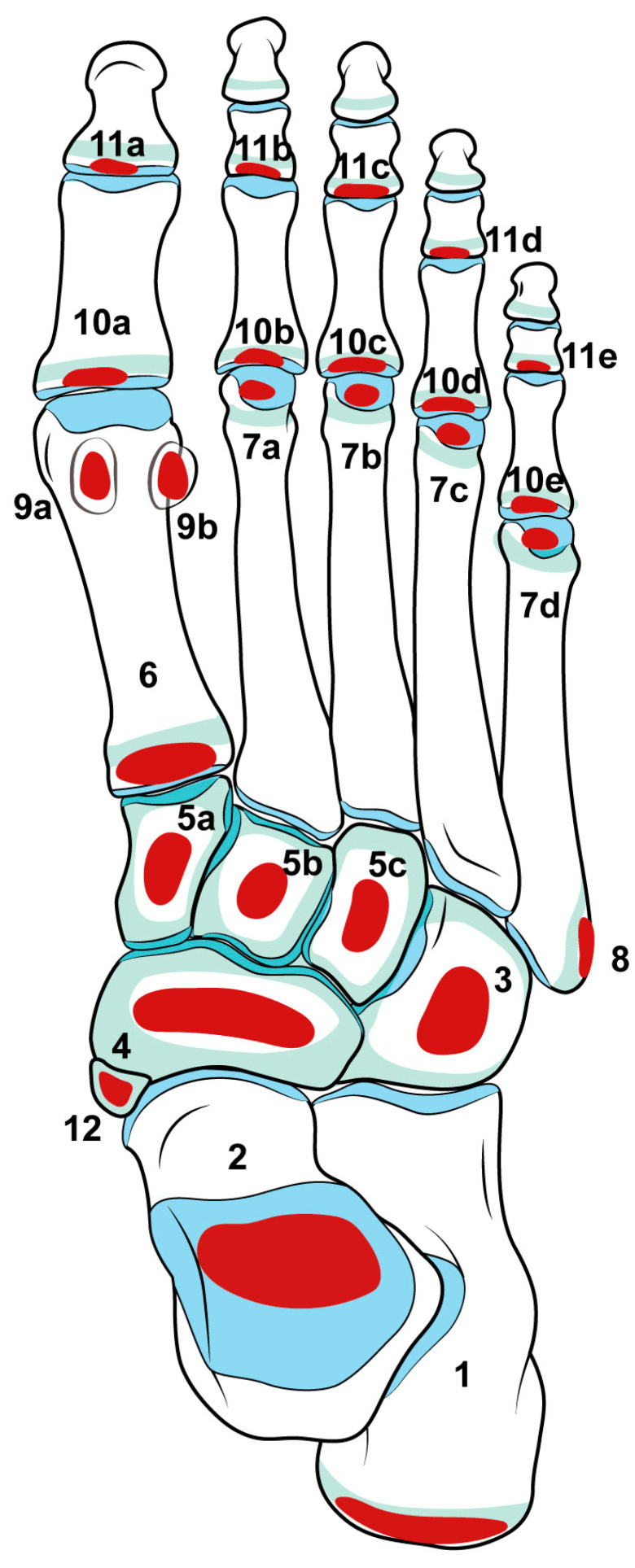
The fifth metatarsal base. The base carries a prominent lateral tuberosity (styloid process). A secondary ossification centre, the apophysis, develops here and is the attachment of the peroneus brevis, which everts and plantarflexes the foot and is the tractioning structure in Iselin disease. The lateral band of the plantar fascia also attaches to this region and adds a further small tractioning force.
Not peroneus longus. Peroneus longus passes plantar to the cuboid to insert on the first metatarsal and medial cuneiform. It does not insert on the fifth metatarsal base, so it is not the culprit, a classic exam point.
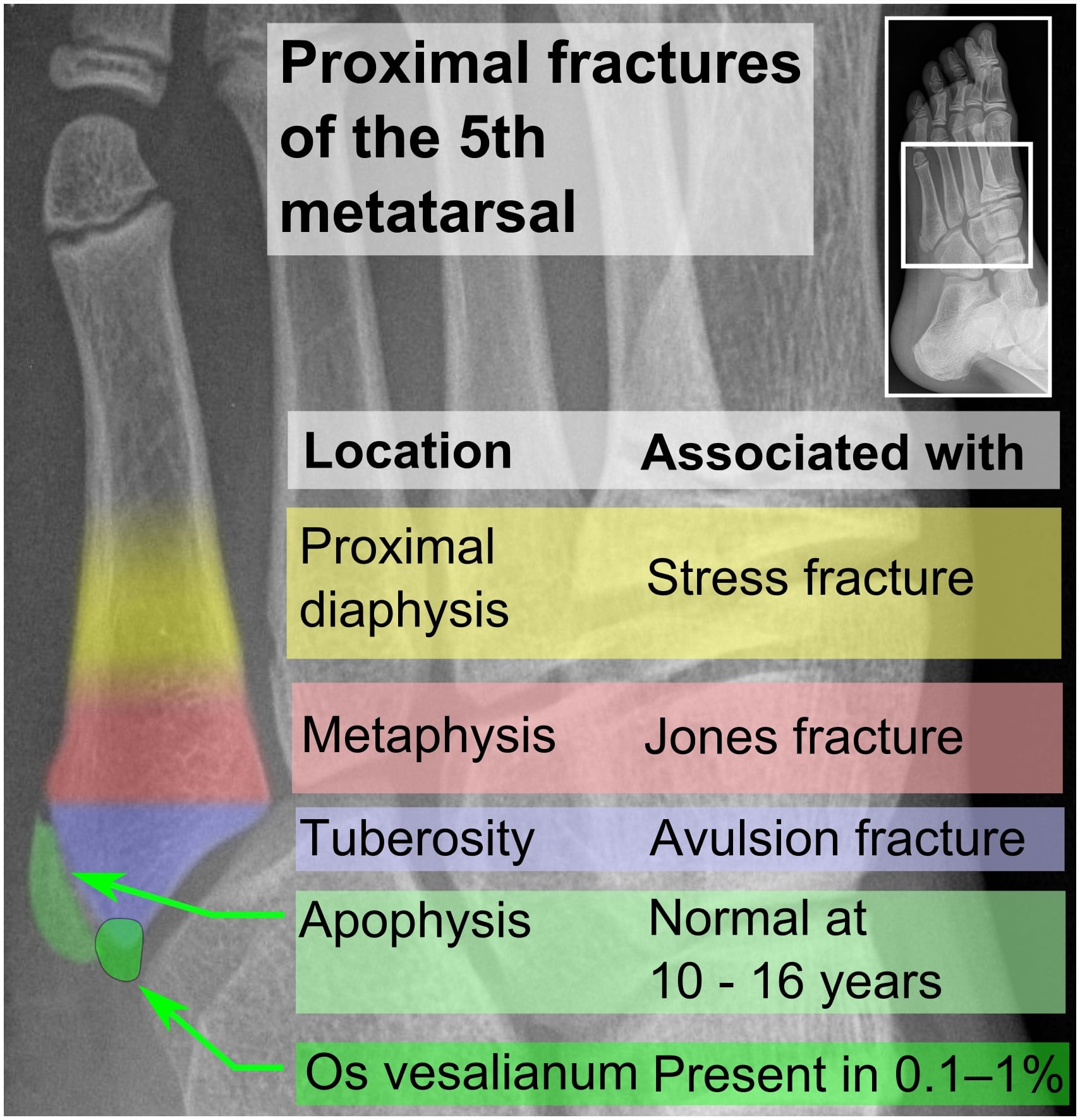
The zones of the proximal fifth metatarsal. Each part of the proximal fifth metatarsal is associated with its own injury: the proximal diaphysis with the stress fracture, the metaphysis with the Jones fracture, and the tuberosity with the avulsion (pseudo-Jones) fracture. The apophysis is a normal secondary ossification centre, and Iselin disease is symptomatic traction injury at it, which is why it sits in the differential of every painful fifth metatarsal base.
- Approx. age (years)
- 0-7
- Description
- Apophysis not yet visible on radiograph
- Clinical Relevance
- Apophysitis does not occur; pain here needs another explanation
- Approx. age (years)
- 7-8
- Description
- Secondary ossification centre becomes radiographically visible as a thin fleck parallel to the shaft
- Clinical Relevance
- Start of the vulnerable period; the fleck is easily mistaken for a fracture
- Approx. age (years)
- 9-12
- Description
- Apophysis ossifying during the growth spurt with high sport load
- Clinical Relevance
- Falls within the 8-13-year peak age of Iselin disease
- Approx. age (years)
- 10-14+
- Description
- Apophysis fuses to the metatarsal (earlier in girls than boys)
- Clinical Relevance
- Symptoms resolve as fusion completes; persistence is rare
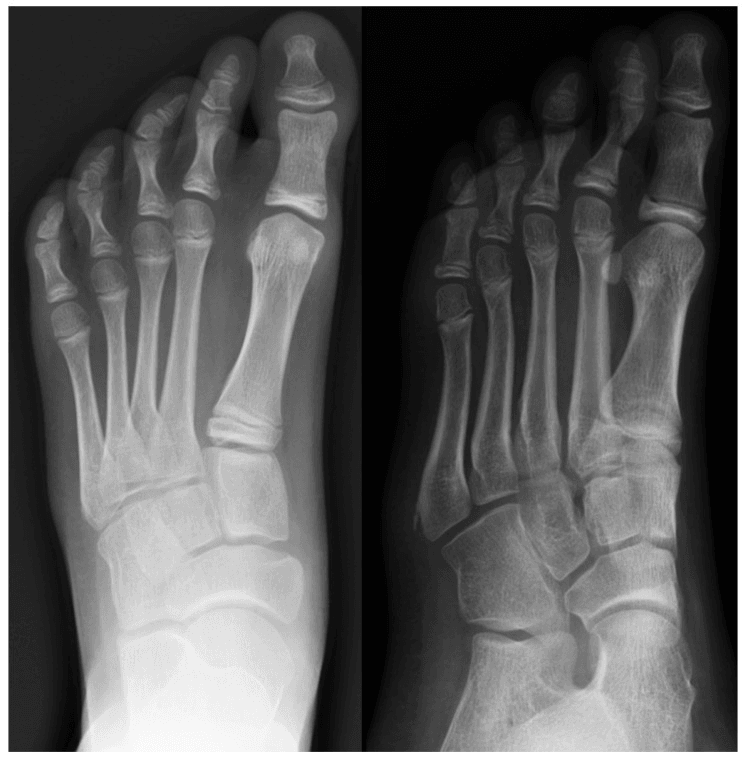
When it appears and fuses. A CT and radiographic study of an Australian paediatric population found that the apophysis begins ossifying as early as 7 years in girls and 8 years in boys, first as a thin fleck of bone that elongates into a crescent. Fusion shows marked sexual dimorphism, commencing at a mean of about 10 years in girls and 12 years in boys (DOI). That tells you whether an apophysis is expected at a given child's age; the study was not designed to evaluate diagnostic accuracy, so it cannot tell you whether a particular fleck is an apophysis or a fracture.
Why the growth spurt. Bone lengthens faster than the muscle-tendon unit can adapt, so the peroneus brevis becomes relatively tight and applies greater traction across the still-cartilaginous apophyseal plate. Repetitive sport-related loading then produces microtrauma at this junction. The cartilaginous physis between the apophysis and the metatarsal is the weak link during growth, as the tibial tubercle is in Osgood-Schlatter disease and the calcaneal apophysis in Sever disease.
What happens at the plate. Iselin disease is a repetitive microtrauma (overuse) phenomenon, not a primary inflammatory or avascular process. Cyclical tensile loading from the peroneus brevis, combined with impact and lateral-column loading, produces microscopic injury and a reparative response at the cartilaginous apophyseal plate. Any radiographic widening, sclerosis or fragmentation reflects loaded ossification rather than a destructive process, which is why imaging changes are subtle and non-specific and why the diagnosis remains clinical.
Classification and Severity
There is no universally adopted formal classification. Like the other apophysitides, Iselin disease is graded pragmatically by symptom severity and functional impact, and the grade decides how much loading to remove and for how long, not whether to operate. All grades share the same favourable endpoint at skeletal maturity.
- Symptoms
- Lateral foot pain only after sport, settles with rest, no limp
- Impact on Activity
- Completes training and play
- Treatment Emphasis
- Peroneal/calf stretching, footwear advice, continue sport
- Symptoms
- Pain during and after sport, mild limp afterwards
- Impact on Activity
- Performance and participation affected
- Treatment Emphasis
- Reduce load, relative rest, formal physiotherapy
- Symptoms
- Pain on everyday walking, persistent limp, marked tenderness/swelling
- Impact on Activity
- Unable to play sport
- Treatment Emphasis
- Short immobilisation in a boot/cast for a few weeks, then graded return
Clinical Assessment
History. The pain is lateral, over the base of the fifth metatarsal, related to activity and eased by rest, in a child of the right age and often during a growth spurt. Ask about the sport: its type and frequency, any recent increase in load, and whether it involves kicking or pivoting. A limp after sport is present in moderate-to-severe cases, and stiff or poorly cushioned boots on hard surfaces are worth noting.
Mechanism. Gradual onset suggests apophysitis; an acute twist or inversion suggests a fracture. The red flags and atypical features are:
- Acute injury with sudden onset: an avulsion or Jones fracture
- Night pain or rest pain: tumour or infection
- Fever or systemic upset: osteomyelitis or malignancy
- Marked swelling, warmth or true deformity, all atypical for apophysitis
- Failure to settle with appropriate care: reconsider the diagnosis (stress injury, non-union)
Lateral foot pain in a child is easily labelled a "sprain", but the base of the fifth metatarsal in this age group hosts a vulnerable apophysis. Persistent, point-tender, activity-related pain at the styloid - especially with normal ankle ligaments - should raise Iselin disease, an avulsion fracture or a stress injury rather than a soft-tissue sprain. Treating it as a trivial sprain risks both missing a fracture and prolonging an apophysitis.
Inspection. Watch the gait for an antalgic limp or weight-bearing on the medial border to offload the lateral foot. Compare both feet for swelling or prominence at the fifth metatarsal base, which is often subtle, and assess foot posture and footwear.
Palpation. Focal tenderness over the base of the fifth metatarsal (the styloid) is the hallmark finding, and there may be localised swelling over the apophysis. Palpate the lateral ligaments, the cuboid and along the shaft to localise the pain and screen for fracture.
Provocation. Because the peroneus brevis is the tractioning tendon, resisted eversion loads it and reproduces pain at the apophysis, and passive inversion and plantarflexion stretch it and can reproduce pain. Single-leg stance or hopping may reproduce lateral foot pain. With focal tenderness at the styloid, the right age and an activity-related history, painful resisted eversion points to Iselin disease.
The rest of the limb. Ankle and subtalar motion is usually preserved, although reduced flexibility of the peroneals and calf is common. Clear the lateral ankle ligaments and the rest of the foot, and finish with a neurovascular check.
Investigations
Iselin disease is a clinical diagnosis. Investigations are used to exclude a fracture, not to confirm apophysitis.
Radiographs. Plain films, oblique and AP, are first line: they exclude an avulsion (pseudo-Jones) or Jones fracture after an acute injury, characterise the apophysis and can identify an os vesalianum as an alternative explanation. The oblique view best profiles the apophysis. Normally it is a flake or crescent of bone lying parallel to the shaft with a smooth corticated margin, easily mistaken for a fracture. It may look slightly widened, irregular or fragmented, but these changes are non-specific and are also seen in asymptomatic children.
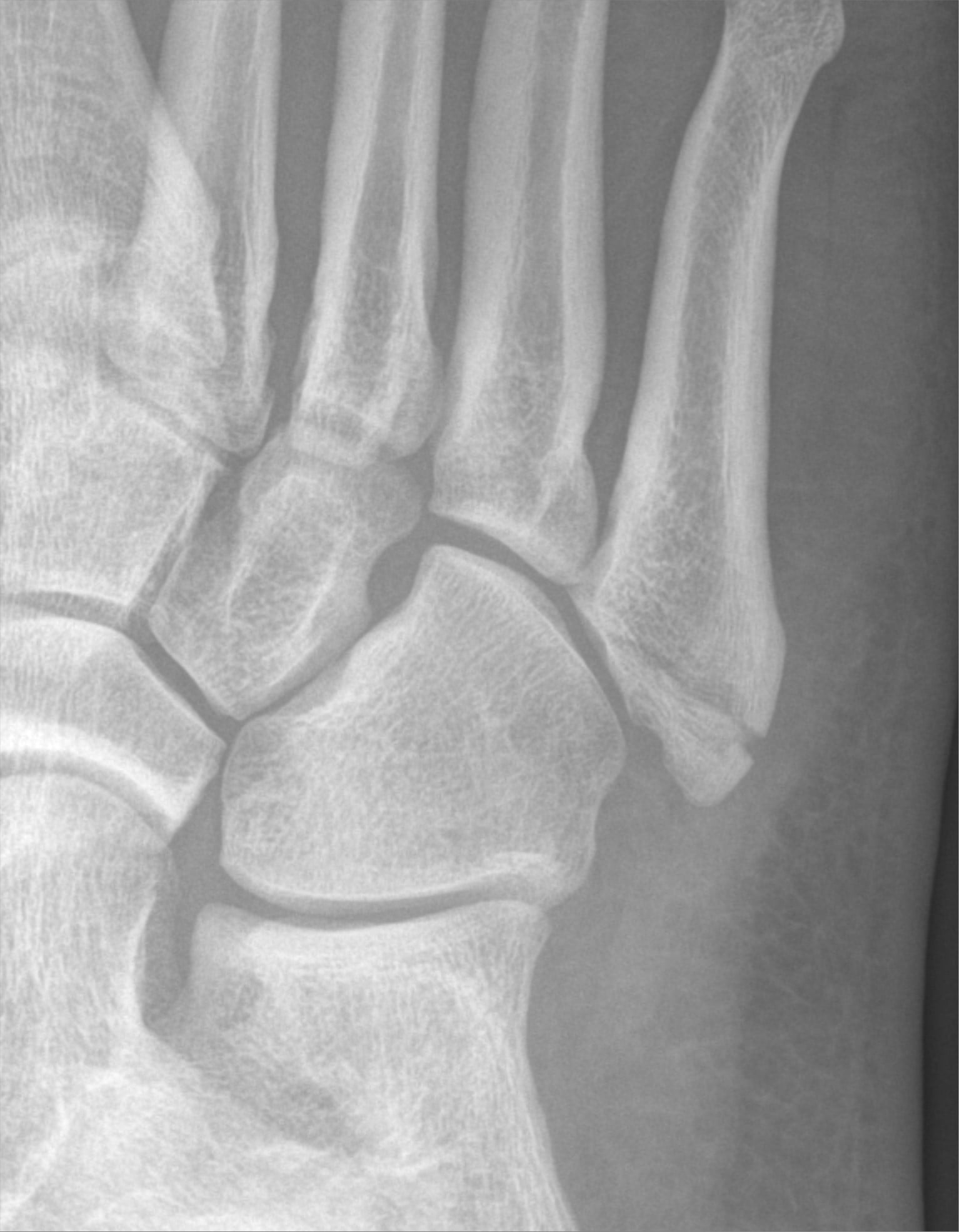
Apophysis or fracture. This is the single biggest pitfall in Iselin disease: misreading the apophysis as an acute fracture, or, just as dangerous, dismissing a genuine avulsion fracture as "just the apophysis". The most reliable discriminator on plain film is orientation.
- The normal apophysis is a flake of bone lying roughly parallel to the long axis of the shaft, separated from it by a smooth, regular lucent line (the physis), with a smooth corticated margin
- A true fracture line typically runs transverse (perpendicular) to the shaft, has sharp non-corticated edges, and is usually accompanied by a clear injury mechanism
How often it goes wrong. In a radiographic review of children who had already been given a fracture diagnosis, the diagnosis was wrong in about 47% of those in whom the normal growth nucleus was visible (DOI). Read that figure as a warning about over-calling a fracture at this site, not as a general error rate for children with foot pain.
LINELINE - Apophysis vs Fracture
Hook:Read the LINE: parallel and smooth is the apophysis; transverse and sharp is a fracture.
The comparison view. When in doubt, image the other foot. The fifth metatarsal apophysis is a normal, bilateral secondary ossification centre: a radiographic review identified the growth nucleus in 115 children across 132 feet, present bilaterally in many of them (DOI). A symmetrical apophysis on the asymptomatic side therefore argues strongly against a fracture and tells you the finding on the symptomatic side is a normal ossification centre, because an avulsion fracture is almost always unilateral and asymmetrical.
What it cannot tell you. A symmetrical pair does not exclude apophysitis. Both the apophysis and the sporting loads are bilateral, so Iselin disease can occur in both feet, and a perfectly symmetrical pair of apophyses can coexist with genuine bilateral symptoms. Contralateral films answer "is this a fracture or a normal apophysis?", not "is this child's pain apophysitis?". The diagnosis stays clinical, on focal styloid tenderness, activity-related pain and painful resisted eversion, however symmetrical the bones look, so examine both feet clinically as well as radiographically.
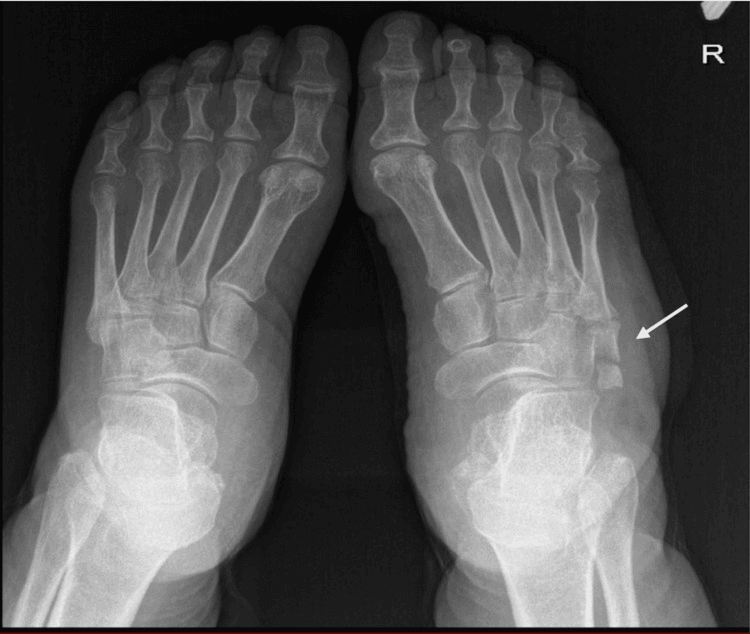
MRI. MRI shows bone marrow oedema in and around the apophysis, the most specific sign when radiographs are normal, along with occult stress injury and soft-tissue detail. It is especially valuable when radiographs are normal but the clinical picture fits, because it can demonstrate apophyseal oedema and avoid misdiagnosing a fracture (DOI). Escalate beyond plain films for:
- Normal radiographs with persistent, typical symptoms
- Diagnostic uncertainty between apophysitis, stress injury and fracture
- Atypical features: night or rest pain, systemic upset, marked swelling
- Failure to respond to appropriate conservative care
Blood tests. A full blood count, CRP and ESR are raised in infection or inflammatory arthritis, and are needed only if infection or systemic illness is suspected.
Differential Diagnosis
- Distinguishing Features
- 8-13y, gradual activity-related styloid pain, tender base, resisted eversion painful, apophysis parallel to shaft
- Key Action
- Clinical diagnosis; image to exclude fracture; conservative care
- Distinguishing Features
- Acute inversion injury, transverse fracture line at the tuberosity, sharp edges
- Key Action
- Confirm on X-ray; usually conservative (boot/cast), good union
- Distinguishing Features
- Transverse fracture at the metaphyseal-diaphyseal junction, distal to the tuberosity
- Key Action
- Higher non-union risk; consider operative fixation in athletes
- Distinguishing Features
- Insidious lateral pain, periosteal reaction distal to the base
- Key Action
- Offload; watch for non-union; sometimes fixation
- Distinguishing Features
- Accessory bone proximal to the base within peroneus brevis; smooth corticated, may be bilateral
- Key Action
- Usually incidental; rarely symptomatic - differentiate from fracture/apophysis
- Distinguishing Features
- Inversion injury, ligamentous tenderness anterior to the malleolus, base usually non-tender
- Key Action
- Examine ligaments; treat as soft-tissue injury
- Distinguishing Features
- Lateral midfoot pain, cuboid tenderness, peroneal tendon signs
- Key Action
- Clinical; targeted physiotherapy
The Jones fracture. It lies further along the bone than the avulsion fracture, at the metaphyseal-diaphyseal junction, distal to the tuberosity and well distal to the apophysis. Placing each injury in its zone along the proximal fifth metatarsal is what keeps Iselin disease, the avulsion fracture and the Jones fracture apart.
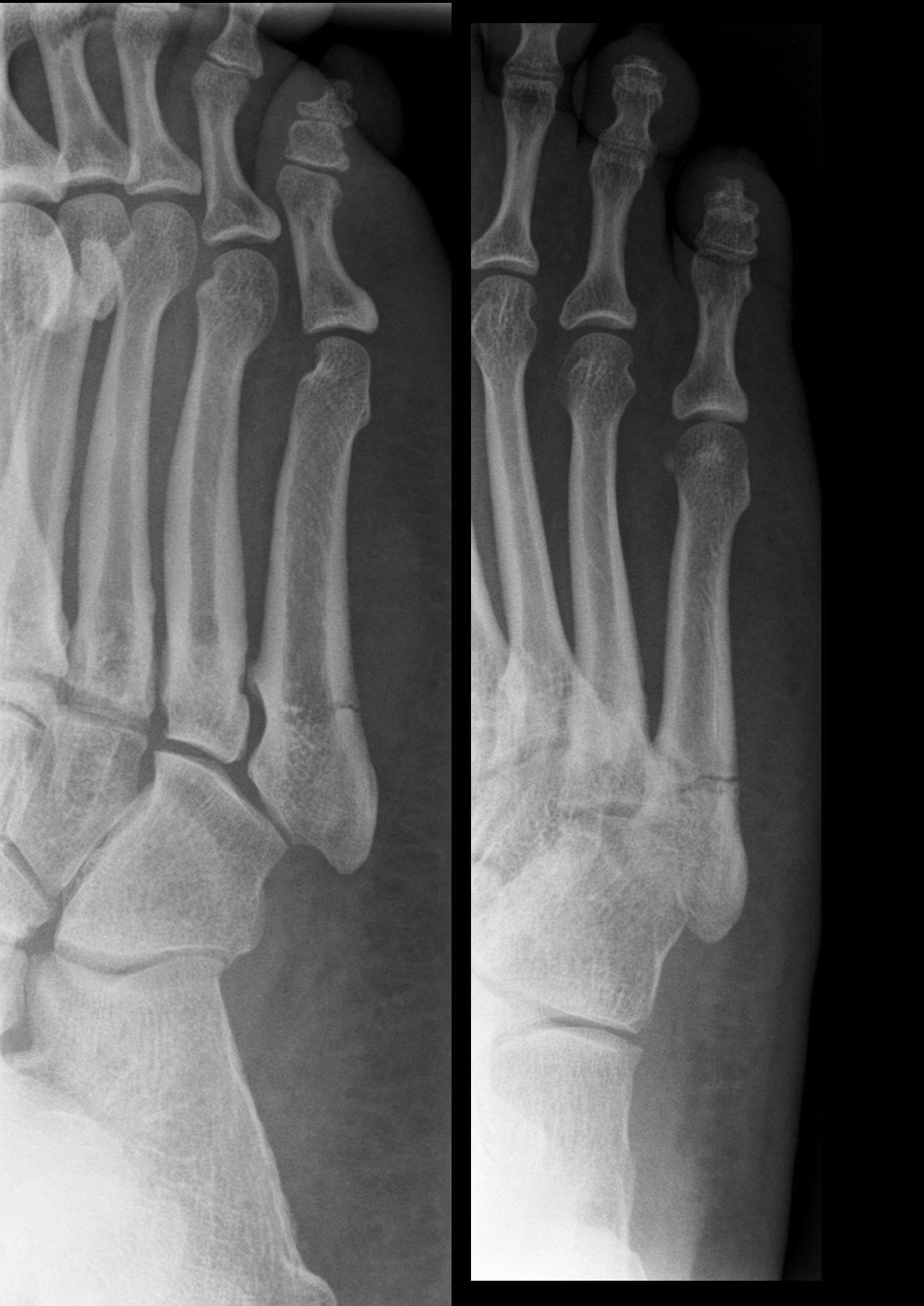
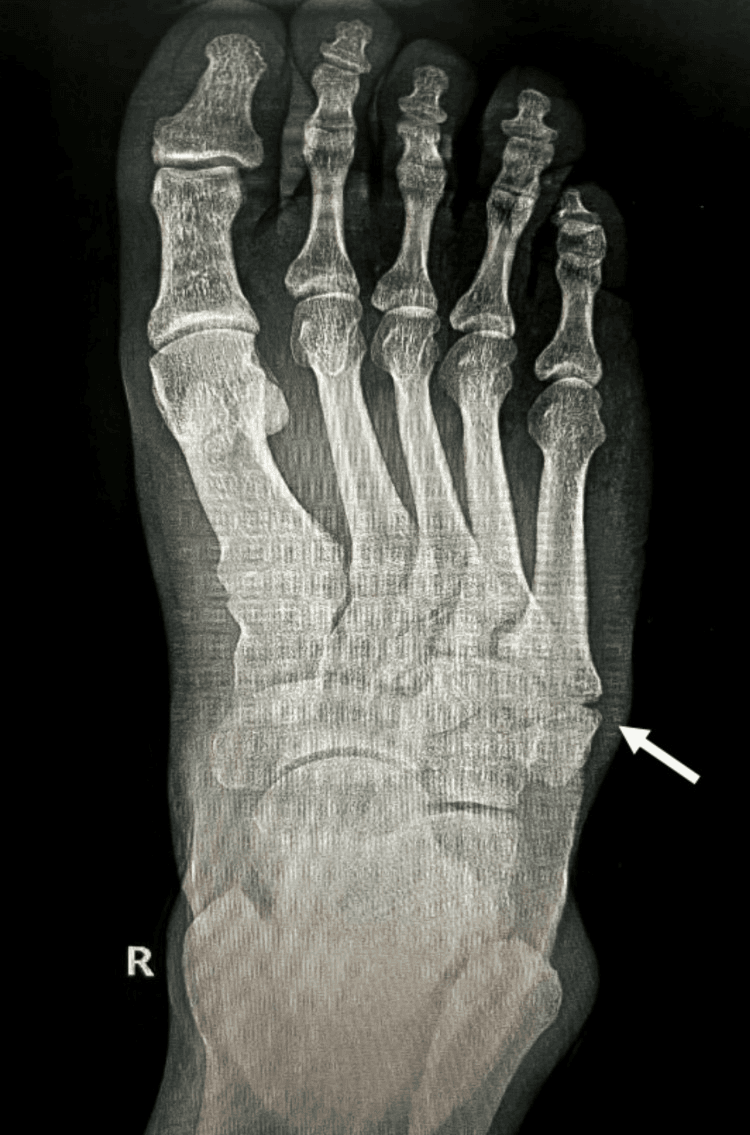
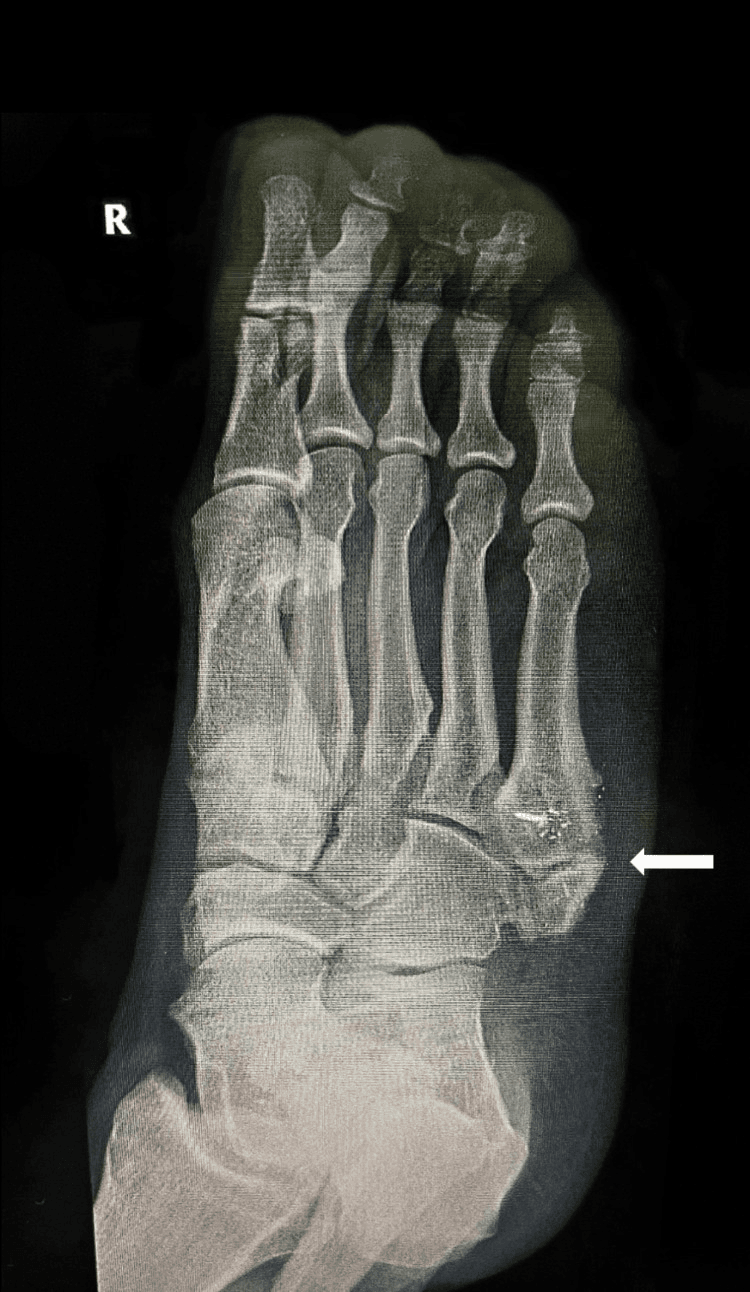
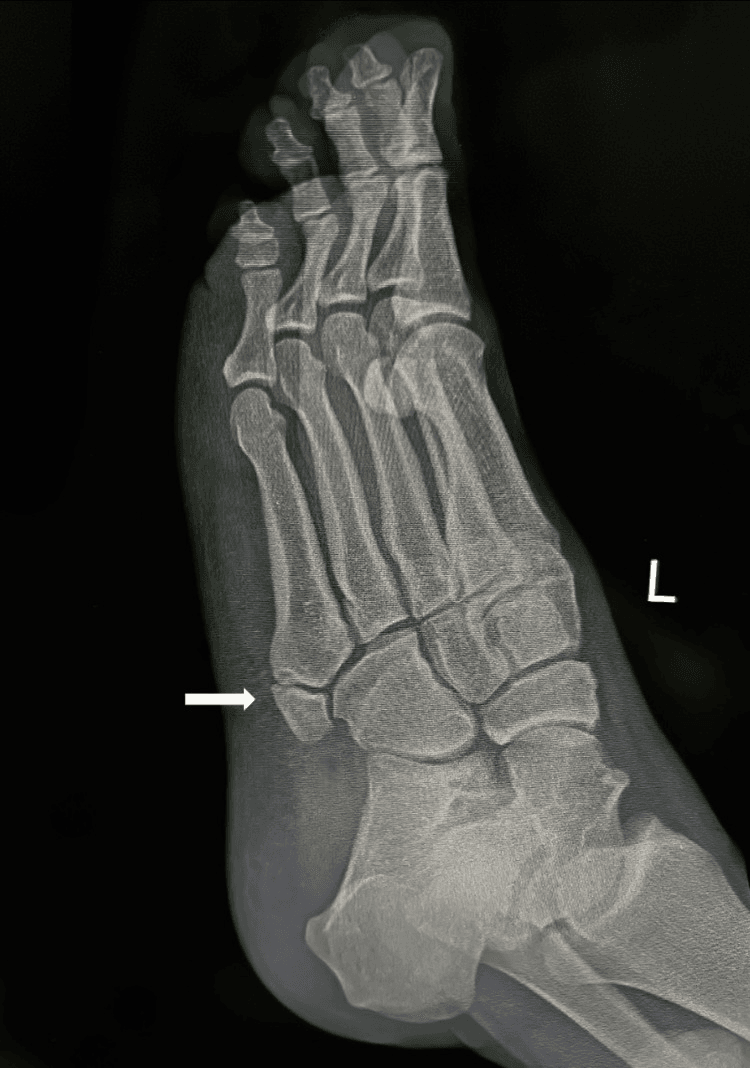
The os vesalianum. The accessory ossicle is told from an avulsion fragment by its margins and its articulations, and from the apophysis by its position. The figures below show each.
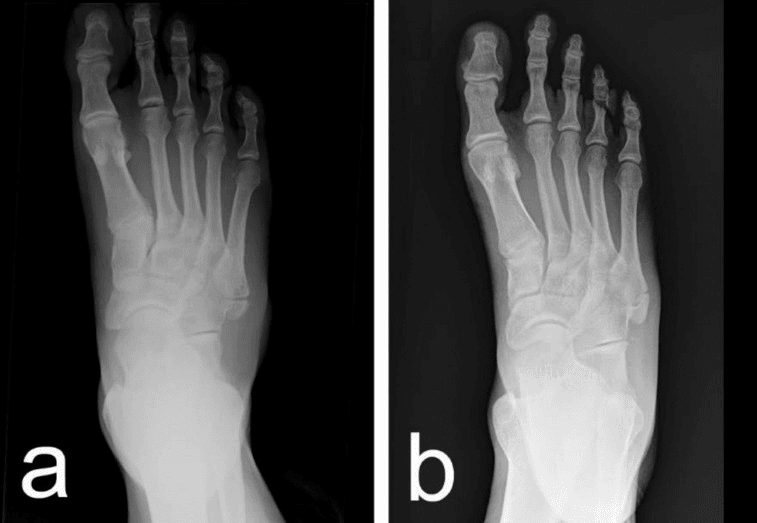
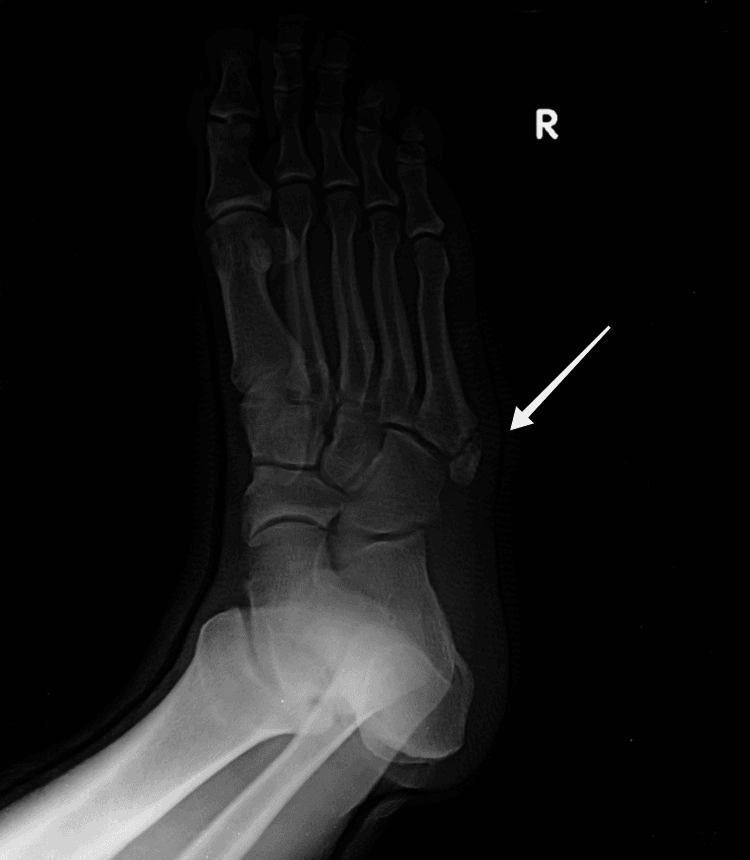
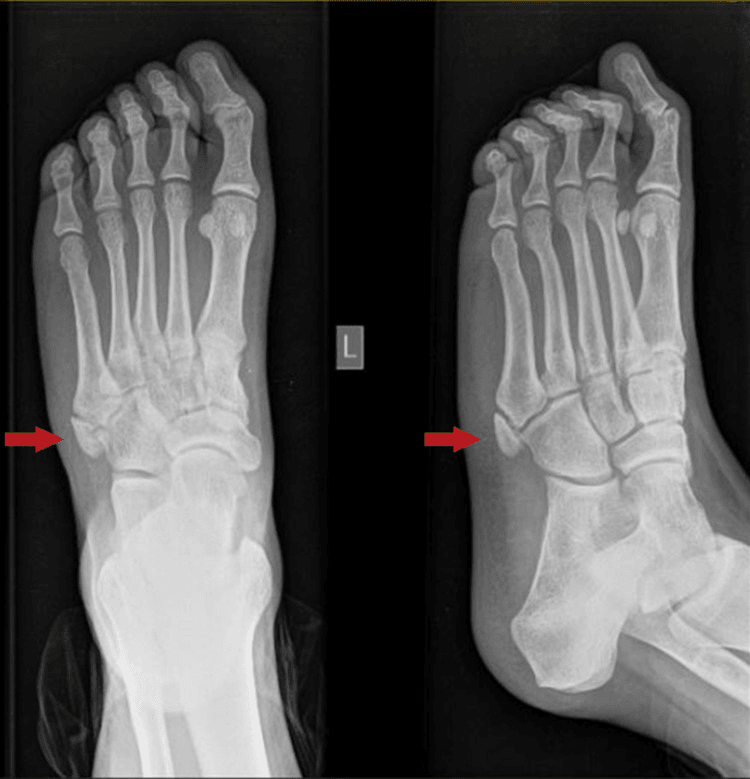
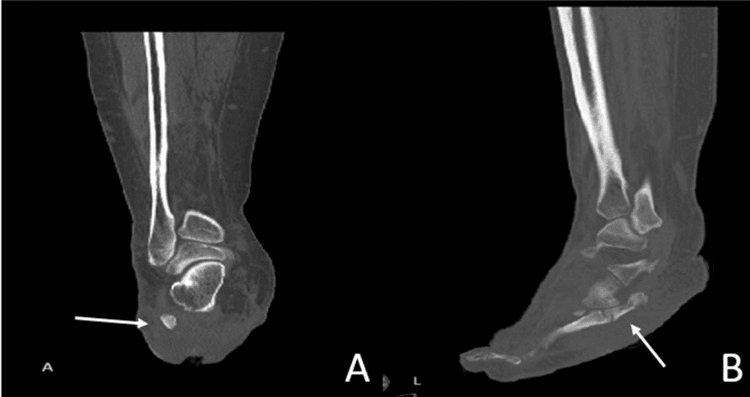
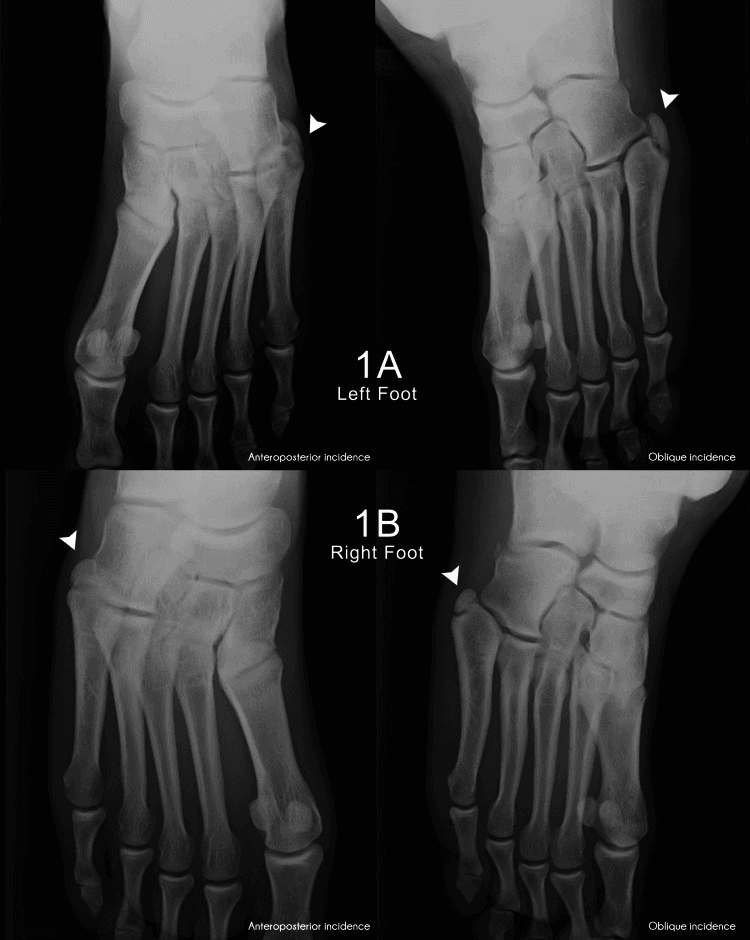
A fracture beside an os vesalianum. The last three films come from one work-up, in which a right-sided fracture of the fifth metatarsal base was found alongside bilateral os vesalianum.
Management
Management is essentially conservative, built on load management, peroneal and calf flexibility, footwear advice and reassurance. Surgery has essentially no role, and corticosteroid injection is not used.
Education and load. Explain the benign, self-limiting natural history to the child and parents. Then reduce, do not abolish, impact and pivoting sport, cutting volume and intensity to a pain-tolerable level, and substitute lower-impact cross-training such as cycling or swimming during flares. Load modification is the goal, not complete, prolonged rest. Address footwear: a supportive, cushioned shoe, not hard, worn-out footwear.
Settling flares. Ice to the lateral foot after activity, simple analgesia or a short course of NSAIDs for painful flares only, and relative rest during severe flares.
Physiotherapy is the core measure. Peroneal and gastrocnemius-soleus stretching reduces traction across the apophysis. Add foot and ankle strengthening as tolerated, including the peroneals and intrinsic muscles, address cavovarus loading and proprioception where relevant, and finish with a graded return-to-sport programme guided by symptoms and tenderness.
Immobilisation for severe or refractory cases. For severe pain or failure of simpler measures, a short period of immobilisation in a walking boot or below-knee cast for a few weeks can break the pain cycle, followed by a graded return as tenderness settles. Reported cases have settled with rest, NSAIDs and short-term restraint or immobilisation followed by graded return (DOI). If symptoms do not respond, reassess and re-image to exclude a fracture or stress injury.
Complications and Prognosis
Prognosis. Excellent. Symptoms wax and wane with activity over weeks to months while the child is still growing and active, and resolve spontaneously once the apophysis fuses around skeletal maturity. No long-term structural sequelae, deformity, growth disturbance or arthritis are described.
The main "complication". Missed time from sport and family anxiety, both mitigated by reassurance. Accurate reassurance is the most therapeutic intervention: this is a benign overuse condition of the growing fifth metatarsal base that does not cause lasting damage and reliably resolves with growth, provided a fracture and other mimics have been excluded. The clinician's job is accurate diagnosis, exclusion of a fracture, symptom control and reassurance.
Pitfalls. The central risk is misdiagnosis in either direction, a normal apophysis called a fracture or a fracture mislabelled as the apophysis. The others are of our own making: deconditioning from unnecessary prolonged rest, and overtreatment and overinvestigation of a benign condition.
Return to Sport and Graded Loading
Iselin disease is load-driven and self-limiting, so return is criterion-based, not calendar-based: progression is dictated by resolving symptoms and tenderness rather than a fixed number of weeks. There is no trial-derived protocol for this rare condition. The framework below applies the principles the management already relies on (relative rest, offloading and staged reloading), which the broader apophysitis literature endorses.
Readiness to progress. Before each step up, the child should have:
- Pain-free walking and a resolved limp
- A non-tender styloid on direct palpation of the fifth metatarsal base
- Pain-free provocation: resisted eversion and passive inversion stretch no longer reproduce pain
- Confident single-leg stance and pain-free hopping on the affected side
The single most useful gate is pain-free resisted eversion, the same peroneus brevis loading manoeuvre used to make the diagnosis. If it still reproduces styloid pain, the apophysis is not ready for sprinting, cutting or kicking.
Reintroducing load. Restore volume before intensity: training minutes and impact exposure first, then sprinting, cutting and kicking, mirroring the prevention advice. Keep up low-impact cross-training through the restricted phase to avoid deconditioning. After a boot for a severe flare, the sequence runs from protected weight-bearing to full weight-bearing, then non-impact work, impact, and sport-specific drills. Any recurrence of styloid pain or limp means stepping back a stage, and fluctuation should be expected until skeletal maturity.
Guidelines, Registries & Global Practice
Global epidemiology. Iselin disease is a worldwide condition of the skeletally immature, running and pivoting athlete and is consistently described as rare and under-recognised. There is no dedicated registry; knowledge comes from case reports, small series and a single systematic review rather than arthroplasty-style national registries. Contemporary anatomical data place the vulnerable window between the appearance of the apophysis (around 7-8 years) and its fusion (mean approximately 10 years in girls and 12 years in boys) (DOI).
Guideline landscape. No major society publishes an Iselin-specific guideline; recommendations are drawn from paediatric overuse-injury and apophysitis guidance, which is strikingly consistent across systems - the diagnosis is clinical and management is conservative, with imaging used to exclude a fracture.
- Position
- Activity modification, peroneal/calf stretching and strengthening; reassurance about the self-limiting course
- Imaging Stance
- Radiograph to exclude a fracture; comparison views useful; MRI if uncertain
- Evidence Basis
- Expert consensus and case-based evidence
- Position
- Primary-care conservative management, load modification, physiotherapy; referral for diagnostic uncertainty
- Imaging Stance
- Imaging mainly to exclude fracture after acute injury or atypical course
- Evidence Basis
- Narrative / consensus guidance
- Position
- Conservative care and family education; avoid mislabelling the normal apophysis
- Imaging Stance
- Selective imaging; emphasise contralateral comparison
- Evidence Basis
- Consensus / practice standards
- Position
- Load management, peroneal flexibility and graded return; flag prolonged or atypical courses
- Imaging Stance
- MRI selectively for normal radiographs with persistent symptoms
- Evidence Basis
- Case-based and anatomical evidence (Level 4-5)
- Position
- Training-load monitoring during growth spurts; gradual return-to-sport progression
- Imaging Stance
- Clinical diagnosis; image to exclude fracture
- Evidence Basis
- Consensus / sports guidance
The main international variation is the threshold for advanced imaging, not the core approach: management is uniformly conservative worldwide. Higher-resource and elite-sport settings reach for MRI sooner to confirm apophyseal oedema and exclude a stress injury, whereas primary-care systems keep the diagnosis clinical and rely on plain radiographs with contralateral comparison to exclude a fracture.
Medicolegal Considerations:
Key documentation points:
- History clarifying gradual overuse onset versus an acute injury
- Documentation of focal tenderness at the fifth metatarsal base and pain on resisted eversion
- Radiographic interpretation noting apophysis orientation (parallel) versus any fracture line (transverse)
- Use and documentation of contralateral comparison views where the diagnosis is uncertain
- Explicit statement that a fracture has been considered and excluded, with a plan for review if symptoms persist
Don't Miss the Fracture: Mislabelling an avulsion or Jones fracture as "Iselin disease" - or vice versa - is the recognised source of harm here. Misdiagnosis rates approaching 47% have been reported in proximal fifth metatarsal injuries in children (DOI). Document the orientation of any lucent line and the comparison views.
Prevention Strategies:
- Training-load management during growth spurts (progress volume before intensity)
- Peroneal and calf flexibility work and attention to footwear and lateral-column loading
- Awareness among coaches and parents that activity-related lateral foot pain in this age group warrants assessment rather than being dismissed as a sprain
Exam Viva Scenarios
Practise clinical reasoning and management decisions out loud
“A 12-year-old boy who plays a lot of football presents with a 4-week history of pain on the outer border of his right foot. The pain is worse during and after matches and he occasionally limps off. There was no specific injury. He is otherwise well.”
“A 13-year-old is brought to the emergency department after twisting her ankle playing netball. She has pain and swelling over the outer border of the foot. The radiograph shows a lucent line near the base of the fifth metatarsal, and the on-call doctor is unsure whether this is Iselin disease or a fracture.”
“An 11-year-old competitive dancer has clinically confirmed Iselin disease. Despite peroneal and calf stretching and activity advice over 6 weeks she still has limiting lateral foot pain and is missing classes. Her parents ask whether she needs surgery.”
Key Anatomy
- Apophysis = secondary ossification centre at the base of the fifth metatarsal
- Peroneus brevis inserts here and provides the traction (NOT peroneus longus)
- Cartilaginous physis is the weak link during growth
- Apophysis lies roughly PARALLEL to the shaft
Diagnosis
- Clinical diagnosis - focal styloid tenderness, activity-related lateral foot pain
- Pain on resisted eversion and passive inversion (loads peroneus brevis)
- Age 8-13 years, gradual overuse onset, often a young athlete
- Image to EXCLUDE a fracture; comparison views of the other foot
Apophysis vs Fracture
- Apophysis = PARALLEL to shaft, smooth corticated edge
- Fracture = TRANSVERSE to shaft, sharp non-corticated edge
- Avulsion fracture at tuberosity; Jones fracture more distal
- Comparison views resolve most cases; MRI if still unclear
Treatment
- Load MODIFICATION, not complete rest
- Peroneal and calf stretching and strengthening
- Ice and short-course NSAIDs for flares
- Short boot/cast immobilisation for severe or refractory cases
- No surgery, no injection
Differentials (NOT Iselin)
- Avulsion (pseudo-Jones) fracture - acute, transverse at tuberosity
- Jones fracture - metaphyseal-diaphyseal, higher non-union risk
- Proximal diaphyseal stress fracture
- Os vesalianum accessory bone; lateral ankle sprain
Prognosis
- Excellent - self-limiting with skeletal maturity
- No long-term deformity or arthritis
- Symptoms may fluctuate for weeks to months while growing
- Reassurance is a key part of treatment
Evidence Base
Iselin disease is rare, so the literature is dominated by case reports, small series and a single systematic review, supplemented by anatomical and imaging studies of the apophysis. Some management principles are shared with the broader paediatric apophysitis literature and labelled where relevant.
Iselin's Disease: A Systematic Review
- Systematic review of the available published data on Iselin's disease, a traction apophysitis of the fifth metatarsal base
- Predominantly affects adolescents, especially those in regular sporting activity
- Rarely reported and likely to remain undiagnosed, with frequent confusion with a fracture
- Investigation, treatment and outcomes are summarised to support diagnosis and management
Apophysitis and Osteochondrosis: Common Causes of Pain in Growing Bones
- Narrative review of apophysitis and osteochondrosis across the growing skeleton
- Lists Iselin disease (base of the fifth metatarsal) among the recognised apophysitides alongside Sever, Osgood-Schlatter and Sinding-Larsen-Johansson
- Apophysitis is an overuse traction injury, typically with tight or inflexible muscle-tendon units
- Treatment includes stretching, relative rest, offloading, icing and limited NSAID use; surgery is rarely needed