Radiological Assessment of Osteoporosis, Paget's, Hyperparathyroidism and Renal Osteodystrophy
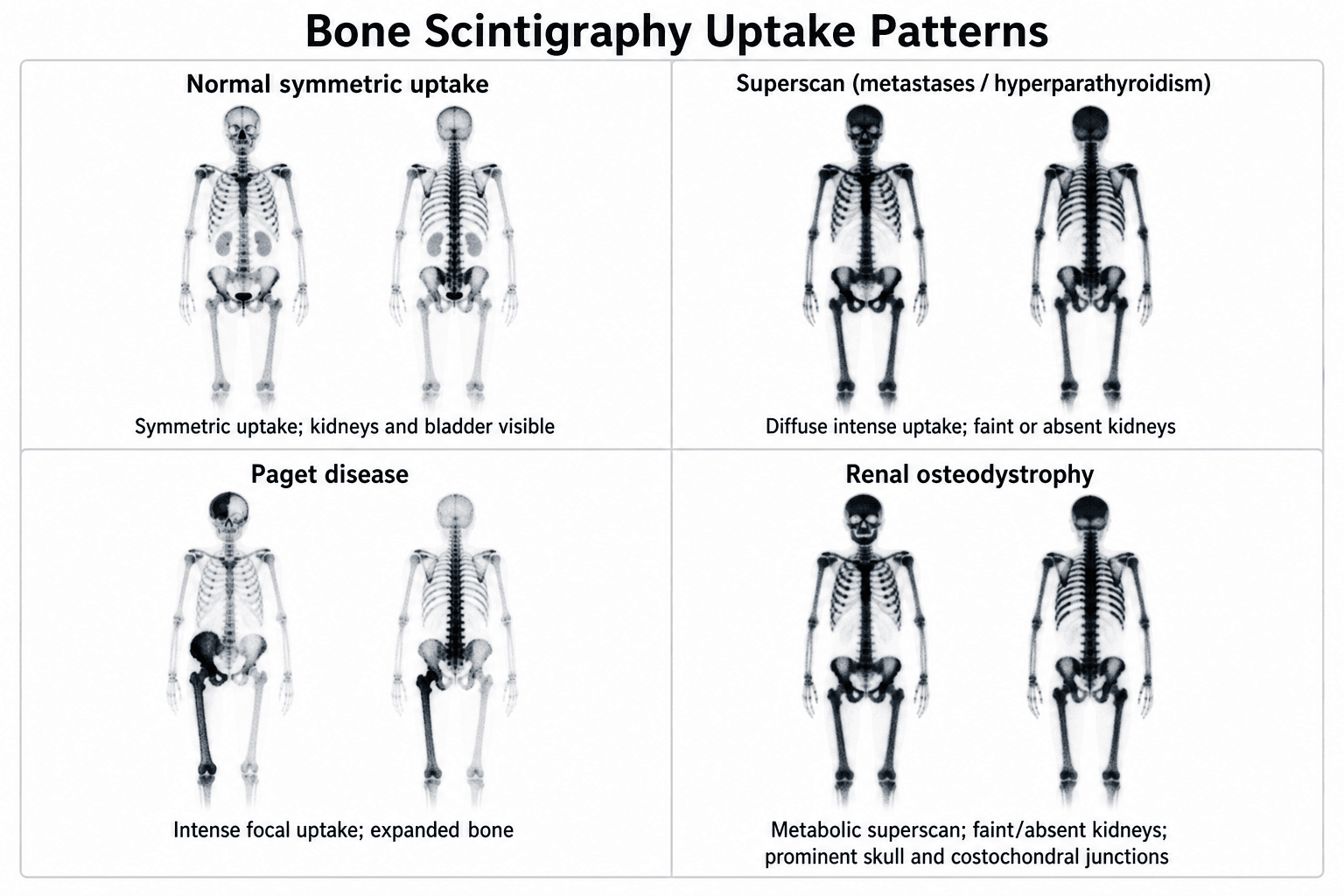
Superscan: Diffuse uptake, no kidneys (metastases or metabolic)
Paget's: Intense uptake, enlarged bone, monostotic or polyostotic
HPT: Diffuse uptake + focal brown tumours
Key: Superscan with uniform uptake favours metabolic; heterogeneous favours metastases
- Osteoporosis: Decreased density, vertebral fractures, cortical thinning
- Paget's: Enlarged bone, coarse trabeculae, mixed lytic/sclerotic
- Hyperparathyroidism: Subperiosteal resorption, brown tumours, chondrocalcinosis
- Osteomalacia: Looser zones (pseudofractures), generalised osteopenia
- Bone scan superscan in diffuse metabolic disease
- “Rugger jersey spine: Renal osteodystrophy
- “Picture frame vertebra: Paget's
- “Cotton wool skull: Paget's (lytic then sclerotic phases)
- “Salt and pepper skull: Hyperparathyroidism
- “Codfish vertebrae: Osteoporosis with biconcave fractures
Overview
Metabolic bone disease is the group of systemic disorders that disturb the normal balance of bone formation, resorption and mineralisation. Because the abnormality is metabolic rather than focal, the imaging signs are usually generalised and bilateral, with a characteristic regional accentuation that points to the specific diagnosis.
Four mechanisms. The radiologist's task is to recognise which process dominates the film:
- Quantity reduced - osteoporosis: less bone, normally mineralised
- Mineralisation defective - osteomalacia and rickets: a normal quantity of osteoid that fails to mineralise
- Resorption excessive - hyperparathyroidism: bone removed under the drive of parathyroid hormone
- Remodelling disordered - Paget's disease: bone enlarged and coarsened by disordered turnover
Chronic kidney disease gives the mixed picture. Renal osteodystrophy combines defective mineralisation, excess resorption and sclerosis, which is why its radiographs show mixed features.
Osteoporosis against osteomalacia. This is the core distinction. Osteoporosis is a reduced quantity of normally mineralised bone; osteomalacia is defective mineralisation of a normal quantity of osteoid. Both lower the density on a radiograph, but only osteomalacia produces Looser zones and coarsened, indistinct trabeculae, and the two have different biochemistry (below).
- Calcium
- Normal
- Phosphate
- Normal
- ALP
- Normal
- PTH
- Normal
- Calcium
- Low / normal
- Phosphate
- Low
- ALP
- High
- PTH
- High (secondary)
- Calcium
- High
- Phosphate
- Low
- ALP
- High
- PTH
- High
- Calcium
- Low / normal
- Phosphate
- High
- ALP
- High
- PTH
- High
- Calcium
- Normal
- Phosphate
- Normal
- ALP
- Very high (isolated)
- PTH
- Normal
Systematic Approach to the Metabolic Bone Radiograph
A disciplined search pattern converts a vague impression of low density into a specific diagnosis. Decide first whether the dominant abnormality is quantity, mineralisation, resorption or remodelling, then work through the film in a fixed order and confirm with the targeted signs and the biochemistry:
- Density - reduced (osteopenia), or increased or mixed (Paget's, sclerosis)?
- Endplates and trabeculae - coarsened and indistinct (osteomalacia) against sharp loss (osteoporosis); horizontal banding (the rugger jersey spine of renal disease)
- Notches and resorption - subperiosteal resorption along the radial phalangeal margins, acro-osteolysis (hyperparathyroidism)
- Soft tissue - vascular and periarticular calcification, chondrocalcinosis
- Insufficiency fractures and Looser zones - bilateral, symmetric, perpendicular to the cortex
- Tumours - brown tumours (hyperparathyroidism), sarcomatous change in Paget's
- Biochemistry - always correlate with calcium, phosphate, ALP, PTH and vitamin D
- Highest-Yield Radiograph
- Hands (PA), distal clavicles
- Looking For
- Subperiosteal resorption on radial phalangeal margins, acro-osteolysis
- Highest-Yield Radiograph
- Pelvis, proximal femora, scapulae, ribs
- Looking For
- Looser zones (bilateral, perpendicular lucent bands)
- Highest-Yield Radiograph
- Lateral thoracolumbar spine + DXA
- Looking For
- Vertebral fractures (Genant grade), low BMD
- Highest-Yield Radiograph
- Affected long bone, skull, pelvis
- Looking For
- Bone enlargement, coarse trabeculae, blade-of-grass front
- Highest-Yield Radiograph
- Hands, lateral spine
- Looking For
- Subperiosteal resorption, rugger jersey spine, soft-tissue calcification
Distribution is the key discriminator. Metabolic disease is generalised and bilaterally symmetric, and that is what separates it from focal pathology: metastasis, primary tumour, infection. When a "metabolic" sign is unilateral or focal, reconsider the diagnosis. A solitary lytic lesion is more likely a metastasis than a brown tumour unless the biochemistry confirms hyperparathyroidism.
Osteoporosis
- Description
- Decreased bone density, increased lucency
- Location
- Diffuse
- Description
- Thin cortices, endosteal scalloping
- Location
- Long bones
- Description
- Loss of horizontal trabeculae, vertical streaking
- Location
- Vertebrae
- Description
- Wedge, biconcave, or crush morphology
- Location
- Spine
- Description
- Loss of trabecular groups in proximal femur
- Location
- Hip
Vertebral fracture morphology. Three shapes, recorded alongside the grade and compared with the adjacent vertebrae:
- Wedge - anterior height loss greater than posterior
- Biconcave (codfish) - endplate depression, with loss of middle height
- Crush (compression) - diffuse height loss
A deformity is called a fracture at greater than 20% height loss, or greater than 4mm absolute loss.
- Approximate height loss
- Normal
- Reporting
- No deformity
- Approximate height loss
- 20-25%
- Reporting
- The threshold at which deformity becomes a fracture — below this, do not call it one
- Approximate height loss
- 25-40%
- Reporting
- Unambiguous fracture
- Approximate height loss
- Over 40%
- Reporting
- Severe fracture; strongest predictor of further fracture
- Approximate height loss
- Wedge / biconcave / crush
- Reporting
- Recorded alongside grade — it does not change the grade
Grading in the viva. It is not enough to say "Genant grade". Grade by approximate height loss against the adjacent vertebrae and state the morphology separately. The method is visual and semiquantitative by design, which keeps it fast and reproducible, but it retains interobserver variability and it establishes that a deformity is fracture-shaped, not what caused it. Malignancy, Scheuermann's and congenital deformity all deform vertebrae; grading does not exclude them.
Measuring density. Quantitative loss is measured by DXA and never estimated from a radiograph. Approximately 30-40% of bone mineral must be lost before osteopenia is reliably perceptible on plain film, and the impression is heavily influenced by exposure factors.
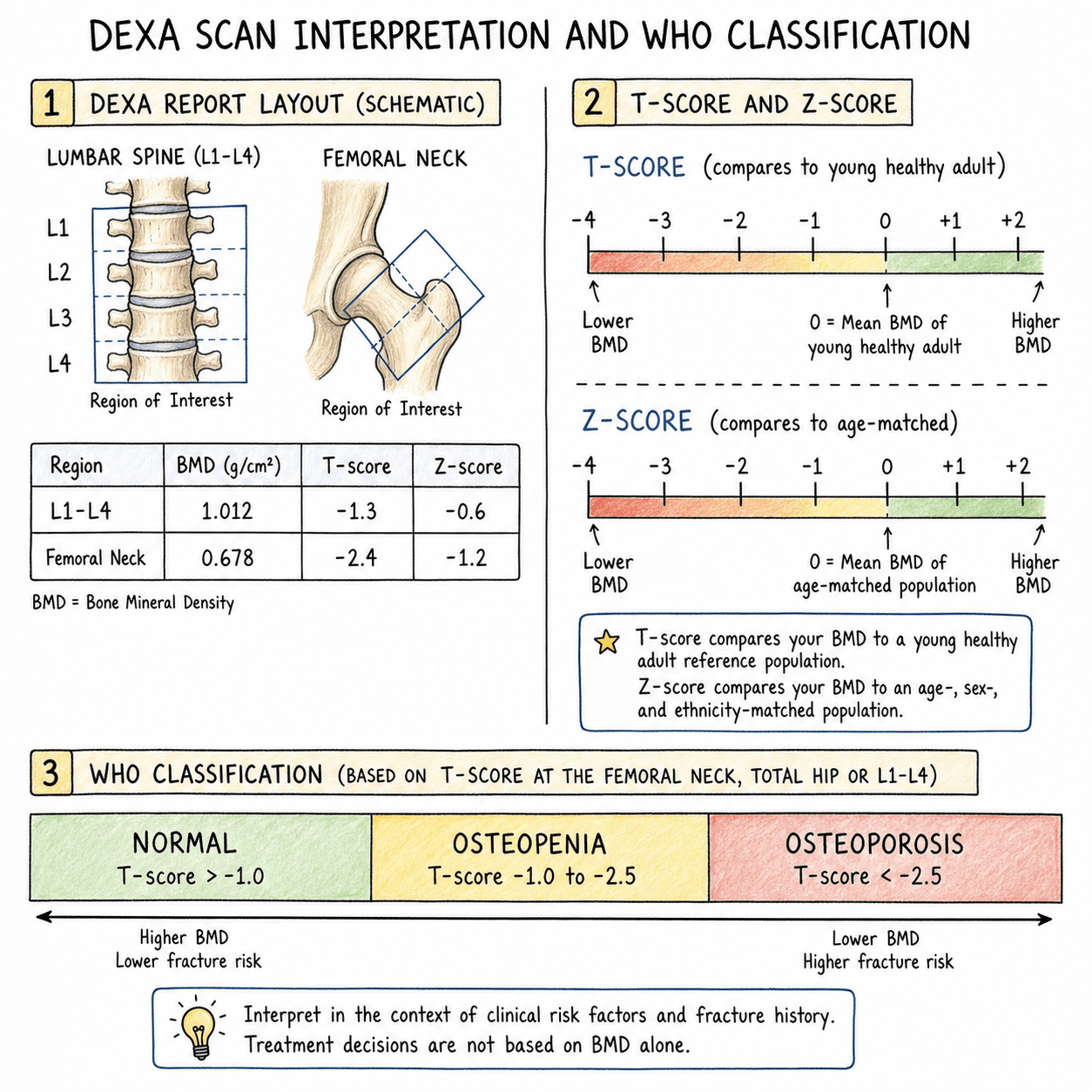
Most people who fracture do not have osteoporosis by T-score. This is the single most counter-intuitive fact in bone densitometry, and it is the reason management moved on. The WHO definition, a T-score at or below -2.5, is a diagnostic threshold, not a risk model. Far more people sit in the osteopenic range than below it, so the majority of low-trauma fractures arise in people who would never be labelled osteoporotic on DXA alone. The converse also holds: a young person with an osteoporotic-range T-score and no other risk factors fractures relatively rarely.
DXA gives a gradient, not a cut-off. Fracture risk approximately doubles for every one standard deviation fall in bone density in untreated postmenopausal women. The T-score is a continuous risk variable that happens to have a diagnostic line drawn through it, which is why a T-score of -2.4 is not meaningfully safer than -2.6.
FRAX exists to fix this. It integrates age, BMI, prior fracture, parental hip fracture, glucocorticoids, rheumatoid arthritis, smoking and alcohol, with or without femoral neck BMD, and outputs an absolute 10-year probability of hip and major osteoporotic fracture. The spread it produces is enormous: 10-year hip fracture probability in women ranges roughly 100-fold, from about 0.2% at age 50 with no risk factors to about 22% at age 80 with a parental hip fracture. Absolute probability, not T-score alone, drives intervention thresholds in AAOS, NOGG and most national guidance.
FRAX has blind spots. It does not capture fall risk, glucocorticoid dose, the number or recency of prior fractures, or lumbar spine BMD, and it is calibrated to country-specific epidemiology, so outputs are not interchangeable between populations.
Insufficiency fractures. The common sites are the sacrum, where the pattern is H-shaped, the pubic rami and the proximal femur. The radiograph may be normal initially, and sacral fractures are often missed on it; MRI or bone scan is sensitive for detection.
The Singh index grades the trabecular pattern of the proximal femur from 1 to 6. Grade 6 has all trabecular groups visible; grades 1-3 indicate significant osteoporosis. It has largely been replaced by DXA but may appear in vivas.
Paget's Disease
Paget's disease is disordered remodelling, and its signature is bone that is enlarged, with coarse trabeculae, a thickened cortex and a mixed lytic and sclerotic texture. Enlargement is the feature that separates it from a sclerotic metastasis, which does not enlarge the bone. The appearance changes with the phase, and the lytic front, the mixed phase and the late sclerosis each have their own signs.
- Pathophysiology
- Osteoclast predominance
- X-ray Appearance
- V-shaped lytic lesion (blade of grass), osteoporosis circumscripta (skull)
- Pathophysiology
- Osteoclast and osteoblast activity
- X-ray Appearance
- Coarse trabeculae, bone enlargement, cortical thickening
- Pathophysiology
- Osteoblast predominance
- X-ray Appearance
- Dense sclerotic bone, ivory vertebra, cotton wool skull
Why pagetic bone bows, then breaks transversely. Pagetic bone is not simply thicker bone. Its mineralisation is lower and heterogeneous, and its tissue age is younger, because accelerated turnover keeps replacing it with immature woven bone that never fully matures. Two mechanical consequences follow, and both are visible on the radiograph. Resistance to plastic deformation is reduced, so the bone deforms progressively under load rather than springing back; that is the bowing. And the crack path through it is straighter than through normal lamellar bone, so the fracture runs transversely across the convex cortex as the classic banana or chalk-stick fracture instead of spiralling.
Why that matters to the surgeon. Non-union of femoral fractures in Paget's is not uncommon, so these deformities are not cosmetic: they predict both the fracture pattern and the difficulty of achieving union, and they should shape the fixation decision from the outset. Bowing also means an intramedullary device may not pass without a corrective osteotomy, and the hypervascular active phase increases intra-operative bleeding.
Sarcomatous transformation is rare, at less than 1%, but important. It presents as new pain, rapid enlargement or lytic destruction in previously stable Paget's, so suspect it whenever new aggressive features develop. Osteosarcoma is the most common, with fibrosarcoma and chondrosarcoma also seen, and the prognosis is poor.
The bone scan. Affected bones take up tracer intensely, and the extent of uptake matches the affected bone, the entire bone being involved. The scan is positive before radiographic change in early disease, and is useful for assessing polyostotic disease and monitoring the response to treatment.
Hyperparathyroidism
- Description
- Lacy, irregular periosteal margin
- Location
- Radial aspect of middle phalanges (classic)
- Description
- Resorption of terminal tufts
- Location
- Distal phalanges
- Description
- Well-defined lytic lesions
- Location
- Mandible, pelvis, femur, ribs
- Description
- Calcification in cartilage
- Location
- Knee menisci, TFCC, pubic symphysis
- Description
- Diffuse granular demineralisation
- Location
- Skull vault
- Description
- Sclerotic endplates, lucent centre
- Location
- More common in renal osteodystrophy
Where resorption shows. Subperiosteal resorption is the hallmark, and the radial aspect of the middle phalanges is its most specific site: resorption along the radial aspect of the 2nd and 3rd middle phalanges is virtually pathognomonic of hyperparathyroidism. The other classic sites:
- Distal clavicle (acromioclavicular joint)
- Sacroiliac joint, producing pseudo-widening
- Symphysis pubis
- Teeth, as resorption of the lamina dura
If you may order one film, order the hand. When whole-body radiographs were taken in 73 haemodialysis patients with severe secondary hyperparathyroidism, subperiosteal resorption was the commonest abnormality by a wide margin, present at the phalanges and distal clavicles in 94%. Ectopic and vascular calcification followed at 80%, brown tumours at 37%, and rugger jersey spine at only 27%, which is worth holding onto, because rugger jersey spine is taught as a classic and is in fact the least frequent of the four. The highest-yield films were the hands, wrists, lateral thoracolumbar spine and femurs, in that order.
Read those percentages against the population they came from. Every patient in that series had severe, dialysis-dependent secondary disease and was being referred for parathyroidectomy, the extreme end of the spectrum. The frequencies are therefore a ceiling, not what to expect in mild secondary or in primary hyperparathyroidism, where the skeleton is now usually radiographically normal because biochemical screening detects the disease long before bone disease develops. A normal hand radiograph does not exclude primary hyperparathyroidism; it is the biochemistry that makes that diagnosis.
Brown tumours are not true neoplasms but focal accumulations of osteoclasts with haemorrhage. They are lytic and well defined, may be expansile, and resolve or ossify once the hyperparathyroidism is treated. Multiple brown tumours mark severe or prolonged disease.
Primary, secondary and tertiary. Primary hyperparathyroidism, from a parathyroid adenoma, usually produces less severe bone changes. Secondary disease, from chronic renal failure, produces more prominent changes, the rugger jersey spine among them. Tertiary hyperparathyroidism is autonomous PTH secretion after prolonged secondary disease.
Osteomalacia and Rickets
- Description
- Lucent bands perpendicular to cortex, bilateral, symmetric
- Significance
- PATHOGNOMONIC
- Description
- Decreased bone density
- Significance
- Non-specific
- Description
- Fuzzy, indistinct trabeculae
- Significance
- Unmineralised osteoid
- Description
- Codfish vertebrae
- Significance
- Softened bone
- Description
- Protrusio, triradiate pelvis
- Significance
- Severe disease
Looser zones are pathognomonic for osteomalacia. They are bilateral, symmetric lucencies perpendicular to the cortex, representing unmineralised osteoid at sites of stress, and they sit at the medial femoral neck, the pubic rami, the lateral scapular border and the ribs. Left untreated, they complete into true fractures.
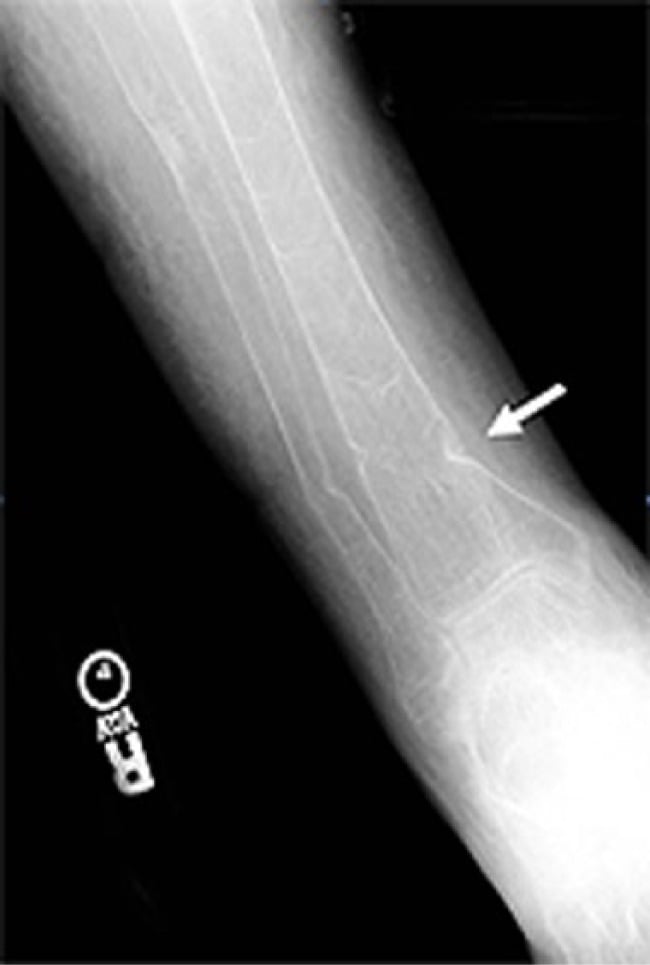
Rickets is the paediatric form of the same mineralisation defect, and the wrist and knee show its changes most obviously.
- Description
- Concave metaphyseal margin
- Location
- Wrist, knee (most obvious)
- Description
- Irregular, brush-like margin
- Location
- Growth plates
- Description
- Increased physeal width
- Location
- Active growth plates
- Description
- Enlarged costochondral junctions
- Location
- Anterior ribs
- Description
- Genu varum or valgum
- Location
- Lower limbs
Renal Osteodystrophy
Renal osteodystrophy is the bone disease of chronic renal failure, and it is a combination rather than a single process: secondary hyperparathyroidism, the most prominent component, osteomalacia from vitamin D deficiency, osteosclerosis and soft tissue calcification. The combination is what produces its characteristic findings, the rugger jersey spine among them.
- Cause
- Sclerotic endplates, lucent centre
- Appearance
- Horizontal banding like rugby jersey
- Cause
- Secondary HPT
- Appearance
- As in primary HPT
- Cause
- High calcium-phosphate product
- Appearance
- Vascular, periarticular
- Cause
- Secondary HPT
- Appearance
- Lytic lesions
- Cause
- Dialysis-related
- Appearance
- Bone cysts, erosions
Osteopetrosis (Marble Bone Disease)
Osteopetrosis is the sclerosing bone disorder that must be excluded whenever dense vertebral endplate bands raise the question of rugger jersey spine. It is caused by failure of osteoclast-mediated resorption, most often a defect in the osteoclast proton pump or chloride channel that stops the cell acidifying the resorption lacuna, so bone that has been laid down is never taken away.
Dense bone that breaks easily is not a paradox once you know why. Bone strength depends on remodelling, not on mineral content alone. Normal osteoclasts continuously remove fatigue-damaged bone so that osteoblasts can replace it; they also carve the marrow cavity and sculpt the metaphyseal flare. When resorption fails, three things follow directly, and each is visible on the radiograph:
- Microdamage accumulates and is never repaired, so the bone is dense but structurally exhausted and snaps transversely, like chalk
- The primary spongiosa, calcified cartilage from the growth plate, is never converted into mature lamellar bone, leaving a brittle mineralised scaffold instead of load-bearing trabeculae
- The marrow cavity is progressively obliterated, which is why the severe infantile forms present with pancytopenia and extramedullary haematopoiesis rather than with fractures at all
- Description
- Generalised dense bone with loss of corticomedullary differentiation
- Note
- Symmetric — the hallmark
- Description
- Sharply defined, very dense sclerotic endplate bands
- Note
- Distinguish from the INDISTINCT rugger jersey spine of renal osteodystrophy
- Description
- A miniature bone within the bone
- Note
- Vertebrae, pelvis, phalanges, carpals/tarsals
- Description
- Undertubulated, flared metaphyses
- Note
- From defective metaphyseal remodelling
- Description
- Dense bone that fractures like brittle chalk
- Note
- Brittle despite the high density
Infantile and adult forms. The infantile autosomal recessive form is severe: the marrow obliteration brings hepatosplenomegaly with the extramedullary haematopoiesis, foraminal narrowing compresses the cranial nerves (optic, facial), and it is often fatal in childhood without haematopoietic stem cell transplant. The adult autosomal dominant form (Albers-Schonberg disease) is mild, frequently incidental, and presents with fractures and the classic radiographic signs. A carbonic anhydrase II deficiency subtype combines osteopetrosis with renal tubular acidosis and cerebral calcification.
The surgical problem. Osteopetrotic bone fractures transversely after minor trauma, and union and surgical fixation are difficult: the bone blunts drills and reamers and heals slowly. Osteomyelitis, classically of the mandible, is a recognised complication because the sclerotic bone is poorly vascularised.
Bone Scan Patterns
- Pattern
- Diffuse uptake, no kidneys
- Key Features
- Uniform, symmetric, all bones
- Pattern
- Diffuse uptake, no kidneys
- Key Features
- Heterogeneous, asymmetric foci
- Pattern
- Intense focal uptake
- Key Features
- Enlarged bone, entire bone involved
- Pattern
- Diffuse + focal
- Key Features
- Brown tumours show focal uptake
- Pattern
- Pseudofractures show uptake
- Key Features
- Looser zone sites positive
Telling the superscans apart. Both metastases and metabolic disease can produce a superscan, diffuse skeletal uptake with absent kidneys. Metabolic uptake is uniform and symmetric throughout the skeleton; metastatic uptake is heterogeneous and patchy, with hot spots. Two further clues: an axial predominance favours metastases, and the specific radiographic signs favour metabolic disease.
Differential Diagnosis
The classic radiographic signs of metabolic bone disease overlap with focal pathology. The decisive discriminators are distribution (generalised and symmetric against focal), the accompanying biochemistry, and whether the affected bone is enlarged.
- Metabolic Cause
- Osteoporosis / osteomalacia
- Mimic to Exclude
- Diffuse marrow infiltration (myeloma, leukaemia)
- Discriminating Feature
- Osteomalacia has coarse trabeculae + Looser zones; myeloma shows punched-out lytic lesions and a paraprotein
- Metabolic Cause
- Brown tumour (HPT)
- Mimic to Exclude
- Metastasis, plasmacytoma, GCT
- Discriminating Feature
- Brown tumour only in proven hyperparathyroidism; check calcium and PTH
- Metabolic Cause
- Paget's disease
- Mimic to Exclude
- Sclerotic (blastic) metastasis
- Discriminating Feature
- Paget's ENLARGES bone and coarsens trabeculae; metastasis does not enlarge bone
- Metabolic Cause
- Metabolic / renal osteodystrophy
- Mimic to Exclude
- Diffuse osteoblastic metastases
- Discriminating Feature
- Metabolic uptake is uniform and symmetric; metastatic is heterogeneous and patchy
- Metabolic Cause
- Looser zone (osteomalacia)
- Mimic to Exclude
- Stress/fatigue fracture
- Discriminating Feature
- Looser zones are bilateral, symmetric, on the concave/medial side; stress fractures are unilateral and at typical sport-related sites
- Metabolic Cause
- Rugger jersey spine (renal)
- Mimic to Exclude
- Osteopetrosis (sandwich vertebra)
- Discriminating Feature
- Renal banding is indistinct; osteopetrosis bands are sharply defined and very dense
Guidelines, Registries & Global Practice
Metabolic bone disease is diagnosed and managed worldwide; imaging interpretation is universal, but access to DXA, scintigraphy and biochemistry varies markedly by resource setting.
- Epidemiology
- Most common metabolic bone disease; lifetime fragility-fracture risk roughly 1 in 2 women and 1 in 5 men over 50
- Imaging-Relevant Point
- DXA-defined; FRAX adds clinical risk factors
- Epidemiology
- Estimated 0.4-1% of adults, rising after age 55; marked geographic and declining temporal variation
- Imaging-Relevant Point
- Often incidental on CT/radiographs (Husseini 2023)
- Epidemiology
- Re-emerging with vitamin D deficiency, malabsorption and limited sun exposure; major burden in some low-resource regions
- Imaging-Relevant Point
- Looser zones and metaphyseal change are diagnostic clues
- Epidemiology
- Affects most patients with advanced CKD on dialysis
- Imaging-Relevant Point
- Hand radiographs highest yield (Lacativa 2009)
- Scope
- Osteoporosis definition
- Imaging-Relevant Position
- T-score at or below -2.5 by central DXA defines osteoporosis; -1 to -2.5 osteopenia
- Scope
- Fragility fracture / osteoporosis care
- Imaging-Relevant Position
- Endorses DXA plus fracture-risk assessment and secondary-fracture prevention after fragility fracture
- Scope
- Fracture risk assessment
- Imaging-Relevant Position
- FRAX-based intervention thresholds; DXA where FRAX indicates; vertebral fracture assessment encouraged
- Scope
- Paget's disease
- Imaging-Relevant Position
- Plain radiographs for diagnosis, radionuclide bone scan to map extent, ALP to monitor; treat symptomatic disease
- Scope
- CKD-mineral and bone disorder
- Imaging-Relevant Position
- Cautions against relying on plain radiographs alone; biochemistry and selective imaging guide CKD-MBD diagnosis
Clinical Imaging
No single modality answers every question in metabolic bone disease. The modalities are complementary, and each has a defined role.
- Primary Role
- Pattern recognition of qualitative signs
- Strengths / Limitations
- Shows Looser zones, subperiosteal resorption, Paget's architecture; insensitive to early density loss
- Primary Role
- Quantify bone mineral density (T-score)
- Strengths / Limitations
- Reference standard for osteoporosis diagnosis; cannot show qualitative signs or assess mineralisation
- Primary Role
- Whole-skeleton survey of turnover
- Strengths / Limitations
- Maps Paget's extent, Looser zones, brown tumours; superscan in diffuse disease; non-specific
- Primary Role
- Cortical detail, fracture and deformity
- Strengths / Limitations
- Defines Paget's cortical thickening, vertebral fractures, brown tumours; higher dose
- Primary Role
- Marrow and occult/insufficiency fractures
- Strengths / Limitations
- Sensitive for sacral and vertebral insufficiency fractures invisible on radiographs
Sequencing in practice. A symptomatic patient with suspected metabolic bone disease is typically assessed with targeted radiographs and biochemistry: the hands for hyperparathyroidism, the pelvis and femora for Looser zones, the spine for fractures and Paget's. DXA quantifies osteoporosis. A bone scan maps polyostotic Paget's or investigates unexplained skeletal pain, and MRI is reserved for radiographically occult insufficiency fractures and for excluding malignancy in an indeterminate lytic lesion.
Clinical Decision Scenarios
Practise clinical reasoning and management decisions out loud
“A 70-year-old man presents with a painful, bowed tibia. X-ray shows an enlarged bone with coarse trabeculae, cortical thickening, and mixed lytic and sclerotic areas.”
“A patient with chronic kidney disease has hand X-rays showing irregular erosions along the radial aspect of the middle phalanges and loss of the lamina dura around teeth.”
“A 45-year-old woman with coeliac disease presents with bone pain. X-rays show generalised osteopenia and bilateral symmetric lucent bands perpendicular to the cortex at the medial femoral necks.”
“A 68-year-old woman is referred after a low-trauma wrist fracture. Her lumbar spine DXA reports a T-score of -1.8 but her femoral neck T-score is -2.7. Lateral spine radiograph shows a grade 2 wedge deformity at T8.”
Paget's Disease Signs
- Bone enlargement (pathognomonic)
- Blade of grass (lytic phase)
- Cotton wool skull (sclerotic)
- Picture frame vertebra
- Banana fractures
Hyperparathyroidism Signs
- Subperiosteal resorption (radial middle phalanges)
- Salt and pepper skull
- Brown tumours (lytic lesions)
- Chondrocalcinosis
- Rugger jersey spine (renal)
Osteomalacia Signs
- Looser zones (PATHOGNOMONIC)
- Bilateral, symmetric pseudofractures
- Medial femoral neck, pubic rami, scapula
- Generalised osteopenia
- Rickets: Cupping, fraying, widened physis
Bone Scan Patterns
- Metabolic superscan: Uniform, symmetric
- Metastatic superscan: Heterogeneous
- Paget's: Intense, entire bone
- Looser zones show uptake
Evidence Base
Genant Semiquantitative Vertebral Fracture Grading
- Introduced the semiquantitative (SQ) visual method that grades vertebral deformity by approximate height loss: grade 1 (mild, 20-25%), grade 2 (moderate, 25-40%), grade 3 (severe, over 40%).
- Validated in 57 postmenopausal women aged 65-75 read by three independent observers, showing the SQ approach can be applied reliably for prevalent and incident fractures when well-defined criteria are used.
- Distinguished true osteoporotic fracture morphology (wedge, biconcave, crush) from non-fracture deformity, reducing interobserver variability.
FRAX — Ten-Year Fracture Probability from Clinical Risk Factors
- Developed the WHO FRAX tool integrating clinical risk factors (age, BMI, prior fracture, parental hip fracture, glucocorticoids, rheumatoid arthritis, smoking, alcohol) with or without femoral neck BMD.
- Ten-year hip fracture probability in women varied roughly 100-fold (0.2% at age 50 without risk factors to 22% at age 80 with parental hip fracture history).
- Demonstrated that most patients who fracture do not meet the DXA T-score definition of osteoporosis, so risk-factor integration improves case-finding.