Infection of the Intervertebral Disc and Adjacent Vertebral Bodies
- Back pain + CRP elevation = Discitis until proven otherwise.
- MRI with Gadolinium is the Gold Standard for diagnosis.
- Do NOT start antibiotics before biopsy unless the patient is septic or has neurological compromise.
- Image-guided biopsy is only about 52% sensitive but nearly 100% specific: a positive result confirms, a negative one changes nothing. Repeat or open biopsy.
- Treatment duration is typically 6 weeks minimum - but that evidence comes from culture-POSITIVE disease only.
- “Batson's Venous Plexus is valveless - allows retrograde spread from pelvis/UTI.
- “The disc is avascular in adults - infection starts in the vertebral endplate.
- “IVDU patients are prone to Pseudomonas (Gram Negative).
- “Epidural Abscess is the most feared complication (Cord Compression).
Overview and Epidemiology
Pyogenic spondylodiscitis is infection of the intervertebral disc and the adjacent vertebral bodies. In the adult it begins in the vertebral endplate and spreads into the disc.
Who. The distribution is bimodal, with one peak under 20 years and another over 50 years. The adult at risk carries one or more of these:
- Diabetes, as an immunocompromised host
- Intravenous drug use, which carries a Pseudomonas risk
- Chronic steroid use
- Cancer, metastatic or primary
- A recent infection such as a UTI or pneumonia
- Trauma, or surgery with post-operative infection
- Immunosuppression from HIV or chemotherapy
Where. The lumbar spine is affected more often than the thoracic, and the thoracic more often than the cervical. Tuberculosis of the spine, by contrast, prefers the thoracic region.
Which organism. Staphylococcus aureus is the most common, accounting for over 50%. The others follow the source:
- E. coli from a urinary infection
- Cutibacterium after surgery, slow growing
- Pseudomonas in intravenous drug users
Pathophysiology and Mechanisms
The adult disc is avascular. It is nourished by diffusion from the endplates. The endplate is the "metaphysis" of the spine: a rich vascular loop system with slow flow, which predisposes to bacteria lodging in its end-arterioles.
How it crosses the segment. The infection sets up an osteomyelitis in the endplate, then breaks through into the disc and destroys it rapidly with proteolytic enzymes. From the disc it spreads to the adjacent vertebra. The child is different, because vascular channels persist across the endplate into the disc (see Childhood Discitis below).
Routes into the spine. Spread is haematogenous, by one of two routes:
- Arterial, through the nutrient arteries
- Venous, through Batson's plexus
Batson's plexus. A valveless system of vertebral veins that communicates freely with the pelvic, abdominal and thoracic venous systems. A rise in intra-abdominal or intra-thoracic pressure, from coughing, straining or lifting, can reverse the flow. That retrograde flow lets bacteria from the pelvis (UTI, prostatitis) or abdomen bypass the liver and lung filters and lodge directly in the spine, which explains the strong association between urinary tract infection and vertebral osteomyelitis.
The mechanical consequence. Infection weakens the anterior column, the body and the disc, and leads to kyphosis (gibbus deformity). Destruction of more than 50% of the vertebral body means mechanical instability.
Childhood Discitis: A Distinct, More Benign Entity
Paediatric discitis behaves so differently from adult vertebral osteomyelitis that it deserves separate treatment.
Why it differs. In young children the disc still has a direct vascular supply, so infection, or a low-grade inflammatory process, can settle in the disc itself rather than starting in the endplate. It is usually a single lumbar level, commonly L3-4 or L4-5, low-virulence, and frequently culture-negative and even blood-culture-negative.
How it presents. The classic picture is a young child, often 1 to 5 years old, who refuses to walk, sit or bear weight, or who is irritable with back, abdominal or hip pain, rather than the toxic septic adult. Fever and inflammatory markers are often only mildly raised. Loss of the normal lumbar lordosis and reluctance to flex the spine are typical.
How it is managed. Much less aggressively than in the adult. It is largely a clinical and MRI diagnosis, and routine biopsy is not required in the typical case. Management is usually immobilisation or rest and a course of anti-staphylococcal antibiotics, with biopsy reserved for atypical, non-responding or destructive disease.
Prognosis. Good: most children recover fully, in contrast to the high residual-morbidity, deformity and mortality figures quoted for adult pyogenic vertebral osteomyelitis.
Classification Systems
Pola's classification is treatment-oriented; Homma's grades bone destruction on MRI.
Pola classification (Eur Spine J 2017). Based on bone, epidural and neurological involvement, with the treatment attached to each type.
- Definition
- Bone or disc involvement without instability, epidural abscess or neurology
- Subtypes
- A1 to A4
- Treatment
- Conservative
- Definition
- Epidural abscess without neurological deficit
- Subtypes
- B1 no instability, B2 with instability
- Treatment
- Conservative or surgery
- Definition
- Neurological deficit, with or without instability or abscess
- Subtypes
- C1 to C4
- Treatment
- Surgery
Clinical Assessment
The pain. Constant and non-mechanical, present at night and progressively worsening. Back pain is about 90% sensitive, and back pain with a raised CRP is discitis until proven otherwise.
Fever is unreliable. Fever, rigors and weight loss may occur but are often absent. Only 50% of patients are febrile, so do not rule out infection because the patient is afebrile.
The neurology. Weakness or numbness suggests an epidural abscess, the most feared complication because of cord compression. Examine the myotomes and dermatomes in detail. Any new neurology mandates urgent MRI to rule out compression.
Examination of the spine. Percussion tenderness is highly sensitive. Paravertebral muscle spasm is "board-like".
Imaging and Investigations
Blood tests. ESR and CRP are elevated in over 90% and are used to monitor response to treatment. The white cell count is often normal. Blood cultures are positive in about 50%, and a positive culture may avoid the need for biopsy.
MRI with gadolinium is the gold standard. Each sequence shows a different part of the picture:
- T1: hypointense (dark) disc and endplates
- T2: hyperintense (bright), "fluid in the disc"
- T1 with gadolinium: enhancement of the disc, endplates and any abscess
The bright T2 disc is the "hot disc" sign, and it is highly specific.
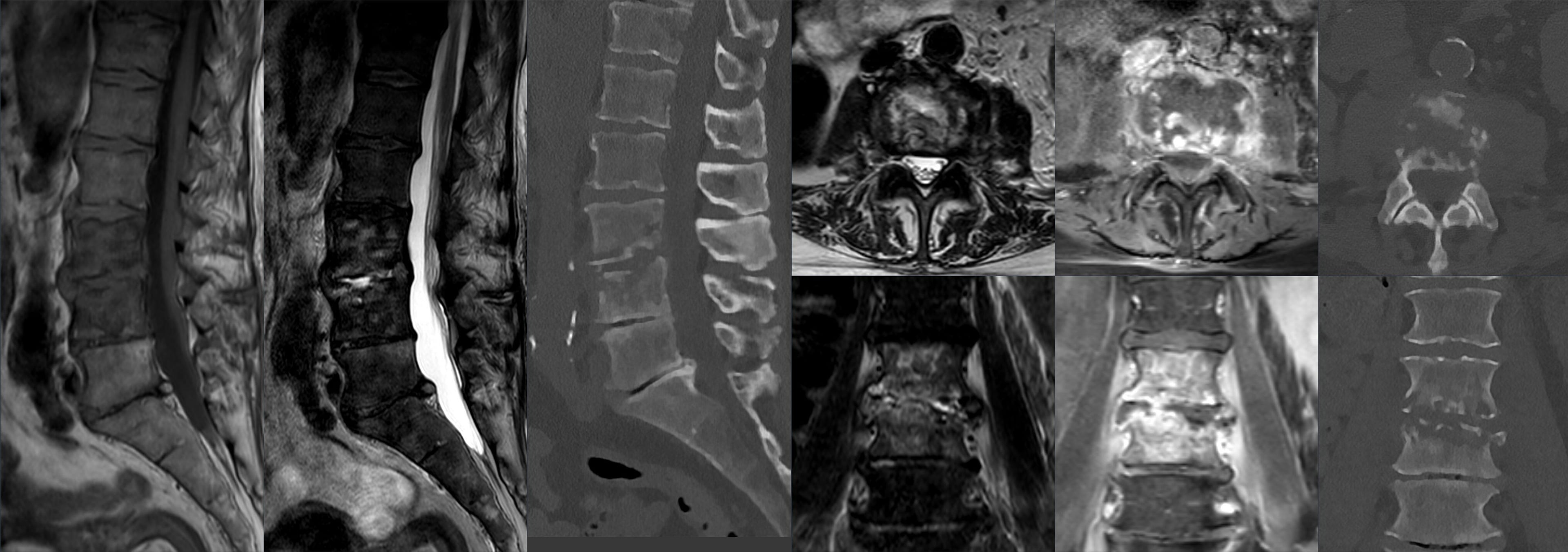
Pyogenic or tuberculous. Early destruction of the disc space is the feature that separates pyogenic infection from tuberculosis, which spares the disc and crosses levels beneath the anterior longitudinal ligament.
- Pyogenic
- Destroyed Early
- Tuberculosis (Pott's)
- Preserved Late
- Pyogenic
- Usually 2 (contiguous)
- Tuberculosis (Pott's)
- Multiple (skip lesions)
- Pyogenic
- Small / Epidural
- Tuberculosis (Pott's)
- Large / Psoas (Cold Abscess)
- Pyogenic
- Less Common
- Tuberculosis (Pott's)
- Common (Gibbus)
Biopsy. CT-guided biopsy is the standard of care and the definitive test. Its yield is only 50-70%, and image-guided biopsy is only about 52% sensitive but nearly 100% specific: a positive result confirms the diagnosis, a negative one changes nothing, and the answer is repeat or open biopsy. Antibiotics must be held for 48-72 hours beforehand if it is safe to do so.
MRI Pitfall: Infection versus Degenerative (Modic) Endplate Change
The trap. Degenerative Modic type 1 endplate change produces endplate marrow oedema that looks like early infection, dark on T1 and bright on T2/STIR. It is the commonest false positive, and distinguishing the two is a classic examiner trap.
- Infection (spondylodiscitis)
- Bright (high signal), with loss of the normal intranuclear cleft
- Degenerative (Modic type 1)
- Dark (low signal) - a degenerate, desiccated disc
- Infection (spondylodiscitis)
- Eroded, irregular, destroyed
- Degenerative (Modic type 1)
- Intact, preserved cortical line
- Infection (spondylodiscitis)
- Disc, endplate and paravertebral/epidural enhancement, often with abscess
- Degenerative (Modic type 1)
- Little or no abnormal disc/soft-tissue enhancement
- Infection (spondylodiscitis)
- Phlegmon or abscess present
- Degenerative (Modic type 1)
- Absent
Look at the disc, not just the endplate. The single most useful discriminator is the disc itself. A T2-bright disc with endplate destruction and paradiscal or epidural enhancement points to infection; a T2-dark degenerate disc with intact endplates and no soft-tissue enhancement is Modic type 1 degeneration. The same caveat explains why a routine post-operative MRI mimics infection.
Management
Organism before antibiotics. Do not start antibiotics before biopsy unless the patient is septic or has neurological compromise. Starting them before deep cultures sterilises the field and makes targeted treatment impossible.
The pathway. Suspicion starts with back pain and a raised CRP; where suspicion is low, monitor. Suspected discitis gets an MRI and blood cultures, and an assessment of the neurology. From there:
- Neurological deficit or sepsis is an emergency: surgery, with empirical antibiotics after cultures
- Stable: hold antibiotics and proceed to CT-guided biopsy
- Biopsy positive: targeted IV or oral antibiotics for 6 weeks
- Biopsy negative: repeat biopsy, or open biopsy
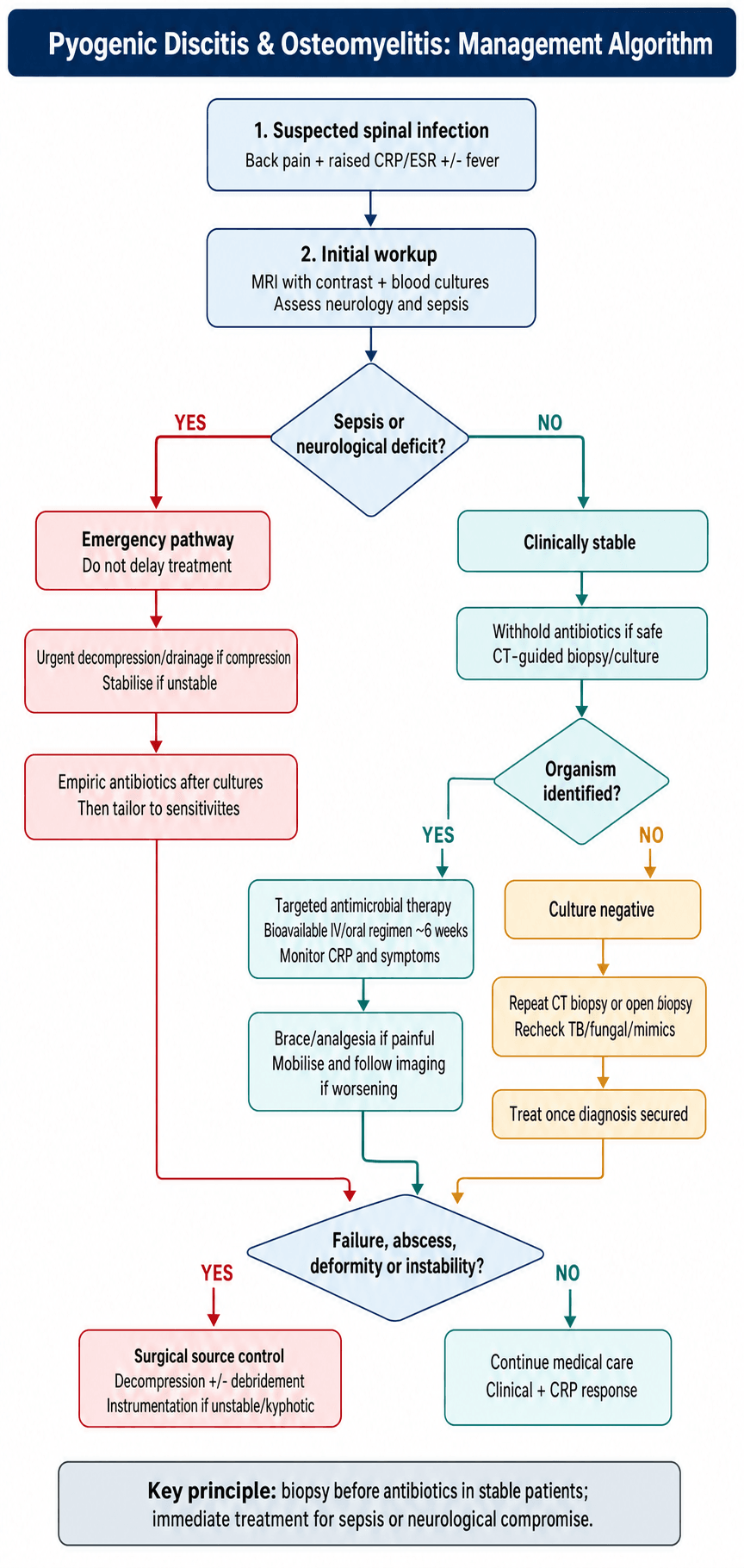
Antibiotics. Empirical cover is vancomycin with ceftriaxone, for MRSA and Gram-negative organisms. Once sensitivities are known, narrow the spectrum to match them.
Route and duration. The traditional course is six weeks intravenously. OVIVA shows oral therapy is non-inferior once a bioavailable agent can be chosen against a known organism, which presupposes an organism. Bernard's trial established six weeks as non-inferior to twelve, but every patient in it had a microbiologically confirmed infection:
- Continue for 6 weeks minimum from the start of targeted therapy
- Stop when the CRP normalises and radiographic healing is seen
- In culture-negative disease, which is roughly half of biopsied patients, six weeks is an extrapolation, and a longer course with closer surveillance is defensible
Bracing. A TLSO is often used for pain control and to prevent kyphosis, worn for 6-12 weeks while the bone heals.
When to operate. Surgical source control, decompression with or without debridement and instrumentation if the spine is unstable or kyphotic, is for failure of medical treatment, abscess, deformity or instability.
BIOPSYManagement
Hook:Workflow.
Surgical Technique
Laminectomy for the epidural abscess. The indication is an epidural abscess compressing the cord or cauda equina. Drainage often finds minimal pus and mostly granulation tissue.
- Midline approach
- Wide laminectomy
- Drainage of the abscess
- Do not destabilise the facets if possible
The pitfall. Laminectomy alone in a destroyed spine causes rapid kyphosis. If the spine is unstable, it must be instrumented.
Complications
- Risk
- 15-20%
- Note
- Can cause rapid onset paraplegia.
- Risk
- 10%
- Note
- Infection inhibits fusion.
- Risk
- Common
- Note
- Collapse of disc and endplates.
- Risk
- 1-5%
- Note
- Always auscultate the heart (Echo if murmur).
Postoperative Follow-up
Surveillance. Check the CRP weekly. Radiographs at 6 weeks and 3 months check fusion and alignment. MRI is only for worsening symptoms, because post-operative change mimics infection.
Outcomes and Prognosis
Mortality. High, at 2-20% depending on comorbidities such as age and diabetes, and higher in MRSA infection.
Recurrence. About 5-10%. The risk factors are an inadequate duration of antibiotics, an undrained abscess and retained hardware if it is loose.
Function. The majority, greater than 70%, have significant residual back pain, and functional impairment is worse than after standard degenerative spine surgery. Quality-of-life scores in studies such as Carragee et al are similar to those in chronic heart failure.
Long-term sequelae. Chronic pain is due to facet joint destruction and the altered biomechanics of kyphosis. Degenerative spondylolisthesis may develop years later above or below the fused level, as adjacent segment disease.
Poor prognostic factors. These predict a worse outcome:
- Age greater than 60
- Concurrent endocarditis
- Disseminated S. aureus infection
- Delay in diagnosis greater than 3 months
- Neurological deficit at presentation, which is often permanent
Guidelines, Registries & Global Practice
Global epidemiology
- Incidence is rising worldwide (ageing populations, IV drug use, more spinal instrumentation and intravascular devices). Reported population incidence is roughly 1 to 7 per 100,000 person-years in high-income settings.
- Strong male predominance and a peak in patients over 50 years. Staphylococcus aureus is the dominant pathogen globally; Gram-negative organisms cluster with urinary sources and IV drug use.
- In TB-endemic regions (much of South Asia, sub-Saharan Africa), Mycobacterium tuberculosis (Pott disease) is a major differential and may outnumber pyogenic cases; Brucella spondylitis is important around the Mediterranean, Middle East and Central Asia.
- Diagnosis emphasis
- MRI + blood cultures; image-guided biopsy if cultures negative
- Antibiotic strategy
- Hold empirical Abx if stable; about 6 weeks total
- Diagnosis emphasis
- MRI gold standard; emphasise culture before therapy
- Antibiotic strategy
- Targeted therapy, oral switch supported by OVIVA
- Diagnosis emphasis
- Classify by neurology, instability, abscess (Pola)
- Antibiotic strategy
- Surgery for deficit, instability, sepsis, failed medical Tx
Registry and practice variation
- No dedicated international spondylodiscitis registry exists; arthroplasty/implant registries (NJR, AJRR, AOANJRR, SHAR) inform biofilm and revision principles that carry over to instrumented spinal infection.
- High-resource settings: routine MRI, CT-guided biopsy, prolonged targeted therapy, single-stage instrumented debridement, OPAT or early oral switch.
- Limited-resource settings: empirical therapy is often started before biopsy due to limited imaging/microbiology; high TB prevalence lowers the threshold for empirical anti-tuberculous treatment; surgical capacity for instrumented reconstruction may be constrained.
Related pages: Tuberculosis of the Spine (Pott's Disease) is the mimic that must be excluded before any culture-negative case is treated as pyogenic - it spares the disc early, crosses levels beneath the anterior longitudinal ligament and produces a paraspinal abscess out of proportion to the pain, and it is also the disease the instrumentation-safety paper carded above actually studied; Spinal Epidural Abscess for the complication that turns this from a medical problem into an emergency, and for the deficit-duration rule that governs the timing of decompression; Fungal Osteomyelitis for the other reason a biopsy grows nothing; Osteomyelitis Pathophysiology for the biofilm and sequestrum biology that explains why source control matters more than antibiotic duration; Pediatric Acute Osteomyelitis for the haematogenous disease in the child whose vascular anatomy differs; and Chronic Recurrent Multifocal Osteomyelitis for the sterile inflammatory condition that images like infection and must not be given six weeks of antibiotics.
Controversies & Areas of Uncertainty
- Empirical antibiotics before biopsy: Guidelines advise holding antibiotics in stable patients to maximise culture yield, yet real-world practice often starts therapy early. The optimal antibiotic-free window before biopsy (commonly quoted as 48 to 72 hours) is not firmly evidence-based.
- Total duration: The Bernard RCT supports 6 weeks for uncomplicated disease, but undrained abscess, implant-associated infection, endocarditis or persistently raised CRP frequently prompt longer courses; the right duration for these subgroups is unresolved.
- Oral versus IV: OVIVA supports early oral switch, but uptake varies and selection of a reliably bioavailable oral agent (and adherence) remains the practical limitation.
- Single-stage instrumentation in active infection: Increasingly accepted with radical debridement, but the threshold for instrumenting, choice of anterior versus posterior approach, and use of titanium versus PEEK cages are debated.
- Role of nuclear imaging: FDG-PET/CT is useful when MRI is contraindicated or equivocal and for monitoring, but is not universally available and its role in defining cure is not standardised.
MCQ Practice Points
Q: What is the earliest MRI sign of discitis? A: Endplate Edema. High signal on T2/STIR in the subchondral bone.
Q: Why does infection start in the endplate, not the disc? A: Vascular Supply. The adult disc is avascular. Bacteria lodge in the vascular loops of the endplate.
Q: Most common organism in IV Drug Users? A: Pseudomonas aeruginosa. (Though S. aureus is still common).
Q: What clinical sign suggests an Epidural Abscess? A: Neurological Deficit or severe radicular pain.
Q: What is the primary indication for surgery in discitis? A: Neurological Deficit. Failure of medical management and instability are secondary.
Exam Day Cheat Sheet
Key Facts
- S. aureus #1
- MRI is Gold Standard
- Biopsy BEFORE Abx
- 6 weeks Tx
Red Flags
- Neuro Deficit (Abscess)
- Sepsis (Systemic)
- IVDU (Pseudomonas)
- Endocarditis
Workup
- Blood Cx x3
- MRI Gadolinium
- CT Biopsy
- Echo
Risks
- Paralysis
- Sepsis
- Deformity (Kyphosis)
- Chronic Pain
Clinical Decision Scenarios
Practise clinical reasoning and management decisions out loud
“60M with L4/5 Discitis. Blood Cx neg. CT Biopsy neg. CRP 150. Stable Neuro. What now?”
“You need to stabilize an L3/4 infection. Is it safe to put Titanium screws into pus?”
“A 45-year-old from a TB-endemic region presents with 3 months of thoracic back pain, night sweats and a large left psoas collection. How do you distinguish pyogenic from tuberculous spondylodiscitis, and how does it change management?”
Evidence Base
OVIVA Trial
- Oral vs intravenous antibiotics for bone and joint infection; 1054 adults across 26 UK centres.
- Treatment failure at 1 year: 13.2% oral vs 14.6% IV (difference -1.4 points, within the 7.5-point non-inferiority margin).
- Oral therapy was NON-INFERIOR to IV therapy.
- Catheter complications were more common with IV (9.4% vs 1.0%).
Duration of Therapy
- Open-label non-inferiority RCT, 351 patients analysed, 6 weeks vs 12 weeks of antibiotics.
- Clinical cure at 1 year identical at 90.9% in both arms (difference 0.05%, 95% CI -6.2 to 6.3).
- 6 weeks was non-inferior for microbiologically confirmed pyogenic vertebral osteomyelitis.
- Shorter course reduces antibiotic burden and resistance pressure.
Image-Guided Biopsy Yield
- Systematic review and meta-analysis of 7 studies (482 patients) of image-guided spinal biopsy.
- Pooled sensitivity only 52.2% (95% CI 45.8-58.5) but specificity 99.9%.
- A positive biopsy strongly confirms infection, but a negative result does NOT rule it out.
- Diagnostic odds ratio 45.5; supports biopsy in the work-up of suspected native vertebral osteomyelitis.
Instrumentation in Spinal Infection
- 11 patients with spinal tuberculosis treated by debridement, anterior fusion and posterior instrumentation.
- No persistence or recurrence of infection after surgery; instrumentation gave immediate stability and prevented kyphosis.
- In vitro adherence of M. tuberculosis to stainless steel was low.
- Concluded posterior instrumentation is not a hazard when combined with radical debridement and chemotherapy.
Spinal Epidural Abscess
- Authoritative review establishing spinal epidural abscess (SEA) as a neurosurgical emergency.
- The classic triad of fever, back pain and neurological deficit is present in a minority of patients.
- MRI with gadolinium is mandatory for any back pain plus fever or new neurology.
- Early decompression and drainage improve neurological recovery; deficit duration predicts outcome.
IDSA Native Vertebral Osteomyelitis Guideline
- Obtain blood cultures and ESR/CRP in all suspected cases; MRI is the imaging of choice.
- Image-guided biopsy is recommended when blood cultures are negative and the patient is haemodynamically stable.
- Withhold empirical antibiotics in stable patients until a microbiological diagnosis is secured.
- Recommend approximately 6 weeks of antimicrobial therapy for most pyogenic cases, monitoring ESR/CRP.