Posterior Interosseous Nerve Compression | Pain Without Weakness | Controversial Diagnosis
- Pain without weakness - distinguishes from PIN syndrome (motor palsy)
- Arcade of Frohse - fibrous arch at proximal supinator edge (70% of cases)
- Rule-of-Nine test - tenderness mapped to the lateral column of nine squares on the volar proximal forearm
- Conservative management first - 3-6 months trial before considering surgery
- Electrodiagnostics usually normal - clinical diagnosis, not confirmed by EMG/NCS
- “Radial tunnel syndrome = pain only; PIN syndrome = motor palsy
- “Differential diagnosis includes lateral epicondylitis (tennis elbow)
- “Arcade of Frohse is present in 30% of population (fibrous in 50% of those)
- “Surgical decompression has variable outcomes (50-90% success)
Overview and Epidemiology
Radial tunnel syndrome (RTS) is pain in the proximal lateral forearm attributed to compression of the posterior interosseous nerve (PIN) within the radial tunnel, without motor weakness. It is a controversial clinical entity, and it is often misdiagnosed as lateral epicondylitis (tennis elbow).
Pain, not palsy. Weakness of thumb or finger extension is no part of RTS. If extensor weakness is present, the diagnosis is PIN syndrome, a motor palsy of the same nerve, and not radial tunnel syndrome.
The radial tunnel. It runs from the radial head to the distal edge of supinator, a length of about 4-5 cm, and carries the PIN, the deep branch of the radial nerve. There are five potential compression sites along its course.
Risk factors. Occupation, sport, previous injury and local anatomy all feature:
- Occupational: repetitive pronation-supination activities
- Sports: racquet sports, golf, weightlifting
- Previous trauma: radial head fracture, elbow dislocation
- Anatomical: a fibrous arcade of Frohse
- Coexisting lateral epicondylitis, which overlaps in 5%
- Space-occupying lesions such as a lipoma or ganglion, which are rare
Anatomy and Pathophysiology
The radial nerve at the elbow. In the proximal forearm the radial nerve lies between brachialis and brachioradialis. At the level of the radiocapitellar joint it divides into the superficial radial nerve, which is sensory, and the PIN, which is motor. The PIN then:
- Enters the radial tunnel anterior to the radial head
- Passes through supinator via the arcade of Frohse
- Emerges at the distal supinator edge to innervate the extensors
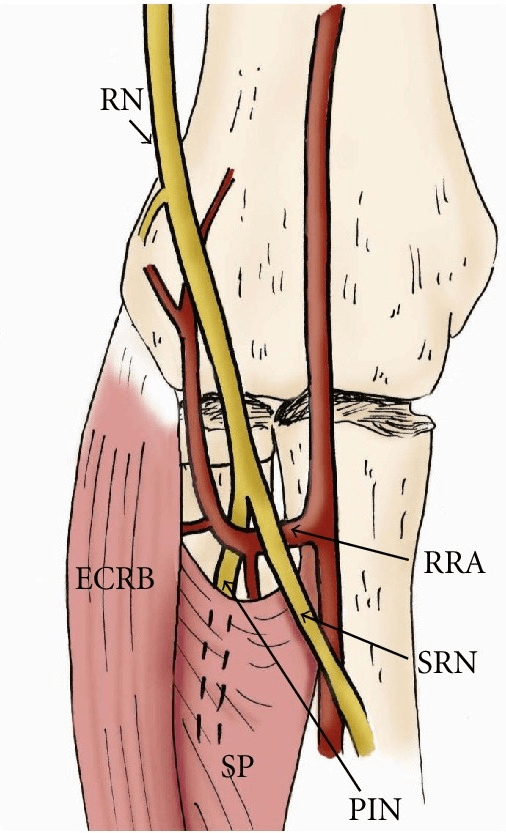
What the PIN supplies. Supinator is its first muscle, followed by ECU, EDC, EDM, APL, EPL, EPB and EIP. ECRL and ECRB are supplied by the radial nerve proper before the bifurcation. Brachioradialis is also supplied by the radial nerve proper.
Why that matters in a palsy. In PIN palsy, which is not RTS, wrist extension is preserved because ECRL and ECRB are intact, but the wrist deviates radially because ECU is paralysed, and finger and thumb extension are lost. In RTS none of these muscles is weak.
The five potential compression sites. Numbered as in the figure below:
- Fibrous bands anterior to the radial head
- The recurrent radial vessels, the leash of Henry
- The tendinous margin of ECRB
- The arcade of Frohse
- The distal edge of supinator
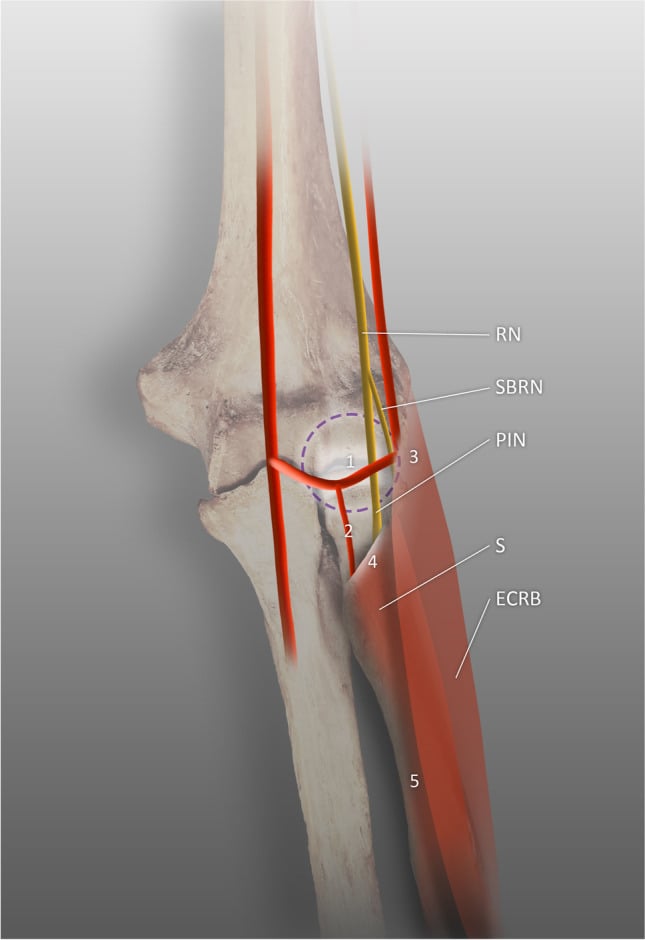
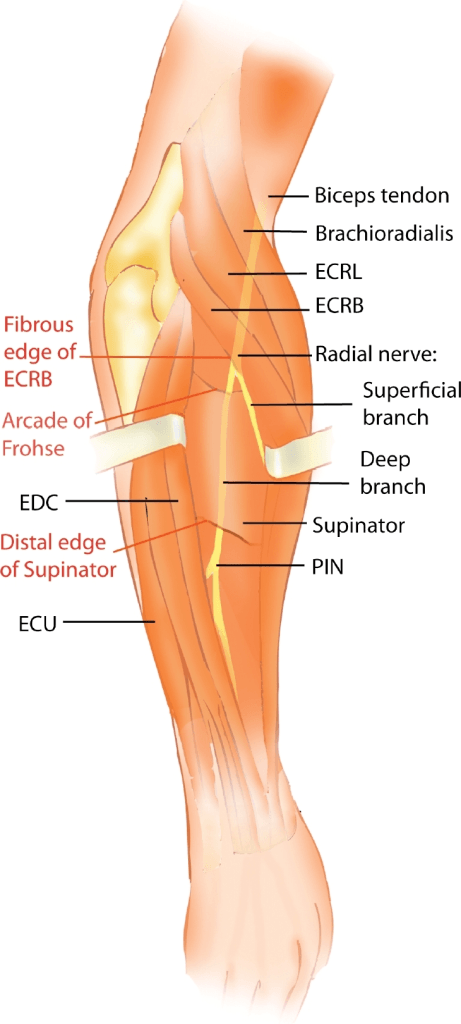
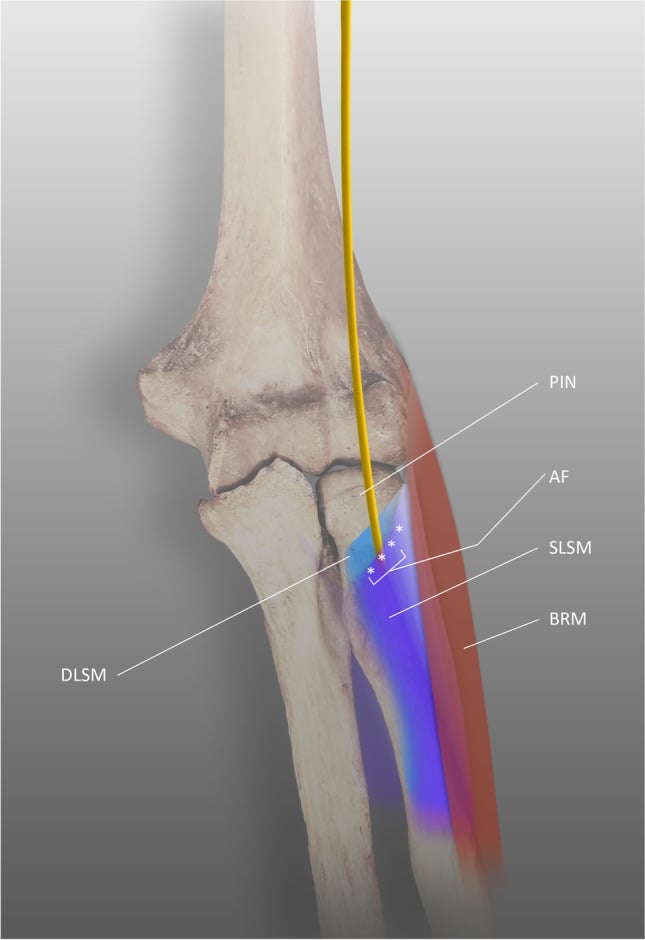
The arcade of Frohse. A fibrous arch at the proximal edge of supinator, formed by the tendinous margin of its superficial head. It is the most common site of compression, in 70%, and the target of surgical release. The arcade is present in about 30% of the population and, when present, is fibrous (non-yielding) in 50%; that variable anatomy explains the inconsistent surgical outcomes.
How the arcade compresses. The PIN passes beneath the arcade as it enters supinator. Pronation increases tension on the arcade, a fibrous arcade does not yield during forearm rotation, and repetitive pronation-supination causes chronic irritation.
The other four sites.
- Fibrous bands lie anterior to the radial head and radiocapitellar joint; Henry et al described them as fibrovascular bands. They are the most proximal site, and their presence varies.
- The leash of Henry, named after A. K. Henry, is the recurrent radial artery and veins crossing the PIN. The vascular leash can compress the nerve and is addressed during decompression.
- The ECRB edge. The PIN passes deep to the ECRB muscle belly, and a tight tendinous margin can compress it. It may coexist with lateral epicondylitis.
- The distal supinator edge is where the PIN emerges to innervate the extensors. Compression here occurs during pronation activities, and it is a less common site.
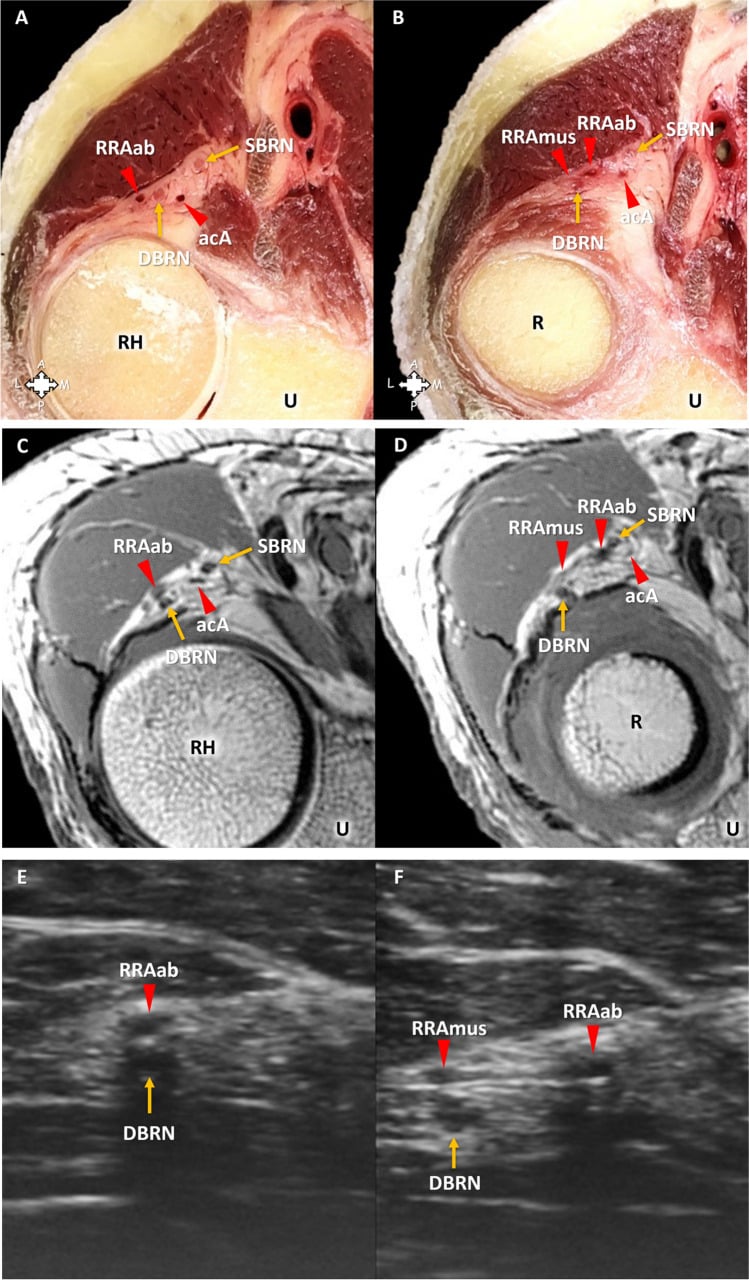
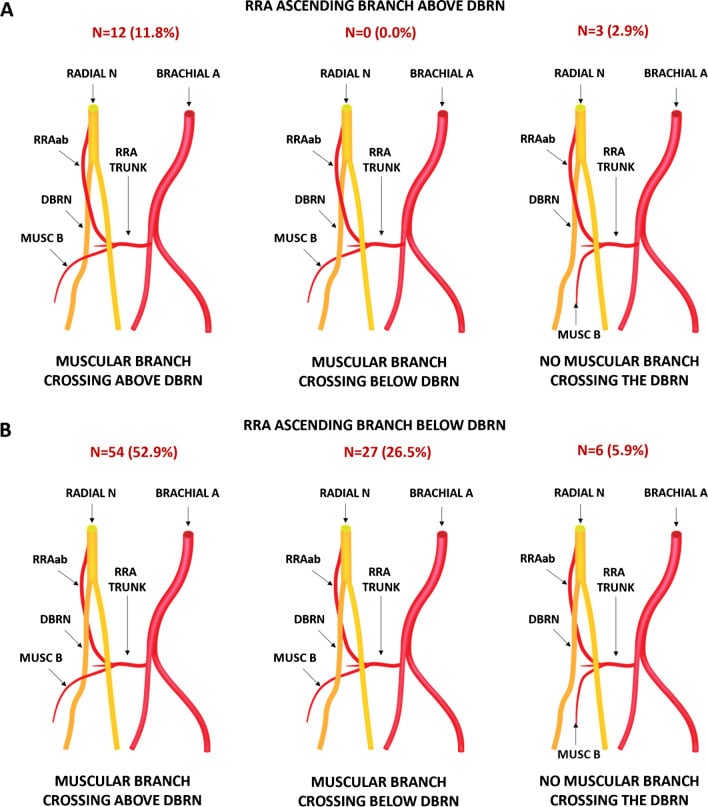
Pathophysiology. Repetitive pronation-supination compresses the PIN at one or more sites in the tunnel, most commonly at the arcade of Frohse during pronation. Chronic compression leads to perineural inflammation and nerve irritation without significant demyelination or axonal injury, which is why electrodiagnostics are normal.
Where the pain comes from. The patient develops chronic proximal forearm pain without motor dysfunction. The pain is thought to arise from nociceptive C-fibres in the nerve sheath, not from nerve dysfunction.
Clinical Presentation and Diagnosis
The history. Aching pain in the proximal dorsal forearm, described as a mobile tender mass 4-5 cm distal to the lateral epicondyle. It is deep, aching or burning, may radiate along the dorsal forearm, and usually comes on insidiously over weeks to months. Repetitive pronation-supination (turning a screwdriver or a doorknob) and gripping make it worse; rest and forearm supination relieve it.
What is absent. There is no motor weakness, and no paraesthesia or numbness, because the PIN is purely motor.
Inspection. In most patients there is no visible deformity and no muscle wasting, which distinguishes RTS from PIN syndrome. Compare both forearms for symmetry.
Palpation, the most important finding. Tenderness lies 4-5 cm distal to the lateral epicondyle, over the radial tunnel. There is no tenderness at the epicondyle itself; if there is, consider lateral epicondylitis.
The mobile mass sign. The PIN and the radial tunnel move with forearm rotation, so the tender point moves distally with pronation and proximally with supination. The tenderness of lateral epicondylitis stays fixed at the epicondyle, which is what separates the two.
The Rule-of-Nine test. Tenderness mapping over the volar forearm:
- Divide the anterior (volar) proximal forearm into nine equal squares, three columns of three, just distal to the elbow crease
- Palpate each square in turn and record where tenderness is elicited
- The test is positive when tenderness is confined to the lateral column, which is where the PIN runs
A positive test follows the course of the PIN through the radial tunnel and points away from lateral epicondylitis, where tenderness sits over the epicondyle itself.
How far to trust it. The test was proposed by Loh and colleagues (DOI) from a cadaveric dissection study of 19 upper limbs, which showed the PIN maps consistently onto that lateral column. Because it was an anatomical study and not a patient series, it reports no sensitivity or specificity, and since RTS has no objective reference standard (electrodiagnostics are normal), no test for it can have a validated accuracy figure. Treat a positive result as supporting evidence, not proof.
A common exam trap. The Rule-of-Nine test is a mapping test. It is not the same as resisted long-finger extension, and it is not a single point 9 cm distal to the epicondyle; the "nine" refers to the nine squares.
Provocative tests. Both aim to compress or irritate the PIN in the tunnel, and both are positive when they provoke pain in the proximal forearm over the tunnel, not at the epicondyle.
- Resisted supination. With the elbow flexed to 90° and the forearm pronated, resist active supination. Contraction of supinator tightens the arcade of Frohse.
- Resisted long-finger extension. Resist MCP extension of the long finger with the forearm pronated. EDC activity increases compression in the tunnel.
The third test, local anaesthetic injection into the tunnel, is described under Investigations.
Motor and sensory examination must be normal. Wrist extension (ECRL, ECRB), finger extension (EDC, EIP) and thumb extension (EPL, EPB) are all full strength, MRC 5/5. Test each finger individually; the thumb-up sign should be strong, and the wrist extends but may deviate radially if the patient splints. Sensation over the dorsal first web space is normal, because the superficial radial nerve is not affected in RTS.
If ANY weakness is present, this is PIN syndrome, not radial tunnel syndrome. A normal motor and sensory examination is required for the diagnosis of RTS.
- Radial Tunnel Syndrome
- Mobile mass 4-5cm distal to lateral epicondyle
- Lateral Epicondylitis
- Lateral epicondyle (fixed)
- PIN Syndrome
- No pain; weakness of finger and thumb extension
- Radial Tunnel Syndrome
- None (key feature)
- Lateral Epicondylitis
- None
- PIN Syndrome
- Extensor weakness (thumb, fingers)
- Radial Tunnel Syndrome
- Pain distal to epicondyle
- Lateral Epicondylitis
- Pain at epicondyle
- PIN Syndrome
- Wrist extension preserved (ECRL/ECRB intact) but deviates radially
- Radial Tunnel Syndrome
- Positive (tenderness in the lateral column)
- Lateral Epicondylitis
- Negative
- PIN Syndrome
- May be positive with weakness
- Radial Tunnel Syndrome
- Normal
- Lateral Epicondylitis
- Normal
- PIN Syndrome
- Abnormal (denervation of PIN-innervated muscles)
Other diagnoses to exclude. Beyond lateral epicondylitis, which can coexist with RTS, and PIN syndrome:
- Key Features
- Neck pain, triceps weakness, radicular symptoms
- Differentiating Test
- MRI cervical spine, EMG shows multiple myotomes
- Key Features
- History of trauma, clicking, limited rotation
- Differentiating Test
- X-ray shows fracture or arthritis
- Key Features
- Mass, progressive symptoms, neurological deficit
- Differentiating Test
- MRI shows lipoma, ganglion, or tumour
Investigations
Electrodiagnostics are usually normal. In RTS, EMG and nerve conduction studies show normal motor latencies in the radial nerve and PIN, normal sensory latencies in the superficial radial nerve, no denervation on needle EMG and normal recruitment in the PIN-innervated muscles. Normal studies do not rule RTS out; the diagnosis is clinical.
What electrodiagnostics are for. They confirm that the clinical picture is not due to nerve pathology, by ruling out:
- PIN syndrome, which shows denervation
- Radial nerve palsy, a proximal lesion
- C7 radiculopathy, from the cervical spine
The PIN syndrome pattern. Denervation of the PIN-innervated muscles (supinator, ECU, EDC, EPL, APL), with fibrillation potentials and positive sharp waves on needle EMG and reduced recruitment. It indicates axonal injury requiring surgical decompression, and it means the diagnosis is PIN syndrome, not RTS.
Radiographs. AP and lateral views of the elbow and of the forearm in every patient with elbow or forearm pain, to rule out bone pathology. They are normal in isolated RTS. Look for:
- A radial head fracture from previous trauma
- Elbow arthritis, an alternative diagnosis
- Post-traumatic heterotopic ossification
- Bone tumours such as an osteochondroma
Ultrasound. It shows space-occupying lesions such as a lipoma or ganglion, allows dynamic assessment of the PIN during pronation-supination and can guide injection, but it is operator-dependent. It is usually normal, and may show swelling of the PIN at the compression site.
MRI is not routinely needed; its role is to rule out alternative diagnoses. The indications are an atypical presentation, excluding a mass, and pre-operative planning. It is usually normal and rarely shows signal change in the PIN, but it can identify a lipoma, ganglion or tumour and evaluate coexisting lateral epicondylitis.
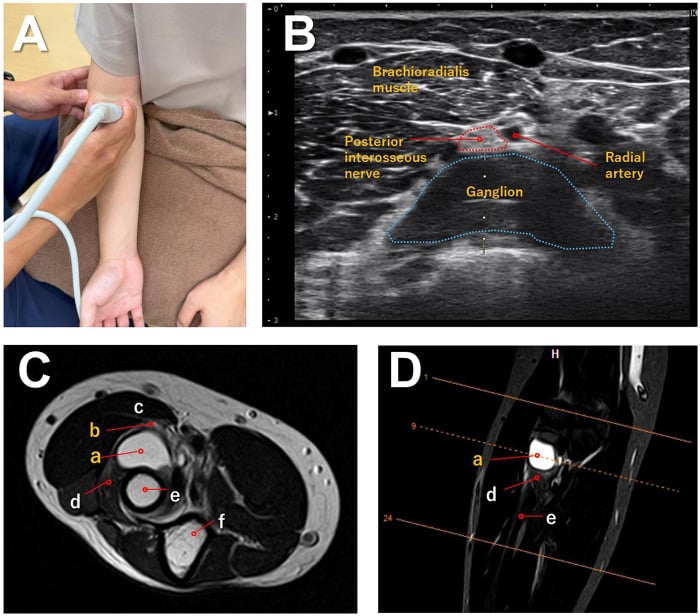
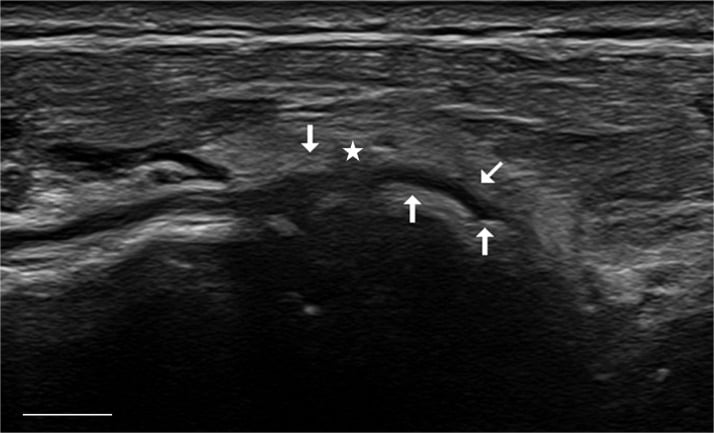
Diagnostic injection. Inject 2-3 mL of 1% lidocaine with corticosteroid into the radial tunnel, 4-5 cm distal to the lateral epicondyle and deep to the mobile point of tenderness, then retest the special tests after 10-15 minutes. Significant temporary pain relief, more than 50% improvement, is a positive test.
What a positive injection means. It is used to confirm the diagnosis, and a positive response predicts a good surgical outcome; it may also give lasting relief in some patients. This makes it the most valuable test for RTS, although it has not been validated against a true reference standard (see Controversies).
Management
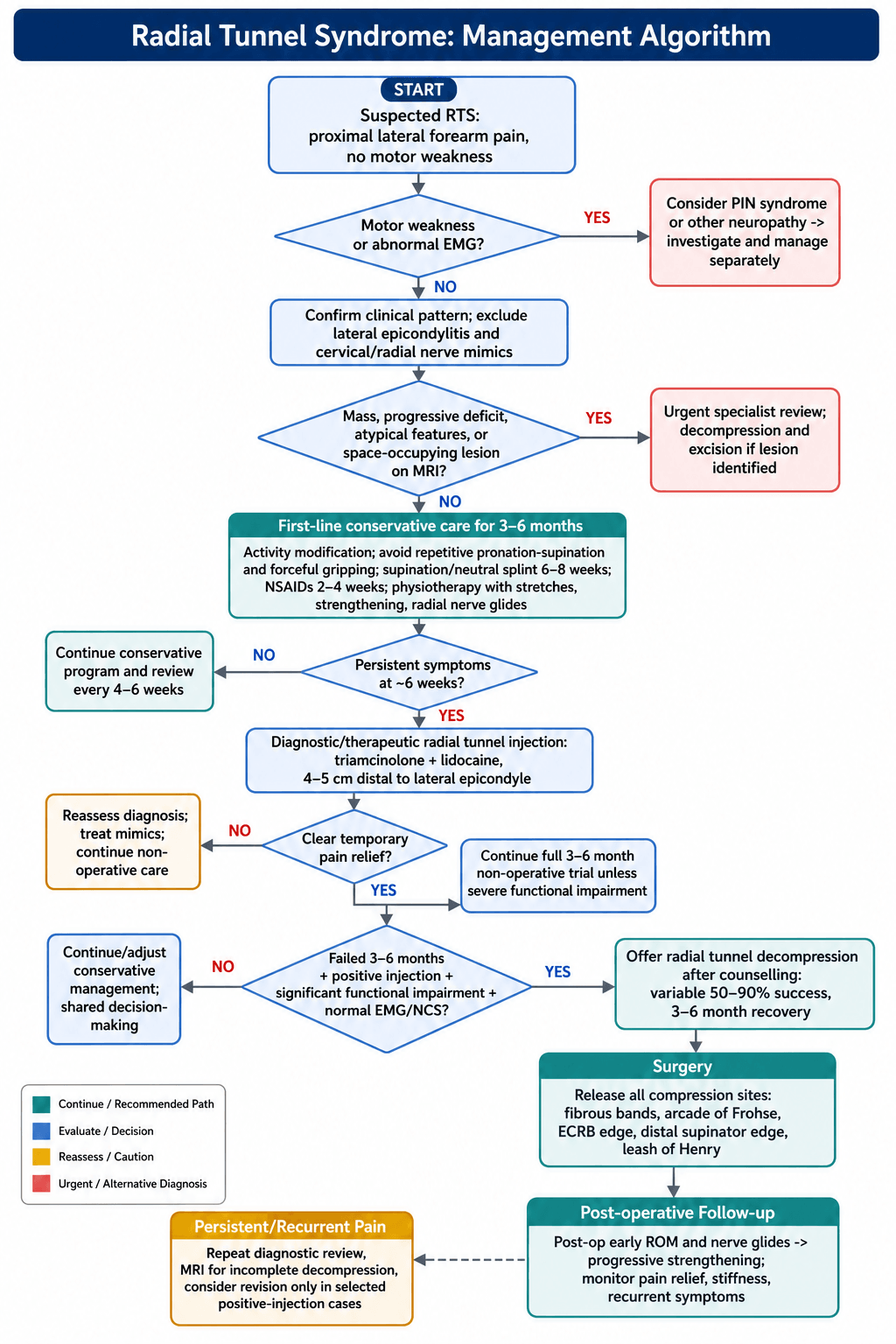
Conservative first. A trial of non-operative treatment for 3-6 months is mandatory before surgical decompression is considered, and 60-80% of patients improve with it. Surgery has variable outcomes and is reserved for patients who fail comprehensive non-operative treatment.
The programme combines the following, reviewed every 4-6 weeks:
- Activity modification: avoid repetitive pronation-supination and forceful gripping with the forearm pronated, make ergonomic changes at work and limit aggravating sport
- Supination splint: holds the forearm in neutral to supination, which opens the arcade of Frohse and reduces compression. Worn during activities and at night, as a 6-8 week trial
- NSAIDs for 2-4 weeks: ibuprofen 400-600 mg three times daily with food, or naproxen 500 mg twice daily. Watch for GI side effects
- Physiotherapy: forearm flexor and extensor stretches, progressive resistance strengthening, and radial nerve glides to reduce adhesions. Ice and ultrasound as modalities have limited evidence
- Corticosteroid injection if conservative measures have failed at 6 weeks: 2-3 mL of triamcinolone 40 mg/mL with 1% lidocaine, 4-5 cm distal to the lateral epicondyle and deep to brachioradialis. Relief should be immediate if the diagnosis is correct, and the injection can be repeated once if the response at 6 weeks is partial. It is diagnostic and therapeutic
At each review, reassess the symptoms and the examination, and reassess the differential diagnosis if the patient is not improving.
Surgical Technique
Set-up. Supine with the arm on an arm board in neutral rotation. Use no tourniquet, to preserve the vascular landmarks of the leash of Henry.
Approach. The Thompson (posterior interosseous) approach is preferred. A longitudinal incision of about 6-8 cm is centred over the mobile point of maximum tenderness, running from the lateral epicondyle distally over the proximal forearm.
Exposure.
- Incise skin and subcutaneous tissue, protecting the lateral cutaneous nerve of the forearm, which crosses superficially
- Identify and develop the interval between ECRL and EDC; both are radial nerve muscles, ECRL supplied by the nerve proper and EDC through the PIN
- Retract ECRL anteriorly and EDC posteriorly, and identify supinator
- Identify the arcade of Frohse at the proximal supinator edge and incise it longitudinally, avoiding injury to the PIN
- Trace the PIN proximally and distally through the entire tunnel
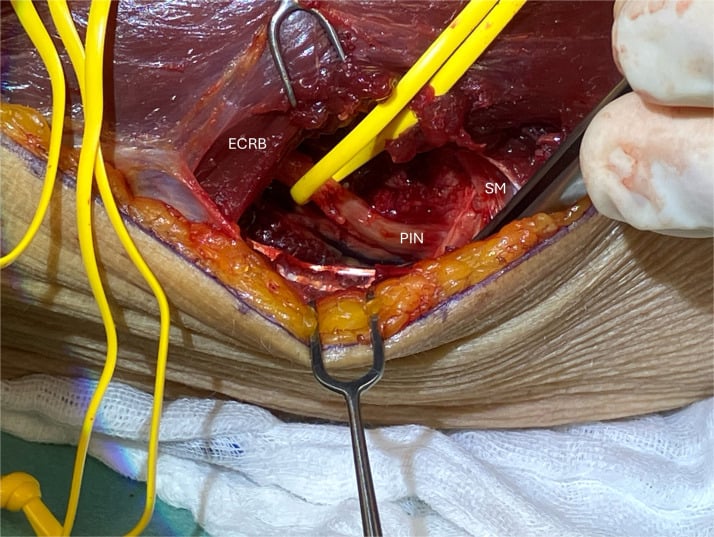
Releasing the five sites. All five must be addressed:
- Fibrous bands anterior to the radial head: release
- Leash of Henry: identify and mobilise carefully, without injuring the vessels
- ECRB edge: release the tendinous margin if tight
- Arcade of Frohse: release completely, the critical step
- Distal supinator: continue the release to the distal edge
Then inspect the PIN throughout the tunnel for kinking or residual compression, and check for a space-occupying lesion such as a lipoma or ganglion. Whether every site needs releasing is debated (see Controversies).
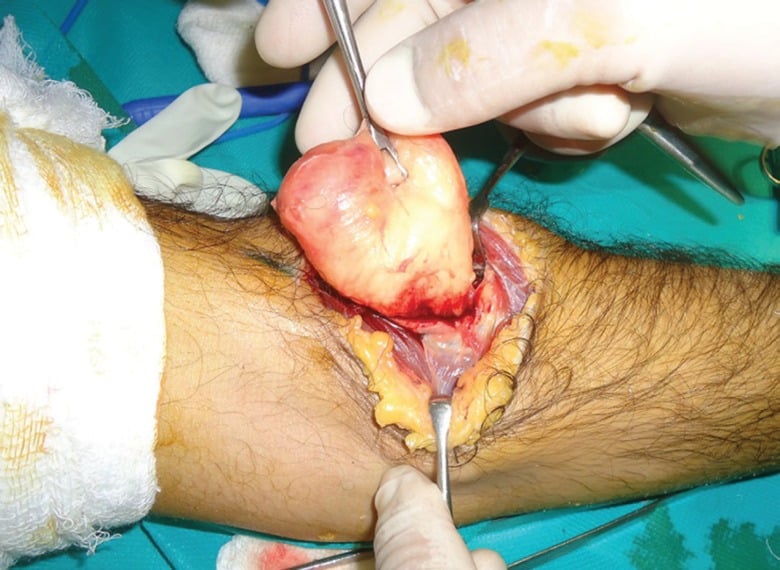
Closure. A drain is not typically required. Close the deep fascia loosely to avoid re-compression, then the subcutaneous tissue and skin.
The Kocher alternative. The interval between EDC and anconeus is less commonly used for radial tunnel release, because the PIN crosses the field and the risk of injuring it is higher. The Thompson approach is safer for seeing and decompressing the PIN.
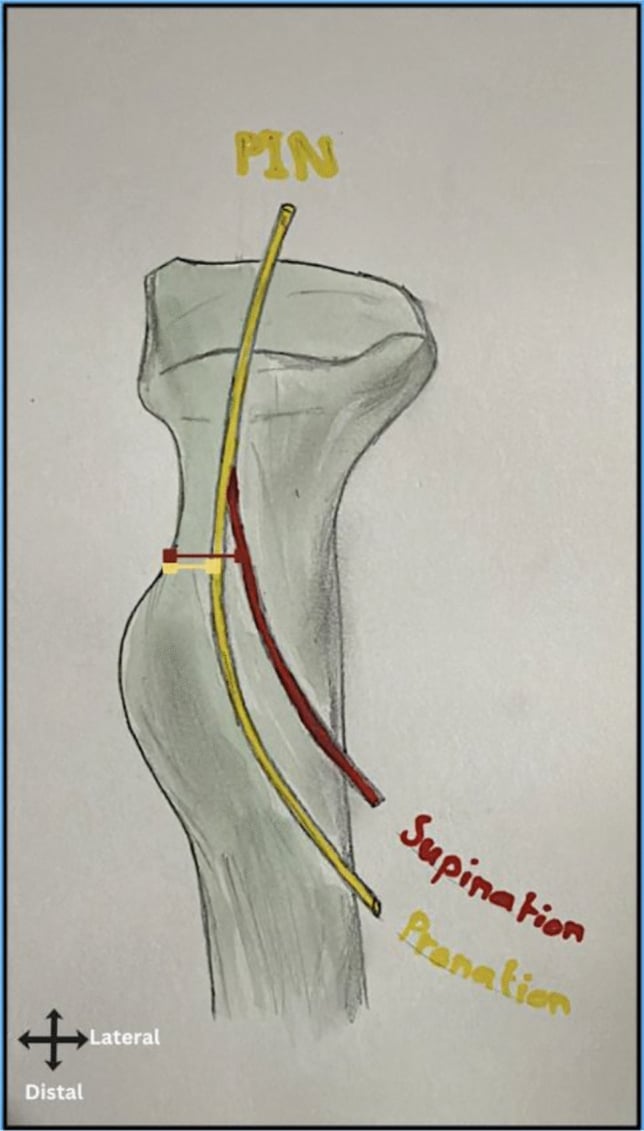
After surgery. A soft dressing without a rigid splint, and early active movement from day 1, because early motion is critical to prevent adhesions and stiffness. Avoid forceful pronation-supination for the first 2 weeks.
- 0-2 weeks: keep the wound clean and dry, oral analgesics as needed; wound check and suture removal at 2 weeks
- 2-6 weeks: progress to full active and passive motion, gentle supination-pronation strengthening against light resistance, radial nerve glides, and scar massage and desensitisation. Review range of motion and strength at 6 weeks
- 6-12 weeks: progressive strengthening of the wrist and finger extensors, a gradual return to work tasks, and sport-specific training if applicable
Light activities resume at 2-4 weeks and full activities at 3-6 months. The full benefit may take 3-6 months to assess; review the functional outcome at 3 months and make the final assessment at 6 months.
Complications
PIN injury is the most serious complication, in 1-5%. It follows direct, stretch or thermal injury during dissection and presents as post-operative weakness of finger and thumb extension. Prevention is careful identification and protection of the PIN throughout the decompression; most recover with observation for 3-6 months, and the nerve is explored or repaired if there is no recovery.
Vascular injury. The leash of Henry can be injured. Careful dissection without a tourniquet keeps the vessels in view; bleeding is controlled by direct pressure, with ligation if necessary.
Early, within 6 weeks.
- Infection, under 1%: antibiotics with or without washout
- Haematoma, rare without a tourniquet, which may need evacuation
- Dehiscence, rare, managed by secondary closure
- Persistent pain, from incomplete decompression (which may need revision), a wrong diagnosis, or nerve injury with neuropathic pain
Late, after 6 weeks.
- Recurrent symptoms, in 10-30%. Incomplete decompression is the most common cause; scar formation can re-compress the nerve and adhesions can tether it. Revision decompression is for selected cases.
- Loss of supination strength, in 10-20%, from partial release of supinator. The functional impact is usually minimal and it improves with strengthening exercises.
- Lateral antebrachial cutaneous nerve injury causes numbness or dysaesthesia in the lateral forearm and usually resolves over 6-12 months. Identify and protect the nerve in the superficial dissection.
- Complex regional pain syndrome (CRPS) is rare, under 1%, with disproportionate pain and autonomic changes. Manage it with early physiotherapy, desensitisation and the pain clinic.
When decompression fails. Failed surgery shows why the diagnosis has to be right at the start. The causes:
- The wrong diagnosis: it was not RTS
- Incomplete decompression, with a missed site
- Coexisting pathology, such as lateral epicondylitis
- Nerve injury during surgery
- Scar or adhesion formation
Work-up. Compare the pre- and post-operative symptoms in detail and re-examine for objective findings. Repeat the injection to assess the response, request EMG/NCS to rule out nerve injury, and obtain an MRI to look for a mass or scar tissue.
Management of failure. The options are conservative treatment (physiotherapy, NSAIDs, activity modification), a steroid injection, which may provide relief, and re-evaluation for an alternative diagnosis such as lateral epicondylitis or C7 radiculopathy. Revision surgery is only for a clear, identified cause, an incomplete release or a mass, and has a lower success rate than primary surgery.
Outcomes and Prognosis
What to tell the patient. Success after decompression is reported at 50-90%, variable across the literature, and counselling about that variability before surgery is essential. The figures quoted are complete relief in approximately 70%, partial relief in 20% and no relief in 10-30%. The alternative is continued conservative management.
The Roles and Maudsley grade. Outcomes are reported with this grading, introduced in the original 1972 description and used in Wilhelm's series, and reproducing its four grades is exactly what a viva examiner expects when you quote a "90 percent good-to-excellent" figure:
- Grade 1, Excellent: no pain, full movement and full activity
- Grade 2, Good: occasional discomfort, full movement and full activity
- Grade 3, Fair: some discomfort after prolonged activity, with activity limited
- Grade 4, Poor: pain limiting activity; the patient is unchanged or worse
Grades 1 and 2 together count as a "good-to-excellent" (satisfactory) result. That is how Wilhelm's figures read: roughly 90% good or excellent for simple denervation, falling to about 65% when aggressive direct PIN decompression was added. The scale was devised for surgery of the resistant tennis elbow and radial tunnel, and remains the standard outcome measure because there is no disease-specific score.
Who does badly after decompression. The factors associated with a poor result:
- Coexisting lateral epicondylitis. When tennis elbow and RTS coexist, decompression outcomes are worse; the overlapping ECRB-edge pathology means the epicondylar component may be the real pain driver and must be addressed too.
- Workers' compensation, litigation and occupational claims, repeatedly associated with poorer outcomes after radial tunnel (and tennis-elbow) surgery. This is a recognised psychosocial or secondary-gain effect, not evidence the operation failed technically.
- Diagnostic uncertainty. Because electrodiagnostics are normal and no test is validated against a reference standard, a wrong diagnosis is a leading cause of "failed" surgery. A negative or equivocal diagnostic injection predicts a poor response and should give pause.
- Chronic pain, bilateral symptoms and central sensitisation. Long-standing, bilateral or disproportionate pain behaves like a chronic pain syndrome and responds poorly to a local decompression.
Guidelines, Registries & Global Practice
Global epidemiology: RTS is rare compared with lateral epicondylitis and has no dedicated implant registry (it is a soft-tissue decompression, not arthroplasty). Reported series are small and retrospective. It is most often seen in adults aged 30-50 in occupations or sports involving repetitive forearm pronation-supination and forceful gripping (manual trades, racquet sports, musicians). Coexisting lateral epicondylitis is reported in a minority of cases and worsens outcomes.
No formal society guidelines exist for RTS specifically; practice is guided by hand-surgery consensus and is broadly consistent worldwide. There is, however, an important difference in emphasis between schools of thought rather than between countries.
- Position on RTS
- Accepted as a pain syndrome from PIN compression; clinical diagnosis
- Practical Emphasis
- Conservative trial first; complete multi-site release if surgery
- Position on RTS
- Recognised but emphasises excluding lateral epicondylitis and PIN palsy
- Practical Emphasis
- Diagnostic injection to confirm before considering decompression
- Position on RTS
- Term should be reserved for truly neurogenic (weakness) cases
- Practical Emphasis
- Caution about operating on pain-only presentations
- Position on RTS
- Diagnosis remains clinical; advanced imaging/EMG often unavailable
- Practical Emphasis
- Greater reliance on examination and diagnostic injection response
- High-resource settings: MRI and ultrasound are used to exclude space-occupying lesions; EMG/NCS routinely performed to exclude PIN syndrome; structured hand therapy available.
- Limited-resource settings: Diagnosis is clinical, anchored on the mobile point of tenderness, the Rule-of-Nine tenderness map, and response to a diagnostic local-anaesthetic injection; surgery is reserved for clear failures with a positive injection.
Because RTS involves no implant, it is not captured by arthroplasty registries (NJR, AJRR, AOANJRR). Evidence is therefore limited to case series, and outcome reporting commonly uses the Roles and Maudsley grading introduced in the original 1972 description.
Controversies and Areas of Uncertainty
RTS is one of the most contested diagnoses in upper-limb surgery, and examiners use it to probe how you handle weak evidence and diagnostic uncertainty. The grounds for doubt are that electrodiagnostic studies are usually normal, that it overlaps significantly with lateral epicondylitis, that surgical outcomes are variable, and that some authors question whether it is a distinct entity.
Does RTS exist as a distinct entity? Rosenbaum argued the term should be reserved for truly neurogenic (motor) cases, viewing the pain-only variant as a flawed analogy to carpal tunnel syndrome. Others accept RTS as a real compressive pain syndrome. There is no resolution; the safe exam line is that it is a clinical diagnosis of exclusion.
Can it be separated from lateral epicondylitis? The two overlap clinically and anatomically at the ECRB edge, can coexist, and some surgeons treat them as a spectrum. The point of maximal tenderness, at the epicondyle or 4-5 cm distal to it, is the practical, if imperfect, separator.
What does a positive injection prove? A positive local-anaesthetic injection is widely used to confirm the diagnosis and predict surgical success. It is not validated against a true reference standard, and a positive result may simply reflect non-specific local anaesthesia.
How much to decompress? Whether to release all five sites or to release selectively is debated. In Wilhelm's large series, adding direct multi-site PIN decompression did not improve results over simpler denervation and prolonged time off work, which questions aggressive multi-site release: a more extensive release is not a route to a better outcome.
State up front that RTS is a controversial, clinically diagnosed pain syndrome with normal electrodiagnostics; emphasise excluding PIN syndrome (weakness) and lateral epicondylitis; commit to a prolonged conservative trial; and reserve surgery for well-selected patients with a positive diagnostic injection after failed non-operative care, with honest counselling about variable outcomes.
MCQ Practice Points
Q: What is the key clinical difference between radial tunnel syndrome and posterior interosseous nerve (PIN) syndrome?
A: Radial tunnel syndrome: Pain only, NO motor weakness. PIN syndrome: Motor weakness (finger/thumb extension), NO pain or sensory loss. Both involve PIN compression in the radial tunnel, but radial tunnel syndrome affects sensory afferents in nerve sheath while PIN syndrome causes axonal damage to motor fibers. Treatment also differs: RTS often conservative, PIN syndrome often requires surgery.
Q: What are the five sites of compression in the radial tunnel?
A: Fibrous bands anterior to radiocapitellar joint, Arcade of Frohse (most common, 70%), ECRB medial edge, exit of PIN from supinator, and leash of Henry (recurrent radial vessels). The Arcade of Frohse is a fibrous arch at the proximal edge of supinator, present in 30% of people, fibrous in 50% of those. Most surgical releases focus on this structure.
Q: What examination findings help differentiate radial tunnel syndrome from lateral epicondylitis?
A: Both cause lateral forearm pain. Radial tunnel syndrome: Tender 4-5 cm distal to lateral epicondyle (over radial tunnel), pain with resisted middle finger extension (ECRB edge stretches over PIN), pain with resisted supination. Lateral epicondylitis: Tender at lateral epicondyle itself, pain with resisted wrist extension. Can coexist in up to 5% of cases.
Q: What muscles does the posterior interosseous nerve supply?
A: Supinator (first branch), then ECU, EDC, EDM, APL, EPL, EPB, EIP. Notably does NOT supply ECRL or ECRB (these are supplied by radial nerve proper before division). This explains why PIN palsy causes finger and thumb drop but preserved wrist extension (radially deviated due to intact ECRL/ECRB without ECU balance).
Q: What is the role of EMG/NCS in radial tunnel syndrome diagnosis?
A: EMG/NCS are typically NORMAL in radial tunnel syndrome (this is a pain syndrome without denervation). This differentiates from PIN syndrome where EMG shows denervation of PIN-innervated muscles. Diagnosis of radial tunnel syndrome is clinical. Diagnostic injection of local anesthetic into the radial tunnel with pain relief supports diagnosis. MRI may show muscle edema but is often normal.
Exam Viva Scenarios
Practise clinical reasoning and management decisions out loud
“A 42-year-old office worker presents with 4 months of lateral elbow pain. She describes the pain as being 'a few centimeters below the bony point' on the outside of the elbow. Pain is worse with typing and turning doorknobs. No history of trauma. She has tried rest and ibuprofen with minimal improvement. How would you assess and manage this patient?”
“A 35-year-old carpenter presents with 6 weeks of progressive difficulty extending his fingers. He reports no pain, but noticed his wrist deviates to the radial side when he extends it. No history of trauma. On examination, he has weak finger and thumb extension but normal wrist extension strength. What is your diagnosis and management?”
“A 48-year-old patient underwent radial tunnel decompression 4 months ago for chronic lateral forearm pain. Post-operatively, he had mild improvement for 6 weeks but now reports pain has returned to pre-operative levels. He is frustrated and asks what went wrong. How would you manage this patient?”
One-Liner
- Compression of PIN in radial tunnel causing pain WITHOUT weakness (differentiates from PIN syndrome)
- Controversial, clinically diagnosed entity with normal electrodiagnostics; a key differential for resistant tennis elbow
Key Anatomy
- Radial tunnel: 4-5cm from radial head to distal supinator
- Five compression sites: Fibrous bands, Arcade (70%), ECRB, Exit, Leash
- PIN innervates: supinator, ECU, EDC, EDM, APL, EPL, EPB, EIP (NOT ECRL/ECRB)
- Arcade of Frohse: present 30%, fibrous 50% of those
Presentation
- Aching pain 4-5cm distal to lateral epicondyle (mobile mass)
- Worse with pronation-supination and gripping
- NO motor weakness (if weakness = PIN syndrome)
- NO paresthesias (PIN is purely motor)
Diagnosis
- Rule-of-Nine: tenderness in the lateral column of nine squares on the volar proximal forearm
- Mobile mass sign: tenderness moves with pronation/supination
- EMG/NCS: NORMAL (abnormal = PIN syndrome)
- Diagnostic injection: pain relief confirms diagnosis
Differential
- Lateral epicondylitis: pain AT epicondyle (fixed), resisted wrist extension
- PIN syndrome: motor weakness with abnormal EMG
- C7 radiculopathy: neck pain, triceps weakness, multiple myotomes on EMG
Management
- Conservative 3-6 months: splint (supination), NSAIDs, PT, injection
- Surgery: Thompson approach, release all five sites
- Success: 50-90% (variable), full benefit 3-6 months
- Complications: PIN injury (1-5%), recurrence (10-30%)
Viva Pearls
- RTS = pain only; PIN syndrome = weakness; radial nerve palsy = wrist drop
- Always try conservative 3-6 months first
- Positive diagnostic injection predicts surgical success
- Arcade of Frohse is most common site (70%)
What Gets You Failed
- Not differentiating RTS from PIN syndrome (check motor strength!)
- Operating without 3-6 month conservative trial
- Not releasing all five compression sites during surgery
- Missing coexisting lateral epicondylitis
Evidence Base
Original Description - Resistant Tennis Elbow as Nerve Entrapment
- Introduced the concept of radial tunnel syndrome as a distinct entity
- Proposed that a subset of 'resistant tennis elbow' is radial nerve/PIN entrapment in the radial tunnel rather than epicondylar tendinopathy
- Reported symptom relief after surgical decompression, establishing the Roles and Maudsley outcome grade still used today
Anatomical Basis - The Arcade of Frohse
- Classic anatomical study of the arcade of Frohse, the fibrous proximal margin of the supinator
- Identified the arcade as the key structure related to posterior interosseous nerve compression in the proximal forearm
- Demonstrated variability of the arcade between fibrous and membranous forms
Diagnosis and Management Review
- RTS is a pain syndrome from PIN compression with no specific radiologic or electrodiagnostic findings
- Recommends conservative treatment first, with surgical release of all potential entrapment sites if it fails
- Outcomes are generally good but poorer with coexisting lateral epicondylitis or workers' compensation claims
Large Surgical Series - Decompression for Resistant Tennis Elbow
- Series of 166 patients (172 cases) of resistant tennis elbow treated by radial nerve denervation/decompression, scored by Roles and Maudsley
- Denervation achieved roughly 90% good-to-excellent results
- Adding direct PIN decompression by resecting the supinator arcade (Group C) did NOT improve outcomes (only 65% good/excellent) and prolonged time off work
The Disputed Entity - Electrodiagnostic Perspective
- Argues the term 'radial tunnel syndrome' is best reserved for truly neurogenic cases with focal PIN motor weakness
- In the painful, weakness-free variant, electrodiagnostic studies are typically normal
- Decompression for forearm pain rests on a flawed analogy to carpal tunnel syndrome and should be assessed in controlled studies