Most Common Hand and Foot Mass | Fluid-Filled Lesion | High Spontaneous Resolution | Recurrence Common
- Ganglion cyst is the most common hand mass (60-70% of all hand masses)
- The majority of untreated ganglia resolve or become tolerable - 58% of untreated dorsal wrist ganglia resolved spontaneously (Dias), and observation is first-line
- Recurrence after excision is reported from ~5% to 39% - the low figure is surgeon-reported short-term (Thornburg), the high figure patient-reported at 6 years (Dias). Aspiration recurs in over half
- Key clinical features: Transilluminates (fluid-filled), fluctuant, wrist or finger location
- Baker's cyst is secondary to intra-articular knee pathology - treat underlying cause first
- “Ganglion fluid is thick, clear, mucinous (mucopolysaccharide-rich) - NOT synovial fluid
- “Dorsal wrist ganglion arises from scapholunate ligament (60-70% of wrist ganglia)
- “Occult dorsal wrist ganglion can cause dorsal wrist pain without visible mass
- “Bible cyst = old name for ganglion (historically hit with Bible to rupture)
Overview and Epidemiology
The ganglion is the most common mass in the hand and wrist, accounting for 60-70% of all hand masses. It is a benign, fluid-filled lesion arising from joint capsule or tendon sheath and filled with thick mucinous fluid. Popliteal (Baker's) cysts and spinal synovial cysts sit in different anatomical locations, with distinct clinical significance.
Who. Ganglia peak between 20 and 50 years, with a female predominance of 3:1 and no preference for the dominant hand. The classic patient is a young to middle-aged woman with a painless fluctuant mass on the dorsal wrist that transilluminates.
Where. Hand and wrist account for 60-70% of ganglia, foot and ankle 10-20%, and the knee 5-10%.
Why it matters. The lesion is benign and resolves spontaneously in over half of untreated cases: 58% of untreated dorsal wrist ganglia in the carded prospective cohort (Dias). When symptomatic it still causes anxiety, pain, mass effect, cosmetic concern and functional impairment. The natural history is strong enough that the same cohort found no significant symptomatic advantage of excision or aspiration over doing nothing at 6 years. Understanding that natural history, and the treatment options, is critical for appropriate management.
Classification and Anatomical Variants
The site decides what the cyst means. Wrist ganglia are primarily a cosmetic and functional concern, a Baker's cyst reflects intra-articular knee pathology, and a spinal synovial cyst causes radiculopathy requiring decompression, so management follows location.
Wrist ganglia are the prototypical ganglion cysts.
Dorsal wrist ganglion. The most common, 60-70% of wrist ganglia, arising from the dorsal scapholunate ligament. It presents as a firm mass over the dorsal wrist, or may be occult. Treatment is observation, aspiration, or excision with debridement of the scapholunate ligament attachment.
Volar wrist ganglion. The second most common, 20-30%, arising from the radiocarpal or scaphotrapezial joint. It lies near the radial artery, the danger during aspiration or excision, and may compress the radial artery or the median nerve. Treatment is as for the dorsal ganglion, at higher risk because of the artery.
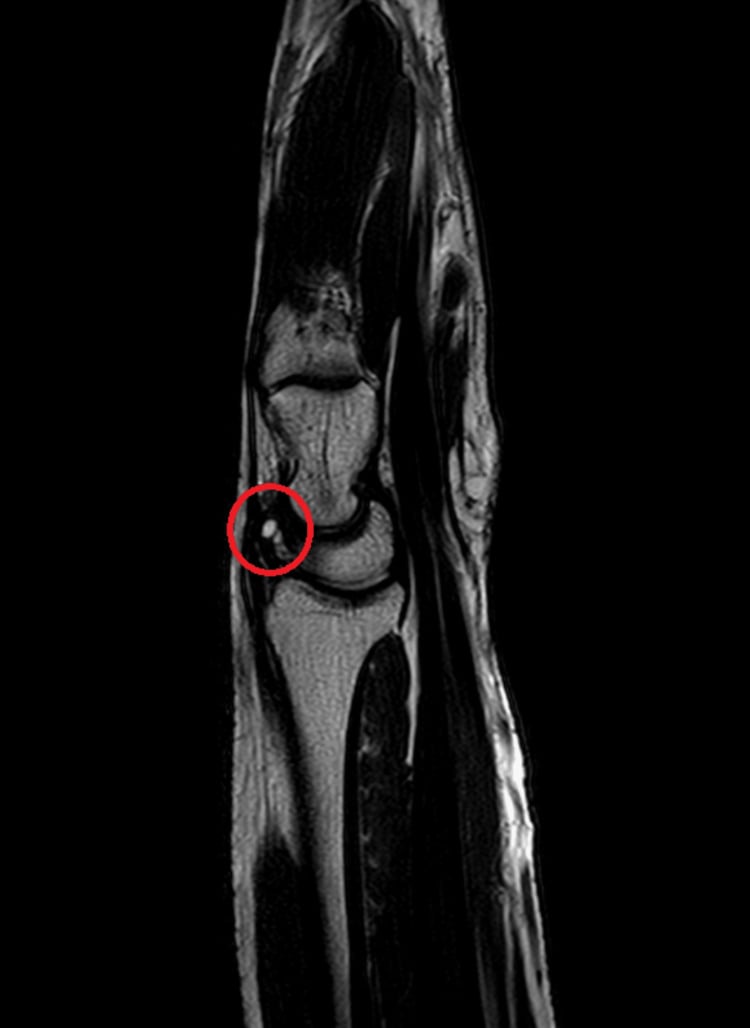
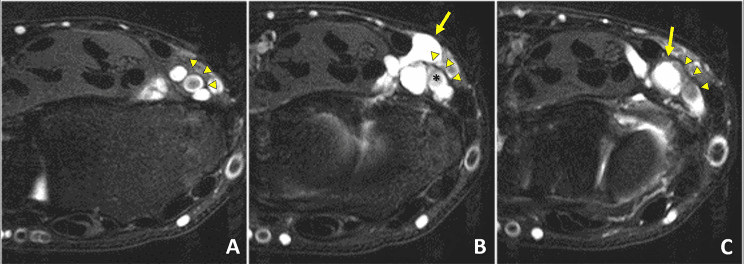
Occult ganglion. There is no visible or palpable mass, only dorsal wrist pain and tenderness over the scapholunate ligament. MRI shows a small cyst within the scapholunate ligament; the example below is a 4-mm ganglion arising from the dorsal band of the ligament. Treatment is arthroscopic or open debridement of the ligament.
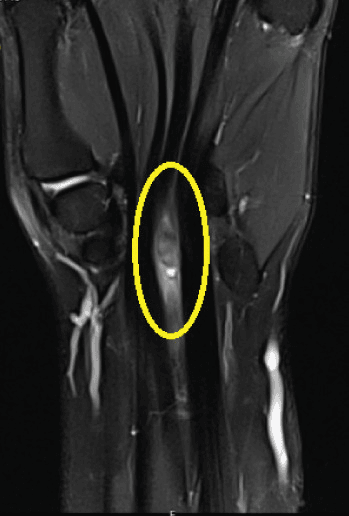
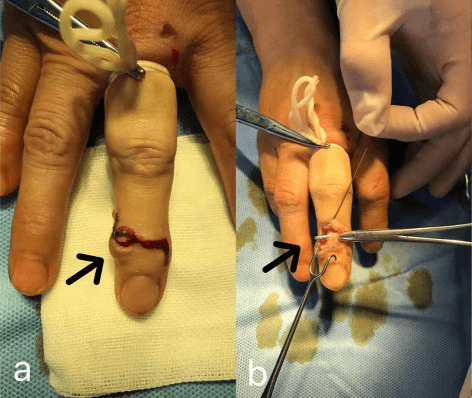
Flexor tendon sheath ganglion. On the volar digit, the retinacular cyst (seed ganglion) arises from the flexor tendon sheath. At the wrist a deep ganglion may also track within the flexor-tendon compartment.
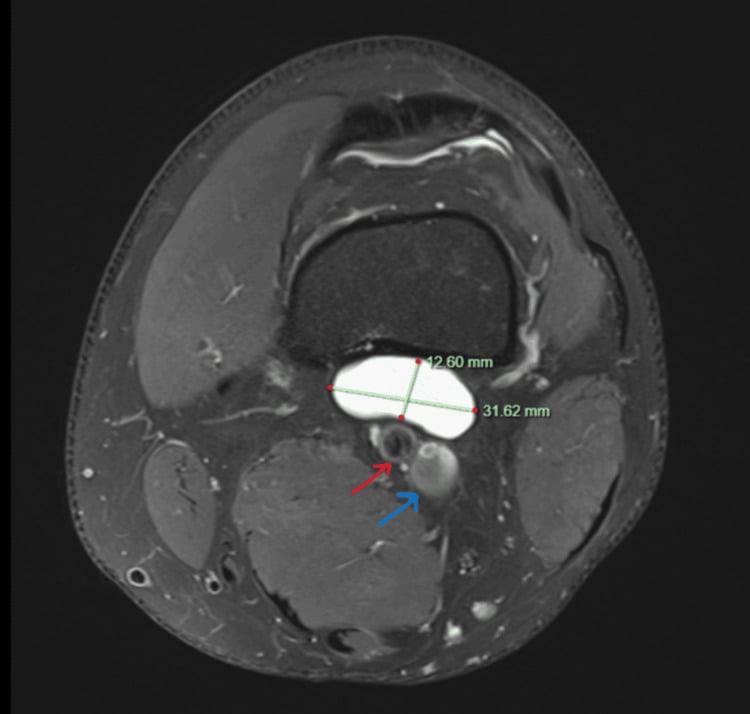
Pathophysiology and Aetiology
A ganglion is a pseudocyst. It has no true epithelial or synovial lining; the wall is compressed fibrous tissue (collagen), and a stalk or pedicle connects it to the joint capsule or tendon sheath, though it may or may not communicate with a joint or tendon sheath. The contents are thick, clear and gelatinous, a high-viscosity gel of mucopolysaccharides (hyaluronic acid, glucosamine) that is not synovial fluid and carries more mucin. The fluid is sterile unless the cyst has been infected after aspiration.
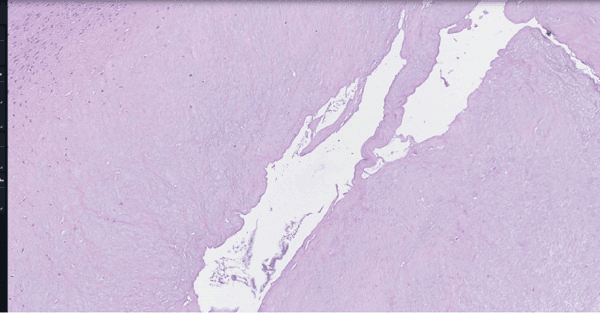
A true synovial cyst has a synovial lining. It is lined by synovial (mesothelial) cells, always communicates with a synovium-lined space, and contains genuine synovial fluid. The spinal juxtafacet cyst (from a facet joint) and the popliteal Baker's cyst (from the gastrocnemius-semimembranosus bursa) are true synovial cysts; the dorsal wrist ganglion and the DIP mucous cyst are ganglia.
Why the terms blur. The two overlap clinically and on imaging and the names are used loosely, but histology is the discriminator: a synovial cell lining means synovial cyst, its absence means ganglion. This is why "juxtafacet cyst" is the safer umbrella term for facet-related cysts, which may be either.
How a ganglion forms and grows. Degeneration of connective tissue produces mucopolysaccharides, and the thick gelatinous fluid accumulates in the cavity. The stalk acts as a one-way valve, letting fluid in but not out, so the cyst enlarges with joint motion and does not drain back to the joint. The joint connection is also why recurrence is common if the stalk is not excised.
Rupture. Trauma or pressure can rupture the cyst into the soft tissues. The mass disappears suddenly, but often recurs.
Aetiology. The exact cause remains incompletely understood. The theories:
- Trauma - repetitive microtrauma causes mucinous degeneration
- Joint degeneration - osteoarthritis or ligament laxity
- Herniation - synovium herniates through the joint capsule
Whichever is right, the ganglion is a mucinous degenerative lesion, not an inflammatory or neoplastic one.
Clinical Presentation and Assessment
The ganglion history. A painless fluctuant swelling that has grown slowly over months to years, on the dorsal or volar wrist or at the finger (DIP joint). It is usually asymptomatic, but a large cyst may hurt, and the size fluctuates, worse with activity. There is usually no trauma, which helps rule out a haematoma.
Examination. A visible fluctuant mass, soft to firm, mobile and non-tender, near a joint or tendon sheath. Range of motion is usually normal unless the cyst is large, and the neurovascular examination is intact, although volar ganglia may compress a nerve or artery.
Transillumination. Shine a penlight through the mass in a dark room. A ganglion transilluminates because light passes through fluid; solid masses (GCTTS, lipoma, neuroma) do not. It is the pathognomonic clinical sign, and this bedside test distinguishes cystic from solid masses with high accuracy.
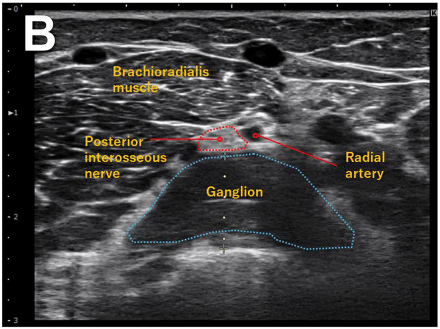
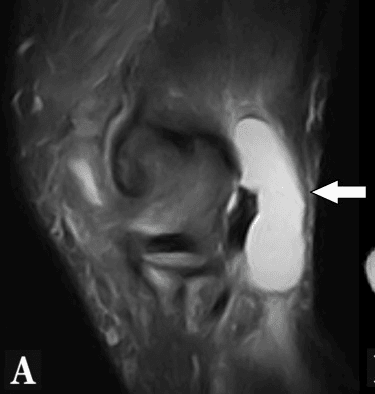
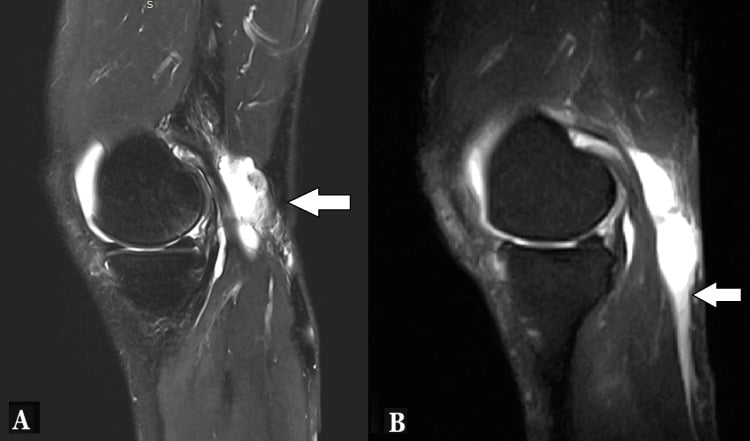
The Baker's cyst. Fullness or a mass in the popliteal fossa with posterior knee discomfort, alongside knee pain and mechanical symptoms from the meniscal tear or osteoarthritis behind it. A ruptured cyst gives acute calf pain and swelling that mimics a DVT, which ultrasound excludes.
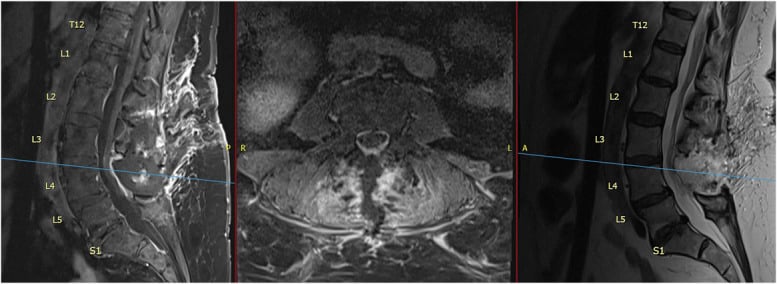
The spinal synovial cyst. Chronic lumbar back pain with radiculopathy: leg pain, numbness and weakness in a dermatomal distribution, and neurogenic claudication with walking if there is stenosis. Examination finds a positive straight leg raise, dermatomal sensory loss and weakness.
Imaging and Diagnosis
Most ganglia are diagnosed clinically. A fluctuant mass that transilluminates is a ganglion, and the typical presentation needs no imaging. Plain radiographs are normal (they rule out a bone lesion). When more is needed, the sequence is:
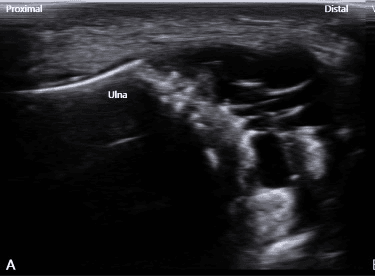
- Ultrasound, if the diagnosis is uncertain - an anechoic cyst with posterior acoustic enhancement, over 90% sensitive for ganglion. It is cheap and quick and shows the relationship to vessels, which matters for volar ganglia.
- MRI, for the occult ganglion or surgical planning - high signal on T2, low on T1, well-defined margins. It shows the small cyst within the scapholunate ligament and defines the stalk for complete excision, although a negative scan does not exclude an occult ganglion.
- Aspiration, diagnostic and therapeutic - thick, clear, gelatinous fluid is pathognomonic. Send it for cell count, culture if infection is suspected, and cytology if malignancy is a concern or the fluid is atypical. Aspiration alone cures 30-50%.
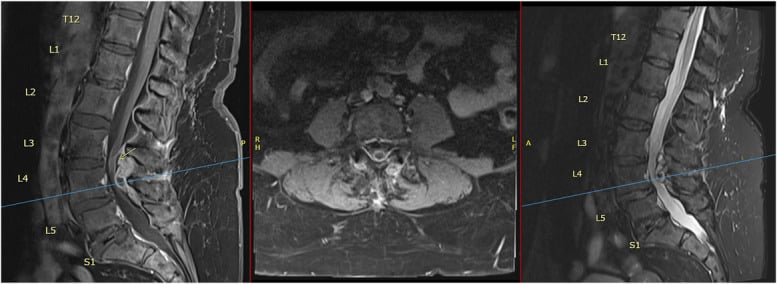
The spinal cyst is an MRI diagnosis. It appears as a cystic mass adjacent to the facet joint, bright on T2, compressing the nerve root or thecal sac.
Differential Diagnosis
The critical distinction is cystic (ganglion, abscess) versus solid (GCTTS, lipoma, neuroma), and transillumination makes it.
- Key Distinguishing Features
- Solid mass, does NOT transilluminate, firm/rubbery
- Imaging/Clinical Differences
- MRI low signal T1/T2 (haemosiderin), solid on US
- Key Distinguishing Features
- Soft, mobile, does not transilluminate, painless
- Imaging/Clinical Differences
- MRI high signal T1 (fat), fat on US
- Key Distinguishing Features
- Painful (Tinel's sign), does not transilluminate, nerve distribution
- Imaging/Clinical Differences
- MRI low to intermediate signal, solid
- Key Distinguishing Features
- MALIGNANT, painful, rapid growth, young adults
- Imaging/Clinical Differences
- Heterogeneous MRI signal, invasion, calcification
- Key Distinguishing Features
- Erythema, warmth, fever, fluctuant, history of trauma/infection
- Imaging/Clinical Differences
- US/MRI shows fluid collection with rim enhancement
Management and Treatment
The ganglion is managed stepwise, observation, then aspiration, then excision, but the numbers behind each step are soft and should be quoted honestly. The Baker's cyst and the spinal cyst follow different rules.
Observation. First-line for the asymptomatic or minimally symptomatic ganglion, and a legitimate option even for the symptomatic. The protocol:
- Educate - it is benign, not cancer, and over half resolve on their own. It may fluctuate in size, and may disappear and recur.
- Modify activity - avoid repetitive wrist flexion and extension, which may enlarge the cyst. A wrist splint can be used if symptomatic and reduces the cyst in some.
- Reassess at 3-6 months - intervene for persistent symptoms, growth or patient preference.
Aspiration. For the symptomatic ganglion in a patient who prefers a non-surgical option. Consent for recurrence of over half and an infection risk under 1%. Local anaesthesia is optional, and an 18-gauge needle is needed because the fluid is thick. A steroid injection is optional and has no proven benefit for recurrence. An optional splint for 1-2 weeks follows, with review at 4-6 weeks for recurrence. Recurrence is high because the stalk remains intact.
Excision. For the symptomatic ganglion, failed aspiration, or a patient who wants definitive treatment. MRI is optional to define the stalk, and the anaesthetic is local with sedation or a regional block. Consent for recurrence, neurovascular injury, stiffness and scar. The steps:
- Transverse incision over the ganglion, dorsal or volar, in a skin crease
- Identify and protect the neurovascular structures, especially the radial artery beside a volar ganglion
- Dissect the cyst wall from the surrounding tissues
- Trace the stalk or pedicle to its origin in the joint capsule
- Excise the cyst with its stalk and a portion of joint capsule
- For a dorsal ganglion, debride the scapholunate ligament attachment, a critical step
- Close skin only; no drain is needed
The stalk is the technical point. Complete excision of the cyst with its stalk and a portion of capsule is the single most important technical factor against recurrence: the stalk connects the cyst to the joint, and if it is not excised fluid can re-accumulate from the joint.
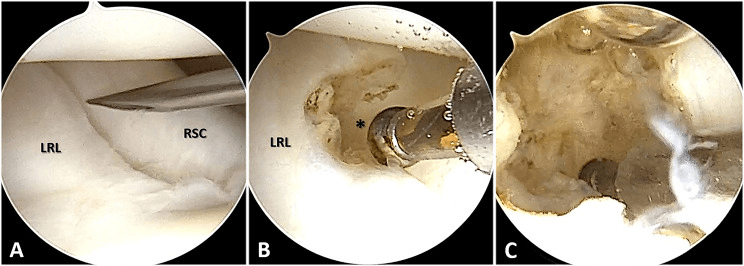
Arthroscopic excision. For a volar ganglion, the 3-4 viewing and 1-2 working portals expose the interval between the long radiolunate and radioscaphocapitate ligaments before controlled shaver and radiofrequency ganglionectomy.
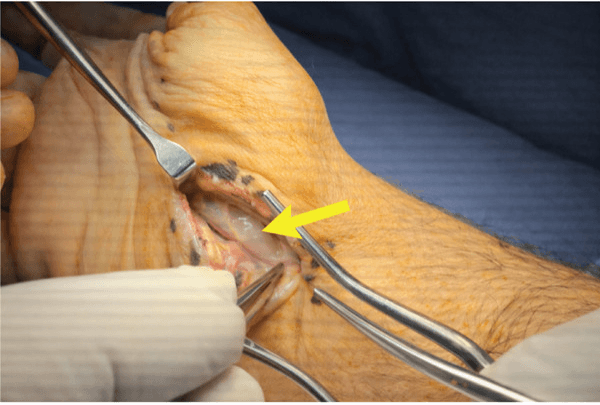
Recurrence after excision. It is reported anywhere from ~5% to 39%, the lowest of the three options, and the spread is a measurement artefact rather than a technical one.
- ~5% comes from surgeon-reported historical series with short follow-up, when the stalk and a capsular cuff are removed (Thornburg).
- 39% comes from a prospective cohort asking patients directly at a mean of 70 months (Dias, 40 of 103).
Even a complete excision of the stalk with a cuff of capsule does not buy the 95% cure the older figure implies. Excision remains the definitive treatment and gives the highest patient satisfaction; counsel from the higher figure, not the lower one.
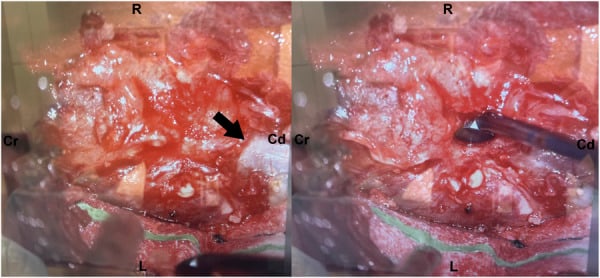
Complications of Treatment
Recurrence is the major complication, which is why complete excision with the stalk matters.
- Incidence/Risk Factors
- ~5-39% after excision, over 50% after aspiration
- Prevention/Management
- Complete excision with stalk and capsule
- Incidence/Risk Factors
- Volar ganglia near radial artery and median nerve
- Prevention/Management
- Identify and protect neurovascular structures
- Incidence/Risk Factors
- Prolonged immobilisation, scar adhesions
- Prevention/Management
- Early range of motion (1-2 weeks)
- Incidence/Risk Factors
- Under 1% risk (aspiration or excision)
- Prevention/Management
- Sterile technique, antibiotics if indicated
- Incidence/Risk Factors
- All surgical excisions leave scar
- Prevention/Management
- Transverse incision in skin crease
Volar wrist ganglia are near the radial artery (and sometimes median nerve). Aspiration or excision carries risk of arterial injury (bleeding, pseudoaneurysm, thrombosis). Always identify radial artery pulsation, use ultrasound guidance for aspiration if concerned, and protect radial artery during surgical excision. Allen test pre-operatively to confirm ulnar collateral circulation.
Postoperative Care and Rehabilitation
Early range of motion is critical to prevent wrist stiffness after ganglion excision. The protocol:
- Days 0-14 - splint in wrist neutral, elevate, oral analgesia, keep the dressing clean and dry.
- Weeks 2-4 - remove the splint at 1-2 weeks and start early active range of motion; scar massage once sutures are out (10-14 days); light activities of daily living, with return to activities at 2-4 weeks.
- Weeks 4-6 - progressive strengthening and return to unrestricted activities at 4-6 weeks. The scar continues to mature for 6-12 months.
Surveillance. Most recurrences occur within 1 year. A recurrence can be re-excised or observed.
Outcomes and Prognosis
Overall outcomes are excellent, with high patient satisfaction whichever treatment is chosen.
- Recurrence Rate
- Over half resolve spontaneously (58% at 6 years)
- Advantages/Disadvantages
- Advantages: No risk. Disadvantages: May not resolve, time
- Recurrence Rate
- Over 50% recurrence (50-58%)
- Advantages/Disadvantages
- Advantages: Office-based, quick. Disadvantages: High recurrence
- Recurrence Rate
- ~5% to 39% recurrence
- Advantages/Disadvantages
- Advantages: Lowest recurrence of the three, and highest patient satisfaction even when it recurs. Disadvantages: Surgery, scar, stiffness risk; the ~5% figure is surgeon-reported short-term and overstates cure
Why satisfaction is highest after excision. In the prospective cohort satisfaction was higher after excision even in the patients whose ganglion recurred, so it is not simply a function of cure. It tracks having had the problem definitively addressed rather than the anatomical result, which is a reasonable thing to offer a patient, provided the recurrence risk is quoted honestly.
Guidelines, Registries & Global Practice
- Most common hand/wrist mass worldwide (around 60-70% of hand soft-tissue masses)
- Demographics: peak 20-50 years, female predominance roughly 3:1
- Distribution: dorsal wrist most common, then volar wrist, then DIP mucous cysts
- Popliteal cysts rise with age and OA prevalence; common incidental MRI finding globally
- No dedicated implant registry (no implant used) - evidence is from cohorts and a small number of RCTs
- Best comparative data: Dias 2007 cohort (natural history) and Kang 2008 RCT (arthroscopic vs open)
- Popliteal-cyst surgical evidence pooled only in retrospective meta-analysis (Zhou 2016)
- Spinal synovial cyst evidence is observational (e.g. Page 2021): decompression +/- fusion
- Position on Ganglion / Synovial Cyst
- Reassurance and observation first-line for asymptomatic ganglia; clinical diagnosis, imaging only if atypical
- Practical Emphasis
- Counsel on high spontaneous-resolution and recurrence rates before any procedure
- Position on Ganglion / Synovial Cyst
- Stepwise observation to aspiration to excision; excision reserved for symptomatic or failed conservative care
- Practical Emphasis
- Complete stalk and capsular-cuff excision to minimise recurrence
- Position on Ganglion / Synovial Cyst
- Many ganglia managed in primary/community care; surgery for pain, function or nerve compression
- Practical Emphasis
- Watchful waiting actively offered; avoid unnecessary MRI
- Position on Ganglion / Synovial Cyst
- Decompression with cystectomy effective; add fusion if instability/spondylolisthesis
- Practical Emphasis
- No single mandated algorithm - decision individualised to facet/instability findings
- Ready access to ultrasound and MRI for atypical or occult lesions
- Arthroscopic excision available where expertise exists (equivalent recurrence to open)
- Hand therapy for structured post-operative ROM and scar management
- Clinical diagnosis and transillumination remain the mainstay - imaging often unnecessary
- Reassurance/observation is a high-value, zero-cost first-line strategy
- Open excision with complete stalk removal is the practical definitive option when surgery is indicated
Document regardless of healthcare system:
- Natural history: high spontaneous-resolution rate - observation is a valid first-line choice that MUST be offered
- Recurrence risk: substantial after aspiration, lower but non-zero after complete excision
- Neurovascular injury: volar ganglia lie adjacent to the radial artery and median nerve (Allen test, protect the artery)
- Stiffness: prevent with early ROM; scar: visible hand scar is a recognised cosmetic trade-off
Recurring litigation themes worldwide: proceeding to surgery without offering observation, radial-artery injury during volar excision, and failure to counsel recurrence pre-operatively.
Synovial/ganglion cysts are common and benign across all regions; the globally consistent message is reassurance first, clinical diagnosis, and complete stalk excision only when intervention is genuinely indicated.
Related pages: this page is the umbrella. Three of the four lesions it introduces have a fuller dedicated treatment, and you should go there for anything beyond the overview. Ganglion Cysts is the definitive hand and wrist page - aspiration technique, recurrent and revision disease, and the same corrected recurrence figures. Baker's Cyst (Popliteal Cyst) covers the knee lesion, including the paediatric primary cyst that behaves nothing like the adult secondary one. Mucous Cysts covers the digital lesion, its nail-matrix effects and osteophyte management. Intraosseous Ganglion is the intra-bone variant that appears as a lucent juxta-articular lesion and enters a tumour differential rather than a lump differential. For the spinal cyst, Degenerative Spondylolisthesis and Facet Arthropathy supply the instability question that decides decompression versus fusion, and Lumbar Radiculopathy is the presentation. Carpal Boss is the firm dorsal wrist lump that does not transilluminate and is the commonest thing mistaken for a dorsal ganglion, while MRI Soft Tissue Interpretation and Systematic Approach to Wrist and Hand Imaging cover the sequences that separate a cyst from a solid mass.
MCQ Practice Points
Q: What percentage of hand masses are ganglion cysts? A: 60-70% - Ganglion cyst is the most common hand mass. Dorsal wrist location accounts for 60-70% of wrist ganglia (arise from scapholunate ligament). Second most common hand tumor overall is giant cell tumor of tendon sheath (GCTTS) at 10%.
Q: What is the pathognomonic clinical test for ganglion cyst? A: Transillumination test - Shine penlight through mass in dark room. Ganglion cyst transilluminates (light passes through fluid). Solid masses (GCTTS, lipoma, neuroma) do NOT transilluminate. This bedside test distinguishes cystic from solid masses with high accuracy.
Q: What percentage of ganglion cysts resolve spontaneously? A: Over half - 58% of untreated dorsal wrist ganglia had resolved at a mean of 70 months in the carded prospective cohort, and the same study found no significant symptomatic advantage of excision or aspiration over doing nothing. This justifies observation as first-line and makes it a legitimate option even for the mildly symptomatic.
Q: What is the recurrence rate after ganglion cyst aspiration vs excision? A: Aspiration: over 50% (58% in Dias, greater than 50% in Thornburg). Excision: quoted anywhere from ~5% to 39% - and the honest answer is to give the range and say why it exists. The ~5% figure comes from surgeon-reported historical series with short follow-up after complete stalk excision; the 39% comes from a prospective cohort that asked 103 patients directly at a mean of 70 months. Aspiration recurs more because the stalk remains intact, allowing fluid to re-accumulate from the joint. Counsel patients from the higher figure.
Q: What is the key principle in managing Baker's (popliteal) cyst? A: Treat the underlying knee pathology, not the cyst. Baker's cyst is a secondary phenomenon caused by increased intra-articular pressure transmitted through a one-way valve from knee effusion (OA, meniscal tear, RA). In a meta-analysis of surgical series, success was highest (96.7%) when the cyst-joint communication was enlarged and intra-articular pathology addressed, rather than the cyst simply closed/excised. Treating the joint is what makes resolution durable.
Exam Viva Scenarios
Practise clinical reasoning and management decisions out loud
“A 32-year-old woman presents with a 6-month history of a painless mass on the dorsal wrist. On examination, you find a 2cm fluctuant, mobile, non-tender mass over the dorsal wrist that transilluminates. What is your diagnosis and management?”
“A 58-year-old man with known knee osteoarthritis presents with new posterior knee swelling and fullness. Ultrasound confirms a 4cm popliteal (Baker's) cyst. He requests treatment for the cyst. How do you manage?”
“A 28-year-old gymnast presents with 12 months of dorsal wrist pain. No visible or palpable mass. Tenderness over scapholunate ligament area. Plain radiographs normal. How do you proceed?”
Key Features
- Most common hand mass (60-70% of all hand masses)
- Fluid-filled pseudocyst (no epithelial lining, fibrous wall)
- Contains thick, clear, mucinous fluid (mucopolysaccharides)
- Transilluminates (pathognomonic clinical sign)
Locations
- Dorsal wrist (60-70% of wrist ganglia) - arises from scapholunate ligament
- Volar wrist (20-30%) - radiocarpal or scaphotrapezial joint
- DIP joint (mucous cyst) - associated with OA (Heberden's node)
- Popliteal (Baker's cyst) - posterior knee, secondary to knee pathology
Natural History
- Over half resolve spontaneously without treatment (58% at 6 years)
- Observation first-line for asymptomatic ganglia
- Size fluctuates (worse with activity)
- Recurrence: over 50% after aspiration, ~5-39% after excision (figure depends on who reports it and when)
Treatment Algorithm
- Asymptomatic: Observation (reassure benign, spontaneous resolution)
- Symptomatic: Aspiration (over 50% recurrence) or Excision (~5-39% recurrence)
- Excision technique: Complete excision with stalk and capsule (minimize recurrence)
- Baker's cyst: Treat underlying knee pathology, not the cyst
Surgical Pearls
- Transverse incision in skin crease for cosmesis
- Protect radial artery and median nerve (volar ganglia)
- Excise with stalk traced to joint capsule origin
- Dorsal ganglia: Debride scapholunate ligament attachment
Evidence Base and Key Studies
Natural History of Untreated Dorsal Wrist Ganglia (Landmark Prospective Cohort)
- Prospective cohort of 283 patients (236 responders, mean 70-month follow-up) comparing excision, aspiration and no treatment
- Spontaneous resolution of untreated ganglia: 58% (23/55)
- Recurrence: 58% after aspiration (45/78) and 39% after excision (40/103)
- Symptom resolution similar across all three groups (p greater than 0.3)
- Patient satisfaction highest after surgical excision, even if the ganglion recurred
Ganglions of the Hand and Wrist (Foundational Review)
- Narrative review establishing the modern observation-aspiration-excision treatment paradigm
- Recurrence after aspiration greater than 50% at most sites, but under 30% for flexor tendon sheath cysts
- Surgical excision recurrence only ~5% IF the cyst stalk and a small cuff of joint capsule are removed
- Observation acceptable in most cases; aggressive treatment for pain, functional limitation, nerve compression or impending mucous-cyst ulceration