Malignant Soft Tissue Sarcoma | t(X;18) SYT-SSX Translocation | Young Adults Near Joints
- About 5-10% of all soft tissue sarcomas, and one of the commonest non-rhabdomyosarcoma soft tissue sarcomas of adolescents and young adults; the old 'third commonest after liposarcoma and MFH' ranking does not hold for this age group, and MFH is an abandoned term
- t(X;18) translocation creating SYT-SSX fusion is pathognomonic (present in over 95%)
- Name is misleading - does NOT arise from synovium but occurs near joints in 60-70%
- Calcification present in 30% on imaging - rare for soft tissue sarcomas
- Wide excision plus adjuvant chemotherapy and radiation is standard multimodal treatment
- “SYT-SSX1 carries a worse unadjusted prognosis than SYT-SSX2, but the effect disappears once you stratify for disease status at presentation: on whole-cohort multivariate analysis only STAGE and TUMOUR SIZE were independent, and fusion type only within localised disease. Biphasic versus monophasic histology had no impact on survival
- “Lung is most common metastatic site (90%), bone metastases in 10-20%
- “Poorly differentiated subtype has 5-year survival under 20% versus 60% for well-differentiated
Overview and Epidemiology
Synovial sarcoma is a malignant soft tissue tumour defined by the t(X;18) SS18-SSX chromosomal translocation. Despite its name it does not arise from joint synovium, and it shows no synovial differentiation. It accounts for 5-10% of all soft tissue sarcomas and is one of the commonest non-rhabdomyosarcoma soft tissue sarcomas of adolescents and young adults.
Retire the old ranking. The line "third commonest after liposarcoma and malignant fibrous histiocytoma" fails on two counts. Liposarcoma and undifferentiated pleomorphic sarcoma peak in the fifth to seventh decades, so the ranking does not describe the young population synovial sarcoma actually affects, and malignant fibrous histiocytoma is an abandoned diagnosis, reclassified as undifferentiated pleomorphic sarcoma.
The name. The tumour was named in the early 20th century for its microscopic resemblance to synovial tissue and its frequent occurrence near joints. Modern molecular studies confirm that it arises from primitive mesenchymal cells, and although 60-70% lie near a joint, it can occur anywhere: up to 30% occur away from joints entirely.
Who. Adolescents and young adults, with a peak at 15-35 years and an equal sex distribution. Children under 15 account for 15-20% of cases, and the tumour is uncommon over 50.
Where. The lower limb carries 60-70%, most often around the knee, ankle and foot, and the upper limb 15-20% (hand, wrist, forearm). The table breaks the sites down further, with the typical presentation and prognosis of each.
- Frequency
- 30-40%
- Typical Presentation
- Deep-seated mass near joint
- Prognostic Consideration
- Standard prognosis, limb salvage usually feasible
- Frequency
- 20-30%
- Typical Presentation
- Superficial or deep mass, often calcified
- Prognostic Consideration
- Good prognosis, smaller tumours at presentation
- Frequency
- 10-15%
- Typical Presentation
- Slow-growing mass, may mimic ganglion
- Prognostic Consideration
- Good prognosis, smaller size
- Frequency
- 10-15%
- Typical Presentation
- Large at diagnosis, deep location
- Prognostic Consideration
- Worse prognosis, difficult margins
- Frequency
- 5-10%
- Typical Presentation
- Rare, complex anatomy
- Prognostic Consideration
- Worse prognosis, margin challenges
Pathophysiology and Molecular Biology
Origin. Synovial sarcoma arises from pluripotent mesenchymal stem cells with the capacity for epithelial differentiation.
The translocation. The t(X;18) translocation is present in over 95% of synovial sarcomas and is pathognomonic. It fuses the SS18 gene (formerly SYT) on chromosome 18 to SSX1 or SSX2 on the X chromosome. The SYT-SSX fusion protein functions as an aberrant transcription factor, disrupting chromatin remodelling and gene expression, and it drives the tumour.
The fusion variants. There are two main fusion types, and each travels with a histological pattern:
- SYT-SSX1, about 61-65%: almost all biphasic tumours carry it
- SYT-SSX2, about 35-37%: almost all SSX2 tumours are monophasic, and the male-to-female ratio shifts to roughly 1:2
- SYT-SSX4, a rare variant, under 1%
Fusion type carries prognostic information that is real but conditional, and it is not the same variable as histology; both points are set out under Prognosis.
Growth and spread. The tumour is slow-growing initially, then progresses rapidly, which is why symptoms have often run for months to years before diagnosis. It infiltrates along fascial planes and neurovascular bundles, so wide margins are essential and neurovascular sacrifice may be needed. Metastatic potential is high: 40-50% metastasise within 5 years, and 5-10% already have metastases at presentation. The pattern of metastasis:
- Lung - 90% of metastases, the most common site
- Bone - 10-20% (vertebrae, pelvis, ribs)
- Lymph nodes - 5%, rare but a higher rate than other sarcomas
Classification and Histology
The WHO recognises three histological subtypes.
Biphasic (20-30%). The classic appearance, with epithelial and spindle cell components both clearly visible. Gland-like structures of columnar or cuboidal cells are intimately admixed with monotonous spindle cells in fascicles, yet the two components remain clearly distinct. When both are prominent the pattern is diagnostic, which makes the diagnosis easier. Almost all biphasic tumours carry SYT-SSX1 (all 12 in Kawai 1998).
Monophasic (60-70%). Spindle cells only on H&E: monotonous, uniform cells with a haemangiopericytoma-like vascular pattern. The epithelial component is inconspicuous or absent on routine staining but may be demonstrated by immunohistochemistry. SYT-SSX2 is enriched here (all SSX2 tumours in Kawai 1998 were monophasic).
Monophasic synovial sarcoma can be difficult to diagnose histologically as it resembles other spindle cell sarcomas. Molecular testing for t(X;18) is essential when synovial sarcoma is in the differential diagnosis. Immunohistochemistry (EMA, cytokeratin positive) supports the diagnosis but is not specific.
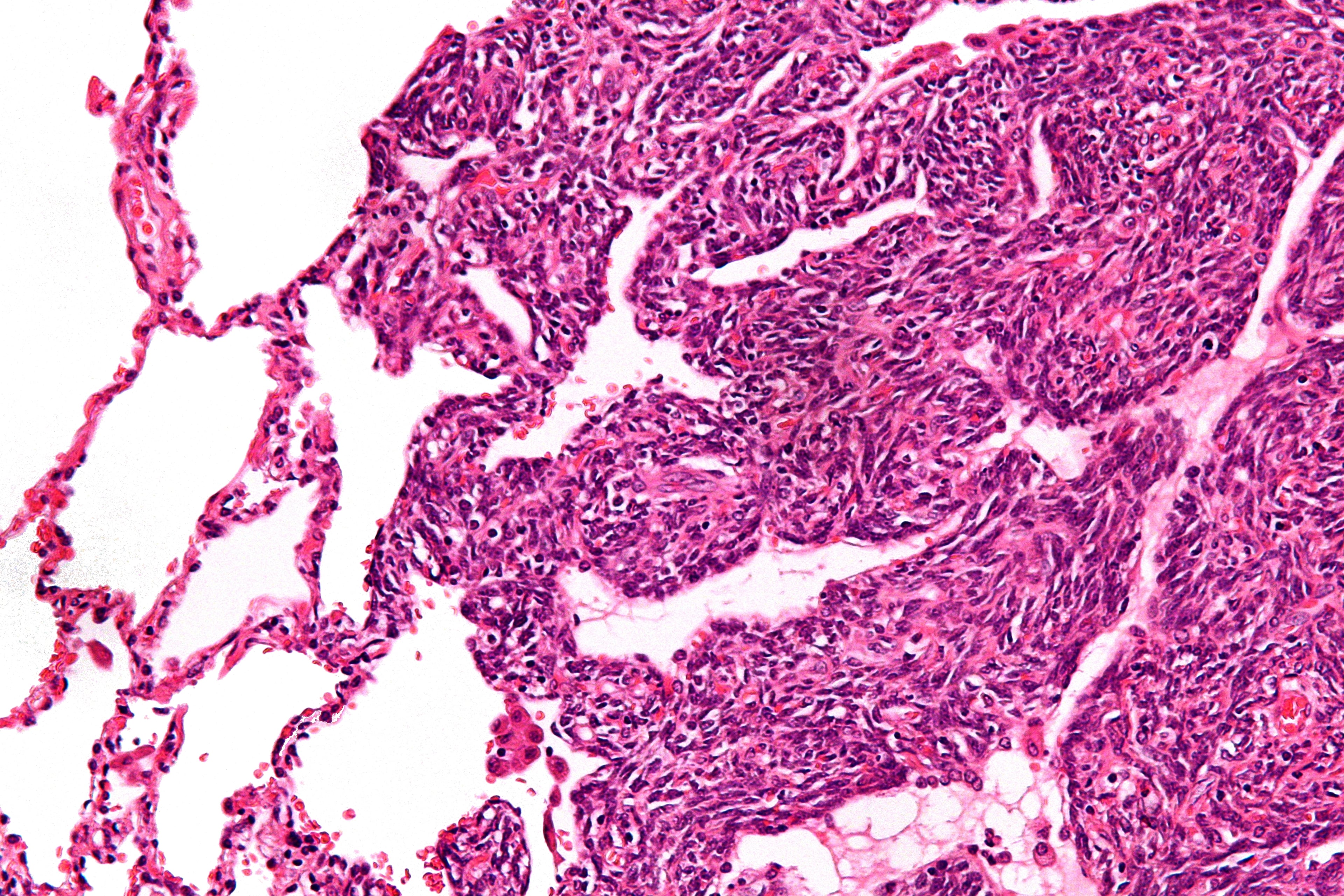
Poorly differentiated (10-15%). A high-grade variant with areas of dedifferentiation. High-grade round/small-cell sarcoma areas make up more than 50% of the tumour, with pleomorphic cells, a high mitotic rate and sometimes necrosis. It can resemble other high-grade sarcomas, and the t(X;18) translocation, still present, is what confirms the diagnosis.
Poorly differentiated synovial sarcoma behaves like a high-grade sarcoma, with the worst prognosis of all subtypes: a metastatic rate of 70-80% and 5-year survival under 20%. It requires aggressive multimodal treatment with neoadjuvant chemotherapy, and despite treatment the prognosis remains poor.
Biphasic against monophasic is not a prognostic question. Histological subtype had no impact on survival in the Ladanyi series (P=0.8). Where biphasic tumours seem to do worse, the outcome is tracking the SSX1 fusion and its association with metastatic presentation, not the biphasic pattern; the subtype that behaves badly is the poorly differentiated one.
Immunohistochemistry
- Positive Rate
- 70-100%
- Diagnostic Value
- Supportive but not specific
- Positive Rate
- 60-90%
- Diagnostic Value
- Supportive but not specific
- Positive Rate
- 90-95%
- Diagnostic Value
- Sensitive marker, helps distinguish from other sarcomas
- Positive Rate
- 90%
- Diagnostic Value
- Supportive but non-specific
- Positive Rate
- 60-70%
- Diagnostic Value
- May cause confusion with Ewing sarcoma
The conventional panel. Of these markers, nuclear TLE1 staining is the most sensitive, but none is specific: TLE1 in particular is also positive in MPNST and some other sarcomas. On a conventional panel, molecular confirmation of the fusion by RT-PCR or FISH remains the gold standard, and it should be requested on every suspected case.
The fusion-specific antibody. The genuine recent advance is a monoclonal antibody to the SS18-SSX fusion junction, clone E9X9V. It gives strong, diffuse nuclear staining only when the fusion protein is present, and in validation studies its specificity approaches 100% and its sensitivity is roughly 95% for synovial sarcoma, clearly outperforming TLE1. A companion SSX (C-terminus) antibody can be run alongside it, and concordant positivity further increases confidence.
What this changes. A positive fusion-specific stain can confirm synovial sarcoma on a small core biopsy within hours, and in many laboratories it now substitutes for FISH/RT-PCR in classic cases. Molecular testing is then reserved for equivocal stains or for when the fusion variant (SS18-SSX1 versus SSX2) is wanted. Asked how you would confirm the diagnosis, the modern answer is no longer just "TLE1 then molecular".
Differential Diagnosis
Monophasic synovial sarcoma is a classic mimic of other monomorphic spindle cell tumours. The combination of clinical context, immunohistochemistry and molecular testing resolves the differential.
- Distinguishing Features
- Often arises from a nerve or in neurofibromatosis type 1; S100 focal, loss of H3K27me3
- Key Discriminator
- No SS18-SSX fusion; can be TLE1 positive so molecular test is decisive
- Distinguishing Features
- Uniform herringbone spindle cells, EMA and cytokeratin negative
- Key Discriminator
- Lacks SS18-SSX fusion and consistent TLE1 positivity
- Distinguishing Features
- Staghorn vessels, CD34 positive, STAT6 nuclear positive
- Key Discriminator
- NAB2-STAT6 fusion, not SS18-SSX
- Distinguishing Features
- Small round blue cells, diffuse membranous CD99
- Key Discriminator
- EWSR1 rearrangement; poorly differentiated synovial sarcoma can overlap, so test both
- Distinguishing Features
- Blunt-ended nuclei, eosinophilic cytoplasm, SMA/desmin positive
- Key Discriminator
- Smooth muscle markers positive, no SS18-SSX fusion
- Distinguishing Features
- Slow growth near joints; can delay diagnosis
- Key Discriminator
- Imaging features and biopsy with molecular testing exclude malignancy
A calcified soft tissue mass near a joint in a young adult is synovial sarcoma until proven otherwise. Do not be reassured by slow growth or a benign-sounding radiology report of myositis ossificans or tumoral calcinosis; biopsy with molecular testing is mandatory.
Clinical Presentation
History. Most patients present with a painless mass (60-70%). The mass is painful in 30-40% (larger tumours, neurovascular involvement), and joint symptoms (pain, stiffness) are reported in 30% when the tumour lies near a joint. Growth is slow, over months to years before diagnosis; rapid growth suggests a high-grade or poorly differentiated tumour.
Delay. The average time from symptom onset to diagnosis is 2-4 years. The slow growth and the location near a joint lead to misdiagnosis as a benign lesion such as a ganglion cyst, lipoma or tendon sheath tumour.
Any persistent soft tissue mass in a young adult should undergo imaging and biopsy.
Examination. The median size at diagnosis is 5cm. The mass is firm to hard, unlike a soft lipoma, and deep lesions are often fixed to fascia; 30-40% are tender on palpation. Skin changes are rare except over superficial lesions, and large tumours may show venous engorgement. A complete examination provides the baseline for treatment planning, so document:
- The location of the mass relative to the joint, and its relation to neurovascular structures
- Range of motion of the adjacent joint
- Neurovascular status distal to the mass, including signs of nerve compression or vascular compromise
- Muscle strength and function
- Regional lymph nodes (nodal metastases are rare but possible, in 5%)
- The chest (lung metastases are uncommon at presentation)
Investigations and Imaging
Plain radiographs. Essential as the initial imaging for every soft tissue mass, but a screening test only; MRI is required for definitive local staging. Beyond calcification, the film may show adjacent bone erosion if the tumour is large and juxta-osseous, the soft tissue mass itself if it is large enough, and, rarely, a periosteal reaction indicating bone involvement.
Calcification in a soft tissue mass is rare for sarcomas (under 10% overall) but is present in 30% of synovial sarcomas, appearing as stippled or curvilinear calcification on X-ray and CT. In a young adult with a soft tissue mass near a joint it should raise suspicion of synovial sarcoma.
MRI. The gold standard for local staging. Image the entire anatomical region from the joint above to the joint below, including the entire muscle compartment, and MRI then guides both the biopsy and the surgical plan. The protocol:
- T1-weighted - anatomical detail and tumour extent
- T2-weighted with fat suppression - high, fluid-like signal, multiloculated
- Post-contrast T1 with fat suppression - heterogeneous enhancement
- MRI Appearance
- T1 low to intermediate, T2 high (heterogeneous)
- Significance
- Reflects high fluid content and necrosis
- MRI Appearance
- Three signal intensities on T2 (fluid-like, intermediate, low)
- Significance
- Characteristic but not pathognomonic
- MRI Appearance
- Present in 30% (haemorrhagic areas)
- Significance
- Can mimic cystic lesion
- MRI Appearance
- Heterogeneous septal enhancement
- Significance
- Solid and cystic components
Staging for metastases. Complete staging before biopsy optimises treatment planning. The lung is the most common site, and a high-resolution CT chest looks for it. PET-CT is useful for detecting occult metastases and assessing treatment response, and a bone scan is added if bone metastases are suspected.
Biopsy. Never perform an excisional biopsy for a suspected sarcoma: it risks inadequate margins and tumour seeding.
- Core needle biopsy (14-16 gauge) preferred - minimally invasive
- Biopsy tract must be excisable at definitive surgery (longitudinal approach)
- Request molecular testing - RT-PCR or FISH for t(X;18) translocation
- Adequate tissue - multiple cores for histology and molecular studies
- Referral to a sarcoma centre before biopsy is ideal
Staging System
- Grade
- Low (G1)
- Size (T category)
- T1: 5cm or less
- 5-Year Survival
- 90%
- Grade
- Low (G1)
- Size (T category)
- T2: greater than 5 to 10cm
- 5-Year Survival
- 80%
- Grade
- Low (G1) T3, or High (G2-3) T1
- Size (T category)
- T3: greater than 10 to 15cm (G1), or T1: 5cm or less (G2-3)
- 5-Year Survival
- 70%
- Grade
- High (G2-3)
- Size (T category)
- T2: greater than 5 to 10cm
- 5-Year Survival
- 60%
- Grade
- High (G2-3)
- Size (T category)
- T3-T4: greater than 10cm
- 5-Year Survival
- 40-50%
- Grade
- Any
- Size (T category)
- Metastatic disease (M1)
- 5-Year Survival
- 10-20%
Reading the table. In the 8th edition the T category for extremity and trunk sarcoma is purely size-based (T1 up to 5cm, T2 over 5-10cm, T3 over 10-15cm, T4 over 15cm); depth was removed. The survival figures are conventional estimates, not stage-specific measurements from a single cohort. Most synovial sarcomas are intermediate to high grade (G2-G3) by virtue of their biology.
Management
The standard is multimodal. Wide surgical resection, chemotherapy and radiotherapy together. Unlike many soft tissue sarcomas, synovial sarcoma is chemosensitive, and ifosfamide-based chemotherapy improves survival, particularly for high-risk patients (larger than 5cm, high grade, deep). How large that benefit is remains the most debated question in the disease (see Controversies), so the intensity of each component is set by risk:
- Surgery - wide excision, with a 2cm margin as the goal
- Chemotherapy - ifosfamide-based, doxorubicin/ifosfamide in the matrix below
- Radiotherapy - 50-66 Gy, before or after surgery
Intensity follows risk. The full multimodal package is the high-risk pathway, with chemotherapy given both before and after surgery. For a low-risk tumour the margin aimed for is 1-2cm, adjuvant chemotherapy is controversial and considered case by case, and radiotherapy is given for a close margin or a local-risk concern.
- Surgery
- Wide excision (1-2cm margins)
- Chemotherapy
- Consider adjuvant (controversial)
- Radiation
- Postoperative if close margins
- Surgery
- Wide excision (2cm margins)
- Chemotherapy
- Neoadjuvant plus adjuvant (doxorubicin/ifosfamide)
- Radiation
- Preoperative or postoperative (50-66 Gy)
- Surgery
- Wide excision or consider amputation
- Chemotherapy
- Neoadjuvant plus adjuvant (aggressive regimen)
- Radiation
- Preoperative (tumour shrinkage)
- Surgery
- Wide excision of primary if feasible
- Chemotherapy
- Systemic chemotherapy (doxorubicin/ifosfamide)
- Radiation
- Palliative for local control
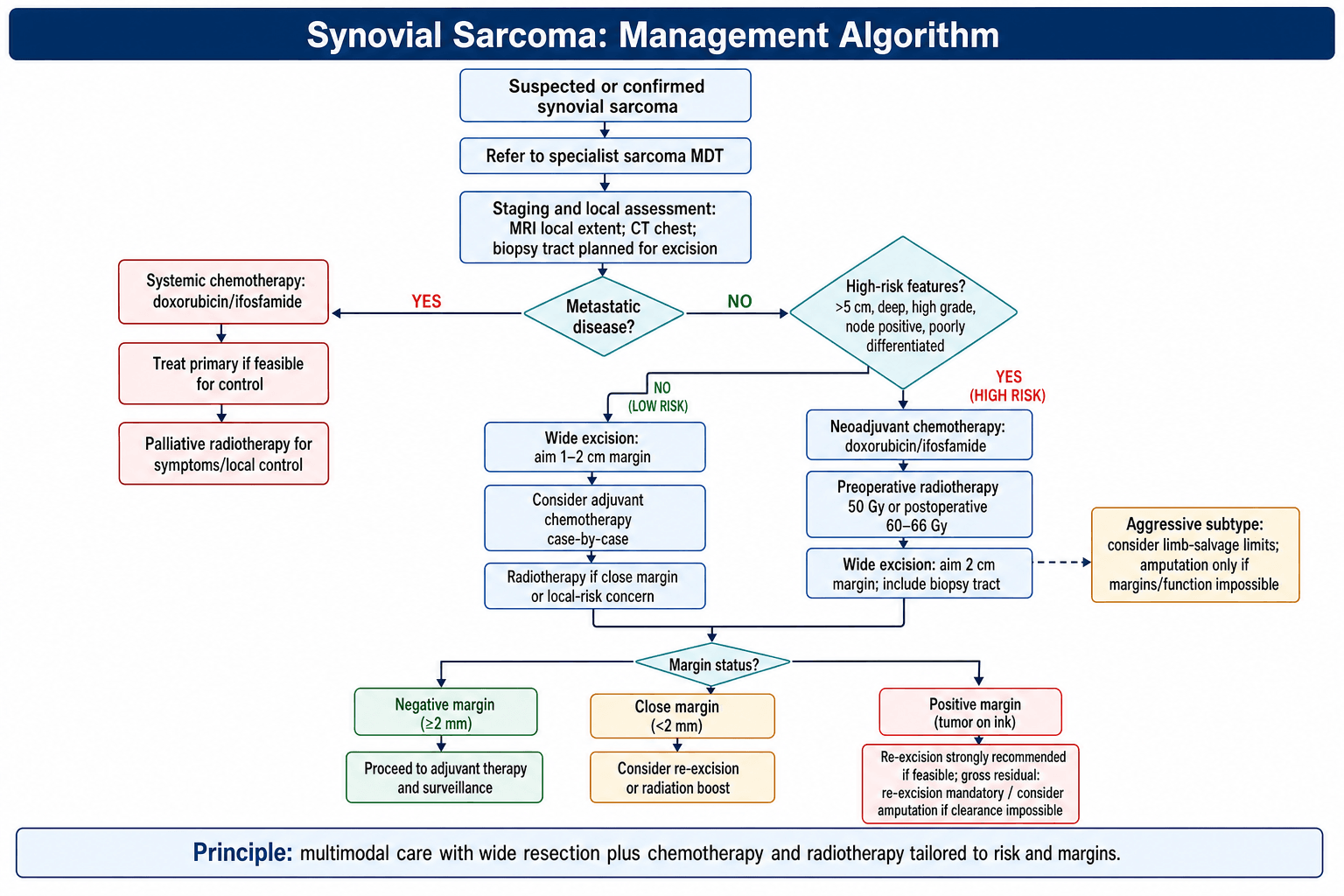
Preoperative or postoperative radiotherapy. Local control is equivalent either way (O'Sullivan, NCIC SR2), so the choice is a trade of early wound morbidity, worse with preoperative treatment, against late functional morbidity, worse with postoperative treatment. It is individualised at the sarcoma MDT. Preoperative radiotherapy is often favoured for large or deep tumours near critical structures, where field size and late function matter most.
- Preoperative
- Lower dose, about 50 Gy; smaller field treating only the tumour plus margin
- Postoperative
- Higher dose, about 60-66 Gy; larger field covering the whole surgical bed and drain sites
- Preoperative
- Roughly double the rate of major wound-healing complications (around 35% versus 17% in SR2), because surgery is through irradiated tissue
- Postoperative
- Fewer, because surgery is through non-irradiated tissue
- Preoperative
- Less late fibrosis, oedema and joint stiffness, from the smaller volume and lower dose
- Postoperative
- More late fibrosis, oedema, stiffness and fracture, driven by the larger field and higher dose, worsening long-term limb function
- Preoperative
- Undisturbed, better-oxygenated tumour bed; the tumour may shrink to aid resection
- Postoperative
- Full pathology available before planning
Surgical Technique
Planning. Review the MRI with the radiology and surgical team to define tumour extent and neurovascular involvement, plan the resection margins (2cm is the goal) and decide whether vascular or nerve reconstruction will be needed. Then plan the approach and the reconstruction:
- Mark the biopsy tract for en bloc excision and plan the incision to incorporate it
- Avoid transverse incisions, which limit extensile approaches, and consider drain sites as contaminated
- Anticipate the size and depth of the defect and arrange soft tissue coverage (flap, graft)
- Plan tendon transfers if muscle resection is needed, and have vascular surgery available if a vessel must be reconstructed
Resection. A longitudinal incision along the biopsy tract, proximal and distal control of the neurovascular structures, and the tumour extent identified from the preoperative MRI while critical structures (vessels, nerves, bone) are protected. The tumour is removed en bloc with a cuff of normal tissue and the biopsy tract, aiming for a 2cm margin in all dimensions and accepting a closer margin on critical structures. Major vessels and nerves are preserved if they are not encased and sacrificed if margin clearance demands it.
The specimen. Orient it for the pathologist:
- Mark the margins with sutures (superior, lateral, deep)
- Photograph it with orientation markers
- Request margin assessment on all surfaces
- Send fresh tissue for molecular testing if the initial biopsy was inconclusive
Closure. Primary closure if possible, local flaps for moderate defects and free tissue transfer for large ones, with a drain for dead space. Functional reconstruction is essential for quality of life.
Margins and re-excision. The final margin sets the local recurrence risk and the next step.
- Local Recurrence Risk
- 10-20%
- Management
- Proceed to adjuvant therapy
- Local Recurrence Risk
- 20-30%
- Management
- Consider re-excision or boost radiation
- Local Recurrence Risk
- 40-60%
- Management
- Re-excision strongly recommended if feasible
- Local Recurrence Risk
- 70-90%
- Management
- Re-excision mandatory, consider amputation if not achievable
Positive margins carry a local recurrence risk of 40-60%, against 10-20% with negative margins, so re-excision is strongly recommended where feasible and mandatory for gross residual disease. Re-excision should be performed within 4-6 weeks of the initial surgery, before adjuvant therapy begins.
Complications
- Incidence
- 15-30% at 5 years
- Risk Factors
- Positive margins, large size, high grade
- Management
- Re-resection if feasible, amputation for failed limb salvage
- Incidence
- 40-50% at 5 years
- Risk Factors
- High grade, larger than 5cm, poorly differentiated
- Management
- Systemic chemotherapy, metastasectomy if oligometastatic
- Incidence
- 15-30% (higher with preop RT)
- Risk Factors
- Preoperative radiation, poor soft tissue coverage
- Management
- Wound care, VAC therapy, flap coverage if needed
- Incidence
- 10-20%
- Risk Factors
- Neurovascular proximity, intentional sacrifice
- Management
- Physiotherapy, orthotics, nerve reconstruction if feasible
- Incidence
- 20-40% at 10 years
- Risk Factors
- High radiation dose, large field
- Management
- Physiotherapy, stretching, manage expectations
- Incidence
- 50-80% (varies by regimen)
- Risk Factors
- High-dose ifosfamide, doxorubicin cumulative dose
- Management
- Supportive care, growth factors, dose modification
Postoperative Care and Surveillance
Recovery. From the ward to the end of adjuvant treatment:
- Days 0-7 (inpatient) - watch the wound (flap viability, haematoma, infection); LMWH for DVT prophylaxis; multimodal analgesia; remove the drain when output is under 30ml per 24 hours
- Weeks 2-6 (clinic) - check wound healing and remove sutures at 2-3 weeks; review the final pathology (margins, grade, molecular) and plan adjuvant chemotherapy and/or radiotherapy
- Months 1-6 (adjuvant) - chemotherapy, 4-6 cycles over 3-4 months; radiotherapy, 5-7 weeks to 50-66 Gy; monitor toxicity and maintain physiotherapy throughout
Surveillance. The high metastatic rate requires vigilant imaging. Review is most frequent in years 1-2, the high-risk period, and 70% of recurrences occur in the first 3 years; late recurrences are possible, and late metastases can occur at 10 years or more.
- Review
- Clinical examination every 3 months
- Chest
- CT every 3 months, to detect lung metastases early
- Primary Site
- MRI every 6 months
- Review
- Clinical examination every 6 months
- Chest
- CT every 6 months
- Primary Site
- MRI annually
- Review
- Clinical examination annually
- Chest
- X-ray or CT annually
- Primary Site
- Imaging if symptoms
Suspected metastasis. High-resolution lung CT for nodule detection, PET-CT when recurrence is suspected to assess resectability, and a bone scan for bone pain, bone being the site of 10-20% of metastases.
Prognosis and Outcomes
- Favourable
- Well-differentiated (biphasic vs monophasic NOT prognostic)
- Unfavourable
- Poorly differentiated
- Favourable
- Under 5cm
- Unfavourable
- Greater than 5cm
- Favourable
- Superficial
- Unfavourable
- Deep (subfascial)
- Favourable
- Under 25 years
- Unfavourable
- Over 25 years
- Favourable
- Negative (2mm or more)
- Unfavourable
- Positive
- Favourable
- SYT-SSX2
- Unfavourable
- SYT-SSX1
- Favourable
- Greater than 90% necrosis
- Unfavourable
- Poor response
Fusion type, quoted precisely. In the 243-patient multi-institutional Ladanyi series, unadjusted overall survival was better with SYT-SSX2 (median 13.7 years, 5-year 73%) than with SYT-SSX1 (6.1 years, 53%; P=0.03). The effect was no longer significant once stratified for disease status at presentation, partly because SSX1 tumours presented with metastatic disease more often. On Cox regression across the whole cohort, only disease status and tumour size were independently predictive.
Where fusion does count. Within the localised-disease subgroup, fusion type became the single independent significant factor (P=0.04), although the unadjusted difference there was itself only a trend (P=0.08). Keep fusion apart from histology: the two are tightly associated, but a viva answer that says "biphasic does worse" is quoting the association and missing the finding.
- 5-Year Survival
- 50-60%
- 10-Year Survival
- 35-45%
- 5-Year Survival
- 70-80%
- 10-Year Survival
- 55-65%
- 5-Year Survival
- 50-60%
- 10-Year Survival
- 35-45%
- 5-Year Survival
- Under 20%
- 10-Year Survival
- Under 10%
- 5-Year Survival
- 10-20%
- 10-Year Survival
- Under 10%
PLANSPoor Prognostic Factors in Synovial Sarcoma
Hook:Poor PLANS lead to poor outcomes in synovial sarcoma!
Guidelines, Registries & Global Practice
Global Epidemiology
- Incidence: Roughly 1 to 3 per million population per year worldwide
- Share of sarcomas: 5 to 10% of all soft tissue sarcomas
- Age: Disproportionate impact in adolescents and young adults (peak 15 to 35 years)
- Paediatric: One of the more common non-rhabdomyosarcoma soft tissue sarcomas in children
- Nodal spread is rare: SEER analysis found regional lymph-node metastasis in only 3.2% of synovial sarcomas
- Survival: 5-year overall survival roughly 50 to 70% for localized disease, far lower once metastatic
- Metastatic pattern: Lung dominant (around 90% of metastases)
Side-by-Side Guidance from Major Societies
- Diagnosis
- Refer to sarcoma centre before biopsy; molecular confirmation of SS18-SSX
- Local Treatment
- Wide excision plus radiotherapy for deep/larger tumours
- Systemic Therapy
- Anthracycline plus ifosfamide considered for high-risk and chemosensitive subtypes
- Diagnosis
- Image-guided core biopsy at a sarcoma centre; multidisciplinary review
- Local Treatment
- Limb-sparing wide excision with radiotherapy; re-excision for positive margins
- Systemic Therapy
- Neoadjuvant/adjuvant chemotherapy individualized; pazopanib for relapsed disease
- Diagnosis
- Mandatory specialist sarcoma MDT before definitive treatment
- Local Treatment
- Centralized surgery and radiotherapy at designated centres
- Systemic Therapy
- Chemotherapy reserved for selected high-risk or advanced cases
- Diagnosis
- Molecular confirmation; risk-stratified protocols
- Local Treatment
- Conservative surgery favoured to preserve function in young patients
- Systemic Therapy
- Risk-adapted ifosfamide-based chemotherapy in intermediate/high-risk groups
Every major society agrees on three points regardless of region: any suspicious deep or enlarging soft tissue mass should be referred to a specialist sarcoma centre before biopsy, diagnosis should be molecularly confirmed (SS18-SSX fusion), and definitive management should be planned by a multidisciplinary sarcoma team. Disagreement centres mainly on the threshold for adjuvant chemotherapy.
High- vs Limited-Resource Practice Variation
- Routine FISH/RT-PCR or NGS for SS18-SSX confirmation
- Centralized sarcoma MDTs and limb-salvage surgery with reconstruction
- Access to MRI staging, PET-CT and pazopanib
- HLA-A*02/MAGE-A4 testing and TCR T-cell therapy (afami-cel) at select cellular-therapy centres
- Diagnosis may rely on morphology plus TLE1 immunohistochemistry where molecular testing is unavailable
- Later presentation with larger tumours; higher amputation rates
- Restricted radiotherapy and chemotherapy access
- Telepathology and regional referral networks help bridge expertise gaps
Applicable in any health system:
- Document the investigation pathway for any persistent soft tissue mass (mitigates the common delayed-diagnosis pitfall)
- Confirm pre-biopsy staging and that biopsy was planned with the definitive surgeon
- Record that molecular confirmation was requested
- Evidence of sarcoma MDT discussion before definitive treatment
- Informed consent covering multimodal therapy, recurrence and metastatic risk, and possible amputation
- A written long-term surveillance plan, given late recurrences beyond 5 to 10 years
Controversies and Areas of Uncertainty
Adjuvant chemotherapy. The single most debated issue. The Italian trial showed a survival benefit in high-risk extremity sarcoma, but pooled meta-analyses and longer follow-up are less consistent, and the EORTC 62931 trial of doxorubicin plus ifosfamide showed no overall-survival benefit. Most centres reserve chemotherapy for young patients with large, deep, high-grade tumours, decided case by case at MDT.
The prognostic weight of fusion type. SYT-SSX1 versus SSX2 correlates with histology and survival in retrospective series, yet on multivariate analysis tumour size and stage often dominate. Fusion type is best regarded as one input among several rather than a standalone treatment driver.
Lung metastasectomy. Resection of pulmonary metastases is widely practised for oligometastatic, resectable disease and is associated with longer survival in selected patients, but no randomised trial confirms a survival benefit. Patient selection (resectability, disease-free interval, fitness) is decisive.
Access to immunotherapy. Engineered TCR T-cell therapy (afami-cel) is a genuine advance but is limited to HLA-A*02-positive, MAGE-A4-expressing tumours and to specialist centres, raising equity-of-access questions globally.
MCQ Practice Points
Q: What chromosomal translocation is pathognomonic for synovial sarcoma? A: t(X;18) translocation creating SYT-SSX fusion - Present in over 95% of synovial sarcomas. The translocation fuses the SYT gene on chromosome 18 with either SSX1 or SSX2 gene on chromosome X. SYT-SSX1 fusion is associated with worse survival than SYT-SSX2, though the effect attenuates once disease status at presentation is considered (Ladanyi 2002). RT-PCR or FISH confirms diagnosis.
Q: What is the peak age and most common location for synovial sarcoma? A: Peak age 15-35 years (young adults), most common near large joints (knee, ankle, foot) in 60-70%. Despite the name, synovial sarcoma does NOT arise from joint synovium but from mesenchymal cells. It accounts for about 5-10% of all soft tissue sarcomas and is one of the commonest non-rhabdomyosarcoma soft tissue sarcomas in this age group.
Q: What imaging finding is characteristic of synovial sarcoma but rare for other soft tissue sarcomas? A: Calcification - present in 30% of synovial sarcomas but rare (under 10%) in most other soft tissue sarcomas. Appears as stippled or curvilinear calcification on X-ray and CT. MRI triple sign (three signal intensities on T2) is also characteristic.
Q: How does treatment of synovial sarcoma differ from most other soft tissue sarcomas? A: Synovial sarcoma is chemosensitive and requires multimodal treatment: surgery PLUS chemotherapy PLUS radiation. Ifosfamide-based chemotherapy improves survival in high-risk patients. Response rate is 30-50%, better than most soft tissue sarcomas. Wide excision alone is insufficient.
Q: What is the 5-year survival for synovial sarcoma and what is the most common site of metastasis? A: Overall 5-year survival is 50-60%. Lungs are the most common metastatic site (90% of metastases). Metastatic rate is 40-50% at 5 years. Poor prognostic factors include: size greater than 5cm, poorly differentiated histology, SYT-SSX1 fusion, positive margins.
Exam Viva Scenarios
Practise clinical reasoning and management decisions out loud
“A 22-year-old woman presents with a 4cm painless mass on the medial aspect of her ankle, present for 18 months and slowly enlarging. MRI shows a multiloculated soft tissue mass with triple sign on T2 imaging and small areas of calcification on X-ray. What is your differential diagnosis and management approach?”
“A 28-year-old man has biopsy-proven synovial sarcoma of the thigh (8cm, deep to fascia, SYT-SSX1 fusion, biphasic histology). CT chest shows no metastases. The tumor is adjacent to the femoral neurovascular bundle. How would you manage this case?”
“A 30-year-old woman treated 2 years ago for synovial sarcoma of the foot (wide excision, chemotherapy, radiation) now presents with 3 lung nodules on surveillance CT (largest 2cm, all in right lung). PET-CT shows FDG-avid nodules, no other disease. How do you proceed?”
Key Epidemiology
- About 5-10% of all soft tissue sarcomas, and one of the commonest non-rhabdomyosarcoma soft tissue sarcomas of adolescents and young adults
- Peak age 15-35 years, equal male and female distribution
- 60-70% near large joints (knee, ankle, foot), but does NOT arise from synovium
- Misleading name - arises from mesenchymal cells not synovial tissue
Molecular Biology (Pathognomonic)
- t(X;18) translocation creating SYT-SSX fusion present in over 95%
- SYT-SSX1 fusion (61-65%): almost all biphasic tumours; worse unadjusted survival (median 6.1y, 5-year 53%)
- SYT-SSX2 fusion (35-37%): almost all monophasic; better survival (median 13.7y, 5-year 73%) - attenuates after stage stratification; histology itself not prognostic
- RT-PCR or FISH confirms diagnosis - molecular testing essential
Histological Classification
- Biphasic (20-30%): Epithelial AND spindle components visible
- Monophasic (60-70%): Spindle cells only, epithelial component hidden
- Poorly differentiated (10-15%): High-grade, under 20% 5-year survival
- Immunohistochemistry: TLE1 (90-95% sensitive), EMA, cytokeratin positive
Clinical Presentation and Imaging
- Painless slow-growing mass (60-70%), average 2-4 years symptom duration
- Calcification in 30% on imaging - rare for soft tissue sarcomas (diagnostic clue)
- MRI triple sign: Three signal intensities on T2 (characteristic)
- CT chest essential for staging - lungs are site of 90% of metastases
Treatment Principles (Multimodal)
- Wide excision with 2cm margins (negative margins critical)
- Chemotherapy: Ifosfamide-based regimens (synovial sarcoma is chemosensitive, response rate 30-50%)
- Radiotherapy: 50-66 Gy adjuvant for high-risk or close margins
- Multimodal treatment (surgery plus chemo plus radiation) is standard unlike many sarcomas
- Neoadjuvant chemotherapy for large (greater than 5cm) or high-risk tumors
Poor Prognostic Factors (PLANS Mnemonic)
- Poorly differentiated histology (under 20% 5-year survival)
- Large size (greater than 5cm)
- Age over 25 years
- Neurovascular invasion
- SYT-SSX1 fusion type (worse than SSX2)
Prognosis and Surveillance
- Overall 5-year survival: 50-60%, 10-year survival: 35-45%
- Metastatic rate: 40-50% at 5 years (lungs 90%, bone 10-20%)
- Local recurrence: 15-30% (negative margins essential)
- Surveillance: Every 3 months years 1-2, every 6 months years 3-5, annually after 5 years
- Chest CT critical - 70% of metastases occur within first 3 years
Evidence Base and Key Studies
Discovery of the t(X;18) SYT-SSX Fusion
- Cloned the genes spanning the recurrent t(X;18)(p11.2;q11.2) breakpoint in synovial sarcoma
- Identified the novel SYT gene on chromosome 18 fused to the SSX gene on the X chromosome
- Demonstrated genomic SYT rearrangement in 10 of 13 synovial sarcomas tested
- Showed rearrangement generates an in-frame SYT-SSX fusion transcript acting as an aberrant transcriptional regulator
SYT-SSX Fusion Type Determines Morphology and Prognosis
- RT-PCR analysis of 45 synovial sarcomas: SYT-SSX1 in 64% and SYT-SSX2 in 36%
- All 12 biphasic tumours carried SYT-SSX1; all SYT-SSX2 tumours were monophasic (P=0.003)
- In localized disease, SYT-SSX2 had significantly better metastasis-free survival than SYT-SSX1 (relative risk 3.0, P=0.03 multivariate)
- Histologic subtype alone was not independently prognostic once fusion type was considered
Fusion Type in a Multi-Institutional Cohort of 243 Patients
- 243 patients across multiple institutions: SYT-SSX1 in 61% and SYT-SSX2 in 37%
- Median and 5-year overall survival: SYT-SSX1 6.1 years and 53% versus SYT-SSX2 13.7 years and 73%
- Fusion type was the single most significant prognostic factor on multivariate analysis in localized disease
- Strong association of fusion type with morphology (almost all biphasic tumours were SYT-SSX1)
Prognostic Factors in Primary Localized Extremity Synovial Sarcoma
- 112 patients with primary localized extremity synovial sarcoma, median follow-up 72 months
- 5-year local-recurrence, distant-recurrence and mortality rates were 12%, 39% and 25% respectively
- Tumour size 5cm or greater was an independent adverse predictor of distant recurrence and mortality (RR ~2.3-2.7)
- Bone or neurovascular invasion was independently associated with distant recurrence and death