Overview and Epidemiology
Ulnar club hand, or ulnar longitudinal deficiency, is a spectrum of congenital upper limb deficiency in which the ulna is partly or completely absent. The deformity typically presents with ulnar deviation of the hand and absent ulnar digits (4th and 5th), often with elbow instability from radial head dislocation. Treatment is aimed at hand function rather than cosmesis.
How rare. About 1 in 100,000 live births, roughly 3 to 4 times rarer than radial longitudinal deficiency (about 1 in 30,000). In the Hungarian Congenital Malformation Registry all limb deficiency defects together had a birth prevalence near 1 in 1,816, and the ulnar/fibular group was among the least frequent and least syndrome-associated.
Who. Boys are affected more often, roughly 1.5:1. Most cases are unilateral, with bilateral involvement in roughly a quarter, and the condition is predominantly sporadic: most cases are not inherited.
Embryology and the Ulnar Anlage
How the deficiency forms. The critical developmental period is 4-8 weeks of gestation. The zone of polarising activity (ZPA), the limb bud's organising centre, produces Sonic Hedgehog (SHH) protein and controls ulnar-radial patterning; its disruption leads to ulnar deficiency. The apical ectodermal ridge (AER) maintains proliferation of the underlying mesenchyme, and AER dysfunction causes longitudinal deficiencies.
The anlage. How the deformity progresses after birth is a separate mechanism, and it is the concept on which all the advice to monitor radial bowing depends. Where the ulna is deficient, a firm fibrocartilaginous band, the anlage, typically runs from the deficient proximal ulna (or the distal humerus) to the ulnar carpus or distal radius, occupying the position of the missing bone.
Why the deformity progresses. The anlage is inelastic and does not grow with the child, whereas the radius does. As the forearm lengthens the tethered ulnar side lags behind, progressively pulling the wrist into ulnar deviation and bowing the radius, typically worse during growth spurts. This is the postnatal engine of the deformity, distinct from the prenatal patterning defect, and the reason serial radiographs track radial bowing and wrist position.
The excision debate, genuinely unsettled. Because the anlage is thought to tether growth, some advocate early anlage excision to prevent progressive bowing and deviation. Others find the evidence of benefit weak and note that excision risks destabilising the wrist with little proven change in natural history. There is no consensus, and the decision is individualised to the rate of progression and the functional limitation. An analogous fibrocartilaginous anlage is debated in fibular and tibial longitudinal deficiency.
Associated Conditions
Ulnar deficiency travels with musculoskeletal company, notably ipsilateral hand and digit deficiency and proximal femoral or fibular deficiency, and with a small number of specific named syndromes. It does not travel with the visceral syndromes of radial deficiency: VACTERL, TAR or Fanconi anaemia.
Skeletal associations. These significantly influence surgical planning and functional outcome.
- Syndactyly - 50-60%, the most common association
- Radial head dislocation - 40-50%
- Thumb hypoplasia or absence - 20-30%
- Proximal radioulnar synostosis - 10-15%
- Scoliosis - 5-10%
- Lower limb deficiency - fibular hemimelia in 5-8%; proximal femoral focal deficiency
- Phocomelia and clubfoot
Syndromes. Syndromic association runs at approximately 10-15%, much lower than in radial club hand.
- Ulnar-mammary syndrome - TBX3 mutation, affecting the limbs and mammary glands; look for absent or hypoplastic apocrine and mammary tissue and for dental and genital anomalies
- Cornelia de Lange syndrome - NIPBL mutation, characteristic facies
- Roberts syndrome - ESCO2 mutation, tetraphocomelia
- Femoral-fibular-ulnar complex - multiple limb deficiencies
Soft tissue. The ulnar side is deficient in soft tissue as well as bone. Flexor carpi ulnaris and extensor carpi ulnaris are absent with complete ulnar deficiency, the ulnar-innervated intrinsic muscles are hypoplastic or absent, and the ulnar-sided skin and subcutaneous tissue are deficient.
Classification
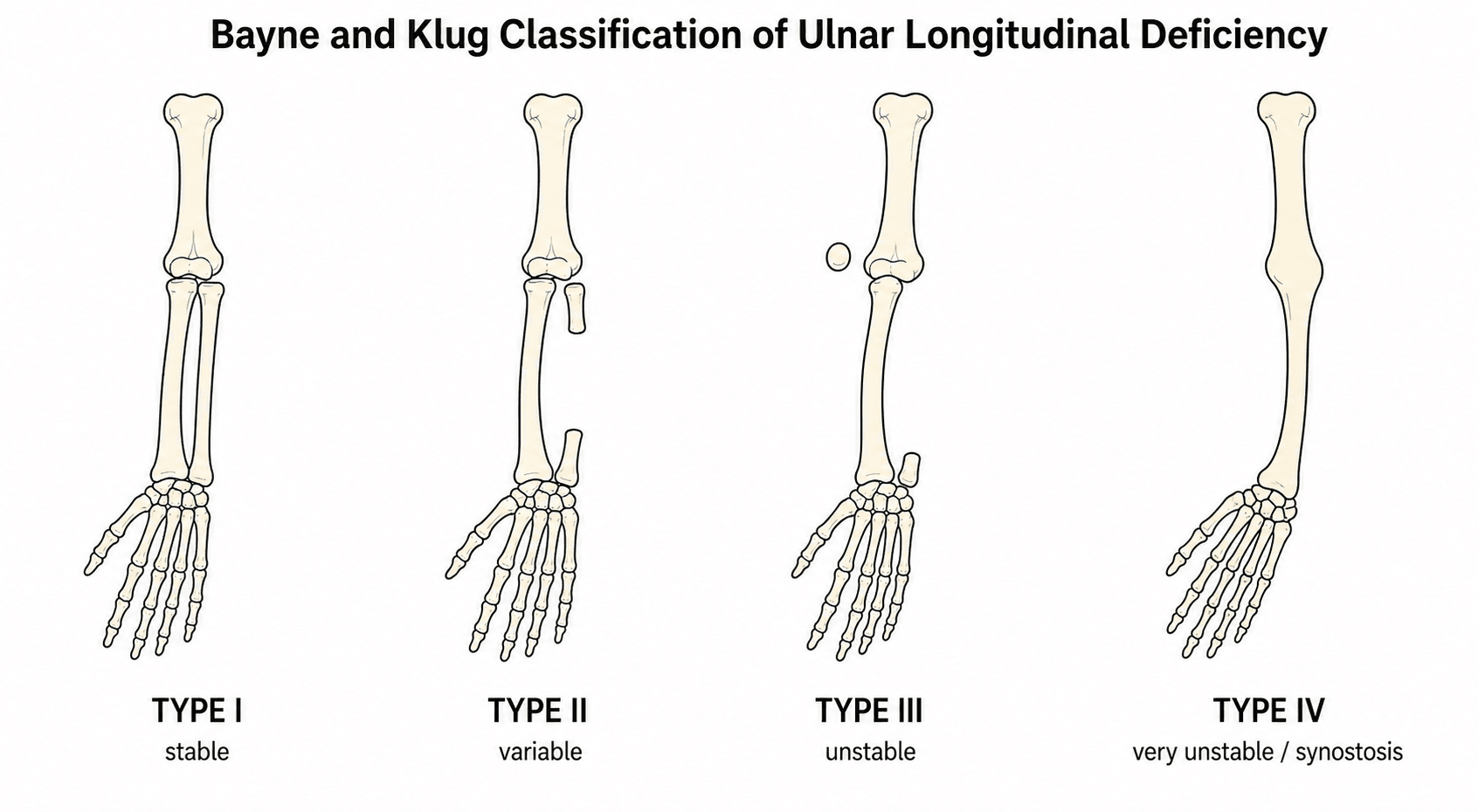
Bayne classification (1982). The most widely used classification, based on the radiographic state of the ulna and the elbow.
Get the attribution right. The four-type ulnar deficiency classification is Bayne's, described in Green's Operative Hand Surgery in 1982. It is frequently miscited as "Bayne and Klug", which is a different paper: Bayne and Klug, J Hand Surg Am 1987, is a long-term review of radial deficiencies and presents the radiologic classification of radial longitudinal deficiency. Both classifications run Types I-IV, both come from Bayne, and they describe opposite sides of the forearm, which is exactly why they are confused.
- features
- Hypoplastic ulna
- characteristics
- Ulna present but short, distal and proximal epiphyses present
- elbow
- Stable
- hand
- Mild deviation, all digits usually present
- prognosis
- Excellent function
- features
- Partial absence (middle segment)
- characteristics
- Proximal and distal ulnar segments present, middle absent
- elbow
- Variable stability
- hand
- Moderate ulnar deviation, ulnar digits may be hypoplastic
- prognosis
- Good function with treatment
- features
- Complete absence (distal only)
- characteristics
- Proximal ulna absent, distal ulnar remnant present
- elbow
- Unstable, radial head dislocation common
- hand
- Severe ulnar deviation, often missing 4th/5th digits
- prognosis
- Fair function, limited rotation
- features
- Complete absence with radiohumeral synostosis
- characteristics
- Complete absence of ulna
- elbow
- Radiohumeral synostosis; no elbow joint
- hand
- Severe deformity, multiple digit absence common
- prognosis
- Limited function, stability priority
Cole and Manske (1997): the hand. Cole and Manske added a grade for the thumb and first web space, which is critical for surgical planning because the thumb determines overall hand function. Neither the Bayne type nor the Cole-Manske letter alone describes the limb, so record both.
- A - normal thumb and first web space
- B - mild first web space deficiency, opposition intact
- C - moderate-to-severe first web space deficiency
- D - absent thumb
Havenhill type 0: the hand-only mild end. Havenhill and colleagues (2005) described 13 extremities with ulnar deficiency confined to the hand and carpus: an absent small-finger ray, absent ring-and-small rays, or an isolated hypoplastic small finger, all with a fully formed ulna, radius and elbow. Simple syndactyly, a delta (longitudinally bracketed) phalanx and carpal coalition, most often capitohamate, are characteristic, sometimes with a ring- or small-metacarpal synostosis.
Why type 0 matters. It extends the Bayne spectrum at its mild end, and it is the entity that overlaps clinically with ulnar-sided cleft hand and symbrachydactyly. An isolated absent ulnar ray, or a small-metacarpal synostosis with a normal forearm, should be recognised as type 0 ulnar longitudinal deficiency rather than dismissed as isolated ectrodactyly. Management is entirely hand-directed (syndactyly release, addressing the deficient rays), and no forearm or elbow surgery is needed.
Clinical Presentation
Inspection. The hallmark is the posture: the hand deviates ulnarly, the opposite of radial club hand, on a shortened forearm with a bowed radius. What else to look for:
- Absent 4th and 5th digits, which is common; finger remnants (nubbins) are common too
- A thumb that may be hypoplastic or absent
- Syndactyly, the border digits often webbed
- Cubitus valgus, which is common
- Skin dimpling over areas of bony prominence
Palpation. No ulnar shaft can be felt, the ulnar border is deficient in soft tissue and muscle bulk is reduced on the ulnar aspect of the forearm. The radial head is often dislocated posterolaterally and palpable as a prominence, and fibrous bands may restrict motion.
Assess carpal stability, and elbow stability in both flexion and extension: it is variable, and often unstable with complete deficiency.
Movement. Document passive against active motion to distinguish joint from muscle limitation.
- Elbow - the flexion-extension arc is often full unless there is a radioulnar synostosis; forearm rotation is markedly limited, especially supination
- Wrist - radial-ulnar deviation; flexion-extension, often preserved; radial carpal stability
- Hand - first web space angle, thumb opposition and stability, motion in the digits present, syndactyly limiting motion
Neurovascular. The radial pulse is usually present and the ulnar pulse often absent, and perfusion may be radial-dominant.
The ulnar nerve may be absent or hypoplastic in severe cases and ulnar-innervated intrinsic function is often weak or absent, while the median and radial nerves are usually normal. Check capillary refill in every digit and an Allen test where the digits present allow it, and map the sensory deficit: a complete neurological examination is essential for surgical planning and prognosis.
Function. Grip follows what is present.
- Power grip - reduced with digit absence
- Precision grip - depends on thumb function
- Key pinch - limited if the thumb is hypoplastic
- Hook grip - limited with 4th and 5th digit absence
Daily life. Bilateral involvement significantly impacts function. In unilateral cases the contralateral hand is dominant for fine tasks; adaptive strategies develop early in childhood, and early intervention improves adaptation.
Differential diagnosis. The short forearm with a deviated hand and absent ulnar-sided digits has several mimics, and distinguishing them changes management and counselling.
- keyFeature
- Ulnar deviation of hand; absent/hypoplastic ulnar (4th/5th) rays; ulna short or absent
- elbow
- Often unstable; radial head dislocation or radiohumeral synostosis
- distinguisher
- Thumb usually present and functional; low syndromic burden
- management
- Function-led; stabilise forearm/elbow only if grossly unstable
- keyFeature
- RADIAL deviation toward absent radius; thumb hypoplastic or absent
- elbow
- Often stiff; radial-sided wrist instability
- distinguisher
- Absent/deficient thumb; high syndromic burden (VACTERL, TAR, Fanconi, Holt-Oram)
- management
- Stretching, centralisation/radialisation, pollicisation
- keyFeature
- Central (3rd ray) deficiency with V-shaped cleft; border rays present
- elbow
- Normal
- distinguisher
- Often bilateral, includes feet; thumb and small finger preserved
- management
- Cleft closure, syndactyly release, web reconstruction
- keyFeature
- Short/absent fingers with nubbins and ectodermal pits; normal forearm bones
- elbow
- Normal
- distinguisher
- Soft-tissue (vascular) aetiology; bones of forearm intact; unilateral, sporadic
- management
- Soft-tissue/digit reconstruction, free toe transfer in selected cases
- keyFeature
- Circumferential constriction rings, distal amputations, acrosyndactyly
- elbow
- Normal proximal bones
- distinguisher
- Bands at varying levels; asymmetric, sporadic; no longitudinal bone axis defect
- management
- Band release, syndactyly correction, reconstruction as needed
Investigations
Plain radiographs classify the deficiency and, repeated, track growth and progression of the deformity. The views and what each answers:
- Forearm AP and lateral - degree of ulnar deficiency (Bayne type), radial bowing (measure the angle), radial head position, carpal arrangement and which bones are present
- Hand AP - metacarpal presence or absence, phalangeal count and morphology, first metacarpal size and position, osseous involvement in syndactyly
- Elbow AP and lateral - radial head-capitellum relationship, ulnar remnant at the proximal forearm, humeral morphology, joint congruency
The measurements worth recording are the radial bowing angle, the radiocapitellar angle, the carpal height ratio and the first web space angle.
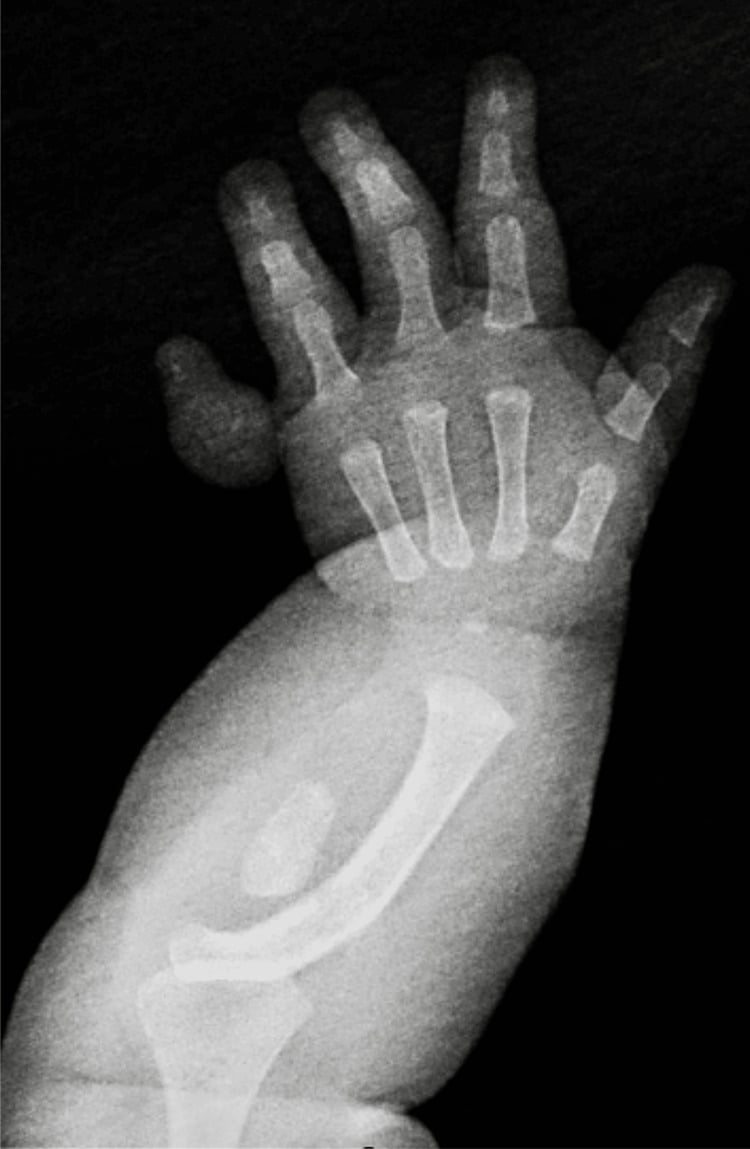
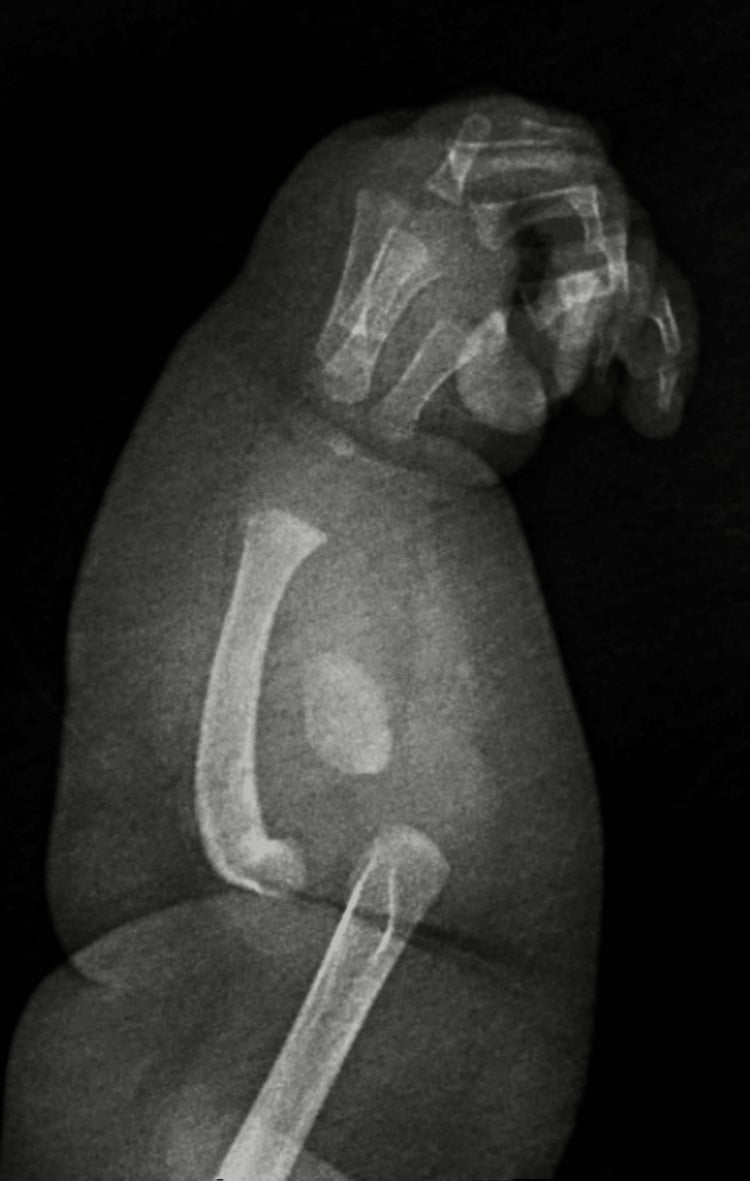
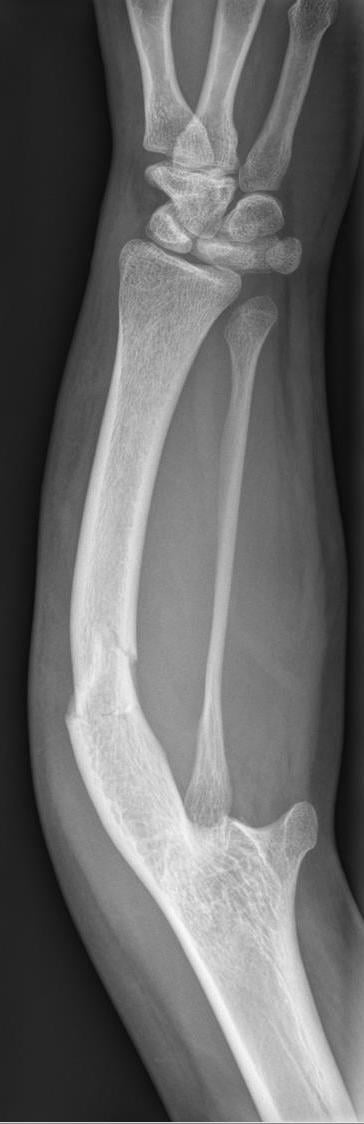
MRI is most useful in infancy, before ossification centres appear on plain radiographs. It assesses the soft tissues (muscles, tendons, nerves), the cartilaginous anlage in infants and radial head-capitellum cartilage congruency, and it serves preoperative planning for reconstruction.
Ultrasound is less invasive than MRI in young children. It screens cartilaginous structures in the neonate, maps the vessels if an arterial abnormality is a concern, and assesses elbow instability dynamically.
CT has a limited role in routine evaluation. It is for preoperative 3D reconstruction in complex cases, bony involvement in syndactyly, and older children with complex carpal anomalies.
Imaging by age. Timing of imaging should align with the potential surgical windows.
- Neonate to 6 months - forearm AP/lateral and hand AP radiographs; ultrasound for cartilaginous structures; MRI if surgical planning is needed early
- 6 months to 2 years - radiographs every 6 months, documenting radial head position and monitoring radial bowing; MRI before any surgical intervention
- Over 2 years - annual radiographs until skeletal maturity, assessing for progressive deformity; MRI before reconstruction; CT for complex carpal reconstructions
Laboratory tests: start from the right premise. Ulnar longitudinal deficiency is not radial club hand, and the haematological and visceral screening that is mandatory in radial deficiency is not indicated here.
The registry evidence. The Evans registry study in the Evidence Base is explicit: in 1,575,904 Hungarian births, strong associations with other-system anomalies were seen with radial/tibial, amelia, rudimentary-limb and central-axis defects, and were not seen with ulnar/fibular defects.
Isolated deficiency. With no dysmorphic or systemic features, no laboratory screening is required at all. Examine the whole child, especially the contralateral limb, the lower limbs and the spine, and image what you find; before surgery, the standard pre-anaesthetic assessment applies.
Genetic testing is only for a syndrome suspected clinically: TBX3 for ulnar-mammary syndrome, NIPBL and related genes for Cornelia de Lange features, and a karyotype or chromosomal microarray for multiple malformations across systems or dysmorphism.
What not to order reflexively. Fanconi anaemia screening (chromosome breakage testing) and a full blood count belong to radial longitudinal deficiency, where an absent or hypoplastic thumb and radius is the presenting sign of a marrow failure syndrome. They are not part of the ulnar deficiency workup unless the child has radial-side hypoplasia as well, which does occur (Cole and Manske found thumb and first-web abnormalities in 73% of ulnar-deficient hands), or has cytopenias, growth failure or café-au-lait macules. Fanconi anaemia should also be considered if involvement is bilateral or there is a family history.
Echocardiography and ECG likewise belong to radial deficiency, where Holt-Oram and VACTERL are in play. Order them for a clinical indication, not for the ulnar deficiency itself.
Non-Operative Management
Observation suits Bayne Type I with minimal deformity. The criteria:
- A functional hand with all digits present
- A stable elbow
- Minimal deviation, and no progressive deformity
- Good passive range of motion
Watch for progressive deviation, developing elbow instability, emerging functional limitation and pain, which is rare in children.
Splinting is not typically effective in ulnar deficiency, compared with radial deficiency. The deviation is difficult to correct with a splint, the bony deficiency limits orthotic correction and dynamic splinting is ineffective for this deformity; a splint may be used temporarily after surgery.
Occupational therapy, 0-2 years. Early intervention promotes bimanual activity and grasp development in the digits present, educates parents on adaptation strategies and monitors developmental milestones.
Occupational therapy, over 2 years. Ongoing therapy assesses adaptive equipment, strengthens the muscles present, maintains range of motion, and prepares the child for surgery and rehabilitates afterwards. Functional training covers compensatory techniques for absent digits, assistive devices if needed, school activity modification and strategies for sports participation.
Management Principles and Algorithm
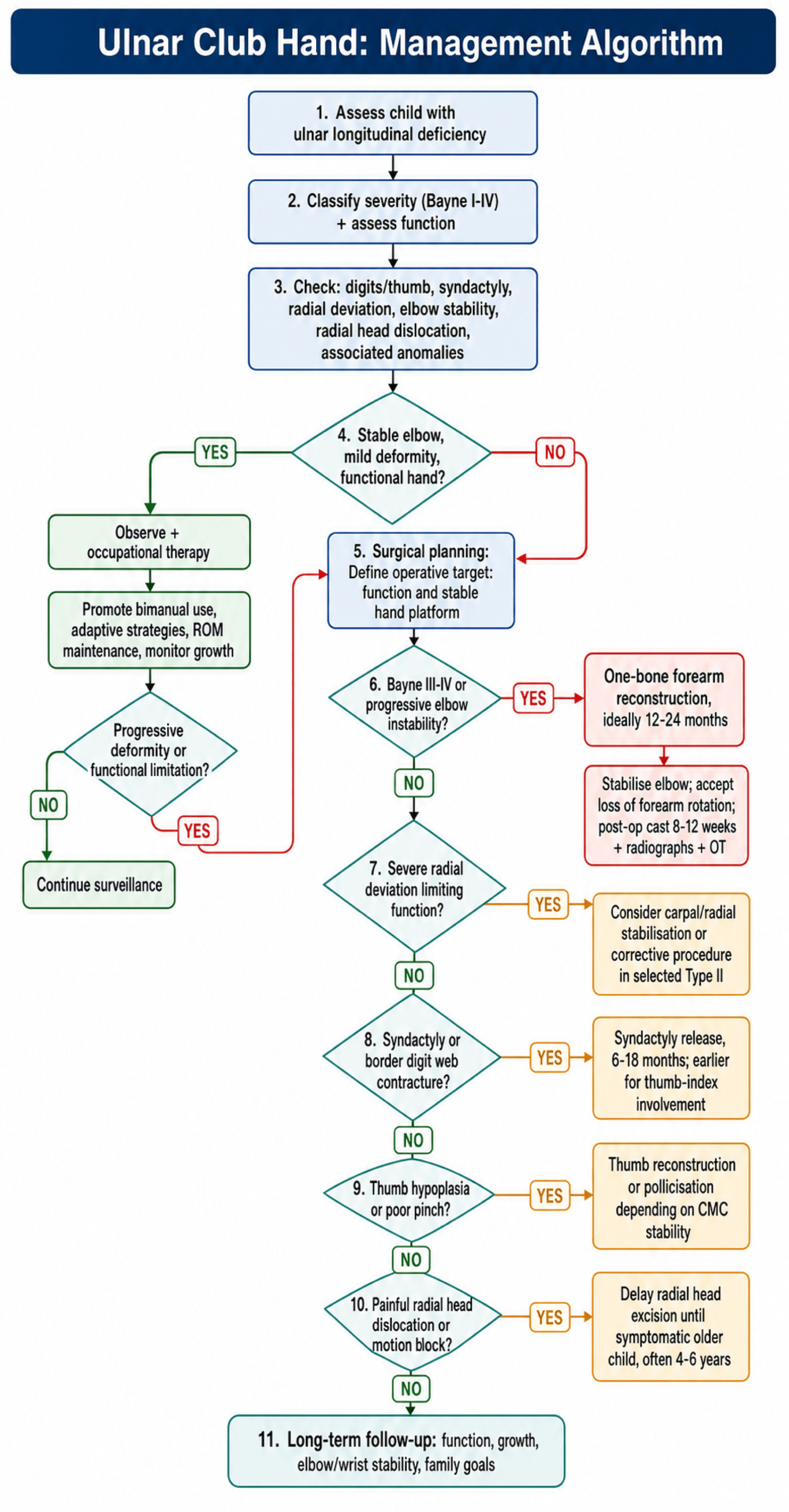
The options run from stretching and splinting, through first web space deepening and radial osteotomy for severe deviation, to a one-bone forearm for elbow instability.
1. Classify both ends of the limb, separately. Record a Bayne type for the forearm and elbow and a Cole-Manske letter for the thumb and first web.
2. Decide the hand first, because the hand determines function. Cole and Manske found that 28 of 53 operations in their ulnar-deficient cohort were for thumb and first-web problems, and the long-term radial-deficiency data (Goldfarb, under Outcomes) show that improving forearm alignment and length does not by itself improve function. Syndactyly release, first-web deepening and thumb reconstruction or pollicisation come before any consideration of the forearm.
3. Treat the forearm only for instability, not for appearance or for a radiograph. Bayne I and most Bayne II forearms are observed. A one-bone forearm is considered when the forearm is grossly unstable, with a dislocated radial head and a progressively bowing radius, which is typically Bayne II or III.
4. Recognise the two ends that fall outside the usual pathway. Havenhill type 0, with a normal forearm, is managed entirely as a hand problem. True Bayne IV radiohumeral synostosis has no proximal ulnar remnant and no elbow, so a one-bone forearm cannot be built; surgery there is a repositioning osteotomy through the synostosis.
5. Monitor for progression throughout growth. Deviation and radial bowing can worsen at growth spurts as the anlage tethers the growing radius. Serial radiographs track it; whether early anlage excision changes the natural history is unresolved.
Management by Bayne type. In every row, the hand operations dictated by the Cole-Manske letter take precedence.
- Forearm and elbow
- Normal forearm and elbow; deficiency in hand/carpus only
- Usual forearm management
- None - hand-directed surgery only
- Forearm and elbow
- Ulna short but complete; elbow stable
- Usual forearm management
- Often observation, occasional soft-tissue release; monitor the deviation
- Forearm and elbow
- Ulna partially absent; elbow stability variable
- Usual forearm management
- Observation unless progressive instability or bowing; one-bone forearm or reconstruction if grossly unstable
- Forearm and elbow
- Ulna absent proximally with a distal remnant; radial head dislocated, elbow unstable
- Usual forearm management
- Radial head excision; one-bone forearm onto the proximal ulnar remnant
- Forearm and elbow
- Radiohumeral synostosis; no elbow joint
- Usual forearm management
- One-bone forearm not possible - repositioning osteotomy through the synostosis for hand-to-mouth function
Timing. These intervals are convention derived from small retrospective series, not from trials; the textbook limitation in the Evidence Base applies directly here.
- 6-18 months - syndactyly release; a thumb-index syndactyly earlier, by 6 months, and earliest where it blocks grasp
- 12-24 months - first-web deepening, and the one-bone forearm where indicated: before habitual compensation patterns are fixed, while the tissues are of adequate size, and when anaesthetic risk is acceptable
- From 2 years - thumb reconstruction or pollicisation, guided by carpometacarpal stability
- 4-8 years - secondary procedures: radial head excision if painful or blocking, carpal stabilisation or corrective radial osteotomy for progressive deviation, delayed thumb reconstruction
- Throughout growth - serial review for progressive deviation and radial bowing
Surgical Management
Indications. The absolute indications are progressive elbow instability, severe deviation limiting function, and radial head dislocation with pain or instability. The relative indications are a Bayne Type II forearm with functional limitation, syndactyly of the border digits, nubbins causing functional or cosmetic concern, and severe thumb hypoplasia needing reconstruction.
One-bone forearm: the indication. Bayne Types II and III with a grossly unstable forearm: a dislocated radial head with an unsupported, progressively bowing radius, and a hand with no stable platform.
The principle, stated precisely. This is where the operation is most often described wrongly. A one-bone forearm converts a deficient two-bone forearm into a single bone running from the proximal ulnar remnant to the distal radius. The proximal ulna is used because it retains its articulation with the humerus, so elbow flexion and extension are preserved; what is sacrificed is forearm rotation, which in these limbs is already minimal or absent.
Fusing the radius to the humerus abolishes the elbow joint. That construct is not the operation - it is the Bayne Type IV deformity (radiohumeral synostosis) that these children are sometimes born with. The reconstruction deliberately preserves the ulnohumeral articulation by building the single bone onto the proximal ulnar remnant. A child who loses elbow flexion cannot get their hand to their mouth, which is the function the whole operation exists to protect.
Technique. The steps:
- Approach - a posterolateral or ulnar incision giving access to both the proximal ulnar remnant and the radial shaft.
- Radial head - excise the dislocated radial head and the proximal radius up to the level of the intended junction.
- Preparation - identify and preserve the proximal ulnar remnant with its ulnohumeral articulation, the foundation of the construct; osteotomise the radius at the level that lets the distal radial segment sit end-to-end on the ulnar remnant without tension; preserve the distal radial physis, which supplies the remaining forearm growth.
- Fixation - an intramedullary wire or rod across the junction, with or without a plate; bone graft from the excised radial head or proximal radius.
- Position - fix the forearm in neutral or slight pronation, since rotation is permanently lost; err towards the position that lets the hand reach the mouth and the midline.
- Soft tissue - excise the fibrocartilaginous anlage if it is tethering the correction, and balance the remaining musculature around the single bone.
- Wrist - address residual deviation separately, by anlage excision, soft-tissue release or a corrective radial osteotomy, rather than by angling the fusion.
Bayne Type IV is a different problem. With a true radiohumeral synostosis there is no proximal ulnar remnant and no elbow joint to preserve, so a one-bone forearm cannot be created. Surgery is a rotational or angular osteotomy through the synostosis, placing the already-fused limb where the hand reaches the mouth and perineum: a repositioning operation, not a reconstruction of motion.
After a one-bone forearm. A long arm cast for 8-12 weeks, with serial radiographs to confirm union, then gentle mobilisation after union and occupational therapy for adaptation.
Union is reported in more than 90% and a stable elbow in more than 95%, with no forearm rotation (the accepted trade-off), improved hand positioning for function and high patient and parent satisfaction.
Radial head excision. The indications are a painful chronic dislocation, a head blocking elbow motion, a cosmetically concerning prominence and failed closed reduction. As a stand-alone operation it is not done in young children, because of growth concerns, and is typically delayed until 4-6 years if symptomatic; it is often performed with the one-bone forearm, where the dislocated head is excised as step 2 of the construct.
The technique is a Boyd approach to the radial head and complete excision including the neck, preserving the annular ligament remnant if present and avoiding the ulnar nerve (if present).
Its complications are proximal radial migration, progression of valgus deformity and, rarely, posterolateral rotatory instability.
Syndactyly release. Standard principles apply: dorsal and volar zigzag incisions, full-thickness skin grafts to fill the defects, and staging if several web spaces are involved. Border digit release improves appearance and may be staged with the forearm reconstruction.
In ulnar deficiency the webbed digits are often the border digits (3-4 if present), the neurovascular anatomy may be aberrant, digital nerves may be shared and bony fusion at phalangeal level is common.
Centralisation is rarely performed in ulnar deficiency compared with radial deficiency. The deviation is less severe than in radial club hand, the soft tissue on the radial side is adequate, and the focus is on elbow stabilisation instead.
It is reserved for severe progressive carpal deviation, failed non-operative management in Type II, and an ulnar remnant adequate for stabilisation. If performed, it resembles radial deficiency centralisation: the carpus centred over the radius, soft-tissue rebalancing and temporary K-wire fixation.
Complications
- complication
- Neurovascular injury
- incidence
- Less than 5%
- prevention
- Careful dissection, identify aberrant anatomy
- management
- Immediate repair if recognised, vascular surgery consult
- outcome
- Good if repaired primarily
- complication
- Wound dehiscence
- incidence
- 5-10%
- prevention
- Tension-free closure, adequate soft tissue
- management
- Local wound care, possible revision
- outcome
- Heals with treatment
- complication
- Infection
- incidence
- Less than 5%
- prevention
- Pre-operative antibiotics, sterile technique
- management
- Antibiotics, possible I&D
- outcome
- Usually resolves with treatment
- complication
- Nonunion (one-bone forearm)
- incidence
- 5-10%
- prevention
- Rigid fixation, adequate immobilisation
- management
- Revision fixation, bone graft
- outcome
- High success with revision
- complication
- Recurrent deformity
- incidence
- 10-20%
- prevention
- Adequate soft tissue release, balanced forces
- management
- Revision centralisation, osteotomy
- outcome
- Variable, may require multiple revisions
- complication
- Stiffness
- incidence
- 20-30%
- prevention
- Early mobilisation, therapy
- management
- Aggressive therapy, possible release
- outcome
- Improves with treatment
- complication
- Growth disturbance
- incidence
- Variable
- prevention
- Preserve epiphyses when possible
- management
- Monitor growth, osteotomy if needed
- outcome
- May require multiple procedures
- complication
- Degenerative arthritis
- incidence
- Unknown (long-term)
- prevention
- Anatomic reconstruction, stable joints
- management
- Activity modification, possible arthrodesis
- outcome
- May limit function in adulthood
After a one-bone forearm. Loss of rotation is the expected outcome and not truly a complication. The specific problems are malposition if the forearm is fused in excessive flexion or extension, proximal radial migration if the radial head is not addressed, and refracture through the fusion site in active children.
After syndactyly release. Web creep (proximal migration of the web space), scar contracture limiting digital motion, nail deformity if the germinal matrix is damaged, and skin graft loss requiring revision grafting.
Outcomes and Prognosis
Unilateral involvement. Adaptation is excellent with a normal contralateral limb. The one-bone forearm provides a stable platform, most activities of daily living are achieved independently and sports participation is usually possible with adaptation.
Bilateral involvement. The functional impact is greater. Both limbs need optimising, staging of the surgery is important, and more extensive adaptive equipment may be needed.
What determines hand function. Thumb presence and function is the most critical determinant. The number of digits present, the adequacy of the first web space, sensation in the digits present and wrist stability also count.
Goldfarb CA, Klepps SJ, Dailey LA, Manske PR. Functional outcome after centralization for radius dysplasia. J Hand Surg Am. 2002;27(1):118-124.
What the series report. These are conventional estimates from small Level IV series, not measured rates from any single carded study.
A one-bone forearm is reported to maintain stability in the large majority of long-term reviews. Function depends on hand ray presence, not forearm length: in the Goldfarb series, alignment and length did not correlate with function.
Satisfaction is high in properly selected and counselled families, most patients achieve age-appropriate independence in activities of daily living in reported cohorts, and secondary procedures are common across series, with quoted proportions varying widely.
Predictors of a poor outcome. The absent thumb is the most significant predictor; the others:
- Bilateral severe involvement
- An associated syndrome with global delays
- An inadequate soft tissue envelope
- Family non-compliance with therapy
- Late presentation, after the age of 3 years
Manske PR, McCarroll HR Jr, James M. Type III-A hypoplastic thumb. J Hand Surg Am. 1995;20(2):246-253.
Guidelines, Registries & Global Practice
Global Epidemiology
- Ulnar longitudinal deficiency is rare worldwide (approximately 1 in 100,000 live births), roughly 3 to 4 times less common than radial deficiency.
- Population registry data (Hungarian Congenital Malformation Registry, over 1.5 million births) place all limb deficiency defects near 1 in 1,816, with the ulnar/fibular group among the least frequent and least associated with other-system anomalies — supporting the low syndromic burden of ulnar deficiency.
- Upper-limb deficiencies markedly outnumber lower-limb deficiencies in registry data; male predominance and largely sporadic occurrence are consistent across populations.
Classification Frameworks (side by side)
- scope
- IFSSH-adopted overarching classification of all congenital upper-limb anomalies
- use
- Nosology, audit, registries; ulnar deficiency = malformation of the proximal-distal/radioulnar axis
- strength
- Embryology/dysmorphology-based; international standard
- scope
- Grades I-IV by degree of ulnar absence and elbow involvement
- use
- Surgical planning for the forearm and elbow
- strength
- Simple, radiographic, widely taught
- scope
- Types A-D by thumb and first-web involvement
- use
- Hand reconstruction planning; supplements Bayne
- strength
- Captures the deficits that actually drive function
Society Guidance and Practice Principles
- There is no high-level (RCT) guideline for ulnar deficiency given its rarity; management rests on expert consensus and case series. Major hand-surgery bodies (ASSH in the US, BSSH/BOA in the UK, FESSH in Europe, IFSSH globally) converge on the same principles rather than divergent protocols.
- Shared consensus across societies: function follows the hand (thumb and digits), not forearm length or rotation; the elbow/forearm are stabilised only when grossly unstable; multidisciplinary care (hand surgery, paediatric occupational therapy, genetics) is standard.
- Genetic screening: widely recommended where syndromic features are present (e.g. ulnar-mammary syndrome / TBX3, Cornelia de Lange / NIPBL); routine VACTERL and Fanconi work-up is less emphasised than in radial deficiency because of the lower syndromic association.
Registry and Resource-Setting Variation
- Dedicated congenital-limb registries are scarce; epidemiology derives largely from national malformation registries (e.g. EUROCAT in Europe, individual national registries) rather than implant/arthroplasty registries, which are not applicable to this paediatric reconstructive condition.
- High-resource settings: early multidisciplinary review, MRI/ultrasound for cartilaginous anatomy before ossification, staged reconstruction, and structured occupational therapy and adaptive-equipment provision.
- Limited-resource settings: later presentation is common; care prioritises function-critical, high-yield interventions (syndactyly release, first-web deepening, elbow/forearm stabilisation only when unstable) over cosmetic procedures, with greater reliance on adaptation and lower availability of advanced imaging and prosthetics. Prosthetic restoration has a limited role in ulnar deficiency in any setting, as digit prostheses for absent ulnar rays are largely cosmetic.
Related pages: Radial Longitudinal Deficiency is the mirror-image condition and the one this page must be read against - it deviates the hand the other way, threatens the thumb rather than the ulnar rays, and carries the high syndromic burden (VACTERL, TAR, Fanconi, Holt-Oram) that ulnar deficiency does not, which is why the two workups differ so sharply; Thumb Hypoplasia holds the Blauth/Manske grading that the Cole-Manske letter depends on, and the III-A versus III-B carpometacarpal stability decision that determines reconstruction against pollicization; Syndactyly is the commonest association here at 50-60% and usually the first operation these children have; Cleft Hand and Congenital Constriction Bands are the two differentials most often confused with the mild, hand-only Havenhill type 0 end of the spectrum; Congenital Hand Overview places all of these within the OMT framework; Radial Head Dislocations covers the dislocation present in 40-50% of these limbs and the decision to excise it; and Fibular Hemimelia, Proximal Femoral Focal Deficiency and Congenital Lower Limb Deficiency Overview are the lower-limb deficiencies that genuinely travel with ulnar deficiency - the associations worth examining for, in place of the visceral screen.
Controversies & Areas of Uncertainty
The rarity of ulnar deficiency means most practice rests on small retrospective series and expert opinion; several questions remain genuinely unsettled.
- Value and timing of one-bone forearm. It reliably trades rotation for stability, but it is required far less often than older teaching implied — many type II-III limbs function well without it. Whether and when to convert an unstable two-element forearm to a single strut, and at what age, is not standardised.
- Management of the fibrocartilaginous anlage. Whether the anlage truly tethers growth and drives progressive radial bowing — and therefore whether prophylactic excision prevents deformity — is debated; excision risks wrist destabilisation and evidence of benefit is weak.
- Radiohumeral synostosis. Takedown to restore elbow motion is generally discouraged because of re-fusion and instability, but a minority advocate repositioning osteotomy in selected malpositioned limbs; the threshold is subjective.
- Radial head dislocation. Indications and timing for radial head excision (symptomatic, blocking motion) versus leaving it are not evidence-based and are extrapolated from other conditions.
- Outcome measurement. Few studies use validated, condition-specific paediatric upper-limb outcome tools, so comparisons across series and centres are unreliable; reported high satisfaction may reflect adaptation rather than reconstruction.
- Classification overlap. The mild end of the spectrum (Havenhill type 0, hand-only deficiency) overlaps clinically with ulnar-sided cleft hand and symbrachydactyly, and there is no consensus on where ulnar deficiency ends and these entities begin.
MCQ Practice Points
Q: What is the Bayne classification for ulnar longitudinal deficiency (ulnar club hand)?
A: Bayne classification (4 types): Type I: Hypoplasia - ulna short but present; Type II: Partial aplasia - only proximal ulna present; Type III: Total aplasia - complete absence of ulna, radiohumeral synostosis common; Type IV: Radiohumeral synostosis with total ulnar aplasia. Additionally, the thumb and first web space are usually normal (unlike radial club hand). The more severe the ulnar deficiency, the greater the elbow involvement and the more likely associated digital anomalies (absent ulnar digits).
Q: What digital anomalies are commonly associated with ulnar longitudinal deficiency?
A: Ulnar-sided digital deficiencies include: absent or hypoplastic 4th and 5th digits (ulnar rays), syndactyly of remaining digits, thumb abnormalities (less common than in radial deficiency). The first web space is usually adequate. Associated conditions include fibular hemimelia, scoliosis, proximal focal femoral deficiency. Unlike radial club hand, ulnar deficiency has fewer systemic associations - no VACTERL or thrombocytopenia-absent radius (TAR) syndrome. Function is often better preserved than radial deficiency.
Q: How does ulnar club hand differ from radial club hand in terms of function and prognosis?
A: Ulnar club hand generally has better function because: 1) Thumb is usually present and functional (essential for grip); 2) Elbow motion is often better despite potential radiohumeral synostosis; 3) Wrist deviation is less severe; 4) Fewer systemic anomalies. Radial club hand has worse prognosis due to absent thumb, severe radial wrist deviation, elbow stiffness, and associated syndromes (VACTERL, TAR, Fanconi anemia, Holt-Oram). Ulnar deficiency is approximately 10 times rarer than radial deficiency.
Q: What is the surgical management approach for ulnar club hand?
A: Surgery is less commonly required than for radial club hand. Options depend on type: Syndactyly release for fused digits; First web space deepening if contracted; Rotational osteotomy of radius for severe forearm pronation deformity; Radiohumeral synostosis release rarely indicated (often worsens stability); Ulnar anlage resection (fibrous band tethering radius) may improve forearm rotation. Function is often adequate without intervention. Goals are improving grip strength and cosmesis rather than correcting wrist alignment.
Q: What is a fibrocartilaginous anlage and what is its clinical significance in ulnar club hand?
A: The anlage is a fibrocartilaginous remnant of the absent ulna that acts as a tether during growth, causing progressive radial bowing and forearm deformity. It connects the distal humerus to the carpus or ulnar digits. Clinical significance: 1) Progressive deformity with growth (worse during growth spurts); 2) Limitation of forearm rotation; 3) May require excision if causing progressive bowing. However, anlage excision risks destabilizing the wrist. Decision to excise depends on rate of deformity progression and functional limitations.
Summary
Ulnar club hand (ulnar longitudinal deficiency) is a congenital spectrum disorder involving partial or complete absence of the ulna. It is less common than radial club hand (1 in 100,000 vs 1 in 30,000) and presents with characteristic ulnar deviation of the hand, often with absent 4th and 5th digits and elbow instability due to radial head dislocation.
The Bayne classification (Types I-IV based on degree of ulnar absence) guides management, with the Cole-Manske modification adding consideration of thumb and first web involvement — and note the citation trap, that "Bayne and Klug" is a separate paper classifying RADIAL deficiency. Type I (hypoplastic ulna) rarely requires surgery, while Types II-III with a grossly unstable forearm may require one-bone forearm reconstruction.
The one-bone forearm procedure joins the proximal ulnar remnant to the distal radius, sacrificing forearm rotation to gain a stable platform for the hand while preserving elbow flexion through the retained ulnohumeral joint. It is not a radius-to-humerus fusion — that construct abolishes the elbow and is the Type IV deformity, not its treatment. In true Type IV radiohumeral synostosis a one-bone forearm cannot be created, and surgery is a repositioning osteotomy through the synostosis.
Thumb function is the primary determinant of overall hand function, more so than forearm stability or length. Associated syndactyly (50-60% of cases) requires release at 6-18 months. Radial head excision may be needed if painful or blocking motion.
Prognosis is generally excellent for unilateral involvement, with greater than 90% achieving age-appropriate independence in activities of daily living. Multidisciplinary team management including pediatric hand surgeon, occupational therapist, and genetic counseling is essential for optimal outcomes.
Clinical Decision Scenarios
Practise clinical reasoning and management decisions out loud
“A 3-month-old infant is referred to your clinic with a right upper limb abnormality. On examination, the right forearm appears shortened with ulnar deviation of the hand. The 4th and 5th digits are absent, and there is syndactyly of the 2nd and 3rd digits. The parents ask about treatment options and prognosis.”
“You are seeing a 15-month-old child in pre-operative clinic for planned one-bone forearm procedure for Bayne Type IV ulnar deficiency. The parents ask you to explain the surgery, why their child needs it, and what to expect. Walk me through your discussion.”
“A 5-year-old presents with a short, ulnarly deviated forearm and a fixed flexed elbow. Radiographs show complete ulnar absence with the radial head fused to the humerus. The thumb is present and the first web is normal. The parents want to know whether you can give the forearm rotation and straighten the elbow. How do you counsel and manage?”
One-Liner Definition
- Ulnar club hand is a spectrum of congenital longitudinal upper limb deficiencies
- Involves partial or complete absence of the ulna
- Causes ulnar deviation of the hand
- Often presents with absent ulnar digits and elbow instability
Classification - Bayne (not Bayne and Klug, which is radial)
- Type I: Hypoplastic ulna (observe)
- Type II: Partial absence, middle segment (variable treatment)
- Type III: Complete absence except distal (one-bone forearm)
- Type IV: Complete absence (one-bone forearm mandatory)
- Cole-Manske adds A-D for thumb/first web involvement
Clinical Triad
- Ulnar deviation of hand (opposite to radial club hand)
- Absent 4th and 5th digits (common)
- Radial head dislocation with elbow instability (40-50% of cases)
Key Examination Findings
- Shortened forearm with ulnar hand deviation
- Absent ulnar-sided digits with syndactyly (50-60%)
- Palpable posterolateral radial head
- Ulnar border soft tissue deficiency
- Limited forearm rotation
- Thumb hypoplasia (20-30%)
Investigations
- Plain radiographs (forearm AP/lateral, hand AP, elbow AP/lateral)
- MRI in infancy for soft tissue assessment
- Genetic testing if syndromic features
- Fanconi anemia screening if bilateral
Management Algorithm
- Type I: Observe, rarely needs surgery
- Type II: Variable (soft tissue release vs. one-bone forearm)
- Type III-IV: One-bone forearm at 12-24 months
- Syndactyly release 6-18 months
- Thumb reconstruction if needed
- Radial head excision if symptomatic
One-Bone Forearm Principles
- Indications: Bayne III-IV with unstable elbow
- Technique: Excise radial head, fuse radius to humerus with rod/plate
- Position 20-30° flexion, neutral rotation
- Trade-off: Gain stability, lose rotation (accepted)
- Union rate greater than 90%
Surgical Timing
- Syndactyly release: 6-18 months (thumb-index by 6 months)
- One-bone forearm: 12-24 months
- Radial head excision: 4-6 years if symptomatic
- Thumb reconstruction: Variable based on severity
Prognosis Determinants
- Thumb function (most critical)
- Digit number/function
- Wrist stability
- Unilateral vs bilateral involvement
- Associated anomalies and family support/therapy compliance
- Greater than 90% achieve ADL independence with unilateral involvement
Common Viva Questions
- Difference from radial club hand? (Less common, ulnar deviation, ulnar digits absent, less syndromic association)
- Why sacrifice rotation? (Stability priority for hand function platform)
- Alternatives to one-bone forearm? (None effective for Type III-IV)
- What determines function? (Thumb presence)
Pearls and Pitfalls
- PEARL: Thumb function determines overall outcome
- PEARL: One-bone forearm very reliable for stability
- PEARL: Early OT involvement critical
- PITFALL: Attempting to preserve rotation in Type III-IV
- PITFALL: Not screening for syndromes
- PITFALL: Late presentation (greater than 3 years)
- PITFALL: Inadequate family counseling about rotation loss
Classification & Global Practice
- OMT (IFSSH) is the overarching classification; ulnar deficiency = proximal-distal axis malformation
- Bayne (forearm/elbow, I-IV) + Cole-Manske (hand, A-D) for surgical planning
- No RCT-level guideline (rare condition); consensus = function follows the hand
- Multidisciplinary care (hand surgery, paediatric OT, genetics) is the global standard
Evidence Base
Cole RJ, Manske PR. Classification of ulnar deficiency according to the thumb and first web. J Hand Surg Am. 1997;22(4):479-488.
- Thumb/first-web abnormality present in 73% of ulnar-deficient hands
- Most surgery is for radial-hand (thumb/web) problems, not forearm realignment
- Four-tier (A-D) hand classification supplements forearm/elbow systems
Havenhill TG, Manske PR, Patel A, Goldfarb CA. Type 0 ulnar longitudinal deficiency. J Hand Surg Am. 2005;30(6):1288-1293.
- Ulnar deficiency can be isolated to the hand/carpus with a normal forearm (type 0)
- Carpal coalition (often capitohamate) and simple syndactyly frequently coexist
- Expands the Bayne spectrum at its mild end
Evans JA, Vitez M, Czeizel A. Congenital abnormalities associated with limb deficiency defects: a population study based on cases from the Hungarian Congenital Malformation Registry (1975-1984). Am J Med Genet. 1994;49(1):52-66.
- Limb deficiency birth prevalence about 1 in 1,816 in a national registry
- Ulnar/fibular defects show weak association with other-system anomalies
- Contrasts sharply with the high syndromic burden of radial defects
Bayne LG, Klug MS. Long-term review of the surgical treatment of radial deficiencies. J Hand Surg Am. 1987;12(2):169-179.
- Original Bayne-Klug paper graded RADIAL (not ulnar) deficiency
- Severity grading by radiologic degree of bone absence
- Outcome depends on soft-tissue release and rehabilitation compliance
Goldfarb CA, Ezaki M, Wall LB, Lam WL, Oberg KC. The Oberg-Manske-Tonkin (OMT) classification of congenital upper extremity anomalies. Adopted by the International Federation of Societies for Surgery of the Hand (IFSSH).
- OMT is the current IFSSH-adopted classification of congenital upper-limb anomalies
- Ulnar deficiency is a malformation of the proximal-distal/radioulnar axis
- Bayne and Cole-Manske remain the operative-planning classifications
Abzug JM, Kozin SH, eds. Congenital anomalies of the upper extremity; and Green's Operative Hand Surgery (Wolfe SW et al, eds). Reference textbooks on ulnar longitudinal deficiency management.
- Individualised, severity-based treatment
- Hand reconstruction prioritised over forearm length/rotation
- Stabilisation reserved for a grossly unstable forearm/elbow