Benign Vascular Lesion of Bone | Usually Incidental | Polka-Dot and Corduroy Signs
- Most common benign tumour of the spine but the vast majority are incidental and need no treatment
- Polka-dot sign on axial CT and corduroy / jail-bar sign on sagittal views are pathognomonic
- Fatty (high T1, high T2) lesions are quiescent; low T1 signal flags a more aggressive, vascular lesion
- Aggressive vertebral haemangioma can cause spinal cord compression and a progressive neurological deficit
- Preoperative embolisation is critical before surgery because these are highly vascular and bleed heavily
- “An incidental vertebral haemangioma on MRI needs reassurance, not a biopsy
- “Low T1 signal (replacement of fat by vascular stroma) is the imaging clue to an aggressive lesion
- “Pregnancy can unmask or worsen a haemangioma through venous engorgement and hormonal effect
- “Staging uses the Enneking benign system (S1-S3) and the WBB / SINS scores for surgical planning
Overview and Epidemiology
Vertebral haemangioma is a benign vascular lesion of bone and the most common benign tumour of the spine. It is overwhelmingly silent, usually discovered by accident on imaging performed for unrelated back pain or trauma. Only a tiny fraction ever produce symptoms, and an even smaller fraction behave aggressively enough to threaten the spinal cord.
The spectrum. For the exam, the single most useful concept is the spectrum. At one end is the typical fatty incidental lesion, which needs nothing more than recognition and reassurance; at the other is the aggressive lesion with epidural extension and cord compression, which needs a coordinated vascular and surgical plan. Everything else, including the painful but neurologically intact lesion, sits in between.
Common lesion, rare problem. The judgement being tested is which lesion to leave alone, which to treat for pain, and which to take to theatre for cord compression. The exam trap is to over-investigate or biopsy a classic incidental lesion.
Who. A vertebral haemangioma is present in roughly 10-12% of adults at autopsy, yet under 1% of all vertebral haemangiomas become symptomatic. Lesions are typically detected in the fourth to sixth decades, and aggressive symptomatic lesions show a female predominance.
Where. Lesions are frequently multiple within the spine.
- Thoracic - the most common site for symptomatic and aggressive lesions
- Lumbar - common, often the painful (non-aggressive) type
- Cervical - less common, but can cause early myelopathy
Pathophysiology and Pathology
Macroscopic. A soft, reddish-brown, blood-filled lesion within cancellous bone. The horizontal trabeculae are replaced by vascular tissue, and the coarse vertical trabeculae that remain have thickened in compensation. These thickened struts are the structural basis of the corduroy and polka-dot signs.
Microscopic. Thin-walled, dilated capillary and cavernous vascular channels are lined by a single layer of bland endothelium, interspersed with mature adipose tissue and the thickened bony trabeculae. There is no cellular atypia and no mitotic activity: this is a benign vascular proliferation.
Why most are harmless. Behaviour tracks tissue make-up. A lesion rich in fat, with slow-flow vessels and widely spaced trabeculae, is metabolically quiet and mechanically stable, which is why the typical incidental lesion never declares itself. When vascular stroma replaces that fat, the lesion becomes more cellular, more vascular and more prone to expand, erode cortex and push into the spinal canal. This is the basis for the imaging distinction between quiescent (fatty, high T1) and aggressive (low T1) lesions.
Drivers of aggression. The change from a quiet lesion to an aggressive one is associated with increased vascular stroma at the expense of fat, expansion beyond the vertebral body, and sometimes a physiological trigger. Pregnancy is a recognised trigger, rare but classic. Increased circulating blood volume, venous engorgement of the epidural plexus and hormonal softening of vessel walls can unmask or worsen a previously silent lesion, sometimes producing rapid deficit in the third trimester.
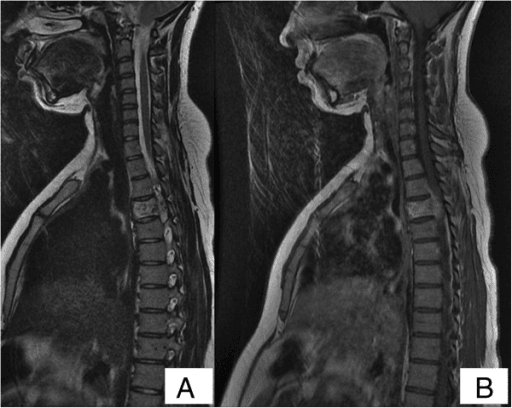
A pregnant patient who develops back pain and a progressive lower-limb neurological deficit may have an aggressive vertebral haemangioma. This demands urgent multidisciplinary imaging and management.
Classification and Staging
The most practical day-to-day classification separates lesions by their clinical behaviour, because this drives management.
- Symptoms
- None
- Imaging
- Fatty, high T1 and T2, polka-dot CT
- Typical Management
- Observe and reassure
- Symptoms
- Mechanical back pain, no deficit
- Imaging
- Lower fat and lower T1, no epidural extension
- Typical Management
- Vertebroplasty or radiotherapy; the typical target for vertebroplasty
- Symptoms
- Deficit, cord or root compression
- Imaging
- Low T1 with avid enhancement, epidural extension, cortical expansion and erosion
- Typical Management
- Embolisation plus surgery
Enneking benign staging. For benign bone tumours the Enneking benign staging system is used. It frames the lesion by its biological activity rather than its histological grade.
- Name
- Latent / inactive
- Description
- Self-limiting, well-marginated, no growth
- Haemangioma Correlate
- Typical incidental fatty lesion
- Name
- Active
- Description
- Progressive growth, still contained
- Haemangioma Correlate
- Painful or slowly enlarging lesion
- Name
- Aggressive
- Description
- Cortical breach, soft-tissue extension
- Haemangioma Correlate
- Aggressive lesion with epidural extension
Stage 3 (aggressive) lesions with neurological deficit are the group in which total en bloc spondylectomy and other major resections have been reported.
Planning tools. For surgical planning of any spinal column tumour, two further tools are used alongside Enneking staging. Asked how you would stage a spinal haemangioma, name all three and say what each adds: Enneking for biological activity, WBB for resectability, SINS for mechanical instability.
Weinstein-Boriani-Biagini (WBB). The vertebra is divided into 12 radiating zones, like a clock face, and 5 concentric layers from paravertebral soft tissue to dura. The map shows exactly which structures the tumour occupies and guides the planning of a safe excision, in particular whether an en bloc resection is anatomically feasible.
Spinal Instability Neoplastic Score (SINS). SINS scores location, pain, bone lesion type, alignment, vertebral collapse and posterolateral involvement to grade instability. A higher score flags a mechanically unstable spine that may need stabilisation as part of treatment, even when neurology is intact.
Clinical Presentation
The usual picture. By far the most common presentation is no symptoms at all. The lesion is reported as an aside on MRI or CT done for unrelated back pain or trauma, and examination is normal, with no tenderness and no deficit. The task is recognition and reassurance rather than work-up.
Axial back pain. A minority present with persistent, mechanical pain localised to the affected level, often the only symptom and without neurological signs. Other causes of back pain must be excluded before the pain is attributed to the lesion.
Neurological presentations. Expansion of the lesion can irritate a nerve root and produce a radiculopathy. An acute deficit is rare, from haemorrhage or rapid expansion.
Progressive myelopathy. Rare, and seen with aggressive lesions. Epidural extension compresses the cord, with gradual onset of leg weakness, gait disturbance or imbalance, a sensory level, and bladder or bowel change. When progressive it is a neurosurgical and oncological emergency.
Red flags. Treat a vertebral haemangioma as potentially aggressive when any of these is present.
- Pain that is progressive rather than mechanical and intermittent, or pain or deficit worsening over weeks to months
- Any neurological signs: weakness, a sensory level, sphincter change
- Imaging showing low T1 signal, cortical expansion or bony destruction, or soft-tissue or epidural extension beyond the vertebral body into the canal
- Involvement across the whole body extending into the pedicle, lamina or posterior elements
- Symptoms that appear or worsen during pregnancy
Do not attribute a neurological deficit to an incidental fatty haemangioma without first excluding a more aggressive component or a separate pathology.
Investigations and Imaging
Imaging makes the diagnosis. The combination of CT and MRI is usually conclusive, and a biopsy is rarely needed for a classic lesion.
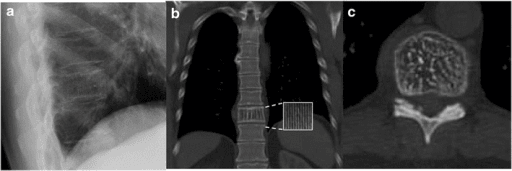
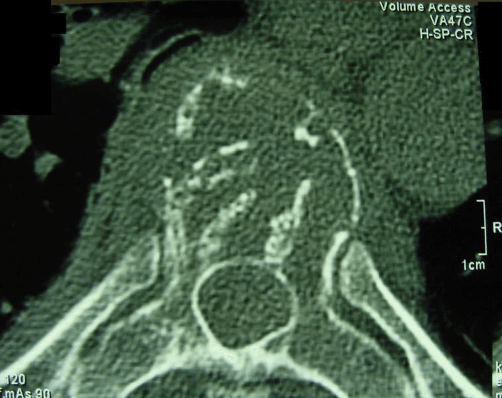
The pathognomonic signs. Both are the thickened residual trabeculae lying among the vascular tissue and fat. Seen end-on on axial CT they appear as discrete dots, the polka-dot sign; seen lengthwise on sagittal CT or a radiograph they appear as vertical striations, the corduroy or jail-bar sign.
The modalities. Radiograph and CT show the bone, MRI the activity and the canal, and angiography the blood supply.
- Radiograph - the first image, often incidental. Shows the coarse vertical striations of the corduroy sign, but many lesions are invisible on plain films until they are large
- CT - best for the bone pattern. Shows the polka-dot sign and defines cortical integrity, expansion and any posterior-element involvement for surgical planning
- MRI - best for activity and the canal. Signal reflects fat content, and MRI crucially shows epidural extension and cord compression
- Angiography - when surgery is planned. Maps the feeding vessels and allows preoperative embolisation to reduce intraoperative blood loss
- Quiescent (typical)
- High (fatty)
- Aggressive
- Low (fat replaced by stroma)
- Quiescent (typical)
- High
- Aggressive
- High, often heterogeneous
- Quiescent (typical)
- Mild
- Aggressive
- Avid
- Quiescent (typical)
- Confined to body
- Aggressive
- Epidural or paravertebral extension
The most useful single MRI discriminator is T1 signal. A bright (fatty) T1 lesion is almost always a quiescent, leave-alone haemangioma. A T1-dark lesion has lost its fat to vascular stroma and is the one that may be aggressive and may need treatment.
When to biopsy. A classic fatty incidental lesion does not need a biopsy, because the imaging is diagnostic. Biopsy is reserved for atypical or aggressive lesions where the differential includes a more sinister pathology such as metastasis, myeloma or another primary tumour.
How to biopsy safely. These lesions are highly vascular, so percutaneous biopsy can bleed. Biopsy of a spinal column tumour should follow oncological principles: planned by the treating surgeon, along a tract that can be excised at definitive surgery, and ideally in a unit able to manage haemorrhage.
Never treat a spinal haemangioma like a routine soft-tissue mass. An ill-planned biopsy can cause significant bleeding, and an ill-placed tract can compromise a future en bloc resection. When in doubt, refer to a specialist spinal oncology unit before any tissue is taken.
Differential Diagnosis
The classic fatty lesion is unmistakable. The atypical (low-fat) haemangioma is the one that causes diagnostic difficulty, because, like a metastasis, it is T1-hypointense.
- Discriminating features
- T1-dark like a metastasis, BUT retains thickened vertical trabeculae (polka-dot/corduroy) on CT and often some intralesional fat; no cortical destruction or soft-tissue mass when non-aggressive
- Key clue
- CT trabecular pattern is preserved/coarsened
- Discriminating features
- T1-dark marrow replacement that DESTROYS trabeculae; lytic or sclerotic without a polka-dot pattern; may have a paravertebral/epidural soft-tissue mass, pedicle destruction and cortical breach; usually hot on bone scan
- Key clue
- Trabeculae destroyed, pedicle involved, known primary
- Discriminating features
- T1-bright and T2-bright like a quiescent haemangioma, BUT NO thickened trabeculae and NO polka-dot; suppresses on fat-saturated sequences and drops on opposed-phase (chemical-shift) imaging
- Key clue
- No trabecular thickening; drops with fat suppression
- Discriminating features
- Enlarged vertebral body with cortical thickening ("picture-frame" vertebra) and coarse trabeculae, or a sclerotic "ivory" vertebra; trabecular coarsening is generalised rather than the fine vertical striations of corduroy
- Key clue
- Bony enlargement + picture-frame cortex
- Discriminating features
- Marrow-replacing, T1-dark, often with a soft-tissue component and trabecular/cortical destruction; lack the polka-dot pattern; myeloma classically lytic with low osteoblastic activity
- Key clue
- Marrow replacement, no polka-dot, clinical/serology
Bone scintigraphy. Scintigraphy helps when the picture is equivocal. Most haemangiomas show only normal or mildly increased uptake (and may be photopenic), whereas most metastases are markedly hot; an aggressive haemangioma can itself be active, though, so a positive scan does not exclude it. When doubt remains after CT and MRI, particularly for a T1-dark, atypical or aggressive-looking lesion in a patient with a known or suspected primary, the issue is settled by image-guided biopsy along an excisable tract in a specialist unit (see biopsy under Investigations) rather than by imaging alone.
Answer in one line: the CT trabecular pattern, the single most useful discriminator. A haemangioma thickens and preserves the vertical trabeculae (polka-dot end-on, corduroy lengthwise) and often retains some fat; a metastasis destroys trabeculae, is lytic or sclerotic without that pattern, frequently involves the pedicle and may have a soft-tissue mass. If still uncertain on CT and MRI, biopsy.
Management Algorithm
Observation, the default. The typical incidental fatty lesion needs no treatment. Recognise it, document it and reassure the patient; routine surveillance imaging of a classic asymptomatic lesion is generally unnecessary. Observation carries no morbidity, but it depends on being confident of the diagnosis. The clinical skill is restraint: not biopsying, not irradiating and not operating on a lesion that is doing no harm.
The painful, neurologically intact lesion. When a lesion is convincingly the source of mechanical back pain and there is no neurological deficit, minimally invasive options are first-line. The choice between them is individualised and often multidisciplinary.
Vertebroplasty. Percutaneous injection of cement into the lesion relieves pain quickly, stabilises the vertebra and can devascularise the lesion. It is widely used for painful and selected aggressive lesions, including with epidural extension in some series, but is limited for cord disease alone.
Radiotherapy. External beam radiotherapy, commonly around 40 Gy in fractions, gives durable pain control and can induce re-ossification. It is effective as a first-line option for painful lesions. Other adjuncts include sclerotherapy or ethanol injection to obliterate the vascular channels.
Radiotherapy and the cord. Radiotherapy is slow in onset and is not a treatment for acute cord compression. For aggressive lesions with only a mild or slowly progressive deficit, it has been used first-line, reserving surgery for severe or progressive cord compression (Wang 2018, in the evidence below), though seven of those twenty patients went on to need an operation.
The aggressive lesion with deficit. This is the surgical group, and the principles are consistent across the literature: control the blood supply first, then decompress the cord and stabilise the spine. It is a major operation on a highly vascular lesion, and the sequence is:
- Preoperative embolisation - transarterial embolisation of the feeding vessels to reduce intraoperative haemorrhage. Essential, and near-universal before resection of an aggressive lesion
- Decompression - remove the epidural component compressing the cord or roots. Restoring neurological function is the primary surgical goal
- Tumour removal, tailored in extent - ranging from intralesional resection or decompression with vertebroplasty, through gross-total or subtotal resection, to total en bloc spondylectomy for the most aggressive lesions
- Stabilisation, if unstable - instrumented fusion where bony resection or destruction has produced instability, often guided by the SINS score
- Adjuvant radiotherapy, if residual - postoperative radiotherapy for residual tumour after subtotal resection, to reduce recurrence
How much surgery. There is no single correct operation. Reported series show that decompression with vertebroplasty and intralesional resection can give good neurological recovery with low recurrence, while total en bloc spondylectomy gives excellent local control but carries higher morbidity. Match the aggressiveness of the operation to the aggressiveness of the lesion and the patient's fitness.
Complications and Prognosis
- Complication
- Progressive cord compression and deficit
- Mitigation
- Timely imaging and referral
- Complication
- Cement leak, rarely into the canal
- Mitigation
- Image guidance, controlled injection
- Complication
- Massive haemorrhage
- Mitigation
- Preoperative embolisation, cell salvage
- Complication
- Recurrence after subtotal resection
- Mitigation
- Adjuvant radiotherapy, surveillance
Outlook. The prognosis is excellent, and the typical incidental lesion never causes a problem. Even in the aggressive group, modern series report that neurological function improves in the great majority of patients after treatment, with low recurrence rates, when the blood supply is controlled and the cord is adequately decompressed. Malignant transformation does not occur.
Patients come to harm in two ways: an untreated aggressive lesion that compresses the cord and an avoidable complication of over-treatment (unnecessary biopsy or surgery on an incidental lesion).
Guidelines, Registries and Global Practice
- Widely Accepted Position
- Imaging is diagnostic for classic lesions
- Practical Implication
- Biopsy reserved for atypical or aggressive lesions
- Widely Accepted Position
- T1 signal separates fatty from vascular lesions
- Practical Implication
- Low T1 prompts closer evaluation
- Widely Accepted Position
- Enneking, WBB and SINS used together
- Practical Implication
- Structured planning of resection and stabilisation
- Common Global Practice
- Observation without surveillance imaging
- Variation And Reason
- Some centres image once to confirm stability
- Common Global Practice
- Vertebroplasty or radiotherapy
- Variation And Reason
- Choice depends on local expertise and resources
- Common Global Practice
- Embolisation then decompression and stabilisation
- Variation And Reason
- Extent of resection ranges from intralesional to en bloc by lesion and unit
There is no large randomised evidence base for vertebral haemangioma because symptomatic disease is rare; practice is therefore guided by retrospective series and the principles of benign spinal tumour surgery. Across high- and lower-resource settings the constant themes are recognition of the classic imaging signs, restraint with incidental lesions, embolisation before any major resection, and matching the intensity of treatment to the behaviour of the lesion. Resource-rich units may have ready access to en bloc spondylectomy and interventional radiology, while in other settings decompression with vertebroplasty and radiotherapy are pragmatic and effective alternatives.
MCQ Practice Points
Exam Viva Scenarios
Practise clinical reasoning and management decisions out loud
“An MRI reported for low back pain incidentally shows a T1-bright, T2-bright lesion in an L2 vertebral body with a polka-dot pattern on the accompanying CT. The patient has no neurological signs. What is it and what would you do?”
“A 30-year-old woman in the third trimester of pregnancy develops progressive weakness of both legs and a sensory level. MRI shows a thoracic vertebral lesion with epidural extension compressing the cord. How do you approach this?”
“What staging and assessment tools would you use to plan surgery for an aggressive vertebral haemangioma, and what does each contribute?”
Key Facts
- Most common benign tumour of the spine; vascular lesion of bone
- Present in roughly 10-12% of adults at autopsy; under 1% symptomatic
- Thoracic spine is the most common symptomatic and aggressive site
- Benign lesion - no malignant transformation
Pathognomonic Imaging
- Polka-dot sign on axial CT (trabeculae end-on)
- Corduroy / jail-bar sign on sagittal CT or radiograph
- High T1 and T2 signal = fatty, quiescent lesion
- Low T1 signal = vascular stroma, potentially aggressive
Aggressive Features
- Low T1 signal with avid enhancement
- Cortical expansion and bony destruction
- Epidural or paravertebral soft-tissue extension
- Progressive neurological deficit; pregnancy can trigger
Staging Tools
- Enneking benign: S1 latent, S2 active, S3 aggressive
- WBB: 12 zones and 5 layers to plan resection
- SINS: grades mechanical instability
- ASIA scale for neurological status
Management
- Incidental fatty lesion: observe and reassure, no biopsy
- Painful, intact: vertebroplasty or radiotherapy
- Aggressive with deficit: embolisation then decompression and stabilisation
- Adjuvant radiotherapy for residual tumour after subtotal resection
Surgical Pearls
- Always embolise before resecting - highly vascular, heavy bleeding
- Match extent of surgery to lesion behaviour and patient fitness
- Less extensive surgery can give good recovery with low recurrence
- Biopsy only atypical lesions, along an excisable tract, in a specialist unit
Evidence Base and Key Studies
Total En Bloc Spondylectomy For Enneking Stage 3 Aggressive Lesions
- Series of 23 Enneking stage 3 aggressive vertebral haemangiomas with neurological deficit treated by one-stage posterior total en bloc spondylectomy
- 17 thoracic and 6 lumbar lesions; all had cord compression with or without instability (mean SINS 9.78)
- Mean operative blood loss 1883 mL after preoperative embolisation, with no serious complications reported
- All patients recovered to ASIA-E (normal) neurological status after surgery
- Mean pain score fell from 8.0 to 2.8 out of 10
Is A Less Extensive Approach Adequate For Aggressive Lesions With Deficit
- 21 patients with aggressive vertebral haemangioma and neurological deficit, staged by Enneking and WBB systems with SINS
- All underwent preoperative embolisation; procedures ranged from intralesional spondylectomy to decompression with vertebroplasty and stabilisation
- Neurology improved in all patients over a mean follow-up of about 56 months
- Only one recurrence across the cohort
- Less extensive procedures achieved good clinical, neurological and radiological outcomes
Role Of Radiotherapy And Surgery In Aggressive Vertebral Haemangioma
- 20 patients with aggressive vertebral haemangioma and mild or slowly progressive deficit treated with radiotherapy as first-line therapy (40-50 Gy)
- 65% (13 of 20) were symptom-free without recurrence or malignant transformation at last follow-up (mean 75 months)
- Seven patients needed subsequent surgery for increasing or persistent deficit
- No malignant transformation was observed in any patient
- Radiotherapy was concluded to be safe and effective for mild or slowly progressive disease
Combined Surgical And Endovascular Treatment Of Aggressive Lesions
- 10 patients with aggressive vertebral haemangioma over 17 years, undergoing 13 procedures
- All but one had preoperative procedures to minimise intraoperative blood loss
- All eight patients presenting with neurological deficit improved postoperatively
- Most underwent subtotal resection; one had en bloc resection, with one recurrence requiring staged surgery
- Combined embolisation, resection and stabilisation was safe and effective