Motion-Preserving Salvage | RA Primary Indication | Distal Loosening Challenge | Low-Demand Essential
- Rheumatoid arthritis is the primary indication - low demands, soft bone, bilateral disease
- Distal component loosening is the most common failure mode (10-30%) - metacarpal stress shielding
- Low-demand patients essential - heavy use accelerates loosening and failure
- Preserves 40-60 degrees motion arc vs arthrodesis which eliminates all motion
- Fusion remains gold standard for high-demand patients due to durability concerns
- “TWA vs fusion: Motion preservation (TWA) vs durability (fusion) - patient selection critical
- “Distal component loosening most common complication - occurs at metacarpal-carpal junction
- “RA patients ideal: low demands, soft bone accepts cement, often bilateral disease
- “Extensor tendon rupture occurs due to dorsal hardware prominence - 5-10% incidence
Overview and Epidemiology
Total wrist arthroplasty (TWA) is a motion-preserving salvage procedure for end-stage wrist arthritis. It replaces the radiocarpal and midcarpal joints with prosthetic components and keeps the wrist moving, where arthrodesis eliminates all motion.
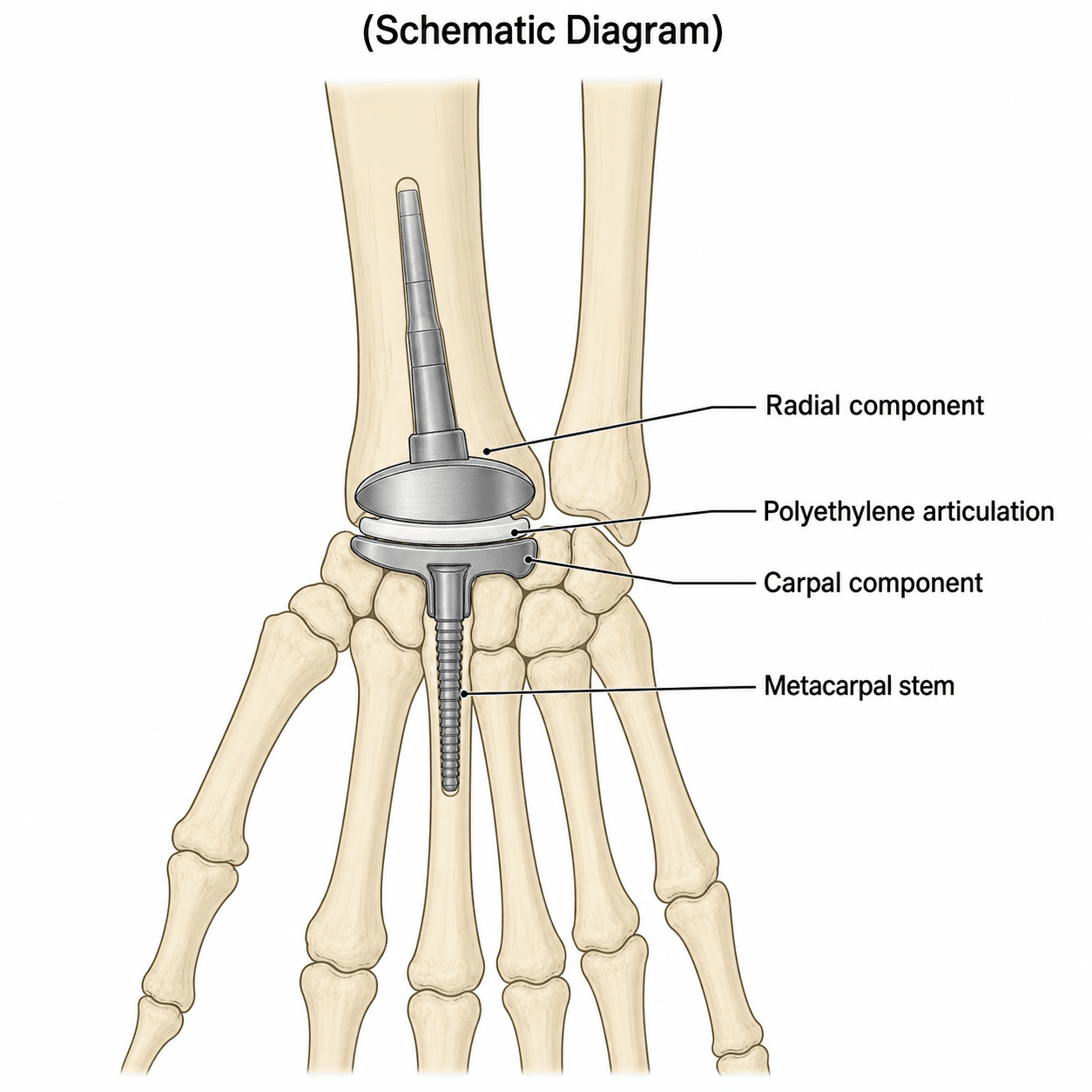
How often. TWA is uncommon beside fusion, at a ratio of approximately 1:10. Its use is increasing on the strength of the improved third-generation designs, but the numbers are still so low that the AOANJRR holds only limited data.
Indications and Patient Selection
The trade. Arthroplasty preserves a 40-60 degree arc of motion; arthrodesis gives up all of it in exchange for reliable pain relief and 95% union. Motion preservation comes at the cost of durability, so fusion remains the gold standard for high-demand patients and the trade-off must be discussed with every patient. Patient selection is the single most important factor determining outcome, and poor selection leads to early loosening and revision.
- Total Wrist Arthroplasty
- RA, low-demand, bilateral disease
- Wrist Arthrodesis
- High-demand, OA, post-traumatic
- Total Wrist Arthroplasty
- Preserves 40-60 degree arc
- Wrist Arthrodesis
- Eliminates all wrist motion
- Total Wrist Arthroplasty
- 78-95% survival depending on implant and follow-up length
- Wrist Arthrodesis
- 95% union rate, durable long-term
- Total Wrist Arthroplasty
- Distal component loosening (10-30%)
- Wrist Arthrodesis
- Nonunion (5-10%)
- Total Wrist Arthroplasty
- 15-25% at 10 years
- Wrist Arthrodesis
- 5-10% at 10 years
- Total Wrist Arthroplasty
- 50-70% of normal
- Wrist Arthrodesis
- 60-80% of normal
- Total Wrist Arthroplasty
- Low-demand activities only
- Wrist Arthrodesis
- Higher-demand activities possible
- Total Wrist Arthroplasty
- Ideal - motion both sides
- Wrist Arthrodesis
- Functional limitation if bilateral
The ideal candidate. Rheumatoid arthritis with low functional demands is the primary indication. Low demand is essential, because heavy use causes loosening. The typical candidate is older, typically over 60 years, with natural activity limitations; has widespread rheumatoid disease with multiple joints involved, often bilaterally; has soft bone that accepts cement well; and still has adequate bone stock for component fixation. The primary indications are:
- Rheumatoid arthritis with low functional demands
- Bilateral wrist disease, to preserve motion on both sides
- A contralateral wrist fusion, where motion preservation is essential
- An elderly patient with limited activity expectations
Motion preservation is also critical for a patient whose occupation requires wrist motion.
Secondary indications. Primary osteoarthritis in a low-demand patient, post-traumatic arthritis in a carefully selected one, and SLAC or SNAC wrist when motion preservation is desired.
Contraindications. Active infection is absolute: eradicate it first. The relative contraindications follow; in the high-demand and the young, fusion is preferred.
- High demand: manual labour or heavy lifting
- Young age, with its longevity concerns
- Poor bone stock (severe osteopenia)
- An inadequate soft tissue envelope or extensor deficiency, with its risk of tendon rupture
Sports and heavy recreation preclude TWA.
Implant Types and Biomechanics
First generation (1970s-1980s). Silicone spacers (Swanson) and ball-and-socket designs (Meuli) failed at high rates from silicone synovitis, excessive constraint, poor fixation and loosening, and are largely abandoned. The silicone failure is a subject of its own, below.
Second generation (1980s-1990s). The biaxial design (Cooney) improved fixation but still loosened significantly, and its constrained design caused bone loss.
Third generation (2000s to the present). Universal 2, Maestro and ReMotion use an ellipsoidal articulation, improved distal fixation and better bone preservation. Their survival is improved but still concerning in the long term. ReMotion, the newest of the three, is also described as a fourth-generation design.
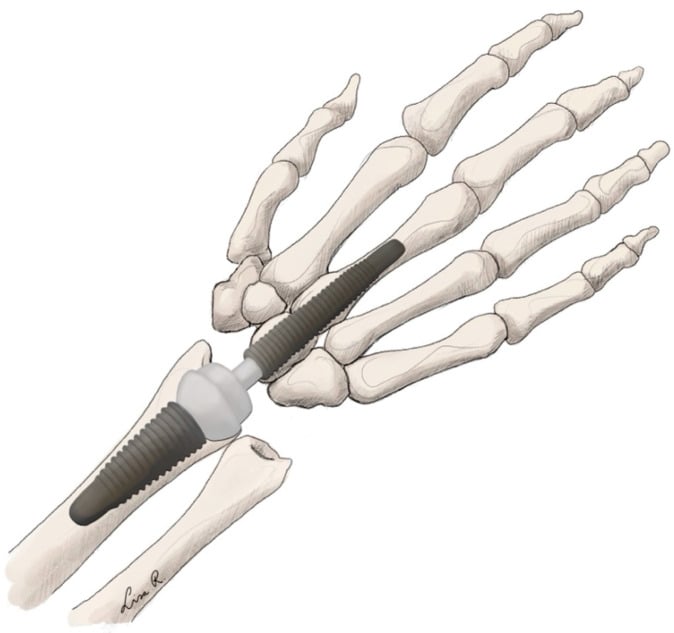
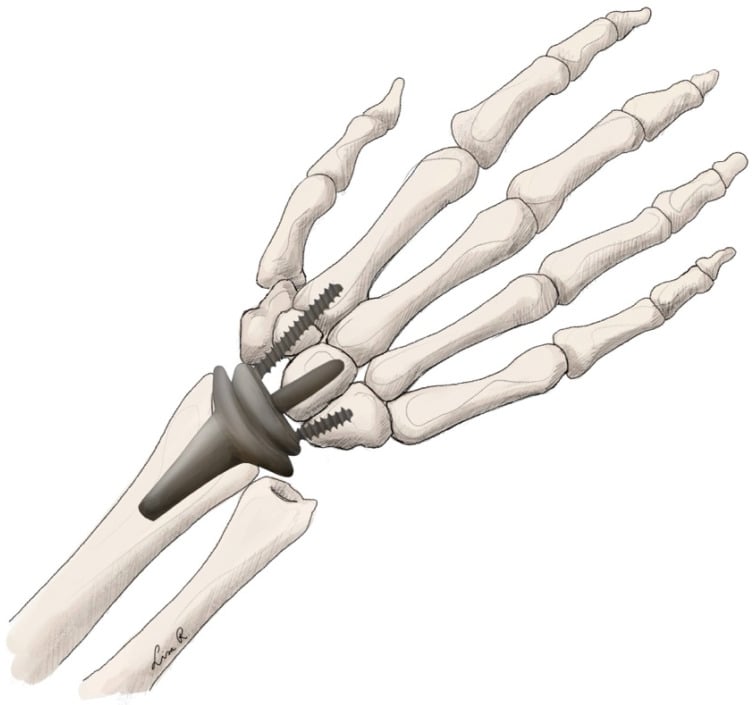
What the third generation changed. Four design principles separate the current implants from their predecessors, and distal loosening remains the challenge despite all of them:
- Ellipsoidal articulation mimics normal wrist kinematics, reduces constraint and stress transfer, and allows coupled (dart-throwing) motion
- Improved distal fixation, by metacarpal stems or a central screw, is the critical advance and addresses the distal loosening problem
- Bone preservation: less resection than earlier designs maintains bone stock and facilitates revision to fusion
- An unlinked design reduces constraint but relies on the soft tissues for stability, so it requires adequate ligaments
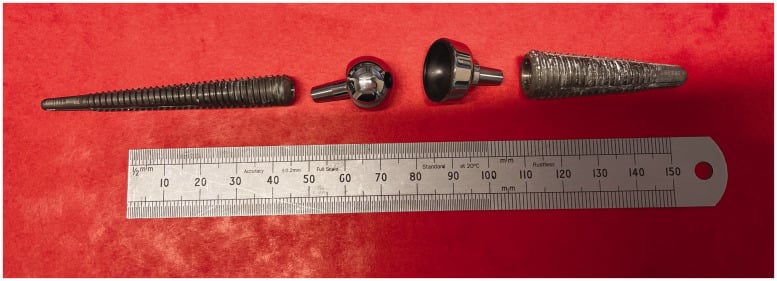
Universal 2 (Integra) is the most widely used design and has the longest follow-up. A toroidal, porous-coated titanium radial component articulates ellipsoidally with a cobalt-chrome carpal component through a UHMWPE polyethylene insert. The radial component is press-fit or cemented; distally, a carpal plate with metacarpal stems fixes into the 2nd and 3rd metacarpals. It gives a flexion-extension arc of 40-60 degrees and a radial-ulnar deviation arc of 15-25 degrees.
Results. In the largest long-term rheumatoid cohort (Newton), survivorship was 78% at 10 years with an overall revision rate of 22%. In a smaller series 81% remained in situ at a mean of 11 years and 92% of patients were satisfied (Zijlker). Late failure is periprosthetic loosening with subsidence, and explant analysis implicates polyethylene wear.
Silicone Wrist Arthroplasty and Silicone-Induced Synovitis
The first-generation silicone (Silastic) implants popularised by Swanson were not true articulating replacements. They were flexible hinged spacers inserted after resection of the proximal carpal row or radiocarpal joint, acting as a dynamic interposition that guided fibrous encapsulation. They gave early pain relief and were technically simple, but their mechanical and biological failures are the reason modern total wrist arthroplasty exists, and they remain a favourite examiner theme.
Implant fracture. Repetitive loading of a flexible polymer across the high-stress wrist tore and fractured the spacer, with loss of alignment and recurrent deformity.
Silicone-induced particulate synovitis. Micro-fragmentation shed silicone debris that provoked a foreign-body granulomatous reaction. The proliferative synovitis and macrophage response drove progressive cystic bone erosions (geodes), component subsidence and, occasionally, regional silicone lymphadenopathy. This destructive osteolysis, rather than simple surface wear, is the hallmark lesion.
Bone loss. The cystic destruction consumed carpal and metacarpal bone stock, which made later conversion to arthrodesis technically demanding and graft-dependent.
Grommets. Metal (titanium) grommets were introduced to shield the silicone from sharp resected bone edges, reduce abrasion and delay fracture. They mitigated the problem without eliminating it.
Where silicone persists. Silicone is now essentially abandoned for total wrist replacement. Silicone interposition retains a limited role in some low-demand settings, and silicone remains widely used in metacarpophalangeal arthroplasty for the rheumatoid hand, a distinction worth stating explicitly in the viva.
Asked why early wrist arthroplasty was abandoned, name silicone-induced particulate synovitis specifically, compounded by implant fracture. Contrast it with modern designs, whose dominant late failure is polyethylene wear-driven distal component loosening.
Surgical Technique
Planning. Confirm the patient's low-demand lifestyle and functional requirements, whether the disease is bilateral, and that the expectations and limitations are understood. Confirm end-stage arthritis, and assess bone quality (rheumatoid bone is often osteopenic), the soft tissue envelope and the integrity of the extensor tendons.
- Imaging: PA and lateral wrist radiographs, templated for component sizing; CT if there are bone stock concerns, MRI if there are soft tissue concerns
- Equipment: the TWA system (Universal 2, Maestro or ReMotion) in multiple sizes, cement if needed (rheumatoid patients with soft bone), and fluoroscopy
- Consent: the motion benefit against the durability concerns, a revision rate higher than fusion, permanent activity restrictions, and fusion as the alternative
Set-up. Supine, with the arm on a radiolucent hand table positioned for dorsal access, an upper arm tourniquet at 250mmHg for a bloodless field, and fluoroscopy from the radial side; fluoroscopy is essential for component positioning. Mark Lister's tubercle, the 3rd metacarpal, the extensor tendons and the DRUJ. Give cefazolin 2g IV (or vancomycin if allergic) within 60 minutes of incision.
Exposure. A longitudinal dorsal incision of 8-10cm is centred over the 3rd metacarpal and Lister's tubercle, running from the distal radius to the metacarpal bases. Protect the superficial radial nerve branches radially, whose injury causes numbness (10%), and the dorsal ulnar sensory branches ulnarly.
- Identify the extensor retinaculum and incise it between the 3rd and 4th compartments
- Retract EPL radially and EDC and EIP ulnarly, or release the 4th compartment and transpose the tendons; retract the extensor tendons carefully
- Expose the dorsal capsule and make a capsulotomy that preserves tissue for closure
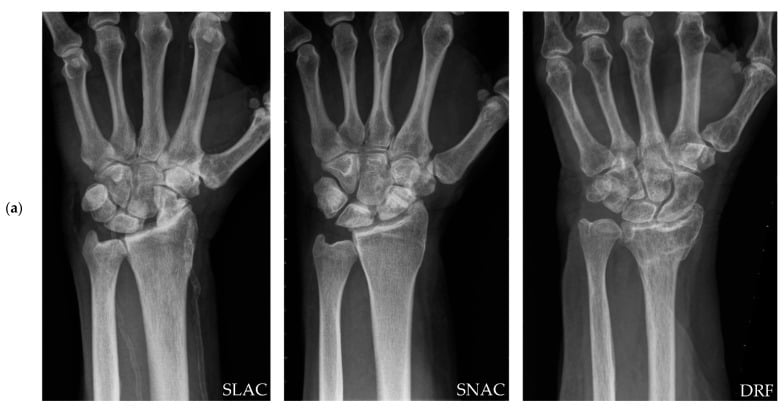
Bone preparation. Preparation balances adequate resection against preservation of bone for a possible revision: resect as little as possible, keep the cuts perpendicular to the long axis and maintain carpal height. Rheumatoid bone is often soft and osteopenic, so handle it gently to avoid fracture; cement may be needed for fixation.
- Expose the distal radial articular surface and resect 10-15mm of distal radius with the cutting guide (the amount varies by system)
- Create the canal for the radial stem and trial the radial component for fit
- Excise the proximal carpal row (scaphoid, lunate, triquetrum), or fuse it to the capitate, depending on the system
- Prepare the distal row for the carpal component, with channels for metacarpal stems if they are used
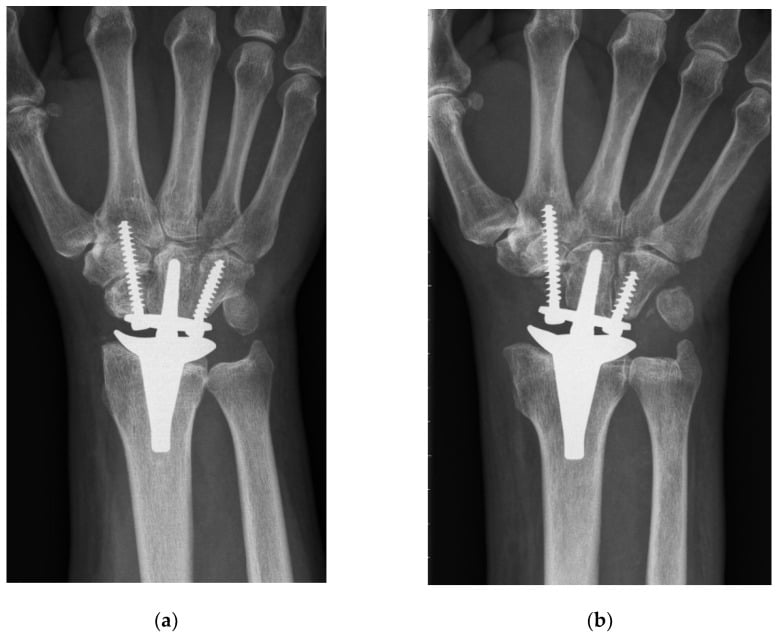
Component insertion. Each component is trialled, checked on fluoroscopy and then inserted definitively. The radial component is assessed for fit and alignment, then press-fit or cemented according to bone quality and its seating confirmed. The carpal component is assessed for alignment with the metacarpals, with metacarpal stems inserted if required, and its position confirmed before the definitive component goes in.
The polyethylene. A thicker insert increases stability but limits motion. Choose the thickness that allows 40-60 degrees of flexion-extension.
Final checks. The radial component should be centred on the radius and the carpal component aligned with the 3rd metacarpal, with the wrist in neutral.
- Component position confirmed on PA and lateral fluoroscopy
- Range of motion tested in flexion, extension, and radial and ulnar deviation
- Stable, with no subluxation
- No impingement through the range or at its extremes
Closure. Careful closure protects the tendons and the wound. Close the capsule with absorbable 2-0 Vicryl if there is sufficient tissue, snug but not overtight. Close the extensor retinaculum carefully so the extensor tendons glide smoothly; a portion may need to be left open to prevent impingement. Achieve haemostasis with bipolar, irrigate thoroughly and consider a drain if there is significant ooze. Close with 4-0 absorbable subcutaneous sutures and 4-0 nylon or a subcuticular skin closure, and apply a volar splint with the wrist in neutral and the fingers free.
Complications
- Incidence
- 10-30%
- Risk Factors
- High demand, poor bone quality, malalignment
- Management
- Revision arthroplasty or conversion to fusion
- Incidence
- 10-15%
- Risk Factors
- Component malposition, inadequate resection
- Management
- Debridement, component revision if severe
- Incidence
- 5-10%
- Risk Factors
- Dorsal hardware prominence, RA (weakened tendons)
- Management
- Tendon reconstruction or transfer
- Incidence
- 5-10%
- Risk Factors
- Soft tissue deficiency, component malalignment
- Management
- Thicker polyethylene, ligament repair, revision
- Incidence
- 3-5%
- Risk Factors
- Osteopenic bone, trauma, stress risers
- Management
- ORIF if stable, revision if loose
- Incidence
- 2-5%
- Risk Factors
- RA (immunosuppression), diabetes, poor nutrition
- Management
- Debridement, antibiotics, may need explant
- Incidence
- 5-10%
- Risk Factors
- Superficial radial nerve at risk dorsally
- Management
- Usually neuropraxia - observe, neuroma excision if persistent
Distal component loosening. The Achilles heel of wrist arthroplasty and its most common failure mode, quoted at 10-30% at 5 years. It occurs at the carpal-metacarpal junction, from stress concentration, inadequate fixation and stress shielding, and the stress shielding erodes bone at the same junction. Third-generation metacarpal stems and central screw fixation address it, but long-term durability remains inferior to fusion, and selecting low-demand patients is critical to minimising it.
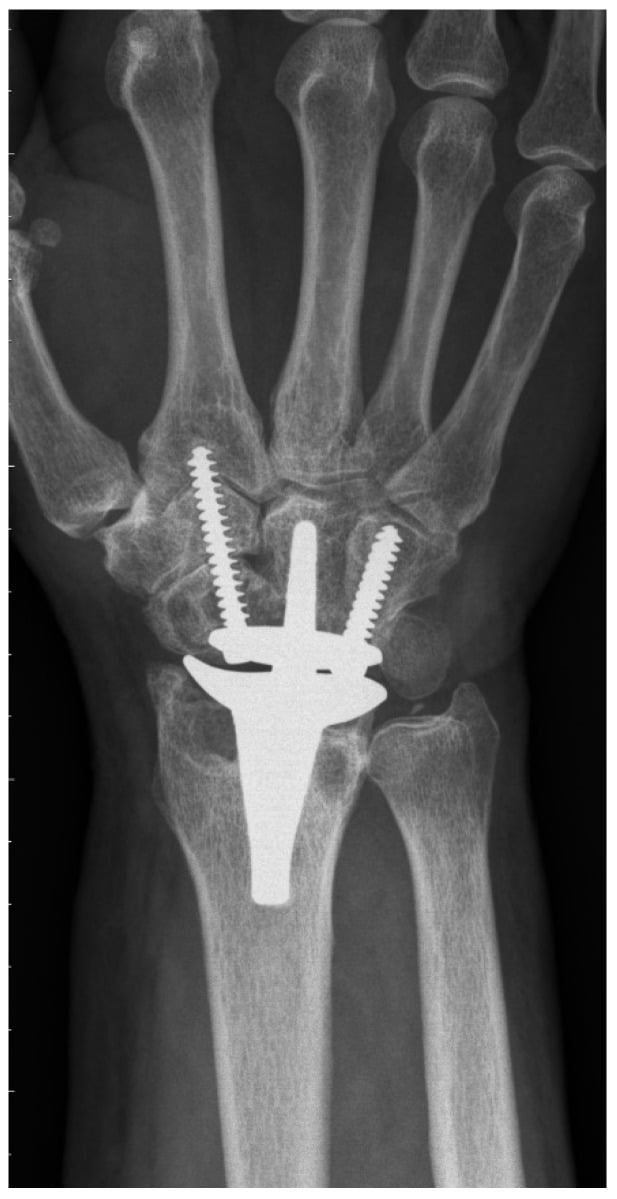
Impingement. Bony or soft tissue impingement limits motion.
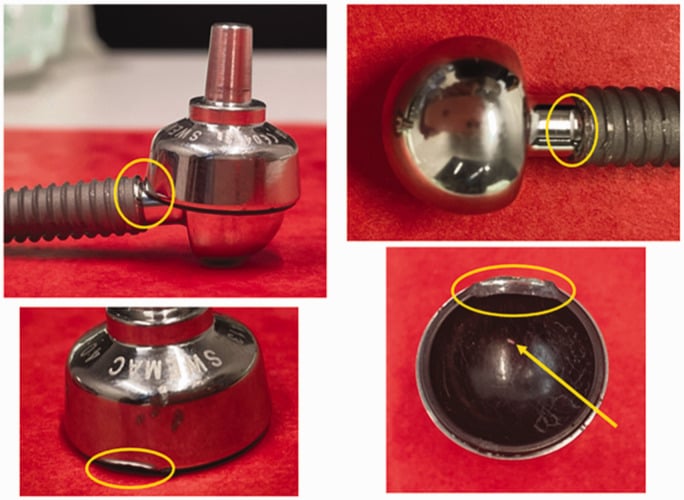
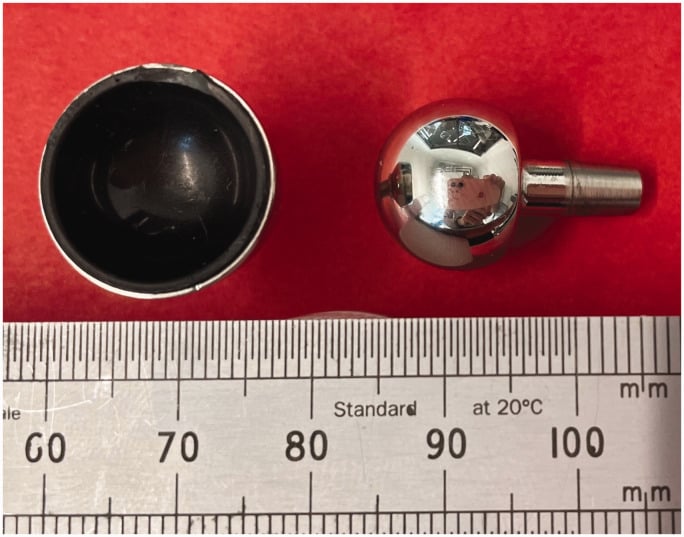
Extensor tendon rupture. Prevention is a smooth dorsal profile, adequate soft tissue coverage and early removal of prominent hardware. An EPL rupture is treated by EIP to EPL transfer.
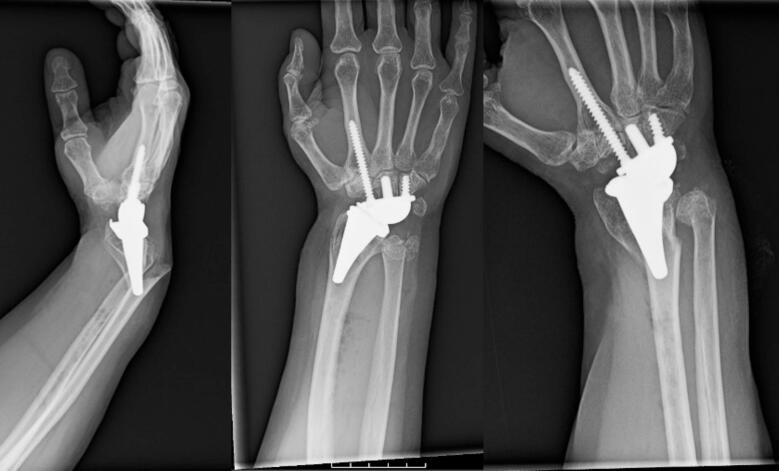
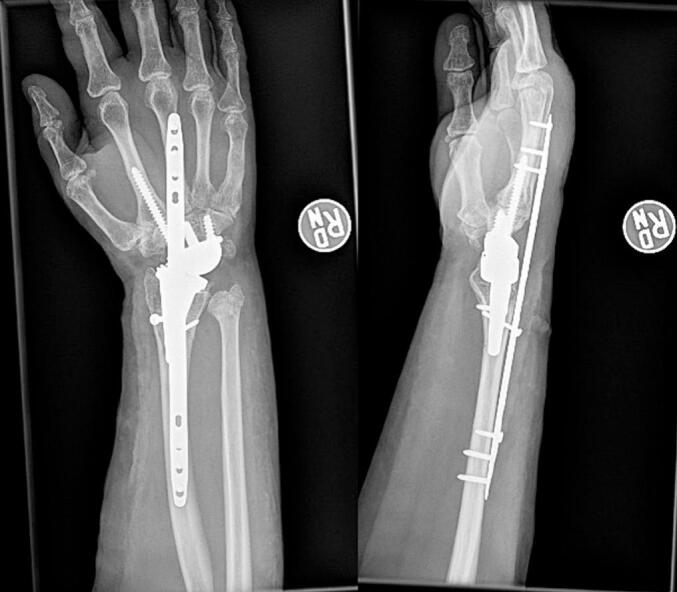
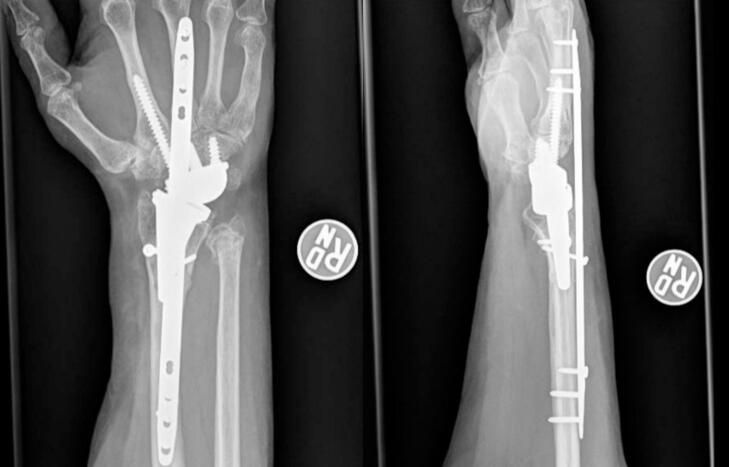
Periprosthetic fracture. The case below was fixed with the wrist components left in place.
Diagnosing and Monitoring Component Loosening
Loosening is judged on serial radiographs, always compared with the immediate post-operative film. The features are:
- Progressive radiolucent lines at the bone-implant or bone-cement interface. A thin (fewer than 2 mm), non-progressive lucent line may represent stable fibrous fixation; a lucency greater than 2 mm that widens across serial films suggests true loosening.
- Migration or subsidence: the carpal (distal) component sinking into the metacarpal, or the radial component tilting or shifting.
- A change in alignment or tilt, cement-mantle fracture, and focal osteolytic (particle disease) lesions with a scalloped margin.
Zonal analysis. The Wrightington zonal classification, used by Newton and colleagues for the Universal 2, scores lucency systematically around defined radial and carpal component zones, and is more reproducible than a subjective global impression.
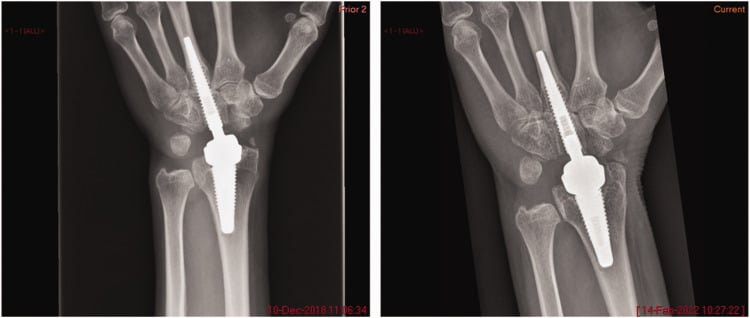
Reading the films against the patient. Sagerfors and colleagues found that radiographic loosening did not reliably predict revision, and satisfaction stayed high despite lucent lines, so imaging is read alongside symptoms, never in isolation. The combination that warrants intervention is progressive lucency, subsidence and activity-related pain. Serial plain films are the workhorse; CT better defines bone stock and osteolysis for revision planning.
Exclude infection first. Before attributing symptoms to aseptic loosening, exclude low-grade infection with ESR, CRP and, where indicated, joint aspiration. An infected loose implant is managed entirely differently.
Postoperative Care and Rehabilitation
Rehabilitation moves from protected motion to progressive loading while protecting the implant-bone interface, and it ends in lifelong activity modification to protect the implant.
Immediate phase (0-2 weeks). A volar splint in neutral, worn continuously, with elevation above heart level and neurovascular checks every 4 hours on the day of surgery. Active finger motion starts immediately, because early finger motion maintains tendon gliding and prevents stiffness. The wound is checked at 7-10 days, sutures come out at 10-14 days, and the splint is converted to a removable one at 2 weeks. Analgesia is multimodal (paracetamol, NSAIDs if appropriate), with opioids for breakthrough pain and ice and elevation for swelling.
Early phase (2-6 weeks). Protected motion. The removable volar splint is worn between exercises, at night and for all activities, and removed for hygiene and exercises. Active wrist motion in the splint begins with gentle flexion-extension of 20-30 degrees, alongside active finger motion, to maintain tendon gliding and manage swelling.
- No passive stretching or resistance
- No lifting over 500g
- No gripping or twisting
Intermediate phase (6-12 weeks). The splint is weaned during the day and continued at night until 12 weeks. Active motion progresses towards a 40-60 degree flexion-extension arc with active radial-ulnar deviation, and gentle grip strengthening begins at 8 weeks. Lifting stays under 2kg until 12 weeks, with no impact and no extreme positions. Radiographs at 6 weeks check component position and look for early signs of loosening.
Long-term phase (from 12 weeks). A gradual return to light daily activities, a strengthening programme and functional activities as tolerated. Review is at 6 weeks, 3 months, 6 months and 1 year, with annual radiographs thereafter to monitor for loosening, wear and other complications. The restrictions are permanent:
- Lifting limited to 5-10kg at most
- No impact activities
- No heavy manual labour
- No repetitive heavy gripping
Expected outcome. A 40-60 degree arc of motion, pain relief in 80-85%, and grip strength 50-70% of normal.
Guidelines, Registries & Global Practice
Global Epidemiology
- Wrist arthroplasty is uncommon worldwide - performed roughly an order of magnitude less often than wrist fusion. Most published series are single-centre or national-registry cohorts of a few hundred cases.
- Historically rheumatoid arthritis dominated indications. With widespread DMARD and biologic therapy, the incidence of severe destructive RA wrists requiring surgery has fallen, and the proportion of cases performed for osteoarthritis and post-traumatic disease has risen (Norwegian register trend).
- Typical patient: low-demand, often older than 60, frequently with bilateral or contralateral wrist disease.
Registry Evidence (side by side)
- Cohort
- 189 wrists (Biax, Elos, Gibbon)
- Key Survivorship Signal
- 78% at 5 yr, 71% at 10 yr; Biax 85% vs Elos 57% at 5 yr
- Cohort
- 219 wrists
- Key Survivorship Signal
- 8-yr survival: Maestro 95%, ReMotion 94%, Biax 81%
- Cohort
- Low annual wrist-replacement volumes
- Key Survivorship Signal
- Numbers too small for robust implant ranking - underlines niche status
Society and Practice Guidance
- No major society (AAOS, BOA, EFORT, AO) issues a dedicated stand-alone wrist-arthroplasty guideline; recommendations derive from hand-surgery consensus and registry data.
- Consensus across regions: arthrodesis remains the durable benchmark, particularly for high-demand and younger patients; arthroplasty is reserved for selected low-demand patients prioritising motion, especially with bilateral disease or contralateral fusion.
- Shared decision-making and explicit counselling on revision risk and permanent activity restriction are universally emphasised.
High- vs Limited-Resource Practice Variation
- High-resource settings: third- and fourth-generation modular implants, intraoperative fluoroscopy, and dedicated hand-therapy rehabilitation are standard; revisability and conversion-to-fusion planning influence implant choice.
- Limited-resource settings: implant cost and availability, lack of revision inventory, and limited hand-therapy access shift practice strongly toward arthrodesis, which is cheaper, more durable, and technically more forgiving.
- Worldwide, TWA is concentrated in tertiary units with subspecialty hand-surgery training because low case volumes make maintaining proficiency difficult.
Related pages: Total Wrist Arthroplasty vs Arthrodesis is the decision page to this page's implant page - it carries the reconstruction ladder, the functional arc of wrist motion and the position in which a wrist should be fused; read it to decide whether to replace the joint, and this one for what to replace it with. Proximal Row Carpectomy and Four-Corner Fusion are the motion-sparing operations that come before total replacement on that ladder and that make total wrist arthroplasty a much rarer operation in non-inflammatory disease than the registry trend suggests. The degenerative patterns that bring a wrist to reconstruction are SLAC Wrist from Scapholunate Dissociation and Wrist Ligament Instability, SNAC Wrist from Scaphoid Nonunion, Kienbock's Disease, and post-traumatic arthritis after Distal Radius Fractures. Rheumatoid Arthritis of the Hand is the disease this operation was designed for and covers the tendon ruptures, caput ulnae and digital deformities that usually need addressing in the same wrist. Imaging of the Wrist and Hand covers the surveillance films on which loosening is judged, and Polyethylene: UHMWPE and XLPE with THA Wear and Osteolysis explain the wear-driven loosening that explant analysis implicates in late failure here - the same mechanism, in a joint with a fraction of the bone stock to lose. Radial-Sided Wrist Pain and Ulnar-Sided Wrist Pain are where the differential begins before any of this is contemplated.
Controversies and Areas of Uncertainty
The evidence base for wrist arthroplasty remains predominantly Level III-IV with no high-quality randomised comparison against arthrodesis, leaving several genuine areas of debate.
1. Arthroplasty versus arthrodesis - the core unresolved question. Cavaliere and Chung concluded existing data did not support widespread TWA over fusion in the rheumatoid wrist. No adequately powered randomised trial has since overturned this. Proponents argue motion preservation is functionally important (especially with contralateral fusion or bilateral disease); sceptics counter that fusion delivers more reliable, durable pain relief. Current practice individualises the decision rather than applying a blanket rule.
2. Expanding indications to osteoarthritis and post-traumatic disease. Historically RA was the near-exclusive indication. Registry and cohort data (Norwegian register, ReMotion multicentre series) show increasing use in non-inflammatory disease, with comparable midterm survival in some series. Whether higher-demand OA and post-traumatic patients will erode long-term survivorship remains uncertain - the lower bone quality of RA paradoxically reduces mechanical loading.
3. Cause of late failure - loosening versus polyethylene wear. Distal/carpal component loosening is consistently the dominant failure mode, but its mechanism is contested. Newton et al implicate polyethylene wear-driven osteolysis on explant analysis, shifting attention from purely mechanical fixation toward bearing-surface durability and material science.
4. Radiographic lucency as a revision trigger. Sagerfors et al found radiographic loosening did not reliably predict revision, with high satisfaction despite lucent lines. This challenges the use of radiolucency alone to justify reoperation - clinical symptoms and progressive subsidence matter more than a single radiograph.
5. Implant selection and the absence of head-to-head trials. Marked implant-specific survival differences exist (e.g. second-generation Biax markedly inferior to Maestro/ReMotion), yet randomised comparisons between modern designs are lacking. Choice is driven by surgeon familiarity, registry signals, and revisability rather than Level I evidence.
Examiners reward candidates who acknowledge that TWA evidence is low-level and that fusion remains the durable benchmark, while articulating the specific scenarios (low-demand RA, bilateral disease, contralateral fusion) where motion preservation justifies the trade-off. Avoid dogmatism in either direction.
Exam Viva Scenarios
Practise clinical reasoning and management decisions out loud
“A 62-year-old woman with bilateral rheumatoid arthritis affecting both wrists presents with end-stage disease. Her left wrist was fused 3 years ago and she now has progressive pain in her right wrist. She works as a retired librarian and has low physical demands. Discuss your management options and justify your recommendation.”
“A 68-year-old man presents 4 years after total wrist arthroplasty with progressive wrist pain. X-rays show lucency around the distal component with subsidence. He has low demands and good bone stock. How do you manage this?”
“A 70-year-old woman with RA presents 2 years after TWA with inability to extend her thumb. On examination she has loss of thumb IP extension. X-rays show well-fixed components. What is your diagnosis and management?”
Indications
- Primary: RA with low demands (ideal candidate)
- Bilateral disease - motion preservation both sides
- Contralateral fusion - avoid bilateral fusion
- Elderly with limited activity expectations
Contraindications
- High-demand or manual labor - choose fusion
- Young age - durability concerns
- Poor bone stock - inadequate fixation
- Active infection - eradicate first
Key Numbers
- Motion: 40-60 degree arc preserved
- Survival: implant-dependent — 78% at 10 yr (Universal 2), 94-95% at 8 yr (ReMotion, Maestro)
- Radiographic loosening: 2% Maestro, 18% ReMotion, 26% Biax — poorly predicts revision
- Revision rate: 22% at long-term follow-up in the largest rheumatoid Universal 2 cohort
Implant Types
- Universal 2 - most widely used, longest follow-up
- Maestro - bone-preserving, easier revision
- ReMotion - newest, anatomic design
- All third-generation ellipsoidal articulation
Complications
- Distal loosening - KEY failure mode (10-30%)
- Extensor tendon rupture (5-10%) - dorsal hardware
- Impingement (10-15%)
- Revision to fusion if failed
TWA vs Fusion
- TWA: motion preserved but less durable
- Fusion: no motion but 95% union
- Fusion revision rate 5-10% vs TWA 15-25%
- Fusion gold standard for high-demand
Evidence Base and Key Trials
TWA vs Arthrodesis - Landmark Systematic Review
- 18 TWA studies (~500 procedures) vs 20 fusion studies (over 800 procedures) in rheumatoid wrists
- Total wrist fusion provided more reliable pain relief than arthroplasty
- Complication and revision rates were higher for TWA than fusion
- Only 3 of 14 studies showed a mean active arc within the functional range; satisfaction high in both groups
Norwegian Arthroplasty Register - 189 Wrist Replacements
- 189 primary wrist replacements (Biax, Elos, Gibbon) over 16 years
- 5-year survival 78% (95% CI 70-85); 10-year survival 71% (95% CI 59-80)
- Biax 85% at 5 years vs Elos only 57% at 5 years - large implant-specific differences
- Survival inferior to hip/knee arthroplasty, but a failed TWA still leaves the option of a well-functioning arthrodesis
References
-
Cavaliere CM, Chung KC. A systematic review of total wrist arthroplasty compared with total wrist arthrodesis for rheumatoid arthritis. Plast Reconstr Surg. 2008;122(3):813-825. PMID: 18766045. doi:10.1097/PRS.0b013e318180ece3
-
Krukhaug Y, Lie SA, Havelin LI, Furnes O, Hove LM. Results of 189 wrist replacements. A report from the Norwegian Arthroplasty Register. Acta Orthop. 2011;82(4):405-409. PMID: 21657971. doi:10.3109/17453674.2011.588858
-
Herzberg G, Boeckstyns M, Sorensen AI, et al. "ReMotion" total wrist arthroplasty: preliminary results of a prospective international multicenter study of 215 cases. J Wrist Surg. 2012;1(1):17-22. PMID: 23904975. doi:10.1055/s-0032-1323642
-
Sagerfors M, Gupta A, Brus O, Pettersson K. Total wrist arthroplasty: a single-center study of 219 cases with 5-year follow-up. J Hand Surg Am. 2015;40(12):2380-2387. PMID: 26612635. doi:10.1016/j.jhsa.2015.09.016
-
Zijlker HJA, Ritt MJPF, IJsselstein CB. Long-term results of Universal 2 total wrist arthroplasty. J Wrist Surg. 2019;8(4):317-320. PMID: 31404363. doi:10.1055/s-0039-1685469
-
Newton A, Kandemir G, Joyce T, Murali R, Hayton M, Talwalkar S, Trail I. Long-term outcomes of the Universal 2 total wrist replacement: revision and loosening at 10 years and beyond. J Hand Surg Eur Vol. 2023;48(7):641-647. PMID: 36927271. doi:10.1177/17531934231160380
-
Yeoh D, Tourret L. Total wrist arthroplasty: a systematic review of the evidence from the last 5 years. J Hand Surg Eur Vol. 2014;40(5):458-468. PMID: 24963082. doi:10.1177/1753193414539796
-
Tham A, Ross A, Wright J, et al. Long-term outcomes of the Universal 2 total wrist arthroplasty. J Orthop. 2024;61:103-108. PMID: 40051785. doi:10.1016/j.jor.2024.10.004