OrthoVellum
Knowledge Hub

Study

  • Topics
  • MCQs
  • ISAWE
  • Operative Surgery
  • Flashcards

Company

  • About Us
  • Editorial Policy
  • Contact
  • FAQ
  • Blog

Legal

  • Terms of Service
  • Privacy Policy
  • Cookie Policy
  • Medical Disclaimer
  • Copyright & DMCA
  • Refund Policy

Support

  • Help Center
  • Accessibility
  • Report an Issue
OrthoVellum

© 2026 OrthoVellum. For educational purposes only.

Not affiliated with the Royal Australasian College of Surgeons.

Back to ISAWE Scenarios
Contents
0%
foot ankle

Ankle Fractures (Weber/AO Classification)
intermediate
6 min
28 marks
6 questions
Clinical Scenario
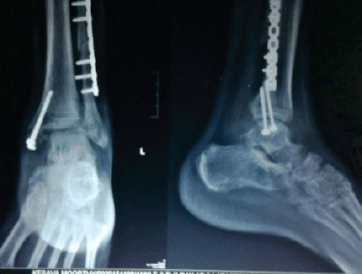
A 52-year-old woman presents to the emergency department following a twisting injury to her right ankle while walking down stairs. She heard a "crack" and was unable to weight-bear. On examination, there is significant swelling around the ankle with tenderness over both malleoli. The foot is neurovascularly intact. AP, lateral, and mortise radiographs reveal a displaced fracture of the distal fibula at the level of the joint line with a transverse medial malleolar fracture. The medial clear space is widened to 6mm.
AP and lateral radiographs of the ankle demonstrating a Weber B bimalleolar ankle fracture. The fibular fracture is at the level of the syndesmosis (trans-syndesmotic). There is an associated transverse medial malleolar fracture. The mortise view shows lateral talar shift with increased medial clear space (>4mm) indicating deltoid ligament injury or medial malleolar fracture. The posterior malleolus is intact on lateral view.
Open Full Size

AP and lateral radiographs of the ankle demonstrating a Weber B bimalleolar ankle fracture. The fibular fracture is at the level of the syndesmosis (trans-syndesmotic). There is an associated transverse medial malleolar fracture. The mortise view shows lateral talar shift with increased medial clear space (>4mm) indicating deltoid ligament injury or medial malleolar fracture. The posterior malleolus is intact on lateral view.

Image source: Open Access medical literature (NIH/PubMed Central) • CC-BY License

Questions

Question 1 (4 marks)

Describe the classification systems for ankle fractures.

Question 2 (5 marks)

How do you assess stability of an ankle fracture?

Question 3 (6 marks)

Describe the surgical approach and fixation principles.

Question 4 (5 marks)

When do you address the syndesmosis and posterior malleolus?

Question 5 (4 marks)

What are the complications of ankle fractures?

Question 6 (4 marks)

Discuss outcomes and special circumstances.

Exam Day Cheat Sheet

Must Mention

  • •Weber: A (below), B (at), C (above) syndesmosis
  • •Medial clear space >4mm = unstable
  • •SER most common mechanism
  • •Syndesmosis: fix Weber C, stress test Weber B
  • •Posterior malleolus: fix if >25% or unstable
  • •Fix fibula first (restores length/rotation)

Common Pitfalls

  • •Missing Maisonneuve
  • •Not stress testing Weber B
  • •Fixing medial before fibula
  • •Wrong ankle position for syndesmosis
  • •Missing posterior malleolus
  • •Not checking mortise alignment
Scenario Info
Answers Revealed0/6
Difficulty
intermediate
Time Allowed6 min
Total Marks28
Questions6
Related Scenarios

Achilles Tendon Rupture

foot ankle•28 marks

Adult Acquired Flatfoot Deformity (PTTD)

foot ankle•28 marks

Calcaneal Fractures (Sanders Classification)

foot ankle•28 marks

Charcot Neuroarthropathy

foot ankle•28 marks

Chronic Ankle Instability

foot ankle•28 marks