OrthoVellum
Knowledge Hub

Study

  • Topics
  • MCQs
  • ISAWE
  • Operative Surgery
  • Flashcards

Company

  • About Us
  • Editorial Policy
  • Contact
  • FAQ
  • Blog

Legal

  • Terms of Service
  • Privacy Policy
  • Cookie Policy
  • Medical Disclaimer
  • Copyright & DMCA
  • Refund Policy

Support

  • Help Center
  • Accessibility
  • Report an Issue
OrthoVellum

© 2026 OrthoVellum. For educational purposes only.

Not affiliated with the Royal Australasian College of Surgeons.

Back to ISAWE Scenarios
Contents
0%
foot ankle

Calcaneal Fractures (Sanders Classification)
advanced
6 min
28 marks
6 questions
Clinical Scenario
A 35-year-old construction worker fell 3 meters from scaffolding, landing on his feet. He has severe bilateral heel pain and is unable to weight-bear. On examination, both heels are swollen with ecchymosis extending to the plantar surface. The hindfoot width is increased bilaterally. Radiographs show decreased Böhler's angle and widening of the calcaneus. CT scan reveals a three-part fracture of the posterior facet on the left (Sanders III) and a two-part fracture on the right (Sanders II).
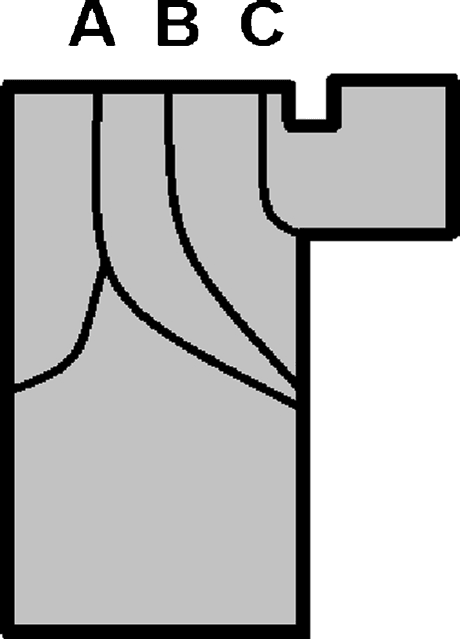
Coronal CT scan through the posterior facet of the calcaneus demonstrating a Sanders Type III intra-articular calcaneal fracture. Three fracture lines divide the posterior facet into four fragments. The lateral wall is displaced and blown out. Böhler's angle is flattened on the lateral radiograph (inset). This is a high-energy injury requiring surgical management with attention to soft tissue handling.
Open Full Size

Coronal CT scan through the posterior facet of the calcaneus demonstrating a Sanders Type III intra-articular calcaneal fracture. Three fracture lines divide the posterior facet into four fragments. The lateral wall is displaced and blown out. Böhler's angle is flattened on the lateral radiograph (inset). This is a high-energy injury requiring surgical management with attention to soft tissue handling.

Image source: Open Access medical literature (NIH/PubMed Central) • CC-BY License

Questions

Question 1 (4 marks)

Describe the relevant anatomy and radiographic assessment.

Question 2 (5 marks)

Classify calcaneal fractures.

Question 3 (6 marks)

Describe the surgical approach and technique for ORIF.

Question 4 (5 marks)

What are the non-operative indications and technique?

Question 5 (4 marks)

Discuss complications and their management.

Question 6 (4 marks)

What are the outcomes and when is subtalar fusion indicated?

Exam Day Cheat Sheet

Must Mention

  • •Sanders classification on coronal CT
  • •Böhler's angle 25-40° (decreased = depression)
  • •Sustentaculum = constant fragment
  • •Wrinkle test for timing
  • •10% bilateral, 10% spine fracture
  • •Extensile lateral vs sinus tarsi approach

Common Pitfalls

  • •Missing spine fracture
  • •Operating too early
  • •Not restoring Böhler's angle
  • •Missing compartment syndrome
  • •Leaving lateral wall wide
  • •Not knowing Sanders
Scenario Info
Answers Revealed0/6
Difficulty
advanced
Time Allowed6 min
Total Marks28
Questions6
Related Scenarios

Achilles Tendon Rupture

foot ankle•28 marks

Adult Acquired Flatfoot Deformity (PTTD)

foot ankle•28 marks

Ankle Fractures (Weber/AO Classification)

foot ankle•28 marks

Charcot Neuroarthropathy

foot ankle•28 marks

Chronic Ankle Instability

foot ankle•28 marks