OrthoVellum
Knowledge Hub

Study

  • Topics
  • MCQs
  • ISAWE
  • Operative Surgery
  • Flashcards

Company

  • About Us
  • Editorial Policy
  • Contact
  • FAQ
  • Blog

Legal

  • Terms of Service
  • Privacy Policy
  • Cookie Policy
  • Medical Disclaimer
  • Copyright & DMCA
  • Refund Policy

Support

  • Help Center
  • Accessibility
  • Report an Issue
OrthoVellum

© 2026 OrthoVellum. For educational purposes only.

Not affiliated with the Royal Australasian College of Surgeons.

Back to ISAWE Scenarios
Contents
0%
hand

Carpal Tunnel Syndrome
intermediate
6 min
28 marks
6 questions
Clinical Scenario
A 52-year-old woman presents with a 6-month history of numbness and tingling in her right hand that wakes her at night. She shakes her hand to relieve symptoms. The symptoms affect her thumb, index, and middle fingers. She has noticed weakness when gripping objects and occasionally drops things. She works as a supermarket checkout operator. On examination, there is reduced sensation to light touch over the median nerve distribution. Thenar wasting is present. Phalen's and Tinel's tests are positive.
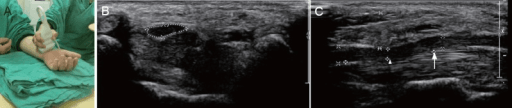
Cross-sectional anatomy of the carpal tunnel at the level of the hook of hamate. The median nerve lies superficially, just deep to the transverse carpal ligament (flexor retinaculum). The nine flexor tendons (4 FDP, 4 FDS, FPL) fill the tunnel. The median nerve is flattened and enlarged proximally. The thenar branch exits radially. Release involves dividing the transverse carpal ligament while protecting the nerve and palmar cutaneous branch.
Open Full Size

Cross-sectional anatomy of the carpal tunnel at the level of the hook of hamate. The median nerve lies superficially, just deep to the transverse carpal ligament (flexor retinaculum). The nine flexor tendons (4 FDP, 4 FDS, FPL) fill the tunnel. The median nerve is flattened and enlarged proximally. The thenar branch exits radially. Release involves dividing the transverse carpal ligament while protecting the nerve and palmar cutaneous branch.

Image source: Open Access medical literature (NIH/PubMed Central) • CC-BY License

Questions

Question 1 (4 marks)

Describe the anatomy of the carpal tunnel and median nerve.

Question 2 (5 marks)

What are the clinical features and examination findings?

Question 3 (6 marks)

Describe the diagnostic workup including nerve conduction studies.

Question 4 (5 marks)

What is the treatment algorithm including surgical technique?

Question 5 (4 marks)

What are the complications and outcomes of surgery?

Question 6 (4 marks)

What are the differential diagnoses for hand numbness?

Exam Day Cheat Sheet

Must Mention

  • •10 structures in tunnel (median nerve, 9 tendons)
  • •Palmar cutaneous branches before tunnel (spared)
  • •Thenar branch variations (Lanz)
  • •NCS: motor >4.2ms, sensory >3.5ms
  • •Splint → injection → surgery algorithm
  • •90%+ success with surgery

Common Pitfalls

  • •Wrong tunnel contents
  • •Missing palmar cutaneous
  • •Wrong NCS values
  • •No thenar branch mention
  • •Missing pronator syndrome
  • •No differential diagnosis
Scenario Info
Answers Revealed0/6
Difficulty
intermediate
Time Allowed6 min
Total Marks28
Questions6
Related Scenarios

Cubital Tunnel Syndrome

hand•28 marks

De Quervain's Tenosynovitis

hand•28 marks

Distal Radius Fracture

hand•28 marks

Dupuytren's Disease

hand•28 marks

Extensor Tendon Injuries

hand•28 marks