OrthoVellum
Knowledge Hub

Study

  • Topics
  • MCQs
  • ISAWE
  • Operative Surgery
  • Flashcards

Company

  • About Us
  • Editorial Policy
  • Contact
  • FAQ
  • Blog

Legal

  • Terms of Service
  • Privacy Policy
  • Cookie Policy
  • Medical Disclaimer
  • Copyright & DMCA
  • Refund Policy

Support

  • Help Center
  • Accessibility
  • Report an Issue
OrthoVellum

© 2026 OrthoVellum. For educational purposes only.

Not affiliated with the Royal Australasian College of Surgeons.

Back to ISAWE Scenarios
Contents
0%
hand

Distal Radius Fracture
intermediate
6 min
28 marks
6 questions
Clinical Scenario
A 58-year-old right-hand dominant female presents to ED 2 hours after falling onto an outstretched hand while walking her dog. She has immediate pain, swelling, and deformity of the right wrist. She has well-controlled type 2 diabetes and osteopenia on recent DEXA. On examination, there is a dinner fork deformity, dorsal swelling, and tenderness. She has intact radial pulse and normal finger sensation and movement.
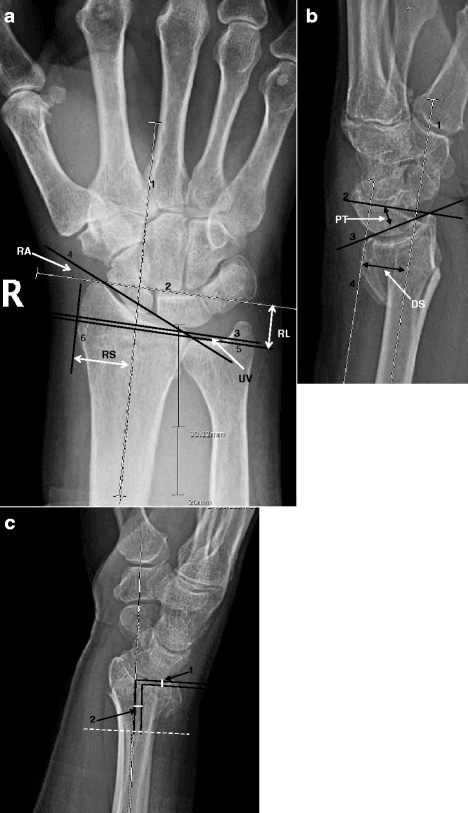
PA and lateral wrist radiographs of a 58-year-old female showing a dorsally displaced distal radius fracture. Key measurements: dorsal tilt 25° (normal 11° volar), radial inclination 12° (normal 22°), radial height 8mm (normal 12mm), positive ulnar variance. Intra-articular step-off of 2mm is visible. This represents an unstable fracture pattern requiring surgical fixation.
Open Full Size

PA and lateral wrist radiographs of a 58-year-old female showing a dorsally displaced distal radius fracture. Key measurements: dorsal tilt 25° (normal 11° volar), radial inclination 12° (normal 22°), radial height 8mm (normal 12mm), positive ulnar variance. Intra-articular step-off of 2mm is visible. This represents an unstable fracture pattern requiring surgical fixation.

Image source: Open Access medical literature (NIH/PubMed Central) • CC-BY License

Questions

Question 1 (4 marks)

Describe the normal radiographic parameters of the distal radius and criteria for instability.

Question 2 (5 marks)

Classify distal radius fractures using the Frykman and AO systems.

Question 3 (6 marks)

Describe the surgical technique for volar locking plate fixation.

Question 4 (5 marks)

What are the associated injuries and how do you assess for them?

Question 5 (4 marks)

What are the complications of distal radius fractures and their management?

Question 6 (4 marks)

Discuss the treatment of distal radius fractures in the elderly.

Exam Day Cheat Sheet

Must Mention

  • •Normal: inclination 22°, height 12mm, volar tilt 11°
  • •Instability: dorsal tilt >10°, shortening >5mm, step >2mm
  • •Volar plate: proximal to watershed line
  • •Check DRUJ stability intra-op
  • •EPL rupture = attritional, EIP transfer
  • •DRAFFT: no difference plate vs K-wire

Common Pitfalls

  • •Wrong normal values
  • •Missing DRUJ check
  • •Forgetting EPL
  • •Not knowing trials
  • •Missing watershed line
  • •Wrong classification
Scenario Info
Answers Revealed0/6
Difficulty
intermediate
Time Allowed6 min
Total Marks28
Questions6
Related Scenarios

Carpal Tunnel Syndrome

hand•28 marks

Cubital Tunnel Syndrome

hand•28 marks

De Quervain's Tenosynovitis

hand•28 marks

Dupuytren's Disease

hand•28 marks

Extensor Tendon Injuries

hand•28 marks