OrthoVellum
Knowledge Hub

Study

  • Topics
  • MCQs
  • ISAWE
  • Operative Surgery
  • Flashcards

Company

  • About Us
  • Editorial Policy
  • Contact
  • FAQ
  • Blog

Legal

  • Terms of Service
  • Privacy Policy
  • Cookie Policy
  • Medical Disclaimer
  • Copyright & DMCA
  • Refund Policy

Support

  • Help Center
  • Accessibility
  • Report an Issue
OrthoVellum

© 2026 OrthoVellum. For educational purposes only.

Not affiliated with the Royal Australasian College of Surgeons.

Back to ISAWE Scenarios
Contents
0%
hand

Cubital Tunnel Syndrome
advanced
6 min
28 marks
6 questions
Clinical Scenario
A 48-year-old accountant presents with a 6-month history of numbness in his right small finger and ulnar half of the ring finger, worse at night and when using his phone. He has noticed weakness of grip and dropping objects. On examination, there is decreased sensation in the ulnar 1.5 digits, positive Tinel's at the cubital tunnel, and a positive elbow flexion test at 30 seconds. The first dorsal interosseous and hypothenar eminence appear wasted. Froment's test is positive. Cross-body adduction of the small finger is weak.
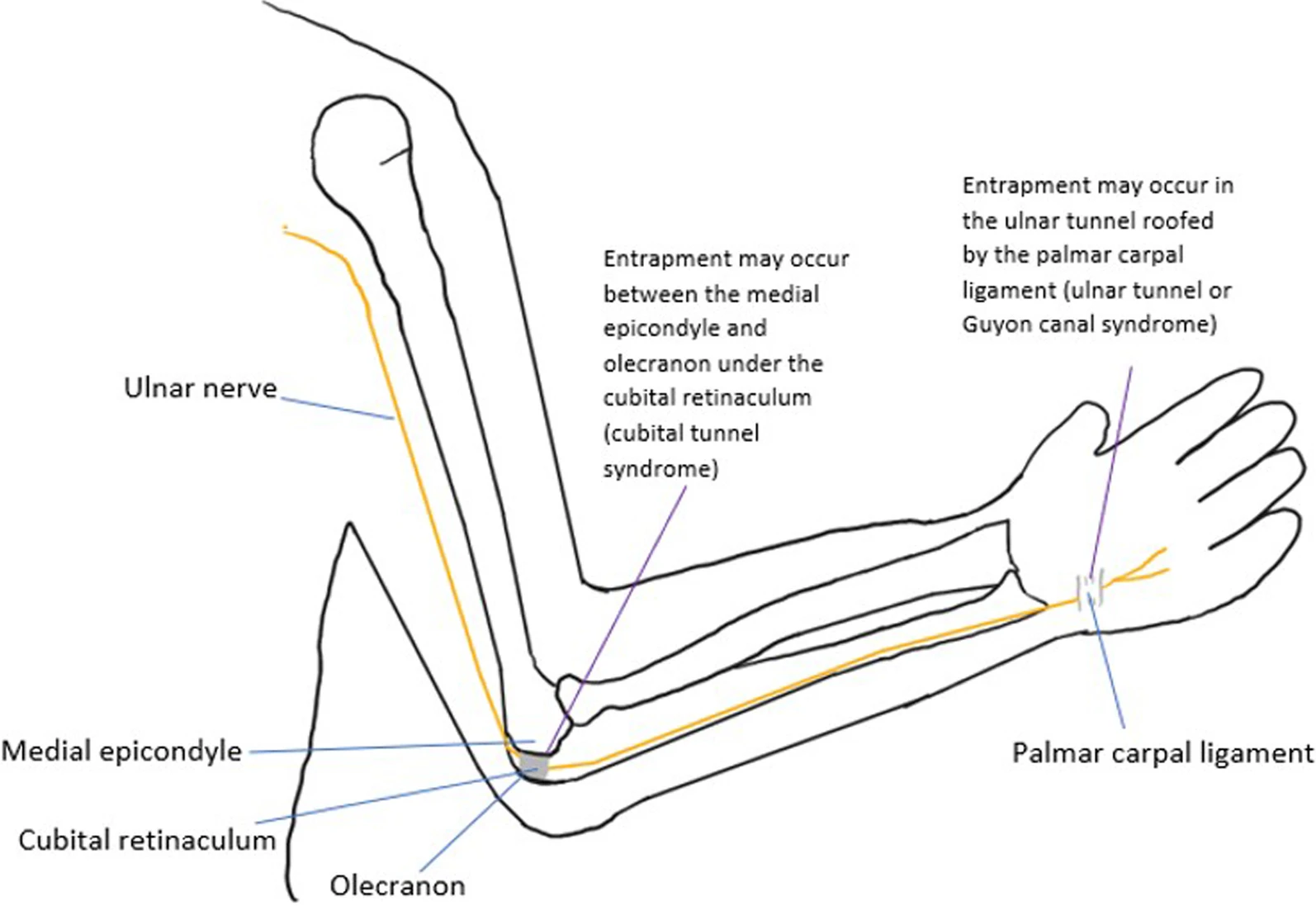
Clinical photograph demonstrating ulnar nerve palsy with intrinsic wasting (first dorsal interosseous, hypothenar) and claw deformity of ring and small fingers (MCP hyperextension, IP flexion). The anatomical diagram shows the course of the ulnar nerve through the cubital tunnel, bounded by the medial epicondyle, olecranon, and Osborne's ligament. FCU muscle belly forms the distal tunnel boundary.
Open Full Size

Clinical photograph demonstrating ulnar nerve palsy with intrinsic wasting (first dorsal interosseous, hypothenar) and claw deformity of ring and small fingers (MCP hyperextension, IP flexion). The anatomical diagram shows the course of the ulnar nerve through the cubital tunnel, bounded by the medial epicondyle, olecranon, and Osborne's ligament. FCU muscle belly forms the distal tunnel boundary.

Image source: Open Access medical literature (NIH/PubMed Central) • CC-BY License

Questions

Question 1 (4 marks)

Describe the anatomy of the ulnar nerve at the elbow and potential sites of compression.

Question 2 (5 marks)

What are the clinical features and examination findings?

Question 3 (6 marks)

Describe the surgical options for cubital tunnel syndrome.

Question 4 (5 marks)

How do you investigate and stage the severity?

Question 5 (4 marks)

What are the outcomes and complications of surgery?

Question 6 (4 marks)

How do you differentiate cubital tunnel from other causes of ulnar neuropathy?

Exam Day Cheat Sheet

Must Mention

  • •Second most common entrapment
  • •Osborne's ligament = tunnel roof
  • •DBUN sensory loss = elbow level
  • •Froment's = FPL compensating
  • •Wartenberg's = small finger abduction
  • •Ulnar paradox = high lesion less claw

Common Pitfalls

  • •Missing DBUN
  • •Confusing with Guyon's
  • •Wrong exam tests
  • •Missing ulnar paradox
  • •Wrong surgery choice
  • •Missing arcade
Scenario Info
Answers Revealed0/6
Difficulty
advanced
Time Allowed6 min
Total Marks28
Questions6
Related Scenarios

Carpal Tunnel Syndrome

hand•28 marks

De Quervain's Tenosynovitis

hand•28 marks

Distal Radius Fracture

hand•28 marks

Dupuytren's Disease

hand•28 marks

Extensor Tendon Injuries

hand•28 marks