OrthoVellum
Knowledge Hub

Study

  • Topics
  • MCQs
  • ISAWE
  • Operative Surgery
  • Flashcards

Company

  • About Us
  • Editorial Policy
  • Contact
  • FAQ
  • Blog

Legal

  • Terms of Service
  • Privacy Policy
  • Cookie Policy
  • Medical Disclaimer
  • Copyright & DMCA
  • Refund Policy

Support

  • Help Center
  • Accessibility
  • Report an Issue
OrthoVellum

© 2026 OrthoVellum. For educational purposes only.

Not affiliated with the Royal Australasian College of Surgeons.

Back to ISAWE Scenarios
Contents
0%
hand

Dupuytren's Disease

intermediate
6 min
28 marks
6 questions
Clinical Scenario
A 62-year-old man of Northern European descent presents with progressive difficulty straightening his right ring finger over the past 2 years. He is a retired builder with a history of heavy alcohol use and type 2 diabetes. On examination, there is a palpable cord from the palm to the proximal phalanx of the ring finger. The MCP joint has a 35° fixed flexion contracture and the PIP has a 25° contracture. He cannot place his palm flat on the table. The small finger has a nodule but no contracture. Sensation is intact.
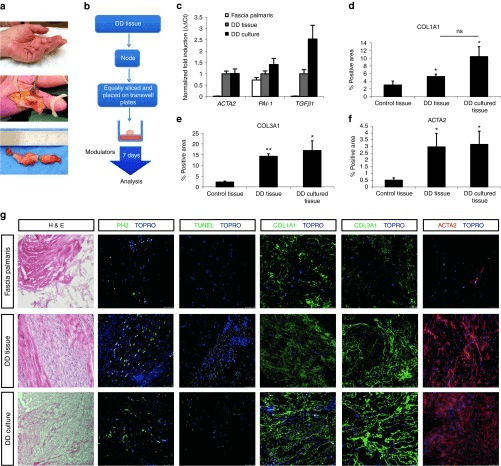
Clinical photograph of the right hand showing Dupuytren's disease. A palpable cord extends from the palm to the ring finger causing MCP flexion contracture of 40° and PIP contracture of 30°. Skin pitting is visible over the cord. The small finger shows early nodule formation. The table-top test is positive (palm cannot be placed flat on table). This patient meets criteria for fasciectomy (MCP >30° or PIP >20°).
Open Full Size

Clinical photograph of the right hand showing Dupuytren's disease. A palpable cord extends from the palm to the ring finger causing MCP flexion contracture of 40° and PIP contracture of 30°. Skin pitting is visible over the cord. The small finger shows early nodule formation. The table-top test is positive (palm cannot be placed flat on table). This patient meets criteria for fasciectomy (MCP >30° or PIP >20°).

Image source: Open Access medical literature (NIH/PubMed Central) • CC-BY License

Questions

Question 1 (4 marks)

Describe the anatomy of the palmar fascia and the pathological cords in Dupuytren's disease.

Question 2 (5 marks)

What are the risk factors, associations, and clinical features?

Question 3 (6 marks)

Describe the surgical technique for fasciectomy.

Question 4 (5 marks)

What are the treatment options and their indications?

Question 5 (4 marks)

What are the complications and how do you manage them?

Question 6 (4 marks)

Discuss the prognostic factors and recurrence.

Exam Day Cheat Sheet

Must Mention

  • •Spiral cord displaces NV bundle centrally/superficially
  • •Table-top test (Hueston)
  • •Surgery: MCP >30°, PIP >20°
  • •Fasciectomy = gold standard, lowest recurrence
  • •Diathesis = bilateral, ectopic, family, young, male
  • •PIP = worse prognosis

Common Pitfalls

  • •Forgetting spiral cord
  • •Wrong surgical threshold
  • •Missing diathesis
  • •Wrong recurrence rates
  • •Missing PIP prognosis
  • •Confusing extension vs recurrence
Scenario Info
Answers Revealed0/6
Difficulty
intermediate
Time Allowed6 min
Total Marks28
Questions6
Related Scenarios

Carpal Tunnel Syndrome

hand•28 marks

Cubital Tunnel Syndrome

hand•28 marks

De Quervain's Tenosynovitis

hand•28 marks

Distal Radius Fracture

hand•28 marks

Extensor Tendon Injuries

hand•28 marks