OrthoVellum
Knowledge Hub

Study

  • Topics
  • MCQs
  • ISAWE
  • Operative Surgery
  • Flashcards

Company

  • About Us
  • Editorial Policy
  • Contact
  • FAQ
  • Blog

Legal

  • Terms of Service
  • Privacy Policy
  • Cookie Policy
  • Medical Disclaimer
  • Copyright & DMCA
  • Refund Policy

Support

  • Help Center
  • Accessibility
  • Report an Issue
OrthoVellum

© 2026 OrthoVellum. For educational purposes only.

Not affiliated with the Royal Australasian College of Surgeons.

Back to ISAWE Scenarios
Contents
0%
hand

De Quervain's Tenosynovitis
intermediate
6 min
28 marks
6 questions
Clinical Scenario
A 32-year-old new mother presents with 3 months of radial wrist pain, worse when lifting her baby. She notices swelling over the radial styloid and pain with thumb movement. She has difficulty opening jars and gripping. On examination, there is tenderness and swelling over the first dorsal compartment. Finkelstein's test reproduces her pain. There is no crepitus with movement. Thumb and finger range of motion is full.
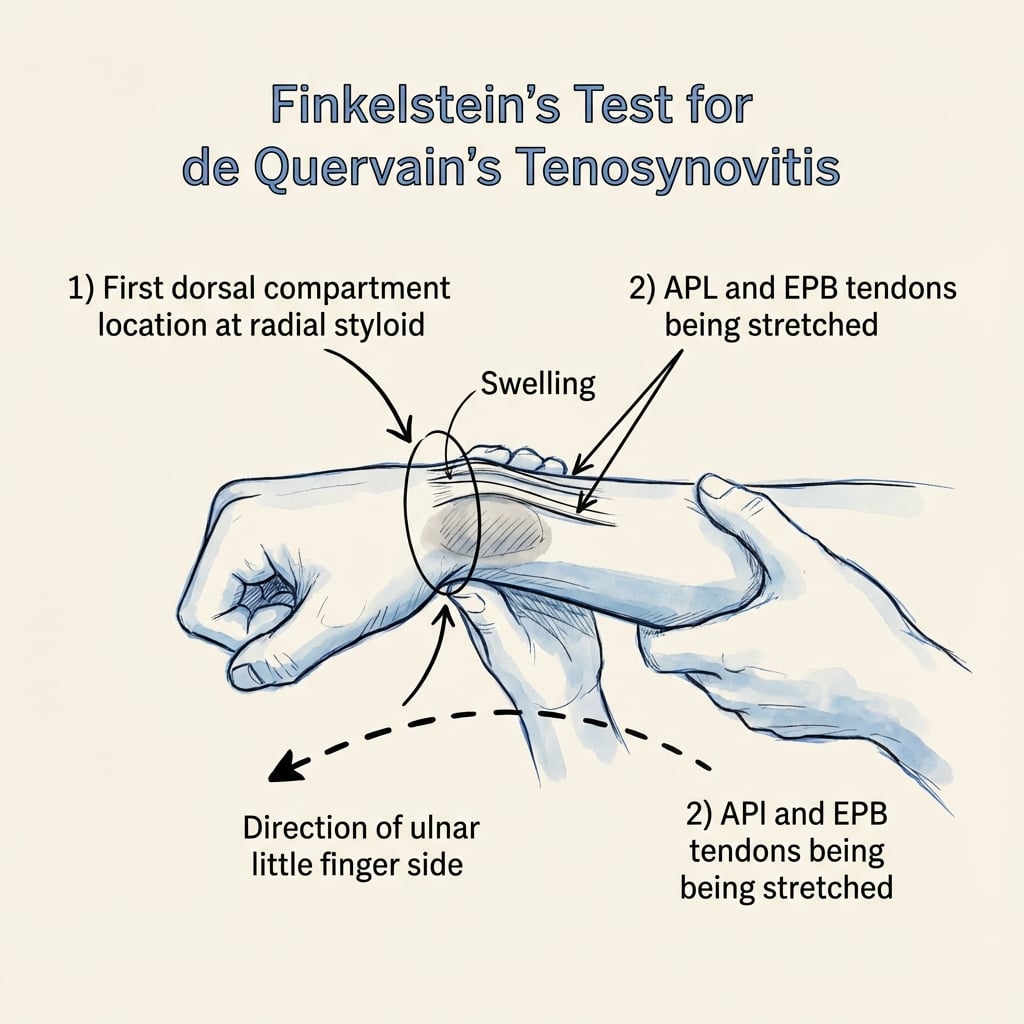
Clinical photograph demonstrating Finkelstein's test. The patient makes a fist over the thumb, and the examiner ulnarly deviates the wrist. This stretches the APL and EPB tendons across the radial styloid, reproducing the patient's pain. A positive test indicates first dorsal compartment tenosynovitis. Note the swelling over the radial styloid corresponding to the first compartment.
Open Full Size

Clinical photograph demonstrating Finkelstein's test. The patient makes a fist over the thumb, and the examiner ulnarly deviates the wrist. This stretches the APL and EPB tendons across the radial styloid, reproducing the patient's pain. A positive test indicates first dorsal compartment tenosynovitis. Note the swelling over the radial styloid corresponding to the first compartment.

Source: AI-Generated Educational Illustration: Finkelstein Test for De Quervain Tenosynovitis • OrthoVellum Educational Use

Questions

Question 1 (4 marks)

Describe the anatomy of the first dorsal compartment and its variations.

Question 2 (5 marks)

What are the clinical features and differential diagnosis?

Question 3 (6 marks)

Describe the treatment algorithm including injection technique.

Question 4 (5 marks)

What is the surgical technique for first compartment release?

Question 5 (4 marks)

Discuss intersection syndrome and its differentiation.

Question 6 (4 marks)

What are the complications and outcomes of treatment?

Exam Day Cheat Sheet

Must Mention

  • •First compartment: APL + EPB
  • •Subsheath 24-40% (EPB separate)
  • •Finkelstein's = fist over thumb + ulnar deviate
  • •Injection success 80%
  • •Surgery: protect SBRN, release subsheath
  • •Intersection = 4-6cm proximal + crepitus

Common Pitfalls

  • •Missing subsheath
  • •Wrong compartment contents
  • •Confusing with intersection
  • •Missing SBRN
  • •Wrong injection site
  • •Not checking EPB
Scenario Info
Answers Revealed0/6
Difficulty
intermediate
Time Allowed6 min
Total Marks28
Questions6
Related Scenarios

Carpal Tunnel Syndrome

hand•28 marks

Cubital Tunnel Syndrome

hand•28 marks

Distal Radius Fracture

hand•28 marks

Dupuytren's Disease

hand•28 marks

Extensor Tendon Injuries

hand•28 marks