FGFR3 Mutation and Short Stature
- FGFR3: Gain-of-function mutation.
- Foramen Magnum: Stenosis can cause sudden death in infancy.
- Spinal Stenosis: Symptomatic in 20-30% of adults.
- Genu Varum: Common, may need correction.
- Thoracolumbar Kyphosis: Resolves in most.
- “FGFR3 gain-of-function
- “Foramen magnum stenosis in infancy
- “Spinal stenosis in adults
- “Rhizomelic shortening
Overview and Epidemiology
Achondroplasia is the most common skeletal dysplasia, with an incidence of 1 in 20,000.
Inheritance. It is autosomal dominant, caused by a mutation in FGFR3 (fibroblast growth factor receptor 3). 80% are new mutations, in children of unaffected parents.
Pathophysiology and Mechanisms
A brake on the growth plate. FGFR3 is a negative regulator of bone growth: at the growth plate it normally inhibits growth. The achondroplasia mutation is gain-of-function, so the inhibition is excessive, endochondral ossification is reduced and the bones are short. Endochondral bones, the limbs and the skull base, are affected more than intramembranous bones.
Why the canal is narrow. Short pedicles give a narrow spinal canal, and the symptoms of stenosis progress in adulthood.
Thoracolumbar Kyphosis (Gibbus): Natural History and Management
Why it develops. Almost all achondroplastic infants develop a flexible thoracolumbar (gibbus) kyphosis at the thoracolumbar junction. It is driven by truncal hypotonia, a relatively large head, and unsupported sitting before trunk control matures.
Natural history. The majority resolve once the child gains trunk control and begins to walk, as the compensatory lumbar lordosis develops. A minority persist or progress into a fixed, angular kyphosis, characteristically with anterior wedging (beaking) of the apical vertebra, typically around the thoracolumbar junction (T12-L2). Persistence is more likely with prolonged unsupported sitting, marked hypotonia, and an apical vertebra that becomes wedged.
Why it matters in achondroplasia. A fixed thoracolumbar kyphosis sits exactly where the canal is already narrowed by short pedicles. It can compound the developing canal stenosis and contribute to later neurological compromise, so it is not merely cosmetic.
The management ladder. Classic exam material, and the fixed deformity is the danger.
- Prevention and counselling in infancy - avoid unsupported sitting and soft C-shaped seating, provide firm back support, and encourage prone time and trunk strengthening (AAP anticipatory guidance)
- Observation - most flexible kyphoses resolve with ambulation; reassure and monitor
- Bracing (TLSO) - for a kyphosis that persists beyond walking age or shows anterior vertebral wedging, to limit progression during continued growth
- Surgery - reserved for progressive, fixed kyphosis with anterior vertebral wedging despite bracing, or neurological compromise. Deformity correction (anterior and/or posterior) is required; an isolated posterior decompression performed over an uncorrected kyphos risks progression. The general operative technique for correcting a structural kyphosis is developed in the congenital-kyphosis topic.
Clinical Features
The appearance. Stature is short, with an adult height of 120-130 cm, and the shortening is rhizomelic: the proximal segments (humeri, femora) are shorter than the distal. The head is large (macrocephaly) with frontal bossing, and midface hypoplasia gives a flat nasal bridge. The lumbar spine is hyperlordotic.
Trident hands. The fingers are short and spread apart, and cannot be approximated in extension.
The spine by age. The spinal problems are best remembered by the age at which they appear.
- Foramen magnum stenosis - infancy; apnoea and a risk of sudden death
- Thoracolumbar kyphosis - infancy; usually resolves with walking
- Lumbar spinal stenosis - adults; claudication and neurological symptoms
The limbs. Genu varum (bowed legs) may need osteotomy.
Clinical Assessment
History. Record the developmental milestones. Ask about apnoea and breathing problems, which point to the foramen magnum, and about back pain, leg pain and claudication, which point to stenosis. Ask too about any concern over the shape of the legs.
Examination.
- General - short stature, rhizomelic limbs
- Head - macrocephaly, frontal bossing, midface hypoplasia
- Spine - lordosis; assess for kyphosis
- Legs - genu varum; the mechanical axis
- Neurological - lower-limb reflexes and power, for the symptoms of stenosis
Investigations
Diagnosis. The diagnosis is usually clinical. The genetic test is FGFR3 mutation testing.
Imaging. Each study is matched to one problem.
- MRI of the craniocervical junction - screening for foramen magnum stenosis (timing below)
- Spine radiographs - to assess stenosis
- MRI of the lumbar spine - if symptomatic
- Lower-limb radiographs - for the mechanical axis
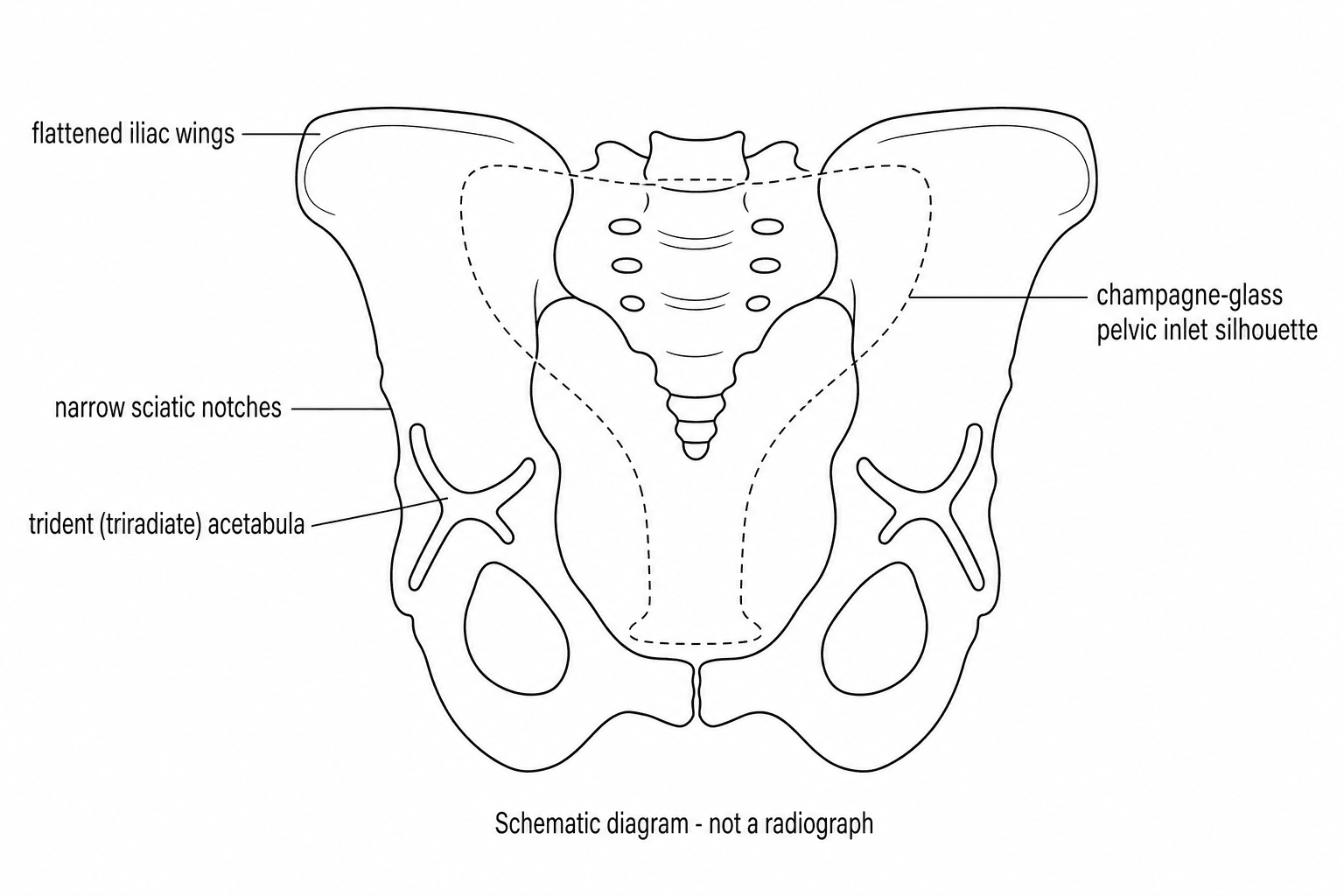
The pelvis. The AP pelvis shows flattened, horizontally oriented iliac wings, narrow greater sciatic notches and trident (triradiate) acetabula, in which each hip socket shows a three-pronged radiolucent appearance at the triradiate cartilage. Together the flattened wings and narrowed inlet create the champagne-glass pelvic inlet silhouette.
Foramen Magnum & Cervicomedullary Compression: Assessment and When to Decompress
The danger. Stenosis of the foramen magnum compresses the cervicomedullary junction. It can lead to central apnoea and sudden infant death, and mortality is significantly higher in infancy.
Screening is mandatory. Monitor for apnoea, hypotonia and feeding problems, and obtain an MRI of the craniocervical junction at birth or in the neonatal period.
The assessment. Three strands are gathered and read together.
- What to look for
- Lower-limb hyperreflexia, sustained clonus, hypotonia, weakness/asymmetry, delayed or regressing milestones
- Why it matters
- Hyperreflexia and clonus are among the best clinical predictors of the need for decompression (Pauli)
- What to look for
- CENTRAL apnoea/hypopnoea (brainstem compression), distinguished from obstructive apnoea (midface hypoplasia, adenotonsillar)
- Why it matters
- Central events reflect cervicomedullary compression; obstructive events are common but a different problem
- What to look for
- MRI: bony foramen magnum size, cord effacement/compression and any T2 cord-signal change at the cervicomedullary junction; CT quantifies the bony aperture
- Why it matters
- Shows the structural lesion and cord injury that justify surgery
Who is operated on. Surgery is justified by symptomatic compression (central apnoea, myelopathic signs) and/or cord effacement with signal change on MRI. A radiographically small foramen magnum in a neurologically normal infant with a normal sleep study is monitored, not automatically operated on. For the asymptomatic infant with severe stenosis, prophylactic decompression may be considered; this is the ground where there is no consensus threshold.
The operation. When indicated, the neurosurgical team performs a suboccipital decompression, with C1 laminectomy as needed.
Not instability. This is a stenosis and compression problem, distinct in mechanism from craniocervical-junction instability, which is developed in its own topic.
Foramen magnum decompression in an achondroplastic infant is decided on the composite of neurological signs (hyperreflexia/clonus), central sleep apnoea on polysomnography and cord effacement/signal change on craniocervical MRI, not on a small foramen magnum in isolation.
Differential Diagnosis
Skeletal Dysplasias:
- Gene
- FGFR3
- Key Differentiator
- Most common, rhizomelic, foramen magnum
- Gene
- FGFR3
- Key Differentiator
- Milder form, less obvious features
- Gene
- FGFR3
- Key Differentiator
- Lethal, very short limbs
- Gene
- COMP
- Key Differentiator
- Normal face and skull; normal at birth, declares around age 2; short-limb predominant with epiphyseal and metaphyseal change plus platyspondyly
- Gene
- COL2A1
- Key Differentiator
- Normal face; short-trunk predominant (spine dominates), present from birth
- Gene
- SLC26A2
- Key Differentiator
- Hitchhiker thumb, cauliflower ear
Key Distinguishing Points:
- Achondroplasia: Characteristic face (frontal bossing, midface hypoplasia)
- Pseudoachondroplasia: Normal face (distinguishes from achondroplasia)
- Thanatophoric: Lethal, telephone receiver femur
- Diastrophic: Hitchhiker thumb is pathognomonic
Management
Lumbar spinal stenosis. Conservative care is physiotherapy, weight management and activity modification. Symptomatic stenosis is treated with a wide, multi-level laminectomy, described under Surgical Technique.
Genu varum. Many are mild and asymptomatic, and are observed. Corrective osteotomy is for symptomatic, progressive or severe deformity.
Limb lengthening. Controversial. It can increase height, but with a high complication rate.
Surgical Technique
Wide laminectomy. The short pedicles make the surgery challenging and demand an extensive decompression. It must extend lateral to the pedicles, and multi-level decompression is often needed. Inadequate decompression is the main surgical pitfall.
Fusion. In the immature spine, add instrumentation/fusion to prevent post-laminectomy instability and revision (Baca/Ain 2010). In adults, weigh fusion against preservation of motion.
Tibial and femoral osteotomy. A proximal tibial and/or distal femoral osteotomy corrects the alignment. Limb length may also be addressed by lengthening, if desired.
Complications
The percentages in these tables are conventional teaching ranges from the achondroplasia natural-history literature, not measurements from a single cited cohort; the sourced anchors on this page are Pauli 1995 (5/53 infants needing decompression) and Baca/Ain 2010 (revision risk without instrumentation).
Neurological Complications
- Incidence
- 5-10% symptomatic
- Risk Factors
- Small foramen magnum
- Management
- MRI screening, early decompression
- Incidence
- 2-5%
- Risk Factors
- Severe stenosis, sleep apnoea
- Management
- Polysomnography, decompression
- Incidence
- Variable
- Risk Factors
- Progressive compression
- Management
- Cervical or thoracolumbar decompression
- Incidence
- Rare
- Risk Factors
- Acute disc herniation
- Management
- Emergency decompression
- Incidence
- 20-30% adults
- Risk Factors
- Lateral recess stenosis
- Management
- Conservative or surgical decompression
Orthopaedic Complications
- Prevalence
- 30-40%
- Prevention
- Monitor with growth
- Treatment
- Guided growth or osteotomy
- Prevalence
- 90% infants
- Prevention
- Avoid early sitting
- Treatment
- Bracing, surgery if progressive
- Prevalence
- Common
- Prevention
- Physiotherapy
- Treatment
- Stretching, rarely surgical release
- Prevalence
- 10-20%
- Prevention
- Wide decompression
- Treatment
- Revision surgery
Anaesthetic and Perioperative Risks
Each of these is a critical consideration before any operation in achondroplasia.
- Difficult airway - short neck, large head and narrow nasopharynx; plan for difficult intubation
- Craniocervical junction - the cervical risk in achondroplasia is foramen magnum stenosis with cervicomedullary compression, not atlantoaxial instability (the Down syndrome and MPS IV concern). Avoid neck hyperextension during intubation and positioning, and confirm the infant craniocervical MRI status before anaesthesia
- Restrictive lung disease - small thorax; optimise respiratory function preoperatively
- Spinal anaesthesia - technically difficult because of the narrow canal; consider GA instead
- Positioning - careful positioning to avoid pressure points and cervical injury
Postoperative Care
After spinal decompression. Rehabilitation is staged.
- Day 1-2 - pain control, mobilisation with supervision
- Week 1-2 - walking programme, stair climbing
- Week 2-6 - core strengthening, avoid heavy lifting
- Week 6+ - progressive return to activities
After osteotomy. Protected weight bearing for 6-8 weeks, with physiotherapy for range of motion and strengthening as tolerated. Hardware removal can be considered once union is confirmed (6-12 months), and recurrence is monitored for during the remaining growth.
Surveillance. An annual neurological examination, regular MRI surveillance for stenosis progression, and monitoring of lower-limb alignment during growth spurts. Growth is followed on height velocity charts, with orthopaedic review every 6-12 months.
Outcomes/Prognosis
Life expectancy. Reduced. In a 42-year mortality follow-up of 793 individuals (Wynn), average life expectancy was about 10 years shorter, mortality was raised at all ages, and heart-disease mortality at ages 25-35 was more than ten times that of the general population.
Function and quality of life. Most patients lead independent, productive lives, and intelligence is normal, without cognitive impairment. Physical function may be limited, but patients adapt well; social integration is generally good in a supportive environment, and a wide range of careers is possible. Rates of depression are higher, so screen for it and offer support.
Surgical Outcomes
Success and complication figures below are conventional teaching ranges from retrospective achondroplasia surgical series, not single-study measurements.
- Success Rate
- 90% symptom relief
- Complications
- CSF leak 5%, infection 2%
- Long-term Result
- Excellent if done early
- Success Rate
- 80% improvement
- Complications
- Dural tear 5%, recurrence 15%
- Long-term Result
- Good to excellent
- Success Rate
- 85% alignment correction
- Complications
- Delayed union 10%
- Long-term Result
- Generally durable
- Success Rate
- 10-15cm gain possible
- Complications
- Pin site infection 30%, nerve injury 5%
- Long-term Result
- Improves function
Guidelines, Registries & Global Practice
Global Epidemiology
- Birth prevalence ~1 in 20,000-30,000 live births; the most common non-lethal skeletal dysplasia worldwide.
- ~80% arise as de novo mutations (unaffected average-stature parents); paternal age effect (older fathers).
- Single recurrent FGFR3 Gly380Arg mutation accounts for the vast majority of cases globally.
Side-by-Side Guidance
- Emphasis
- Age-based health supervision; craniocervical and OSA surveillance; achondroplasia-specific growth charts
- Emphasis
- Multidisciplinary skeletal-dysplasia centres; baseline craniocervical MRI plus polysomnography in infancy
- Emphasis
- Confirmatory FGFR3 testing where diagnosis uncertain; prenatal counselling for de novo and homozygous risk
- Emphasis
- Vosoritide approved for children with open growth plates; ongoing post-marketing follow-up of skeletal outcomes
Practice Variation
- High-resource settings: Neonatal craniocervical MRI, polysomnography, multidisciplinary dysplasia clinics, and access to vosoritide.
- Limited-resource settings: Diagnosis is clinical/radiographic; management is supportive, prioritising recognition of apnoea/cervicomedullary red flags and treatment of symptomatic stenosis and deformity.
- Genetic counselling and peer-support organisations (e.g. national dwarfism/little-people associations) are valuable everywhere for family planning and psychosocial support.
Controversies and Areas of Uncertainty
Prophylactic vs symptom-driven foramen magnum decompression There is no consensus threshold for operating on a radiographically small foramen magnum in an asymptomatic infant. Decisions integrate neurological signs, polysomnography (central hypopnoea), and craniocervical imaging rather than canal diameter alone.
Fusion/instrumentation with lumbar decompression in children Wide multilevel laminectomy can destabilise the immature spine. Evidence (Baca/Ain, J Pediatr Orthop 2010) favours adding instrumentation in growing children to reduce revision, but routine fusion in skeletally mature adults remains debated to preserve motion.
Limb lengthening Substantial height gain is achievable but carries high complication rates (pin-site infection, nerve injury, contracture, long treatment time). Whether lengthening is reconstructive or cosmetic is an ethical debate; many advocacy groups oppose routine lengthening for short stature alone.
Vosoritide and other FGFR3-pathway drugs Vosoritide reliably increases growth velocity, but its effect on final adult height, body proportionality, and serious complications (stenosis, foramen magnum compression) is unproven. Newer agents (e.g. CNP variants and FGFR3 inhibitors) are in trials. The aim of pharmacotherapy - height vs reduction of medical complications - is itself contested.
MCQ Practice Points
Q: What gene is mutated in achondroplasia? A: FGFR3 (gain-of-function mutation).
Q: What is the major orthopaedic issue in adults? A: Lumbar spinal stenosis.
Q: What is the dangerous issue in infancy? A: Foramen magnum stenosis (can cause sudden death).
Q: What is the pattern of limb shortening? A: Rhizomelic (proximal limbs shorter than distal).
Q: What is key to successful lumbar decompression in achondroplasia? A: Wide decompression extending lateral to the pedicles. Multi-level often needed. Short pedicles cause narrow canal.
Q: What new medical therapy is available for achondroplasia? A: Vosoritide - a C-natriuretic peptide analog that increases growth velocity by counteracting FGFR3.
Self-Assessment Quiz
Viva Scenarios
Practise clinical reasoning and management decisions out loud
“Newborn diagnosed with achondroplasia. What screening do you recommend?”
“35-year-old with achondroplasia. Presents with neurogenic claudication, bilateral leg weakness.”
“10-year-old with achondroplasia has progressive genu varum. How do you manage?”
GENETICS
- FGFR3 Mutation
- Gain-of-function
- Autosomal Dominant
- 80% new mutations
CLINICAL
- Rhizomelic short stature
- Macrocephaly
- Trident hands
- Lumbar lordosis
SPINE
- Foramen magnum (infant)
- Lumbar stenosis (adult)
- Thoracolumbar kyphosis
- Short pedicles
LIMBS
- Genu varum
- Osteotomy if symptomatic
- Limb lengthening (controversial)
- High complication rate
FORAMEN MAGNUM
- Screen at birth (MRI)
- Apnea, sudden death risk
- Decompression if symptomatic
- Neurosurgery referral
NEW THERAPIES
- Vosoritide
- C-natriuretic peptide analog
- Increases growth velocity
- Approved (open growth plates)
Evidence Base
Shiang et al
- Identified FGFR3 as the achondroplasia gene at 4p16.3
- Same recurrent transmembrane-domain point mutation in 15/16 affected chromosomes (G1138A)
- Both observed mutations cause the same Gly380Arg substitution
Pauli et al
- Prospective unselected series of 53 infants with achondroplasia
- 5/53 required suboccipital decompression for cervicomedullary compression
- Best predictors: lower-limb hyperreflexia/clonus, central hypopnea on polysomnography, small foramen magnum
Trotter & Hall (AAP)
- AAP health-supervision guideline for achondroplasia
- Anticipatory care for craniocervical compression, OSA, otitis media, kyphosis, genu varum
- Achondroplasia-specific growth and head-circumference charts
Wynn et al
- 42-year mortality follow-up of 793 individuals with achondroplasia
- Average life expectancy reduced by ~10 years; mortality raised at all ages
- Heart-disease mortality ages 25-35 more than 10x the general population