A Congenital Anterior Pelvic Ring Defect, Not Just a Urological Problem
- Pubic diastasis is the signature finding - the pubic bones are widely separated and do NOT meet anteriorly.
- Innominate external rotation about the sacrum (around 12 degrees each side) plus acetabular retroversion widen the anterior ring.
- Osteotomy improves closure - it lets the pubic bones be approximated, reduces tension on the bladder/abdominal wall, and reconstitutes the pelvic floor and symphyseal bar.
- Immobilisation is part of the operation - external fixation with lower-limb traction protects the closure; failure of immobilisation means failure of closure.
- Most children walk normally - long-term gait is usually good, with only a minority showing a transient waddling gait or external rotation.
- “Pubic diastasis is the orthopaedic hallmark on the AP pelvis
- “Iliac wings externally rotated, acetabula retroverted
- “Osteotomy raises primary closure success
- “Successful closure is the single best predictor of later continence
- “Long-term ambulation and hip function are usually good
Overview and Epidemiology
Bladder exstrophy is the central and most common phenotype of the exstrophy-epispadias complex (EEC), a spectrum of midline lower-abdominal and pelvic malformations that runs from epispadias, the mildest, through classic bladder exstrophy to cloacal exstrophy, the most severe.
Who. The whole spectrum occurs in roughly 1 in 10,000 births; classic bladder exstrophy is around 1 in 30,000 and cloacal exstrophy around 1 in 200,000. It is more common in males, roughly 2-3 : 1.
Why the orthopaedic surgeon is there. The condition involves the bony pelvis, the pelvic floor and the abdominal wall, not only the urinary tract. The orthopaedic surgeon is a core member of the closure team.
Embryology. EEC results from abnormal development and premature rupture of the cloacal membrane, which prevents normal medial migration of mesenchyme. The earlier and larger the rupture, the more severe the defect, which is why the same underlying error produces a graded spectrum.
Pathophysiology and Mechanisms
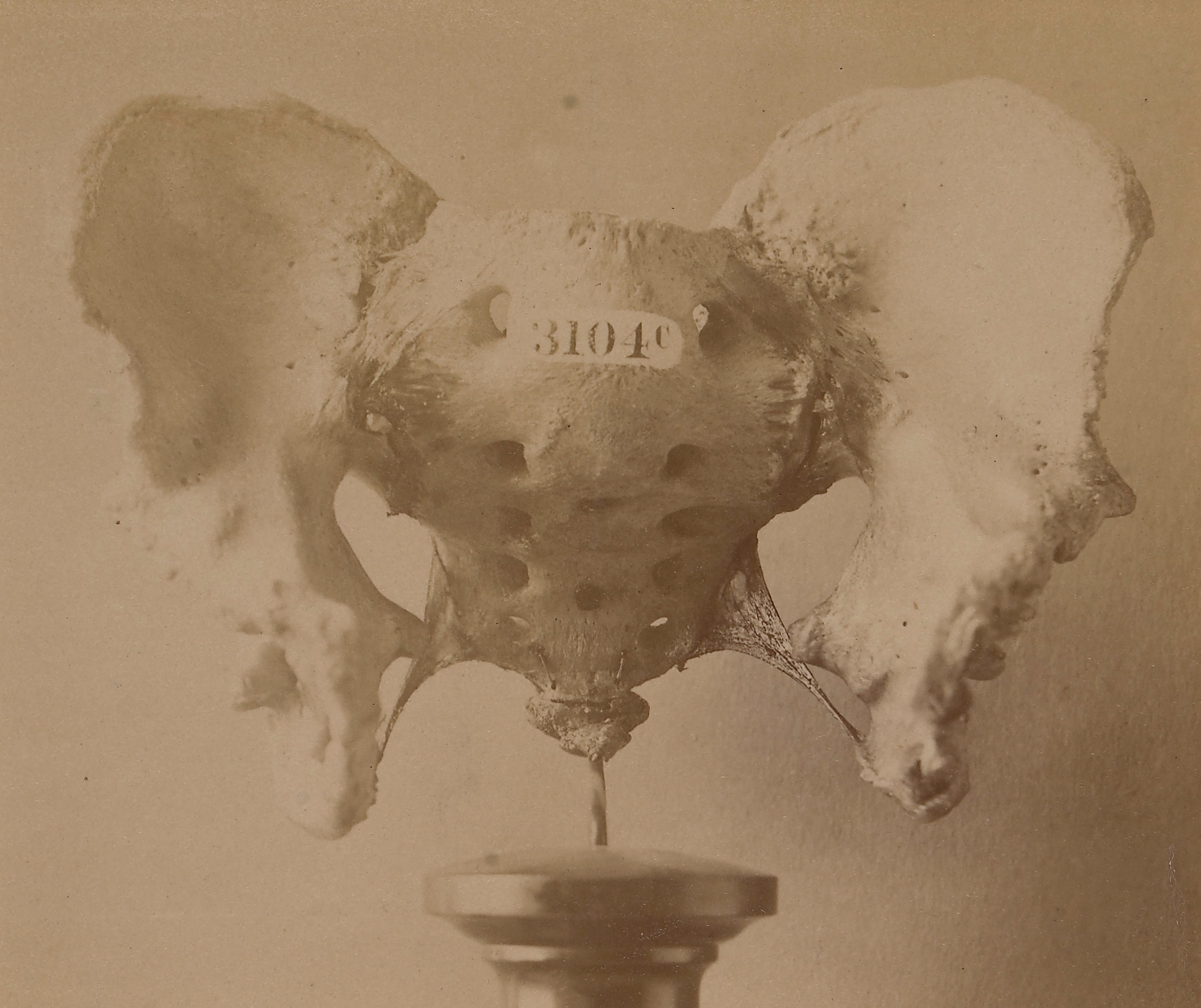
What is actually deformed. Three-dimensional CT studies of children with classic bladder exstrophy, compared with age- and sex-matched controls, show a consistent and reproducible pattern:
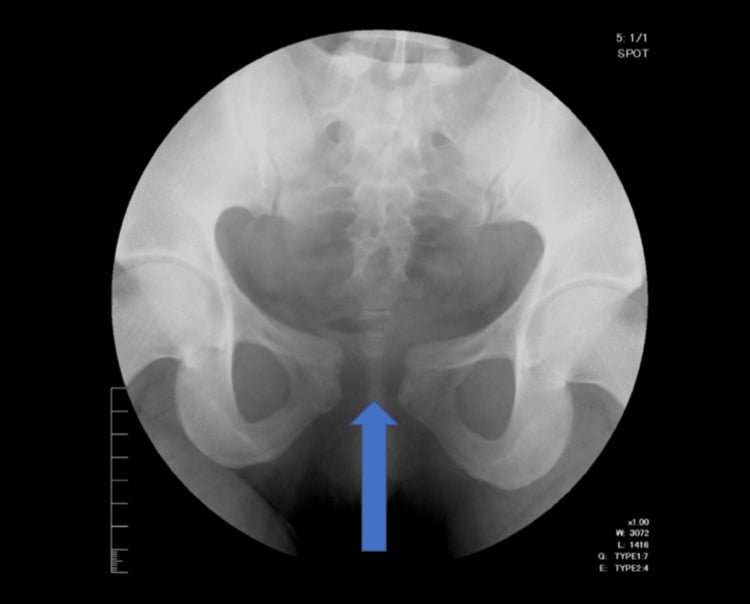
- Pubic diastasis. The pubic bones are widely separated, on average around 4.2 cm against around 0.6 cm in controls, so the anterior pelvic ring is essentially open.
- External rotation of the posterior pelvis. The iliac wings are externally rotated around 11-12 degrees more than normal, and the sacroiliac joints are more externally oriented, by around 10 degrees.
- Inferior rotation of the pelvis. The whole pelvis is rotated in the superoinferior plane, by around 15 degrees, a feature only appreciated on 3D imaging.
- Widened inter-triradiate distance. The triradiate cartilages sit further apart (around 6 cm against around 4 cm), reflecting the externally rotated, splayed-open ring.
- Acetabular retroversion. The acetabula face more posteriorly than normal.
Putting it together. Imagine the two hemipelves hinged on the central sacrum and swung outward. The swing opens the front of the ring, separates the pubic bones and tilts the sockets, and it stretches and displaces the pelvic floor and the would-be symphyseal bar. The corrective logic of surgery is to reverse that swing, rotating the hemipelves back together so that the pubis can meet.
Why the soft tissues matter too. Approximating the pubis is not only cosmetic. It reconstitutes the pelvic floor sling and the fibrous symphyseal bar, which support continence mechanisms and abdominal wall closure, and so links the bony correction directly to the urological outcome.
Classification Systems
The exstrophy-epispadias complex is graded by severity:
- Epispadias, the mildest: an open dorsal urethra with mild or absent diastasis. Often no osteotomy is required.
- Classic bladder exstrophy: an open bladder plate, wide pubic diastasis and externally rotated ilia. This is the typical osteotomy candidate.
- Cloacal exstrophy, the most severe: exstrophy plus omphalocele, imperforate anus and frequently spinal anomalies. It has the greatest diastasis and the most demanding reconstruction.
Clinical Presentation
At birth. There is an obvious midline lower-abdominal wall defect, with an exposed, everted bladder plate in classic exstrophy or an open urethral plate in epispadias, and a wide gap between the pubic bones is palpable. Externally rotated lower limbs may be noted, but the hips are usually clinically stable. Cloacal exstrophy brings its omphalocele and imperforate anus, and may bring lower-limb or spinal anomalies.
The orthopaedic examination. It has three tasks:
- Confirm the diastasis and document its width
- Examine the hips for range and stability; frank dislocation is uncommon, but assess
- Examine the spine and lower limbs, particularly in cloacal exstrophy, where neural tube and limb anomalies are more frequent
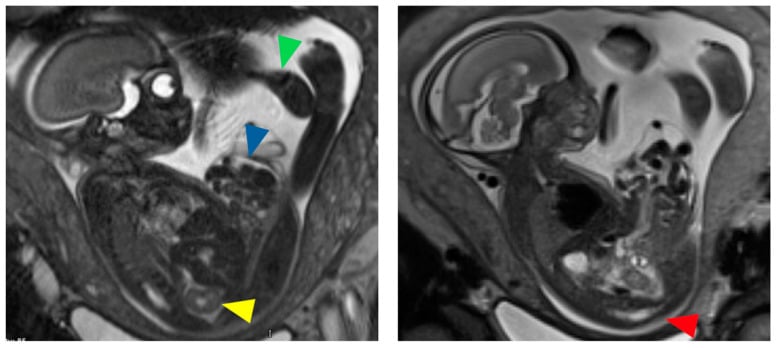
Prenatal clues. Repeated non-visualisation of a normally filled fetal bladder on ultrasound, with a lower abdominal wall bulge, should prompt suspicion. Recognising it allows planned delivery at a specialist centre.
Investigations
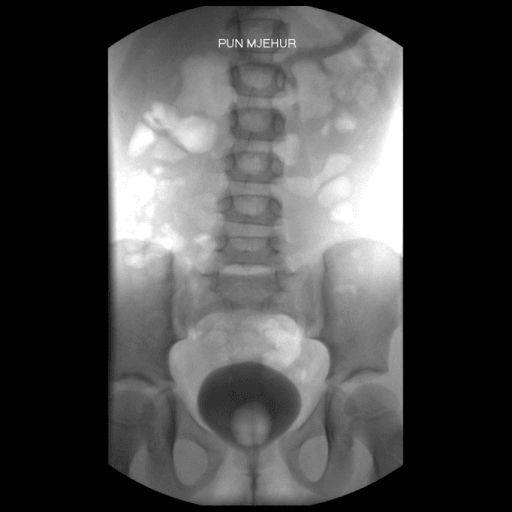
Plain radiographs. An AP pelvis or KUB film is first-line and sufficient to recognise the deformity, showing the pubic diastasis and the externally flared iliac wings. It is also the film on which the inter-symphyseal (pubic) distance is measured before and after surgery and approximation is monitored over time.
Three-dimensional CT. 3D-CT is the reference standard for understanding and planning. It quantifies the iliac wing angle, sacroiliac joint angle, pubic diastasis, inter-triradiate distance and acetabular version, and it reveals the inferior pelvic rotation that plain films do not show. It is particularly valuable for redo closures, cloacal exstrophy and osteotomy planning.
The whole child. The shared assessment goes beyond the pelvis:
- Renal and urinary tract imaging (ultrasound, MCUG, urogram), in the urological remit
- Spinal imaging in cloacal exstrophy, to exclude dysraphism and tethered cord
- Echocardiography and a general anomaly screen before major neonatal surgery
Differential Diagnosis
- Epispadias: Mildest; open dorsal urethra with mild or absent diastasis.
- Classic bladder exstrophy: Open bladder plate with wide diastasis - the typical osteotomy candidate.
- Cloacal exstrophy: Most severe; plus omphalocele, imperforate anus and spinal anomalies.
- Traumatic anteroposterior-compression pelvic disruption: Acquired, with a clear injury history and associated fractures, not a congenital open ring.
- Postpartum symphyseal diastasis: Adult, peripartum, no congenital abdominal wall defect.
- Bladder duplication / other midline anomalies: May show diastasis but lack the everted bladder plate of classic exstrophy.
- Congenital, present at birth, with an exposed bladder plate and abdominal wall defect.
- Externally rotated, inferiorly rotated hemipelves with retroverted acetabula on 3D-CT.
- Part of a recognised severity spectrum (EEC).
Management
The principle. The orthopaedic goal is to reverse the external rotation of the hemipelves so that the pubic bones can be brought together. That takes tension off the bladder and abdominal wall closure and helps to reconstruct the pelvic floor, and the bony correction in turn supports the urological aims of a secure closure and eventual continence.
ATPWhy We Osteotomise
Hook:ATP - Approximate, Take tension off, Pelvic floor.
When to osteotomise. Osteotomy is indicated for:
- Classic bladder exstrophy with significant diastasis
- Delayed or failed primary closure
- Cloacal exstrophy
- Most closures beyond the immediate newborn period
The newborn exception. In the first 48-72 hours the pelvis is malleable, and some surgeons close without osteotomy. Osteotomy becomes increasingly important as the child gets older or when the diastasis is wide.
Which osteotomy. Four are used in closure:
- Bilateral anterior (innominate) osteotomy is the modern workhorse. The anterior approach allows direct external fixator placement and good pubic approximation, and supports continence and gait; a posterior hinge cut can be added for severe cases.
- Posterior iliac osteotomy was the historical original approach and has fallen out of favour as the sole technique.
- Combined anterior and posterior osteotomy is preferred for cloacal exstrophy, redo closures or very wide diastasis (over 6 cm).
- Oblique pelvic (iliac) osteotomy is an alternative described in neonates and for difficult or secondary closures.
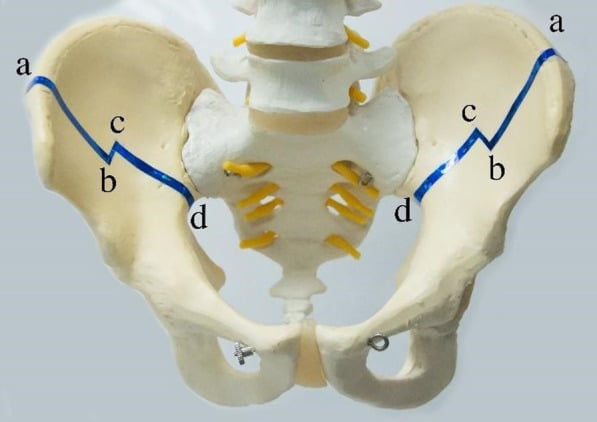
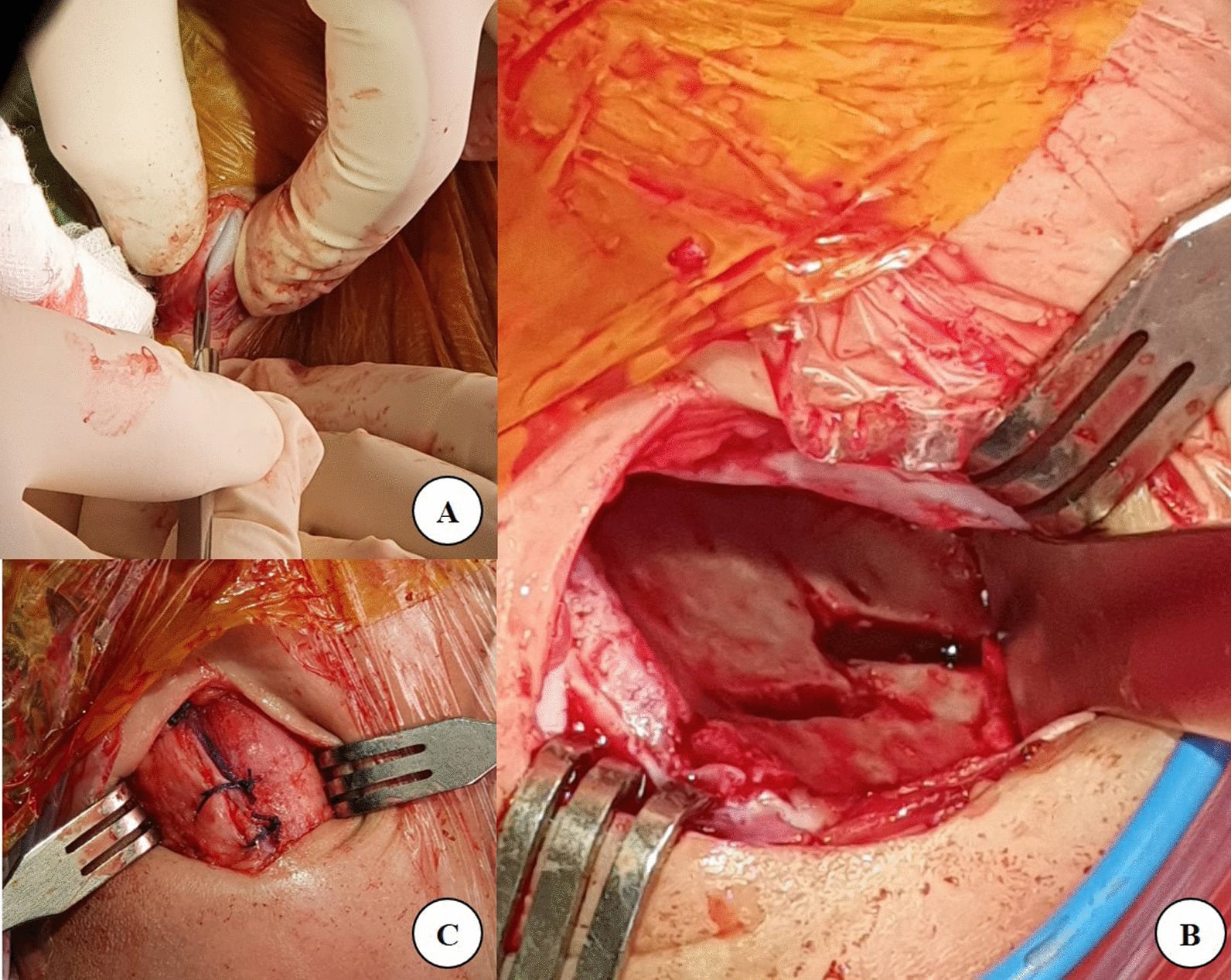
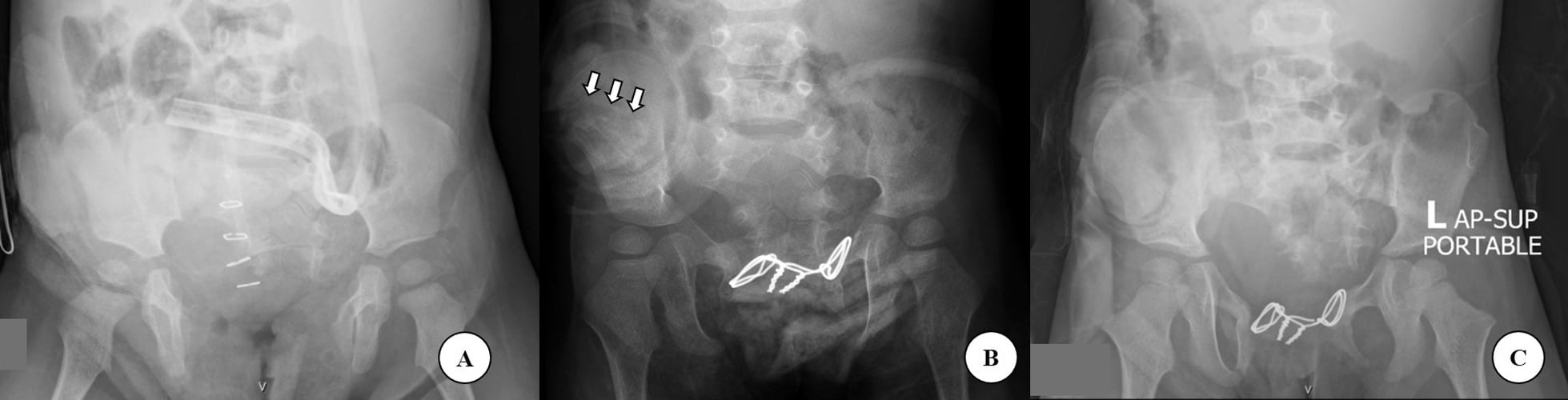
Immobilisation is part of the operation. It is as important as the osteotomy itself: loss of fixation is a leading cause of closure failure, and immobilisation typically lasts several weeks, until the closure is secure. The methods are not equal:
- External fixation with lower-limb traction (modified Buck's traction) has given the best reported success rates
- Spica casting and simple wrapping are less effective and carry higher complication rates
- Custom braces and selected two-pin external-fixation protocols are newer, and aim to ease nursing and wound care while maintaining stability
Staging and the team. Combined paediatric urology and paediatric orthopaedics is the standard of care. A single-stage closure (complete primary repair) closes the bladder, posterior urethra and abdominal wall in one operation; a staged closure closes the bladder and abdominal wall first and leaves the bladder neck and continence procedures for later. The choice is individualised, but in large cohorts, especially in cloacal exstrophy, and in difficult cases, staged combined-osteotomy approaches have been associated with higher closure success when done by an experienced multidisciplinary team.
Why the first closure matters most. Successful initial closure is the single most important determinant of later bladder capacity and continence. It is worth doing once, well.
Complications
Failed closure. Failed or dehisced closure is the most consequential complication, strongly linked to inadequate osteotomy or immobilisation, and it may need revision osteotomy and closure. The continence and urological sequelae lie downstream of the closure outcome.
Hazards of the surgery and immobilisation. The operation and the weeks of immobilisation carry their own risks:
- External fixator pin-site infection or loosening, usually managed without long-term harm
- Pressure ulcers and nerve compression (for example the femoral nerve) from traction and immobilisation, largely avoidable with good technique
- Lateral femoral cutaneous nerve injury during anterior approaches; protect it during exposure
Outcomes and Prognosis
The diastasis recurs partially. Even with good approximation at surgery, the anterior pelvic segment does not develop normally and often cannot stay fully approximated. Some recurrence of the diastasis over time is expected, and it is usually well tolerated.
Gait is usually good. In large orthopaedic series the great majority report no pain or functional disability. A minority have a waddling gait or external rotation of the hips, and in most it normalises.
The hips generally do well. Despite acetabular retroversion, frank hip dysplasia or dislocation is uncommon, and most patients are community ambulators.
The Adult Hip: Acetabular Retroversion and Impingement Risk
The adult who never had an osteotomy. In Nehme's series of 31 adults with bladder exstrophy who never had a pelvic osteotomy (62 hips, mean age 30), 58 percent of hips had a retroverted acetabulum and the rest were neutral or anteverted. Yet 60 of the 62 hips had no arthritis, and the mean lateral centre-edge angle was a normal 32 degrees (DOI). The retroversion is real and common, and it alters hip biomechanics, but it is usually well tolerated and early osteoarthritis is uncommon.
Two different hip concerns. Dysplasia and dislocation are uncommon: despite the deformity, frank instability is rare, and routine DDH-style treatment is seldom needed. Retroversion is the commoner finding and a theoretical pincer-FAI substrate, usually silent and an occasional source of hip symptoms or an external-rotation gait. For the minority who report either, it is a better explanation than dysplasia.
Recognising retroversion. On a well-centred AP pelvis it shows as the crossover, posterior-wall and ischial-spine signs, provided the film is not tilted or rotated, because a malpositioned pelvis manufactures a false crossover sign. The exstrophy pelvis is itself globally rotated, which makes AP crossover-type signs unreliable, so apparent orientation on the AP film must be correlated with acetabular version on axial CT, which is essential here.
What to do about it. Most hips stay arthritis-free, which argues for awareness and surveillance rather than routine intervention. The osteotomy that corrects the diastasis also partially re-orients the externally rotated, retroverted sockets.
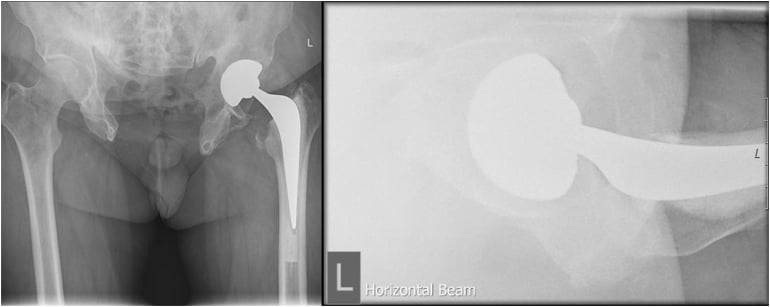
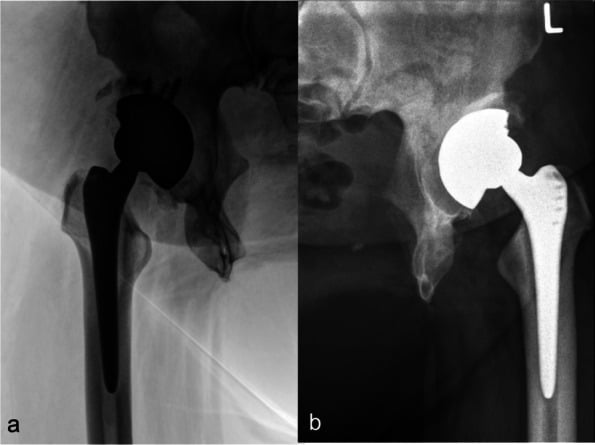
The arthritic adult hip. Adult hip pain may reflect dysplasia, impingement or arthritis rather than the pubic gap itself. Coronal CT, for bone stock and centre-of-rotation planning, complements the axial assessment of version.
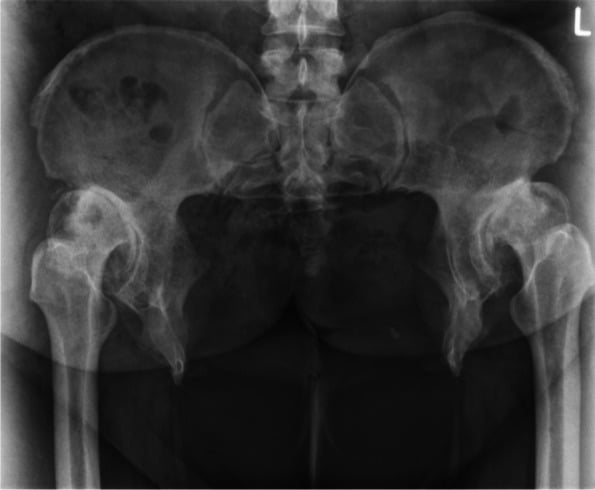
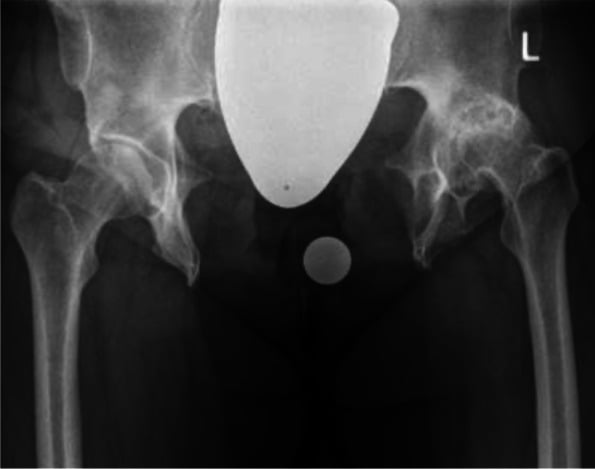
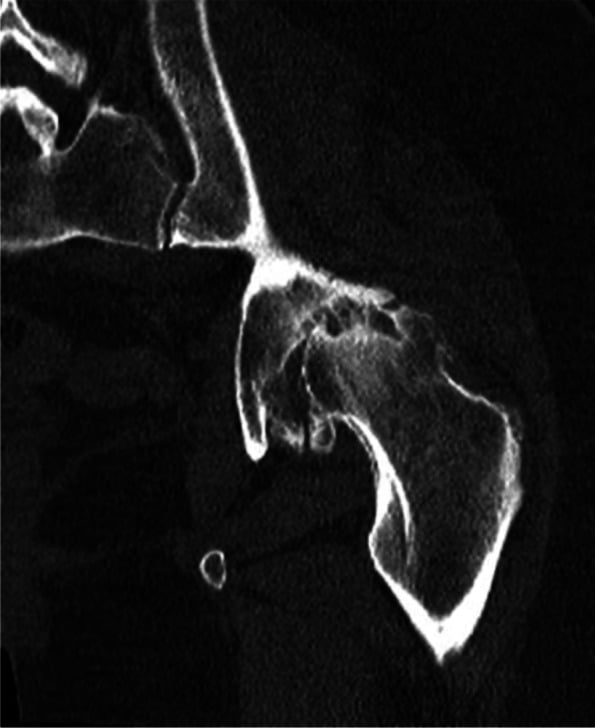
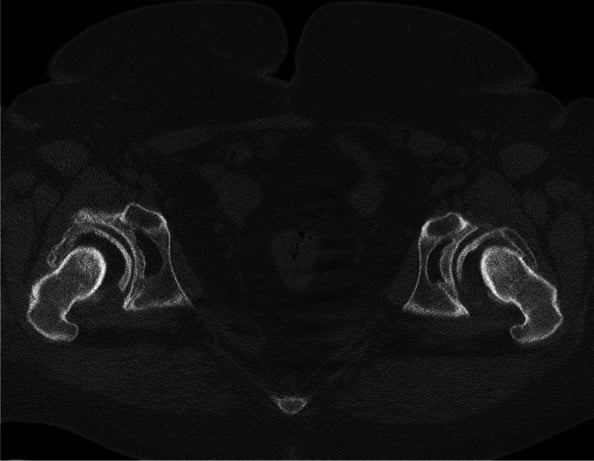
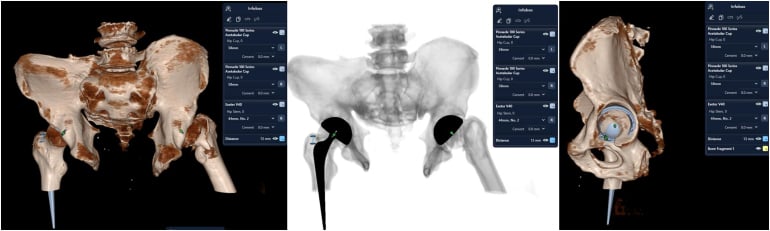
Arthroplasty in the rotated pelvis. Standard landmarks and cup targets cannot be assumed in an externally rotated exstrophy pelvis, so cross-sectional imaging maps the wide anterior ring and abnormal acetabular orientation before arthroplasty. These are bespoke adult reconstructions that require CT planning rather than routine primary-THA assumptions.
Planning and implants. Virtual reconstruction identifies the native acetabular bed and the cup size, centre and version despite severe pelvic rotation, and patient-specific planning reduces the risk of malposition, impingement and instability. Anteverted liners and stable fixation compensate for severe acetabular retroversion and deficient bone.
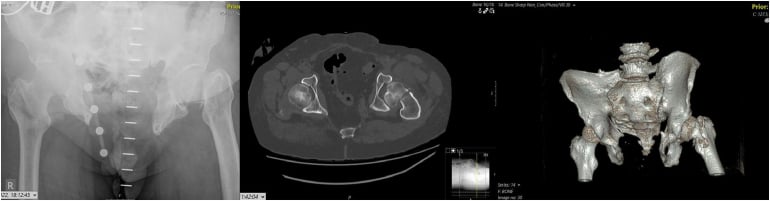
Cloacal Exstrophy: Spine, Lower Limbs and the Ambulation Question
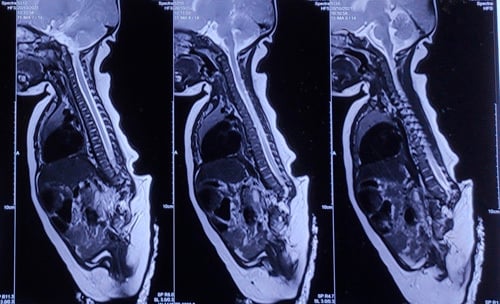
Spinal dysraphism is the rule. Far more often than in classic exstrophy, the child with cloacal exstrophy has an open or occult dysraphism (lipomyelomeningocele, myelomeningocele, a split-cord or diastematomyelia malformation, sacral agenesis or other vertebral anomalies) and a tethered cord. The dysraphism is therefore assumed until imaging excludes it, rather than looked for only if the legs seem weak.
The consequences are neurological as well as bony. They are what most limit walking, more than the pelvic ring:
- A myelodysplasia-pattern lower-limb neurological deficit
- Neuropathic bladder and bowel beyond the exstrophy itself
- Lower-limb anomalies: limb hypoplasia, foot deformities, hip dysplasia
- Later neuromuscular scoliosis
Workup. Every child with cloacal exstrophy needs spinal MRI and neurosurgical assessment for a tethered cord, planned alongside the pelvic closure. Release may be needed to prevent progressive neurological loss.
Prognosis follows the cord. In Jasiewicz's report of a split-notochord / cloacal-exstrophy child with a double sacrum and a split cord, independent walking, even with a prosthesis for a hypoplastic limb, can be feasible, and "walking ability and quality of life depend on the neurologic deficits" (DOI).
Q: Why does a child with cloacal exstrophy have a different gait prognosis from classic exstrophy? A: In classic exstrophy gait is usually normal because the problem is the anterior pelvic ring. In cloacal exstrophy the associated spinal dysraphism / tethered cord and lower-limb anomalies impose a neuromuscular deficit, so ambulation is governed by the neurological level — mandating spinal MRI and neurosurgical input, not just pelvic closure.
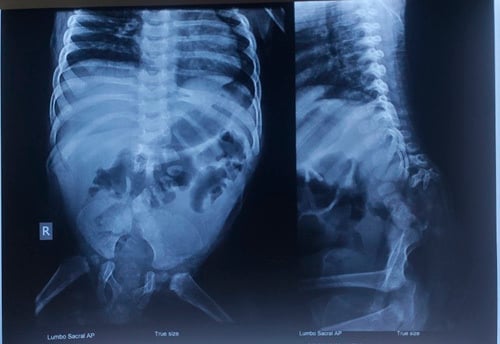
Pubic diastasis in classic exstrophy averages around 4 cm versus around 0.6 cm normal - quoting the numbers shows you know the deformity quantitatively.
Closure success is markedly higher with osteotomy than without (around 75% vs 38% in one large series) - osteotomy is not cosmetic, it protects the closure.
External fixation plus modified Buck's traction gives the best closure rates; spica/wrapping alone is inferior. Failure of immobilisation = failure of closure.
Picture the hemipelves externally rotated about the central sacrum - that single image explains the diastasis, the flared ilia and the corrective logic of osteotomy.
Guidelines, Registries & Global Practice
Global epidemiology
- The exstrophy-epispadias complex affects roughly 1 in 10,000 births worldwide, with classic bladder exstrophy around 1 in 30,000 and cloacal exstrophy around 1 in 200,000; males predominate.
- It is rare enough that outcomes are best in high-volume specialist centres, and much of the published evidence comes from a small number of such units.
Side-by-side practice variation
- Osteotomy stance
- Osteotomy for most closures beyond the newborn period; anterior innominate +/- posterior hinge
- Immobilisation emphasis
- External fixation + modified Buck's traction; staged combined osteotomy for cloacal/redo
- Osteotomy stance
- Closure sometimes without osteotomy while pelvis is malleable
- Immobilisation emphasis
- Lower-limb immobilisation still required (traction or spica)
- Osteotomy stance
- Anterior osteotomy, sometimes two-pin external fixation without osteotomy in selected newborns
- Immobilisation emphasis
- Custom braces / streamlined fixation to ease nursing and family care
Registry and evidence notes
- There is no dedicated exstrophy implant registry; the evidence base is institutional case series and comparative reviews, so individual high-volume-centre series carry disproportionate weight.
- Consistent messages across series: osteotomy improves closure success, secure immobilisation is essential, and long-term gait/hip function is generally good.
High- vs limited-resource practice
- In well-resourced settings, 3D-CT planning, anterior osteotomy with external fixation and multidisciplinary uro-orthopaedic teams are standard, and most children are managed in specialist referral units.
- In limited-resource settings, plain radiography guides assessment, osteotomy technique may be adapted to available fixation, and the priorities are achieving and protecting a secure closure and avoiding immobilisation complications. Centralising these rare cases to experienced teams improves outcomes everywhere.
Controversies & Areas of Uncertainty
1. Whether the newborn needs an osteotomy at all
- The strongest disagreement in the field. Some units close within the first 48-72 hours without osteotomy, relying on the residual laxity of the neonatal symphysis and sacroiliac joints; others osteotomise every child on the grounds that the closure is only worth doing once and tension is what makes it fail.
- Why it stays unsettled: the comparison is confounded at its root. The babies closed without osteotomy are, by selection, the ones who present early, are otherwise well, and have a narrower diastasis - so a series showing that osteotomy-free newborn closure works may be describing a favourable subgroup rather than an equivalent technique. No randomised comparison exists and, given the rarity, none is likely.
2. Which osteotomy
- Bilateral anterior innominate osteotomy is the modern workhorse, but posterior iliac, combined anterior-posterior and oblique/diagonal iliac osteotomies all have advocates, and the published series are small, single-centre and use different closure protocols alongside them.
- Because osteotomy and immobilisation are always changed together, it is rarely possible to say which of the two produced a better closure rate - the technique and the fixation are confounded in almost every series.
3. How much recurrent diastasis matters
- Partial recurrence of the diastasis is expected, because the anterior segment does not develop normally whatever is done to it. What is genuinely unknown is whether the degree of recurrence predicts anything a patient will feel - continence, gait or later hip symptoms - so a widening measurement on a surveillance film has no agreed threshold for action.
4. Whether to do anything about acetabular retroversion
- Retroversion is present in roughly half of adult exstrophy hips and is a recognised pincer-FAI substrate, yet arthritis in that same cohort was uncommon. Whether the minority who develop hip pain in adult life would benefit from FAI-style treatment, and whether any early intervention prevents it, is unanswered - so current practice is recognition and surveillance, not prophylaxis.
5. Whether closure success or bladder biology drives continence
- It is well established that a secure first closure is associated with better later bladder capacity and continence. Whether that is because failed closures mechanically injure the bladder, or because the bladders that fail to close were the more abnormal ones to begin with, is not settled - and it changes how much of the outcome we should attribute to surgical technique.
Self-Assessment Quiz
Viva Scenarios
Practise clinical reasoning and management decisions out loud
“A neonate has classic bladder exstrophy. The urologist asks for your help with closure. The examiner asks: what exactly is wrong with the pelvis, and what does your osteotomy achieve?”
“You are closing a 6-month-old with classic bladder exstrophy who had a failed neonatal closure elsewhere. How do you decide on osteotomy and how will you keep the closure secure?”
“Parents of a child who had a successful exstrophy closure with osteotomy ask whether their child will walk normally and whether the pelvis is 'fixed for good'.”
THE DEFORMITY
- Pubic diastasis ~4 cm (vs 0.6 cm)
- Iliac wings externally rotated ~12 deg
- Acetabula retroverted
- Pelvis rotated inferiorly
WHY OSTEOTOMY
- Approximate pubis
- Lower closure tension
- Reconstitute pelvic floor/symphyseal bar
- Raises closure success
OSTEOTOMY TYPES
- Anterior innominate = workhorse
- Posterior = historical
- Combined for cloacal/redo/wide
- Oblique iliac an alternative
IMMOBILISATION
- External fixation + Buck's traction = best
- Spica/wrapping inferior
- Part of the operation
- Watch pins/pressure/nerves
OUTCOMES
- Gait usually normal
- Minority waddle/external rotation
- Some diastasis recurs
- Hip dysplasia uncommon
EXAM PEARLS
- EEC: epispadias to classic to cloacal
- Successful closure drives continence
- Hemipelves hinge on sacrum
- 3D-CT for planning
Evidence Base
Stec AA, Pannu HK, Tadros YE, Sponseller PD, Wakim A, Fishman EK, Gearhart JP - Evaluation of the bony pelvis in classic bladder exstrophy by using 3D-CT
- Exstrophy iliac wing angle was 11.4 degrees larger and the sacroiliac joint 9.9 degrees more externally rotated than matched controls
- Mean pubic diastasis was 4.2 cm versus 0.6 cm in controls; inter-triradiate distance 6.0 cm versus 4.2 cm
- The whole pelvis was rotated about 14.7 degrees inferiorly - a previously unrecognised deformity
Jones D, Parkinson S, Hosalkar HS - Oblique pelvic osteotomy in the exstrophy/epispadias complex
- 42 of 45 patients reported no pain or functional disability at mean 57 months; only 6 had a waddling gait and 2 marked hip external rotation
- Mean pubic approximation was 37% and was better when external fixation was used
- The anterior pelvic segment failed to develop naturally despite close intra-operative approximation, so some recurrence of diastasis is expected
Meldrum KK, Baird AD, Gearhart JP - Pelvic and extremity immobilization after bladder exstrophy closure
- Initial closure success was highest with osteotomy (75% vs 38% without)
- External fixation plus 6-8 weeks modified Buck's traction with osteotomy achieved 96% success
- Spica casting and 'mummy wrapping' were less effective and caused more complications
Haney NM, Crigger CB, Sholklapper T, et al - Pelvic osteotomy in cloacal exstrophy: a changing perspective
- Any osteotomy was associated with successful closure (77.6% vs 41.7% without)
- Combined anterior+posterior osteotomy had the highest success (90%) versus posterior (76.2%) and anterior alone (60.9%)
- Buck's traction (92.1%) and external fixation (86.0%) outperformed spica casting for immobilisation