Machine learning for fracture detection, measurement and planning - decision support, not decision replacement
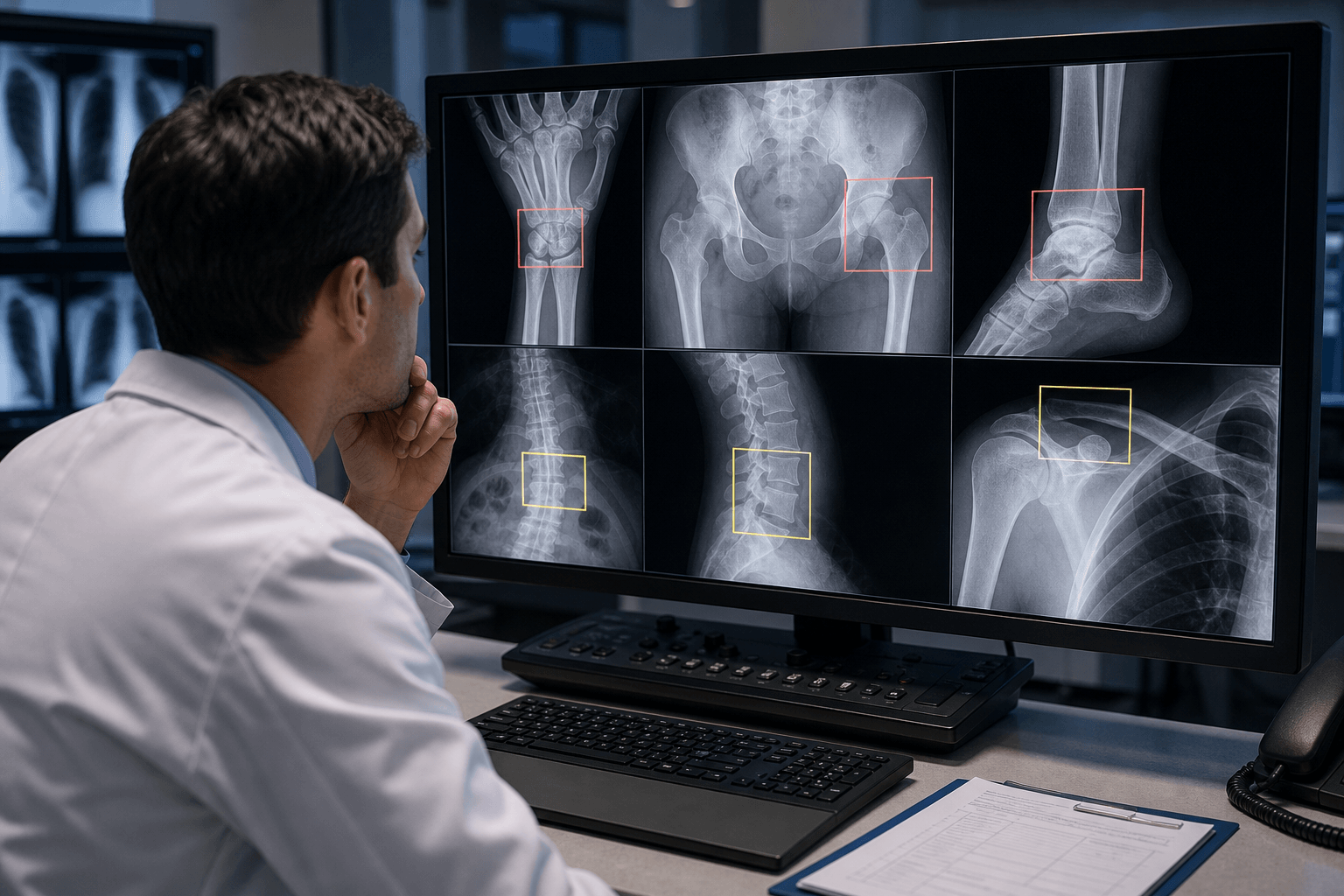
Detection: Fracture identification, abnormality flagging
Measurement: Automated angles, alignment metrics
Planning: Arthroplasty templating, surgical simulation
Prioritisation: Worklist triage by urgency
Key: AI augments clinical capability but requires human oversight
- AI tools are decision support - clinician remains responsible
- High sensitivity for fracture detection reduces missed injuries
- Best validated for wrist, hip, and chest radiograph applications
- Cannot replace clinical correlation and physical examination
- Regulatory clearance (FDA 510(k), CE/UKCA, or national equivalent) required for clinical use
- “AI assists detection but does not replace clinical decision-making
- “Deep learning uses convolutional neural networks (CNNs)
- “Performance depends on training data quality and diversity
- “Particularly useful for reducing missed fractures in ED
Overview & Core Principles
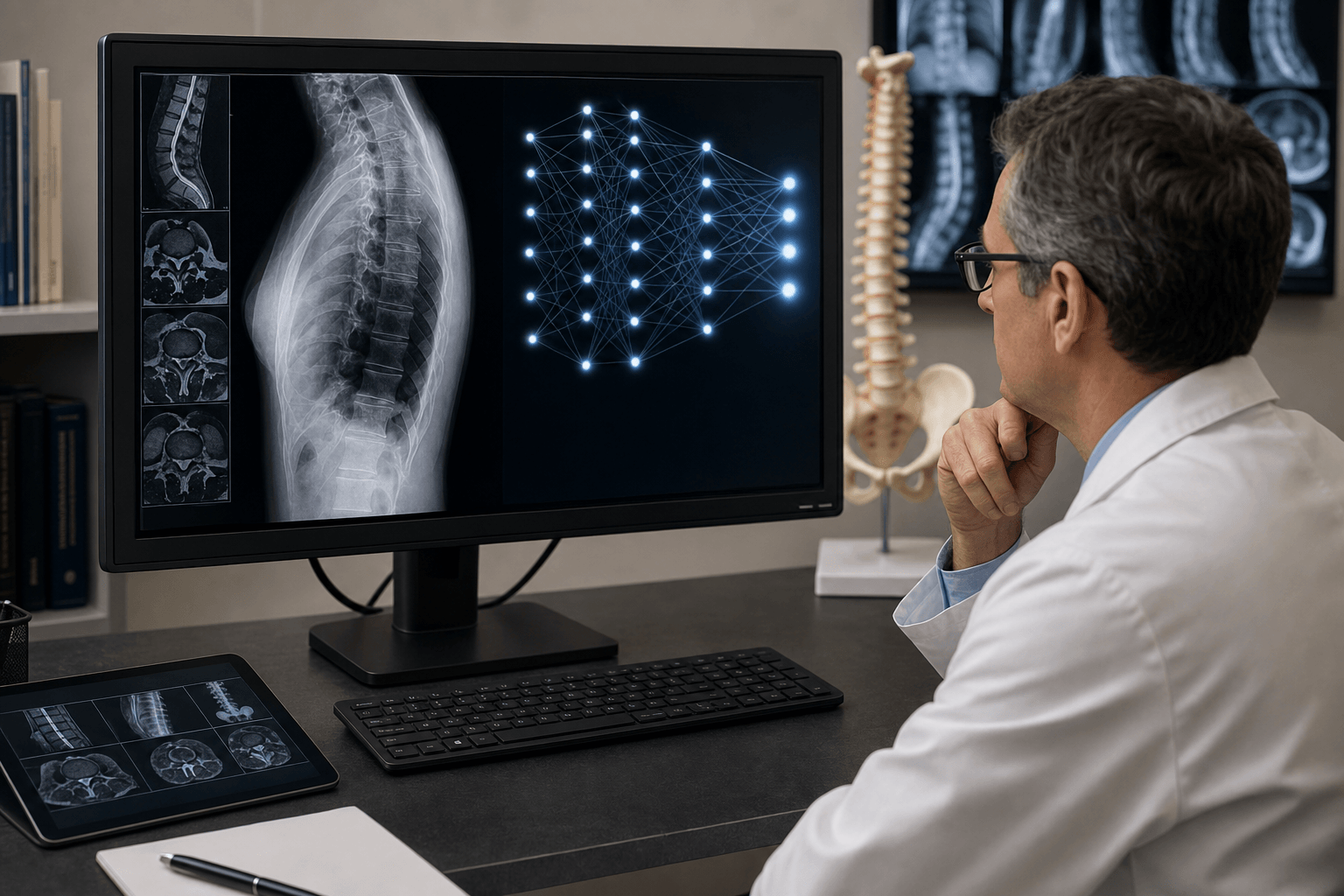
Artificial intelligence in radiology is an emerging topic. For the exam, understand the basic concepts (machine learning and deep learning), the currently validated applications (fracture detection), the limitations (training bias, and that AI cannot replace clinical judgement) and the medicolegal position: clinician responsibility remains.
The vocabulary. The rest of the page relies on six terms.
- Definition
- Machines performing tasks requiring human intelligence
- Example
- Any automated image analysis
- Definition
- Algorithms that improve through experience
- Example
- Learning from labelled examples
- Definition
- Neural networks with multiple layers
- Example
- Convolutional neural networks
- Definition
- Neural network for image analysis
- Example
- Fracture detection models
- Definition
- Labelled examples used to teach the algorithm
- Example
- Radiographs with/without fractures
- Definition
- Applying trained model to new data
- Example
- Analysing a new patient radiograph
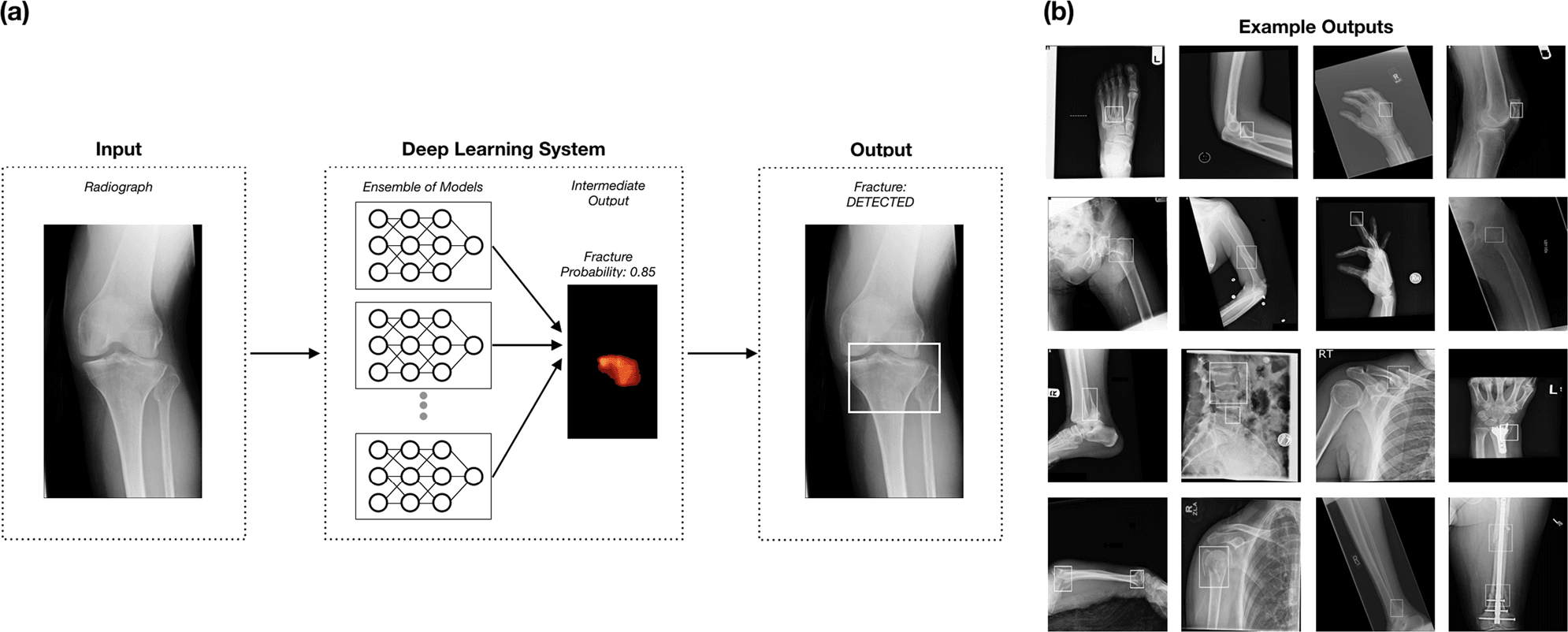
How a model learns to detect fractures. A deep learning model is trained on thousands of labelled radiographs, each marked fracture or no fracture. The CNN learns for itself the features that distinguish a fracture, such as cortical disruption, angulation and subtle lucent lines, without explicit programming.
How a Model Is Trained and Why It Overfits
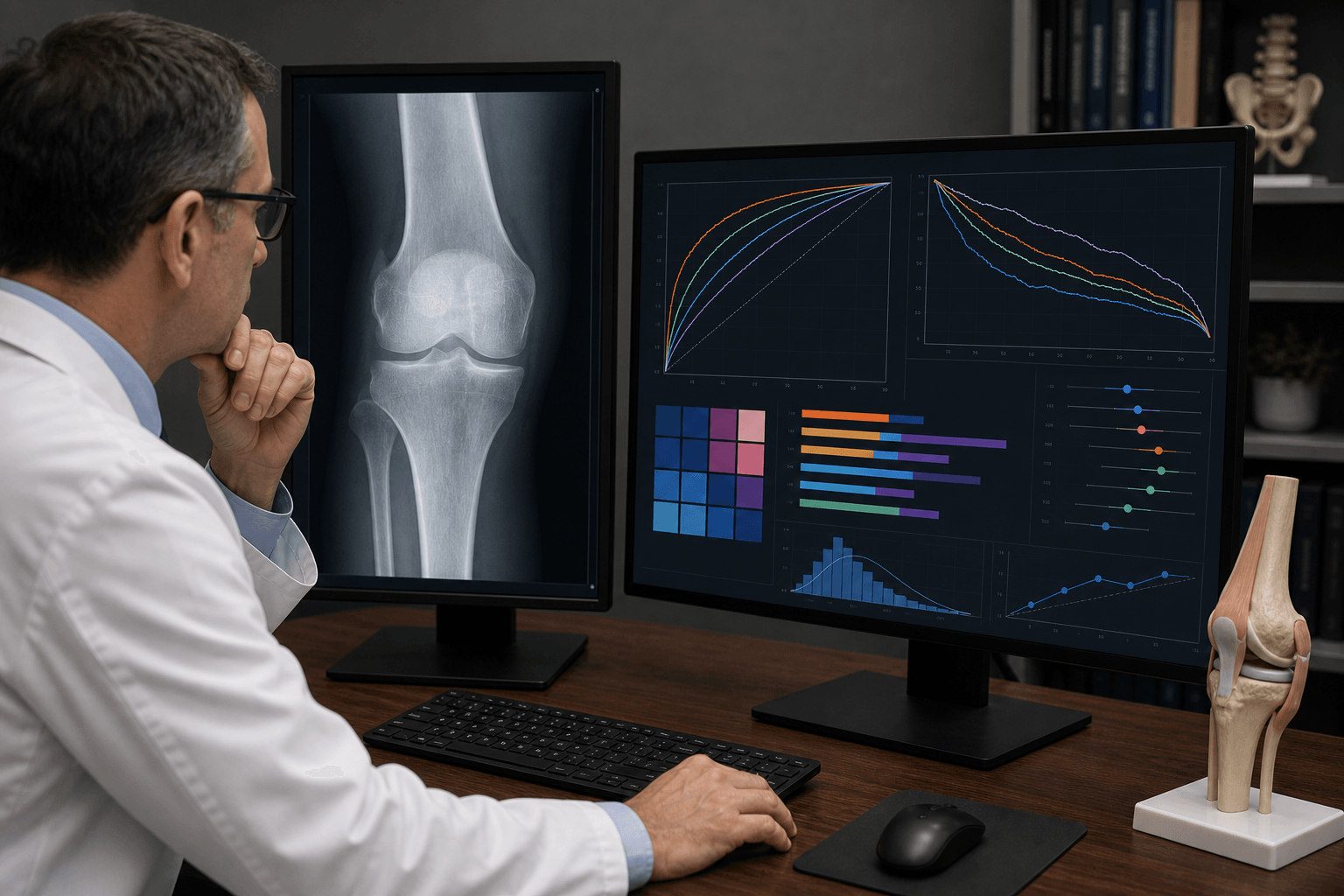
Three data sets. A model is fitted on a training set. Hyperparameters and the choice of model are tuned on a separate validation set, and final, unbiased performance is measured on a held-out test set, ideally an external dataset from a different centre. One published fracture tool, for example, was trained on an 87% / 11% / 2% train-validation-test split.
Overfitting. A model that memorises the training data, noise included, rather than learning generalisable features performs excellently on the images it was trained on and poorly on new data.
Preventing it. The defences are more data and more diverse data, which generally improves generalisation; data augmentation, the rotations, flips and brightness changes that synthetically expand the dataset; regularisation; and early stopping. Any tuning done on the test set leaks information and inflates the reported performance, which is why an untouched, ideally external, test set matters.
Q: How do you recognise an overfitted model?
A: High training accuracy with much lower validation or test accuracy.
Explainability: Opening the Black Box
The problem. A deep CNN outputs a prediction without a human-readable reason: the black box.
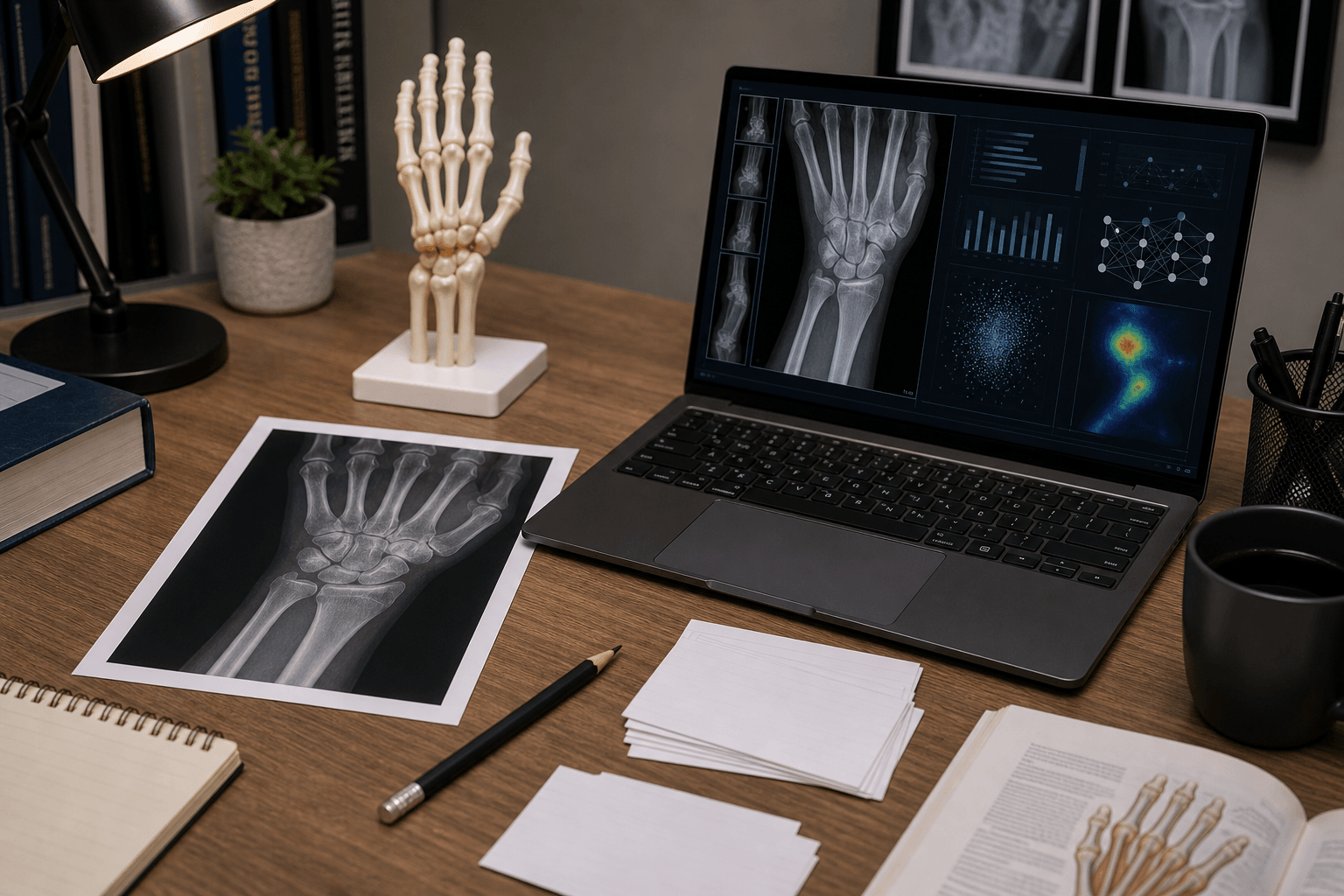
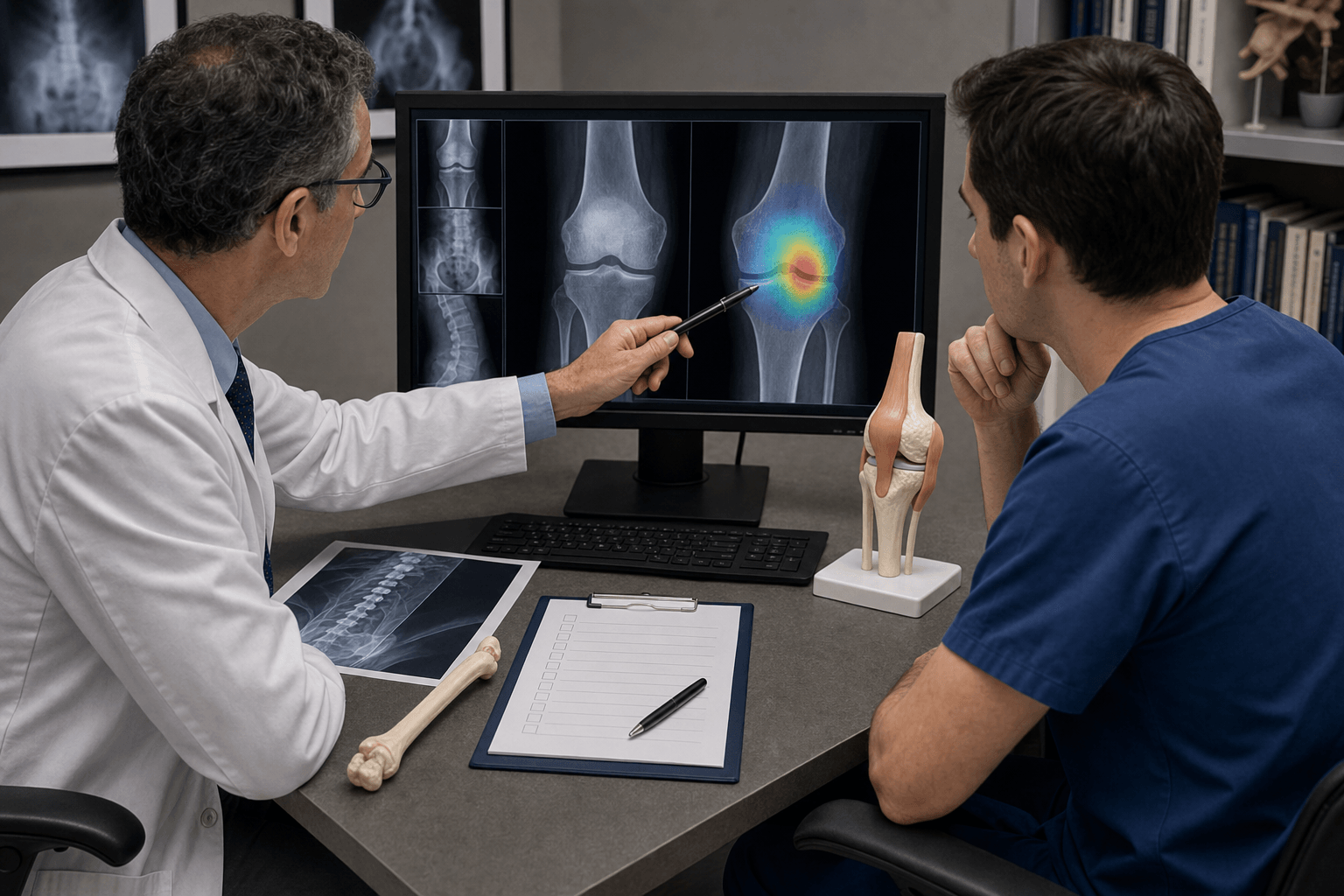
The commonest solution. A saliency or class-activation map, for example Grad-CAM (gradient-weighted class-activation mapping), overlays a heatmap on the radiograph showing the region that most drove the model's decision.
Why it matters. The heatmap lets the clinician sanity-check the model, confirming that it looked at the fracture and not at a spurious cue such as a laterality marker, text or a cast ('shortcut learning', the Clever-Hans effect). That builds trust and helps catch out-of-distribution failures.
A heatmap shows where the model looked, not its true reasoning. It is a check, not a proof of correctness.
Performance Metrics
- Definition
- True positive rate (detects fractures)
- Clinical Interpretation
- High = few missed fractures
- Definition
- True negative rate (correct negatives)
- Clinical Interpretation
- High = few false alarms
- Definition
- Positive predictive value
- Clinical Interpretation
- Probability positive result is true
- Definition
- Negative predictive value
- Clinical Interpretation
- Probability negative result is true
- Definition
- Area under ROC curve
- Clinical Interpretation
- Overall discriminative ability (0.5-1.0)
- Definition
- Harmonic mean of precision/recall
- Clinical Interpretation
- Balanced performance measure
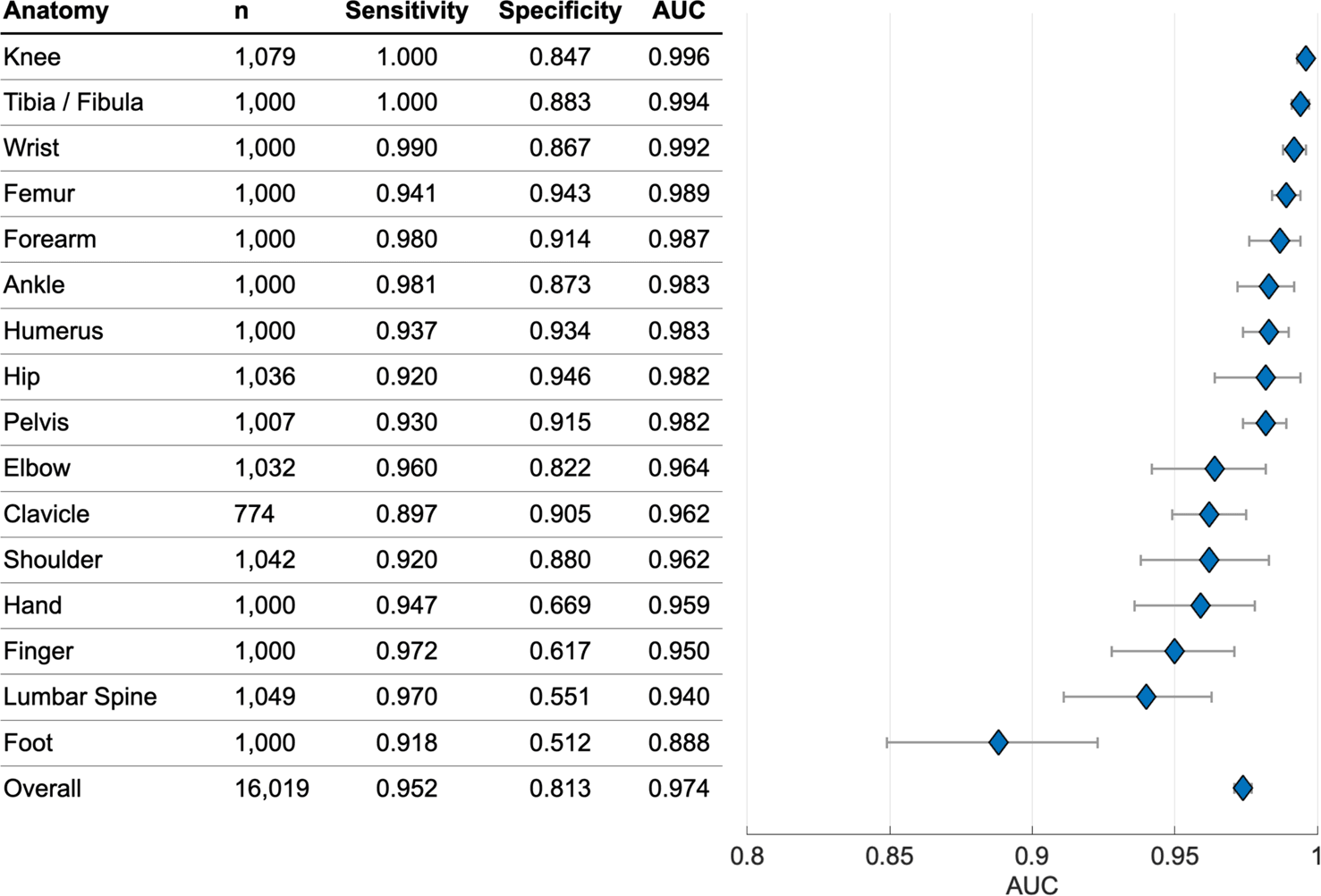
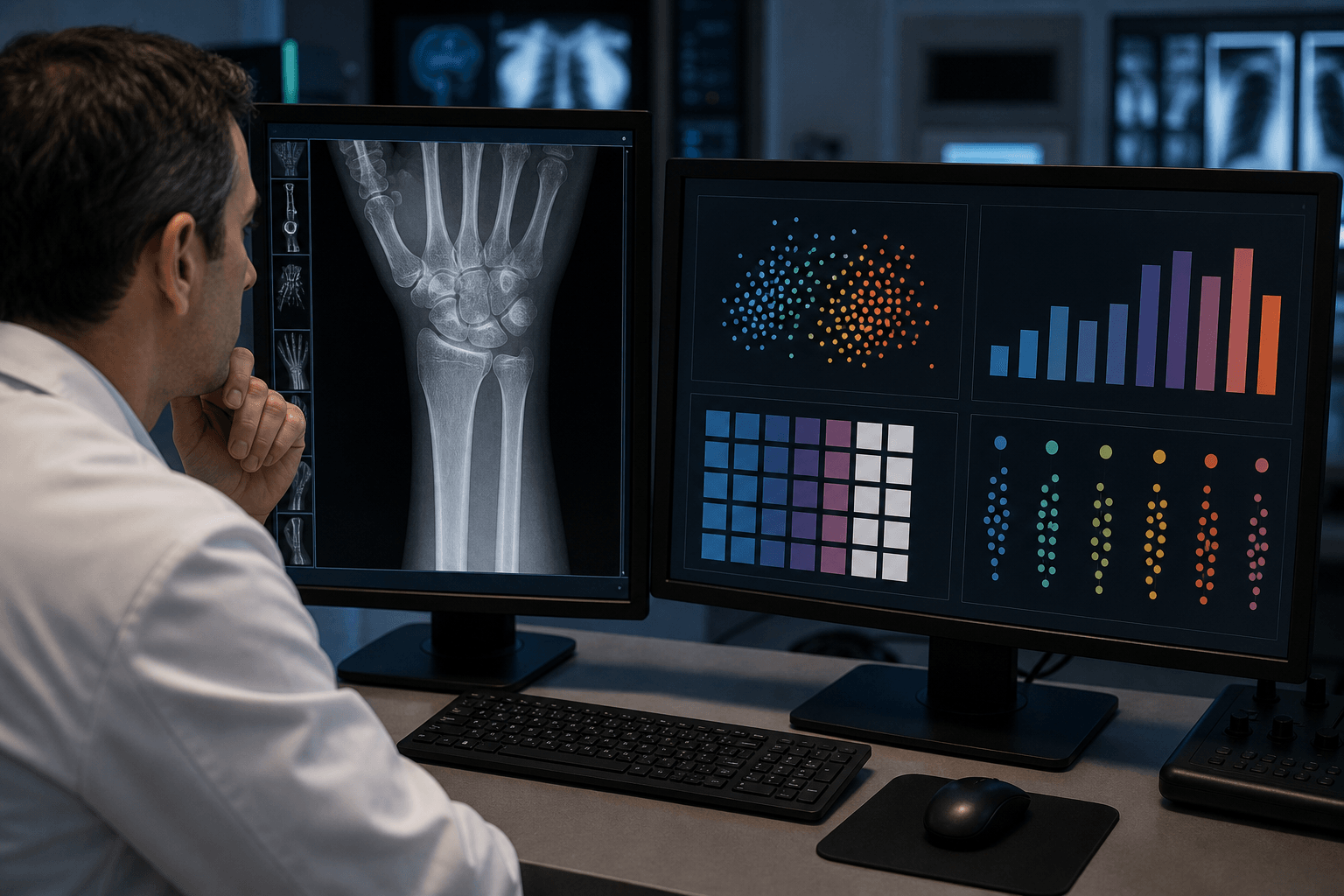
The trade-off. In fracture detection, high sensitivity is prioritised over specificity. Missing a fracture has more serious consequences than a false positive, so most tools are tuned for high sensitivity and accept some overcalling.
The cost of overcalling. A single false positive is easily dismissed by the clinician. At scale, false positives risk alert fatigue and over-investigation, with extra CT or MRI and incidental findings.
Limitations
- Explanation
- Model reflects training data characteristics
- Mitigation
- Diverse, representative datasets
- Explanation
- Poor performance on unusual cases
- Mitigation
- Clinical oversight, flag uncertainty
- Explanation
- Cannot explain reasoning
- Mitigation
- Explainability research, heatmaps
- Explanation
- Garbage in, garbage out
- Mitigation
- Quality training data curation
- Explanation
- Approval slower than development
- Mitigation
- Use only approved tools clinically
- Explanation
- Technical/workflow barriers
- Mitigation
- PACS integration, user training
It cannot replace clinical judgement. AI cannot assess the mechanism of injury, examine the patient, correlate with symptoms or consider the full clinical picture.
Bias and generalisation. A model trained predominantly on one population may perform differently on others, through different equipment, demographics or disease prevalence, and can degrade silently when deployed elsewhere (distribution shift). Validating performance in the local population is important before deployment.
Systematic Approach: A Negative AI Result Is Not a Differential
The most dangerous error is treating an AI "no fracture" output as a clinical answer. AI flags a pattern; the clinician must still work through why a region hurts despite a reassuring algorithm.
Why a negative result does not settle it. Sensitivity is not 100%, so occult fractures are still missed, and a negative AI result does not exclude a fracture if clinical suspicion is high. Examination and mechanism override the algorithm, and high suspicion warrants immobilisation, repeat imaging, or MRI or CT.
The table contrasts the entities a fracture-detection model is and is not built to resolve.
- Why AI may miss or mislabel it
- Often invisible on initial radiograph (AI trained on radiographs cannot see what is not yet visible)
- Clinical action that overrides AI
- Snuffbox tenderness - immobilise, repeat imaging or MRI at 10-14 days
- Why AI may miss or mislabel it
- Subtle trabecular disruption, frequent false negatives in osteopenic bone
- Clinical action that overrides AI
- Inability to weight-bear - CT or MRI regardless of AI output
- Why AI may miss or mislabel it
- Radiographically silent for 2-3 weeks; outside most training distributions
- Clinical action that overrides AI
- History (load change, metabolic risk) - MRI or bone scan
- Why AI may miss or mislabel it
- Model trained on traumatic fractures may not flag underlying lesion
- Clinical action that overrides AI
- Atraumatic mechanism, lytic/blastic clues - cross-sectional imaging, oncology referral
- Why AI may miss or mislabel it
- AI detects the fracture, not the pattern or social context
- Clinical action that overrides AI
- Recognise inconsistent history, multiple ages of injury - safeguarding pathway
- Why AI may miss or mislabel it
- Fracture model has no class for ligament or tendon
- Clinical action that overrides AI
- Examination, stress views, MRI / ultrasound
- Why AI may miss or mislabel it
- Unusual projection, hardware, paediatric physis, rare anatomy degrades performance
- Clinical action that overrides AI
- Treat AI output as unreliable; rely on clinical reasoning
Automation bias. The validated harm of AI is automation bias, the tendency to defer to a confident-looking output and stop thinking, rather than the false negative itself. Studies show readers can be anchored by an incorrect AI suggestion, occasionally being talked out of a correct call.
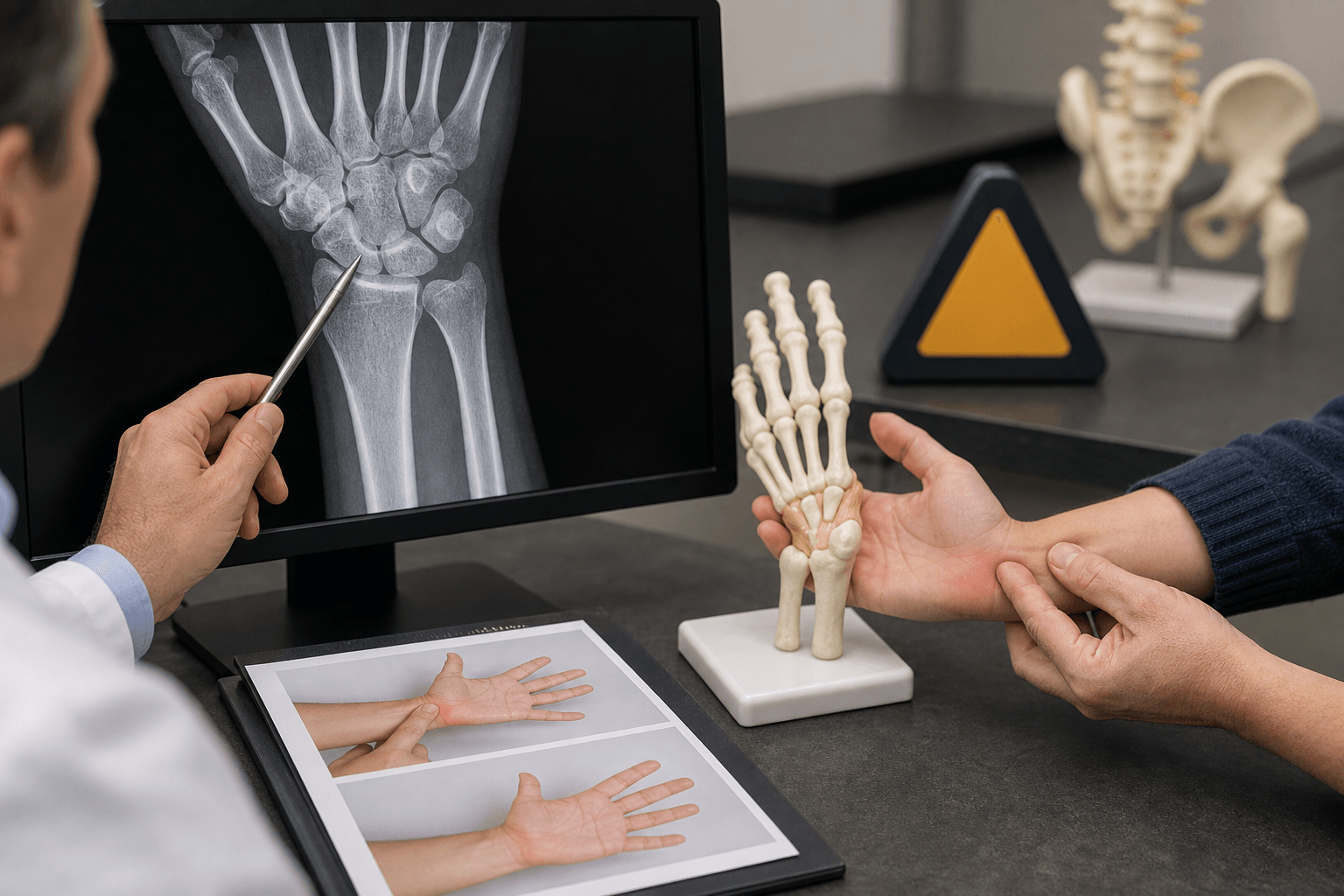
Read the image first, then consult the AI, and let a discordant high clinical suspicion always win. The classic trap: AI says 'no fracture', the patient has snuffbox tenderness - you still treat as a scaphoid fracture.
Regulatory and Medicolegal
- Requirement
- Medical device (software)
- Notes
- SaMD - Software as Medical Device (IMDRF framework)
- Requirement
- Required for clinical use in USA
- Notes
- 510(k) pathway most common for fracture AI
- Requirement
- Required in EU (MDR) and UK (UKCA)
- Notes
- Most fracture tools are MDR Class IIa/IIb
- Requirement
- Required in each jurisdiction
- Notes
- TGA (Australia), Health Canada, PMDA (Japan), CDSCO (India)
- Requirement
- Performance data required
- Notes
- Prospective, locally representative studies preferred
- Requirement
- Ongoing monitoring + drift detection
- Notes
- Report adverse events; monitor performance over time
Who is responsible. The clinician remains legally responsible for the clinical decision, whether or not AI was used. AI is a decision support tool, not a decision-maker: if it misses a fracture, the clinician is still responsible for the missed diagnosis if they did not exercise appropriate clinical judgement. Documentation should reflect that AI was used as an adjunct, not as the sole basis for the decision.
V-A-L-I-DAppraising an Imaging AI Tool
Hook:If a tool is not VALID for your jurisdiction and population, a high published AUC is irrelevant - never deploy on the vendor's numbers alone.
Guidelines, Registries & Global Practice
Missed fractures are the single most common diagnostic error in musculoskeletal imaging worldwide, and the burden falls hardest where specialist reporting is scarce - this is the global rationale for fracture-detection AI.
- Position on imaging AI
- Clears most fracture tools via 510(k); evolving framework for adaptive/locked algorithms
- Practical implication
- Cleared tools are decision support; predicate-based clearance does not prove outcome benefit
- Position on imaging AI
- Endorses AI as an adjunct; runs the ACR AI registry (Assess-AI) and Data Science Institute use cases
- Practical implication
- Encourages local performance monitoring rather than blind adoption
- Position on imaging AI
- RCR cautious endorsement; NICE early value assessment of fracture-detection AI (e.g. ED use)
- Practical implication
- Permits conditional use with evidence generation; human report still required
- Position on imaging AI
- Support AI as augmentation; emphasise CE/MDR compliance and explainability
- Practical implication
- MDR Class IIa/IIb obligations and post-market surveillance
- Position on imaging AI
- Promotes AI for classification, templating and surgical planning education
- Practical implication
- Focus on consistency of fracture classification and pre-operative planning
- Position on imaging AI
- Frameworks for SaMD and ethics of AI in health, relevant to limited-resource scale-up
- Practical implication
- Stresses equity, validation in local populations, and governance
- High-resource setting
- Second-read / worklist triage to support specialist radiologists
- Limited-resource setting
- Front-line decision support where no radiologist is available
- High-resource setting
- Integrated into PACS/RIS, on-premise or cloud inference
- Limited-resource setting
- May rely on smartphone capture or intermittent connectivity
- High-resource setting
- Efficiency, reduced miss rate, faster turnaround
- Limited-resource setting
- Access to expertise that would otherwise be absent (task-shifting)
- High-resource setting
- Automation bias, alert fatigue, over-investigation
- Limited-resource setting
- Deployment of unvalidated tools, distribution shift, no oversight
- High-resource setting
- Formal validation, audit and surveillance pathways
- Limited-resource setting
- Often absent - the key barrier to safe scale-up
Related pages: Diagnostic Test Statistics is the page to read first and the one that makes every number here interpretable - sensitivity against specificity, why accuracy is a misleading summary when most films are normal, and why a test's predictive value collapses when prevalence falls from the 60-70% of a curated dataset to the few per cent of an emergency department. Levels of Evidence and Evidence-Based Orthopaedics and Critical Appraisal supply the appraisal framework that the retrospective, vendor-authored design of most of this literature fails, and Research Ethics and Integrity covers the conflict-of-interest declarations that decide how much weight an industry-authored evaluation earns. Scaphoid Fractures is the clinical problem these tools are most often aimed at and the reason a negative output never overrides snuffbox tenderness; Scaphoid Nonunion is what a missed one becomes. CT Imaging Principles and MRI Imaging Principles are the reference standards against which occult fracture is defined - and the heterogeneity in which of them each study used is a live source of bias in the pooled estimates. Systematic Approach to Trauma Imaging is the discipline that automation bias erodes: a reader who has stopped searching because the model reported nothing has abandoned the very habit that catches the second injury. Medicolegal Principles and Negligence and Informed Consent and Shared Decision-Making carry the responsibility question - the clinician remains liable for the report, and the patient is rarely told an algorithm was involved. Patient Safety and Wrong-Site Surgery Prevention is the wider literature on how checklists and alerts change behaviour, including how quickly people learn to ignore an alarm that is usually wrong. 3D Printing from Imaging, Robotic and Navigated Arthroplasty and Navigation and Robotics in Spine Surgery are the neighbouring technologies, and the same two tests apply to all of them: is the unaided task genuinely unreliable, and is the thing being made more accurate the outcome or only a surrogate?
Controversies & Areas of Uncertainty
Retrospective hype, prospective reality. Most fracture-AI evidence is retrospective, single-centre and at high risk of bias (QUADAS-2). Multi-reader studies show genuine reader improvement, but few prospective, randomised, real-world deployment trials measure whether patient outcomes (missed fractures, return visits) actually improve. The gap between reported AUC and clinical benefit remains the central controversy.
Local re-validation and drift. There is no consensus on how much local re-validation is required before deployment, nor on how to monitor performance drift over time.
Liability when AI is wrong. Medicolegal frameworks have not settled whether ignoring a correct AI flag, or following an incorrect one, changes the standard of care. Current consensus keeps the clinician responsible, but liability for the vendor and the institution is legally untested in most jurisdictions.
The operating threshold. The optimal operating threshold, and whether it should differ by setting (ED against fracture clinic), is unresolved.
Future Directions
- Application
- Automated report generation
- Potential Impact
- Efficiency, consistency
- Application
- Combined imaging and clinical data
- Potential Impact
- More holistic assessment
- Application
- Training without sharing data
- Potential Impact
- Privacy-preserving improvement
- Application
- Pre-trained, adaptable models
- Potential Impact
- Faster development of new tools
- Application
- Intraoperative AI assistance
- Potential Impact
- Surgical precision
- Application
- Predict treatment success
- Potential Impact
- Personalised medicine
Radiologist and AI together. The future is likely radiologist-AI collaboration rather than replacement. AI handles routine detection and measurement, freeing radiologists for complex interpretation, clinical correlation and communication, and studies suggest radiologist plus AI outperforms either alone for many tasks.
Clinical Imaging Applications
Applications fall into four groups: detection of fractures and other abnormalities, automated measurement, surgical planning, and prioritisation, which triages the worklist by urgency.
- Typical Sensitivity
- 90-95%
- Clinical Utility
- Reduces missed scaphoid, metacarpal fractures
- Typical Sensitivity
- 90-98%
- Clinical Utility
- Flags occult neck of femur fractures
- Typical Sensitivity
- 85-95%
- Clinical Utility
- Detects subtle rib fractures
- Typical Sensitivity
- 85-92%
- Clinical Utility
- Identifies vertebral compression fractures
- Typical Sensitivity
- 88-94%
- Clinical Utility
- Assists with subtle malleolar fractures
- Typical Sensitivity
- 85-92%
- Clinical Utility
- Helps with occult fractures
Reading the sensitivities. These are typical figures. The independent meta-analysis of scaphoid detection in the Evidence Base pooled a sensitivity of 0.80, and the Evidence Base discusses why figures from different study designs differ.
In the emergency department. The tool analyses radiographs automatically and flags potential fractures. It can reduce missed fractures, prioritise urgent cases and provide a second read; the first matters particularly where trainees provide cover and in high-volume departments. The clinician reviews every suggestion and makes the final determination.
Clinical Decision Scenarios
Practise clinical reasoning and management decisions out loud
“Your hospital is considering implementing an AI tool for fracture detection on emergency department radiographs. What factors would you consider?”
“An ED registrar reviews a wrist X-ray and the AI tool reports 'no fracture detected'. The patient has snuffbox tenderness.”
“You are asked to give a presentation on AI in orthopaedic imaging to your department. What key messages would you convey?”
Core Concepts
- Deep learning uses CNNs for image analysis
- Trained on labelled examples
- Validated on separate test data
- Regulatory clearance required for clinical use
Current Applications
- Fracture detection (wrist, hip common)
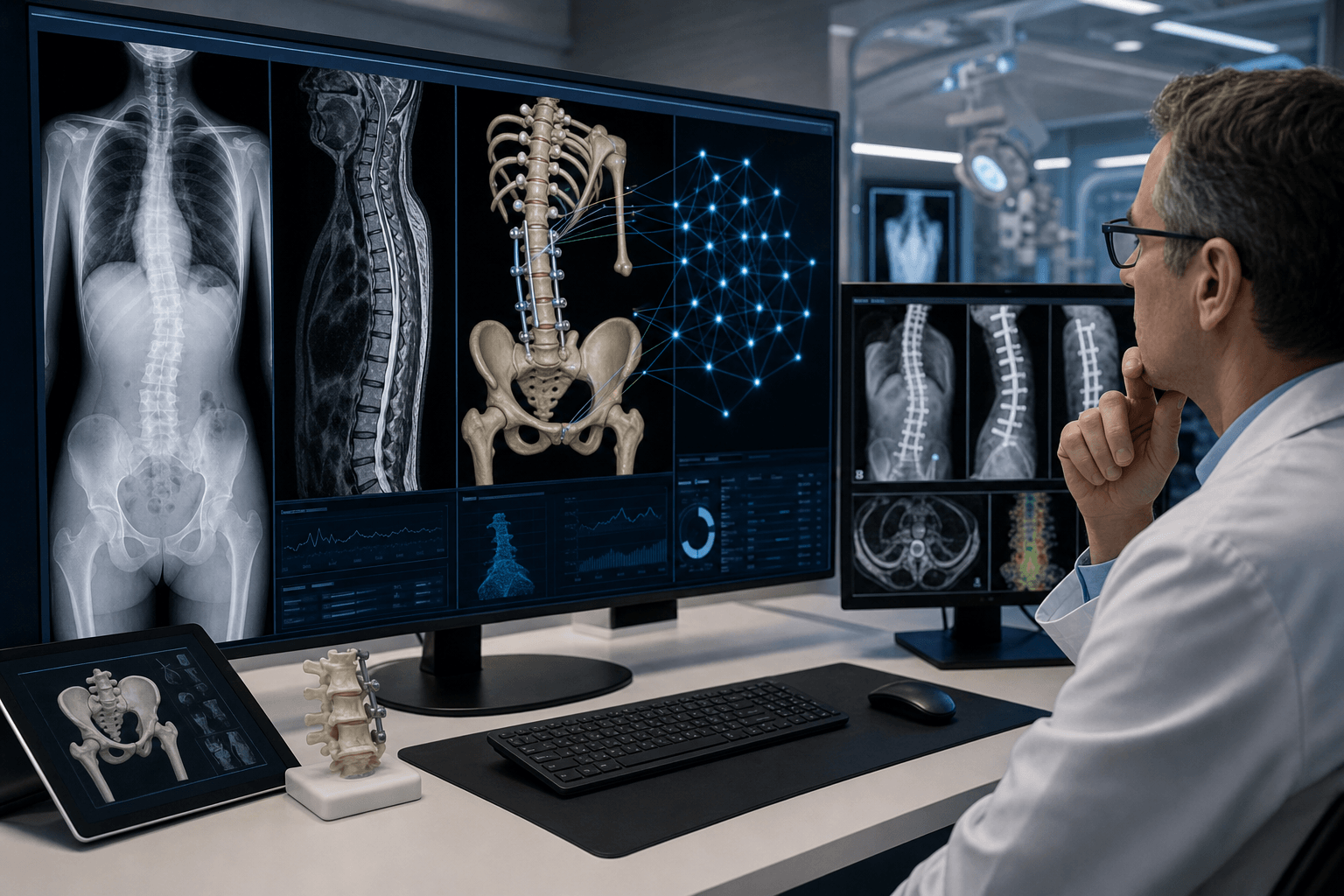
- Automated measurements (Cobb angle)
- Arthroplasty templating
- Worklist prioritisation
Performance
- Sensitivity 90-95% for fracture detection
- High sensitivity prioritised (few missed)
- May have lower specificity (overcalling)
- AI + clinician better than either alone
Key Principles
- Decision support, not replacement
- Clinical correlation essential
- Clinician remains legally responsible
- Negative AI does not exclude pathology
Evidence Base
Deep Learning Assistance Closes the Accuracy Gap in Fracture Detection Across Clinician Types
- Multi-reader multi-case study: 24 clinicians (radiologists, orthopaedic surgeons, PAs, primary care and emergency physicians) read 175 cases across 12 anatomical regions, aided and unaided by an FDA-cleared deep learning tool
- Reader accuracy rose with AI aid: AUC 0.90 unaided to 0.94 aided (difference 0.04, 95% CI 0.01 to 0.07)
- Sensitivity improved from 82% to 90% and specificity from 89% to 92% with AI assistance
- Clinicians with limited MSK imaging training reduced their fracture miss rate from 20% to 9%, matching radiologist performance (10%)
Deep Learning Tool to Improve Fracture Detection by Radiologists and Emergency Physicians on Extremity Radiographs
- Standalone deep learning performance on 2626 extremity radiographs: accuracy 0.986, sensitivity 0.987, specificity 0.885, with accuracy over 0.95 across body part, age, sex, view and scanner
- Multi-reader study (24 readers): with AI aid, accuracy rose by 0.047 (95% CI 0.034 to 0.061) and sensitivity improved from 0.865 to 0.955
- Average interpretation time fell by 7.1 seconds (27%) per examination
- Diagnostic gain was largest for emergency physicians and non-MSK radiologists
Reading these six studies together
The two sensitivities on this page differ by nineteen points, and the reason is the study design, not the bone. The industry-authored standalone evaluation reports a sensitivity of 0.987; the independent meta-analysis pooling seven scaphoid datasets reports 0.80. Whenever you meet an AI performance figure, the first question is who generated it and on whose images: a manufacturer's held-out test set is the most favourable condition a model will ever see, while a pooled estimate across tools, centres and reference standards is the closest available approximation to what happens when someone else installs it. QUADAS-2 rated nine of ten primary studies at high risk of bias or applicability concern, which tells you the direction the published literature errs in.
Convert specificity into workload before you believe a tool is deployable. A standalone specificity of 0.885 sounds excellent and means roughly one normal radiograph in nine is flagged. A department reading a thousand normal extremity films a week would receive about 115 false alarms a week - the mechanism by which screening tools lose the trust of the people using them, and a driver of unnecessary CT, immobilisation and follow-up. Accuracy figures near 0.99 are dominated by true negatives and should never be quoted as the performance of a fracture detector.
Nothing here measures a patient outcome. All five clinical studies are retrospective; none randomised anybody, none followed a patient, and the scaphoid meta-analysis states explicitly that no study has compared AI with clinicians in a clinical setting. What the evidence does support, consistently and across independent groups, is narrower and still useful: AI assistance helps the non-specialist reader more than the specialist (miss rate 20% to 9% for clinicians with limited imaging training, against essentially no change for radiologists) and it shortens reading time by around a quarter. Those are workflow claims, they are reproducible, and they are the honest case for these tools.