Post-traumatic Predominance | Arthrodesis vs TAR | Functional Outcomes | Adjacent Joint Disease
- Post-traumatic is the commonest cause (78% in Valderrabano series) - unlike hip/knee (primary OA)
- Ankle arthrodesis remains the durable reference standard - bone non-union about 12% on radiographs but only ~7% symptomatic in TARVA
- TAR for lower demand, good alignment, adequate bone stock, intact deltoid
- Accelerated adjacent (ipsilateral foot) OA is consistent at 22 years post-fusion (Coester)
- Neutral alignment critical for both fusion and replacement
- “Most ankle OA is post-traumatic (fractures, instability, osteochondral lesions)
- “Ankle tolerates less cartilage loss than hip/knee before symptoms
- “TAR contraindicated with significant varus/valgus deformity, neuropathy, AVN
- “Fusion position: neutral DF, 5 degrees valgus, 5-10 degrees ER, slight posterior translation
- “TARVA RCT (2023): no significant difference in walking/standing score at 1 year; both improve quality of life
Overview and Epidemiology
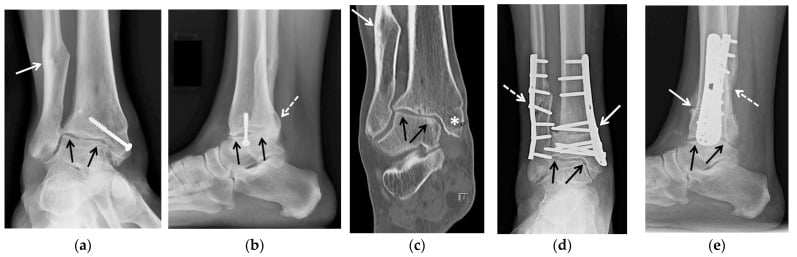
Ankle arthritis is less common than hip or knee arthritis but causes significant disability. Symptomatic ankle OA is roughly 9 times less common than knee OA, and its aetiology differs fundamentally from that of the other large joints: primary ankle OA is rare.
Aetiology. In Valderrabano's series of 406 end-stage ankles (Clin Orthop Relat Res 2009):
- Post-traumatic - 78%. Malleolar fractures most common, then instability and osteochondral lesions
- Secondary - 13%. Inflammatory, haemophilic, clubfoot, AVN and other causes
- Primary osteoarthritis - 9%. Rare, unlike the hip and knee
The secondary causes to name are the neurological conditions (Charcot, neuropathy) and the erosive arthropathies (rheumatoid, psoriatic, gout), alongside haemophilia.
These figures differ from the older "70%" estimate that is still widely quoted; the contemporary single-centre series of end-stage patients reports closer to 78% post-traumatic. Either way, trauma dominates and primary OA is uncommon.
This page covers the full spectrum of ankle arthritis: aetiology, conservative care, and the arthrodesis-versus-replacement decision. The dedicated total ankle arthroplasty page covers the procedure itself, with implant generations, patient selection, technique and outcomes.
Latency. Post-traumatic OA develops after a long delay, a mean of 20.9 years (range 1-52) after ankle fracture in Horisberger's series. The latency is shorter with pilon and plafond fractures, with healing complications, and with older age at injury.
Burden. End-stage ankle OA causes mental and physical disability at least as severe as end-stage hip OA on the SF-36 (Glazebrook).
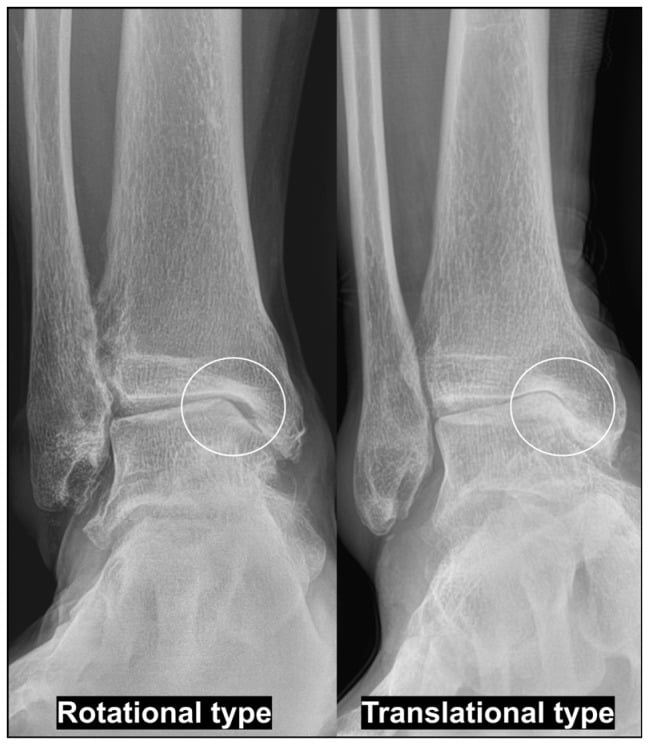
Alignment. The mean tibiotalar alignment in end-stage ankle OA is varus, regardless of aetiology.
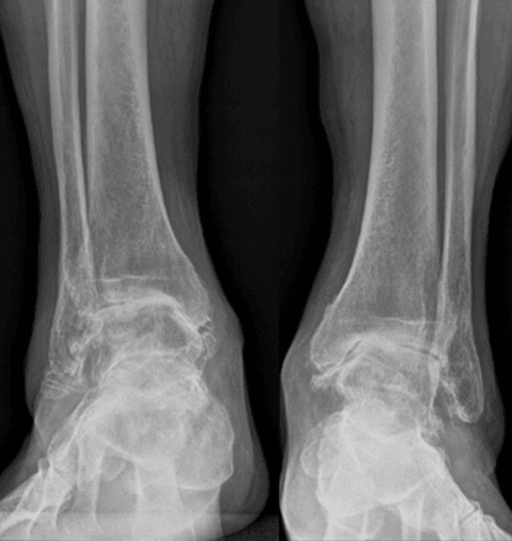
The ankle has the thinnest articular cartilage of the major weight-bearing joints, 1-1.5mm against 3-4mm in the knee. That makes it vulnerable to damage from fracture incongruity, although it also means the joint normally distributes load efficiently. Post-traumatic changes from malunion or instability rapidly lead to OA.
Natural history. Left untreated, the joint space narrows progressively, osteophytes form and limit motion, and pain and functional limitation increase. Deformity develops, usually varus, and the gait becomes abnormal with compensation at the joints above.
Anatomy and Biomechanics
The mortise. The tibiotalar joint is a highly constrained mortise joint with minimal inherent stability from its soft tissues alone. The concave tibial plafond sits on the talus between two buttresses, the medial malleolus and the lateral malleolus of the fibula, which reaches 1cm more distal than the medial. The talus is trapezoidal, wider anteriorly, which provides stability in dorsiflexion.
Ligamentous stability. Three groups of ligaments:
- Deltoid (medial) - the primary restraint to valgus, with deep and superficial components
- Lateral complex - ATFL, CFL and PTFL, resisting varus
- Syndesmosis - AITFL, PITFL and the interosseous ligament, maintaining mortise width
An intact deltoid ligament is essential for TAR success. A preoperative valgus deformity with deltoid insufficiency is a relative contraindication to TAR, because the implant will fail to balance properly.
Motion and load. The ankle moves mainly in the sagittal plane, about 20 degrees of dorsiflexion and 50 degrees of plantarflexion, around an oblique axis through the tips of the malleoli. It transmits 5 times body weight during running through a small contact area, approximately 350mm², but with high congruency.
The joints below. The subtalar joint has 25-30 degrees of motion and compensates for an ankle fusion; the talonavicular joint accommodates rotation. Hindfoot function is interdependent, and this compensatory motion, together with the gait adaptation a properly positioned fusion allows, is why the ankle tolerates arthrodesis.
Classification Systems
Kellgren-Lawrence grades the radiograph. It was designed for knee OA and is commonly applied to the ankle.
- Radiographic Features
- No features of OA
- Clinical Correlation
- Asymptomatic
- Radiographic Features
- Doubtful narrowing, possible osteophytes
- Clinical Correlation
- Minimal symptoms
- Radiographic Features
- Definite osteophytes, possible narrowing
- Clinical Correlation
- Moderate symptoms
- Radiographic Features
- Moderate osteophytes, definite narrowing, some sclerosis
- Clinical Correlation
- Significant symptoms
- Radiographic Features
- Large osteophytes, marked narrowing, severe sclerosis, deformity
- Clinical Correlation
- End-stage disease
Clinical Assessment
History. Establish where the pain is (anterior, medial or lateral), how it relates to activity and weight bearing, and how long the morning stiffness lasts. Night pain suggests more advanced disease. The rest of the history covers:
- Previous trauma: fractures, sprains, instability
- Previous surgery
- Functional limitations: walking distance, stairs, uneven ground
- Response to conservative treatment
Examination. Assess range of motion, alignment, stability, the site of tenderness, gait and the adjacent joints:
- Significance
- Reduced DF/PF, crepitus
- Implications
- Severity indicator
- Significance
- Varus/valgus tilt
- Implications
- Affects surgical planning
- Significance
- Anterior drawer, talar tilt
- Implications
- May need ligament reconstruction
- Significance
- Location guides differential
- Implications
- Anterior = impingement, medial/lateral = gutter OA
- Significance
- Antalgic, compensatory patterns
- Implications
- Functional assessment
- Significance
- Subtalar, talonavicular motion
- Implications
- Fusion compensates, TAR requires
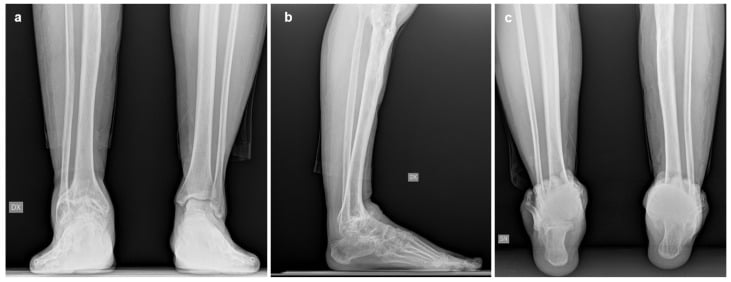
Adequate subtalar and talonavicular motion is essential for a good outcome after ankle fusion. If those joints are already arthritic or fused, an ankle fusion will leave the patient significantly stiff, which may favour TAR if the other factors permit.
Provocative tests. The anterior impingement test (pain with forced dorsiflexion), the compression/rotation test (pain with axial load and rotation) and the Silfverskiold test for gastrocnemius contracture complete the examination.
Vascular assessment. Palpate the dorsalis pedis and posterior tibial pulses and check capillary refill; consider an ABI where there is concern, in diabetics and smokers.
Differential diagnosis. The alternatives for the painful, stiff ankle, and what separates them:
- Discriminating features
- Anterior/diffuse ankle-line pain, dorsiflexion loss, varus tilt
- Key investigation
- Weight-bearing AP/lateral/mortise radiographs
- Discriminating features
- Hindfoot pain below the malleoli, pain on inversion/eversion, normal tibiotalar line
- Key investigation
- Broden/hindfoot views; selective subtalar local-anaesthetic injection
- Discriminating features
- Giving-way, positive anterior drawer and talar tilt, often younger
- Key investigation
- Stress radiographs; MRI of ATFL/CFL
- Discriminating features
- Focal, deep, activity-related pain, may catch/lock, often near-normal joint space
- Key investigation
- MRI (or CT) of talar dome
- Discriminating features
- Anterior pain at terminal dorsiflexion, anterior osteophytes, preserved joint space
- Key investigation
- Lateral radiograph; impingement test
- Discriminating features
- Bilateral/symmetrical, multi-joint, morning stiffness, systemic features
- Key investigation
- RF/anti-CCP, CRP/ESR, HLA-B27 if indicated
- Discriminating features
- Warm, swollen, often painless deformity in neuropathic (diabetic) foot
- Key investigation
- Radiographs (fragmentation/dislocation), HbA1c, sensory testing
- Discriminating features
- Acute hot swollen joint, rapid onset, hyperuricaemia or chondrocalcinosis
- Key investigation
- Joint aspirate for crystals; serum urate
Investigations
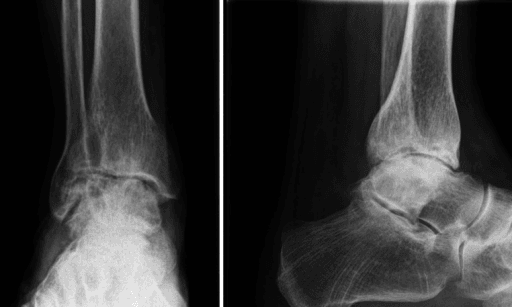
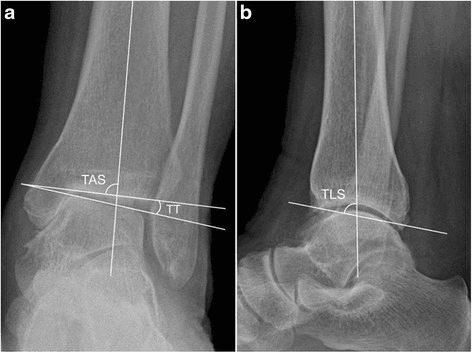
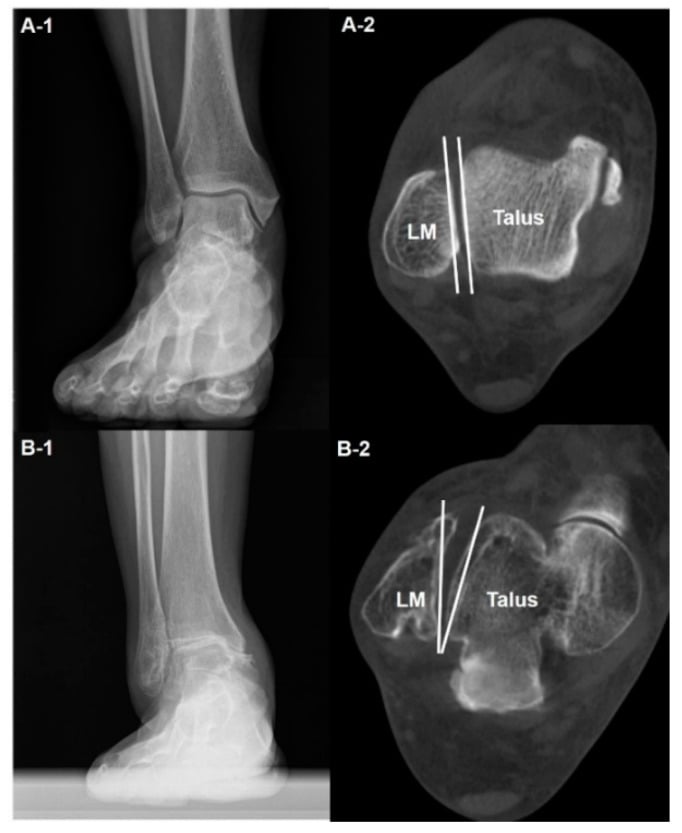
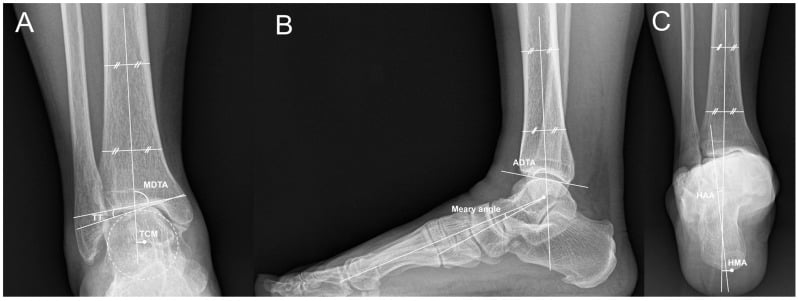
Weight-bearing views are essential, because they reveal the functional joint space and the alignment. The standard series:
- Weight-bearing AP ankle
- Weight-bearing lateral ankle
- Mortise view
- Hindfoot alignment view if there is deformity
Assess the pattern of joint space narrowing, the location and size of osteophytes, subchondral sclerosis and cysts, varus or valgus tilt, and involvement of the adjacent joints. Stress views are added when instability is suspected: the anterior drawer tests the ATFL and talar tilt the CFL.
Management Algorithm
- 1Conservative Trial
Activity modification, bracing, NSAIDs, PT, injections
May provide long-term relief in mild disease
- 2Failed Conservative
Reassess for surgical candidacy
Most progress to surgery eventually
- 3Malalignment Present
Consider supramalleolar osteotomy if early disease
Joint preservation if appropriate
- 4End-stage Disease
Fusion vs TAR based on patient factors
Both provide reliable pain relief
First-line management. Activity modification means low-impact activities, weight loss if overweight, and avoiding the activities that aggravate the pain. Medication is NSAIDs, oral or topical, and acetaminophen, with PPI protection considered for long-term use.
Bracing. Be specific, because "an AFO" is not a prescription. The aim is to do two things mechanically: stop the painful arc of tibiotalar motion, and replace the lost roll-over so the patient can still get from heel strike to toe-off.
- Lace-up gauntlet AFO (Arizona-type): a custom moulded leather-and-plastic ankle gauntlet. The workhorse where hindfoot and ankle are both involved or where there is deformity to accommodate, because it controls the subtalar joint as well. Fits inside a shoe.
- Solid (non-articulated) AFO: eliminates sagittal motion altogether. Effective for pain but obliges a compensating shoe modification, since the ankle can no longer roll over.
- Patellar-tendon-bearing (PTB) AFO: offloads axial load through the proximal tibia rather than the joint. Reserved for those needing genuine load transfer, and less well tolerated.
- Carbon-fibre energy-storing AFO: lighter and better for the active patient who wants to keep walking distances, at higher cost.
- Shoe modification is part of the prescription: a rocker-bottom sole substitutes for the lost sagittal arc and is what makes a solid AFO tolerable, and a cushioned (SACH-type) heel absorbs the heel-strike impulse the stiff ankle no longer damps.
- Custom foot orthosis to accommodate fixed deformity and offload tender areas, an adjunct to the above rather than a treatment for tibiotalar arthritis on its own.
Injections. Corticosteroid, to a maximum of 2-3 per year; hyaluronic acid, with limited evidence; and PRP, which is experimental.
Physiotherapy. Strengthening of the periarticular muscles, maintenance of range of motion and gait training.
Conservative measures may delay surgery but rarely prevent eventual progression in symptomatic patients.
- Indications
- Early disease, low demand, comorbidities
- Advantages
- Non-invasive, reversible
- Disadvantages
- Limited long-term efficacy
- Indications
- Durable reference standard, most patients
- Advantages
- Reliable pain relief, ~12% radiographic non-union (~7% symptomatic)
- Disadvantages
- Loss of motion, adjacent joint disease
- Indications
- Lower demand, good alignment, adequate bone
- Advantages
- Motion preservation, gait improvement
- Disadvantages
- Higher revision rate, strict selection
- Indications
- Malalignment with early arthritis
- Advantages
- Joint preservation, corrects deformity
- Disadvantages
- Limited to appropriate deformity patterns
- Indications
- Young patients, limited disease
- Advantages
- Joint preservation
- Disadvantages
- Limited evidence, prolonged treatment
Surgical Technique
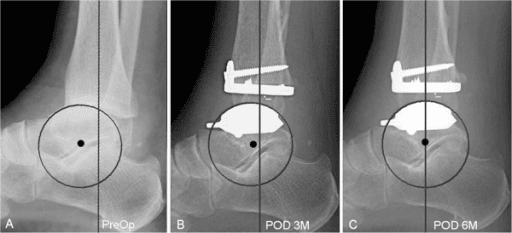
Approach and set-up. Anterior or lateral. The patient is supine with a bump under the ipsilateral hip and a tourniquet at the thigh.
Ankle Fusion Steps
Anterior approach between tibialis anterior and EHL, or lateral transfibular approach. Protect the superficial peroneal nerve.
Remove all articular cartilage from the tibial plafond and talar dome with curettes, osteotomes or a burr. Fenestrate the subchondral bone. Preserve the overall contour for stability.
Set the foot in the fusion position described under Management. Compare with the opposite side and check the alignment with fluoroscopy.
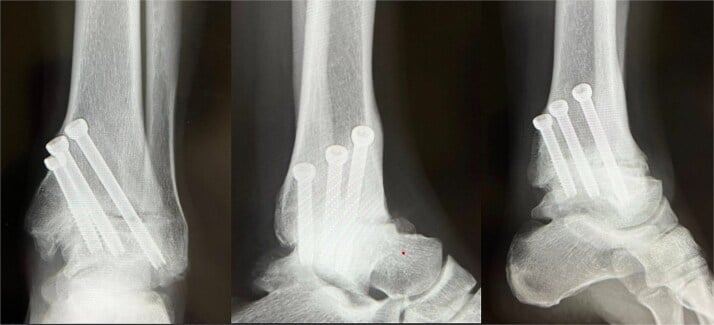
Crossed screws (2-3 large fragment), an anterior plate or an IM nail. Compress the fusion site and confirm the alignment on final fluoroscopy.
Layered closure. Posterior splint in the neutral position. Non-weight bearing initially.
Crossed screws. 6.5-7.3mm cannulated screws, typically two from the anterior tibia into the talus and one from the medial malleolus into the talus.
Complications
Early. Wound complications in 5-10%, infection in 2-5%, DVT and PE, and injury to the superficial peroneal nerve.
Delayed. Non-union (the rate is given under Management), malunion from a positioning error, and prominent or irritating hardware. The risk factors for non-union:
- Smoking (the most significant)
- Diabetes
- AVN of the talus
- Previous infection
- Technical errors
Smoking cessation is mandatory before fusion surgery.
Late. Accelerated OA of the ipsilateral foot, discussed under Outcomes and Prognosis, persistent pain, and stress fractures.
Postoperative Care
Rehabilitation Phases
Non-weight bearing in a posterior splint. Elevation. Wound check at 2 weeks.
Non-weight bearing in a short leg cast. Continue elevation. Serial radiographs.
Protected weight bearing in a CAM boot if union is progressing. Physiotherapy for adjacent joint range of motion.
Wean the boot. Rocker-bottom shoes. Gait training.
Union is assessed with CT if radiographic healing is uncertain, and delayed union may require bone stimulation.
Outcomes and Prognosis
The fused ankle. Stiff but functional. There is some difficulty on uneven ground, which shoe-wear modifications may help.
Why a Fused Ankle Walks Better Than It Should - and Why That Is Also the Problem
Candidates are routinely surprised that abolishing tibiotalar motion leaves gait as good as it does, and the explanation is worth having because it also explains the long-term cost.
The sagittal motion is not lost, it is relocated. After tibiotalar fusion the transverse tarsal (Chopart) joint, the talonavicular and calcaneocuboid articulations, together with the subtalar joint takes over a substantial share of the sagittal arc, so the foot continues to progress from heel strike to toe-off through the midfoot rather than the ankle. Walking speed and stride length on level ground end up close to normal, which is why a well-positioned fusion is compatible with heavy work and why "the patient will never walk properly again" is the wrong thing to tell them.
Two consequences follow directly.
- Position becomes everything. The compensation only works from a neutral starting point, which is why fusing in equinus produces a back-knee (genu recurvatum) thrust and why the fusion position given under Management matters. A malpositioned fusion removes the compensation and the gait really does deteriorate.
- The compensation is the mechanism of adjacent-joint arthritis. The midfoot and subtalar joints absorb load and motion they were not designed for, over decades. At a mean of 22 years after fusion, Coester found the ipsilateral subtalar, talonavicular and calcaneocuboid joints significantly more arthritic than the contralateral side, while the knee was not affected: the loading is transmitted distally, not proximally.
The trade-off to state in a viva is therefore not that fusion is stiff and replacement moves. It is that fusion exports the motion to the foot and eventually wears it out, while replacement retains the motion at the ankle and accepts an implant that may need revising, and the population-level data bear this out precisely, with fusion carrying the higher rate of subsequent subtalar fusion and replacement the higher rate of revision.
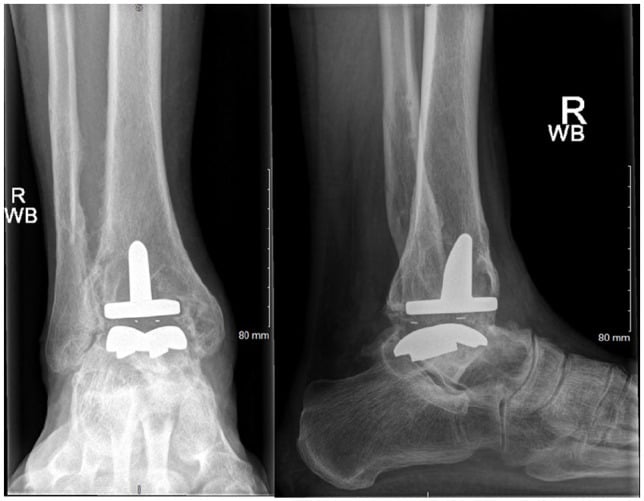
The replaced ankle. Gait kinematics are better and ankle motion is preserved compared with fusion, and the quality-of-life improvement at one year is equivalent (TARVA). Global registry survival is about 80-91% at 5 years and 66-84% at 10 years (Perry), and the reoperation and revision rate is higher than after fusion, which is why patient selection is critical.
Head-to-head evidence. The comparison rests on four studies:
- TARVA RCT (2023, 303 patients): no statistically significant difference in the primary walking/standing score at 52 weeks; both arms improved quality of life. A post-hoc analysis favoured fixed-bearing TAR over fusion. Quote the endpoint as well as the result, because a 52-week outcome cannot measure the two things that actually separate these operations: implant survivorship and adjacent-joint arthritis both declare themselves over 10 to 20 years, not one. TARVA establishes that a patient is not worse off in the first year either way; the long-term trade-off still rests on registry and cohort data.
- COFAS prospective multicentre cohort (Daniels, 2014): comparable intermediate-term clinical scores, but higher reoperation (17% vs 7%) and major-complication (19% vs 7%) rates after TAR at a mean 5.5 years.
- Population data (SooHoo, 2007): major revision 9% at 1 year and 23% at 5 years after TAR, against 5% and 11% after fusion.
- STAR pivotal trial (Saltzman, 2009): TAR non-inferior to fusion for overall success, with equivalent pain relief and better function but more secondary procedures.
The choice between fusion and TAR depends on patient factors (age, demand, deformity, bone stock, deltoid competence) and surgeon experience.
Guidelines, Registries & Global Practice
Global epidemiology. Symptomatic ankle OA is far less common than knee or hip OA, and unlike those joints it is predominantly post-traumatic. In Valderrabano's series of 406 end-stage ankles, 78% were post-traumatic, 13% secondary and only 9% primary. The latency from ankle fracture to end-stage OA is long (mean ~21 years), so the disease burden falls on a relatively young, working-age population - and its disability is at least as severe as end-stage hip OA (Glazebrook).
Guidance compared, side by side:
- Position
- Both ankle fusion and TAR are recognised options for end-stage ankle OA; shared decision-making, with TAR favoured for older, lower-demand patients and fusion for high-demand or major-deformity cases
- Evidence base
- Informed by the TARVA RCT and UK practice
- Position
- No single mandated procedure; emphasise patient selection (alignment, bone stock, deltoid, demand). Arthrodesis remains the durable reference standard, TAR an accepted motion-preserving alternative
- Evidence base
- Level II-III comparative and registry data
- Position
- Technique-focused: anatomical fracture reduction to prevent post-traumatic OA; for end-stage disease, rigid compression arthrodesis (screw/plate/nail) or arthroscopic fusion in suitable joints
- Evidence base
- Expert consensus + biomechanical data
- Position
- TAR uptake higher in parts of Europe; supramalleolar osteotomy promoted for malaligned early/intermediate OA as a joint-preserving option
- Evidence base
- Cohort and registry evidence
Registry evidence. Pooled national arthroplasty registries (AOANJRR Australia, NZ Joint Registry, Norwegian and Swedish registries) show primary TAR survival of about 80-91% at 5 years and 66-84% at 10 years, with consistently higher survival in Australia and New Zealand than in Norway and Sweden (Perry et al., 2022). Population-level discharge data (SooHoo) and the COFAS prospective cohort (Daniels) both confirm higher reoperation rates after TAR than after fusion, balanced against a lower rate of subsequent subtalar fusion after TAR.
Practice variation. TAR uptake is highly variable internationally - higher in well-resourced arthroplasty centres with established revision pathways, and lower in limited-resource settings where arthrodesis (often without expensive implants) remains the default for cost, durability and lower revision-infrastructure requirements. In high-demand manual labourers and in any setting where revision capability is limited, fusion is generally preferred worldwide. Smoking cessation is a universal, evidence-based prerequisite for fusion regardless of health system, given its strong effect on non-union risk.
MCQ Practice Points
- Post-traumatic aetiology: 78% most common (Valderrabano); primary OA only 9%
- Latency from fracture to end-stage OA: mean ~21 years
- Fusion: radiographic non-union ~12%, symptomatic ~7% (TARVA)
- TAR registry survival: ~80-91% at 5 years, 66-84% at 10 years (Perry)
- Accelerated ipsilateral foot OA after fusion at 22 years (Coester)
- Fusion position: neutral DF, 5 degrees valgus, 5-10 degrees ER, posterior translation
- Etiology of ankle OA (post-traumatic predominance)
- Fusion vs TAR indications
- Optimal fusion position
- TAR contraindications
- Complications (nonunion risk factors)
- Adjacent joint arthritis incidence
- Post-traumatic OA pathophysiology
- Subtalar arthritis (hindfoot pain, different motion loss)
- Ankle instability (positive drawer, talar tilt)
- Osteochondral lesion (may be early cause)
- Inflammatory arthritis (symmetrical, systemic features)
Q: What is the most common aetiology of ankle osteoarthritis? A: Post-traumatic - 78% in Valderrabano's series, unlike the hip and knee where primary OA predominates. Only about 9% of end-stage ankle OA is primary/idiopathic.
Q: What is the optimal fusion position for ankle arthrodesis? A: Neutral dorsiflexion, 5 degrees valgus, 5-10 degrees external rotation, and slight posterior translation of the talus.
Q: What is the implant survivorship for modern total ankle replacement? A: Global registries (Perry, 2022) report about 80-91% at 5 years and 66-84% at 10 years, varying by country - quote registry figures, not single-centre best cases.
Q: What deformity threshold is a relative contraindication for TAR? A: Greater than 15-20 degrees varus or valgus deformity, as it affects implant longevity and function.
Q: What happens to adjacent joints after ankle fusion? A: Coester (JBJS 2001) showed accelerated ipsilateral foot OA at a mean 22 years - subtalar, talonavicular and calcaneocuboid joints significantly more arthritic than the contralateral side, while the knee is spared.
Exam Cheat Sheet
Key Numbers
- Post-traumatic: 78% (primary OA only 9%)
- Fusion non-union: ~12% radiographic, ~7% symptomatic
- TAR registry survival: 80-91% at 5yr, 66-84% at 10yr
- Accelerated ipsilateral foot OA at 22 years post-fusion
Fusion Position (Critical)
- Neutral dorsiflexion
- 5 degrees hindfoot valgus
- 5-10 degrees external rotation
- Slight posterior translation
TAR Contraindications
- Severe deformity greater than 15-20 degrees
- Talar AVN
- Peripheral neuropathy
- Young, high-demand patients
TAR Ideal Candidate
- Age greater than 55 years
- Lower demand activity
- Neutral alignment
- Intact deltoid ligament
Exam Traps
- Recommending TAR for severe varus
- Wrong fusion position
- Not knowing post-traumatic predominance
- Operating on active smoker
Exam Viva Scenarios
Practise clinical reasoning and management decisions out loud
“A 58-year-old woman presents with end-stage ankle arthritis following an ankle fracture 20 years ago. She has 15 degrees of varus deformity. She works as a receptionist and wants to return to walking for exercise. What are her surgical options?”
“A 65-year-old retired man presents with ankle arthritis and neutral alignment. His subtalar joint has good motion. He is a non-smoker with well-controlled diabetes. He wants to maintain ankle motion for recreational golf. Would you consider TAR?”
“A patient returns 4 months after ankle fusion with persistent pain. X-rays show incomplete union at the fusion site. He is a smoker. How would you manage this?”
Evidence Base
TARVA: TAR vs Arthrodesis RCT
- No significant difference in primary walking/standing outcome at 1 year
- Wound-healing (13.4% vs 5.7%) and nerve injury (4.2% vs under 1%) higher after TAR
- Radiographic fusion non-union 12.1% but only 7.1% symptomatic
- Post-hoc: fixed-bearing TAR favoured over fusion
Global Registry TAR Survival
- 5-year survival 80-91%
- 10-year survival 66-84%
- Between-country variation widens with time
- Even at 5 years over 80% revision-free survival
COFAS: Intermediate-term TAR vs Fusion
- Comparable patient-reported outcome scores
- Higher reoperation rate after TAR (17% vs 7%)
- Higher major complication rate after TAR (19% vs 7%)
- Treatment tailored to patient presentation
Reoperation: Population-level Data
- TAR higher major revision (HR 1.93)
- Fusion higher subsequent subtalar fusion (HR for TAR 0.28)
- TAR higher device-related infection
- Trade-off: revision risk vs adjacent-joint salvage
Adjacent Joint OA After Fusion
- Accelerated ipsilateral foot OA at 22 years
- Subtalar and talonavicular most affected
- Knee not significantly affected
- Longest follow-up series of ankle fusion
Post-traumatic Aetiology Predominance
- 78% post-traumatic
- Only 9% primary OA
- 13% secondary
- Varus alignment predominates
Optimal Fusion Position (Gait Study)
- Neutral dorsiflexion essential
- 0-5 degrees valgus (not varus)
- 5-10 degrees external rotation
- Posterior talar translation reduces knee stress
Disability Equivalent to Hip OA
- Ankle OA as disabling as hip OA
- All SF-36 subscales ~2 SD below normal
- Worse mental component than hip OA
- Justifies aggressive treatment of end-stage disease
References
- Valderrabano V, Horisberger M, Russell I, Dougall H, Hintermann B. Etiology of ankle osteoarthritis. Clin Orthop Relat Res. 2009;467(7):1800-1806. PMID: 18830791. doi:10.1007/s11999-008-0543-6
- Saltzman CL, Mann RA, Ahrens JE, et al. Prospective controlled trial of STAR total ankle replacement versus ankle fusion: initial results. Foot Ankle Int. 2009;30(7):579-596. PMID: 19589303. doi:10.3113/FAI.2009.0579
- Coester LM, Saltzman CL, Leupold J, Pontarelli W. Long-term results following ankle arthrodesis for post-traumatic arthritis. J Bone Joint Surg Am. 2001;83(2):219-228. PMID: 11216683. doi:10.2106/00004623-200102000-00009
- Buck P, Morrey BF, Chao EY. The optimum position of arthrodesis of the ankle. A gait study of the knee and ankle. J Bone Joint Surg Am. 1987;69(7):1052-1062. PMID: 3654697
- Glazebrook M, Daniels T, Younger A, et al. Comparison of health-related quality of life between patients with end-stage ankle and hip arthrosis. J Bone Joint Surg Am. 2008;90(3):499-505. PMID: 18310699. doi:10.2106/JBJS.F.01299
- Goldberg AJ, Chowdhury K, Bordea E, et al. Total ankle replacement versus ankle arthrodesis for patients aged 50-85 years with end-stage ankle osteoarthritis: the TARVA RCT. Health Technol Assess. 2023;27(5):1-80. PMID: 37022932. doi:10.3310/PTYJ1146
- Daniels TR, Younger AS, Penner M, et al. Intermediate-term results of total ankle replacement and ankle arthrodesis: a COFAS multicenter study. J Bone Joint Surg Am. 2014;96(2):135-142. PMID: 24430413. doi:10.2106/JBJS.L.01597
- Perry TA, Silman A, Culliford D, et al. Survival of primary ankle replacements: data from global joint registries. J Foot Ankle Res. 2022;15(1):33. PMID: 35524275. doi:10.1186/s13047-022-00539-2
- SooHoo NF, Zingmond DS, Ko CY. Comparison of reoperation rates following ankle arthrodesis and total ankle arthroplasty. J Bone Joint Surg Am. 2007;89(10):2143-2149. PMID: 17908889. doi:10.2106/JBJS.F.01611
- Horisberger M, Valderrabano V, Hintermann B. Posttraumatic ankle osteoarthritis after ankle-related fractures. J Orthop Trauma. 2009;23(1):60-67. PMID: 19104305. doi:10.1097/BOT.0b013e31818915d9
- Easley ME, Vertullo CJ, Urban WC, Nunley JA. Total ankle arthrodesis. J Am Acad Orthop Surg. 2002;10(3):157-167. PMID: 12041937
- Gougoulias NE, Agathangelidis FG, Parsons SW. Arthroscopic ankle arthrodesis. Foot Ankle Int. 2007;28(6):695-706. PMID: 17592700
- Takakura Y, Tanaka Y, Kumai T, Tamai S. Low tibial osteotomy for osteoarthritis of the ankle. Results of a new operation in 18 patients. J Bone Joint Surg Br. 1995;77(1):50-54. PMID: 7822395
- Goldberg AJ, Bordea E, Chowdhury K, et al. Cost-utility analysis of total ankle replacement compared with ankle arthrodesis: the TARVA study. Pharmacoecon Open. 2024;8(2):235-249. PMID: 38189868. doi:10.1007/s41669-023-00449-4
- Horisberger M, Hintermann B, Valderrabano V. Alterations of plantar pressure distribution in posttraumatic end-stage ankle osteoarthritis. Clin Biomech (Bristol). 2009;24(3):303-307. PMID: 19150745. doi:10.1016/j.clinbiomech.2008.12.005
- Kellgren JH, Lawrence JS. Radiological assessment of osteo-arthrosis. Ann Rheum Dis. 1957;16(4):494-502. PMID: 13498604. doi:10.1136/ard.16.4.494