Developmental Acetabular Deficiency | Progressive Arthritis | Joint-Preserving vs Arthroplasty
- Lateral CEA less than 25° = acetabular dysplasia (Wiberg angle)
- Periacetabular osteotomy (PAO) = gold standard joint preservation in young adults
- True acetabulum must be identified in Crowe III-IV for component placement
- Femoral shortening required in Crowe II-IV to avoid nerve stretch injury
- High hip center increases revision risk - restore anatomy when possible
- “DDH is the leading cause of hip arthritis in young women
- “Tönnis angle greater than 10° indicates lateral acetabular deficiency
- “Hartofilakidis classification focuses on acetabular development (preferred by some)
- “Shelf procedures augment lateral coverage but do not reorient acetabulum
Overview and Epidemiology
Adult hip dysplasia is acetabular underdevelopment carried over from infancy or childhood: the socket never grew to cover the head, and the result is progressive instability and premature osteoarthritis. It is often undiagnosed in infancy and declares itself in early adulthood, once it becomes painful.
Why it matters. DDH is the leading cause of hip arthritis in women under 40, and about 10% of total hip arthritis in young adults is dysplastic in origin. Recognised early, the hip can be preserved with a periacetabular osteotomy before the cartilage damage becomes irreversible; missed, it ends in arthroplasty in the third or fourth decade, with the high revision burden that an early THA carries.
Who. Women outnumber men 9:1, due to hormonal laxity, and the painful subluxation presents at 20-40 years. Prevalence is higher in First Nations and Southern European populations. The contralateral hip is dysplastic in 20-30%, so the radiograph is always of the whole pelvis and never of the symptomatic side alone; when both hips need a PAO, the operations may be staged 6-12 months apart.
Natural history. Left untreated, 50-75% have developed arthritis by the age of 50, and the functional limitation is already significant in the third decade.
Anatomy and Pathophysiology
The cascade. A shallow acetabulum concentrates load on a smaller area of cartilage. Contact stress rises, the rim is overloaded, the labrum tears, cartilage is lost progressively and arthritis arrives early. The lateral centre-edge angle is the measure of that coverage, and once it falls under 25° the contact stress on the remaining cartilage doubles.
- Normal Hip
- 25-40°
- Dysplastic Hip
- Under 25°
- Consequence
- Increased joint reactive force
- Normal Hip
- 0-10°
- Dysplastic Hip
- Greater than 10°
- Consequence
- Lateral instability and migration
- Normal Hip
- 15-20°
- Dysplastic Hip
- Often greater than 25°
- Consequence
- Anterior instability, labral damage
- Normal Hip
- 500-600 mm²
- Dysplastic Hip
- Under 300 mm²
- Consequence
- Doubled or tripled contact stress
The labrum. Anterosuperior labral tears are present in 90% of symptomatic dysplastic hips. Chronic edge loading makes the labrum hypertrophic, it degenerates within its substance, and in long-standing disease it ossifies.
The capsule. Capsular laxity contributes to the instability and the capsule becomes redundant in chronic subluxation; in the Crowe IV hip it is adherent within the false acetabulum. The ligamentum teres is hypertrophic.
Classification Systems
Three systems answer three different questions. Crowe describes how far the femoral head has migrated, Hartofilakidis describes what has become of the acetabulum, and Tönnis grades the arthritis that decides whether the joint can still be preserved.
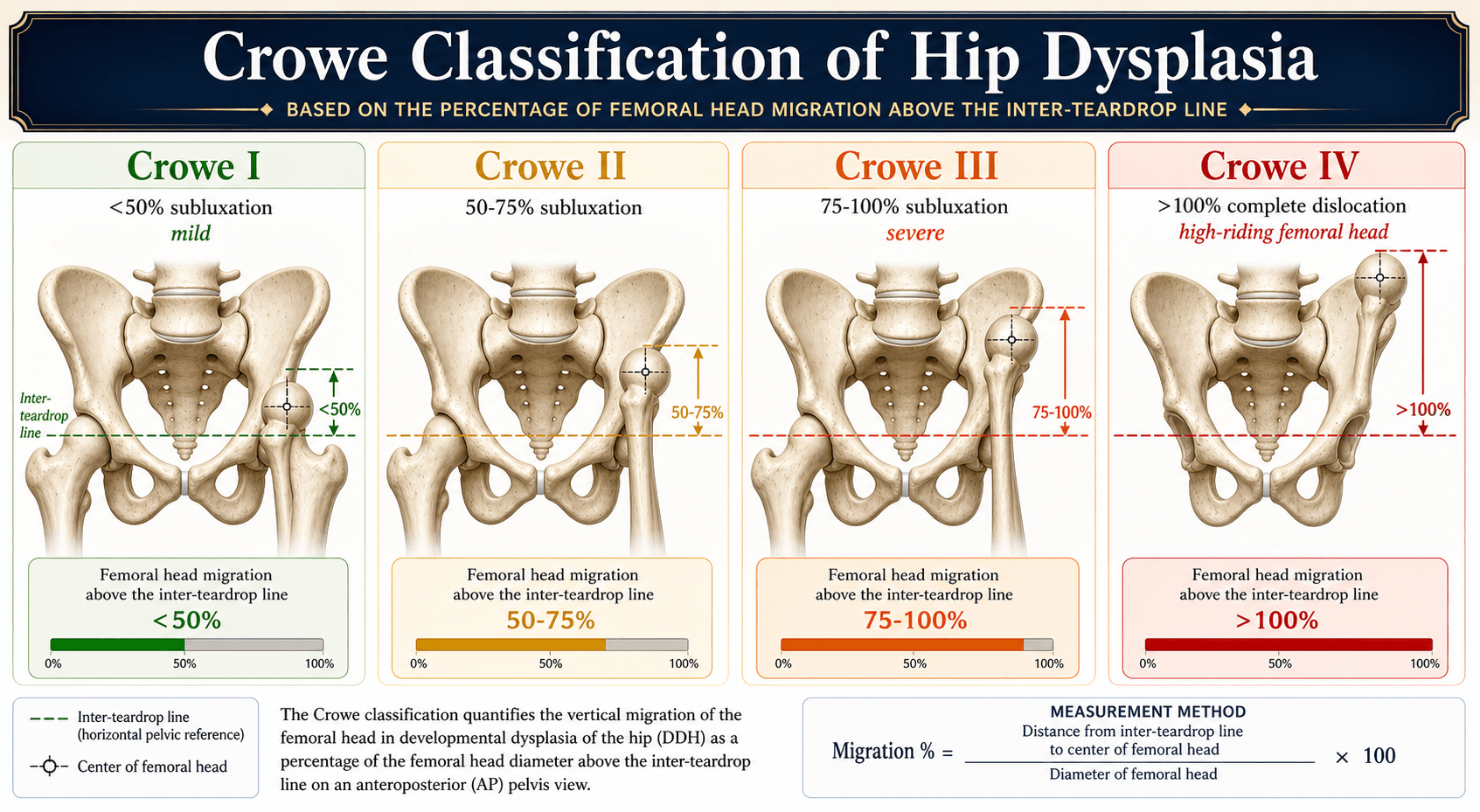
Crowe Classification (Most Common)
Crowe grades the superior migration of the femoral head on an AP pelvis radiograph. The grade tells the arthroplasty surgeon how far the hip has to be brought down and whether the femur will have to be shortened to get it there.
- Femoral Head Position
- Under 50% superior migration, mostly in socket
- Acetabular Development
- Shallow but identifiable acetabulum
- Treatment Implications
- Standard THA or PAO possible
- Femoral Head Position
- 50-75% migration, at level of acetabular rim
- Acetabular Development
- Moderate deficiency, true acetabulum visible
- Treatment Implications
- THA requires shortening or high hip centre
- Femoral Head Position
- 75-100% migration, above acetabulum
- Acetabular Development
- Severely deficient, false acetabulum forming
- Treatment Implications
- Subtrochanteric osteotomy for anatomic placement
- Femoral Head Position
- Complete dislocation, no contact with true socket
- Acetabular Development
- Rudimentary acetabulum, well-developed false socket
- Treatment Implications
- Complex reconstruction with bone grafting
Measure proximal migration of the femoral head-neck junction, NOT the centre of the head — this is the single most commonly misquoted step.
- Draw the interteardrop line, connecting the inferior margins of both acetabular teardrops. This is the baseline, so identifying the teardrop reliably is the first task.
- Find the head-neck junction on the dysplastic side.
- Drop a perpendicular from the interteardrop line to that junction — this is the migration distance.
- Divide it by the femoral head height (the vertical diameter on the normal side; if bilateral, estimate from femoral shaft width or pelvic proportions).
Two equivalent ways of quoting the thresholds, which is why the numbers look inconsistent between sources — say which one you are using:
- As % of femoral head height
- under 50%
- As a fraction of pelvic height
- under 0.10
- As % of femoral head height
- 50-75%
- As a fraction of pelvic height
- 0.10-0.15
- As % of femoral head height
- 75-100%
- As a fraction of pelvic height
- 0.15-0.20
- As % of femoral head height
- over 100%
- As a fraction of pelvic height
- over 0.20
Both need a well-positioned standing AP pelvis with both hips adequately exposed; rotation or pelvic tilt shifts the teardrops and invalidates the measurement.
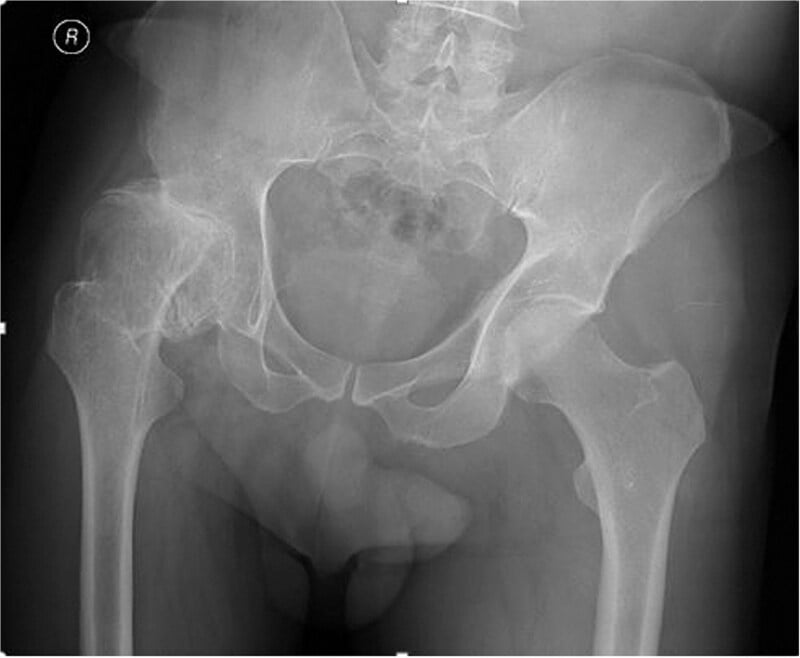
Clinical Assessment
History. The complaint is groin pain, anterior or anterolateral, worse with activity. Clicking or catching points to labral pathology, and a sensation of subluxation or giving way to instability. Ask about hip screening, bracing or surgery in childhood, and about DDH in relatives, because there is a genetic component.
Gait and length. Watch the patient walk before anything else. A Trendelenburg gait, the trunk shifting over the stance leg because the abductors are insufficient, is the finding to look for, and the Trendelenburg test (the pelvis drops on the opposite side) is positive in 40-60% of symptomatic DDH; abductor strength is often weak from the disturbed lever arm. In high dislocation the limb is apparently short from pelvic tilt, so measure both true length (ASIS to medial malleolus) and apparent length (umbilicus to malleolus).
Movement. Range is usually preserved early (flexion normally 120° or more, abduction 45°, adduction 30°) and falls as arthritis develops; loss of internal rotation is often the first sign of arthritis. Document the range, because it feeds the PAO-versus-THA decision.
Provocative tests. The FADIR test (flexion-adduction-internal rotation) reproduces anterior pain from impingement or an anterosuperior labral tear; the FABER test (flexion-abduction-external rotation) looks for posterior impingement or the sacroiliac joint. Apprehension or a clunk in flexion-abduction-external rotation is the sign of instability.
Differential Diagnosis of the Painful Young Adult Hip
- Distinguishing features
- Activity-related groin pain, instability sense, female predominance
- Key radiographic / imaging finding
- Lateral CEA under 25°, Tönnis angle over 10°, broken Shenton's line
- Pitfall
- Borderline CEA 20-25° easily missed
- Distinguishing features
- Pain with deep flexion and pivoting, positive FADIR, often male (cam)
- Key radiographic / imaging finding
- Alpha angle over 55°, crossover/posterior wall signs; CEA normal or high (pincer)
- Pitfall
- Dysplasia and impingement can coexist; do not over-resect the rim
- Distinguishing features
- Instability symptoms; apprehension; anteverted femur
- Key radiographic / imaging finding
- CEA 18-25° with femoral version 20° or more on CT
- Pitfall
- Isolated arthroscopy gives inferior results — consider PAO/femoral osteotomy
- Distinguishing features
- Mechanical clicking/catching, positive FADIR, no global instability
- Key radiographic / imaging finding
- Labral tear on MR arthrogram with normal CEA and version
- Pitfall
- Treating the labrum alone fails if underlying dysplasia is unrecognised
- Distinguishing features
- Rest and night pain, stiffness, loss of internal rotation
- Key radiographic / imaging finding
- Joint-space loss, osteophytes, subchondral cysts (Tönnis 2-3)
- Pitfall
- Mislabels an arthritic hip as a PAO candidate
- Distinguishing features
- Childhood hip history, deformity, leg-length difference
- Key radiographic / imaging finding
- Coxa magna/plana, residual subluxation, proximal femoral deformity
- Pitfall
- May need femoral as well as acetabular correction
Investigations
Radiographs. The first study is a weight-bearing AP pelvis with the coccyx centred over the pubic symphysis. On it measure the lateral centre-edge angle and the Tönnis angle and grade the arthritis; a false profile view adds the anterior centre-edge angle, and an anterior CEA under 20° is anterior deficiency. The thresholds are in the table below.
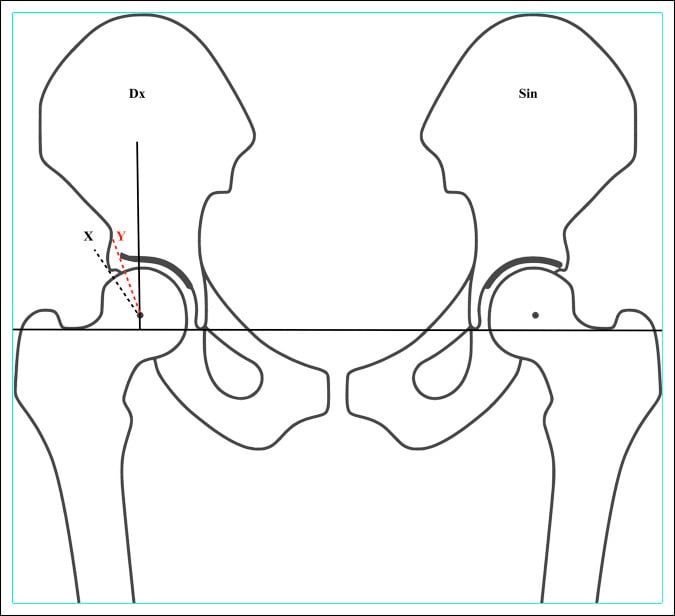
- Normal Range
- 25-40°
- Dysplasia Threshold
- Under 25°
- Clinical Significance
- Primary diagnostic criterion for lateral dysplasia
- Normal Range
- 0-10°
- Dysplasia Threshold
- Greater than 10°
- Clinical Significance
- Measures acetabular slope - predicts progression
- Normal Range
- Greater than 20°
- Dysplasia Threshold
- Under 20°
- Clinical Significance
- Anterior deficiency requires specific PAO correction
- Normal Range
- Under 40°
- Dysplasia Threshold
- Greater than 43°
- Clinical Significance
- Alternative measure of lateral deficiency
CASTRadiographic Assessment of Hip Dysplasia
Hook:CAST your assessment on plain films - these 4 measurements determine treatment!
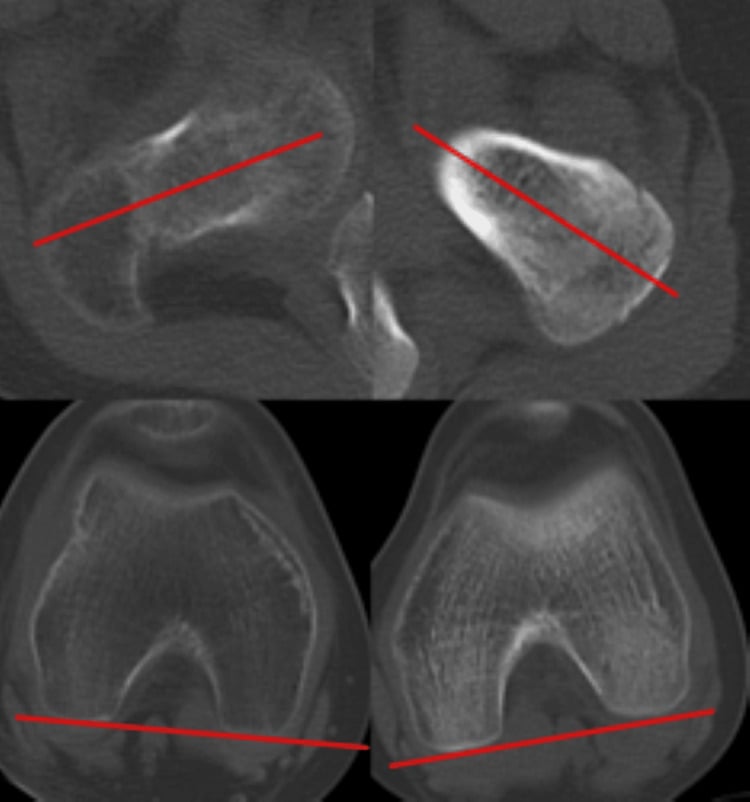
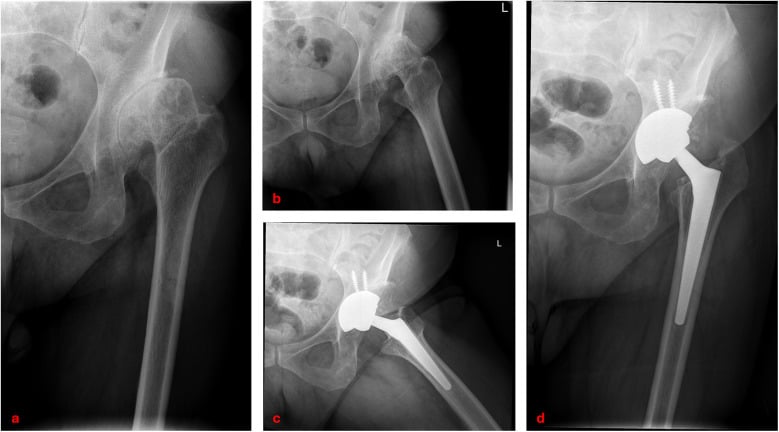
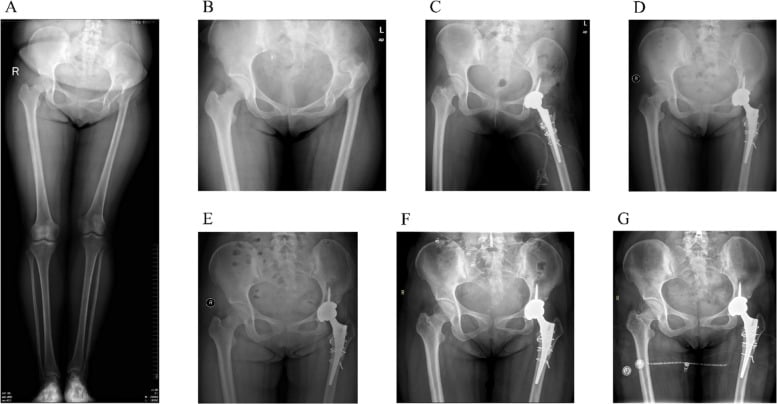
CT. A 3D CT of the pelvis is the planning study for PAO or THA. It gives acetabular version, the bony defects and, in Crowe III-IV, the location of the true acetabulum, and it allows templating and virtual correction.
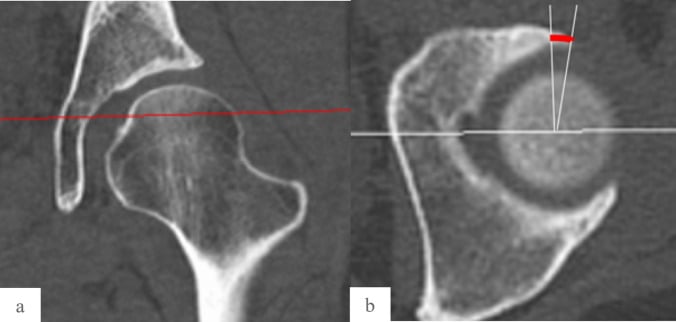
MRI arthrogram. The gold standard for labral pathology, with a sensitivity over 90% for tears. It also grades the cartilage (Outerbridge), which is what decides PAO candidacy or the need for arthroscopy.
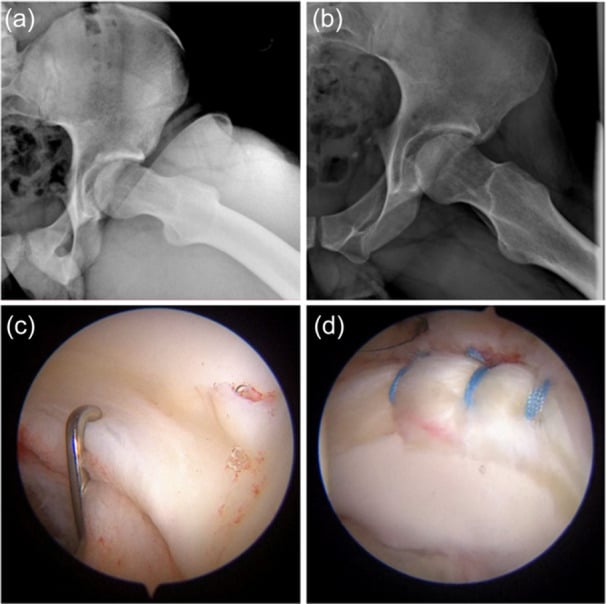
Diagnostic arthroscopy. In the equivocal PAO candidate, arthroscopy looks at the cartilage directly: Outerbridge grade 3-4 change means a poor PAO candidate. A labral tear can be addressed at the time of PAO, staged or simultaneous.
The hardest decision is the borderline hip (lateral CEA 20-25°), where the question is not "is it dysplastic?" but "is it unstable?" — because an unstable borderline hip does poorly with isolated arthroscopy and capsulotomy and needs reorientation (PAO), whereas a truly stable one may be managed more like impingement. The Femoro-Epiphyseal Acetabular Roof (FEAR) index helps quantify this: it is the angle between a line along the acetabular sourcil (weight-bearing roof) and a line along the femoral physeal scar on a standing AP pelvis. A high/positive FEAR index (commonly cited as more than 5°, roof inclined laterally) predicts an unstable hip that favours PAO; a low or negative index suggests stability. Supporting instability signs are a broken Shenton's line, a high Tönnis angle and iliocapsularis hypertrophy — the iliocapsularis works overtime to stabilise an uncovered head, so on MRI/CT it becomes thicker than the rectus femoris. The trap to avoid: never offer isolated hip arthroscopy with capsulotomy to an unstable borderline hip, because it can precipitate frank instability or even dislocation.
Management Algorithm
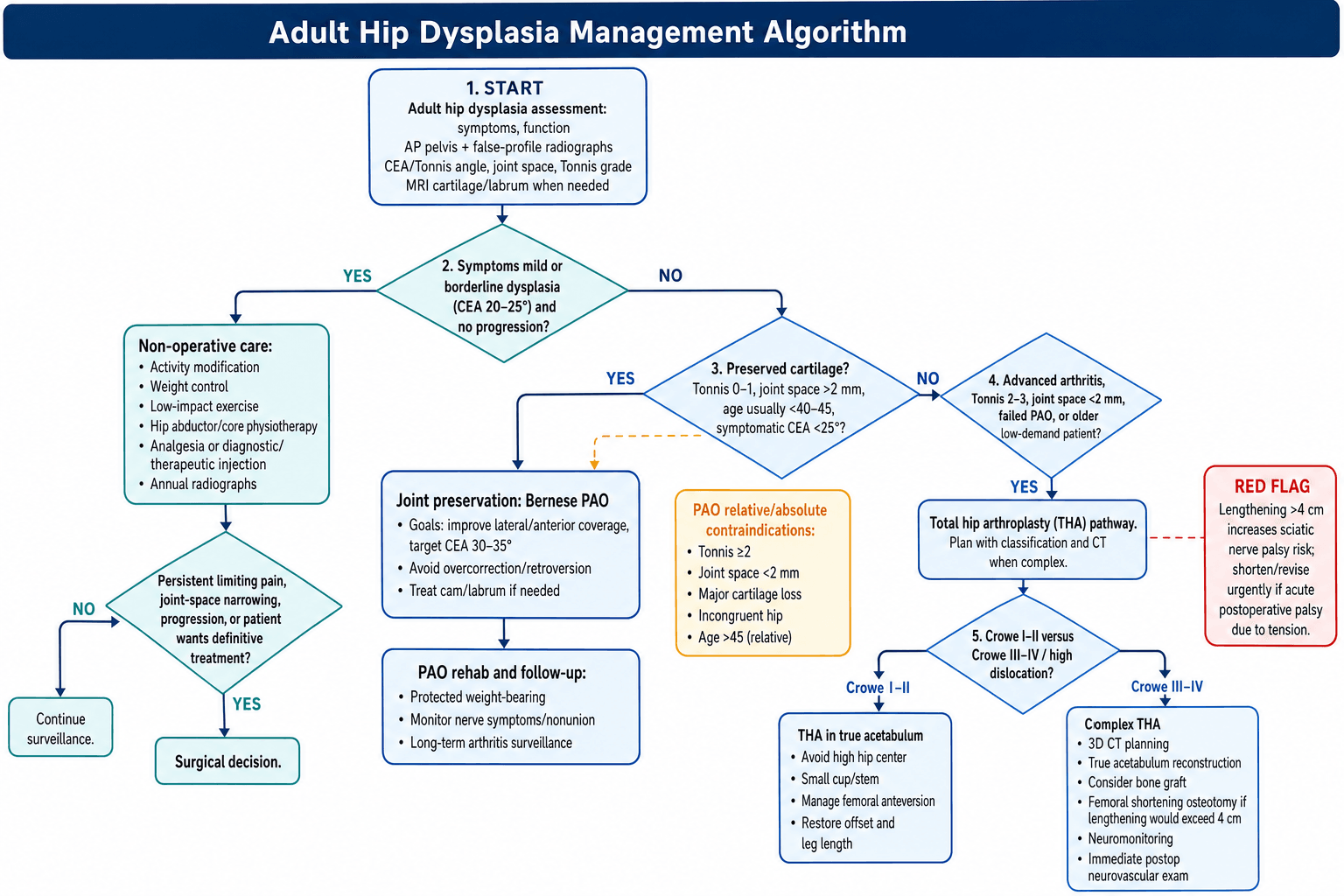
The decision turns on two things: the state of the cartilage and the age of the patient. Preserve the joint while the cartilage allows it; replace it, anatomically, when it does not.
- Crowe Grade
- I (under 50% subluxation)
- Treatment
- Periacetabular osteotomy (PAO)
- Key Pearl
- Reorients acetabulum - best long-term preservation
- Crowe Grade
- I-II (50-75% subluxation)
- Treatment
- Consider PAO if Tönnis grade under 2
- Key Pearl
- Success depends on remaining cartilage quality
- Crowe Grade
- I-II (under 75% subluxation)
- Treatment
- THA - standard technique with small modifications
- Key Pearl
- Restore centre of rotation, avoid high hip centre
- Crowe Grade
- III-IV (over 75% subluxation)
- Treatment
- THA with subtrochanteric shortening osteotomy
- Key Pearl
- Lengthen under 4cm to protect sciatic nerve
Initial Conservative Approach
Who. Patients who are asymptomatic or mildly symptomatic, the borderline hip with a CEA of 20-25°, and older patients who decline surgery.
Conservative Treatment Steps
Avoid high-impact activity (running, jumping). Swimming and cycling maintain fitness without excessive loading. Weight management is critical.
Strengthen the hip abductors (gluteus medius) to compensate for the biomechanical disadvantage, with core stability and pelvic control, and stretch the hip flexors and iliotibial band.
NSAIDs for symptom control, avoiding chronic use, and paracetamol for baseline pain. An intra-articular steroid injection gives temporary relief and confirms an intra-articular source.
Annual radiographs to monitor progression.
When it has failed. Surgery is indicated when pain limits function despite therapy, when the radiographs show progression with loss of joint space or the symptoms worsen, or when the patient wants definitive treatment before the damage becomes irreversible.
Surgical Technique
Bernese Periacetabular Osteotomy - Step by Step
Positioning. Supine on a radiolucent table with the affected hip at the table edge, and C-arm access for AP and lateral views.
PAO Surgical Steps
Incision from the ASIS along the iliac crest. Develop the interval between sartorius (femoral nerve) and tensor fascia lata (superior gluteal nerve), then elevate iliacus subperiosteally off the inner table.
Through the same incision, a curved osteotome directed posteriorly and inferiorly cuts the ischium 10mm medial to the acetabular rim. This cut exits just medial to the acetabulum posteriorly.
A straight osteotome directed medially along the superior pubic ramus, exiting 10mm medial to the acetabular rim anteriorly. Protect the obturator neurovascular bundle with a retractor.
From the AIIS superiorly toward the SI joint (10-15cm), with a curved osteotome under fluoroscopy. The cut is left incomplete posteriorly to keep the posterior column in continuity.
Complete the ischial cut with a Gigli saw passed from intrapelvic to extrapelvic. Mobilise the fragment with Schanz pins and rotate it laterally and anteriorly to increase coverage.
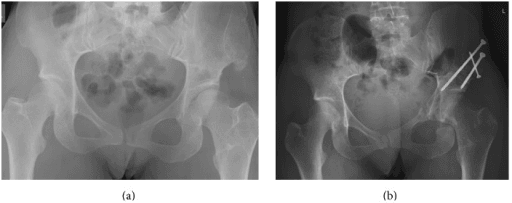
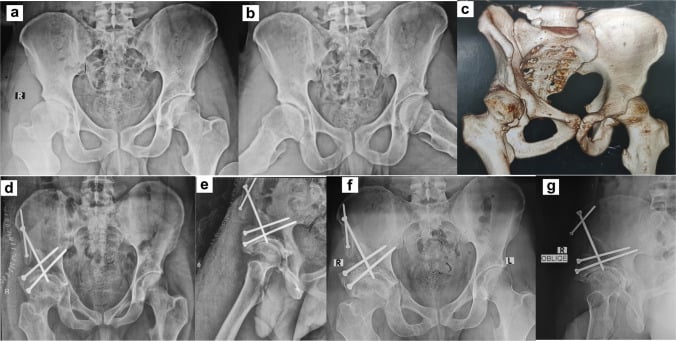
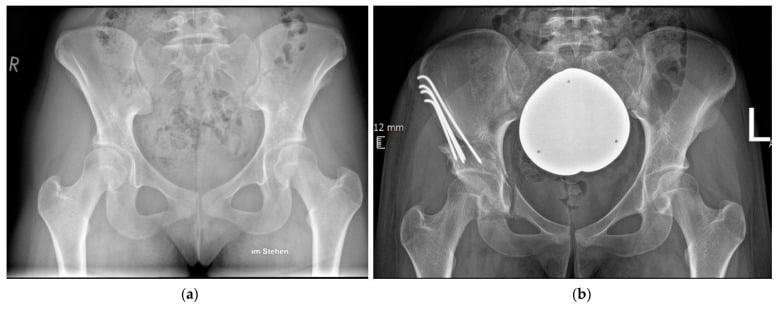
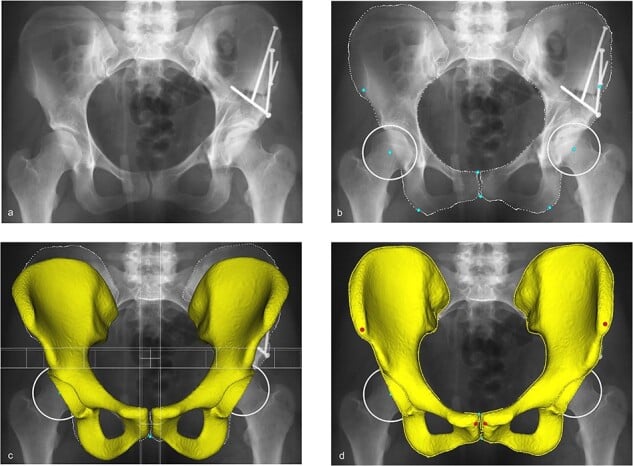
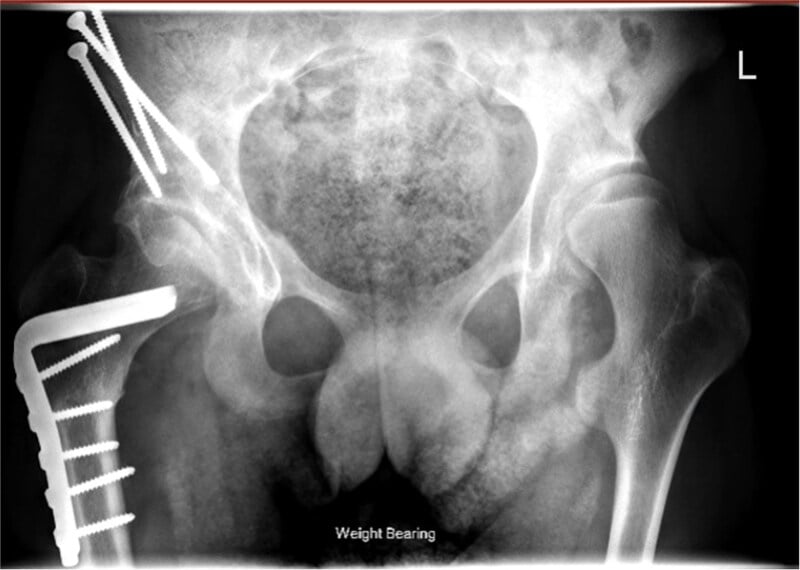
Fix with 3-4 cortical screws from the ilium into the mobilised fragment. Confirm hip congruity and the improved CEA on fluoroscopy.
Final lateral CEA should be 30-35° - adequate correction without overcorrection. Tönnis angle should be 0 to negative 5°. Confirm hip remains congruent through full ROM.
"Avoid overcorrection" has a measured threshold and a large effect size, which is why it is a target rather than a preference. In 154 hips followed a mean of 10.3 years, a postoperative lateral CEA over 38° raised the risk of failure eightfold (OR 8.04) — overcoverage converts a dysplastic hip into an impinging one. Two other findings from the same cohort belong beside it: fair or poor preoperative joint congruency carried a similar penalty (OR 8.65), and concurrent head-neck osteochondroplasty was protective (OR 0.27), which is the evidence behind addressing cam morphology at the same sitting rather than leaving it. Level IV, single high-volume centre.
The longer-term series adds iatrogenic acetabular retroversion (HR 4.8) and anterior overcoverage beyond 27% (HR 3.2) to the list of technical errors that predict failure at 30 years. So the correction is bounded on both sides: too little leaves the dysplasia, too much creates impingement, and the direction of the correction matters as much as its magnitude.
Complications
- Incidence
- 1-5% (up to 10% in Crowe IV)
- Risk Factors
- Lengthening over 4cm, inadequate shortening
- Management
- Usually neurapraxia - observation, PT, may recover 6-18 months
- Incidence
- 10-15%
- Risk Factors
- Smith-Petersen approach, excessive retraction
- Management
- Usually temporary dysesthesia, resolves 3-6 months
- Incidence
- 2-5%
- Risk Factors
- Smoking, inadequate fixation, bone quality
- Management
- ORIF with bone graft and plate if symptomatic
- Incidence
- 1-5%
- Risk Factors
- Osteotomy extends into joint
- Management
- Convert to THA if severe; ORIF if minimal displacement
- Incidence
- 5-10% (higher in DDH)
- Risk Factors
- High hip centre, component malposition, laxity
- Management
- Closed reduction, brace, revision if recurrent
- Incidence
- 15-25% at 15 years
- Risk Factors
- High hip centre, inadequate bone stock, young age
- Management
- Revision THA with bone grafting
- Incidence
- 10-20%
- Risk Factors
- Extensive dissection, male gender
- Management
- Prophylaxis with indomethacin or radiation
Immediate postoperative foot drop or numbness after THA in high dislocation = sciatic palsy. Document exam pre-closure. If noted immediately, consider shortening revision urgently (within 24-48 hours) to decompress nerve.
Postoperative Care and Rehabilitation
PAO Recovery Timeline
Touch weight-bearing with crutches. DVT prophylaxis (enoxaparin or rivaroxaban), multimodal analgesia and early mobilisation to prevent stiffness.
Touch to 25% weight-bearing on crutches, with gentle hip range-of-movement exercises but no active hip flexion against gravity, which protects the iliopsoas. Watch for signs of nonunion.
Increase to full weight-bearing if the radiographs show healing. Formal physiotherapy for abductor strengthening, progressing to a single crutch and then a cane, and a return to the activities of daily living.
Full weight-bearing without aids, progressing to impact activity. Return to work at 6-8 weeks for a desk job and 3-4 months for manual work. High-impact sports are delayed to 12 months.
Annual radiographs for 5 years to monitor for progression of arthritis. Low-impact exercise is encouraged. Loss of range or recurrent pain suggests progression.
PAO recovery is long - expect 3-4 months to full function. Patients should be counselled preoperatively. Peak improvement is 12-18 months. Some never regain pre-DDH athletic ability.
Outcomes and Prognosis
PAO Outcomes
- Success Rate
- 85-90%
- Key Determinants
- Preop Tönnis grade 0-1, adequate correction, age under 40
- Success Rate
- 80-85%
- Key Determinants
- Realistic expectations, good cartilage quality, minimal complications
- Success Rate
- 60-70%
- Key Determinants
- Low-impact sports better outcomes than high-impact
What predicts PAO failure. A Tönnis grade of 2 or higher at the time of surgery. A joint space under 2mm, age over 40 and inadequate correction (a final CEA under 25°) also predict a poor outcome.
THA Outcomes in DDH
What helps and what hurts. THA does best in the Crowe I-II hip with an anatomic cup, adequate bone stock, modern implants (highly cross-linked polyethylene) and properly restored leg length. It does worse in Crowe III-IV, with a high hip centre, in patients under 50, with poor bone quality, and when a femoral shortening osteotomy has added its complexity.
Registry signal. Across the major national joint registries, THA performed for developmental dysplasia carries a higher long-term revision burden than THA for primary osteoarthritis, driven mainly by younger age at surgery, severe (Crowe III-IV) dysplasia, a high hip centre and acetabular bone deficiency. Restoring the anatomic centre of rotation, securing durable acetabular fixation and using modern bearings are the principal modifiable factors.
Joint-preservation survivorship at a glance
- Hips preserved (free of THA)
- Approximately 92%
- Source
- Wells/Clohisy (Washington University)
- Key lesson
- Avoid overcoverage; treat concomitant cam
- Hips preserved (free of THA)
- Approximately 60%
- Source
- Steppacher/Siebenrock (Bern)
- Key lesson
- Selection: minimal arthritis, no impingement signs
- Hips preserved (free of THA)
- Approximately 29%
- Source
- Lerch/Siebenrock (Bern)
- Key lesson
- Tönnis grade 2 or more contraindicates PAO
Guidelines, Registries & Global Practice
Global epidemiology
Developmental dysplasia of the hip is the single most important cause of secondary hip osteoarthritis in young adults, particularly women. There is striking geographic and ethnic variation: prevalence is high in populations with traditional swaddling (Eastern Europe, parts of the Mediterranean and the Middle East, some First Nations and Native American groups) and comparatively low in populations who carry infants in abduction. Late-presenting (adolescent and adult) dysplasia is over-represented in regions without universal neonatal hip screening, so a surgeon anywhere in the world should expect a spectrum from subtle borderline dysplasia to neglected Crowe IV high dislocation.
Major guidance, side by side
- Core position on adult DDH
- PAO is the reorientation osteotomy of choice in the skeletally mature dysplastic hip with congruent joint and Tönnis grade 0-1; correct to a lateral CEA in the low-to-mid 30s without overcoverage
- Evidence base
- Long-term originator cohorts (Ganz; Steppacher; Lerch)
- Core position on adult DDH
- Joint preservation (PAO, with arthroscopy or osteochondroplasty for concomitant impingement) for symptomatic dysplasia with preserved cartilage; THA when arthritis is established
- Evidence base
- Multicentre PAO cohorts (Clohisy / ANCHOR group)
- Core position on adult DDH
- No DDH-specific surgical guideline; arthroplasty is governed by general hip-replacement standards emphasising shared decision-making, implant choice supported by registry data and routine registry submission
- Evidence base
- NICE NG157 (joint replacement); National Joint Registry
- Core position on adult DDH
- Standardised description of Bernese PAO and of subtrochanteric shortening for high dislocation; emphasises preserving the posterior column and protecting the sciatic nerve
- Evidence base
- AO surgical reference / instructional material
Registry evidence (arthroplasty)
The major national joint registries — the NJR (England, Wales, NI), AJRR (USA), AOANJRR (Australia), the Swedish (SHAR), Norwegian and New Zealand registries — consistently show that THA for developmental dysplasia revises more often than THA for primary osteoarthritis, with the excess risk concentrated in younger patients, severe (Crowe III-IV) deformity, high hip centres and bone-deficient acetabula. Registries also support uncemented acetabular fixation in good bone and a survival advantage for larger heads and modern cross-linked or ceramic bearings, all of which matter disproportionately in this young, high-demand population. Exact percentages differ between registries and reporting years, so quote the trend (higher revision burden) rather than a single number in a viva.
A common viva pivot is: "This patient could have been screened as a neonate — why are you seeing dysplasia now?" Be ready to discuss variability in neonatal screening, swaddling practices and late presentation, then move to a principle-based plan (preserve if cartilage allows, replace anatomically if it does not) that holds true regardless of health system.
Global practice variation
- 3D CT and software templating available for complex Crowe III-IV planning
- PAO concentrated in high-volume hip-preservation units (learning-curve dependent)
- Modern bearings and modular/uncemented implants routinely available
- Mandatory or near-universal registry submission
- Later presentation; more neglected high dislocations
- Reliance on plain radiographs and intra-operative judgement
- Cemented or basic uncemented constructs; restricted implant inventory
- Subtrochanteric shortening especially valuable where small, low-cost stems must reach the true acetabulum
Regardless of health system, document:
- Preoperative counselling: higher long-term revision burden than THA for primary OA, nerve-injury risk (rising with lengthening, up to 5-10% in high dislocation), and the long PAO recovery (3-4 months to full function)
- Surgical planning: imaging and templating for complex cases, with identification of the true acetabulum
- Informed consent: nerve palsy, dislocation, nonunion/intra-articular fracture (PAO) and the possibility of eventual conversion to THA
- Postoperative monitoring: a documented neurovascular examination immediately after THA in high dislocation
MCQ Practice Points
Q: What is the normal range for the lateral center edge angle (Wiberg angle) and what value indicates dysplasia? A: Normal lateral CEA is 25-40°. A value under 25° indicates acetabular dysplasia. The CEA is measured on AP pelvis radiograph as the angle between a vertical line through the femoral head center and a line from the center to the lateral acetabular edge. It quantifies lateral coverage of the femoral head.
Q: Describe the Crowe classification of developmental hip dysplasia. A: Crowe classification grades DDH based on degree of femoral head superior migration: Type I = subluxation under 50% (head mostly in socket), Type II = 50-75% subluxation (head at rim level), Type III = 75-100% subluxation (head above socket), Type IV = complete dislocation with false acetabulum. Higher grades require femoral shortening to avoid nerve injury during THA.
Q: What are the key indications and contraindications for periacetabular osteotomy (PAO)? A: Indications: Symptomatic acetabular dysplasia (CEA under 25°), age under 40-45 years, minimal arthritis (Tönnis grade 0-1), preserved joint space (over 2mm). Contraindications: Advanced arthritis (Tönnis grade 2-3), inadequate cartilage (Outerbridge 3-4), reduced joint space (under 2mm), age over 45, large osteophytes. PAO success depends on remaining cartilage quality.
Q: What is the safe limit for limb lengthening during THA in dysplastic hips, and what is the risk of exceeding it? A: The safe limit for acute limb lengthening is generally under 4cm. Lengthening beyond this threshold significantly increases the risk of sciatic nerve palsy due to nerve stretch. In Crowe III-IV hips with greater than 4-5cm superior migration, femoral shortening osteotomy should be performed to allow anatomic cup placement without excessive lengthening. Sciatic nerve palsy incidence rises from 1-2% to 5-10% when lengthening exceeds 4cm.
Q: How do THA outcomes in developmental dysplasia compare to primary osteoarthritis? A: THA in DDH has higher revision rates than primary OA. Registry data shows 15-year revision rates of 15-25% for DDH vs 5-10% for OA. Poor prognostic factors include Crowe III-IV classification, young patient age (under 50), high hip center placement, and inadequate bone stock. Modern techniques emphasizing anatomic cup placement and femoral shortening when needed have improved outcomes.
Q: How does long-term joint-preservation survivorship after PAO change with follow-up, and what is the single most important predictor of failure? A: Survivorship free of conversion to THA falls progressively with time: around 92% at 15 years (Wells/Clohisy), about 60% at 20 years and roughly 29% at 30 years in the original Bern cohort (Steppacher, then Lerch). The dominant, consistent predictor of failure across these series is preoperative arthritis - a Tönnis grade of 2 or more is a contraindication. Older age, positive impingement signs, postoperative acetabular retroversion and anterior overcoverage also predict failure.
Exam Viva Scenarios
Practise clinical reasoning and management decisions out loud
“A 32-year-old woman presents with 2 years of progressive left groin pain. Pain is worse with activity and relieved by rest. She has no history of childhood hip problems. Examination shows full ROM but positive FADIR test. AP pelvis radiograph demonstrates lateral CEA of 18°, Tönnis angle of 15°, and Tönnis grade 1 arthritis. What is your assessment and management?”
“A 58-year-old woman requires THA for severe arthritis secondary to DDH. Preoperative radiographs show Crowe type III dysplasia with the femoral head 5cm superior to the true acetabulum. She has a well-developed false acetabulum. Walk me through your surgical planning and technique.”
“You have just completed a THA for Crowe type II dysplasia in a 52-year-old woman. Intraoperative lengthening was approximately 3.5cm. In recovery, she has a complete foot drop and numbness over the dorsum of the foot. How do you manage this?”
Key Measurements
- Lateral CEA under 25° = dysplasia (normal 25-40°)
- Tönnis angle greater than 10° = abnormal slope
- Anterior CEA under 20° = anterior deficiency
- Joint space under 2mm = poor PAO candidate
Crowe Classification
- Type I = under 50% subluxation (in socket) - standard THA or PAO
- Type II = 50-75% subluxation (at rim) - THA with shortening or high center
- Type III = 75-100% subluxation (above socket) - subtrochanteric osteotomy
- Type IV = complete dislocation - complex THA with femoral shortening
Treatment Algorithm
- Age under 40 + Tönnis 0-1 + CEA under 25° = PAO
- Age over 45 or Tönnis 2-3 = THA
- Crowe I-II = standard THA to true acetabulum
- Crowe III-IV = THA with femoral shortening (under 4cm lengthening)
- PAO success = 85-90% at 10 years if well selected
Surgical Pearls
- PAO: reorient acetabulum to CEA 30-35° (avoid overcorrection)
- THA: restore anatomy to true acetabulum, avoid high hip center
- Femoral shortening when lengthening would exceed 4cm
- Neuromonitoring for Crowe III-IV THA
- Long stem to bridge subtrochanteric osteotomy
Complications
- Sciatic nerve palsy: 1-5% (up to 10% in Crowe IV)
- LFCN injury in PAO: 10-15% (usually temporary)
- PAO nonunion: 2-5%
- THA dislocation: 5-10% (higher than primary OA)
- Revision rate: 15-25% at 15 years (vs 7-8% in OA)
Evidence Base and Key Trials
A New Periacetabular Osteotomy for Hip Dysplasia (Bernese PAO — landmark)
- Original description of the Bernese periacetabular osteotomy through a single Smith-Petersen approach
- Allows extensive multiplanar acetabular reorientation without changing true pelvic diameter
- Posterior column left mechanically intact, permitting stable two-screw fixation and early partial weight-bearing
- Mean correction of 31° in the vertical (lateral) centre-edge angle of Wiberg
- Early complications: two intra-articular osteotomies, one transient femoral nerve palsy, one nonunion, heterotopic bone before indomethacin prophylaxis
Intermediate-Term Hip Survivorship and PROMs After PAO (Washington University)
- 154 hips (129 patients) with classic acetabular dysplasia followed a mean of 10.3 years
- Kaplan-Meier hip survival (endpoint THA) was 92% at 15 years; only 8 hips (5%) underwent THA
- Fair or poor preoperative joint congruency raised failure risk (OR 8.65)
- Postoperative lateral CEA over 38° (overcoverage) raised failure risk (OR 8.04)
- Concurrent head-neck osteochondroplasty was associated with reduced failure (OR 0.27)
Mean 20-Year Follow-up of the Bernese PAO
- First 75 hips treated at the originating institution, mean age 29 years, followed a mean of 20.4 years
- 60% of hips (41 of 68) preserved without conversion to THA at minimum 19 years
- Predictors of poor outcome: older age, lower preoperative Merle d'Aubigné-Postel score, positive anterior impingement test, limp, higher osteoarthritis grade, higher postoperative extrusion index
- Radiographic parameters stable over 20 years except osteoarthritis grade
Thirty-Year Survivorship After PAO for Hip Dysplasia
- Same originator cohort (75 hips) followed to a mean of 29 years (range 27-32)
- Cumulative survivorship free of THA, radiographic OA progression and pain was 29% at 30 years
- More than 70% eventually developed progressive osteoarthritis, pain or underwent THA
- Strong predictors of failure: preoperative Tönnis grade over 1 (HR 5.7), age over 40 (HR 4.3), postoperative acetabular retroversion (HR 4.8) and anterior overcoverage over 27% (HR 3.2)
PAO in Patients 40 Years and Older — Outcomes and Predictors of Failure
- 166 patients aged 40 years or older (mean 44), median follow-up 9.6 years
- Median survival was 17.0 years for Tönnis grade 0, 14.6 years for grade 1 and only 12.9 years for grade 2
- Higher preoperative Tönnis grade and worse WOMAC function predicted failure
- PAO remained effective in patients over 40 provided arthritis was absent or mild (Tönnis 0-1)
Proximal Placement of the Acetabular Component (High Hip Centre) — Long-Term Follow-up
- 37 complex cemented THAs in which the hip centre was placed proximally relative to the interteardrop line, mean follow-up 11 years
- 84% rated good or excellent; mean Harris hip score improved from 43 to 93
- 33 of 37 components were not displaced laterally — proximal placement without lateralisation was the key to acceptable results
- Six components (16%) loosened; only one required revision over the follow-up
Cementless THA with Subtrochanteric Shortening Osteotomy for Crowe IV DDH
- 21 Crowe IV hips reconstructed with a cementless stem and transverse subtrochanteric shortening osteotomy, cup placed at the anatomic hip centre, mean follow-up 5 years
- Mean Harris hip score improved from 36.2 to 90.8
- No osteotomy nonunions; one permanent sciatic nerve palsy and two early dislocations
- Allows reduction to the true acetabulum while limiting nerve stretch
Subtrochanteric Shortening with a Cemented Exeter Stem for Crowe IV DDH
- 18 Crowe IV hips treated with derotational subtrochanteric shortening osteotomy and a cemented Exeter stem, mean follow-up 114 months
- Significant improvement in Merle d'Aubigné-Postel pain, function and movement scores
- No postoperative sciatic nerve palsy; one osteotomy nonunion revised successfully
- Three acetabular revisions for aseptic loosening over the follow-up period