OrthoVellum
Knowledge Hub

Study

  • Topics
  • MCQs
  • ISAWE
  • Operative Surgery
  • Flashcards

Company

  • About Us
  • Editorial Policy
  • Contact
  • FAQ
  • Blog

Legal

  • Terms of Service
  • Privacy Policy
  • Cookie Policy
  • Medical Disclaimer
  • Copyright & DMCA
  • Refund Policy

Support

  • Help Center
  • Accessibility
  • Report an Issue
OrthoVellum

© 2026 OrthoVellum. For educational purposes only.

Not affiliated with the Royal Australasian College of Surgeons.

Revision Shoulder Arthroplasty

Back to Topics
Contents
0%

Revision Shoulder Arthroplasty

Comprehensive guide to revision shoulder arthroplasty including indications, bone loss classification, surgical techniques, and outcomes for failed shoulder replacements

complete
Updated: 2025-12-17
High Yield Overview

REVISION SHOULDER ARTHROPLASTY

Aseptic Loosening | Infection | Instability | Bone Loss Management

10-15%10-year revision rate
40-50%infection as cause
20-30%aseptic loosening rate
70-80%good outcomes with RSA conversion

PRIMARY INDICATIONS FOR REVISION

Infection
PatternMost common indication, requires staged approach
TreatmentTwo-stage revision with spacer
Aseptic Loosening
PatternProgressive pain and implant failure
TreatmentReverse shoulder arthroplasty preferred
Instability
PatternRecurrent dislocation
TreatmentRSA with increased offset/constraint
Periprosthetic Fracture
PatternGlenoid or humeral fracture
TreatmentRevision with fracture fixation

Critical Must-Knows

  • Infection is the most common indication for revision shoulder arthroplasty (40-50% of cases)
  • Glenoid bone loss requires classification (Sirveaux E0-E4) and often augmentation or bone grafting
  • Reverse shoulder arthroplasty is the preferred option for most revisions due to bone loss and rotator cuff deficiency
  • Two-stage revision is mandatory for confirmed infection with 6-week antibiotic spacer interval
  • Australian registry data (AOANJRR) shows reverse shoulder has better survivorship in revision setting

Examiner's Pearls

  • "
    Failed hemiarthroplasty with intact rotator cuff can be converted to anatomic TSA
  • "
    Sirveaux E3-E4 glenoid bone loss requires augmented baseplate or bone grafting
  • "
    Humeral bone loss managed with longer stems, impaction grafting, or structural allografts
  • "
    Subscapularis failure predisposes to instability - consider lesser tuberosity osteotomy for repair

Critical Revision Shoulder Arthroplasty Exam Points

Know Your Indications

Infection first. Always exclude infection with aspiration, CRP, ESR before revision. Two-stage mandatory if infected.

Bone Loss Classification

Sirveaux classification for glenoid (E0-E4). E3-E4 needs augmentation. Humeral side uses Morrey bone stock grading.

RSA vs Anatomic Decision

Default to RSA for most revisions. Only convert to anatomic TSA if intact rotator cuff and adequate bone stock. RSA more forgiving.

Approach and Exposure

Subscapularis management critical. Lesser tuberosity osteotomy if previous repair failed. Extended deltopectoral with careful neurovascular protection.

Quick Decision Guide: Revision Shoulder Arthroplasty

Failed ImplantKey FeaturesRevision StrategyKey Pearl
Failed hemiarthroplastyIntact rotator cuff, good bone stock, no infectionConvert to anatomic TSAGlenoid bone must be adequate - check for medialization
Failed anatomic TSAAseptic loosening, glenoid erosion, cuff intactRevise to RSA or anatomic depending on bone/cuffAssess glenoid bone loss with CT - Sirveaux grade
Failed RSAAseptic loosening, instability, or fractureRevise to RSA with longer stem and augmentsManage bone loss - allograft, augmented baseplate, BIO-RSA
Any failed implant with infectionPositive aspiration, elevated inflammatory markersTwo-stage revision with antibiotic spacerMinimum 6 weeks antibiotics, normalize CRP before reimplantation
Mnemonic

FAILSIndications for Revision Shoulder Arthroplasty

F
Fracture
Periprosthetic glenoid or humeral fracture requiring component revision
A
Aseptic loosening
Progressive implant loosening without infection - most common in glenoid component
I
Infection
Deep prosthetic joint infection - requires two-stage revision in most cases
L
Late instability
Recurrent dislocation from component malposition, soft tissue insufficiency, or bone loss
S
Stiffness/pain
Severe capsular contracture, component malposition, or unexplained pain requiring revision

Memory Hook:The shoulder arthroplasty FAILS when these complications occur - each requires careful preoperative planning and often conversion to reverse!

Mnemonic

ERODESirveaux Glenoid Bone Loss Classification

E
E0 - Equal
No bone loss, glenoid surface equal to native
R
E1 - Round
Round erosion, central glenoid defect less than 50% width
O
E2 - Oblique
Oblique erosion, eccentric bone loss creating biconcave glenoid
D
E3 - Deep central
Deep central erosion greater than 50% glenoid width - needs augmentation
E
E4 - Extensive
Extensive superior and medial bone loss - structural bone graft required

Memory Hook:Glenoid bone ERODES progressively from E0 to E4 - E3 and E4 need augmentation or grafting at revision!

Mnemonic

IMAGESPreoperative Workup for Revision Shoulder

I
Infection screen
CRP, ESR, shoulder aspiration with culture - essential to rule out infection
M
MRI or CT scan
CT for bone stock assessment, MRI if rotator cuff status unclear
A
Axial radiographs
True AP, axillary lateral, scapular Y - assess component position and loosening
G
Glenoid version/bone loss
Quantify glenoid retroversion, central or peripheral bone defects with 3D CT
E
Existing hardware
Document current implant type, size, and position for surgical planning
S
Soft tissue status
Assess subscapularis integrity, deltoid function, axillary nerve - critical for outcome

Memory Hook:Get complete IMAGES before revision surgery - infection exclusion and bone stock assessment are non-negotiable!

Mnemonic

REPAIRSurgical Steps for Revision RSA

R
Remove components
Careful extraction avoiding further bone loss - use thin flexible osteotomes
E
Expose glenoid fully
360-degree glenoid exposure, identify bone defects, prepare for augmentation
P
Prepare humeral canal
Extract humeral stem, ream canal if needed, plan for revision stem length
A
Augment bone defects
Augmented glenoid baseplate, bone graft, or BIO-RSA for severe loss
I
Insert revision components
Baseplate fixation with multiple screws, longer humeral stem with cement
R
Repair subscapularis
Anatomic subscapularis repair or lesser tuberosity osteotomy fixation - critical for stability

Memory Hook:REPAIR the failed shoulder - systematic component removal, bone augmentation, and soft tissue reconstruction are key!

Overview and Epidemiology

Clinical Significance of Revision Shoulder Surgery

Revision shoulder arthroplasty represents a challenging surgical problem with increasing incidence as primary shoulder replacement utilization grows. The Australian Orthopaedic Association National Joint Replacement Registry (AOANJRR) reports revision rates of 10-15% at 10 years for total shoulder arthroplasty and 8-12% for reverse shoulder arthroplasty. Infection is the most common indication (40-50%), followed by aseptic loosening (20-30%), instability (15-20%), and periprosthetic fracture (10-15%). Reverse shoulder arthroplasty has emerged as the preferred revision option due to its ability to compensate for rotator cuff deficiency and accommodate bone loss.

Demographics

  • Age: Mean 65-75 years at revision (older than primary)
  • Gender: Female predominance (60-65%) mirrors primary arthroplasty
  • Time to revision: Mean 5-8 years from index procedure
  • Multiple revisions: 10-15% require re-revision within 5 years

Clinical Impact

  • Worse outcomes: Compared to primary arthroplasty (lower function, higher complications)
  • Bone loss progression: Glenoid bone loss worsens with each revision
  • Higher cost: 2-3 times cost of primary procedure
  • Infection risk: 5-10% infection rate in aseptic revisions, up to 20% in septic

Anatomy and Biomechanical Considerations

Neurovascular Anatomy in Revision Setting

The revision shoulder arthroplasty field presents increased risk to neurovascular structures due to scar tissue, altered anatomy, and bone loss. The axillary nerve is at particular risk during inferior capsular release and glenoid exposure (average 5-7mm from inferior glenoid rim). The musculocutaneous nerve enters the coracobrachialis 5-8cm distal to the coracoid and can be injured with vigorous inferior retraction. Cephalic vein is often scarred to deltopectoral interval - careful dissection prevents avulsion and hematoma. The brachial plexus is at risk with superior-medial glenoid exposure for bone grafting.

StructureLocation/RelevanceRisk During RevisionProtection Strategy
Axillary nerveExits quadrilateral space, 5-7mm from inferior glenoidCapsular release, inferior retractionBlunt dissection, limit inferior retraction, palpate nerve
Musculocutaneous nerveEnters coracobrachialis 5-8cm from coracoidExcessive inferior/medial retractionPlace retractors carefully, avoid prolonged tension
Cephalic veinRuns in deltopectoral intervalScar tissue can cause avulsionIdentify early, ligate if necessary, control bleeding
Brachial plexusMedial to glenoid, superior to subscapularisMedial glenoid exposure for bone graftingSubperiosteal dissection, avoid medial drilling

Biomechanics of Revision Shoulder Arthroplasty

Glenoid Bone Loss Biomechanics

  • Medialization: Each 1mm medial shift reduces deltoid lever arm by 2-3%
  • Retroversion: Increased retroversion causes posterior subluxation and eccentric loading
  • Superior tilt: Superior tilt greater than 10 degrees increases shear forces and failure risk
  • Baseplate fixation: Minimum 4 screws required for stable fixation in revision setting

Humeral Bone Loss Biomechanics

  • Stem stability: Longer stems required for fixation past bone loss zone (150-200mm)
  • Cement use: Cemented stems recommended for poor bone quality or cortical thinning
  • Impaction grafting: Restores bone stock for potential future revision
  • Stress shielding: Minimize with modular stems and anatomic reaming

Classification Systems

Sirveaux Classification (Glenoid Bone Loss in Failed RSA)

GradeDescriptionBone LossManagement
E0No bone loss - intact glenoid surface0%Standard glenoid baseplate, no augmentation
E1Round erosion - central defect less than 50% widthUnder 25%Standard baseplate with central screw or BIO-RSA
E2Oblique erosion - eccentric biconcave pattern25-40%Eccentric reaming or small augmented baseplate
E3Deep central erosion greater than 50% width40-60%Augmented baseplate or structural bone graft required
E4Extensive superior and medial bone lossOver 60%Structural allograft, BIO-RSA, or custom implants

Sirveaux E3 vs E4 Distinction

E3 has deep central erosion but intact superior and medial glenoid cortex - can be managed with augmented baseplate or bone graft impaction. E4 has extensive superior and medial bone loss with loss of structural integrity - requires structural allograft (scapular spine bone graft, iliac crest strut graft) or BIO-RSA (bony-increased offset RSA with large bone graft). The distinction is critical because E4 has significantly higher failure rates without structural grafting.

Morrey Classification (Humeral Bone Stock)

TypeBone StockManagementStem Options
Type 1Adequate proximal bone stock for standard stemStandard length revision stem with press-fit or cementPress-fit metaphyseal engaging stem or short cemented
Type 2Compromised metaphyseal bone, intact diaphysisLonger stem bypassing deficient zone by 2 cortical diametersLong cemented stem or press-fit diaphyseal engaging
Type 3Extensive metaphyseal and diaphyseal bone lossExtra-long stem with impaction grafting or structural allograftExtra-long cemented stem (200mm plus) with grafting

Cortical Perforation Management

Intraoperative cortical perforation during revision humeral stem extraction or canal preparation should be managed with cerclage wiring (18-gauge wire) at the fracture level and one level above and below. The revision stem must bypass the perforation by at least 2 cortical diameters (8-10cm). Use of cement is recommended for perforated cortex to enhance fixation and prevent propagation. If large segmental defect, consider structural allograft strut graft.

This guidance ensures adequate fixation despite bone loss while preventing intraoperative fracture propagation.

Revision Shoulder Infection Classification

CategoryDefinitionTreatmentSuccess Rate
Acute (under 4 weeks)Symptoms within 4 weeks of index surgeryDebridement, component retention, suppressive antibiotics (DAIR)40-60% success with DAIR
Chronic (over 4 weeks)Symptoms developing greater than 4 weeks postopTwo-stage revision with antibiotic spacer mandatory70-85% infection eradication
Cutibacterium (low virulence)Indolent infection, often culture-negative initiallyExtended culture (14 days), consider single-stage if low biofilm80-90% success with appropriate antibiotics

Shoulder-Specific Infection Considerations

Cutibacterium acnes (formerly Propionibacterium) is the most common organism in shoulder prosthetic joint infection (30-40% of cases), requiring 14-day extended cultures for detection. Standard 5-day cultures miss 20-30% of shoulder infections. Two-stage revision is the gold standard for chronic infection with 70-85% infection eradication rates. Antibiotic-laden cement spacers (vancomycin 4g and tobramycin 2.4g per 40g cement) maintain joint space and deliver local antibiotics during 6-12 week interval.

Clinical Assessment

History

  • Onset of symptoms: Acute vs gradual onset (infection vs aseptic loosening)
  • Pain character: Rest pain suggests loosening/infection; activity pain suggests instability
  • Prior surgeries: Number of revisions, previous infections, complications
  • Functional loss: What patient can no longer do (overhead activities, lifting)
  • Systemic symptoms: Fevers, night sweats, weight loss (infection red flags)
  • Current antibiotics: Recent antibiotic use may mask infection

Examination

  • Look: Scars, drainage, erythema, muscle atrophy (deltoid, supraspinatus)
  • Feel: Warmth, effusion, component prominence, crepitus
  • Move: Active and passive ROM - distinguish true ROM from scapulothoracic compensation
  • Strength: Deltoid, rotator cuff testing (external rotation, belly press for subscapularis)
  • Stability: Anterior/posterior load-shift test, sulcus sign for inferior laxity
  • Neurovascular: Axillary nerve (deltoid), musculocutaneous (biceps), radial pulse

Beware the Infected Revision

Infection can present insidiously in revision shoulder arthroplasty. Red flags include: progressive pain without mechanical symptoms, persistent drainage beyond 3 weeks postoperatively, elevated inflammatory markers (CRP greater than 10 mg/L, ESR greater than 30 mm/hr after 3 months), persistent shoulder effusion, or radiographic signs (periosteal reaction, progressive osteolysis). Low-grade infections with Cutibacterium acnes may present with only pain and stiffness without systemic symptoms. Always aspirate suspicious shoulders before revision surgery - cultures must be held for 14 days for Cutibacterium detection.

Differential Diagnosis

DiagnosisClinical FeaturesKey InvestigationsTreatment
Aseptic looseningGradual onset pain, mechanical symptoms, normal inflammatory markersSerial radiographs showing progressive radiolucencyRevision to RSA in most cases
InfectionPain, stiffness, elevated CRP/ESR, possible drainageAspiration with extended 14-day cultures, CRP greater than 10Two-stage revision with spacer
InstabilityClunking, apprehension, recurrent dislocationCT showing component malposition or glenoid bone lossRevision to RSA with increased offset
Periprosthetic fractureAcute onset pain and loss of function after fall or minor traumaRadiographs or CT showing fracture around componentsRevision with fracture fixation if unstable

Investigations

Imaging and Laboratory Protocol

First LinePlain Radiographs

Views required: True AP (Grashey), axillary lateral, scapular Y. What to look for:

  • Component position (version, height, tilt)
  • Radiolucency greater than 2mm (glenoid or humeral loosening)
  • Periprosthetic fracture
  • Heterotopic ossification
  • Baseplate screw breakage or hardware migration
  • Glenoid notching (Sirveaux grades in RSA)
  • Humeral stem subsidence or loosening lines

Key measurements: Glenoid version (normal 5 degrees retroversion), superior tilt (less than 10 degrees acceptable), humeral offset.

Second LineCT Scan

Gold standard for bone stock assessment. Obtain 3D reconstructions. Critical information:

  • Quantify glenoid bone loss (Sirveaux classification)
  • Glenoid version, inclination, medialization
  • Humeral bone stock and canal dimensions
  • Baseplate fixation and screw trajectories
  • Plan bone graft needs and augmented implants
  • Identify occult fractures

Sensitivity: 95% for glenoid loosening detection, 90% for bone loss quantification.

Infection WorkupLaboratory Tests and Aspiration

Mandatory infection screening before revision:

  • CRP: Greater than 10 mg/L after 3 months suggests infection (sensitivity 85%)
  • ESR: Greater than 30 mm/hr after 3 months (sensitivity 70%, less specific than CRP)
  • Shoulder aspiration: Pre-operative aspiration off antibiotics for 2 weeks
  • Extended cultures: Hold for 14 days minimum for Cutibacterium acnes detection
  • Synovial fluid analysis: WBC greater than 3000, PMN greater than 70% suggests infection
  • Frozen section: Greater than 5 PMN per high-power field (intraoperative confirmation)

Pearl: Standard 5-day cultures miss 20-30% of shoulder infections. Extended 14-day cultures are non-negotiable.

AdvancedMRI (Selected Cases)

Indications for MRI:

  • Assess rotator cuff status if considering conversion to anatomic TSA
  • Evaluate soft tissue masses (infection, tumor)
  • Assess subscapularis integrity for surgical planning
  • Metal artifact reduction sequences (MARS) protocols for better visualization

Limitations: Metal artifact from prosthesis limits resolution. CT usually more helpful for bone assessment.

Imaging Gallery

Walch glenoid erosion classification on axial CT
Click to expand
Walch glenoid erosion classification demonstrated on axial CT: A1 (mild concentric wear), A2 (marked concentric wear with deep central erosion), B1 (eccentric posterior erosion with early humeral subluxation), B2 (marked biconcave glenoid with significant posterior wall loss), and C (severe retroversion exceeding 25 degrees with marked posterior deficiency). This classification guides surgical planning in revision cases, as B2 and C patterns typically require bone grafting or augmented components.
CT preoperative planning for reverse shoulder arthroplasty showing vault measurements
Click to expand
CT-based preoperative planning for reverse shoulder arthroplasty revision. Panel A (axial): Vault depth measurement ensuring adequate central peg accommodation (minimum 10mm required). Panel B (coronal): Vault volume assessment with superior-inferior screw trajectory planning. Panel C (sagittal): Vault dimensional analysis with measurement zones indicating optimal screw placement locations. These measurements are critical for determining baseplate size and fixation strategy in revision cases with glenoid bone loss.

Management Algorithm

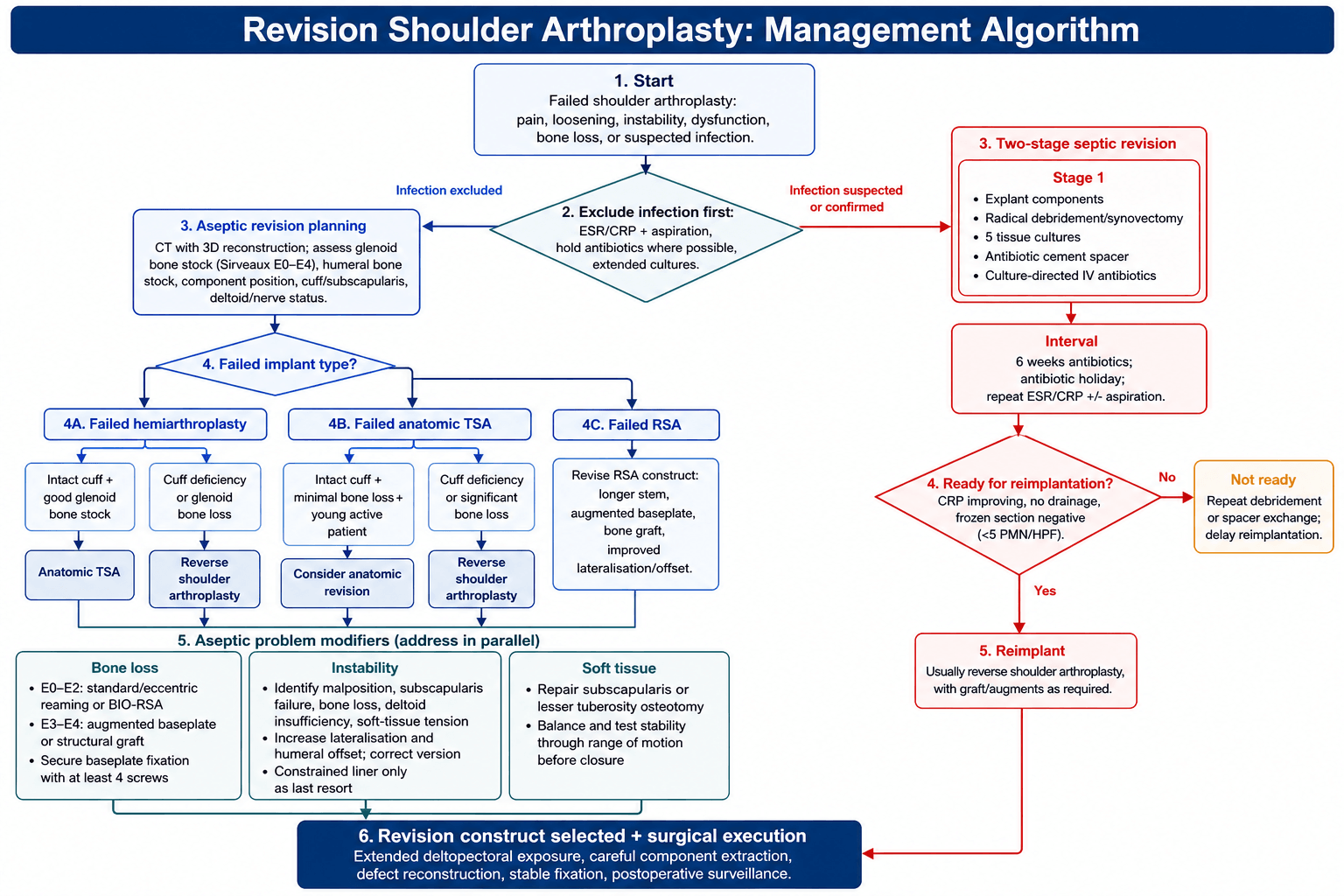
📊 Management Algorithm
revision shoulder arthroplasty management algorithm
Click to expand
Management algorithm for revision shoulder arthroplastyCredit: OrthoVellum

Aseptic Revision Shoulder Arthroplasty Algorithm

Goal: Restore shoulder function with durable fixation despite bone loss and soft tissue compromise.

Decision Making and Surgical Steps

MandatoryStep 1: Exclude Infection
  • CRP, ESR, shoulder aspiration with 14-day extended cultures
  • Hold antibiotics for 2 weeks before aspiration
  • If positive cultures or high clinical suspicion → proceed to two-stage revision
  • If negative → proceed with aseptic revision planning
PreoperativeStep 2: Assess Bone Stock
  • CT scan with 3D reconstruction (mandatory for revision planning)
  • Classify glenoid bone loss: Sirveaux E0-E4
  • Assess humeral bone stock: Morrey classification
  • Plan for augmented baseplate (E3-E4) or bone grafting
  • Determine stem length for humeral revision
Critical DecisionStep 3: Choose Implant Type

Failed Hemiarthroplasty:

  • If intact rotator cuff and good glenoid bone → convert to anatomic TSA
  • If cuff deficiency or moderate bone loss → convert to RSA

Failed Anatomic TSA:

  • Default to RSA for most cases (more forgiving of bone loss and cuff issues)
  • Consider anatomic revision only if intact cuff, minimal bone loss, and young active patient

Failed RSA:

  • Revise to RSA with longer stem, augmented baseplate, or bone grafting
  • Manage instability with increased lateralization and offset
OperativeStep 4: Surgical Execution
  • Extended deltopectoral approach with subscapularis management
  • Careful component extraction minimizing bone loss
  • Address bone defects with augmented implants or structural grafting
  • Secure baseplate fixation (minimum 4 screws)
  • Subscapularis repair or lesser tuberosity osteotomy

RSA vs Anatomic TSA Decision in Revision

Default to reverse shoulder arthroplasty for most revision cases. RSA compensates for rotator cuff deficiency (common after failed TSA), accommodates glenoid bone loss better than anatomic TSA (medialization is less detrimental), and has better survivorship in the revision setting per AOANJRR data. Only convert failed hemiarthroplasty to anatomic TSA if: (1) intact rotator cuff confirmed on MRI or intraoperatively, (2) adequate glenoid bone stock (E0-E1 Sirveaux), (3) no component malposition requiring excessive bone removal. If in doubt, choose RSA.

Two-Stage Revision for Infected Shoulder Arthroplasty

Goal: Eradicate infection, maintain joint space, and allow reimplantation with low reinfection risk.

Two-Stage Revision Protocol

First SurgeryStage 1: Explantation and Spacer

Surgical technique:

  • Complete synovectomy and debridement of all infected tissue
  • Remove all components and cement (ensure no retained cement fragments)
  • Obtain minimum 5 tissue samples from different sites for culture (14-day hold)
  • Irrigate extensively with 9L normal saline (3L pulse lavage, 3L bulb syringe, 3L gravity)
  • Insert antibiotic-laden cement spacer (vancomycin 4g and tobramycin 2.4g per 40g cement)
  • Spacer options: Static spacer, articulating spacer (maintains ROM), or prosthesis of antibiotic-loaded acrylic cement (PROSTALAC)

Postoperative antibiotics: 6 weeks IV antibiotics based on cultures (vancomycin for Staph, ceftriaxone for strep, penicillin for Cutibacterium).

6-12 WeeksAntibiotic Interval
  • Complete 6 weeks IV antibiotics
  • Hold antibiotics for minimum 2 weeks before reimplantation
  • Repeat CRP, ESR at 2 weeks off antibiotics
  • Goal: CRP less than 10 mg/L, ESR less than 30 mm/hr, normalizing trend
  • Consider repeat aspiration if persistent elevation (though sensitivity low after stage 1)
Second Surgery (Week 6-12)Stage 2: Reimplantation

Surgical technique:

  • Obtain 5 fresh tissue samples before reimplantation (frozen section, cultures)
  • Remove cement spacer, debride residual cement
  • Proceed with revision arthroplasty (usually RSA) if frozen section less than 5 PMN/HPF
  • If frozen section positive (greater than 5 PMN/HPF) → replace spacer and extend antibiotics
  • Antibiotic-impregnated cement for humeral stem fixation
  • Postoperative antibiotics for 3-6 months (oral suppressive therapy)

Reimplantation contraindicated if: Persistent drainage, CRP greater than 20 mg/L, positive frozen section.

OngoingLong-Term Surveillance
  • Monitor CRP at 6 weeks, 3 months, 6 months, then yearly
  • Clinical assessment for recurrent infection signs
  • Reinfection occurs in 10-15% despite appropriate two-stage protocol
  • Persistent infection may require resection arthroplasty or chronic suppressive antibiotics

Do Not Reimplant If Inflammatory Markers Elevated

Absolute contraindications to stage 2 reimplantation: (1) CRP greater than 20 mg/L off antibiotics, (2) positive intraoperative frozen section (greater than 5 PMN per HPF), (3) positive repeat cultures, (4) persistent clinical signs (drainage, erythema). Proceeding with reimplantation despite these red flags results in 60-80% reinfection rate. Better to delay reimplantation or perform third-stage debridement than fail with early reinfection.

Revision for Recurrent Shoulder Instability

Goal: Restore stability with soft tissue balancing and component optimization.

Instability Assessment and Treatment

PreoperativeDetermine Cause

Common causes of instability after shoulder arthroplasty:

  • Component malposition (excessive glenoid retroversion or humeral retroversion)
  • Subscapularis failure or insufficiency
  • Glenoid bone loss (posterior or superior deficiency)
  • Deltoid insufficiency (axillary nerve injury)
  • Inadequate soft tissue tension (overlengthening or undersizing)

Workup: CT for component version and bone stock, examination under anesthesia (EUA) to assess direction and magnitude of instability.

Surgical PlanningRevision Strategy

For anatomic TSA instability:

  • Revise to RSA (inherently more stable due to medialized center of rotation)
  • Address glenoid bone loss with augmented baseplate
  • Repair or reconstruct subscapularis if deficient

For RSA instability:

  • Increase lateralization (36mm glenosphere vs 32mm, or add lateralized glenosphere)
  • Increase humeral offset (plus 6mm or plus 9mm polyethylene inserts)
  • Ensure adequate glenoid version correction (anteriorize glenoid baseplate)
  • Consider constrained polyethylene insert (last resort - increases stress on glenoid fixation)
IntraoperativeSoft Tissue Balancing
  • Subscapularis repair or lesser tuberosity osteotomy for anterior instability
  • Deltoid advancement if deltoid insufficiency identified
  • Assess stability through full ROM before closure
  • Accept slight inferior subluxation (1-2mm) for improved ROM; tight reduction increases stiffness risk

Subscapularis Management in Revision

Subscapularis integrity is critical for anterior stability. If prior subscapularis repair failed or tissue is poor quality, perform lesser tuberosity osteotomy (10-15mm thickness, 2 screws for fixation) rather than direct repair. Osteotomy provides bone-to-bone healing with higher success rates (80-90% vs 50-60% for tendon repair in revision). Protect with sling and no active internal rotation for 6 weeks. Assess intraoperatively with belly press test - weak belly press suggests subscapularis deficiency and need for increased anterior-posterior stability.

Surgical Technique

Preoperative Planning and Consent

Consent Points

  • Infection: 5-10% risk in aseptic revision, up to 20% if septic two-stage
  • Nerve injury: 5% risk (axillary nerve most common)
  • Instability: 10-15% recurrent dislocation risk
  • Need for bone grafting: May need iliac crest or allograft if severe bone loss
  • Need for re-revision: 10-15% require further surgery within 5 years
  • Stiffness/pain: 20% have persistent pain despite revision
  • Medical risks: DVT/PE (1-2%), anesthesia complications

Equipment Checklist

  • Implants: Revision RSA system with augmented baseplates, long humeral stems (150-200mm), bone graft options
  • Power tools: High-speed burr, reciprocating saw, flexible osteotomes
  • Component extraction tools: Explantation instruments, thin flexible osteotomes, gigli saw
  • Imaging: C-arm positioned for AP and axillary views
  • Bone graft: Iliac crest instruments on standby, allograft femoral head available
  • Cultures: Culture bottles and specimen containers for tissue samples

Implant Planning - Have Backup Options

Revision shoulder arthroplasty often encounters unexpected intraoperative findings. Always have available: (1) multiple glenoid baseplate sizes and augmented options, (2) range of humeral stem lengths (standard, long, extra-long), (3) structural allograft (femoral head, distal femur), (4) bone graft substitutes (cancellous chips, demineralized bone matrix), (5) antibiotic-laden cement for humeral fixation. Confirm all implants are in the OR before incision - intraoperative delays for missing components increase infection risk and operative time.

Patient Positioning

Setup Checklist

Step 1Position

Beach chair position on specialized shoulder positioner.

  • Head: Secure head in neutral position with foam head ring or pins
  • Body: 30-40 degree upright position, stabilize torso
  • Operative arm: Free drape from hand to scapula to allow full ROM assessment
  • Contralateral arm: Secure across body on arm board with padding

Hypotensive anesthesia: Reduces bleeding, enhances visualization (mean arterial pressure 55-65 mmHg if tolerated).

Step 2Padding
  • Bony prominences: Sacrum, heels, contralateral elbow
  • Nerves at risk: Ulnar nerve at contralateral elbow (pad and avoid pressure)
  • Peroneal nerve: Lateral knee if legs crossed (keep uncrossed)
  • Axilla: Avoid axillary roll (not needed in beach chair, can compress brachial plexus)
Step 3Draping
  • Landmarks exposed: Sternoclavicular joint to deltoid insertion, medially to spine
  • Free limb draping: Entire limb free to assess ROM intraoperatively
  • C-arm access: Confirm adequate AP and axillary views before draping
  • Impervious drapes: Waterproof U-drape and extremity stockinette

Surgical Approach: Extended Deltopectoral

Step-by-Step Approach

Step 1Skin Incision

Landmarks: Coracoid process to deltoid insertion (15-20cm incision). Utilize previous scar if cosmetically acceptable. Extend proximally and distally as needed for exposure. Orientation: Slightly lateral to deltopectoral interval (accounts for skin contraction).

Step 2Identify Cephalic Vein

Careful dissection: Cephalic vein often scarred to interval in revision cases. Options: Ligate vein if densely adherent (avoids avulsion and bleeding). Take laterally with deltoid or medially with pectoralis based on anatomy. Control bleeding: Meticulous hemostasis critical - bleeding increases infection risk.

Step 3Develop Deltopectoral Interval

Identify plane: Between deltoid (axillary nerve) and pectoralis major (medial and lateral pectoral nerves). Scar tissue: Expect dense scar - use sharp dissection, cautery for hemostasis. Retraction: Self-retaining retractor (Kolbel or equivalent) maintains exposure. Neurovascular protection: Palpate musculocutaneous nerve medially at coracobrachialis entry (5-8cm from coracoid). Avoid excessive inferior retraction (axillary nerve at inferior capsule).

Step 4Identify Subscapularis

Assessment: Determine subscapularis integrity and previous repair method. Options:

  • If previous tenotomy or repair intact → attempt repair of subscapularis
  • If subscapularis deficient or poor tissue quality → lesser tuberosity osteotomy (10-15mm thickness)
  • If subscapularis irreparable → proceed without (accept some anterior instability risk)

Lesser tuberosity osteotomy technique: Mark osteotomy 1cm medial to bicipital groove with electrocautery. Use oscillating saw to create 10-15mm thick wafer. Tag with two heavy sutures (number 5 Ethibond) for later repair. Elevate with subscapularis attached.

Step 5Capsular Release and Exposure

360-degree capsular release: Release capsule circumferentially from glenoid rim using electrocauary. Inferior release: Place blunt retractor inferiorly to protect axillary nerve (5-7mm from glenoid rim). Stay on bone to avoid nerve injury. Posterior release: Extend posteriorly to visualize posterior glenoid for baseplate placement. Superior release: Release rotator interval, coracoacromial ligament if needed for exposure.

Goal: Complete exposure of glenoid face, scapular neck, and inferior capsule to allow component extraction and revision implant placement.

Subscapularis Management Strategy

The subscapularis decision is one of the most important in revision shoulder surgery. Assessment sequence: (1) Identify subscapularis - may be scarred, atrophic, or absent. (2) If intact and good quality → attempt direct repair with transosseous sutures or suture anchors. (3) If poor quality or previous repair failed → lesser tuberosity osteotomy for bone-to-bone healing (success rate 80-90% vs 50-60% for tendon repair). (4) If subscapularis irreparable → accept increased anterior instability risk, compensate with increased component constraint or glenosphere lateralization. (5) Always test belly press and lift-off strength at closure to assess subscapularis function.

Component Removal Technique

Systematic Extraction Steps

FirstStep 1: Humeral Component Removal

Exposure: Externally rotate and extend arm to deliver humeral component into wound. Polyethylene removal: Remove polyethylene insert or humeral head if modular. Extract humeral stem:

  • Press-fit stems: Use flexible osteotomes at bone-implant interface, gentle extraction with mallet and extraction device
  • Cemented stems: Use high-speed burr to create window in lateral cortex, disrupt cement-bone interface with osteotomes, extract with mallet
  • Ingrown stems: May require extended trochanteric osteotomy if severely ingrown (rare in shoulder)

Minimize bone loss: Use thin flexible osteotomes, avoid aggressive levering that fractures proximal humerus.

SecondStep 2: Glenoid Component Removal

RSA baseplate removal:

  • Remove glenosphere first (unscrew with torque driver)
  • Identify all screws and remove (4-6 screws typically)
  • Central peg or keel: Use curved osteotomes around periphery to loosen baseplate
  • Avoid excessive force: Glenoid fracture risk if baseplate well-fixed

Anatomic glenoid removal:

  • Remove all-polyethylene glenoid with curved osteotomes at bone-implant interface
  • Metal-backed glenoid: Remove screws, then extract baseplate
  • Remove cement if cemented glenoid (curettage, high-speed burr)

Goal: Preserve maximum glenoid bone stock - this is the limiting factor for revision.

CriticalStep 3: Cement and Debris Removal
  • Remove all cement fragments: Curettage, pulsed lavage, high-speed burr
  • Debride membrane: Remove fibrous membrane from bone surfaces (improves fixation for revision implants)
  • Copious irrigation: 9L total (3L pulse lavage, 3L bulb syringe, 3L gravity)
  • Assess bone defects: Now that components removed, assess true extent of bone loss for revision planning

Prevent Intraoperative Glenoid Fracture

Glenoid fracture during baseplate removal is catastrophic and severely compromises revision options. Prevention: (1) Remove all screws before attempting baseplate extraction - a single missed screw causes fracture. (2) Use thin flexible osteotomes around baseplate periphery, not rigid instruments. (3) Apply gentle circumferential force, never pry from one location. (4) If baseplate severely ingrown, use high-speed burr to thin baseplate from top surface and weaken bone-implant interface. (5) Accept some baseplate remnant if alternative is glenoid fracture - remnant can be incorporated into revision construct. If fracture occurs, options include screw fixation of fragments, BIO-RSA with structural graft, or resection arthroplasty.

Glenoid Bone Defect Management

Mild to Moderate Bone Loss (Sirveaux E0-E2)

Management strategy: Standard baseplate with eccentric reaming or BIO-RSA for E2.

Technique:

  • E0 (no bone loss): Standard glenoid baseplate, central fixation
  • E1 (round central erosion): Eccentric reaming to create flat surface, or BIO-RSA with bone graft impaction
  • E2 (oblique erosion): Eccentric reaming to correct version, consider small posterior augment

Reaming principles:

  • Ream to create flat stable surface for baseplate contact
  • Correct glenoid version to neutral (0-10 degrees retroversion)
  • Avoid excessive medialization (each 1mm medial = 2-3% deltoid efficiency loss)
  • Confirm fixation with minimum 4 screws (preferably 6)

BIO-RSA technique (for E1-E2):

  • Ream glenoid to bleeding bone
  • Impaction graft with cancellous autograft or allograft chips
  • Compress bone graft with baseplate impaction
  • Restores bone stock for potential future revision

This approach is adequate for E0-E2 bone loss with good outcomes.

Severe Bone Loss (Sirveaux E3-E4)

Management strategy: Augmented baseplate, structural bone graft, or BIO-RSA with graft.

Augmented baseplate technique (E3):

  • Prepare glenoid to bleeding bone
  • Select augmented baseplate (posterior augment most common for E3 with posterior deficiency)
  • Position baseplate to correct version and restore glenoid anatomy
  • Secure with minimum 4 screws (preferably 6) into good bone
  • Confirm screw purchase - if screw fails to engage bone, upsize or add bone graft

Structural bone graft technique (E4):

  • Autograft: Iliac crest tricortical graft (2-3cm × 3-4cm) for posterior column deficiency
  • Allograft: Distal femoral condyle allograft for large superior/medial defects
  • Fixation: 3.5mm cortical screws or headless compression screws to secure graft to native glenoid
  • Baseplate placement: Over structural graft with screws into native bone and graft

BIO-RSA with structural graft:

  • Place structural graft medially to restore glenoid depth
  • Impaction graft around structural graft with cancellous chips
  • Impact baseplate over graft construct
  • Long screws (35-45mm) penetrate graft and engage native scapular bone

E3-E4 defects require advanced techniques with higher complication rates but can achieve acceptable outcomes.

Humeral Bone Defect Management

Bone Loss SeverityManagementStem TypeFixation Method
Minimal (Morrey Type 1)Standard length revision stemMetaphyseal engaging or short cemented stemPress-fit or cement depending on bone quality
Moderate (Morrey Type 2)Long stem bypassing defect by 2 cortical diameters (8-10cm)Diaphyseal engaging long stem (150-175mm)Cemented preferred for secure fixation
Severe (Morrey Type 3)Extra-long stem with impaction grafting or strut allograftExtra-long stem (200mm plus) with cortical supportCement mandatory, consider strut allograft for cortical defects

Impaction Grafting for Humeral Bone Loss

Impaction bone grafting technique: (1) Prepare humeral canal by reaming 0.5mm undersized. (2) Pack morselized cancellous allograft or autograft into canal in 1cm layers. (3) Impact each layer with impactor dowels progressively increasing size. (4) Final layer should be firmly impacted and stable. (5) Insert cemented long stem into prepared grafted canal. (6) Cement pressurization achieves interdigitation with impacted graft. Benefits: Restores bone stock for future revision, enhances cement mantle quality, improves stress distribution. Success rate: 85-90% stem stability at 5 years. Preferred over cortical strut allografts for contained defects.

Glenoid Baseplate Fixation

Glenoid Baseplate Steps

Step 1Prepare Glenoid Surface
  • Ream to bleeding bone, create flat surface
  • Correct version with eccentric reaming (goal: 0-10 degrees retroversion)
  • Correct superior tilt (goal: less than 10 degrees)
  • Ensure adequate bone contact for baseplate (greater than 80% contact)
Step 2Central Peg or Keel Preparation
  • Drill central hole for baseplate peg (typically 10-15mm deep)
  • Ensure central peg engages good bone for stability
  • Avoid excessive depth (risk of glenoid fracture or neurovascular injury)
Step 3Baseplate Impaction
  • Position baseplate on glenoid (confirm neutral version with guide wires)
  • Impact baseplate onto glenoid surface (firm seating critical for stability)
  • Confirm flush contact with bone (no rocking or instability)
Step 4Screw Fixation
  • Minimum 4 screws required for secure fixation (preferably 6)
  • Screw trajectory: Superior screw into coracoid base, inferior screw into scapular spine, posterior screws into scapular body
  • Screw length: 30-45mm (longer screws in revision for bicortical purchase)
  • Compression screws: Locking or compression screws for maximum stability
  • Confirm purchase: Each screw should have firm purchase - if loose, upsize screw or change trajectory

Key pearl: Superior screws into coracoid base provide strongest fixation. Avoid superior tilt greater than 10 degrees (increases shear forces and failure risk).

Step 5Glenosphere Attachment
  • Select glenosphere size (32mm, 36mm, or 42mm based on bone stock and stability needs)
  • Larger glenosphere (36-42mm) increases stability but requires adequate bone stock
  • Secure glenosphere to baseplate with locking mechanism (torque to manufacturer specifications)
  • Consider lateralized glenosphere (BIO-RSA) if bone stock adequate (improves deltoid efficiency and ROM)

Humeral Component Preparation

Humeral Stem Fixation

Step 1Canal Preparation
  • Extract previous stem as described earlier
  • Ream canal to appropriate diameter (based on stem size and cortical thickness)
  • Plan stem length: bypass bone loss zone by 2 cortical diameters (minimum 8-10cm)
  • For severe bone loss: Consider extra-long stem (200mm plus)
Step 2Stem Insertion

Cemented technique (preferred for revision):

  • Clean and dry canal thoroughly
  • Insert cement restrictor 2cm beyond stem tip
  • Retrograde cement insertion with cement gun
  • Insert stem with gentle pressure (ensure proper version: 20-30 degrees retroversion)
  • Hold position until cement polymerizes (5-8 minutes)
  • Remove excess cement before polymerization

Press-fit technique (if excellent bone quality):

  • Undersized reaming to ensure tight press-fit
  • Impact stem into canal with gentle mallet blows
  • Confirm stable fixation with manual stress test
Step 3Humeral Tray and Polyethylene
  • Attach humeral tray to stem (locking mechanism or cement depending on system)
  • Select polyethylene insert thickness (standard, plus 3mm, plus 6mm, plus 9mm)
  • Thicker inserts increase soft tissue tension and stability (use for instability)
  • Thinner inserts improve ROM but may compromise stability
  • Goal: Stable reduction with slight inferior subluxation (1-2mm) for optimal ROM
Step 4Trial Reduction
  • Reduce shoulder with trial components
  • Assess stability through full ROM (forward elevation, abduction, rotation)
  • Check for impingement (acromial, scapular notching)
  • Adjust component position or polyethylene thickness if needed
  • Acceptable reduction: Slight inferior subluxation, stable through ROM, no clunking

Polyethylene Insert Selection for Stability

Polyethylene insert thickness directly affects soft tissue tension and stability. Standard practice: Start with standard insert, trial reduction, and assess stability. If unstable → increase thickness by 3mm increments. Maximum increase: Plus 9mm (beyond this, consider other causes of instability like component malposition). Trade-off: Thicker inserts increase stability but decrease ROM and increase stress on glenoid fixation. Goal: Slight inferior subluxation (1-2mm) with gentle traction is ideal - indicates appropriate soft tissue tension without overtightening. Overtensioning causes stiffness and glenoid loosening; undertensioning causes instability.

Subscapularis Repair and Closure

Closure Steps

Critical StepSubscapularis Repair

If lesser tuberosity osteotomy performed:

  • Reduce lesser tuberosity fragment to anatomic position
  • Fix with 2 heavy screws (4.5mm or 4.0mm cannulated screws)
  • Screw heads countersunk to avoid impingement
  • Supplement with heavy sutures (number 5 Ethibond) through bone tunnels
  • Confirm stable fixation with manual stress test

If direct subscapularis repair:

  • Repair tendon to bone with transosseous tunnels or suture anchors
  • Use heavy non-absorbable sutures (number 2 FiberWire or Ethibond)
  • Multiple sutures for secure repair (4-6 sutures minimum)
  • Tension-free repair in neutral rotation

Test repair: Belly press test - strong belly press indicates intact subscapularis.

Step 2Deltopectoral Closure
  • Approximate deltoid and pectoralis with interrupted absorbable sutures (0 or 1 Vicryl)
  • Do NOT overtighten (can cause deltoid denervation or stiffness)
  • Cephalic vein may be ligated if necessary
Step 3Subcutaneous and Skin Closure
  • Subcutaneous layer: 2-0 Vicryl interrupted or running sutures
  • Skin: Staples, interrupted 3-0 nylon, or running subcuticular 3-0 Monocryl
  • Sterile dressing and ABD pads for drainage
Step 4Immobilization
  • Abduction sling with pillow (abduction brace if available)
  • Position: 30 degrees abduction, neutral rotation
  • Protects subscapularis repair and prevents inferior subluxation
  • Continue for 6 weeks if subscapularis repair or osteotomy performed

Subscapularis Protection Protocol

Subscapularis repair or lesser tuberosity osteotomy requires strict protection for 6 weeks. Protocol: (1) Abduction sling full-time except for hygiene and pendulum exercises. (2) No active internal rotation for 6 weeks (high risk of repair failure). (3) Passive ROM only - forward elevation, abduction, external rotation allowed. (4) At 6 weeks, if radiographs show healed osteotomy or clinical exam shows intact belly press, progress to active-assisted ROM. (5) Strengthen subscapularis at 10-12 weeks with resistance internal rotation. (6) Early repair failure results in permanent anterior instability and poor outcomes.

Complications

ComplicationIncidenceRisk FactorsManagement
Infection5-10% in aseptic revision, 10-20% in septic two-stagePrevious infection, multiple revisions, immunosuppression, diabetesTwo-stage revision with antibiotic spacer, 6 weeks IV antibiotics
Instability10-15% recurrent dislocationSubscapularis failure, component malposition, inadequate soft tissue tensionRevise to RSA with increased offset, thicker polyethylene, subscapularis repair
Aseptic loosening5-10% at 5 yearsPoor bone stock, inadequate fixation, infectionRe-revision with bone grafting, augmented baseplate, or structural allograft
Periprosthetic fracture3-5% intraoperative, 2-3% postoperativeOsteoporosis, aggressive component extraction, cortical perforationIntraop: cerclage wiring, longer stem. Postop: ORIF vs revision depending on fracture pattern and implant stability
Nerve injury3-5% (axillary most common)Excessive retraction, prolonged operative time, traction injuryObservation (most recover spontaneously), EMG at 3 months, nerve exploration if no recovery at 6 months
Stiffness15-20% significant ROM limitationOvertensioned soft tissues, capsular scarring, heterotopic ossificationIntensive PT, consider manipulation under anesthesia if severe and early (within 3 months)
Scapular notching20-30% in RSAInferior glenosphere position, small glenosphere size, medialized center of rotationUsually asymptomatic. If symptomatic loosening, revise with lateralized glenosphere

Early Recognition of Deep Infection

Early infection (within 4 weeks) may be salvageable with DAIR (debridement, antibiotics, and implant retention) if recognized immediately. Red flags: persistent drainage beyond 72 hours, fever, purulent drainage, elevated WBC. Protocol: (1) Return to OR immediately (within 24-48 hours of symptom onset). (2) Aggressive debridement and synovectomy. (3) Polyethylene exchange. (4) Obtain cultures before antibiotics. (5) 6 weeks IV antibiotics based on cultures. Success rate: 40-60% for acute infections caught early. Delayed recognition (beyond 4 weeks) requires two-stage revision - DAIR will fail in chronic infections (success rate under 20%).

Complication Prevention Strategies

Infection Prevention

  • Preoperative optimization: Control diabetes (HbA1c under 7%), discontinue immunosuppression if possible
  • Antibiotic prophylaxis: Cefazolin 2g (3g if over 120kg) within 1 hour of incision
  • Extended prophylaxis: Continue 24 hours postoperatively for revision cases
  • Operative time: Minimize time (longer surgeries = higher infection risk)
  • Meticulous hemostasis: Hematoma is infection risk
  • Wound closure: Multiple layer closure, avoid tension

Instability Prevention

  • Component positioning: Correct glenoid version (0-10 degrees retroversion), avoid excessive humeral retroversion
  • Soft tissue balancing: Adequate polyethylene thickness, subscapularis repair
  • Intraoperative stability testing: Test through full ROM before closure
  • Lateralization: Consider lateralized glenosphere for increased stability (36mm or 42mm vs 32mm)
  • Postoperative protection: Abduction sling for 6 weeks protects subscapularis

Postoperative Care and Rehabilitation

Rehabilitation Timeline

Immediate PostoperativeDay 0-1

Hospital management:

  • Abduction sling with pillow (30 degrees abduction)
  • Drain management if placed (remove when output under 30mL per 8 hours)
  • Pain control: Regional block (interscalene catheter for 2-3 days), oral narcotics
  • DVT prophylaxis: Mechanical (sequential compression devices), chemical (enoxaparin 40mg daily) if low bleeding risk
  • Antibiotics: Continue prophylaxis for 24 hours (cefazolin 1g every 8 hours)
  • Early mobilization: Out of bed to chair on postoperative day 0-1

Discharge: Usually postoperative day 1-2 for uncomplicated cases.

Early Phase - Passive Motion OnlyWeeks 1-6

Protection phase:

  • Abduction sling full-time (remove for exercises and hygiene only)
  • No active internal rotation (protects subscapularis repair)
  • Passive ROM only: Therapist-assisted forward elevation to 120 degrees, abduction to 90 degrees, external rotation to 30 degrees
  • Pendulum exercises 3 times daily
  • Grip strengthening
  • Elbow, wrist, hand ROM to prevent stiffness

Goals: Protect subscapularis while preventing stiffness. ROM goals at 6 weeks: Forward elevation 120 degrees passive, external rotation 30 degrees.

Follow-up: Week 2 (wound check, remove staples), Week 6 (radiographs to assess healing, progress PT).

Progressive Active MotionWeeks 6-12

Active motion phase:

  • Wean from abduction sling at 6 weeks if radiographs satisfactory and clinical exam reassuring
  • Progress to active-assisted ROM (pulley exercises, cane-assisted elevation)
  • Begin active ROM at week 8 (deltoid-driven forward elevation and abduction)
  • Light internal rotation at week 8-10 (hand to belly, hand to opposite shoulder)
  • Continue to avoid forceful internal rotation (subscapularis still healing)

Goals: Active forward elevation to 140 degrees, active abduction to 100 degrees, external rotation to 45 degrees by week 12.

Follow-up: Week 12 radiographs and clinical assessment.

Strengthening PhaseWeeks 12-24

Progressive strengthening:

  • Resistance band exercises for deltoid, rotator cuff (avoid heavy internal rotation)
  • Scapular stabilization exercises (rows, scapular squeezes)
  • Functional activities (reaching, lifting light objects)
  • Gradual return to activities of daily living
  • Continue home exercise program indefinitely

Goals: Functional ROM and strength for daily activities. Forward elevation 150-160 degrees, abduction 120-140 degrees, functional internal rotation.

Follow-up: 6 months, 1 year, then yearly radiographs to monitor for loosening or complications.

Long-Term SurveillanceOngoing

Annual follow-up:

  • Clinical assessment: Pain, function, ROM, strength
  • Radiographs: AP and axillary views to assess component position, lucencies, scapular notching
  • Monitor for late complications: Infection, loosening, instability, scapular notching progression

Patient education:

  • Avoid heavy overhead lifting (over 10kg)
  • No contact sports or high-impact activities
  • Report new pain, clicking, or instability immediately
  • Maintain shoulder ROM with home exercises

The Critical 6-Week Window

The first 6 weeks are critical for subscapularis healing and determine long-term stability. Patients must understand: (1) No active internal rotation means no reaching behind back, no pulling shirt on, no forceful activities. (2) Sling compliance is non-negotiable - remove only for exercises and hygiene. (3) Passive motion is safe and necessary - stiffness is preventable but subscapularis failure is catastrophic. (4) At 6-week visit, assess subscapularis integrity with belly press test - if strong, progress to active motion; if weak, continue protection and repeat at 8 weeks. (5) Early return to internal rotation (before 6 weeks) results in 60-80% subscapularis failure rate with permanent anterior instability.

Rehabilitation After Two-Stage Revision for Infection

Infection-Specific Rehabilitation

Weeks 0-6Stage 1 (Spacer Phase)

After explantation and spacer insertion:

  • Abduction sling for comfort and protection
  • Gentle passive ROM only (avoid aggressive PT that dislodges spacer)
  • Pendulum exercises for pain relief
  • Elbow, wrist, hand ROM
  • IV antibiotics per infectious disease recommendations (6 weeks typically)

Goals: Maintain some shoulder motion to prevent contracture, eradicate infection. Do not aggressively rehabilitate - spacer provides limited stability.

Follow-up: Weekly during IV antibiotics, CRP/ESR monitoring.

Weeks 6-8 or 6-12Antibiotic Holiday

After completing IV antibiotics:

  • Hold antibiotics for minimum 2 weeks (ideally 4 weeks)
  • Monitor CRP, ESR at 2 weeks off antibiotics
  • Repeat shoulder aspiration if markers remain elevated
  • Continue gentle ROM with spacer in place

Decision point: If CRP less than 10 mg/L and ESR less than 30 mm/hr → proceed to stage 2. If elevated → extend antibiotic holiday or repeat debridement.

Week 6-12 OnwardStage 2 (Reimplantation Phase)

After successful reimplantation:

  • Standard revision RSA rehabilitation protocol (as above)
  • May progress slightly slower due to soft tissue compromise from previous surgeries
  • Continue oral suppressive antibiotics for 3-6 months post-reimplantation (infectious disease decision)
  • Monitor inflammatory markers at 6 weeks, 3 months, 6 months, then yearly

Goals: Same as aseptic revision - functional ROM and pain relief. Infection eradication is primary outcome.

Spacer Precautions

Antibiotic-impregnated spacers provide limited stability and are not designed for aggressive rehabilitation. Spacer dislocation occurs in 10-15% of cases with aggressive PT. Instructions: (1) Passive ROM to 90 degrees forward elevation maximum. (2) No active motion or strengthening. (3) No resistance exercises. (4) If spacer dislocates, reduce under sedation and restrict motion further. (5) Spacer is temporary - goal is infection eradication, not function. (6) Counsel patients that function will be limited during spacer phase but should improve after reimplantation.

Outcomes and Prognosis

Revision TypeSurvivorship at 5 YearsTypical OutcomesNotes
Aseptic revision to RSA85-90%Good pain relief, functional ROM (140 degrees FE average), return to light ADLsOutcomes inferior to primary RSA but acceptable for most patients
Aseptic revision to anatomic TSA75-85%Good outcomes if intact cuff and good bone stock, but higher revision rate than RSAOnly recommended for select cases with excellent bone and cuff
Two-stage septic revision70-80%Infection eradication 85-90%, but 15-20% reinfection. Function similar to aseptic if successfulReinfection requires prolonged antibiotics or resection arthroplasty
Revision for instability70-75%50-60% achieve stable shoulder, but 15-20% recurrent instability despite revisionMultiple revisions for instability have poor outcomes
Re-revision (3rd surgery)60-70%Diminishing returns with each revision. Consider resection arthroplasty if multiple failuresPatient selection critical - counsel realistic expectations

Predictors of Poor Outcome After Revision

Poor prognostic factors for revision shoulder arthroplasty: (1) Multiple prior revisions (each revision decreases success rate by 15-20%). (2) Severe glenoid bone loss (Sirveaux E4 has 2-3 times higher failure rate than E0-E2). (3) Infection as indication (septic revisions have 15-20% reinfection rate vs 5-10% infection rate in aseptic revisions). (4) Neurological injury (axillary nerve injury results in poor functional outcomes despite stable implant). (5) Poor soft tissue envelope (deltoid insufficiency, subscapularis irreparable). (6) Patient factors (diabetes, smoking, immunosuppression, age over 80). Best outcomes: Single aseptic revision to RSA with intact soft tissues and moderate bone loss (E1-E2).

Functional Outcomes

ROM Expectations

Typical ROM after revision RSA:

  • Forward elevation: 120-140 degrees (vs 150-160 for primary)
  • Abduction: 100-120 degrees (vs 130-150 for primary)
  • External rotation: 30-40 degrees (vs 40-50 for primary)
  • Internal rotation: Limited (hand to belly vs hand to low back for primary)

Functional impact: Most patients can perform overhead ADLs (eating, hygiene, dressing) but limited for heavy lifting or overhead work.

Pain Relief and Satisfaction

  • Pain relief: 80-85% achieve significant pain improvement (VAS 7-8 to VAS 2-3)
  • Patient satisfaction: 70-75% satisfied or very satisfied (vs 85-90% for primary)
  • Return to activities: 60-70% return to light recreational activities (golf, swimming)
  • Work: 50-60% able to return to work if pre-retirement age

Realistic expectations: Patients must understand revision outcomes are inferior to primary arthroplasty.

Evidence Base and Key Trials

Reverse Shoulder Arthroplasty for Failed Shoulder Arthroplasty

3
Boileau P et al • Journal of Shoulder and Elbow Surgery (2009)
Key Findings:
  • Retrospective series of 45 failed shoulder arthroplasties revised to RSA
  • 78% good or excellent outcomes at mean 40-month follow-up
  • Significant improvement in Constant score from 22 to 54 points
  • 15% complication rate including infection (7%) and instability (4%)
  • Glenoid bone loss (Sirveaux E3-E4) associated with higher revision rates
Clinical Implication: RSA is effective for revision of failed shoulder arthroplasty with acceptable complication rates. Outcomes superior to repeat anatomic TSA in setting of rotator cuff deficiency.
Limitation: Retrospective design, relatively short follow-up, heterogeneous patient population including different primary failure modes.

Two-Stage Revision for Infected Shoulder Arthroplasty

3
Klatte TO et al • Journal of Bone and Joint Surgery Am (2013)
Key Findings:
  • Systematic review of 175 infected shoulder arthroplasties treated with two-stage revision
  • Infection eradication rate 84% (147/175 patients)
  • Cutibacterium acnes most common organism (38% of cases)
  • Mean antibiotic interval 12 weeks (range 4-24 weeks)
  • Functional outcomes inferior to aseptic revisions but acceptable pain relief
Clinical Implication: Two-stage revision is effective for infected shoulder arthroplasty with 84% infection eradication. Extended cultures (14 days) required for Cutibacterium detection.
Limitation: Heterogeneous treatment protocols across studies, variable antibiotic regimens, selection bias toward complex cases in tertiary centers.

Glenoid Bone Loss Management in Revision RSA

3
Favre P et al • Journal of Shoulder and Elbow Surgery (2018)
Key Findings:
  • Biomechanical study and clinical series of 34 revision RSA cases with severe glenoid bone loss
  • Augmented baseplates restored glenoid version and stability in E3 defects
  • Structural bone grafting required for E4 defects (over 60% bone loss)
  • Baseplate failure rate 12% at 3-year follow-up (higher in E4 vs E3)
  • Medialization greater than 5mm associated with decreased deltoid efficiency and outcomes
Clinical Implication: Augmented baseplates effectively manage E3 glenoid bone loss. Structural grafting needed for E4 defects but has higher failure rates. Minimize medialization to preserve deltoid function.
Limitation: Relatively small sample size, short-term follow-up, learning curve with augmented baseplate techniques affects early results.

Australian Orthopaedic Association National Joint Replacement Registry (AOANJRR)

3
AOANJRR • Annual Report (2023)
Key Findings:
  • 10-year cumulative revision rate for primary shoulder arthroplasty: 10.2% for TSA, 8.4% for RSA
  • Revision shoulder arthroplasty has 2.5 times higher re-revision rate than primary (25% vs 10% at 10 years)
  • Infection is most common indication for revision (48% of revisions)
  • RSA used in 72% of revision procedures (vs 28% anatomic TSA)
  • Cemented humeral stems have lower revision rates than uncemented in revision setting (7% vs 12% at 5 years)
Clinical Implication: Australian registry data supports RSA as preferred revision option and cemented humeral fixation in revision setting. Infection prevention is critical given high infection-driven revision rates.
Limitation: Registry data subject to selection bias, incomplete capture of complications not requiring revision, variability in surgeon technique and experience.

Functional Outcomes After Revision Shoulder Arthroplasty: Systematic Review

2
Chalmers PN et al • Journal of Shoulder and Elbow Surgery (2020)
Key Findings:
  • Systematic review of 23 studies including 892 revision shoulder arthroplasties
  • Mean Constant score improvement from 28 to 56 points post-revision
  • Mean forward elevation 132 degrees post-revision (vs 150 degrees for primary RSA)
  • Complication rate 18% (infection 6%, instability 5%, nerve injury 3%, fracture 4%)
  • Revision to RSA had better outcomes than revision to anatomic TSA (Constant score 58 vs 48)
Clinical Implication: Revision shoulder arthroplasty provides significant pain relief and functional improvement despite being inferior to primary arthroplasty. RSA preferred over anatomic TSA for revisions.
Limitation: Heterogeneity in indications for revision, variable surgical techniques, lack of patient-reported outcome measures in many studies.

Exam Viva Scenarios

Practice these scenarios to excel in your viva examination

VIVA SCENARIOStandard

Scenario 1: Failed Hemiarthroplasty (~3 min)

EXAMINER

"A 62-year-old woman presents with progressive shoulder pain 5 years after hemiarthroplasty for fracture sequelae. She has painful limited ROM. Radiographs show glenoid erosion with medialization. CRP 5 mg/L, ESR 15 mm/hr. Aspiration shows no growth on 5-day cultures. What is your assessment and management?"

EXCEPTIONAL ANSWER
This is a failed hemiarthroplasty with glenoid arthrosis, likely Sirveaux E2 or E3 erosion based on medialization. My systematic approach would be: First, complete the infection workup with extended 14-day cultures for Cutibacterium acnes despite low inflammatory markers, as shoulder infections can be indolent. Second, obtain CT scan with 3D reconstruction to quantify glenoid bone loss and classify using Sirveaux system. Third, assess rotator cuff integrity with MRI to guide implant choice. If cultures remain negative and cuff is deficient or moderate bone loss, I would recommend conversion to reverse shoulder arthroplasty. If cuff is intact and bone loss minimal (E0-E1), conversion to anatomic total shoulder arthroplasty is an option. My surgical approach would be extended deltopectoral, hemiarthroplasty stem extraction, glenoid preparation with reaming or augmented baseplate if E3 loss, and RSA components with cemented humeral stem. I would counsel about 70-80% good outcomes but inferior to primary arthroplasty, 5-10% infection risk, 10-15% instability risk, and need for subscapularis protection for 6 weeks postoperatively.
KEY POINTS TO SCORE
Extended 14-day cultures mandatory despite low inflammatory markers
CT scan to quantify glenoid bone loss (Sirveaux classification)
RSA preferred for most cases due to bone loss and potential cuff deficiency
Realistic outcome expectations - inferior to primary arthroplasty
COMMON TRAPS
✗Missing Cutibacterium infection with standard 5-day cultures
✗Converting to anatomic TSA without assessing cuff integrity
✗Underestimating glenoid bone loss without CT scan
LIKELY FOLLOW-UPS
"How would you manage Sirveaux E4 glenoid bone loss?"
"What if 14-day cultures grow Cutibacterium acnes?"
"What surgical approach would you use and what are the dangers?"
VIVA SCENARIOChallenging

Scenario 2: Failed Reverse Shoulder with Instability (~4 min)

EXAMINER

"A 68-year-old man had reverse shoulder arthroplasty 2 years ago for cuff tear arthropathy. He now has recurrent anterior dislocations (3 episodes in 6 months). Radiographs show well-fixed components with 32mm glenosphere, standard polyethylene insert, and neutral glenoid version. Belly press test is weak. Walk me through your revision planning and surgical technique."

EXCEPTIONAL ANSWER
This is recurrent instability after reverse shoulder arthroplasty, likely multifactorial from subscapularis insufficiency (weak belly press), undersized glenosphere (32mm), and inadequate soft tissue tension (standard polyethylene). My systematic approach: First, exclude infection with CRP, ESR, and aspiration with 14-day cultures despite no clinical suspicion. Second, obtain CT scan to assess glenoid component position, version, and bone loss - ensure no occult loosening. Third, plan revision strategy addressing all instability factors. My surgical technique would be extended deltopectoral approach, assess subscapularis integrity (likely failed or deficient), increase stability with larger glenosphere (36mm or 42mm if bone stock adequate), increase soft tissue tension with plus 6mm or plus 9mm polyethylene insert, and repair subscapularis with lesser tuberosity osteotomy if tissue quality poor. I would use same glenoid baseplate if well-fixed (just exchange glenosphere), but revise humeral stem to accommodate thicker polyethylene if current stem geometry inadequate. Intraoperatively, I would assess stability through full ROM and accept slight inferior subluxation (1-2mm) rather than overtension. Postoperatively, abduction sling for 6 weeks to protect subscapularis osteotomy, no active internal rotation for 6 weeks. I would counsel about 50-60% success rate for recurrent instability revisions, with 15-20% risk of re-dislocation despite revision.
KEY POINTS TO SCORE
Multifactorial instability - address all factors (subscapularis, glenosphere size, soft tissue tension)
Lesser tuberosity osteotomy for failed subscapularis (bone-to-bone healing superior to tendon repair)
Increase glenosphere size and polyethylene thickness incrementally
Realistic expectations - instability revisions have lower success rates
COMMON TRAPS
✗Focusing only on component exchange without addressing subscapularis insufficiency
✗Overtensioning soft tissues (causes stiffness and baseplate stress)
✗Using constrained polyethylene as first-line solution (high baseplate stress, glenoid loosening risk)
LIKELY FOLLOW-UPS
"What if glenoid baseplate shows signs of loosening on CT?"
"How do you perform lesser tuberosity osteotomy and what is the fixation?"
"What is your threshold for using a constrained polyethylene insert?"
VIVA SCENARIOCritical

Scenario 3: Infected Shoulder Arthroplasty (~3 min)

EXAMINER

"A 71-year-old diabetic woman presents 8 months after reverse shoulder arthroplasty with persistent pain, no improvement in function, and occasional drainage from the incision. CRP 25 mg/L, ESR 45 mm/hr. Aspiration grows Staphylococcus epidermidis (2 of 3 bottles). She is devastated and asks if you can just give antibiotics. How do you manage this case and what is your counseling?"

EXCEPTIONAL ANSWER
This is a chronic prosthetic joint infection, greater than 4 weeks from index surgery, with positive cultures and elevated inflammatory markers. This requires two-stage revision - antibiotics alone have under 5% success rate for established shoulder prosthetic infection. My management: Stage 1 explantation and antibiotic spacer involves complete removal of all components and cement, thorough synovectomy and debridement of infected tissue, obtaining minimum 5 tissue samples from different sites for extended 14-day cultures and sensitivities, copious irrigation with 9 liters normal saline, and insertion of antibiotic-impregnated cement spacer (vancomycin 4g and tobramycin 2.4g per 40g cement). Postoperatively, she receives 6 weeks IV antibiotics based on final culture sensitivities (likely vancomycin for Staph epi). After completing antibiotics, we hold antibiotics for 2 weeks and recheck CRP and ESR - goal is CRP less than 10 mg/L and ESR less than 30 mm/hr before stage 2. Stage 2 reimplantation at 6-12 weeks involves obtaining fresh tissue samples and frozen section (less than 5 PMN per HPF required to proceed), removing spacer, and reimplantation with reverse shoulder arthroplasty using cemented humeral stem with antibiotic cement, followed by 3-6 months oral suppressive antibiotics. I would counsel that infection eradication rate is 85-90% with two-stage protocol, but 10-15% reinfection risk remains. Functional outcomes similar to aseptic revision if infection eradicated successfully. The alternative - chronic suppressive antibiotics without surgery - has over 90% failure rate with progressive bone loss and eventual need for resection arthroplasty. Her diabetes must be optimized (HbA1c under 7%) before stage 2 to minimize reinfection risk.
KEY POINTS TO SCORE
Two-stage revision is mandatory for chronic infection (over 4 weeks)
Complete component and cement removal, thorough debridement, extended cultures (14 days)
6-week antibiotic interval, normalize inflammatory markers before reimplantation
85-90% infection eradication rate but 10-15% reinfection risk
COMMON TRAPS
✗Attempting debridement and component retention (DAIR) for chronic infection (success under 20%)
✗Reimplanting before normalizing inflammatory markers (high reinfection risk)
✗Missing Cutibacterium coinfection with standard cultures (need 14-day hold)
✗Inadequate patient counseling about prolonged treatment course
LIKELY FOLLOW-UPS
"What if CRP remains 18 mg/L at 2 weeks off antibiotics - what do you do?"
"Describe your antibiotic spacer technique and cement preparation."
"What if frozen section at stage 2 shows 8 PMN per HPF - do you proceed or abort?"

MCQ Practice Points

Glenoid Bone Loss Question

Q: What is the Sirveaux classification for glenoid bone loss in failed reverse shoulder arthroplasty, and what is the threshold for requiring augmented baseplate or bone grafting? A: The Sirveaux classification grades glenoid bone loss from E0 (no loss) to E4 (extensive superior and medial loss). E0-E2 can be managed with standard glenoid baseplate or eccentric reaming. E3 (deep central erosion greater than 50% width) and E4 (extensive bone loss) require augmented baseplate or structural bone grafting. E3 can often be managed with augmented baseplate alone, while E4 typically requires structural allograft (scapular spine bone graft or BIO-RSA technique).

Infection Workup Question

Q: Why are extended 14-day cultures required for suspected shoulder prosthetic joint infection, and what is the most common organism? A: Cutibacterium acnes (formerly Propionibacterium) is the most common organism in shoulder prosthetic joint infection (30-40% of cases) and is a slow-growing anaerobe requiring 14 days of culture incubation for detection. Standard 5-day cultures miss 20-30% of shoulder infections. Cutibacterium is low-virulence and can cause indolent infection with minimal systemic symptoms, making extended cultures essential even when clinical suspicion is low.

RSA vs Anatomic TSA Decision Question

Q: What factors favor conversion to reverse shoulder arthroplasty vs anatomic total shoulder arthroplasty when revising a failed hemiarthroplasty? A: Favor reverse shoulder arthroplasty (most common choice): (1) Rotator cuff deficiency or massive cuff tear, (2) Moderate to severe glenoid bone loss (Sirveaux E2-E4), (3) Patient age over 70 years, (4) Low functional demands, (5) Deltoid function intact. Favor anatomic TSA (uncommon): (1) Intact rotator cuff confirmed on MRI or intraoperatively, (2) Minimal glenoid bone loss (E0-E1), (3) Younger patient (under 60 years), (4) High functional demands, (5) Adequate glenoid bone stock after component removal. Default to RSA if uncertain - more forgiving of bone loss and cuff deficiency.

Two-Stage Revision Protocol Question

Q: What are the key steps and success rates for two-stage revision of infected shoulder arthroplasty? A: Two-stage revision protocol: (1) Stage 1 - Complete removal of all components and cement, synovectomy, debridement of infected tissue, minimum 5 tissue cultures (14-day hold), antibiotic-impregnated cement spacer (vancomycin 4g and tobramycin 2.4g per 40g cement), followed by 6 weeks IV antibiotics. (2) Antibiotic holiday - Hold antibiotics for minimum 2 weeks, repeat CRP and ESR (goal: CRP less than 10 mg/L, ESR less than 30 mm/hr). (3) Stage 2 - Reimplantation if inflammatory markers normalized, obtain fresh tissue cultures and frozen section (less than 5 PMN per HPF required to proceed), followed by 3-6 months oral suppressive antibiotics. Success rate: 85-90% infection eradication, but 10-15% reinfection risk. Functional outcomes similar to aseptic revision if infection cleared.

Subscapularis Management Question

Q: What are the options for subscapularis management in revision shoulder arthroplasty, and which has the best healing rate? A: Subscapularis options: (1) Direct tendon repair - If subscapularis intact and good tissue quality, repair with transosseous sutures or suture anchors (success rate 50-60% in revision). (2) Lesser tuberosity osteotomy - If poor tissue quality or previous repair failed, perform 10-15mm thick osteotomy with two screw fixation (success rate 80-90% with bone-to-bone healing). (3) Accept insufficiency - If subscapularis irreparable, proceed without repair and compensate with increased component constraint or glenosphere lateralization (higher anterior instability risk). Lesser tuberosity osteotomy is preferred in revision setting due to superior healing and allows bone-to-bone contact. Protection for 6 weeks with no active internal rotation is mandatory for either repair technique.

AOANJRR Registry Data Question

Q: What does the Australian Orthopaedic Association National Joint Replacement Registry (AOANJRR) report regarding revision shoulder arthroplasty indications and implant choice? A: AOANJRR 2023 data: (1) Most common indication for revision is infection (48% of all revisions), followed by aseptic loosening (28%) and instability (15%). (2) Reverse shoulder arthroplasty is used in 72% of revision procedures vs 28% anatomic TSA. (3) Cemented humeral stems have lower re-revision rates than uncemented in the revision setting (7% vs 12% at 5 years). (4) Cumulative re-revision rate at 10 years is 25% for revision shoulders vs 10% for primary arthroplasty (2.5 times higher). This data supports RSA as the preferred revision option and cemented humeral fixation for improved survivorship.

Australian Context and Medicolegal Considerations

AOANJRR Data and Guidelines

  • Revision rates: 10-year cumulative revision 10.2% for TSA, 8.4% for RSA (2023 report)
  • Infection dominance: 48% of revisions due to infection (higher than hip or knee)
  • RSA preference: 72% of revisions use RSA (reflects bone loss and cuff deficiency)
  • Cemented stems: Cemented humeral fixation associated with lower re-revision rates in revision setting
  • Hospital volume: Higher volume centers (over 50 shoulder arthroplasties per year) have lower revision rates
  • Annual reporting: Registry participation mandatory for all arthroplasty cases in Australia

Australian Clinical Guidelines

  • ACSQHC Surgical Site Infection Prevention: Preoperative skin preparation with chlorhexidine-alcohol, appropriate antibiotic prophylaxis (cefazolin 2g within 60 minutes)
  • Antimicrobial Stewardship: Extended antibiotic prophylaxis (24 hours) acceptable for revision cases per Therapeutic Guidelines (eTG)
  • VTE Prophylaxis: NHMRC guidelines recommend mechanical prophylaxis for all cases, chemical prophylaxis (enoxaparin) for high-risk patients
  • Perioperative Diabetes Management: Target HbA1c under 7% for elective arthroplasty per ANZCA guidelines
  • PBS Restrictions: Some revision implants require prior approval for PBS subsidy

Medicolegal Considerations in Revision Shoulder Arthroplasty

Key documentation requirements for revision cases:

Preoperative Counseling (document in medical record):

  • Realistic outcome expectations (outcomes inferior to primary by 30-40%)
  • Infection risk specific to revision setting (5-10% aseptic, 10-20% septic two-stage)
  • Need for bone grafting if severe bone loss discovered intraoperatively
  • Possibility of re-revision (10-15% at 5 years)
  • Alternative treatment options (non-operative management, arthrodesis, resection arthroplasty)
  • Two-stage process for infected cases with prolonged treatment timeline

Intraoperative Documentation:

  • Indication for revision (aseptic loosening, infection, instability, fracture)
  • Infection workup results (cultures, inflammatory markers, aspiration)
  • Bone stock assessment and classification (Sirveaux grade for glenoid)
  • Implant choices and rationale (RSA vs anatomic TSA, augmented components, bone grafting)
  • Tissue samples sent for culture and pathology
  • Subscapularis management technique
  • Complications encountered (fracture, nerve injury, bleeding)

Postoperative Care:

  • Clear rehabilitation protocol with subscapularis protection guidelines
  • Antibiotic regimen for infection cases with infectious disease consultation
  • Follow-up plan with inflammatory marker monitoring
  • Radiographic surveillance for loosening or complications

Common Litigation Issues:

  • Failure to exclude infection before aseptic revision (results in persistent infection)
  • Inadequate bone stock assessment leading to early failure
  • Subscapularis repair failure from inadequate protection or technique
  • Nerve injury from excessive retraction or direct trauma
  • Inadequate informed consent regarding realistic outcomes

Risk Management: Document detailed preoperative discussion, obtain infectious disease consultation for septic cases, ensure adequate radiographic assessment (CT for bone stock), clear postoperative instructions, and close follow-up with inflammatory marker monitoring.

Australian Hospital Protocols

Public Hospital Pathways

  • Outpatient Services: Elective revision shoulder referred through outpatient clinics with 6-12 month wait times (Category 2-3)
  • Infection cases: Fast-tracked as Category 1 (within 30 days) if symptomatic infection
  • MDT approach: Complex revisions discussed at multidisciplinary meeting (orthopedics, infectious disease, radiology)
  • Resource allocation: Revision cases require specialized implants and longer operative time (2-4 hours) - pre-approve with hospital
  • Allied health: Physiotherapy review prior to discharge, outpatient PT for 3-6 months postop

Private Hospital Considerations

  • Insurance coverage: Check private health insurance excess and coverage for revision implants (can be 2-3 times cost of primary)
  • Gap payments: Inform patients of potential out-of-pocket costs for revision surgery
  • Prosthesis funding: Some revision implants not fully covered by prosthesis list - discuss with patient
  • Hospital choice: Ensure hospital has revision implant inventory and expertise
  • Medico-legal: Private practitioners require comprehensive informed consent and documentation

REVISION SHOULDER ARTHROPLASTY

High-Yield Exam Summary

Key Indications

  • •Infection = most common indication (40-50% of revisions) - requires two-stage with 6-week antibiotics
  • •Aseptic loosening = 20-30% - progressive pain and radiolucency, revise to RSA
  • •Instability = 15-20% - subscapularis failure or malposition, increase offset and repair
  • •Periprosthetic fracture = 10-15% - revise if unstable, ORIF if stable implant

Glenoid Bone Loss Classification

  • •Sirveaux E0 = no bone loss - standard baseplate
  • •Sirveaux E1 = round erosion under 50% - standard or BIO-RSA
  • •Sirveaux E2 = oblique erosion - eccentric reaming or small augment
  • •Sirveaux E3 = deep central erosion over 50% - augmented baseplate required
  • •Sirveaux E4 = extensive superior/medial loss - structural bone graft + BIO-RSA

Surgical Pearls

  • •Extended 14-day cultures mandatory for Cutibacterium acnes (30-40% of infections)
  • •Default to RSA for most revisions - more forgiving of bone loss and cuff deficiency
  • •Lesser tuberosity osteotomy for failed subscapularis (80-90% healing vs 50-60% for tendon repair)
  • •Cemented humeral stems preferred in revision (better fixation in compromised bone)
  • •Minimum 4 screws for glenoid baseplate fixation (preferably 6 for revision)
  • •Bypass bone loss by 2 cortical diameters with humeral stem (8-10cm minimum)

Two-Stage Infection Protocol

  • •Stage 1 = explantation, debridement, antibiotic spacer (vancomycin 4g + tobramycin 2.4g per 40g cement)
  • •6 weeks IV antibiotics based on cultures, then 2-week antibiotic holiday
  • •Stage 2 = reimplant if CRP less than 10 mg/L and ESR less than 30 mm/hr off antibiotics
  • •Frozen section less than 5 PMN per HPF required to proceed with reimplantation
  • •85-90% infection eradication rate, 10-15% reinfection risk despite protocol

Complications

  • •Infection = 5-10% in aseptic revision, 10-20% in septic two-stage
  • •Instability = 10-15% recurrent dislocation - manage with larger glenosphere, thicker poly, subscap repair
  • •Re-revision = 10-15% at 5 years (2.5x higher than primary per AOANJRR)
  • •Nerve injury = 3-5% (axillary most common) - observation, most recover spontaneously
  • •Periprosthetic fracture = 3-5% intraop - cerclage wiring and longer stem

Key Evidence and Registry Data

  • •AOANJRR 2023: Infection accounts for 48% of revisions, RSA used in 72% of revision cases
  • •Boileau 2009: RSA for failed arthroplasty achieves 78% good/excellent outcomes at 40 months
  • •Klatte 2013: Two-stage revision achieves 84% infection eradication for shoulder PJI
  • •Favre 2018: Augmented baseplates effective for E3 bone loss, structural grafting needed for E4
  • •Chalmers 2020: Revision RSA superior to anatomic TSA (Constant 58 vs 48 points)
Quick Stats
Reading Time203 min
🇦🇺

FRACS Guidelines

Australia & New Zealand
  • AOANJRR Shoulder Registry
  • MBS Shoulder Items
Related Topics

Shoulder Arthroplasty Anatomy

Shoulder Arthroplasty Complications

Shoulder Hemiarthroplasty

Total Shoulder Arthroplasty