Footballer's Ankle | Anterior Osteophytes
- Anterior tibial and talar osteophytes cause mechanical block
- Footballer's ankle = repeated dorsiflexion microtrauma
- Pain at end-range dorsiflexion is characteristic
- Lateral radiograph shows anterior spurs
- Arthroscopic debridement is treatment of choice
- “Kicking and forced-dorsiflexion sports (soccer, AFL, ballet)
- “Pain with kicking, squatting, stairs
- “Local anaesthetic injection can confirm diagnosis
- “Outcome depends on joint-space preservation, not spur size
Overview
Anterior ankle impingement is pain and limited dorsiflexion caused by impingement of structures at the front of the ankle, typically bony spurs and/or hypertrophic soft tissue. Its other name, "footballer's ankle", comes from its association with kicking sports.
Where this page sits. This page is the anterior deep dive: osteophytes, the anterolateral gutter, Scranton-McDermott grading and anterior arthroscopic debridement. The two companion pages are worth reading alongside it, because the anterior and posterior syndromes are mirror images rather than variants.
- Ankle Impingement Syndromes - the overview, comparing anterior against posterior and covering the shared principles: impingement is a mechanical diagnosis, so pain is positional, and imaging confirms rather than diagnoses, because osteophytes and an os trigonum are common in people with no symptoms
- Posterior Ankle Impingement - the plantarflexion side: os trigonum, Stieda process, flexor hallucis longus tenosynovitis and hindfoot endoscopy
The bedside distinction. Anterior impingement hurts in dorsiflexion; posterior impingement hurts in plantarflexion. Everything else, which structure, which view, which portal, follows from that.
Who gets it. It is a leading cause of chronic anterior ankle pain in athletes and common in kicking and forced-dorsiflexion sports: soccer, Australian Rules football, ballet, basketball, gymnastics and rugby are the most commonly affected. Incidence peaks in athletes aged 20-35 years, with a male predominance that reflects sports-participation patterns. A prior ankle sprain is common, particularly in the soft-tissue (anterolateral) subtype.
Grading. Scranton and McDermott graded the lesion by the size of the spur, and the grade points to the treatment.
- Description
- Synovial impingement only
- Treatment
- Conservative
- Description
- Osteophyte under 3mm
- Treatment
- Conservative/Arthroscopy
- Description
- Osteophyte 3-5mm
- Treatment
- Arthroscopic debridement
- Description
- Osteophyte greater than 5mm or secondary arthritis
- Treatment
- Arthroscopic +/- open
Pathophysiology
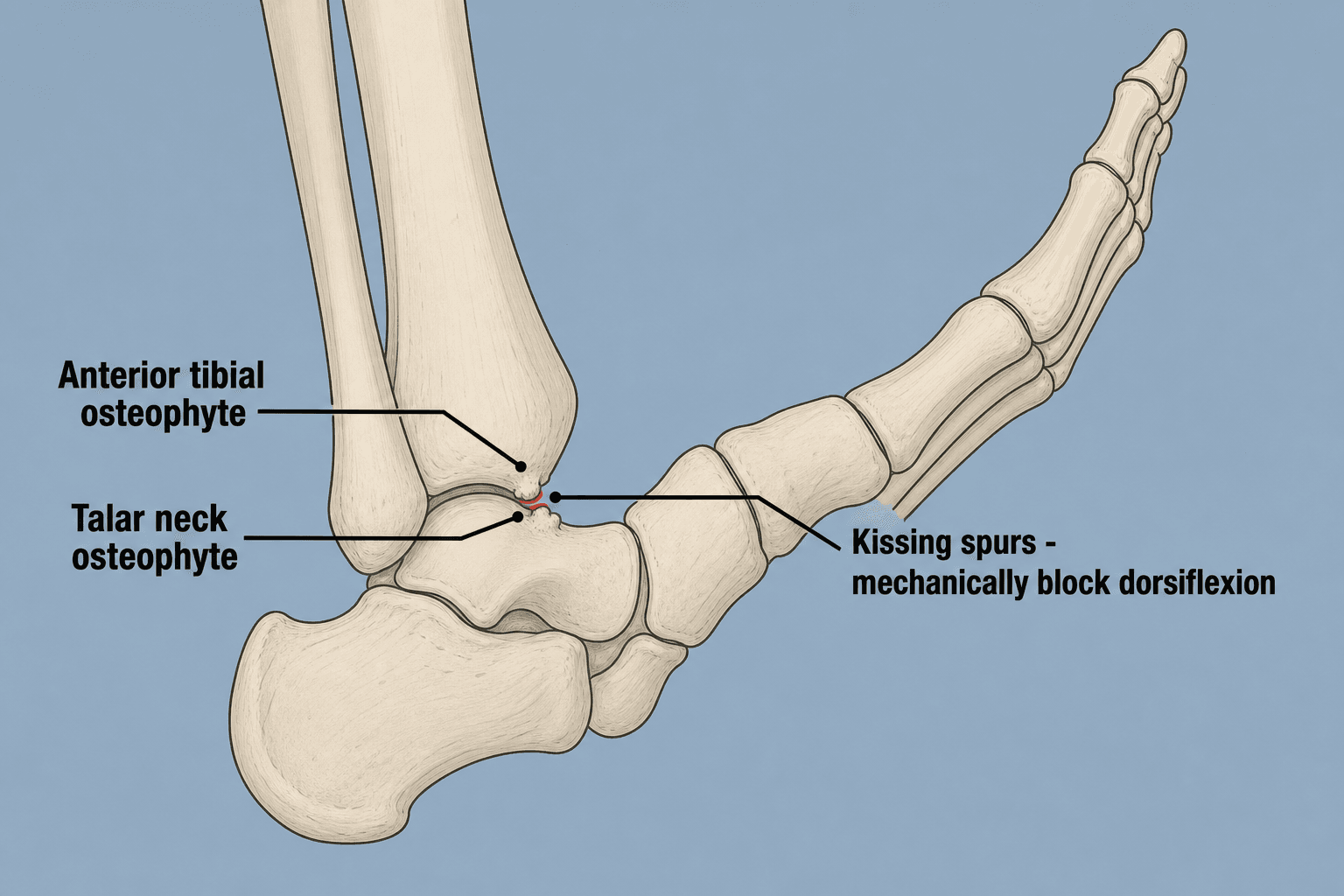
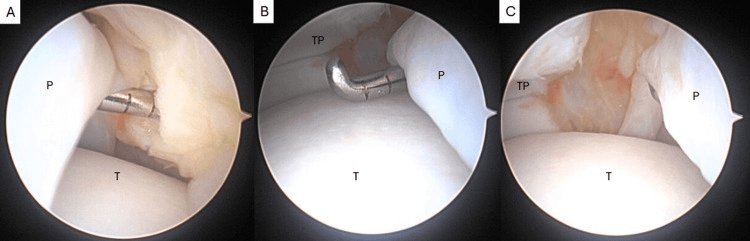
Bony impingement (primary). Anterior tibial and dorsal talar-neck osteophytes, the "kissing spurs", form at the joint margin and impinge at end-range dorsiflexion, producing a mechanical block and pain.
Why the spurs form. Direct microtrauma is the favoured theory: recurrent ball-strike and forced dorsiflexion drive repetitive intra-articular impact at the anteromedial joint margin, which stimulates marginal osteophyte. The classic teaching, that traction at the capsular insertion drives spur formation, is now largely refuted. Tol and van Dijk's cadaveric anatomical study showed the anterior capsule attaches several millimetres proximal to where the spurs actually arise, so repetitive capsular traction does not plausibly explain their location (PMID 15215021).
Soft-tissue impingement (secondary). The impinging tissue may be:
- Hypertrophic synovium or capsule, particularly after ankle sprains
- Bassett's lesion - an accessory fascicle of the anterior inferior tibiofibular ligament (AITFL)
- Meniscoid lesions - hypertrophic synovial folds trapped in the joint
- Scar tissue from previous injury or surgery
The anterior tibiotalar recess. The anterior joint line is the most common site of pathology. The space between the tibial plafond and the talar dome narrows as the ankle dorsiflexes, from a normal clearance of 3-5mm to less than 1mm at maximal dorsiflexion. The structures at risk there:
- Anterior tibial osteophyte (most common)
- Talar neck osteophyte
- Anterior joint capsule
- Extensor retinaculum
- Deep peroneal nerve and dorsalis pedis artery, a surgical consideration
The pathological sequence. Four phases:
- Acute - capsular stretch and periosteal reaction from repetitive microtrauma
- Inflammatory - synovitis and capsular thickening
- Proliferative - osteophyte formation at the joint margin
- Chronic - established osteophytes with secondary soft-tissue changes
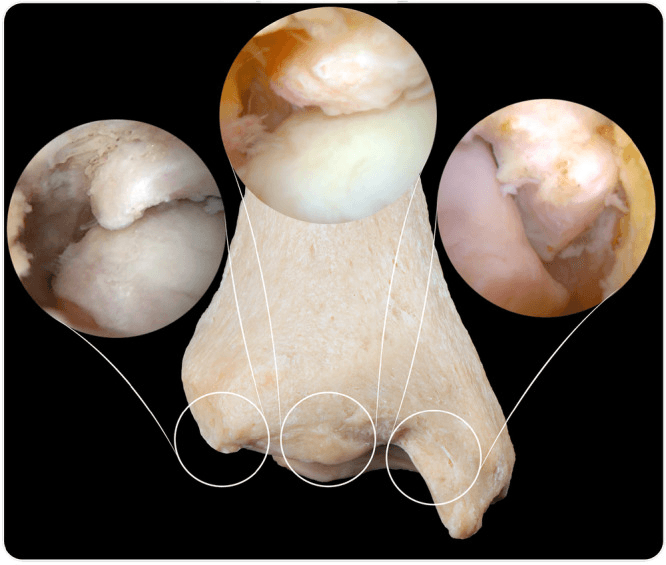
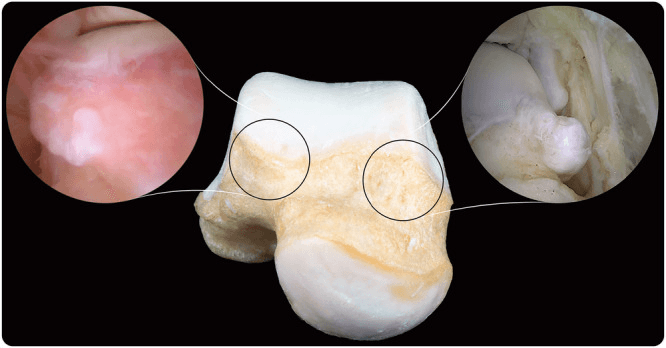
Anteromedial versus Anterolateral Impingement
Anterior ankle impingement is really two subtypes, and an examiner expects you to separate them: they differ in cause, in the offending tissue and in the imaging that reveals them.
- Anteromedial impingement
- Bony — anteromedial tibial and talar-neck osteophytes
- Anterolateral impingement
- Soft tissue — meniscoid lesion, gutter synovitis, hypertrophic distal AITFL fascicle (Bassett)
- Anteromedial impingement
- Repetitive forced dorsiflexion / kicking (footballer's ankle)
- Anterolateral impingement
- After a lateral (inversion) ankle sprain
- Anteromedial impingement
- Anteromedial spurs sit behind the anterolateral tibial rim on a true lateral — need the oblique AMI view
- Anterolateral impingement
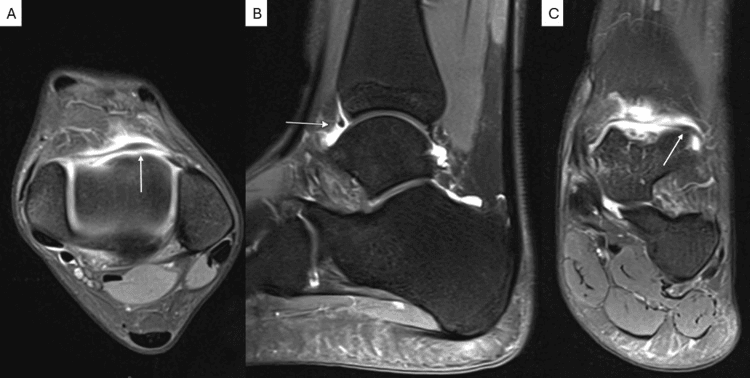
- The soft-tissue lesion is invisible on plain film — needs MRI (or arthroscopy)
- Anteromedial impingement
- Anteromedial joint line
- Anterolateral impingement
- Anterolateral gutter
Why the imaging differs. This is why the plain lateral radiograph misses so many lesions, and why the oblique AMI view and MRI each have their place in the investigations: they target different subtypes.
Combined impingement. The two frequently coexist, and arthroscopic debridement addresses both. Resect the bony spurs for the anteromedial pattern; excise the synovitis, meniscoid lesion or Bassett fascicle for the anterolateral one.
Clinical Presentation
History. Athletes, particularly footballers (soccer, Australian Rules) and dancers, present with anterior ankle pain. It is worse with activities that demand dorsiflexion: squatting, going uphill, climbing stairs and kicking. Patients notice that dorsiflexion is limited compared with the other side, and there may be a history of previous ankle sprains.
Look and feel. Mild anterior swelling may be visible, and there may be a mild effusion: palpate the anterior recesses. Compare with the other ankle and note any previous surgical scars. Tenderness lies at the anterior joint line, over the anterior tibiotalar joint; palpate with the ankle in slight plantarflexion to reach the anterior structures.
Dorsiflexion. Range is reduced compared with the other side, measured with a goniometer if one is available, and end-range dorsiflexion reproduces the pain. The impingement test, passive forced dorsiflexion, reproduces the anterior pain, and a positive test strongly suggests anterior impingement.
Excluding the neighbours. The squeeze test compresses the fibula against the tibia at mid-calf; pain suggests a syndesmotic injury rather than pure anterior impingement. With a history of sprains, check for lateral ligament laxity with the anterior drawer and talar tilt tests.
- Key Distinguishing Features
- Deep joint pain, catching, MRI findings
- Key Distinguishing Features
- Global pain, weight-bearing symptoms
- Key Distinguishing Features
- Squeeze test positive, high ankle pain
- Key Distinguishing Features
- Lateral symptoms, peroneal provocation tests
- Key Distinguishing Features
- Subtalar instability, sinus tarsi tenderness
Investigations
Radiographs. Plain films are first-line:
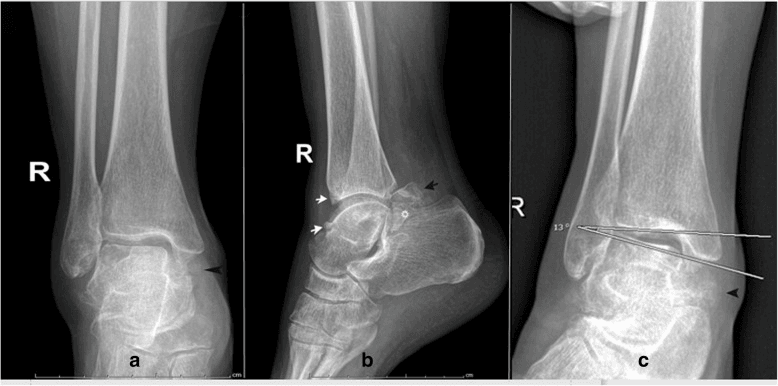
- Lateral weight-bearing - the standard view for anterior tibial and talar-neck spurs and, taken in maximal dorsiflexion, the key film for grading them. It is poorly sensitive for medially located lesions: only 40% for tibial and 32% for talar osteophytes (PMID 14992704)
- Oblique anteromedial impingement (AMI) view - beam tilted 45° craniocaudal with the leg in 30° external rotation
- AP mortise - the syndesmosis, and joint-space narrowing (the degenerative grade)
The AMI view's trade. Adding the AMI view to the lateral raises sensitivity to 85% (tibial) and 73% (talar) by unmasking anteromedial spurs hidden behind the anterolateral tibial rim (PMID 14992704). Specificity falls, from 70% to 45% for tibial and from 82% to 68% for talar osteophytes, so the view buys sensitivity by accepting roughly twice as many false positives. It is a test for not missing an anteromedial spur rather than for confirming one.
Keep the diagnosis clinical. A positive AMI view in a patient whose pain is not positional and not reproduced by forced dorsiflexion is weak evidence. That is why the diagnosis stays clinical, and a spur seen on any view still has to be shown to be the pain source.
Q: A normal lateral radiograph in suspected anterior ankle impingement — what next, and why? A: It does not exclude impingement. If you suspect a bony anteromedial lesion, add the oblique AMI view (it unmasks anteromedial spurs hidden behind the anterolateral tibial rim); if you suspect a soft-tissue anterolateral lesion (post-sprain, Bassett/meniscoid), get an MRI.
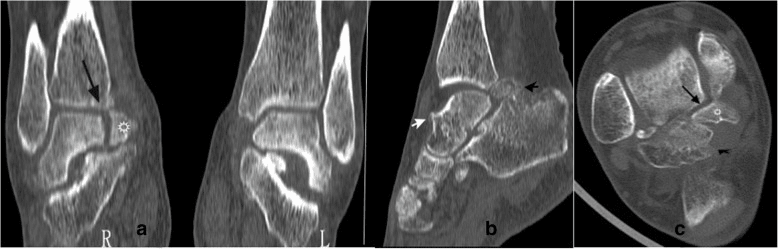
CT. For surgical planning. It quantifies osteophyte size and location, gives a better three-dimensional picture of the kissing osteophytes, and identifies the lateral and posteromedial spurs that radiographs miss. It is essential for large Grade III-IV lesions.
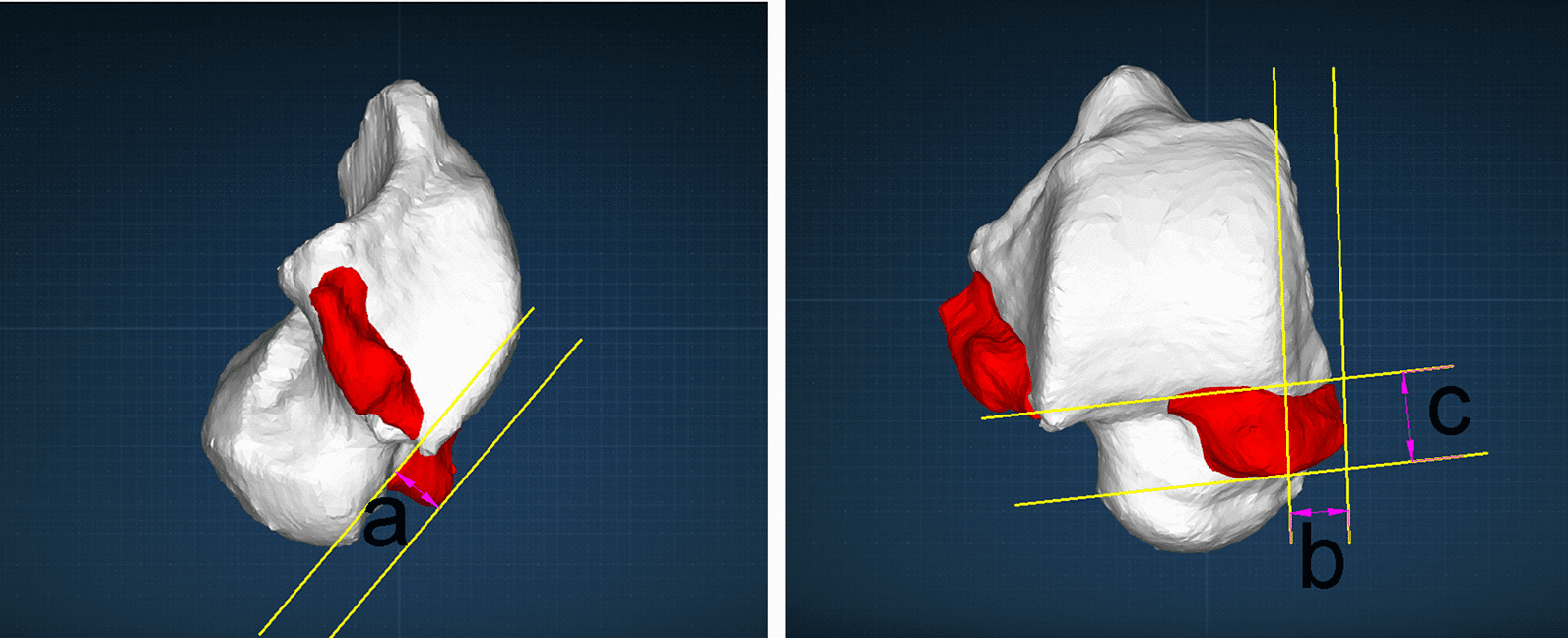
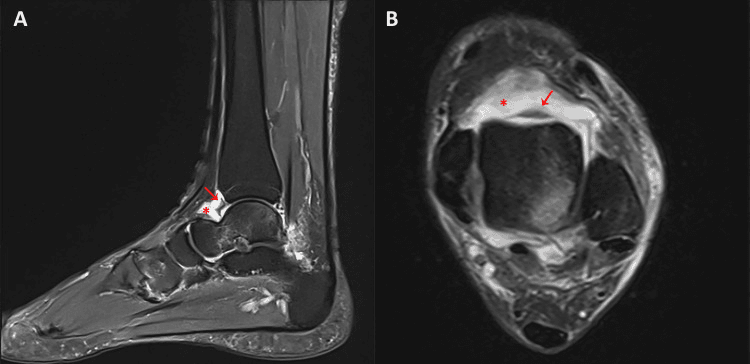
MRI. For suspected soft-tissue impingement and associated pathology. T2-weighted sequences show synovitis, effusion and bone marrow oedema; MRI identifies Bassett's lesion, meniscoid lesions and capsular thickening, and evaluates the talus for osteochondral lesions (OCL), though it is poorly sensitive for the chondral lesions that accompany a Bassett fascicle (below).
Diagnostic injection. Under fluoroscopic or ultrasound guidance, 2-3ml of local anaesthetic (lidocaine or bupivacaine) goes into the anterior recess, and steroid can be added for therapeutic effect. Pain relief confirms the diagnosis:
- More than 50% pain relief is a positive diagnostic test
- Complete relief differentiates impingement from other causes (OCD, arthritis)
- The duration of relief guides prognosis
Management
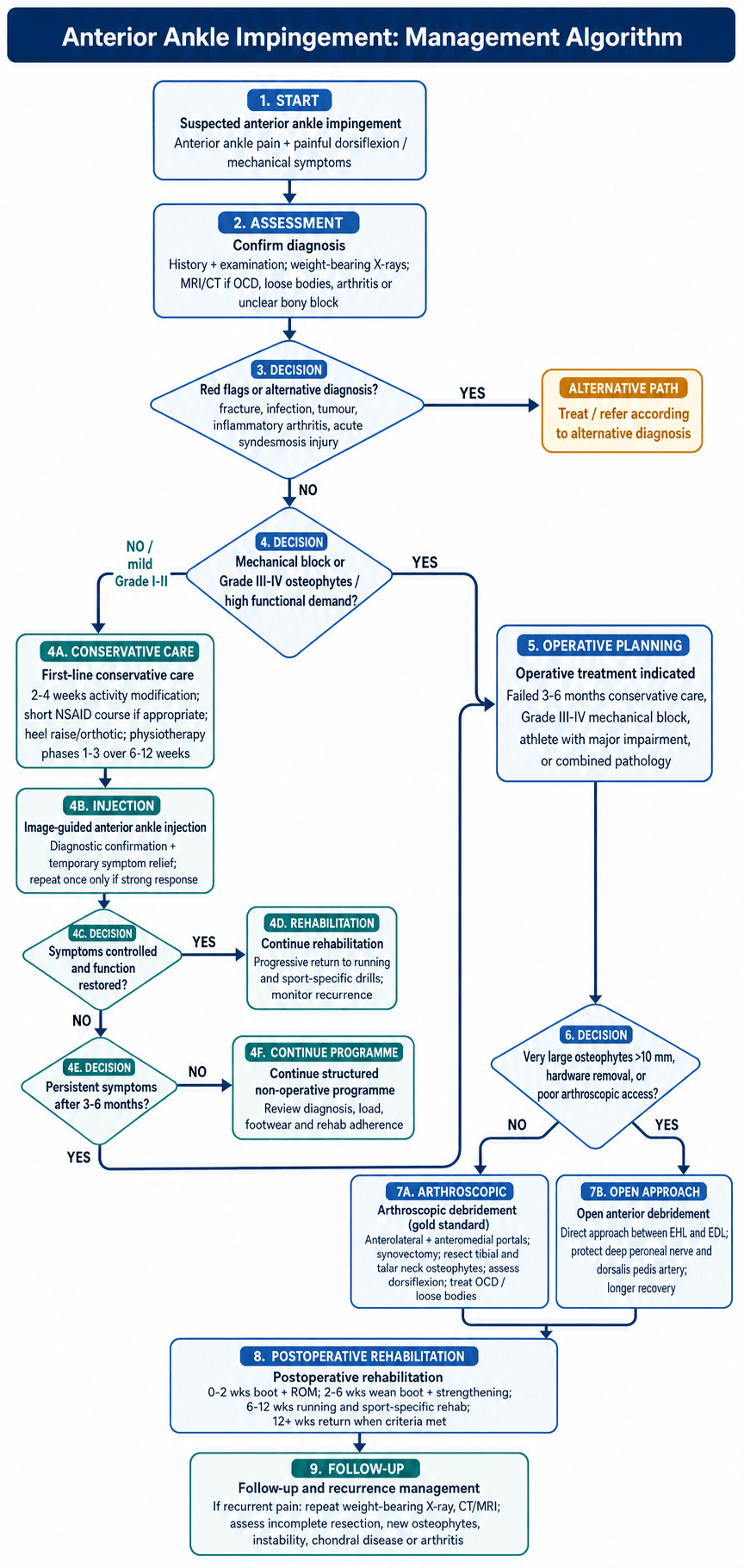
The decision. Conservative treatment is appropriate for Grade I-II lesions and is first-line for all grades, with success rates of 40-60% reported for mild cases. Arthroscopic debridement is the gold-standard operation.
Activity modification. Avoid the provocative activities (kicking, squatting, climbing) and stop sport temporarily, for 2-4 weeks initially; the athlete may need to modify training or position. A short course of NSAIDs for pain and inflammation and topical anti-inflammatory agents support this.
Physiotherapy. A three-phase protocol:
- Phase 1 (weeks 1-2) - reduce inflammation and maintain range: ankle mobilisation avoiding end-range dorsiflexion, gastrocnemius and soleus stretching, isometric strengthening
- Phase 2 (weeks 3-6) - restore range and strength: progressive dorsiflexion stretching, closed chain exercises, balance and proprioception training
- Phase 3 (weeks 6-12) - sport-specific rehabilitation: plyometrics and agility, a progressive return to running, sport-specific drills
Adjuncts. A 5-10mm heel raise in the shoe reduces the dorsiflexion demand, and orthotics with a heel lift give symptomatic relief. Taping provides proprioceptive feedback.
Corticosteroid injection. An anterior joint injection, guided in the same way as the diagnostic one, of 1ml betamethasone (or equivalent) with 2ml local anaesthetic provides diagnostic confirmation and temporary relief. It can be repeated once if the response is good.
Don't Miss the Osteochondral Lesion
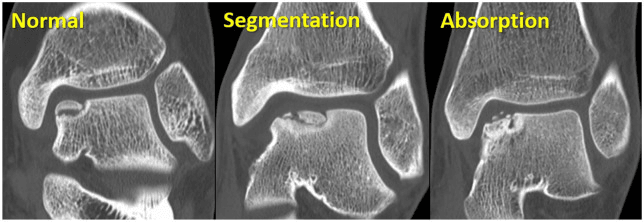
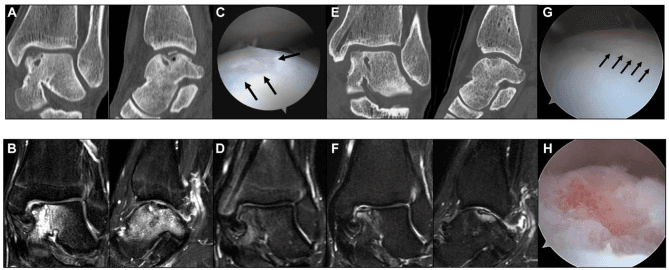
The association. Butler and colleagues found a lateral talar dome osteochondral lesion (OCL) in roughly three-quarters of ankles with a hypertrophic Bassett fascicle. The hypertrophic distal AITFL fascicle repeatedly abrades the anterolateral talar dome in dorsiflexion, so anterolateral soft-tissue impingement and a lateral-dome OCL travel together.
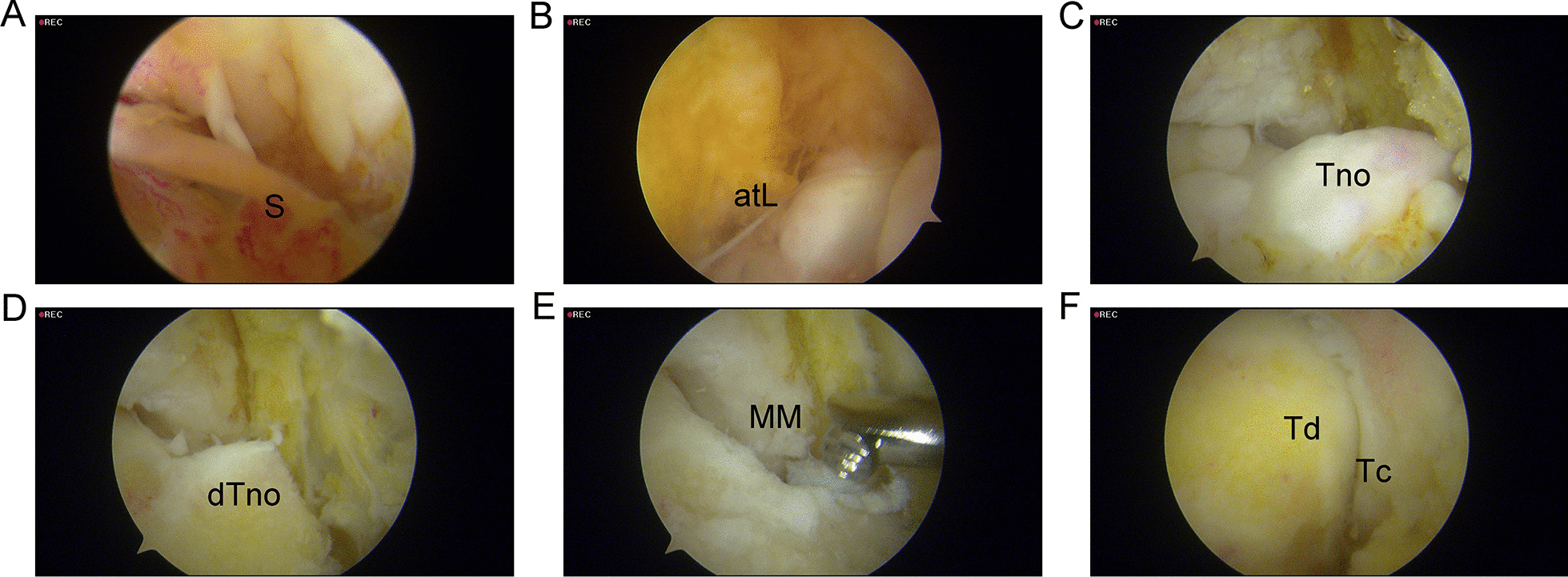
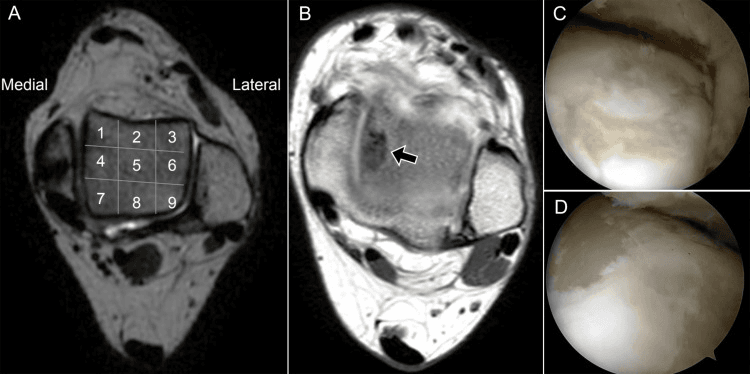
A clean MRI is not enough. MRI is poorly sensitive for these chondral lesions (Butler; Subhas), so a normal scan does not exclude an OCL. At arthroscopy for impingement, systematically probe the talar dome, especially its anterolateral shoulder, rather than stopping once the spur or fascicle is resected.
Treat it at the same sitting. Debride unstable cartilage and microfracture or marrow-stimulate small lesions; larger or cystic lesions follow the osteochondral-lesion ladder, developed in the osteochondral-lesion-talus topic. Counsel the patient that a co-existing chondral lesion worsens the prognosis, in keeping with Tol's finding that joint status rather than spur size governs outcome.
Complications
Left untreated. Dorsiflexion is progressively lost, with functional decline, and chronic pain affects athletic performance and daily activities. Compensatory gait abnormalities lead to proximal symptoms, and altered joint mechanics to secondary ankle arthritis.
General surgical complications. Infection occurs in less than 1% of arthroscopic procedures, and deep vein thrombosis is rare in a young athletic population. Wound-healing problems arise particularly with the open approach.
- Incidence
- 2-5%
- Prevention/Management
- Careful portal placement, transillumination
- Incidence
- Less than 1%
- Prevention/Management
- Avoid excessive medial traction
- Incidence
- Rare
- Prevention/Management
- Lateral portal placement
- Incidence
- 5-10%
- Prevention/Management
- Complete resection, address all pathology
- Incidence
- 2-3%
- Prevention/Management
- Early mobilisation, physiotherapy
- Incidence
- 10-15%
- Prevention/Management
- Patient selection, manage expectations
Guidelines, Registries & Global Practice
Global Epidemiology
- Anterior impingement is a leading cause of chronic anterior ankle pain in athletes, dominating kicking and forced-dorsiflexion sports (soccer worldwide, Australian Rules football, ballet, basketball, rugby, gymnastics).
- Peak incidence is in athletes aged 20-35, with a male predominance reflecting sports-participation patterns rather than an intrinsic sex difference.
- A prior history of ankle sprain or recurrent inversion injury is common, especially in the soft-tissue/anterolateral subtype.
Guidance Across Societies
There is no dedicated AAOS/NICE clinical practice guideline for anterior ankle impingement; management is driven by foot-and-ankle society consensus and the van Dijk/Amsterdam group's body of work. The shared international position is consistent:
- Position on anterior ankle impingement
- Trial of structured non-operative care first; arthroscopic debridement for recalcitrant cases; outcome governed by joint-space preservation
- Position on anterior ankle impingement
- Anterior arthroscopy is the standard approach; emphasis on portal safety and complete osteophyte resection
- Position on anterior ankle impingement
- Oblique AMI radiograph for diagnosis; arthroscopic resection; staging by joint-space narrowing rather than spur size alone
- Position on anterior ankle impingement
- Graduated return-to-sport with objective clearance criteria after surgery
Registry & Evidence Notes
- There is no implant involved, so arthroplasty registries (NJR, AJRR, AOANJRR) do not capture this condition; the evidence base is case-series and prospective cohort level (II-IV), not randomised.
- The single most-cited prognostic dataset remains Tol et al's 6.5-year cohort (PMID 11245545), reinforcing joint-space narrowing as the key outcome determinant globally.
High- vs Limited-Resource Practice
- High-resource settings: routine MRI/CT, arthroscopic debridement with fluoroscopy, formal return-to-sport testing.
- Limited-resource settings: diagnosis rests on clinical examination plus lateral and oblique radiographs; a diagnostic/therapeutic intra-articular local-anaesthetic injection is a high-value, low-cost confirmatory test. Where arthroscopy is unavailable, open anterior debridement remains a valid alternative with comparable osteophyte clearance, at the cost of slower recovery.
Controversies & Areas of Uncertainty
- Mechanism of spur formation: the classic capsular-traction theory is contradicted by anatomical evidence that the capsule attaches proximal to the spur origin (PMID 15215021); direct repetitive microtrauma is now the favoured explanation, but the debate is unsettled.
- Where to draw the surgical line: spur size (Scranton-McDermott) versus joint-space narrowing (Tol/van Dijk) as the dominant prognostic factor. Current evidence favours joint-space status, which can downgrade a radiographically "small spur" into a poor surgical prospect once narrowing is present.
- Significance of osteophyte recurrence: regrowth occurs in roughly two-thirds of operated ankles yet most stay symptom-free, so radiographic recurrence is a weak surrogate for clinical failure.
- Role and timing of injection: corticosteroid gives diagnostic confirmation and short-term relief, but durable benefit and the optimal number of injections before surgery are not standardised.
- Open vs arthroscopic for very large or Grade IV lesions: arthroscopy is standard, but for extensive spurs or established arthritis the marginal benefit over open debridement (and whether either alters the arthritic trajectory) is uncertain.
MCQ Practice Points
Q: What is footballer's ankle? A: Anterior ankle impingement from repeated dorsiflexion causing anterior tibial and talar osteophytes. Common in soccer and Australian Rules football.
Q: What is the treatment of choice for anterior ankle impingement? A: Arthroscopic debridement of osteophytes and impinging soft tissue. Greater than 85% good/excellent outcomes.
Q: What nerve is most at risk during anterior ankle arthroscopy? A: Superficial peroneal nerve - crosses 6.5cm proximal to lateral malleolus. Identify by transillumination before portal placement.
Q: What is Bassett's lesion? A: Accessory distal fascicle of the AITFL that can impinge on the anterolateral talar dome with dorsiflexion and cause soft tissue anterior impingement.
Q: What classification is used for anterior ankle impingement? A: Scranton and McDermott classification - Grade I (synovial only), Grade II (less than 3mm spur), Grade III (3-5mm spur), Grade IV (greater than 5mm or arthritis).
Q: What is the standard portal sequence for anterior ankle arthroscopy? A: Anterolateral first (viewing portal), then anteromedial under direct vision (working portal). Both portals are at joint line level.
Exam Viva Scenarios
Practise clinical reasoning and management decisions out loud
“A 25-year-old soccer player has anterior ankle pain that limits his ability to kick. Pain is worse going up stairs. How do you assess and manage him?”
“You are performing ankle arthroscopy for anterior impingement debridement. Describe your portal placement and how you would avoid neurovascular injury.”
“A patient returns 18 months after arthroscopic debridement with recurrent anterior ankle pain. How do you approach this?”
Key Facts
- Footballer's ankle
- Anterior tibial and talar spurs
- Repeated dorsiflexion microtrauma
- Pain at end-range dorsiflexion
Diagnosis
- Lateral weight-bearing X-ray
- CT for spur detail
- MRI for soft tissue
- Injection confirms diagnosis
Treatment
- Conservative: Activity mod, physio, injection
- Surgical: Arthroscopic debridement
- Greater than 85% good/excellent outcomes
- Most return to sport
Evidence Base
Scranton & McDermott
- Open vs arthroscopic resection of anterior tibiotalar spurs - similar operative time but shorter hospital stay and faster recovery with arthroscopy
- Proposed the Grade I-IV grading of spur formation that predicts recovery time
- Recovery to full activity: Grade I 5.0 wk, II 5.6 wk, III 6.4 wk, IV 10.0 wk
- Grade IV lesions deemed unsuitable for arthroscopic debridement
Tol, Verheyen & van Dijk
- Prospective series of 57 arthroscopic debridements, mean follow-up 6.5 years (range 5 to 8) - long enough that spontaneous resolution cannot explain the results
- Excellent/good results stratified by osteoarthritis grade: 100% with no OA, 77% grade I, 53% grade II
- Osteophytes recurred in around two-thirds of grade I ankles yet most stayed symptom-free
- Joint-space narrowing did not progress in most grade II ankles at follow-up
Tol & van Dijk (etiology)
- Cadaveric anatomical study of 8 ankles examining capsule attachment and spur origin
- Anterior capsule attaches PROXIMAL to the site where talotibial spurs originate
- Repetitive capsular traction therefore does not plausibly explain spur formation
- A triangular anterior soft-tissue component is squeezed between tibia and talus at 15 degrees dorsiflexion
Tol et al (oblique radiograph)
- Prospective diagnostic study of 60 patients vs CT, MRI and arthroscopy reference standard
- Lateral radiograph sensitivity only 40% (tibial) and 32% (talar) for anterior osteophytes
- Adding the oblique anteromedial impingement (AMI) view raised sensitivity to 85% and 73%
- Anteromedial spurs are hidden behind the anterolateral tibial rim on a true lateral
Baums et al
- Prospective study of 26 athletes treated arthroscopically for anterior ankle pain
- Karlsson score improved from 66 to 92 and Tegner from 3 to 8 at mean 31 months
- 25 of 26 athletes very satisfied with return to competitive sport
- No significant outcome difference between soft-tissue and bony impingement groups
Subhas et al (Bassett's ligament)
- MRI of 18 surgically proven abnormal Bassett's ligaments vs 18 controls
- Bassett's ligament identified on MRI in 94% of cases, best seen in the axial plane
- Mean thickness 2.37mm in abnormal cases vs 1.87mm in controls
- Associated talar cartilage lesions and gutter synovitis are poorly detected on conventional MRI
Butler et al
- Retrospective series of 32 patients with hypertrophic distal AITFL fascicle (mean MRI thickness 2.5mm)
- Lateral talar dome osteochondral lesions found arthroscopically in 75.9%
- Preoperative MRI had poor sensitivity for these chondral lesions
- FAOS and VAS improved significantly; no syndesmotic instability after fascicle resection