Fifth MT Lateral Prominence | Coughlin Classification | Osteotomy Selection
- 4-5 intermetatarsal angle (IMA): Normal under 8 degrees; over 8 degrees = Type III component
- Type I (lateral condyle only): Simple lateral condylectomy, highest recurrence (15-25%)
- Type II (shaft bowing): Distal chevron osteotomy or oblique shaft osteotomy
- Type III (increased IMA): Proximal osteotomy provides best correction of divergent metatarsals
- Combination deformities are most common: Often Type II plus Type III requiring shaft osteotomy
- “Coughlin classification directly determines surgical procedure - know Type I, II, III
- “4-5 IMA over 8 degrees requires proximal or shaft osteotomy, not condylectomy alone
- “Transfer metatarsalgia occurs if fifth MT shortened over 3-4mm
- “Coexistent hallux valgus present in 30-40% - address staging if both symptomatic
Overview and Epidemiology
A bunionette, historically the tailor's bunion, is a painful lateral prominence of the fifth metatarsal head. With it come lateral deviation of the fifth toe at the metatarsophalangeal (MTP) joint, a bursa over the prominence from chronic friction, and callus or thickened skin over the symptomatic area.
The name. In the pre-industrial era tailors sat cross-legged on the floor for hours while sewing, which put the lateral fifth metatarsal head in direct contact with a hard surface. The repetitive pressure produced bursa formation and pain, and the deformity took the trade's name.
Who gets it. It is present in approximately 0.25-1.0% of the general population and accounts for 3-4% of forefoot surgery, although the exact incidence is unknown because many cases are asymptomatic. There is a female predominance of 4:1 to 9:1, the peak age is 40-60 years, and it is often bilateral (40-60% of cases). It is more common in Western populations, an effect attributed to footwear.
Risk factors. The intrinsic factors belong to the patient and the foot:
- Genetics, with a familial predisposition in 30-50%
- Female sex, through a hormonal influence on ligament laxity
- Pes planus and the flexible flat foot
- Generalised ligamentous laxity and hypermobility syndromes
- Congenital metatarsal abnormalities, with lateral bowing present from birth
The extrinsic factors are constrictive footwear with a narrow or pointed toe box, high heels (which increase forefoot loading), prolonged occupational standing, running, ballet and gymnastics, and obesity, which increases the mechanical stress on the forefoot.
Constrictive footwear is typically an aggravating factor, not the primary cause. Patients with a structural abnormality, an increased 4-5 IMA or lateral shaft bowing, develop symptoms when the shoe presses on the existing prominence. A wide toe box may reduce the symptoms but does not correct the underlying bony deformity.
Associated deformities. Hallux valgus coexists in 30-40% and has its own section below. The fifth toe itself may overlap or underlap, or develop a flexion contracture of the interphalangeal joint, and these deformities may require concurrent correction.
Pathophysiology and Biomechanics
The normal fifth ray. The fifth metatarsal is the lateral weight-bearing column and its head bears approximately 10% of forefoot load during stance. The ray is relatively mobile compared with the rigid medial rays (first through third): it pronates during weight acceptance and gives the lateral column stability through terminal stance and push-off. Peroneus brevis inserts on the fifth metatarsal base and exerts a lateral pull.
How the prominence becomes painful. In a bunionette the pressure concentrates on the lateral prominence of the head, and chronic friction between shoe and prominence produces an adventitial bursa as a protective response. The soft-tissue inflammation and pain are progressive, and capsular attenuation allows the fifth toe to drift into valgus.
Classification Systems
Coughlin's classification is the standard system. It divides bunionettes into three types by the radiographic location of the structural abnormality, and it directly guides the choice of operation.
- Radiographic finding
- Enlarged lateral condyle (hypertrophied lateral eminence) of the MT head; normal shaft without bowing
- 4-5 IMA
- Normal (under 8 degrees)
- Surgical approach
- Lateral condylectomy ± medial displacement
- Radiographic finding
- Lateral bowing (increased lateral convexity) of the MT shaft, apex at mid-shaft; the head may be normal-sized
- 4-5 IMA
- Normal or mildly increased
- Surgical approach
- Distal chevron or oblique shaft osteotomy
- Radiographic finding
- Splay foot, with divergence between the fourth and fifth metatarsals; shaft normal or minimally bowed
- 4-5 IMA
- Over 8 degrees (pathological)
- Surgical approach
- Proximal osteotomy (best IMA correction) or shaft osteotomy
- Radiographic finding
- Features of more than one type, most often shaft bowing plus an increased IMA; the most common presentation
- 4-5 IMA
- Variable, often over 8 degrees
- Surgical approach
- Oblique shaft osteotomy or staged procedures
A bursa over the prominence is common in Type I. Combination deformities need careful radiographic analysis, and a single oblique shaft osteotomy can address both components. Recurrence after correcting a combination deformity is variable, 5-15%.
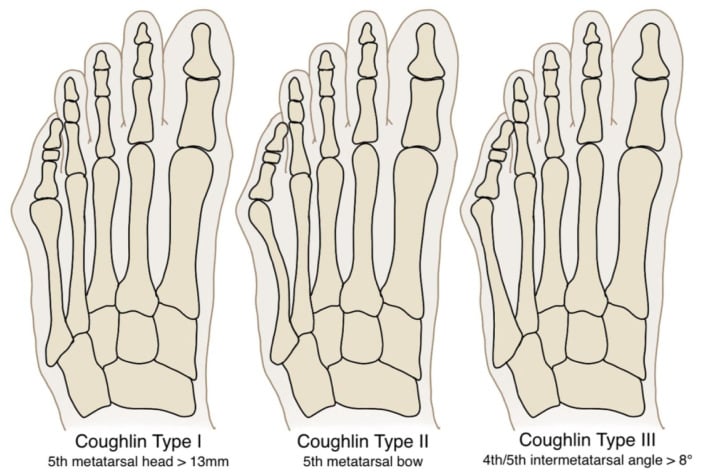
Operate at the apex of the deformity. Type I apex is at MT head (condylectomy). Type II apex is at shaft (distal/shaft osteotomy). Type III apex is at base (proximal osteotomy). Operating at the wrong level results in inadequate correction and high recurrence.
Fallat's classification is an alternative, less commonly used, built on the same ideas with different numbering: Type I is lateral deviation of the fifth metatarsal head, Type II lateral bowing of the shaft, and Type III enlargement of the head. Coughlin's is more widely accepted and is the one used in exam settings.
Clinical Presentation and Assessment
History. Pain over the lateral fifth metatarsal head is the most common presenting symptom. Patients also complain of the visible lateral bump, of being unable to wear the shoes they want and being limited to a wide toe box, and of skin problems: redness, a bursa, callus and occasional skin breakdown.
The pain. It is aching, burning or pressure-type and sits over the prominence. Tight shoes, high heels and prolonged walking or standing make it worse; wide shoes, going barefoot and rest relieve it. Ask what it costs the patient: how far shoe choice is limited, whether formal or dress shoes are possible, whether pain limits walking distance or exercise, and the effect on work, especially work that requires formal footwear.
Standing inspection. Look first at the whole foot: forefoot width and splay, a concurrent hallux valgus, arch height (planus, cavus or neutral) and lesser toe deformities such as hammer, claw or overlapping toes. Then the bunionette itself: the size and site of the prominence, the position of the fifth toe (valgus, varus, overlapping or underlapping), skin changes from erythema and an adventitial bursa to callus or ulceration, and the other foot for comparison.
Palpation. Point tenderness over the lateral fifth metatarsal head, and a tender bursa that is fluctuant if it contains fluid. Feel for plantar callus under the head, an intractable plantar keratosis, and palpate the fourth webspace, because an interdigital neuroma may coexist.
Movement and stability. Test dorsiflexion and plantarflexion of the fifth MTP joint and the mobility of the fifth toe interphalangeal joints. Pain on motion suggests intra-articular pathology and crepitus indicates degenerative change. Medial-lateral stress of the fifth MTP joint assesses capsular integrity and instability.
Gait and shoes. A significantly painful bunionette may produce an antalgic gait; watch the foot through stance and push-off for lateral column overload or transfer to the fourth metatarsal. Examine the patient's usual shoes for toe box width, heel height, sole flexibility and asymmetric wear, correlate the pressure areas with the painful sites, and document any modification the patient has already made.
Investigations and Imaging
The weight-bearing AP radiograph is the most important investigation, and the film on which the deformity is measured and classified:
- 4-5 intermetatarsal angle (IMA), between the long axes of the fourth and fifth metatarsals. Normal is under 8 degrees; over 8 degrees indicates a Type III component and decides whether a proximal osteotomy is needed.
- Lateral deviation angle (LDA), between the fifth metatarsal axis and the proximal phalanx of the fifth toe. Normal is 0-12 degrees and pathological over 16 degrees; it assesses fifth toe valgus, which may need soft-tissue balancing.
- Fifth metatarsal head width, from its medial to its lateral edge, increased in Type I.
- Shaft morphology: the presence and degree of lateral bowing (Type II), compared with the convexity of the normal opposite side.
- Head position: its relationship to the fourth metatarsal head and the degree of lateral prominence.
Do not confuse the 4-5 IMA with the 1-2 IMA of hallux valgus, which is normal under 9 degrees. Know both thresholds: examiners test the difference.
The same film shows degenerative change at the fifth MTP joint (joint-space narrowing, osteophytes, subchondral sclerosis), a sesamoid under the fifth metatarsal head (rare, but note it), the metatarsal length pattern and parabola, and the hallux valgus angle and 1-2 IMA if there is a coexistent hallux valgus.
Degenerative arthritis of the fifth MTP joint can develop in long-standing bunionette deformity. Severe arthritis may require a modified surgical approach or salvage fusion rather than osteotomy alone.
Lateral and oblique views. The weight-bearing lateral shows the fifth metatarsal declination angle (sagittal alignment), any plantarflexion of the fifth ray, medial column alignment and the overall shape of the foot, cavus or planus. The oblique gives a better view of the fifth metatarsal head articular surface, the MTP joint space and congruity, and osteophytes.
MRI is rarely indicated and not routine for an uncomplicated bunionette. It may be useful for suspected MTP joint pathology (osteochondral defect, loose body, severe synovitis), concern for a stress fracture of the fifth metatarsal, planning a complex revision, or an unclear diagnosis with an atypical pain pattern.
CT is rarely needed for a primary bunionette. It may help with a complex three-dimensional bony deformity, is useful for evaluating severe degenerative change, and can be considered when planning revision surgery.
Ultrasound can show bursal thickening and fluid over the metatarsal head and assess soft-tissue inflammation, but it is operator-dependent and not standard of care.
Differential diagnosis. Other causes of lateral forefoot pain:
- Fifth metatarsal stress fracture (Jones fracture or shaft stress fracture): pain at the base or shaft, tenderness along the metatarsal, radiographic findings
- Interdigital neuroma (fourth webspace): burning pain radiating to the fourth and fifth toes, positive Mulder's click, relief with toe separation
- Fifth MTP synovitis: inflammatory arthritis, joint effusion, morning stiffness, systemic features if rheumatoid arthritis
- Intractable plantar keratosis: primarily plantar pain, no lateral prominence, callus under the metatarsal head
- Fifth toe deformity (overlapping toe, hammertoe): primarily toe pathology, less metatarsal head prominence
- Gout or pseudogout: acute inflammatory monoarthritis, crystal deposition, erythema and warmth
- Ganglion cyst: fluctuant soft-tissue mass that may transilluminate and varies in size
- Soft-tissue tumour: rare, but consider it with an atypical mass or progressive symptoms
Management Approach
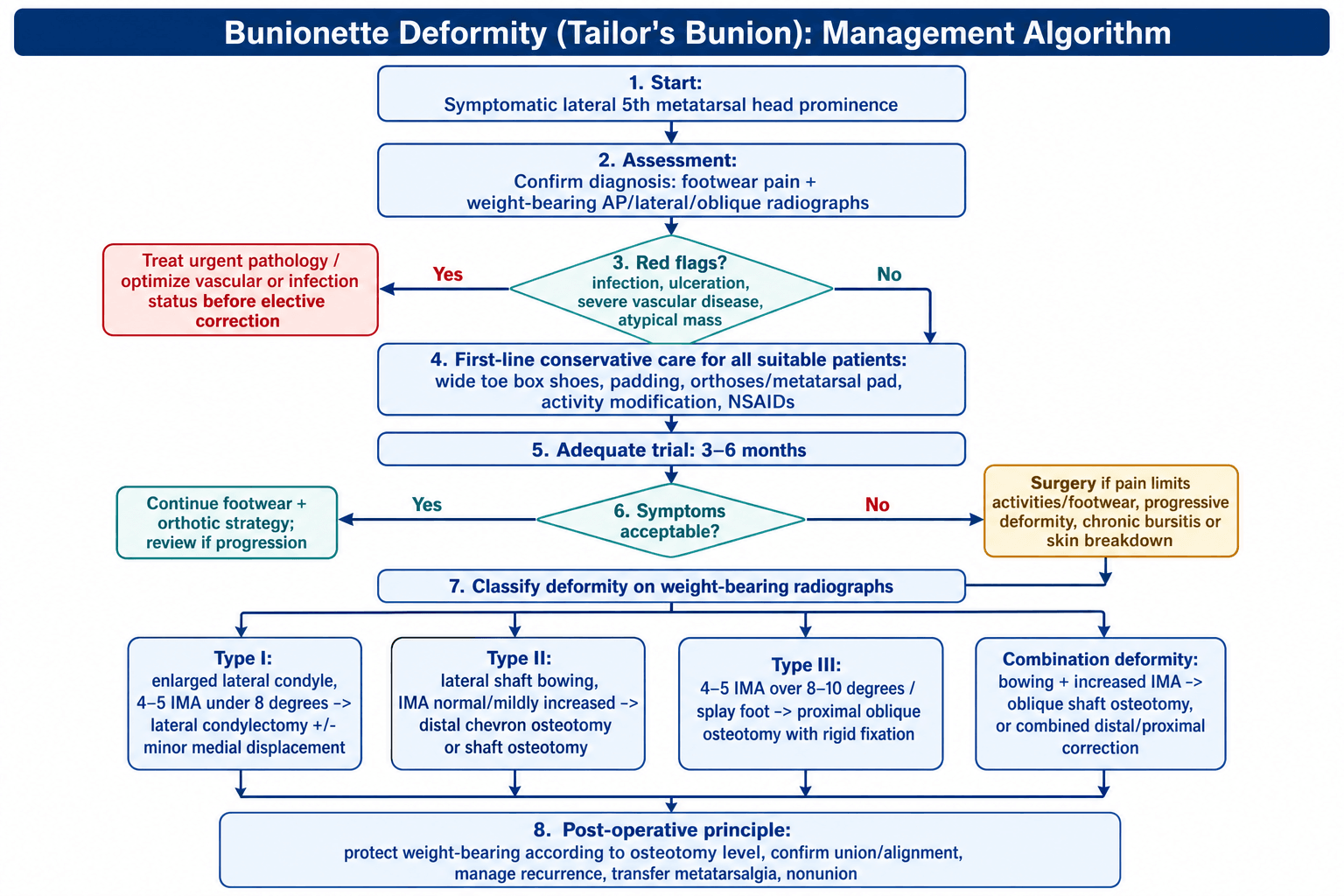
Conservative care comes first. It is the first-line approach for every bunionette, and every patient should have an adequate trial of 3-6 months minimum before surgery is considered. It is indicated for mild to moderate symptoms, for the patient unwilling or medically unfit for surgery, and at first presentation without previous conservative attempts.
Footwear is the most important modification, and a wide toe box is the essential change. Soft leather uppers stretch and accommodate, lace-up shoes allow the width to be adjusted, and custom or orthopaedic shoes are for severe deformity. High heels, which increase forefoot loading, and pointed toes are avoided.
Padding and orthoses. Bunionette pads or cushions, felt or gel pads, and a bunion shield or protective sleeve reduce direct pressure over the lateral head; toe spacers between the fourth and fifth toes are of limited benefit. Custom orthoses with lateral posting, metatarsal pads that redistribute forefoot pressure away from the fifth metatarsal, and arch support for a concurrent pes planus add to the offloading. Orthoses improve symptoms but do not correct the structural deformity.
Activity, medication and physiotherapy. Reduce high-impact activity during symptomatic periods, cross-train with low-impact alternatives such as swimming and cycling, wear proper footwear for all activities, and lose weight if obese to reduce forefoot loading. NSAIDs treat acute inflammatory episodes, alongside topical anti-inflammatory preparations and paracetamol if NSAIDs are contraindicated. Physiotherapy offers foot and ankle stretching, intrinsic muscle strengthening, gait training and biomechanical optimisation, and ice for acute flares.
Corticosteroid injection into the bursa over the fifth metatarsal head may give temporary relief for weeks to months and is useful for diagnostic confirmation, but it is not recommended as definitive treatment. A superficial injection risks skin atrophy and depigmentation.
What conservative care achieves. Appropriate shoe modification improves symptoms in 40-60%, most effectively in mild deformity where the problem is primarily extrinsic shoe pressure. It has limited benefit for significant structural deformity and does not prevent progression of the bony deformity, and many patients eventually require surgical correction.
Surgery is indicated for:
- A symptomatic bunionette despite an adequate conservative trial
- Pain significantly interfering with desired activities or footwear
- Progressive deformity causing increasing symptoms
- Recurrent skin breakdown, ulceration or chronic bursitis
- Cosmetic concern, as a relative indication only: the patient must understand the risks and have realistic expectations
Contraindications. The absolute ones are active infection in the surgical field, severe peripheral vascular disease with critical limb ischaemia, unrealistic expectations or poor understanding, and medical instability precluding elective surgery. Relative contraindications are mild symptoms adequately managed conservatively, poor expected compliance with post-operative restrictions, active inflammatory arthropathy (which may require a modified approach), significant comorbidities increasing perioperative risk, and an occupation requiring an immediate return to unprotected weight-bearing.
Surgical Techniques
The operation follows the Coughlin type. The condylectomy and the chevron and proximal osteotomies are all done supine under an ankle tourniquet with small-fragment instruments and a microsagittal saw; the image intensifier is available for a condylectomy and essential for the two osteotomies.
Lateral Condylectomy for Type I Bunionette
Indications. A true Type I deformity: isolated enlargement of the lateral condyle, a normal 4-5 IMA (under 8 degrees), no significant lateral deviation of the fifth toe, and minimal or no shaft bowing.
Principle. Remove the prominent lateral bone without shortening the metatarsal, preserving the articular surface and MTP stability and disturbing normal biomechanics as little as possible. It is the simplest procedure.
- Incision. Under a tourniquet at 250 mmHg, a dorsolateral longitudinal incision 3-4 cm long, straight or gently curvilinear, centred over the fifth metatarsal head, protecting the dorsal sensory branches in the sural nerve distribution.
- Exposure. Identify and protect the neurovascular bundles, open the capsule longitudinally over the lateral head, and reflect it subperiosteally to expose the lateral eminence and define how much bone must be resected.
- Resection. With the microsagittal saw or an osteotome, remove the eminence parallel to the lateral shaft, from dorsal to plantar cortex. Take only the prominent portion and stay out of the articular surface, leaving a smooth lateral contour that matches the normal shaft.
- Smoothing. Rongeur or power burr to every edge, then palpate to be sure no lateral projection remains.
- Optional medial displacement. If a significant lateral prominence remains after condylectomy alone, a small chevron-type osteotomy at the head-neck junction allows medial displacement of 2-3 mm at most, with a 0.062-inch K-wire if unstable.
- Capsule. Excise redundant capsule if a large chronic bursa is present, repair with 3-0 or 4-0 absorbable suture, and consider a medial capsular reef to help realign the fifth toe.
- Closure. Layered, with 3-0 absorbable subcutaneous sutures and 4-0 absorbable subcuticular or non-absorbable interrupted skin sutures, under a soft compressive dressing that holds the fifth toe corrected.
How much bone. Remove enough to eliminate the prominence and no more; intraoperative fluoroscopy can confirm an adequate but not excessive resection. Too little leaves a residual prominence and recurrence, too much makes the head unstable and causes transfer metatarsalgia, and entering the articular surface leads to post-operative degenerative arthritis. Stay lateral to the MTP joint margin and smooth every edge meticulously to prevent a recurrent bony prominence.
The nerve at risk. The plantar lateral neurovascular bundle is the most at risk, and injury to the plantar lateral digital nerve to the fifth toe is the particular pitfall.
Afterwards. A rigid-soled, open-toe post-operative shoe for 2-4 weeks with weight-bearing as tolerated immediately, and elevation and ice for the first 72 hours. Range-of-motion exercises start on day 2-3 to prevent stiffness. Wide toe-box shoes follow at 4-6 weeks and full unrestricted activity at 6-8 weeks, with radiographs at 6 weeks to assess bone healing.
Outcome. Success is 65-80%, lower than the osteotomy procedures, and satisfaction 70-85%. Recurrence, at 15-25%, is the highest of all bunionette procedures. The best results are in a true Type I deformity without a structural increase in the IMA.
Minimally Invasive (Percutaneous) Distal Chevron Osteotomy
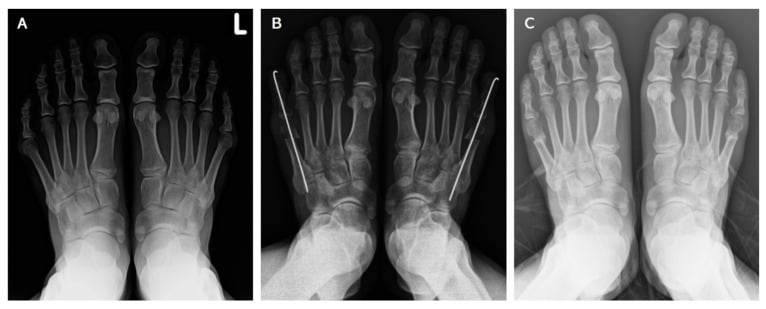
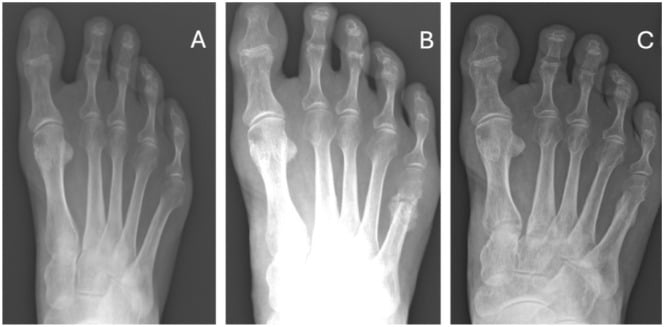
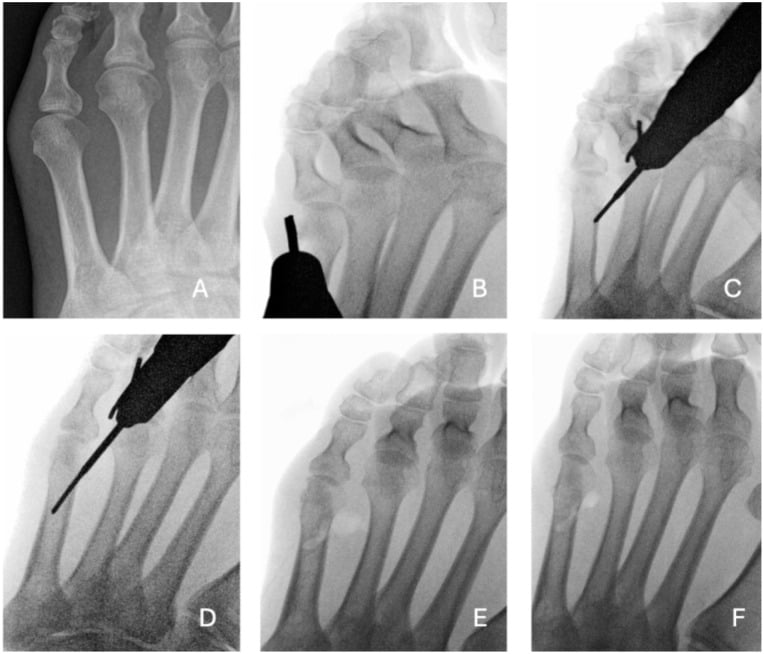
Rationale. Reflecting the wider shift to percutaneous forefoot surgery, the distal chevron can be performed through a stab incision with a burr rather than an open arthrotomy. The aim is the same correction with less soft-tissue dissection, less stiffness and a smaller scar.
Technique. A percutaneous portal is made at the fifth metatarsal head-neck junction and a low-speed, high-torque Shannon/wedge burr is introduced under fluoroscopic control. A transverse or chevron-type osteotomy is completed through the bone while the surrounding periosteal soft-tissue sleeve is preserved. The capital fragment is displaced medially, then often left unfixed, held by the intact soft-tissue envelope, or fixed with a single percutaneous screw or K-wire; any residual lateral prominence is smoothed with the burr.
Evidence. In the Benavente series (28 patients, 31 feet, no fixation) the 4-5 IMA corrected from 10.3 to 4.8 degrees and the lateral deviation angle from 8.5 to 0.97 degrees, with a mean AOFAS gain of 29 points and only one asymptomatic delayed union.
Caveats. It is fluoroscopy- and skill-dependent, and thermal necrosis from the burr must be avoided with irrigation and a low speed. High-quality trials directly comparing it with open osteotomy are still lacking, so open osteotomy remains the reference standard.
Bunionette with Concurrent Hallux Valgus (Combined Forefoot Correction)
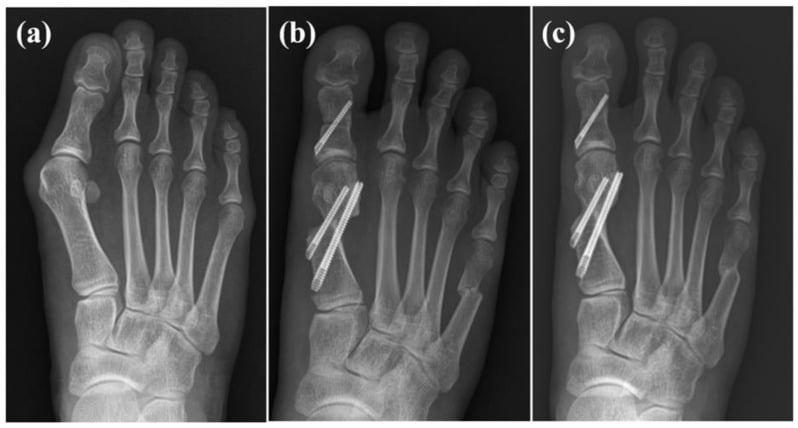
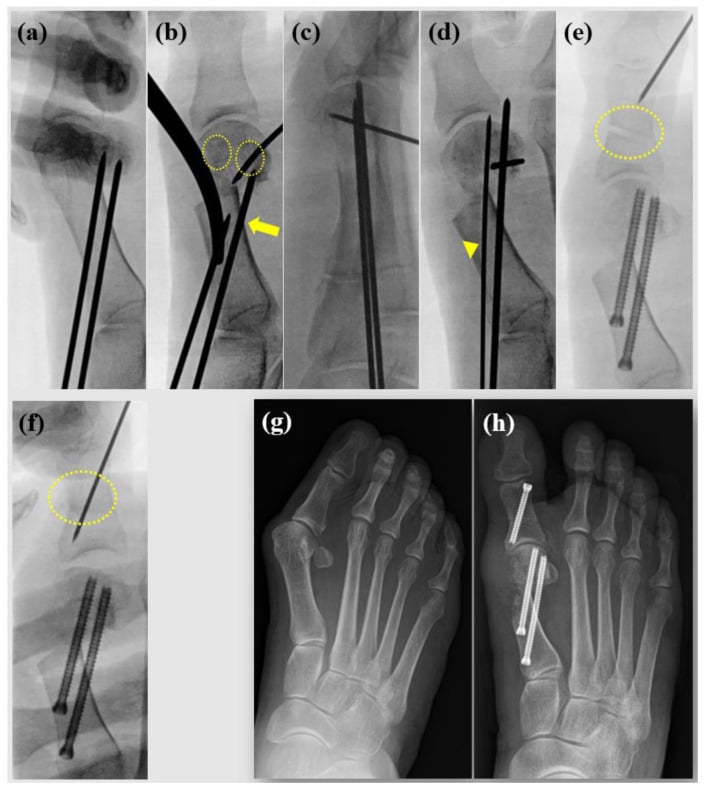
Why they coexist. Both are expressions of a generalised splay foot. Nestor's radiographic study showed that bunionette feet have increased 1-2 and 4-5 intermetatarsal angles, so the same forefoot widening drives a medial prominence, the hallux valgus, and a lateral one, the bunionette.
Assess both borders. Measure the hallux valgus angle and 1-2 IMA medially and the 4-5 IMA and lateral deviation angle laterally, and establish which deformity is actually symptomatic.
Correct only what is symptomatic. An asymptomatic bunionette alongside a painful bunion, or the reverse, does not mandate correcting both. Operate on the symptomatic deformity and match each side's procedure to its own deformity: the Coughlin type laterally, hallux valgus severity medially.
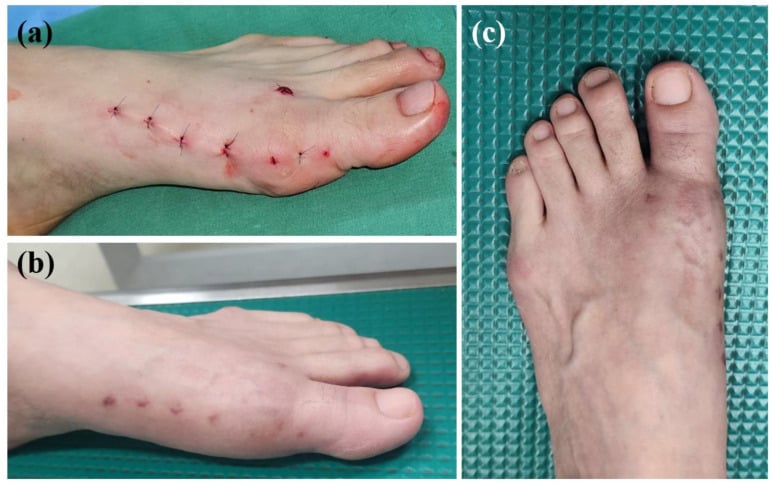
When both are symptomatic. Correcting a first-ray and a fifth-ray osteotomy at the same sitting is attractive, with one anaesthetic and one recovery, and it is done. It does, however, create two osteotomies at the two widest, most tenuously vascularised borders of the forefoot, and a swollen foot that is harder to rehabilitate. Many surgeons therefore stage the corrections roughly 3-6 months apart, letting the first side heal and rehabilitate before the second. The decision balances patient preference and a single recovery against the greater swelling, stiffness and wound risk of simultaneous surgery on both borders.
Complications and Management
Early Complications (Under 6 Weeks)
Wound problems. Infection occurs in 2-5%. Superficial infection, with erythema and drainage, is treated with oral antibiotics; deep infection may require debridement and IV antibiotics. Meticulous sterile technique, prophylactic antibiotics and gentle tissue handling prevent it.
Wound dehiscence (2-3%) is managed with local wound care and secondary healing if small, and revision closure if large or problematic. Skin-edge necrosis (1-2%) is more likely after previous surgery or with poor vascularity; dressings are usually sufficient and debridement is rarely required.
Nerves and vessels. Sural nerve injury or irritation, 5-10%, is the most common neurological complication. Most cases are temporary dysaesthesia or numbness that usually improves over 3-6 months, and permanent sensory change remains in 1-2%. Prevention is careful identification and protection of the sural branches during the approach, gentle soft-tissue handling without excessive stripping, meticulous haemostasis and gentle closure.
Plantar lateral digital nerve injury (1-2%) leaves the lateral fifth toe numb and is most concerning during a condylectomy, with its plantar dissection. Vascular compromise is rare (under 1%): haematoma is more common, and true arterial injury very rare.
Hardware. K-wire migration, a prominent screw head irritating the lateral side, and screw penetration into the MTP joint, which is checked on intraoperative fluoroscopy.
Late Complications (Over 6 Weeks)
Recurrence is the most common long-term complication overall, at 10-20% across all procedures: higher after condylectomy alone and lower after osteotomy, with the rates given under each technique. Inadequate initial correction is the most common cause; the others are the wrong procedure for the deformity type, loss of fixation or correction during healing, and progression of the underlying structural problem. Revision uses the osteotomy appropriate to the deformity now present. Prevention is accurate pre-operative classification and measurement, the right procedure for the type, adequate correction (4-5 IMA under 8 degrees), rigid fixation to hold it during healing, and a patient who complies with the post-operative restrictions.
Nonunion and delayed union follow 5-8% of proximal and 2-5% of distal osteotomies; a condylectomy has no osteotomy to fail. The risk factors are smoking, diabetes, excessive motion at the osteotomy and inadequate fixation. Delayed union is treated with extended protected weight-bearing and a bone stimulator, nonunion with revision osteotomy, bone graft and rigid fixation. Prevention is adequate bone-to-bone contact, rigid internal fixation (two screws for a proximal osteotomy), protected weight-bearing until radiographic healing, and optimising smoking cessation, diabetic control and nutrition.
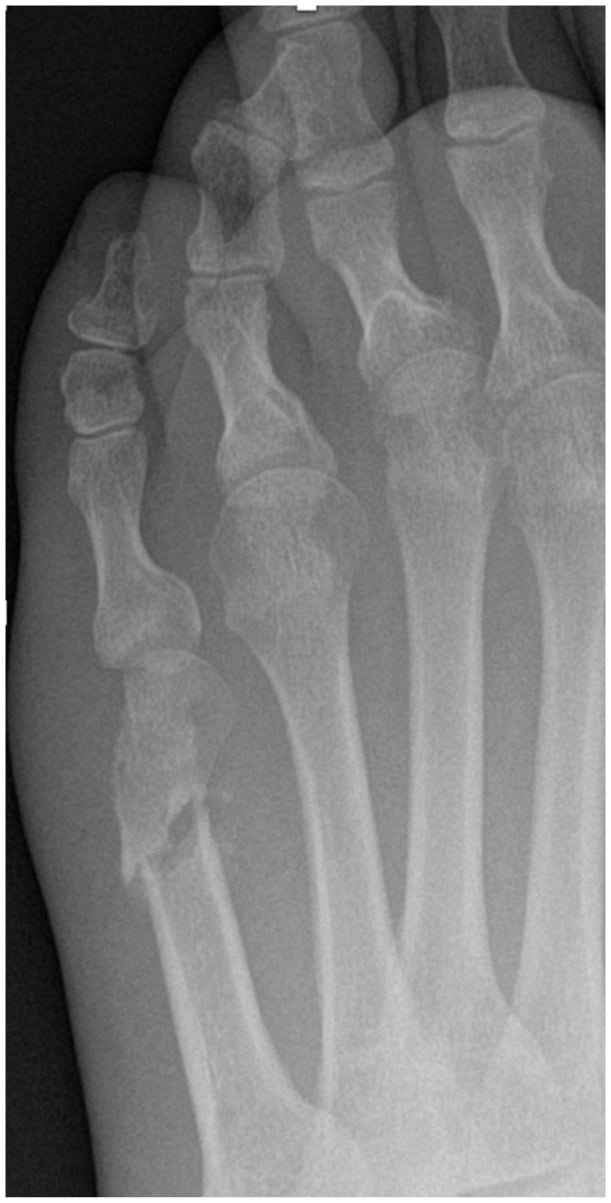
Transfer metatarsalgia. Pain shifts to the adjacent metatarsal heads, usually the fourth and sometimes the third, in 5-15% depending on procedure and technique. Relative shortening or elevation of the fifth metatarsal shifts load to the adjacent rays. The risk factors are excessive medial displacement causing shortening over 3-4 mm, dorsiflexion of the fifth metatarsal, and a pre-existing long fourth metatarsal. Prevention means limiting fifth metatarsal shortening to 2-3 mm at most, avoiding dorsiflexion to keep the sagittal alignment, maintaining the metatarsal parabola on the lateral radiograph, and considering a Weil osteotomy of the fourth metatarsal if it is already overloaded pre-operatively.
Treatment is conservative first: a metatarsal pad proximal to the painful head, custom orthotics with selective metatarsal relief, and rocker-bottom soles. If that fails, a Weil osteotomy of the fourth (or third) metatarsal shortens it by 2-3 mm and restores the parabola.
Malunion. Dorsal, plantar or rotational malalignment at the osteotomy, or excessive or insufficient medial displacement, can cause transfer symptoms, recurrent deformity or altered gait mechanics. A symptomatic malunion may require corrective revision osteotomy.
Stiffness and arthritis. Fifth MTP stiffness affects 10-20% of patients but is usually not functionally significant, because the fifth MTP has less motion than the first; aggressive early range-of-motion exercises help prevent it. Progressive degenerative arthritis is rare unless the articular surface was violated during surgery, and is treated with NSAIDs, intra-articular steroid injection and activity modification, with salvage fusion if severe.
Persistent pain. Complex regional pain syndrome is rare (under 2%), neuroma of the sural nerve branches occurs in 2-3%, and hardware irritation in 5-10%, higher with K-wires and lower with buried screws; residual deformity from inadequate correction is the other cause. Management depends on the cause: hardware removal, neuroma excision, revision surgery or referral to pain management.
Coughlin: Longitudinal Diaphyseal Osteotomy for Bunionette
- Diaphyseal osteotomy with distal soft-tissue repair gave 93% good/excellent results in 30 feet
- Single oblique shaft osteotomy can simultaneously correct shaft bowing and an increased 4-5 IMA
- Lateral condylectomy was combined with the osteotomy to remove residual prominence
- Technique described as useful and predictable for the symptomatic bunionette
- Underpins the classification-based, operate-at-the-apex approach attributed to Coughlin
Radiologic Anatomy of the Painful Bunionette
- Significantly increased 4-5 IMA and MTP-5 angle in symptomatic versus control feet
- Increased 1-2 IMA also present, reflecting generalised forefoot splay
- Lateral shaft bowing and enlarged MT head width were uncommon findings
- Increased 4-5 IMA was the key asymmetry between symptomatic and contralateral feet
- Establishes the weight-bearing radiographic measurements used for classification
Meta-Analysis: Fifth Metatarsal Osteotomies for Bunionette
- Proximal osteotomies achieved significantly greater 4-5 IMA correction than diaphyseal or distal osteotomies
- Distal osteotomies had the lowest major complication rate
- Highest satisfaction with proximal osteotomies (though based on a single study), then distal (92%)
- Overall mean success rate of bunionette osteotomy surgery was 93%
- When major IMA reduction is not needed, distal osteotomy is favoured for its low complication rate
Minimally Invasive Distal Chevron Osteotomy for Bunionette
- 4-5 IMA corrected from 10.3 to 4.8 degrees with a percutaneous distal chevron
- Mean AOFAS improved by 29 points; VAS pain fell by 6 points
- Lateral deviation angle of the fifth metatarsal corrected from 8.5 to 0.97 degrees, and the metatarsophalangeal angle by a mean of 16.05 degrees (all corrections p less than 0.001)
- Forefoot width and fifth metatarsal length were reduced after correction
- Low complication rate (one asymptomatic delayed union) supporting MIS techniques
Distal Chevron Metatarsal Osteotomy: Long-Term Series
- No failures at mean 7.1-year follow-up; 17 of 19 feet good, 2 fair
- Forefoot score nearly doubled (35.8 to 73.9 of 75)
- Significant correction of 4-5 IMA, MTP-5 angle, and forefoot width
- Transfer metatarsalgia occurred in one foot (a recognised risk)
- Establishes distal chevron osteotomy as a durable workhorse for Type II bunionette
Metatarsal Head Resection for Bunionette: A Cautionary Series
- Poor results in 7 of 11 feet at mean 9.1-year follow-up
- 64% complication rate, including transfer metatarsalgia and fifth toe deformity
- Failures driven by transfer metatarsalgia and persistent lateral prominence
- Distal fifth metatarsal resection explicitly NOT recommended as initial treatment
- Supports joint- and length-preserving osteotomy over ablative resection
AAOS Instructional Review: Management of Bunionette Deformity
- Bunionette is multifactorial: fifth MT bony morphology plus soft-tissue imbalance
- Most symptomatic bunionettes respond to nonsurgical management first
- Surgical choice should be directed by the underlying bony deformity (apex of deformity)
- Constrictive footwear is an aggravating factor producing keratosis and ulceration
- Consolidates contemporary AAOS-endorsed management principles
Guidelines, Registries & Global Practice
Global Epidemiology
Bunionette deformity is a common but under-reported forefoot condition. There is no dedicated international registry (unlike arthroplasty), so prevalence data come from radiographic and clinic-based series rather than population registries.
- Prevalence: Estimated at roughly 0.25-1.0% of the general adult population; true figure uncertain because many cases are asymptomatic.
- Sex and age: Strong female predominance (commonly cited 4:1 or higher), peak presentation in the fourth to sixth decades.
- Bilaterality and association: Frequently bilateral; coexists with hallux valgus in a substantial minority, reflecting generalised forefoot splay (increased 1-2 and 4-5 intermetatarsal angles documented radiographically by Nestor et al).
- Footwear influence: Higher symptomatic rates in populations habitually wearing narrow, constrictive, or high-heeled footwear; constrictive shoes are an aggravating factor superimposed on underlying bony morphology rather than the sole cause.
Society Guidance: Side-by-Side
No single society publishes a dedicated bunionette clinical practice guideline; recommendations are consensus- and review-derived. Across major bodies the principles converge.
- First-line
- Nonsurgical: wide toe-box footwear, padding, activity modification
- Surgical principle
- Choose osteotomy by underlying bony morphology (operate at apex)
- Emphasis
- Most cases resolve without surgery; deformity-directed selection
- First-line
- Footwear advice and offloading before any surgery
- Surgical principle
- Length- and joint-preserving osteotomy preferred over resection
- Emphasis
- Avoid over-shortening; manage expectations on cosmetic indication
- First-line
- Conservative trial first
- Surgical principle
- Stable internal fixation of osteotomy for early mobilisation
- Emphasis
- Rigid fixation, preserve vascularity, anatomic reduction
- First-line
- Footwear and orthotic modification
- Surgical principle
- Distal osteotomy for modest IMA; proximal/diaphyseal for large IMA
- Emphasis
- Match osteotomy level to required IMA correction vs complication risk
Registry and Evidence Notes
- No implant registry applies: Bunionette osteotomy uses screws or wires rather than registered implants, so survivorship data come from case series and meta-analysis, not national joint registries.
- Best available pooled evidence: A meta-analysis of 28 studies (Martijn et al, 2018) reports an overall success rate of approximately 93% across osteotomy types, with proximal osteotomies giving the largest IMA correction and distal osteotomies the fewest major complications.
- Cautionary historical data: Long-term series of distal metatarsal head resection showed unacceptable transfer metatarsalgia and poor results, establishing that ablative resection should be avoided in favour of length-preserving osteotomy.
High- vs Limited-Resource Practice Variation
- Weight-bearing radiographs with formal IMA/LDA measurement
- Increasing use of minimally invasive (percutaneous) distal chevron osteotomy with image intensification
- Cannulated screw fixation enabling earlier weight-bearing
- Custom orthoses and gait analysis available for transfer metatarsalgia
- Clinical assessment and plain (sometimes non-weight-bearing) radiographs
- Open osteotomy with K-wire fixation where screws or C-arm unavailable
- Greater reliance on footwear modification and padding as definitive care
- Condylectomy may be chosen for simplicity despite higher recurrence
Controversies and Areas of Uncertainty
- Classification reliability: The Coughlin types are widely taught, but combination deformities are the most common presentation, and inter-observer agreement on type assignment (especially distinguishing shaft bowing from increased IMA) is imperfect. Many surgeons treat by the magnitude of IMA and the apex of deformity rather than rigidly by type number.
- Open versus minimally invasive osteotomy: Percutaneous distal chevron osteotomy shows promising correction and low complication rates in contemporary series, but high-quality comparative trials against open techniques are lacking. Adoption is driven by equipment availability and surgeon training.
- Optimal osteotomy level for large IMA: Proximal osteotomy gives the greatest IMA correction but carries higher nonunion risk and longer recovery; diaphyseal (shaft) osteotomy is a versatile middle ground. The threshold IMA at which to move from distal to proximal correction is not firmly defined and varies between authors.
- Cosmetic indication: Surgery purely for appearance remains controversial given real complication rates (recurrence, transfer metatarsalgia, nerve injury); careful expectation-setting is essential.
- Defining recurrence: Reported recurrence rates vary partly because studies differ in whether recurrence is defined radiographically (return of IMA) or clinically (symptomatic prominence), limiting direct comparison.
Exam Viva Scenarios
Practise clinical reasoning and management decisions out loud
“A 48-year-old woman presents with painful bunionette deformity. On weight-bearing radiographs, the 4-5 intermetatarsal angle is 12 degrees and there is lateral bowing of the fifth metatarsal shaft. She has failed 6 months of conservative management with wide shoes and padding. How would you classify and manage this?”
“Describe the Coughlin classification of bunionette deformity and explain how it guides your surgical management.”
“You perform a distal chevron osteotomy for bunionette. At 3 months post-operatively, the patient returns with new onset pain under the fourth metatarsal head. Radiographs show the osteotomy has healed in good position. What has happened and how do you manage it?”
Definition
- Lateral prominence of 5th MT head with pain, aka Tailor's bunion
- Named for tailors sitting cross-legged (pressure on lateral foot)
- F:M ratio 4:1 to 9:1, peak age 40-60 years
- Bilateral in 40-60%, coexistent hallux valgus in 30-40%
Coughlin Classification (Critical)
- Type I: Enlarged lateral MT head condyle, normal 4-5 IMA (under 8°)
- Type II: Lateral shaft bowing, normal/mild IMA increase
- Type III: Increased 4-5 IMA (over 8°), splay foot at base
- Combination: Features of multiple types (most common presentation)
Key Measurements
- 4-5 IMA: Normal under 8° (versus 1-2 IMA under 9° for hallux valgus)
- LDA (lateral deviation angle): Normal 0-12°, pathologic over 16°
- MT head width: Increased in Type I
- Weight-bearing AP radiograph essential for measurement
Conservative Management
- Wide toe box shoes (most important modification)
- Bunionette pads/cushions over lateral MT head
- Custom orthotics with lateral posting, metatarsal pads
- NSAIDs for acute inflammation, activity modification
- Success 40-60%, required trial 3-6 months before surgery
Type I Treatment
- Lateral condylectomy (remove prominent bone)
- ±Medial displacement if significant residual prominence
- Success 65-80%, recurrence 15-25% (highest of all procedures)
- Post-op shoe 2-4 weeks, return to activity 6-8 weeks
Type II Treatment
- Distal chevron osteotomy (60° V-cut, medial displacement 3-5mm)
- OR oblique shaft osteotomy (for combination deformities)
- Fixation: 2.0-2.7mm screw or K-wires
- Success 85-90%, recurrence 5-10%, post-op shoe 6 weeks
Type III Treatment
- Proximal oblique osteotomy (1-2cm distal to MT base)
- Best IMA correction (can correct 5-8° of increased IMA)
- Two-screw fixation essential, NWB/TDWB 2-3 weeks
- Success 80-85%, nonunion 5-8%, recovery 12-16 weeks
Combination Deformity Treatment
- Oblique shaft osteotomy addresses both bowing and IMA (preferred)
- Alternative: Staged proximal + distal procedures
- Success 85-90%, nonunion 5-7%
- Most common clinical scenario in practice
Complications
- Recurrence 10-20% overall (higher condylectomy 15-25%, lower osteotomy 5-10%)
- Transfer metatarsalgia 5-15% (from 5th MT shortening over 3mm)
- Nonunion: proximal 5-8%, distal 2-5%
- Sural nerve injury/irritation 5-10% (usually temporary)
- Malunion, stiffness (10-20%, usually not functionally significant)
Exam Pearls
- Know 4-5 IMA normal (under 8°) versus 1-2 IMA for hallux valgus (under 9°)
- Operate at apex: Type I (head)→condylectomy, Type II (shaft)→distal osteotomy, Type III (base)→proximal osteotomy
- Combination deformity most common, not isolated types
- Prevent transfer metatarsalgia: limit 5th MT shortening to 2-3mm max
- Coexistent hallux valgus 30-40%: stage corrections 3-6 months apart
Evidence Base and Outcomes
Comparative Outcomes by Procedure Type
- Success rate: 65-80%
- Patient satisfaction: 70-85%
- Recurrence: 15-25% (highest of all procedures)
- Best results: True Type I deformity with normal IMA
- Limitations: Does not address structural abnormalities
- Success rate: 85-90%
- Patient satisfaction: 85-92%
- Recurrence: 5-10%
- Nonunion: 2-5%
- Transfer metatarsalgia: 5-10%
- Best results: Type II with normal to mild IMA increase
- Success rate: 80-85%
- Patient satisfaction: 80-85%
- Better IMA correction than distal (can correct 5-8 degrees)
- Nonunion: 5-8%
- Transfer metatarsalgia: 8-10%
- Longer recovery: 12-16 weeks versus 8-12 weeks for distal
- Best results: Type III with IMA over 10 degrees
- Success rate: 85-90% for combination deformities
- Can address both bowing and IMA with single cut
- Nonunion: 5-7%
- Patient satisfaction: 85-90%
- Best results: Combination Type II and Type III
Factors Affecting Outcomes
- Appropriate procedure selection matching deformity type
- Adequate deformity correction (4-5 IMA under 8 degrees post-operatively)
- Stable rigid fixation
- Patient compliance with post-operative restrictions
- Addressing coexistent deformities (hallux valgus, lesser toe deformities)
- Realistic patient expectations
- Non-smoker status
- Good bone quality
- Undercorrection of IMA (leads to recurrence)
- Wrong procedure for deformity type
- Inadequate fixation
- Smoking (impairs bone healing)
- Diabetes (wound healing, infection risk)
- Revision surgery (more difficult, less predictable)
- Obesity (increased mechanical stress)
- Poor patient compliance
References
-
Coughlin MJ. Treatment of bunionette deformity with longitudinal diaphyseal osteotomy with distal soft tissue repair. Foot Ankle. 1991;11(4):195-203. PMID 1855704.
-
Davies H. Metatarsus quintus valgus. Br Med J. 1949;1(4604):664-665.
-
Fallat LM, Buckholz J. An analysis of the tailor's bunion by radiographic and anatomical display. J Am Podiatr Med Assoc. 1980;70(12):597-603.
-
Nestor BJ, Kitaoka HB, Ilstrup DM, et al. Radiologic anatomy of the painful bunionette. Foot Ankle. 1990;11(1):6-11.
-
Diebold PF. Basal osteotomy of the fifth metatarsal with intermetatarsal pinning: a new approach to bunionette. Foot Ankle. 1991;12(1):40-45.
-
Kitaoka HB, Holiday AD Jr. Lateral condylar resection for bunionette. Clin Orthop Relat Res. 1992;(278):183-192.
-
Polzer H, Polzer S, Brumann M, et al. Diagnosis and treatment of the bunionette deformity. Foot Ankle Clin. 2018;23(1):49-63.
-
Kelikian AS, ed. Sarrafian's Anatomy of the Foot and Ankle: Descriptive, Topographic, Functional. 3rd ed. Philadelphia: Lippincott Williams & Wilkins; 2011.
-
Steinke MS, Boll KL. Hohmann bunionectomy versus lateral condylectomy procedures: a comparison study. J Am Podiatr Med Assoc. 1989;79(6):269-275.
-
Martijn HA, Sierevelt IN, Wassink S, Nolte PA. Fifth metatarsal osteotomies for treatment of bunionette deformity: a meta-analysis of angle correction and clinical condition. J Foot Ankle Surg. 2018;57(1):140-148. PMID 29268897.
-
Di Giovanni CW, Greisberg J. Core Knowledge in Orthopaedics: Foot and Ankle. Philadelphia: Mosby Elsevier; 2007.
-
Kitaoka HB, et al. Bunionette: review of surgical treatment. Foot Ankle Int. 1990;11(2):93-97.
-
Dermon AJ, et al. Distal chevron osteotomy with lateral condylectomy for treatment of symptomatic bunionette. Foot Ankle Int. 2012;33(9):755-761.
-
Diebold PF, Bejjani FJ. Basal osteotomy of the fifth metatarsal with intermetatarsal pinning: a new approach to tailor's bunion. Foot Ankle. 1987;8(1):40-45.
-
Benavente Valdivia JC, Thull DM. Minimally invasive distal chevron osteotomy for symptomatic bunionette: clinical and radiologic results of a 31-case retrospective study. Foot Ankle Orthop. 2022;7(2):24730114221099022. PMID 35615075.
-
Kitaoka HB, Holiday AD, Campbell DC. Distal Chevron metatarsal osteotomy for bunionette. Foot Ankle. 1991;12(2):80-85. PMID 1773999.
-
Kitaoka HB, Holiday AD. Metatarsal head resection for bunionette: long-term follow-up. Foot Ankle. 1991;11(6):345-349. PMID 1894226.
-
Shi GG, Humayun A, Whalen JL, Kitaoka HB. Management of bunionette deformity. J Am Acad Orthop Surg. 2018;26(19):e396-e404. PMID 30130354.
-
Nestor BJ, Kitaoka HB, Ilstrup DM, Berquist TH, Bergmann AD. Radiologic anatomy of the painful bunionette. Foot Ankle. 1990;11(1):6-11. PMID 2210536.