Junctional Fracture | Neck-Intertrochanteric Junction | ORIF vs Arthroplasty
- Basicervical fracture = fracture at the base of the femoral neck; current AO/OTA code 31-B3
- Definition varies across studies - inspect the fracture line, greater-trochanter extension and comminution rather than relying on a label
- Control shear and rotation through reduction quality, cortical support and an appropriate fixed-angle construct
- SHS versus CMN evidence is heterogeneous and does not establish one universally superior implant
- Failure rates are definition- and cohort-dependent - do not present one pooled percentage as an individual prognosis
- “Basicervical = base-of-neck fracture, current AO/OTA 31-B3
- “Distinguish a true basicervical line from transcervical and intertrochanteric extension on both views and CT when morphology remains unclear
- “Choose fixation by fracture orientation, comminution, cortical support, bone quality and reduction achievable
- “Discuss arthroplasty as salvage or a selected primary strategy only after patient- and fracture-specific assessment
Overview and Epidemiology
A basicervical fracture runs across the base of the femoral neck, at its junction with the trochanteric region; the current AO/OTA code is 31-B3. Published series have not used a uniform defining line or permitted trochanteric extension. That changes which injuries enter each cohort, and it is a major reason reported mechanical-failure rates vary.
The useful clinical task is therefore morphological. Trace the fracture on AP and lateral views, identify its verticality, displacement, comminution and any greater- or lesser-trochanter extension, and decide whether stable cortical contact can be restored.
Do not infer capsule, vascular risk or implant choice from the label alone. Describe the pattern first, then choose a construct that maintains the achieved reduction.
Mechanism. The mechanisms are similar to those of femoral neck fractures:
- Low-energy fall - elderly patients with osteoporosis
- High-energy trauma - young patients (motor vehicle accident, fall from height)
- Torsion - a rotational force
- Direct trauma - less common
Who. The fracture is uncommon: 1.8% of all proximal femoral fractures in pooled review data, and up to about 4% in single-centre series. The older "5-10%" figure is not supported. Most patients are elderly with osteoporotic bone, hence a female predominance, and the injury is usually unilateral.
The high-energy minority. A minority of these fractures follow high-energy trauma in younger patients. In them, consider an ipsilateral femoral shaft fracture; that combination has its own section below.
Anatomy and Pathophysiology
The region. The basicervical region is the base of the femoral neck, immediately proximal to the intertrochanteric line: distal to the true femoral neck and proximal to the lesser trochanter. It is a transition zone between the femoral neck and the intertrochanteric region.
The capsule. The fracture line lies close to the capsular attachment, and its intracapsular or extracapsular extent varies with fracture morphology. "Extracapsular" is therefore not an absolute radiographic definition of this fracture.
The blood supply. Displacement at the base of the neck can still threaten the retinacular vessels, and published basicervical cohorts do not define vascular risk consistently. Assess displacement, intracapsular extension and viability concerns rather than assuming the femoral head is protected because the line is low.
Why it fails. Verticality, a short proximal segment, comminution and loss of the cortical buttress all influence shear and rotational stability, and shear, rotation and loss of cortical support may all contribute to failure. Because the line sits at the base of the neck, the head-neck fragment is short and its rotational lever arm small, which is why a single lag screw or blade is prone to allowing rotation and collapse. Fixation fails by:
- Rotational instability - the short head-neck fragment can spin around a single lag screw or blade
- Collapse and shortening - axial and varus collapse at the fracture line
- Cut-out - lag-screw migration through the head, worsened by a high tip-apex distance
Failure is not explained by rotation alone. Restore cortical apposition, avoid varus and malrotation, and select a construct that addresses the actual line orientation, comminution and trochanteric extension. Evidence does not support a single compulsory implant or anti-rotation accessory for every basicervical fracture.
Classification Systems
AO/OTA. In the current AO/OTA proximal-femur classification a basicervical femoral-neck fracture is 31-B3, but older studies may place similar patterns in 31-A1.2 or use local definitions. Record which classification edition and radiographic criteria are being applied. The code identifies location; it does not by itself establish capsular extent, vascular risk or the optimal implant.
The definition problem. There is no consensus radiographic definition of a basicervical fracture. Some authors define it by the relation of the fracture line to the intertrochanteric crest, others by the capsular reflection, and studies also differ in their implants and failure endpoints. This heterogeneity is a major reason reported failure rates range from 0% to over 50% across series, and why pooled estimates must be read with caution.
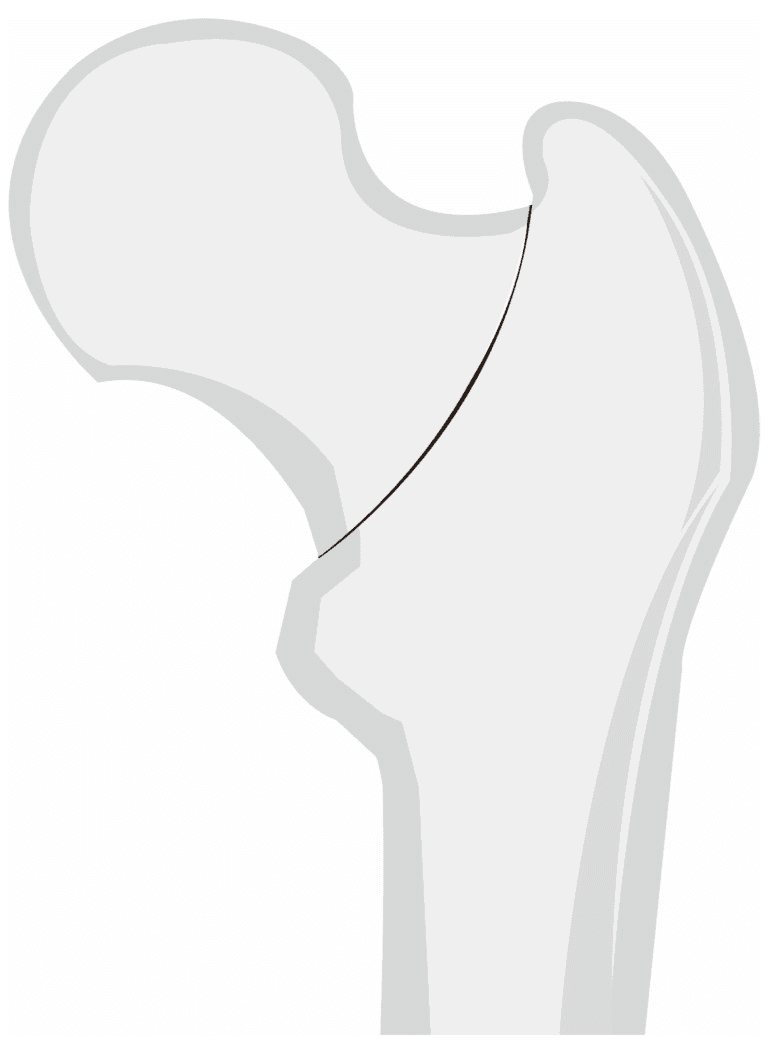
For the exam, state that the lack of a uniform definition limits the evidence base, and that you would treat the pattern as an intertrochanteric-type injury.
Stability and comminution. For treatment the fractures fall into two groups. Comminution and bone quality, not patient age alone, drive implant selection.
- Features
- Single oblique line, no medial comminution
- Implication
- Sliding hip screw (with derotation screw) or cephalomedullary nail
- Features
- Medial comminution, osteoporosis
- Implication
- Cephalomedullary nail with helical blade preferred; higher collapse risk; consider arthroplasty in the frail elderly
Clinical Assessment
History. The mechanisms are set out above. The patient has immediate pain in the hip or groin, pain with movement and an inability to bear weight, and a shortened, externally rotated leg if the fracture is displaced.
Examination. Basicervical fractures may present like femoral neck or intertrochanteric fractures, so imaging is essential for diagnosis and classification. Leg shortening and external rotation suggest displacement. Swelling is minimal because the fracture lies deep.
- Palpation - tenderness over the hip, groin and greater trochanter; crepitus is rare
- Movement - hip range of motion limited by pain, pain with passive motion, and inability to perform a straight leg raise if displaced
- Neurovascular status - usually intact; assess distal pulses and sensation
Associated injuries. Other injuries may accompany the fracture:
- Other fractures (wrist, spine, other hip) - 10-15%
- Head injury - 5-10% (high-energy trauma)
- Soft-tissue injuries - less common
These associated-injury percentages are conventional teaching estimates for high-energy hip trauma, not measured rates from a basicervical-specific cohort.
Investigations
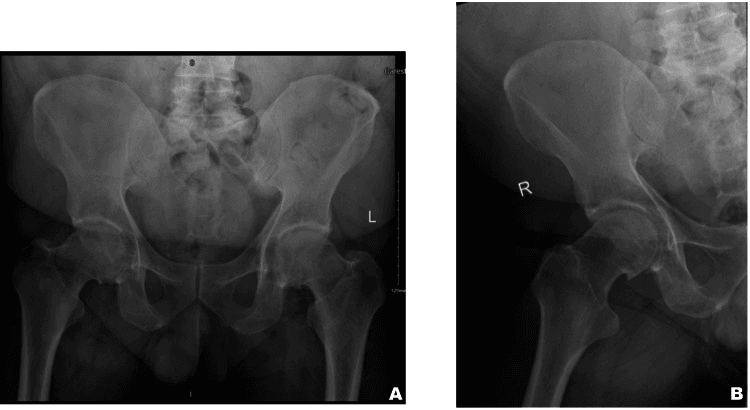
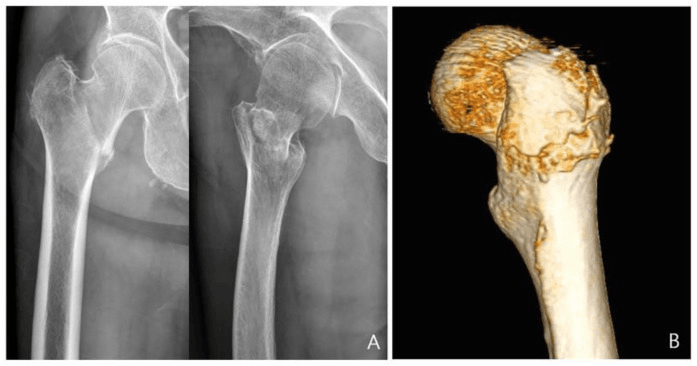
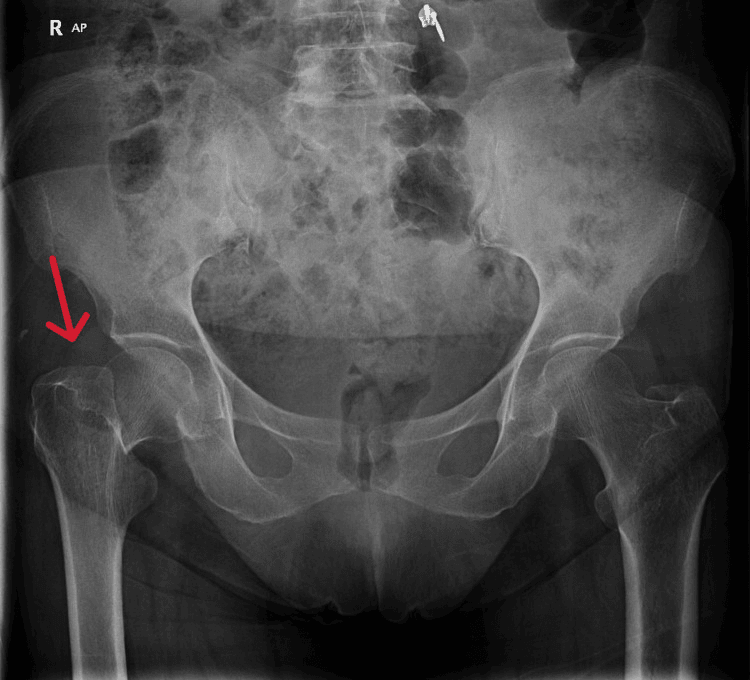
Radiographs. An AP pelvis and a lateral hip are essential; together they show the fracture's location and displacement. Read them for:
- Location - the base of the femoral neck, at the junction with the intertrochanteric region
- Displacement - under or over 2mm
- Comminution
- Bone quality - osteoporosis
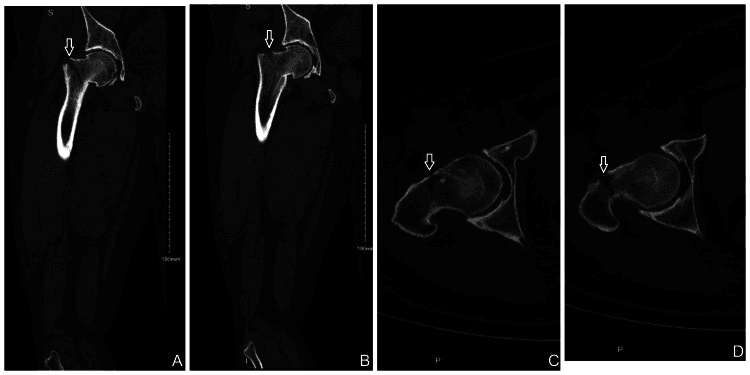
CT is not routine, but it helps in complex cases and for surgical planning. It assesses the fracture pattern, comminution and displacement, plans the fixation strategy and looks for associated fractures.
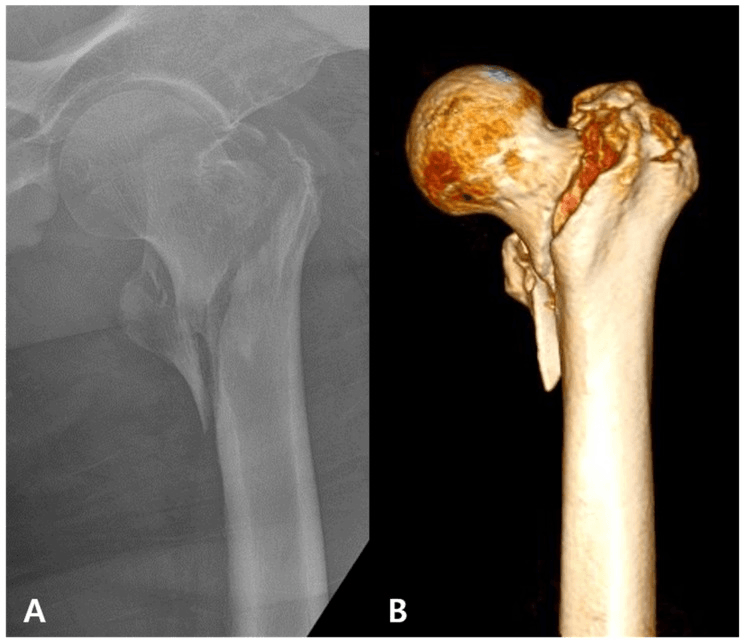
Three-dimensional reconstruction is helpful for complex patterns, for judging comminution and for preoperative planning.
MRI is rarely needed and is not routine. It is indicated only for a specific concern: an occult fracture when the radiographs are negative, pre-existing AVN, or associated injuries.
Where is the fracture line? The whole management decision turns on distinguishing a basicervical fracture from its neighbours on the AP and lateral films.
- Location of line
- Just below head
- Capsule
- Predominantly intracapsular
- AVN risk
- Displacement-dependent
- Preferred fixation
- Patient- and fracture-specific
- Location of line
- Mid neck
- Capsule
- Predominantly intracapsular
- AVN risk
- Displacement-dependent
- Preferred fixation
- Patient- and fracture-specific
- Location of line
- Base of neck
- Capsule
- Relation to attachment varies
- AVN risk
- Do not infer from label alone
- Preferred fixation
- Pattern-specific fixed-angle fixation or selected arthroplasty
- Location of line
- Through trochanteric region
- Capsule
- Extracapsular
- AVN risk
- Head perfusion usually preserved
- Preferred fixation
- Stability-specific fixation
- Location of line
- Lateral wall or below lesser trochanter
- Capsule
- Extracapsular
- AVN risk
- Head perfusion usually preserved
- Preferred fixation
- Intramedullary fixation commonly selected
Management Algorithm
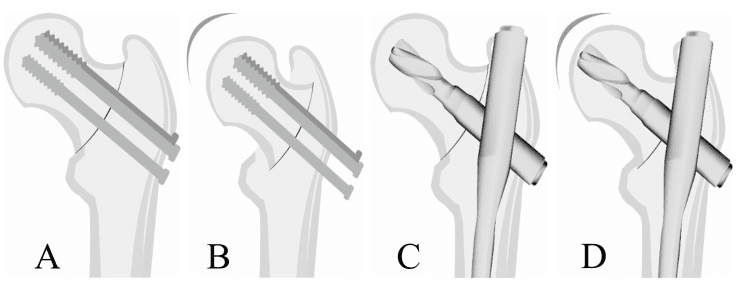
The decision. Fixed-angle fixation is usual, but comparative evidence does not mandate one device for every pattern. Select a sliding hip screw, cephalomedullary nail or other construct after assessing fracture orientation, trochanteric extension, comminution, reduction and bone quality, and address any missing cortical support. Do not reduce the decision to an implant label.
Basicervical Fracture Management
Confirm a base-of-neck fracture on AP and lateral films and distinguish it from transcervical and intertrochanteric patterns. Assess comminution, bone quality and, in high-energy cases, an ipsilateral shaft fracture.
Most patients, including the elderly with reasonable bone, are fixed: a sliding hip screw with a derotation screw, or a cephalomedullary nail with a helical blade, with the lag element central and within the tip-apex target.
For comminuted or rotationally unstable patterns, favour an intramedullary nail with a helical blade; the evidence behind that preference is weighed under Controversies. Do not use isolated cannulated screws.
Reserve arthroplasty for the frail elderly with very poor bone or marked comminution, and for salvage after failed fixation.
Non-operative treatment is rarely indicated: a non-displaced, stable fracture in a low-demand patient, medical contraindications to surgery, or patient refusal. Outcomes are poor compared with surgical treatment, with a high risk of displacement and nonunion. The protocol:
- Bed rest initially
- Progressive mobilisation
- Non-weight bearing for 6-8 weeks
- Follow-up radiographs
Surgical indications. Operate within 24-48 hours, as for femoral neck fractures.
- Absolute - a displaced fracture, an unstable pattern, or a symptomatic non-displaced fracture
- Relative - a non-displaced fracture in an active patient, or failed non-operative treatment
Surgical Technique
Principles for every construct. Obtain cortical apposition, restoring medial and anterior cortical support when possible, and avoid varus and malrotation. Place the head element safely, and confirm on both views that the chosen construct controls the instability you observed.
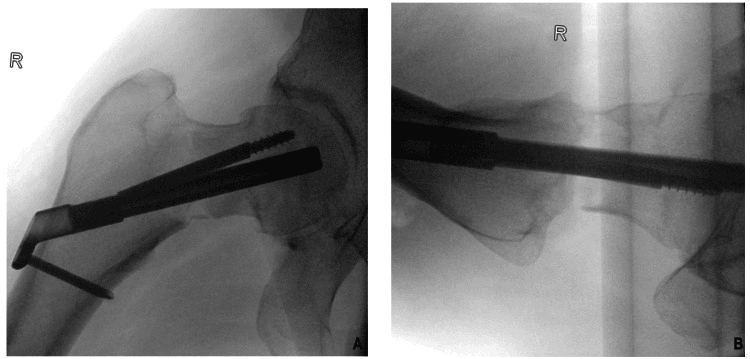
Indications. The first-line extramedullary option for a two-part basicervical fracture in good bone. It is familiar and low-cost and allows controlled compression, and its pooled revision rate is similar to that of cephalomedullary nailing.
The derotation screw. Place an anti-rotation (derotation) screw above the lag screw. Without it the head-neck fragment can rotate during lag-screw insertion, the classic technical pitfall of this fracture.
Technique.
- Lateral approach
- Reduce the fracture anatomically
- Insert the anti-rotation guide wire first
- Place the lag-screw guide wire centre-centre
- Ream and insert the lag screw within the tip-apex target
- Attach and fix the side plate
- Insert the derotation screw; confirm reduction and rotational stability
Tip-Apex Distance: The Central Technical Target
Every construct in this topic is judged against one number, the tip-apex distance (TAD). A low TAD is the single most reproducible way to reduce lag-screw cut-out in a rotationally unstable base-of-neck fracture, so the metric deserves defining in its own right.
Definition (Baumgaertner). TAD is the sum of two distances: from the tip of the lag screw to the apex (subchondral surface) of the femoral head on the AP radiograph, plus the same distance on the lateral radiograph. Each is corrected for radiographic magnification, using the known diameter of the lag screw as the on-screen scale.
Why 25 mm. In the original 198-fracture series, none of the 120 screws with a TAD of 25 mm or less cut out. Mean TAD was 24 mm in fractures that healed and 38 mm in those that failed, with a strong dose-response: every additional millimetre raised the cut-out risk regardless of fracture pattern, reduction or implant.
How to hit it. Aim the guide wire centre-centre or slightly inferior-central, deep to within 5-10 mm of subchondral bone, on both views before reaming. A calcar-referenced TAD (CalTAD), which measures the AP component from an inferiorly placed screw to the calcar rather than to the centre, has been proposed as a refinement; it reflects evidence that an inferior rather than superior AP screw position resists cut-out. The practical message is the same: deep, central-to-inferior, and never superior or short.
Tip-Apex Distance Predicts Cut-out - Original Series
- TAD = AP tip-apex distance + lateral tip-apex distance, corrected for magnification
- No cut-outs among the 120 screws with a TAD of 25 mm or less
- Rising TAD strongly predicts cut-out regardless of other fracture variables
In the basicervical pattern a low TAD must be combined with explicit rotational control (a derotation screw or a helical blade). A perfectly central screw still fails if the short head-neck fragment is free to spin.
Complications
- Incidence
- ~25%
- Risk Factors
- Comminution, rotational instability
- Prevention/Management
- Anti-rotation construct, central lag screw, low TAD
- Incidence
- ~8-9%
- Risk Factors
- Failed fixation, cut-out
- Prevention/Management
- IM nail + helical blade; salvage with arthroplasty
- Incidence
- Variable
- Risk Factors
- High TAD, eccentric screw, osteoporosis
- Prevention/Management
- Low TAD, central screw position
- Incidence
- Uncommon
- Risk Factors
- Inadequate fixation, poor reduction, poor bone quality
- Prevention/Management
- Stable construct with good cortical apposition
- Incidence
- Uncommon
- Risk Factors
- Displacement at the base of the neck
- Prevention/Management
- Arthroplasty if symptomatic AVN develops
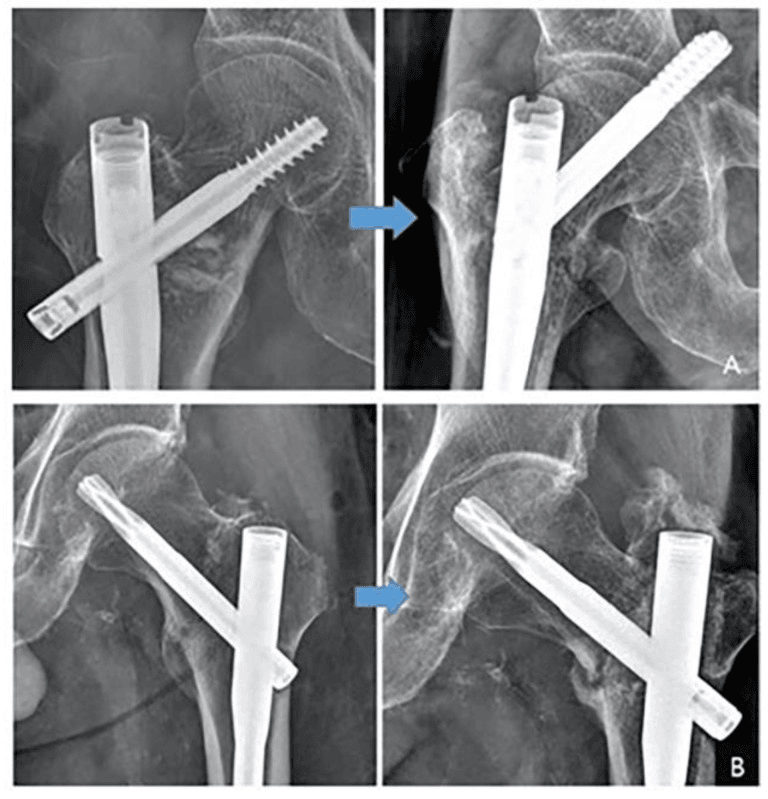
Collapse and fixation failure. The collapse and conversion figures come from a cohort of fixed fractures (Lee 2018). Rotational instability and comminution of the short proximal fragment cause the collapse, and its sequelae are neck shortening and varus malunion. Prevention is rotational control (a derotation screw or helical blade), a central lag screw and a low TAD; established failure is managed by revision fixation or conversion to arthroplasty.
AVN and nonunion. Both are uncommon. The fracture is largely extracapsular and distal to the main retinacular entry, so the head usually keeps its blood supply and AVN is far less common than after a displaced intracapsular neck fracture; nonunion, too, is less common than after intracapsular neck fractures. Capsular extent still varies with morphology, and displacement can still threaten the retinacular vessels, so vascular risk is assessed in each fracture rather than assumed from the label. Nonunion is managed by revision fixation or conversion to arthroplasty.
Postoperative Care
Weight bearing. Early mobilisation is the goal in this elderly population: prolonged restricted weight bearing is poorly tolerated and increases medical complications. With a stable cephalomedullary nail or sliding hip screw the patient weight bears as tolerated under physiotherapy supervision, and protected weight bearing is reserved for very comminuted or tenuous constructs. After arthroplasty the patient also weight bears as tolerated. Hip and knee range of motion and quadriceps work begin from day one.
Orthogeriatric review, VTE prophylaxis, analgesia, delirium screening.
Supervised gait re-education, progressive loading, falls prevention.
Most patients consolidating; check radiographs for collapse and screw position.
Bone-protection therapy, continued strength and balance work.
The endpoint. Functional recovery to pre-injury mobility is the realistic endpoint. The priority is preventing collapse and a second fall; return to sport is not the aim.
Outcomes and Prognosis
Revision by implant. Pooled systematic-review data (Dekhne 2021; Yoon 2022) give approximate revision rates; the cannulated-screw figure sits with the argument against them under Surgical Technique.
- Sliding hip screw - ~7%
- Cephalomedullary nail - ~8%
- Hemiarthroplasty - ~8%
- Total hip arthroplasty - ~0% (very small numbers)
Prognostic factors. The dominant late problem is mechanical collapse rather than vascular failure.
- Unfavourable
- Medial comminution / rotational instability
- Unfavourable
- Severe osteoporosis
- Unfavourable
- Isolated cannulated screws / no derotation screw
- Unfavourable
- High tip-apex distance, eccentric screw
Prevention and Bone Health
This is predominantly a fragility fracture, so management does not end with the operation.
- Treat the osteoporosis - assess fracture risk and start bone-protective therapy (for example a bisphosphonate or denosumab) with calcium and vitamin D as indicated
- Prevent falls - multifactorial assessment, gait and balance training, medication review, home-hazard modification
- Orthogeriatric co-management and early mobilisation reduce medical complications and mortality after hip fracture
The Concurrent Ipsilateral Femoral Neck-Shaft Fracture
Recognise it. Ipsilateral neck-and-shaft fractures are a recognised association of high-energy femoral shaft fractures in younger patients. The neck component is notoriously easy to miss: it is often minimally displaced, vertical or basicervical, and overshadowed by the dramatic shaft injury. In a review of 722 cases basicervical was the commonest hip-fracture subtype (39%), and diagnosis was delayed in 30% (Alho 1997).
Image the neck. Every high-energy femoral shaft fracture therefore warrants dedicated hip imaging: a true AP internal-rotation hip view, fine-cut CT of the femoral neck, and a deliberate fluoroscopic check of the neck before, during and after shaft fixation.
The neck fracture takes priority. Its risk of avascular necrosis and nonunion dominates the long-term prognosis, so it must be anatomically reduced and stabilised; do not let neck reduction be lost while passing an antegrade nail. There are two construct strategies:
- Single-implant reconstruction (cephalomedullary) nail - one device spans both fractures, but neck reduction and proximal-screw placement are constrained by the nail, and the neck can be left under-reduced
- Dual-implant "separate" fixation - the neck is fixed independently (cannulated screws or a sliding hip screw) and the shaft with a retrograde nail or plate; increasingly favoured because the higher-stakes neck fracture can be reduced and fixed anatomically and independently of the shaft implant
Whichever is chosen, treat the neck fracture as the priority injury and confirm that its reduction is maintained after the shaft is stabilised.
Guidelines, Registries & Global Practice
Global Epidemiology
- Basicervical fractures are uncommon: ~1.8% of all proximal femoral fractures in pooled review data, up to ~4% in single-centre series
- Predominantly a fragility fracture of older adults with osteoporotic bone; female predominance
- In high-energy young patients, basicervical was the commonest hip-fracture subtype (39%) in concurrent ipsilateral hip-and-shaft injuries (Alho 1997, 722 cases)
Guidelines Side by Side
- Position relevant to basicervical fractures
- Current AO/OTA code 31-B3; describes a base-of-neck fracture and emphasises morphology, reduction and angular-stable fixation
- Position relevant to basicervical fractures
- Hip-fracture pathways address timely surgery, orthogeriatric care and mobilisation but do not provide a basicervical-specific implant mandate
- Position relevant to basicervical fractures
- Hip-fracture guidance supports timely surgery, interdisciplinary care, VTE prophylaxis and secondary fracture prevention; implant selection remains fracture-specific
- Position relevant to basicervical fractures
- Uses inconsistent basicervical definitions and provides low-certainty comparative implant evidence
Registry and Practice Variation
- Registries generally pool basicervical injuries with broader neck or trochanteric categories, limiting fracture-specific outcome estimates
- Resource setting affects implant availability, imaging and rehabilitation, but the same principles apply: define morphology, obtain stable reduction, place the implant safely and mobilise according to construct and patient
Basicervical fractures are a classification and morphology test: use current AO/OTA 31-B3, acknowledge inconsistent historical definitions, describe the line and cortical support, and justify fixation or arthroplasty from reconstructibility and patient factors. Do not claim that the label proves extracapsular location, eliminates vascular risk, mandates one implant, or carries one universal failure rate.
Controversies and Areas of Uncertainty
No agreed definition. The definition problem set out under Classification is the first uncertainty (Yoo 2020; Dekhne 2021). Until series agree on the boundary, every pooled estimate on this page must be read cautiously.
Nail or plate. A meta-analysis found no significant difference in cut-out or reoperation between the cephalomedullary nail and the sliding hip screw, with slightly faster union for the nail (Yoon 2022). One cohort, however, found substantially higher collapse and failure with a purely extramedullary plate-and-screw construct than with an intramedullary helical-blade construct, and identified the plate as an independent risk factor for failure (Lee 2018). Read that interval before quoting it: OR 12.2, 95% CI 1.08 to 137.7, which barely excludes 1 and spans two orders of magnitude. The pragmatic position is that both work, with an intramedullary helical-blade construct favoured in osteoporotic or comminuted bone.
Cannulated screws. Once considered acceptable, isolated cannulated screws now have clear evidence against them from pooled revision data and biomechanics (Dekhne 2021; Panteli 2015). This is a genuine change in recommended practice.
Primary arthroplasty. Whether primary arthroplasty should be offered to selected frail elderly patients, rather than fixation followed by conversion when it fails, remains unresolved for want of comparative trials.
MCQ Practice Points
Q: Where is a basicervical fracture and how is it coded? A: At the base of the femoral neck; current AO/OTA 31-B3. Describe line orientation, displacement, cortical support, comminution and trochanteric extension. Capsular extent and vascular risk are not determined by the code alone.
Q: Why are basicervical fractures prone to failure? A: Shear, rotation, varus and loss of cortical support may all contribute. Reported failure rates vary with the radiographic definition, cohort, reduction and endpoint, so one pooled percentage should not be presented as the prognosis for every fracture.
Q: How should the implant be selected? A: Choose a fixed-angle construct that maintains the achieved reduction and addresses the observed line orientation, comminution and cortical support. Comparative evidence is heterogeneous and does not identify one compulsory implant for every basicervical fracture.
Q: Can one pooled revision rate dictate fixation? A: No. The published “basicervical” cohorts use inconsistent definitions and small implant subgroups. Multiple cancellous screws raise concern in several reports, but reduction quality, morphology and construct mechanics must remain explicit.
Q: When may arthroplasty be considered? A: For failed fixation, a non-reconstructible fracture, or selected patients in whom fixation cannot provide a durable, mobilisable construct. Primary arthroplasty evidence specific to basicervical fractures is limited.
Q: What technical targets reduce mechanical failure? A: Restore alignment and cortical contact, avoid varus and malrotation, place the head element safely on both views, and confirm that the entire construct controls the instability. Tip-apex distance is useful for lag-screw constructs but is not the sole determinant of failure.
Exam Viva Scenarios
Practise clinical reasoning and management decisions out loud
“A 45-year-old man presents after a motor vehicle accident with a painful hip and inability to bear weight. AP and lateral radiographs show a base-of-neck femoral fracture with mild displacement. He is otherwise fit.”
“An 80-year-old woman presents after a fall. AP and lateral films show a base-of-neck fracture with medial comminution. She has osteoporosis but is independently mobile with a stick.”
“A 74-year-old man returns 3 months after sliding hip screw fixation of a basicervical fracture with increasing groin pain. Radiographs show varus collapse and the lag screw has cut out superiorly into the joint.”
Key Anatomy
- Base of femoral neck at the neck-trochanter junction
- Current AO/OTA 31-B3
- Capsular extent and vascular risk vary with morphology and displacement
- Verticality, comminution and cortical support influence stability
Classification / Definition
- Current AO/OTA 31-B3; older studies used other groupings
- No consensus historical radiographic definition
- Describe orientation, displacement, comminution and trochanteric extension
- Differentiate from transcervical and trochanteric fractures on both views
Treatment Algorithm
- Fixation is usual when stable reconstruction is achievable
- Choose the fixed-angle construct from morphology and reduction
- Arthroplasty may suit failed or non-reconstructible fractures and selected patients
- Primary arthroplasty evidence is limited
Surgical Pearls
- Restore cortical apposition and avoid varus or malrotation
- Confirm safe head-element position on AP and lateral views
- Use tip-apex distance as one implant-position metric, not a complete plan
- Comparative evidence does not establish universal SHS or CMN superiority
Complications
- Fracture-site collapse: ~25%
- Conversion to arthroplasty: ~8-9%
- Lag screw cut-out: worse with high TAD
- AVN and nonunion: uncommon (extracapsular pattern)
Evidence Base
Definition, Treatment and Failure - Systematic Review
- Basicervical fractures = 1.8% of all proximal femoral fractures (uncommon)
- No consensus definition - heterogeneity drives variable failure rates
- Treat as an intertrochanteric-type injury, not with isolated cannulated screws
Treatment and Outcomes - Systematic Review (910 patients)
- Cannulated screws revision 23% - unacceptable for basicervical pattern
- SHS (7%) and CMN (8%) equivalent and acceptable
- Arthroplasty data limited but appears acceptable
Cephalomedullary Nail vs DHS - Meta-analysis
- No significant difference in cut-out or reoperation between CMN and DHS
- CMN achieved slightly faster union than DHS
- Implant selection can follow surgeon preference
Risk Factors for Fixation Failure (multicentre cohort)
- Collapse 24.6%, conversion to arthroplasty 8.6%
- Sliding hip screw plate had higher failure than IM nail + helical blade (OR 12.2, 95% CI 1.08-137.7)
- Inherent rotational and collapse instability drives failure
Biomechanical Comparison of Fixation Devices (cadaver)
- No clear biomechanical superiority of plate vs nail
- Add a derotation/anti-rotation element to resist rotational failure
- Select construct by anatomy and surgeon comfort
Concurrent Ipsilateral Hip and Shaft Fractures - Systematic Review (722 cases)
- Basicervical was the commonest hip-fracture subtype (39%) in ipsilateral hip-and-shaft injuries
- Hip component diagnosis delayed in 30% - actively image the neck in every shaft fracture
- Locked nailing and hip screws gave the best results; AVN 5.1%
Biomechanical Rationale by Fracture Pattern
- Triangular cannulated screws are biomechanically weak in basicervical pattern
- Match implant to the specific fracture geometry
- Cephalomedullary devices favoured for high-shear patterns