Irreducible Ankle Fracture-Dislocation | Fibula Trapped Behind Tibia | Emergency Surgery
- Definition: Rare fracture-dislocation where the distal fibula becomes entrapped behind the posterior tubercle of the distal tibia.
- Clinical Sign: Foot is severely externally rotated, often 'axilla sign' (pucker) over medial malleolus.
- X-ray Pitfall: Can look like a standard ankle fracture on AP; Lateral view is diagnostic (fibula behind tibia).
- Management: Usually irreducible by closed means. Requires urgent Open Reduction Internal Fixation (ORIF).
- Attempting forced closed reduction can cause additional iatrogenic fractures or soft tissue damage.
- “Suspect Bosworth if closed reduction of an 'ankle fracture-dislocation' is impossible.
- “The 'Axilla Sign' is a medial skin pucker caused by severe deltoid ligament traction.
- “CT scan is critical if diagnosis is unclear or reduction fails.
- “Always assess the proximal fibula (Maisonneuve variant potential).
Overview and Epidemiology
A Bosworth fracture-dislocation is a rare and severe ankle injury in which a fragment of the distal fibula displaces posteriorly behind the posterior tubercle of the distal tibia and becomes entrapped. Locked in that position, the fibula cannot be reduced closed in almost all cases without specific manoeuvres or open surgery.
History. David Bosworth described it in 1947 (J Bone Joint Surg Am). He identified the fibula trapped behind the "posterior tibial ridge" (posterior tubercle) and attributed the irreducibility to this bony block rather than to the soft-tissue interposition that had previously been blamed. Recognising the entity matters because persistent forceful closed reduction attempts can cause iatrogenic fracture, massive swelling and compartment syndrome.
Frequency. Rare, estimated at under 2% of ankle fractures, with roughly 175 cases described in the world literature. Patients are predominantly young to middle-aged adults injured by high-energy trauma: sport, falls and motor-vehicle crashes. The morphology is age-dependent, and "pure" dislocations without a fibular fracture occur classically in younger, more elastic patients.
Mechanism. The pathognomonic mechanism is severe external rotation of the supinated foot, with the tibia driven anteriorly relative to the fibula. The fibula rotates externally, snaps out of the incisura fibularis, moves posteriorly and gets locked behind the posterior ridge of the tibia. The interosseous membrane is torn.
Associated fractures. There is usually a fibular fracture, most often Weber B, and a posterior malleolar fracture is present in roughly 70% of cases.
Why it is an emergency.
- It will not reduce with standard traction
- The skin is threatened from both sides: medially it is puckered (the axilla sign) or tented by the tibia, and over the posterior fibula it is compressed. Necrosis occurs rapidly
- Distortion of the deep posterior compartment can lead to ischaemia
Anatomy
The incisura fibularis. The lateral surface of the distal tibia forms a concave notch, the incisura, in which the fibula sits. It is bounded anteriorly by the anterior tubercle (Chaput) and posteriorly by the larger posterior tubercle (Volkmann), the border of Volkmann's triangle, which forms a buttress. In a Bosworth injury the fibula jumps this buttress.
The distal fibula fits into the incisura and carries the syndesmotic attachments: the anterior inferior tibiofibular ligament (AITFL) anteriorly, the posterior inferior tibiofibular ligament (PITFL) posteriorly and the interosseous membrane (IOM) medially.
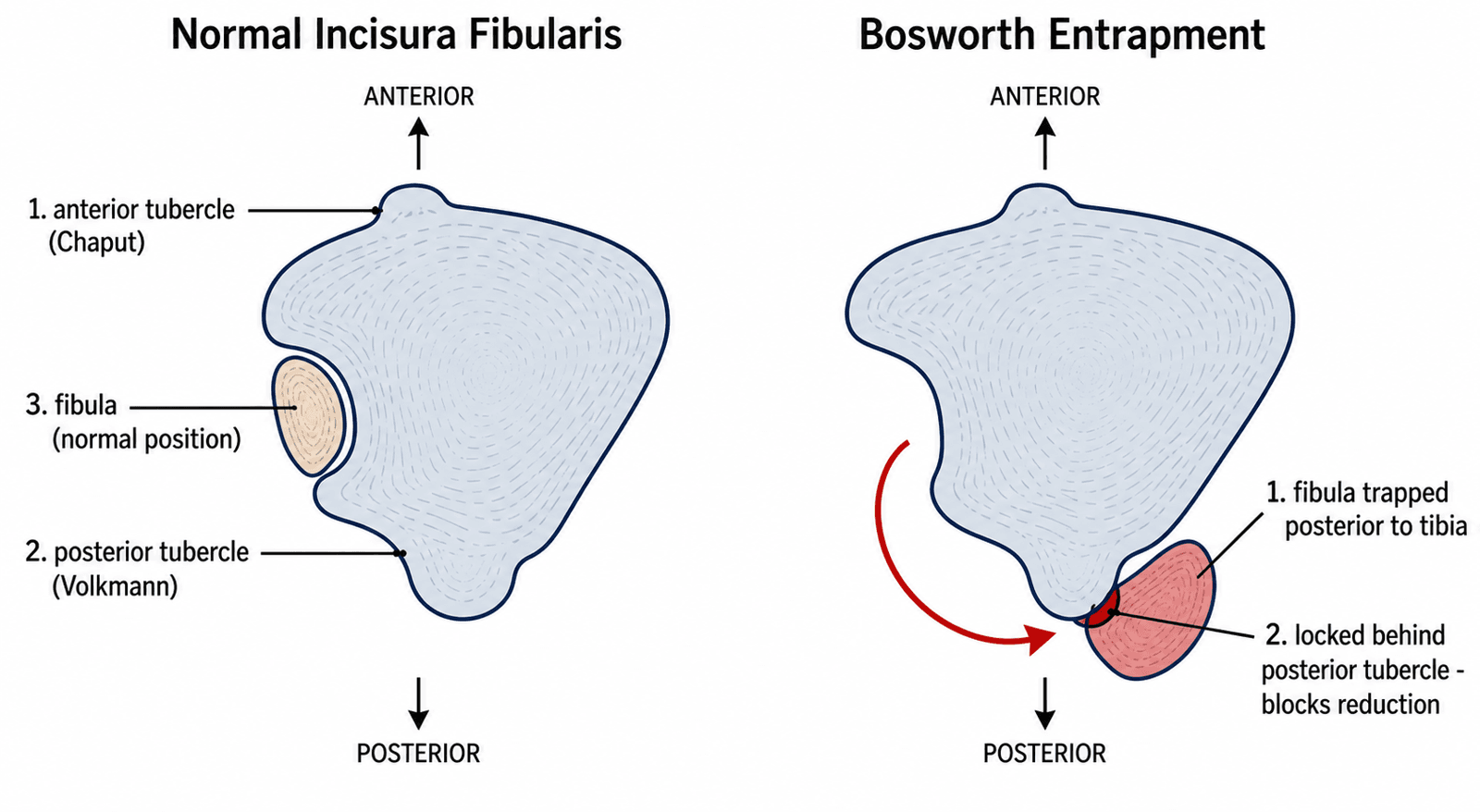
How the fibula is trapped. External rotation levers the fibula out of the incisura, the fibula acting as a lever arm and the posterior tubercle as a "cam". It fails in sequence:
- Ligament failure - the AITFL ruptures or is avulsed (Tillaux-Chaput or Wagstaffe), releasing the anterior constraint
- Translation - the fibula rotates externally and translates posteriorly out of the groove
- Crossing the equator - the equator of the fibula passes the posterior colliculus of the tibia
- The lock - elastic recoil of the soft tissues, the IOM or its remaining fibres superiorly, snaps the fibula medially and pulls it tightly against the posterior cortex of the tibia
- Irreducibility - the posterior tubercle now prevents the fibula sliding forward
Why traction fails. Traction alone simply tightens the IOM against the bone. Reduction means overcoming the posterior ridge by "unhooking" the fibula laterally.
The ligaments. Each fails, or survives, in a way that shapes the injury:
- AITFL - always torn or avulsed; the first restraint to fail
- PITFL - often intact, in which case it contributes to the posterior tethering; otherwise it pulls off the posterior malleolus (Volkmann fracture) or tears
- IOM - torn, and torn extensively proximally with a high (Maisonneuve-type) fracture; with a low fracture it may be intact proximally but is still torn at the incisura. The extent of the IOM tear and the level of the fibular fracture often go together
- Deltoid ligament - universally injured, as a tear or a medial malleolar fracture, allowing the talus to shift laterally and externally rotate
- Lateral ligament complex (ATFL/CFL) - usually intact, because the fibula moves with the talus
With the AITFL always torn and the IOM torn, the syndesmosis is almost always unstable once the fibula is reduced, and syndesmotic fixation is almost always required.
Nerves and vessels at risk.
- Posterior tibial artery and nerve - run just medial to the Achilles tendon but lateral to the medial malleolus. In a severe posterior dislocation the bundle can be tented or stretched over the posterior tibia
- Superficial peroneal nerve - runs anteriorly in the subcutaneous tissue and is at risk in the lateral approach if not identified and retracted
- Sural nerve - runs with the small saphenous vein posterior to the peroneal tendons, and must be identified and protected in the posterolateral approach
The Posterior Malleolus as Part of the Lock
A double entrapment. In the classic description the fibula is caught behind the posterior tubercle (Volkmann border) of the incisura. When the injury also avulses a posterior malleolar (Volkmann) fragment, the displaced distal fibula can become wedged between the posterior surface of the distal tibia and the displaced posterior malleolar fragment (Ji, Xu, Lu, Front Surg 2021). The fragment can then be a co-component of the mechanical block, which is why simple lateral traction may fail even after the posterior tubercle is cleared: the fibula is boxed in on two sides.
Why CT is the diagnostic standard. The 2024 EFORT current-concept review concluded that CT with 3D reconstruction should be routine in Bosworth injuries, principally to characterise the frequently associated posterior malleolar fracture. Its size, displacement and articular involvement dictate both the reduction strategy and the fixation, and a large or rotated fragment can prevent the fibula sliding back into the incisura until the fragment itself is reduced.
One window, two problems. The posterolateral approach is favoured because it exposes the posterior malleolus and the entrapped fibula through a single interval. Fixing the posterior malleolus, with a buttress plate or anteroposterior/posteroanterior screws, restores the posterior buttress of the incisura and contributes to syndesmotic stability.
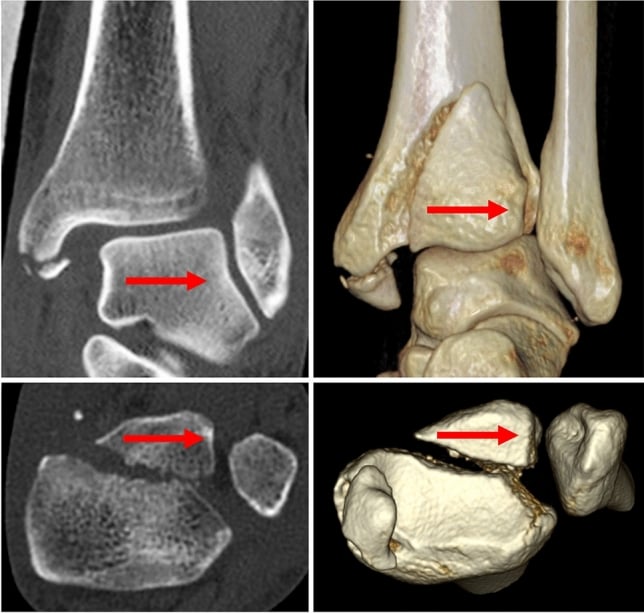
If the fibula will not disengage once the posterior tubercle has been addressed, an unreduced posterior malleolar fragment is a prime suspect. Suspect a malreduced or interposed fragment and reduce it first, through the same posterolateral window.
Classification
There is no universally accepted classification. Bosworth injuries are described by the level of the fibular fracture, although the key feature is the dislocation, not the fracture pattern:
- Proximal fracture (Maisonneuve-type) - the fibula is trapped distally and the fracture is proximal; harder to diagnose
- Shaft fracture - a spiral fracture of the shaft, with the distal fragment trapped
- No fracture (pure dislocation) - rare, with only ligamentous disruption
Danis-Weber. Most Bosworth fractures are Weber B (trans-syndesmotic spiral fracture) or Weber C (suprasyndesmotic, the Maisonneuve variant) equivalents. A pure dislocation is technically unclassifiable in Weber's system but behaves like a Weber C injury because of the extensive syndesmotic disruption.
Lauge-Hansen. The Bosworth injury is an extreme form of supination-external rotation (SER). In a standard SER injury, stage 1 is AITFL rupture and at stage 2 the rotating force normally breaks the fibula in a short oblique (Weber B) pattern. In a Bosworth injury the fibula instead rotates externally out of the incisura before it fractures, acting as a rigid lever, and the energy that would have dissipated through the fracture is converted into displacement.
What it means at the bedside. As an SER variant, the foot is externally rotated, and un-rotating the foot is the key to reduction.
Clinical Assessment
History. A high-energy twisting injury, in sport or a fall. The patient cannot stand, is in severe pain, and may report that "the ankle looks twisted around backward".
Examination. The foot lies in severe external rotation relative to the leg. Swelling is rapid and massive, from the violence of the injury and the extensive tearing of the IOM, and it further compromises the skin. Tenderness is diffuse but maximal over the syndesmosis and posterior fibula, and the patient can neither bear weight nor hop.
- Axilla sign - a skin dimple or pucker over the medial malleolus, resembling an axilla, due to the tibia buttonholing through the capsule or severe deltoid tethering
- Skin - look for tenting posteriorly (fibula) or medially (tibia). Skin necrosis is a major risk
- Neurovascular - check the dorsalis pedis and posterior tibial pulses. Tibial nerve stretch injury is possible and should be documented carefully
Pre-hospital care. Do not forcefully reduce in the field. Forcing the ankle into a standard backslab without disengaging the lock is dangerous and futile, so support the limb in a pillow splint in the position of deformity, usually significant external rotation.
- Analgesia after a pain score: methoxyflurane or IV opioids
- Neurovascular status documented before and after any movement
- Urgent transport to a centre capable of surgery, because this is a time-critical ischaemic injury for the skin
- "Non-reducible deformity" documented clearly, to alert emergency staff on arrival
In the emergency department. Three signs together point to the diagnosis:
- Severe external rotation of the foot, often 90 degrees
- Closed reduction that fails
- The axilla sign
The usual Quigley manoeuvre (lift the toe, internally rotate) feels locked, and there is elastic resistance ("bounces back") on internal rotation.
Stop the reduction attempt as soon as the locked sensation is felt. Repeated attempts damage the articular surface of the posterior tibia.
- Reducibility
- Irreducible / 'locked'
- Discriminating Feature
- Severe external rotation + axilla sign; fibula posterior to tibia
- Key Imaging
- Lateral: posterior tibiofibular dissociation; CT confirms entrapment
- Reducibility
- Usually reducible (Quigley)
- Discriminating Feature
- Reduces with traction/internal rotation; no bony block
- Key Imaging
- Mortise restored after reduction
- Reducibility
- Variable
- Discriminating Feature
- High-energy axial load, articular comminution, not a pure dislocation
- Key Imaging
- CT shows plafond impaction/comminution
- Reducibility
- Often reducible closed
- Discriminating Feature
- Foot deformity but tibiotalar mortise intact
- Key Imaging
- AP: intact ankle mortise; talus displaced at subtalar joint
- Reducibility
- Surgical emergency
- Discriminating Feature
- Talus extruded, usually open, dramatic deformity
- Key Imaging
- Talus displaced out of all articulations
TRAPBosworth Characteristics
Hook:The fibula is caught in a TRAP behind the tibia.
Investigations
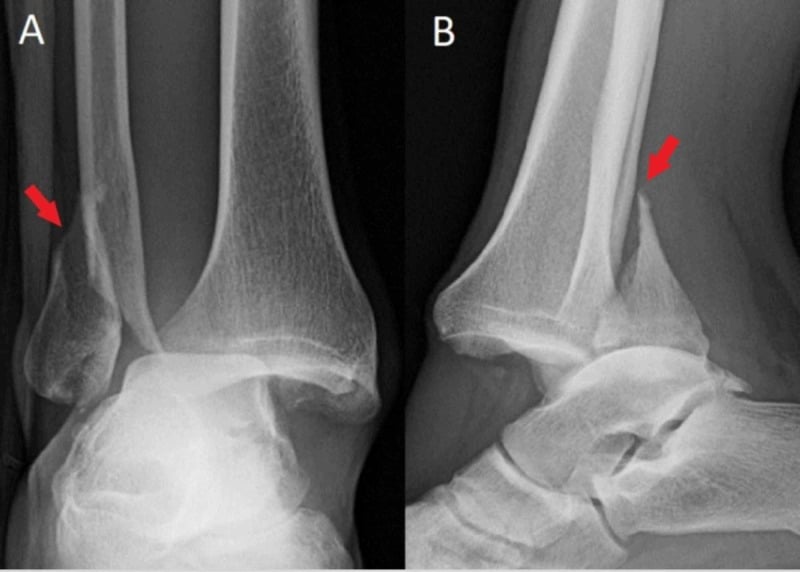
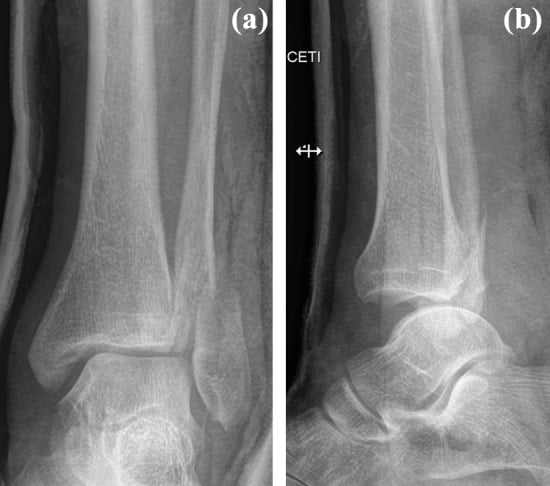
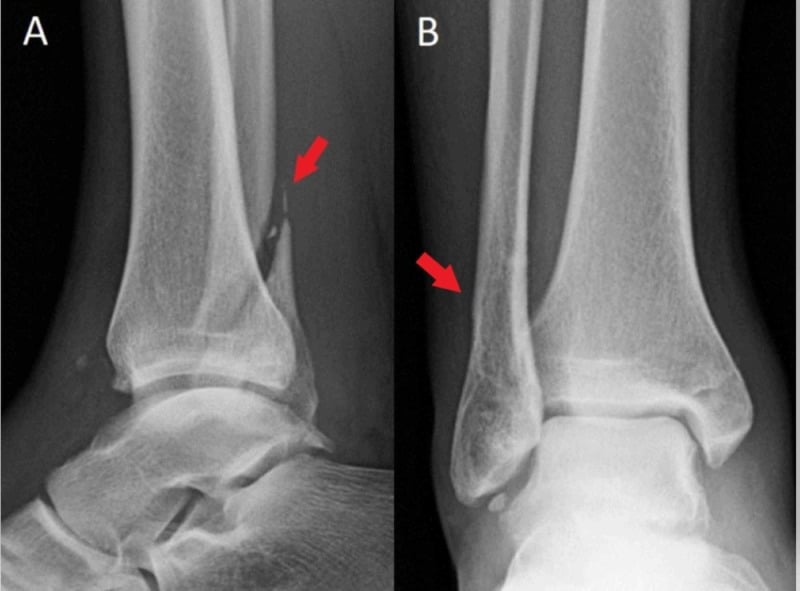
Radiographs. A trauma series, in which the lateral view makes the diagnosis and the AP can deceive.
The AP view may look like a "well-reduced" ankle fracture if it is not scrutinised, in a patient with severe pain and deformity.
- Cortical overlap sign - the proximal cortex of the distal fibular fragment overlaps the lateral cortex of the distal tibia, significantly more than the normal tibiofibular overlap (greater than 6mm)
- Medial clear space - often widened by the deltoid rupture
The lateral view is the single most important film. Normally the fibula superimposes on the posterior third of the tibia; in a Bosworth injury the distal fibula is seen completely posterior to it.
- Empty notch - the tibial incisura is empty
- Double shadow - if the fibula is fractured, the proximal shaft may lie in its normal position while the distal fragment is posterior
CT. Recommended for surgical planning in all cases if resources allow, and with 3D reconstruction now the diagnostic standard (see the posterior malleolus above). In practice it is often obtained after a failed reduction, or when the diagnosis is suspected but the radiographs are equivocal.
- Bone windows - show the "fibular head locked behind tibial plume", identify associated marginal fractures (Volkmann, Chaput), and size the posterior malleolar fragment, which matters for fixation
- 3D reconstruction - extremely useful for understanding the rotational deformity and planning the "unhooking" manoeuvre
- Soft-tissue windows - can show entrapment of the FHL or peroneus brevis tendons, which may block reduction
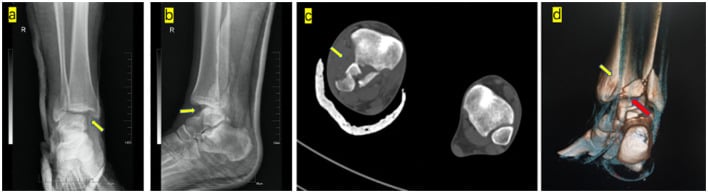
Incomplete Reduction: The Reduced Talus with a Still-Trapped Fibula
The talus can reduce while the fibula does not. In the series of Bartoníček, Rammelt, Tuček and colleagues (Eur J Trauma Emerg Surg 2025), posterior tibiofibular dissociation on the lateral view was the single most reliable sign, present in 96% of cases, and it persisted in all 18 patients whose closed reduction was unsuccessful. Inadequate closed reduction of the talus beneath the distal tibia was associated with an average increase in anterior fibular angulation of 24.5 degrees. Pulling the talus back under the plafond can produce a plausible-looking AP mortise while the still-entrapped fibula is levered into abnormal anterior angulation: a "reduced" ankle that is not actually reduced.
Judge success on the lateral view, not the AP. Either of two findings means the fibula is still in the trap, whatever the AP shows:
- Persistent posterior tibiofibular dissociation - the fibula still posterior to the tibia
- Increased anterior fibular angulation relative to the uninjured side - a marker of incomplete reduction with a persistently entrapped distal fibula
Either finding mandates CT and, in practice, open reduction. Do not accept a satisfactory AP as proof of success.
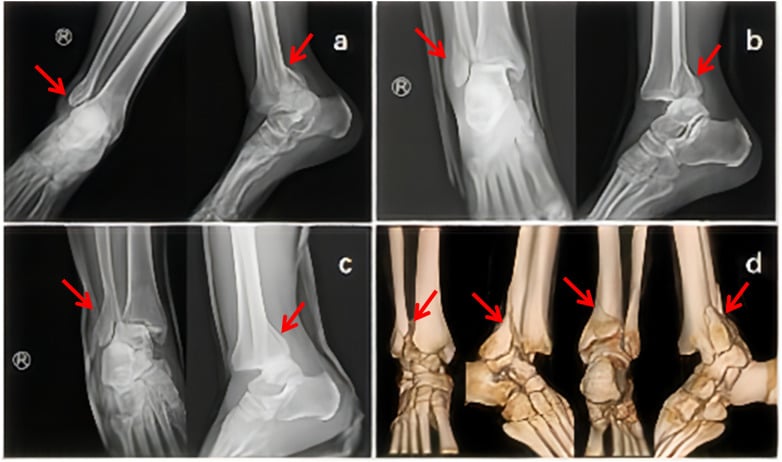
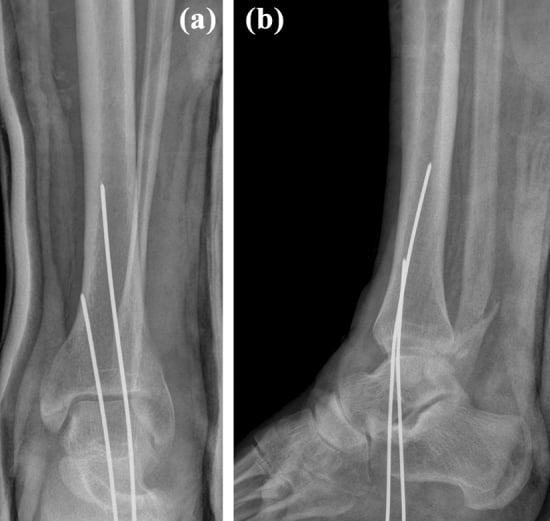
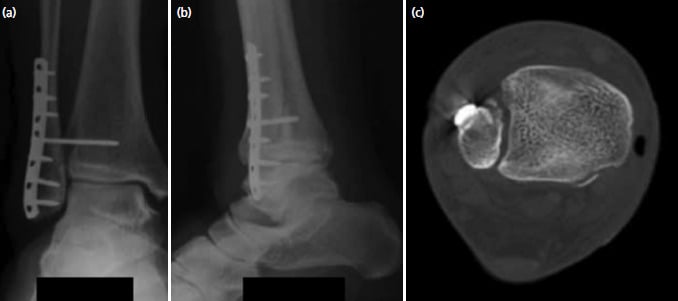
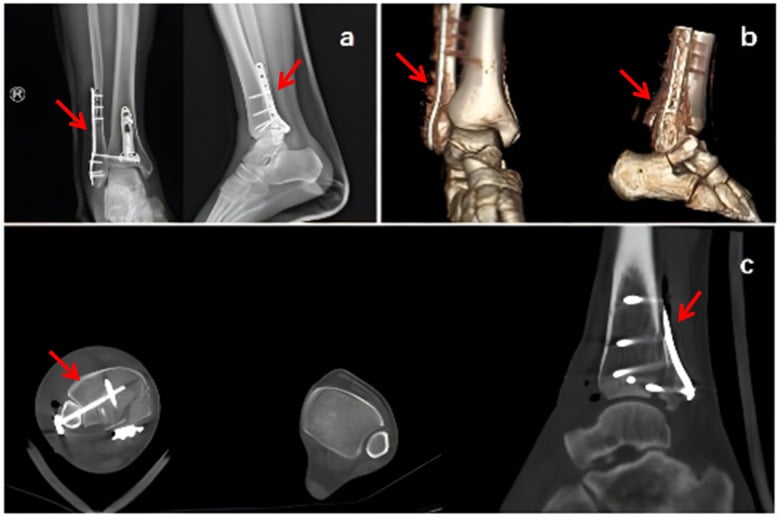
Confirming reduction. A single gentle closed attempt is reasonable, but confirmation requires the lateral view and, where available, CT. Post-reduction or postoperative CT is recommended to confirm both syndesmotic and fibular seating in the incisura, because an apparently reduced ankle can conceal a fibula that never left the posterior trap.
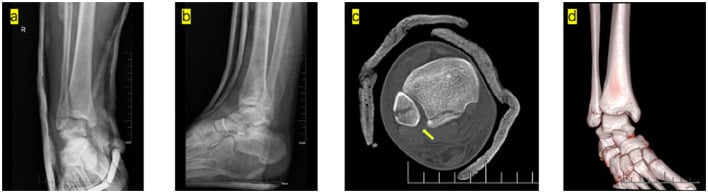
Management Algorithm
The decision. A standard ankle fracture-dislocation is usually reducible with the Quigley manoeuvre: it is reduced urgently in the emergency department, splinted, and fixed later once the swelling allows. A Bosworth injury usually is not, and open reduction is the standard of care. It is urgent and cannot wait for the swelling, since the sooner it is done the lower the risk of skin necrosis, which is why early recognition is crucial.
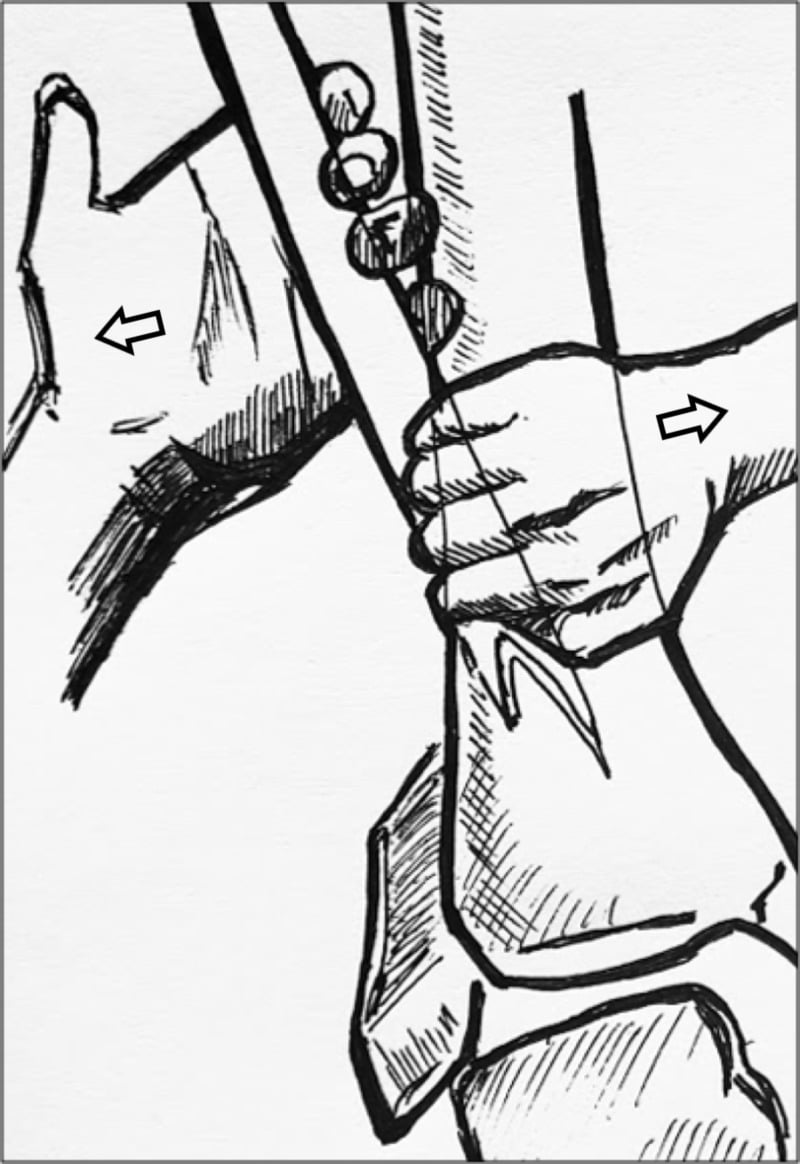
One gentle closed attempt. Under sedation in the emergency department: traction, external rotation to unlock, anterior translation of the fibula, then internal rotation. It rarely works, and excessive force must not be used. The fibular shaft is stabilised proximal to the fracture while the other hand controls the foot, and directed lateral-anterior pressure disengages the fibula from behind the tibia before the external-rotation mechanism is reversed. Forceful blind traction alone cannot clear the lock.
The approach.
- Posterolateral (preferred) - between the peroneal tendons and the Achilles tendon. It gives direct visualisation of the fibula trapped behind the tibia, and the posterior malleolus is easy to fix if present
- Lateral - the standard approach, but the entrapment can be difficult to see. An intact fibula may need an osteotomy to reduce it (rare)
- Anterolateral - difficult access to the posterior block
Surgical Technique
Setup. The lateral decubitus position on a beanbag is preferred for the posterolateral approach. Supine with a sandbag under the ipsilateral hip allows easier access to the medial side if needed, but makes posterolateral access slightly more difficult. Thigh tourniquet, the C-arm from the opposite side, and full muscle paralysis from the anaesthetist.
Approach. A longitudinal incision midway between the posterior border of the fibula and the lateral border of the Achilles tendon. Identify and protect the sural nerve and short saphenous vein, typically in the posterior flap. The nerve is retracted laterally or medially depending on its path, usually laterally with the peroneals. Incise the deep fascia and find the interval between peroneus brevis (lateral) and flexor hallucis longus (medial); retracting the peroneal tendons anteriorly and laterally and FHL posteriorly and medially exposes the posterior aspect of the distal tibia and fibula.
Reduction. The distal fibula will be seen trapped behind the posterior colliculus of the tibia. Carefully clear any interposed periosteum or torn labrum from the incisura. Place a bone hook around the fibula (a periosteal elevator also works) and apply lateral and anterior traction to "pry" it back into the incisura, while an assistant internally rotates the foot. A palpable and audible "clunk" is often felt; verify on fluoroscopy that the fibula is centred in the notch on the lateral view.
If it will not reduce. Do not force it.
- Check for soft-tissue interposition, particularly tendons
- In very chronic or difficult cases, a small osteotomy of the posterior tibial tubercle, the blocking bone, can be performed to facilitate reduction
Fixation. Ensure the fibula is length-restored and fully seated in the incisura before fixing anything.
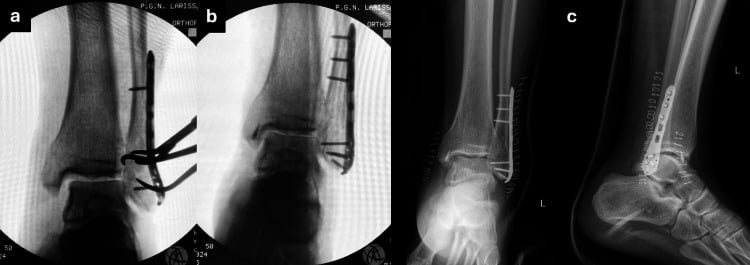
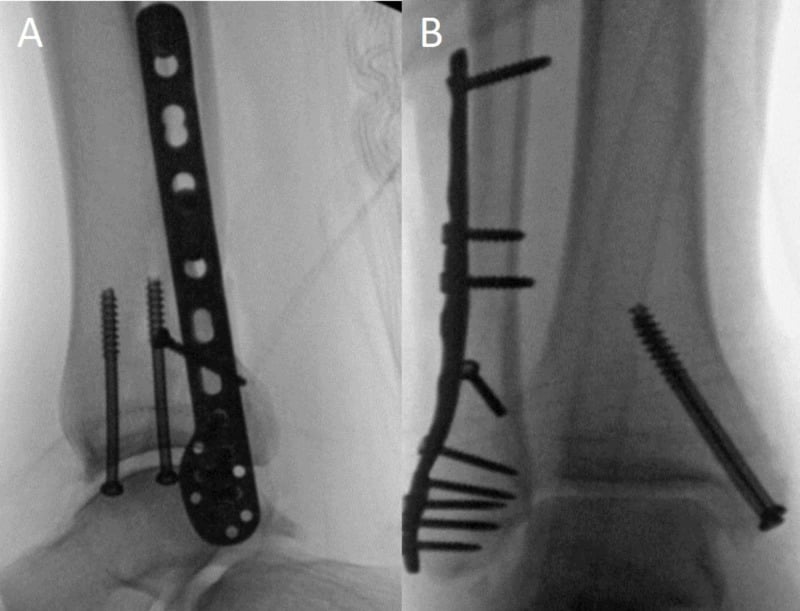
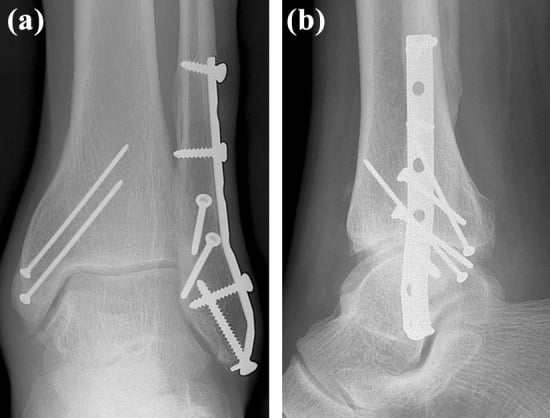
- Fibula - standard ORIF with a one-third tubular plate, an anatomical (locking) distal fibular plate, or lag screws. A high (Maisonneuve) fracture may not need plating if the syndesmosis is stabilised
- Syndesmosis - the critical step. Assess stability with the Cotton (hook) test, then place 1 or 2 syndesmotic screws (3.5mm or 4.5mm) or suture buttons (TightRope), aimed from fibula to tibia parallel to the joint, about 2-3 cm proximal to the joint line and angled 30 degrees anteriorly to match the transmalleolar axis
- Posterior malleolus - if fractured (Volkmann), fixed through the same posterolateral window
Closure. Thorough irrigation, then repair of the deep fascia if possible, carefully so as not to constrict, and subcutaneous and skin closure. A bulky dressing and posterior slab (backslab) in neutral dorsiflexion.
Complications
Skin necrosis. Disproportionately common for a malleolar injury, especially with delayed reduction and repeated closed attempts. The entrapped fibula tents the posterior skin and causes pressure necrosis, while medially the axilla sign compromises the skin through extreme tension. Risk factors are time to reduction greater than 24 hours, older age, smoking and diabetes.
Prevention is urgent reduction, within hours, with gentle soft-tissue handling and no "searching" for the nerve in compromised skin. Established necrosis is managed by debridement, negative pressure wound therapy (VAC), or flap coverage (sural or free flap) if the defect is large.
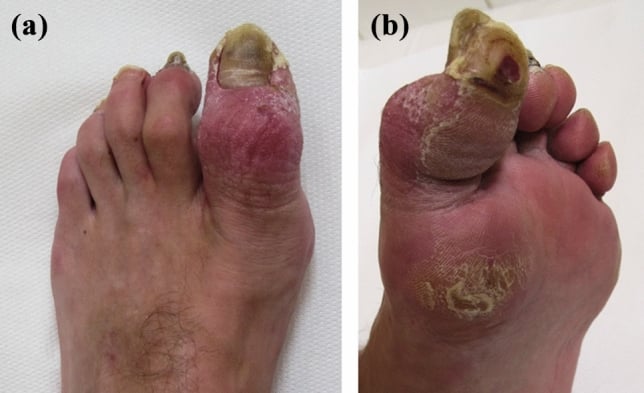
Compartment syndrome. Far higher risk than in ordinary malleolar fractures, with a calculated prevalence of around 5.4% across reported Bosworth cases (Bartoníček et al, 2022). The high energy, the distorted anatomy and bleeding and oedema from the torn IOM and muscles set it up; severe dislocation, repeated closed reduction attempts and a long interval to surgery are the key risk factors. The deep posterior compartment is most at risk, so monitor pressures if surgery is delayed. The signs:
- Pain out of proportion
- Pain on passive toe stretch, especially the great toe
- Tense compartments
- Paraesthesia
Keep a high index of suspicion, and perform an emergent four-compartment fasciotomy if pressures are elevated (greater than 30 mmHg, or delta pressure less than 30 mmHg). The sequelae are claw toes, sensory loss and weakness.
Post-traumatic osteoarthritis. Chondral damage occurs as the fibula "grinds" across the posterior tibia during dislocation and reduction, and some degree of cartilage scuffing is common. Arthritis is more frequent than after standard ankle fractures, and persistent pain, restricted motion and degenerative change are commonly reported, although large long-term series are lacking (Bartoníček, Rammelt, Tuček, 2024). It presents with chronic pain, stiffness, weather-related ache and swelling, and is treated non-operatively (bracing, injections) initially, with ankle arthrodesis or total ankle arthroplasty for end-stage disease.
Nerve injury. The posterior tibial nerve can be stretched around the tibia or injured during reduction, leaving paraesthesia in the sole of the foot. The sural nerve crosses the posterolateral incision and its injury numbs the lateral foot; the superficial peroneal nerve is at risk in the lateral approach and its injury numbs the dorsum of the foot. Careful dissection protects them, and any deficit should be documented preoperatively if possible.
Missed diagnosis. Often mistaken for a "bad sprain" or a simple fracture if only the AP radiograph is seen, because the cortical overlap is subtle. Delayed treatment leads to irreducible contractures, severe arthritis and a "chronic Bosworth injury" that is very difficult to treat and often requires fusion. The lateral view rule: the fibula must superimpose on the tibia, and if it lies behind, it is out.
Postoperative Care
- Backslab or bulky dressing applied in theatre, the foot held in neutral dorsiflexion to prevent equinus contracture
- Strict elevation (toes above nose) for 48-72 hours to minimise swelling and reduce wound complications
- Chemical DVT prophylaxis (LMWH, Xarelto) is standard, given non-weight-bearing status and trauma risk
- Strict non-weight-bearing
- Wound review at 2 weeks: sutures out if healed, and a check for marginal necrosis, especially at the corners of the incision
- Transition to a removable CAM (moon) boot once the wounds have healed
- Gentle active dorsiflexion and plantarflexion out of the boot 3-4 times daily, avoiding inversion and eversion to protect the ligaments and syndesmosis
- Isometric calf, quadriceps and gluteal exercises
- Generally still non-weight-bearing. Some protocols allow touch-down weight bearing if fixation is rigid, but caution is advised because of the syndesmotic injury
- Radiographs to confirm callus formation and maintained reduction, with no syndesmotic diastasis
- Progression from partial to full weight bearing in the boot over 2-3 weeks
- Wobble board and balance training once fully weight bearing
- Theraband resistance exercises to strengthen the peroneals and tibialis posterior
- Syndesmotic screws were traditionally removed at 12-16 weeks before full return to sport to prevent breakage; the current trend is to leave them unless symptomatic. Suture buttons do not need removal
- Impact activities (jogging) at 4-6 months; cutting sports (football, rugby) at 6-9 months, pending functional testing (single-leg hop)
- Return to sedentary work at 2-3 weeks; manual labour at 4-6 months
Outcomes/Prognosis
Bosworth fractures have historically had poorer outcomes than standard ankle fractures because of the severity of the soft-tissue injury and chondral damage, but early recognition and anatomical reduction can yield good results. Three factors influence the outcome:
- Time to reduction - the most critical modifiable factor. Delay and repeated closed attempts correlate with skin necrosis, compartment syndrome and worse function
- Cartilage damage - the grinding of the fibula against the posterior tibia causes osteochondral defects, which predispose to arthritis
- Syndesmosis and posterior malleolus reduction - malreduction of the syndesmosis or of a large posterior malleolar fragment leads to accelerated joint degeneration
Even in surgically treated patients, chronic pain and stiffness, with reduced range of motion, particularly dorsiflexion, are commonly reported. Prominent lateral plates may require removal.
Guidelines, Registries & Global Practice
Global epidemiology:
- A rare injury worldwide (under 2% of ankle fractures), with roughly 175 cases in the world literature; concentrated in major trauma centres because of referral patterns.
- Mechanism is consistent across regions: severe external rotation of the planted, supinated foot — classically a planted-foot tackle in contact sport (rugby, soccer, gridiron, Australian football) or a high-energy fall/motor-vehicle crash.
- Age-dependent morphology (Bartoníček, 2007): physeal separation in children/adolescents, pure dislocation in young adults, fibular fracture in middle-aged/older adults.
Guideline and consensus positions (side by side):
- Position relevant to Bosworth
- Treat as an unstable ankle fracture-dislocation: urgent reduction of the dislocation, anatomical fibular length/rotation, and syndesmotic stabilisation.
- Position relevant to Bosworth
- CT with 3D reconstruction as diagnostic standard; avoid repeated closed attempts; early ORIF is standard; postoperative CT to confirm reduction.
- Position relevant to Bosworth
- Emphasis on early reduction of a deformed/dislocated ankle to protect skin, senior-led decision-making, and timely transfer if soft tissues are at risk.
- Position relevant to Bosworth
- No Bosworth-specific guideline; managed under unstable ankle-fracture and syndesmosis principles.
Note: there is no Bosworth-specific guideline from any society — the literature is Level IV/V — so recommendations are extrapolated from ankle fracture-dislocation and syndesmosis principles.
- No arthroplasty/implant registry captures Bosworth injuries specifically. National ankle-fracture and syndesmosis data (e.g. from large trauma registries) inform syndesmotic fixation practice generally — the screw-versus-suture-button debate is driven by that wider evidence, not Bosworth-specific data.
- Well-resourced settings: Early CT, posterolateral ORIF, intra-operative and postoperative CT to confirm syndesmotic and posterior-malleolar reduction, suture-button or screw fixation, and functional rehabilitation in a removable boot.
- Limited-resource settings: Diagnosis rests on careful scrutiny of plain radiographs (the lateral view for posterior fibular dissociation) where CT is unavailable; reduction must not be repeatedly attempted; early transfer to a unit able to perform open reduction is the priority, since delay drives skin necrosis and compartment syndrome.
Special Populations and Chronic Cases
The neglected Bosworth. A case presenting or diagnosed after 3-4 weeks. By then there is significant soft-tissue contracture of the triceps surae, a distinct false facet (articulation) on the posterior tibia, and extensive osteopenia, and the lock needs release rather than repeated manipulation:
- Open reduction with extensive release, often with lengthening of the Achilles tendon
- Osteotomy - removal of the posterior tibial tubercle (buttress) to allow the fibula to slide forward
- Arthrodesis - beyond 6 weeks with cartilage destruction, primary fusion may be the better option to avoid painful stiffness
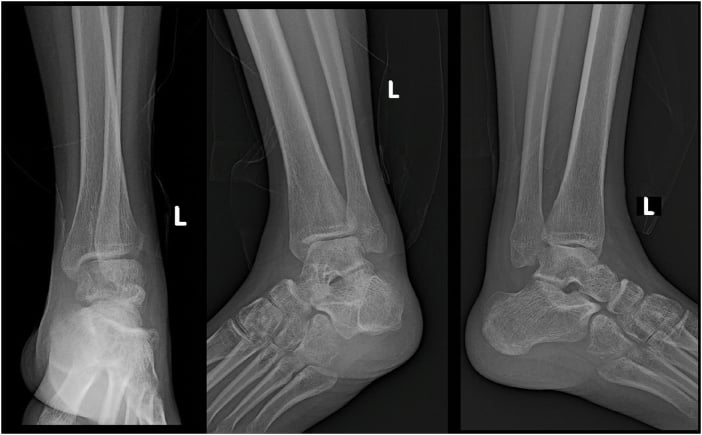
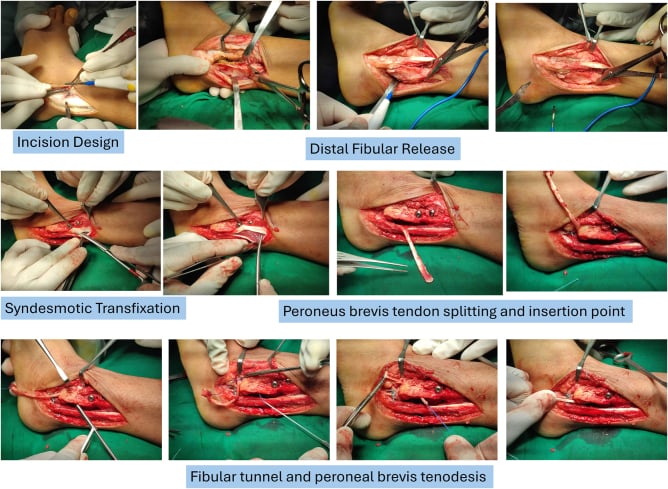
Children. Even rarer than in adults, and often a Salter-Harris type separation of the distal fibular physis. If the physis has separated, the distal fibular epiphysis may be trapped behind the tibia while the metaphysis looks aligned. Treatment is gentle reduction under anaesthesia; if closed reduction fails, which is common because of periosteal entrapment, open reduction is required. Smooth K-wires are preferred to avoid growth arrest, crossing the physis only if necessary and removed early, at 3-4 weeks.
Older patients. Porotic bone makes the "locking" mechanism less secure, but the associated fractures (posterior malleolus) are more comminuted: the posterior wall may be crushed, making the lock less distinct but the joint more unstable. The skin is at extreme risk of sloughing, and minimally invasive techniques should be used if possible. Fixation is augmented with locking plates (distal fibula LCP) or a fibular nail if the soft tissues allow, and a primary fusion (hindfoot) nail is a salvage option for non-reconstructable locking injuries with poor skin.
MCQ Practice Points
Q: What structure acts as the fulcrum trapping the fibula in a Bosworth injury? A: The Posterior Tubercle of the distal tibia (posterior aspect of the incisura fibularis).
Q: Which X-ray view is diagnostic for Bosworth fracture-dislocation? A: The Lateral Ankle view, showing the fibula posterior to the tibia (overlap is normally present; clear space implies dislocation).
Q: Primary management for a confirmed Bosworth injury? A: Open Reduction. Closed reduction typically fails and risks fracture.
Q: Bosworth fracture-dislocations are almost universally associated with injury to which ligamentous complex? A: The Syndesmosis (AITFL, PITFL, IOM).
Q: The 'Axilla Sign' in ankle trauma suggests risk of which complication? A: Skin necrosis (medial side) and Bosworth injury.
Clinical Decision Scenarios
Practise clinical reasoning and management decisions out loud
“A 25-year-old rugby player presents with a severe ankle deformity after a tackle. The foot is externally rotated 90 degrees. There is a deep skin pucker over the medial malleolus. You attempt reduction in ED but it feels 'blocked'.”
“You are in the operating room for a Bosworth fracture. You have performed a lateral approach. You cannot get the fibula back into the notch.”
“A 44-year-old is referred from a peripheral hospital 5 days after an 'ankle sprain' that was splinted as a Weber B fracture. They have ongoing severe pain, cannot weight-bear, and the foot looks externally rotated. The original AP radiograph shows tibiofibular overlap crossing the joint line.”
Key Features
- Fibula dislocated POSTERIOR to tibia
- Trapped by posterior tibial tubercle
- Irreducible by closed means
- Axilla sign (medial skin pucker)
- Lateral X-ray is diagnostic
Management
- Urgent Open Reduction (ORIF)
- Posterolateral approach often best
- Fix fibula fracture
- Stabilize syndesmosis (100% injured)
- Watch for compartment syndrome
Common Pitfalls
- Mistaking for simple ankle fracture on AP view
- Continuing forceful closed reduction (causes fracture)
- Delaying surgery (skin necrosis risk)
- Missing proximal fibula fracture (Maisonneuve)
Prognosis
- Stiffness is common
- Post-traumatic arthritis risk
- Good outcome if reduced within 24 hours
- Poor outcome if missed/delayed
Evidence
Original Description of the Lesion
- First description of fixed posterior displacement of the fibula behind the tibia.
- Identified the bony 'locking' mechanism behind the posterior tibial tubercle as the cause of irreducibility, rather than soft-tissue interposition.
- Concluded that closed traction and rotation fail, and open reduction is required.
The Bosworth Lesion: Series and Literature Analysis
- Six operatively/conservatively treated cases plus analysis of 54 cases from the literature.
- The one patient treated by closed reduction and cast required ankle fusion at 2 years for severe osteoarthritis; all ORIF cases healed with good outcome.
- Proposed an age-related morphology: epiphyseolysis in children, pure dislocation (no fracture) in young adults, and fibular fracture in middle-aged/older adults due to reduced elasticity.
Current Concept Review
- CT with 3D reconstruction should be the diagnostic standard, particularly to define the frequently associated posterior malleolar fragment.
- Repeated closed reduction attempts must be avoided; non-operative treatment almost always fails and early ORIF is standard.
- The injury is disproportionately prone to soft-tissue complications including compartment syndrome; long-term outcomes are mixed with persistent pain, stiffness and degenerative change.
Reliability of Radiographic Signs
- 23 consecutive patients; mean age 44 years; diagnosis confirmed at surgery in 22 and/or on CT in 15.
- Posterior tibiofibular dissociation on the lateral view was the most reliable sign, present in 22 of 23 (96%) and persisting in all cases with unsuccessful closed reduction.
- Posterior talar subluxation (91%) and tibiofibular overlap crossing the joint line on AP (87%) were the other reliable signs and should prompt CT.
Compartment Syndrome Risk
- Case report plus literature review identifying 9 cases of compartment syndrome among 167 reported Bosworth fractures (calculated prevalence 5.4%).
- Risk factors were severe dislocation, repeated closed reduction attempts, and long interval to definitive surgery.
- Delayed diagnosis produced lasting deficits including hallux flexion contracture and lesser-toe clawing.
Successful Closed Reduction (Exception)
- 25-year-old man whose Bosworth fracture-dislocation was reduced closed and treated in a U-shaped plaster splint.
- Full weight-bearing, pain-free, with no ankle or subtalar range-of-motion limitation at 30 months.
- Authors emphasise that successful closed treatment is rare and emergent open surgery remains the recommended default.