SLAP Lesions | Biceps Tendinitis | Pulley Lesions | Tenotomy vs Tenodesis
- Anatomy: Intra-articular portion 3-4cm, passes through rotator interval (biceps pulley system)
- SLAP Type II most clinically significant - detachment of biceps anchor from superior labrum
- Clinical triad: Speed test (flexion resistance), Yergason (supination resistance), O'Brien (active compression)
- Age-based treatment: Under 40 = repair SLAP, over 40-50 = consider tenodesis/tenotomy
- Pulley lesions (medial sling damage) cause instability - require repair or tenodesis
- “SLAP = Superior Labrum Anterior to Posterior
- “Type II SLAP is biceps anchor detachment - most common surgical lesion
- “MRA gold standard for SLAP diagnosis (sensitivity 90%)
- “Tenotomy vs tenodesis: age, activity level, cosmesis are key factors
- “Associated RTC tears in 30% - always evaluate cuff in biceps pathology
Overview and Epidemiology
Long head of biceps (LHB) pathology is a spectrum of conditions affecting the intra-articular and proximal extra-articular portions of the tendon: SLAP lesions, tendinitis, instability, and partial or complete tears. It is a common cause of anterior shoulder pain, and treatment has evolved significantly with age-based algorithms.
Primary or secondary. Biceps pathology can be primary (isolated tendinitis, a SLAP tear) or secondary to rotator cuff disease, glenohumeral instability or impingement. Secondary pathology is more common in patients over 40, and 30% of biceps pathology occurs with a rotator cuff tear, so isolated biceps symptoms may be coming from underlying cuff pathology. Always evaluate the cuff and look for underlying shoulder conditions.
Mechanism. The mechanism differs by lesion:
- SLAP lesions - traction injury (a fall on the outstretched hand) or repetitive overhead activity (throwing, swimming)
- Biceps tendinitis - overuse, impingement, instability
- Pulley lesions - trauma, subscapularis tears, chronic instability
Risk factors. Overhead athletes (baseball pitchers, swimmers, tennis players), repetitive lifting, age over 40 with its degenerative changes, shoulder instability and rotator cuff disease.
Pathophysiology and Mechanisms
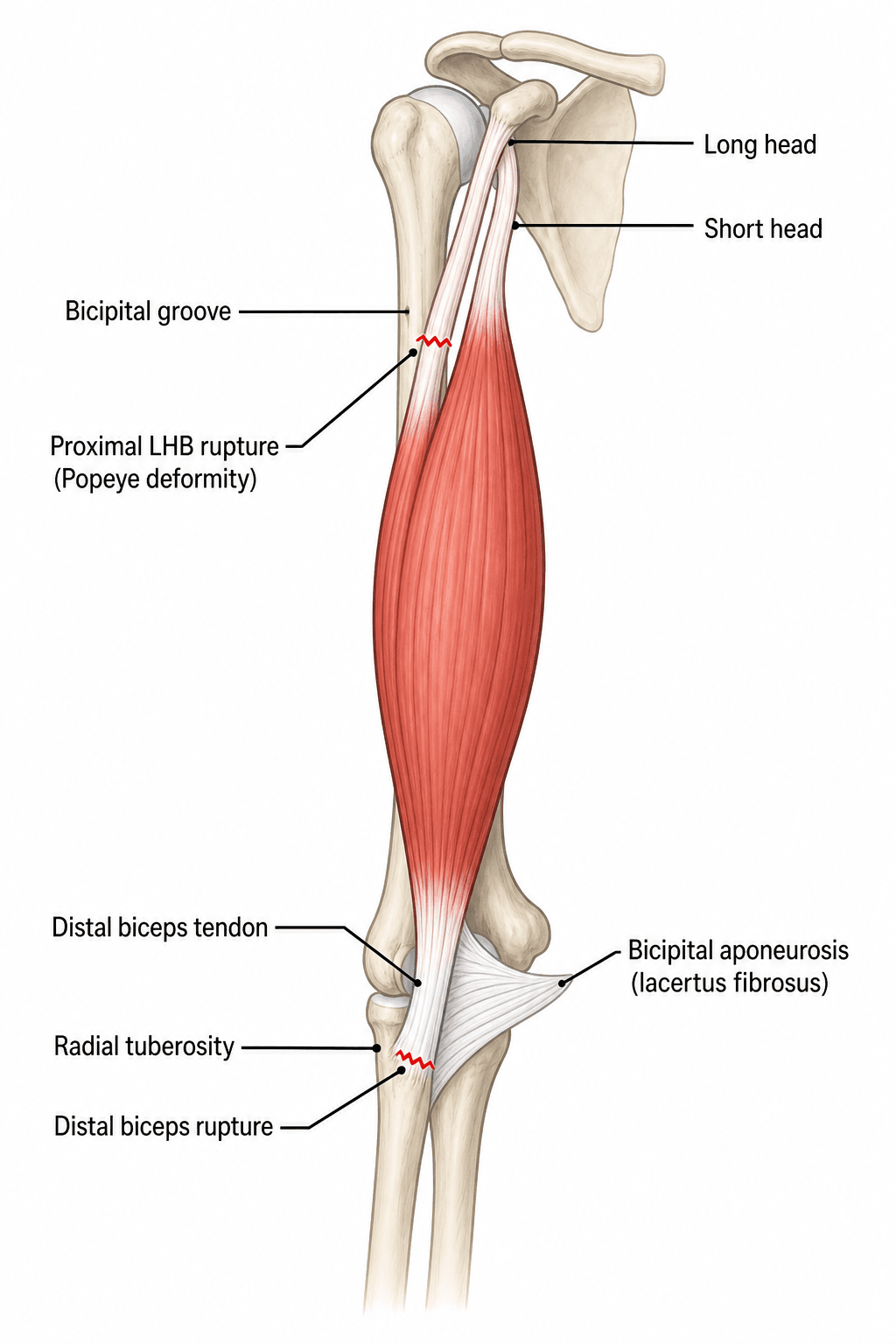
Four zones. The LHB is described in four anatomical zones:
- Intra-articular portion (3-4 cm) - from the superior labrum to the entrance of the bicipital groove
- Extra-articular proximal portion - within the bicipital groove
- Musculotendinous junction - distal to the groove
- Muscle belly - continuing to the radial tuberosity
The intra-articular portion of the LHB is unique: it is the only tendon that courses through a synovial joint without a synovial sheath in its intra-articular segment, which leaves it vulnerable to inflammatory processes affecting the glenohumeral joint.
Blood supply. The anterior humeral circumflex artery is the primary supply. The tendon is relatively avascular in its intra-articular zone, which predisposes it to degeneration, and there is a watershed at the entrance to the bicipital groove, a common site of tears.
The anchor. The LHB originates from the superior glenoid labrum, 50-60% posterior and 40-50% anterior, with an additional attachment to the supraglenoid tubercle of the scapula. The type of attachment varies (entirely posterior, entirely labral, or mixed), and normal anatomical variants can mimic a SLAP lesion.
The pulley. The biceps pulley is the stabilising structure at the tendon's entry into the groove, and its job is to prevent medial subluxation. It is formed by:
- Superior glenohumeral ligament (SGHL) - the superior roof
- Coracohumeral ligament (CHL) - reinforces laterally
- Superior subscapularis fibres - the medial sling
- Supraspinatus fibres - contribute laterally
Damage to the medial sling (superior subscapularis and SGHL) allows the tendon to subluxate medially and creates a "pseudolaxity" pattern. Look for an associated subscapularis tear: that makes it a combined pulley lesion, which needs different management from isolated biceps pathology.
The groove. The bicipital groove is bounded by the lesser tuberosity medially and the greater tuberosity laterally, and is spanned by the transverse humeral ligament, which holds the biceps in it. Average depth is 4-6 mm and width 9-10 mm. The height of the intertubercular ridge varies, and a shallow groove is prone to instability.
What the biceps does. Elbow flexion is its primary function, shared with the short head, and it supinates the forearm together with supinator. At the shoulder it is a secondary humeral head depressor, particularly when the rotator cuff is deficient, and its role as an anterior shoulder stabiliser is controversial.
Classification Systems
Snyder described the SLAP lesion in 1990 with four types, and the system has since been expanded to ten:
- Description
- Degenerative fraying, stable anchor
- Treatment
- Debridement
- Description
- Biceps anchor detachment from labrum
- Treatment
- Repair (young) or tenodesis (older)
- Description
- Bucket-handle tear, stable biceps anchor
- Treatment
- Excise unstable portion, preserve anchor
- Description
- Bucket-handle tear extending into biceps tendon
- Treatment
- Repair or tenodesis based on extent
Type II is the one that matters. It is true detachment of the biceps-labral anchor, which makes the biceps origin unstable, and it is the most clinically significant type because the surgical decision hangs on it: repair or tenodesis, depending heavily on patient age and activity level. Morgan (1998) subdivided it by the direction of extension:
- Pattern
- Anterior extension
- Clinical Significance
- May be associated with instability
- Pattern
- Posterior extension
- Clinical Significance
- Most common throwing athlete pattern
- Pattern
- Anterior and posterior
- Clinical Significance
- Complex tear, surgical challenge
Types V-X. Rare, and primarily of academic interest:
- Type V - Bankart lesion extending to SLAP
- Type VI - unstable labral flap
- Type VII - extension into the middle glenohumeral ligament
- Type VIII - extension into the posterior labrum
- Type IX - circumferential labral tear
- Type X - extension into the rotator interval
Before calling a superior labral finding a SLAP tear, exclude the normal anatomical variants of the antero-superior labrum, because "repairing" them produces a painful, stiff shoulder. Three are classic:
- Sublabral recess (sulcus) - a smooth, cartilage-lined cleft beneath the biceps-labral anchor that follows the glenoid contour. A true SLAP tear is irregular, extends posteriorly and shows granulation or displacement
- Sublabral foramen - an unattached but otherwise normal antero-superior labrum with a hole between it and the glenoid, present in roughly 10% of shoulders
- Buford complex - a cord-like middle glenohumeral ligament with congenital absence of the antero-superior labrum, in around 1-2%
The danger is that surgically reattaching a sublabral foramen or a Buford complex tethers the MGHL and causes marked loss of external rotation and pain. The discriminators are location (variants are antero-superior; a true SLAP is at or behind the biceps anchor), smooth versus frayed edges, and whether the "tear" follows the normal articular contour. A Buford complex and a sublabral foramen are left alone, not repaired.
Clinical Presentation and Examination
History. The pain is anterior, over the bicipital groove. Ask whether the onset was acute (a fall on the hand, a sudden load) or chronic overuse, what the patient does (overhead athletes, manual labourers), and about night pain, weakness, and the catching or popping sensation that suggests a SLAP lesion. Record previous treatments: injections and physiotherapy.
Examination. The table sets out each provocative test with its technique, its positive finding and its diagnostic value:
- Technique
- Shoulder flexion 90deg, elbow extended, forearm supinated. Resist forward flexion.
- Positive Finding
- Pain in bicipital groove
- Sensitivity/Notes
- Sensitivity 90%, most sensitive test
- Technique
- Elbow 90deg flexed, forearm pronated. Resist supination and elbow flexion.
- Positive Finding
- Pain in bicipital groove or biceps subluxation
- Sensitivity/Notes
- Sensitivity 43%, tests stability
- Technique
- Arm forward flexed 90deg, adducted 10deg, internally rotated (thumb down). Resist forward flexion. Repeat with forearm supinated.
- Positive Finding
- Pain with thumb down, relief with palm up
- Sensitivity/Notes
- For SLAP lesions, specificity 90%
- Technique
- Supine, shoulder abducted 90deg, elbow flexed 90deg, forearm supinated. Resist elbow flexion while externally rotating shoulder.
- Positive Finding
- Increased apprehension or pain
- Sensitivity/Notes
- For SLAP in patients with instability
- Technique
- Elbow 90deg, forearm supinated. Patient performs uppercut motion against resistance.
- Positive Finding
- Pain in bicipital groove
- Sensitivity/Notes
- Good for proximal biceps pathology
- Technique
- Direct palpation of groove with arm in 10deg internal rotation.
- Positive Finding
- Point tenderness over groove
- Sensitivity/Notes
- Simple, low specificity but useful
No single test is definitive. Combine tests for better accuracy: a positive Speed test and O'Brien test together is highly suggestive of biceps-labral pathology. Add imaging (MRA) for definitive diagnosis.
The rest of the shoulder. Examine for the conditions that cause secondary biceps pathology and for the ones that mimic it:
- Rotator cuff - Jobe, external rotation lag, hornblower
- Impingement - Neer, Hawkins-Kennedy
- Instability - apprehension, relocation, load-shift
- AC joint - cross-arm adduction
Specific findings. A Popeye deformity means complete LHB rupture with distal retraction of the muscle belly. An audible snap or pop with arm movement means biceps instability. Tenderness sits over the bicipital groove and the anterior shoulder.
Differential diagnosis. The conditions that mimic biceps pathology, and how to tell them apart:
- Distinguishing Features
- Bicipital-groove tenderness, pain with overhead/throwing, catching
- Best Test / Investigation
- Speed/O'Brien tests, MR arthrography for SLAP
- Distinguishing Features
- Painful arc, weakness, night pain, positive Jobe/Hawkins; coexists in ~30%
- Best Test / Investigation
- Neer/Hawkins, cuff strength testing, MRI or ultrasound
- Distinguishing Features
- Anterior pain, increased passive external rotation, positive belly-press/lift-off, biceps medial subluxation
- Best Test / Investigation
- Belly-press and lift-off tests, MRI, arthroscopy
- Distinguishing Features
- Pain localised to AC joint, positive cross-body adduction, tenderness over AC joint
- Best Test / Investigation
- Cross-arm adduction test, AC joint injection, plain radiograph
- Distinguishing Features
- Sense of slipping, apprehension, younger patient, labral injury
- Best Test / Investigation
- Apprehension/relocation tests, MR arthrography
- Distinguishing Features
- Global loss of active AND passive ROM, especially external rotation; diabetic association
- Best Test / Investigation
- Clinical (restricted passive ROM), normal radiograph
- Distinguishing Features
- Neck pain, radiation below elbow, dermatomal sensory change, neck movement reproduces pain
- Best Test / Investigation
- Spurling test, neurological exam, cervical MRI
- Distinguishing Features
- Acute severe pain, calcium deposit in cuff or groove
- Best Test / Investigation
- Plain radiograph / ultrasound showing calcific deposit
Anterior shoulder pain is rarely isolated biceps pathology. Always exclude rotator cuff and subscapularis tears (the biceps is frequently a co-existing pain generator), screen for adhesive capsulitis by checking passive range, and rule out cervical radiculopathy when pain radiates below the elbow or there are neurological signs.
Investigations and Imaging
Plain radiographs. A standard shoulder series (AP, scapular Y, axillary) is usually normal in isolated biceps pathology. It may show calcific tendinitis in the groove, and it is there to assess for other pathology: arthritis, the AC joint, fracture.
Ultrasound. Cost-effective and readily available, and its advantage is that it is dynamic: subluxation can be seen as the arm moves. It shows tendinopathy (thickening, hypoechoic change), fluid in the tendon sheath, partial or complete tears, and subluxation on dynamic imaging. It is excellent for bicipital groove pathology (tendinitis, partial tears, instability) but poor for SLAP lesions, because the intra-articular biceps origin cannot be adequately assessed; a suspected SLAP tear goes to MRA.
MRI and MR arthrography. Standard MRI shows T2 hyperintensity around the biceps in tendinitis, partial or complete tendon tears, associated rotator cuff tears and labral pathology. MRA, with intra-articular gadolinium, is the gold standard imaging test for SLAP lesions and intra-articular pathology: sensitivity 90% and specificity 95% for SLAP lesions, better delineation of labral detachment, and it identifies the extent and type of the SLAP.
For a suspected SLAP lesion, MRA is superior to standard MRI. The intra-articular contrast outlines the biceps anchor and the labral detachment; standard MRI has a lower sensitivity (60-70%) and may miss a SLAP II lesion.
- MRI Finding
- Fluid signal extending under biceps anchor on coronal images
- MRI Finding
- T2 hyperintensity, tendon thickening
- MRI Finding
- Partial discontinuity, increased signal
- MRI Finding
- Empty groove, retracted tendon
- MRI Finding
- Tendon medial to lesser tuberosity
- MRI Finding
- SGHL/CHL tear, subscapularis partial tear
Diagnostic arthroscopy. Arthroscopy remains the gold standard for definitive diagnosis and treatment. It gives direct visualisation of the biceps, labrum and cuff, dynamic assessment of stability, and the chance to debride or repair at the same sitting. It shows the SLAP type and extent, the quality of the biceps (degenerative or healthy), associated cuff and labral tears, and the integrity of the pulley.
The most symptomatic part of the long head of biceps lies in the extra-articular bicipital groove, which is not seen on standard intra-articular glenohumeral arthroscopy: the scope shows only the intra-articular segment and the biceps-labral anchor. Significant groove tendinopathy, fraying, partial tearing and instability can be missed if only the joint is inspected. To assess it, pull the extra-articular tendon into the joint with a probe (the arthroscopic "traction" manoeuvre) to deliver the hidden groove portion for inspection, and examine the pulley and medial sling for subtle subluxation. The same point is why bicipital-groove palpation, dynamic ultrasound and MRI of the groove add value over arthroscopy alone, and why a normal-looking intra-articular biceps does not exclude symptomatic groove disease. Think of the biceps in zones: the painful one is often the one you cannot see from inside the joint.
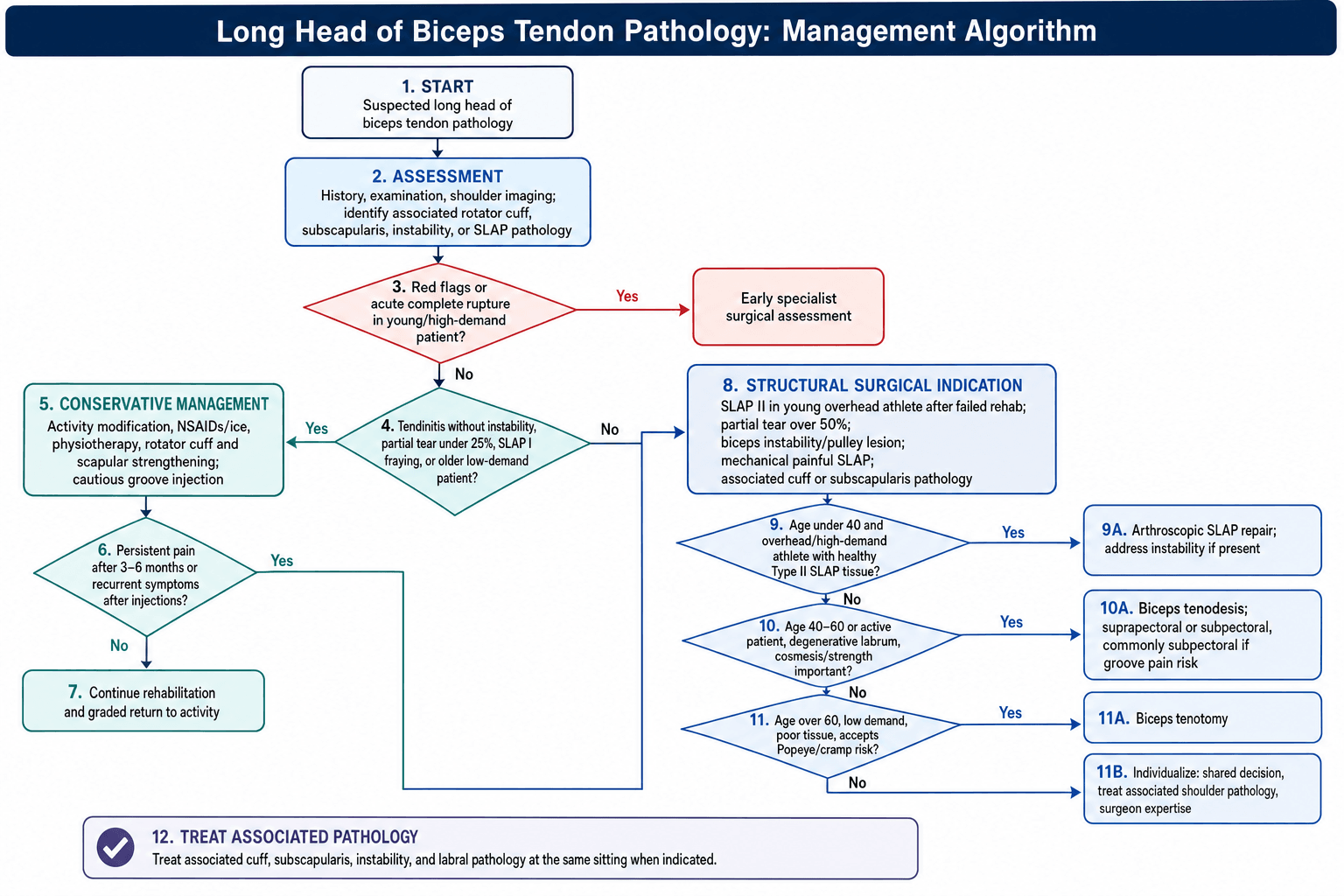
Management Algorithm
The decision. Assess the whole shoulder first, for associated rotator cuff, subscapularis, pulley and SLAP disease, because whatever is chosen for the biceps, the associated cuff, subscapularis and labral pathology is addressed at the same sitting. Low-grade problems are managed conservatively and structural lesions surgically, and the operation is chosen mainly by age and demand: a young overhead athlete with healthy type II SLAP tissue gets an arthroscopic SLAP repair, a middle-aged or active patient who values cosmesis and strength gets a tenodesis, and an older, low-demand patient who accepts the risk of a Popeye deformity and cramping gets a simple tenotomy.
- Age/Activity
- Under 40, athlete
- First-Line Treatment
- Arthroscopic SLAP repair
- Backup Options
- Tenodesis if repair fails
- Age/Activity
- Over 40-50, recreational
- First-Line Treatment
- Biceps tenodesis
- Backup Options
- Tenotomy if low demand
- Age/Activity
- Any age
- First-Line Treatment
- Conservative (NSAIDs, physio, injection)
- Backup Options
- Tenodesis if failed conservative
- Age/Activity
- Any age, active
- First-Line Treatment
- Subpectoral tenodesis
- Backup Options
- Suprapectoral if young athlete
- Age/Activity
- Any age
- First-Line Treatment
- Tenotomy or tenodesis
- Backup Options
- Debridement if under 25%
Who. Biceps tendinitis without instability, partial tears under 25%, SLAP I lesions (degenerative fraying), and elderly patients with low functional demands. Conservative management remains the foundation of treatment for patients over 40.
- Rest from aggravating activities (overhead, lifting)
- NSAIDs for pain and inflammation
- Ice therapy
- Activity modification
- Gentle pendulum exercises
- Progressive ROM exercises
- Rotator cuff strengthening
- Scapular stabilisation
- Posterior capsule stretching
- Eccentric biceps exercises
- Sport-specific rehabilitation
- Return to overhead activities gradually
- Maintenance strengthening programme
- Ergonomic modifications for work
Corticosteroid injection. An injection can be used for bicipital groove tendinitis, but avoid injecting into the tendon substance, and keep to a maximum of 2-3 injections at 3-month intervals.
Avoid repeated steroid injections into the bicipital groove: multiple injections increase the risk of complete tendon rupture. If symptoms recur after 2 injections, consider surgical options.
How often it works. Conservative treatment resolves symptoms in 40-50%, with higher success in older, low-demand patients. SLAP lesions in young athletes rarely resolve without surgery.
Surgical Technique
Who. A SLAP Type II in a patient under 40, an overhead athlete (throwing, swimming), healthy labral and biceps tissue, and 3-6 months of failed conservative management.
Step 1 - diagnostic arthroscopy. View from the standard posterior portal. Probe the biceps anchor for stability (the peel-back sign), confirm the SLAP type and extent, and evaluate the associated pathology: cuff, labrum, cartilage.
Step 2 - preparation. Debride frayed labral tissue back to a stable base and prepare the superior glenoid neck with a gentle burr to bleeding bone, creating a healthy tissue bed for healing while preserving the biceps tendon insertion.
Step 3 - anchor placement. Place 1-2 suture anchors in the superior glenoid, just posterior to the biceps root and off the articular surface, 5.5 mm or 3.0 mm depending on bone quality, angled toward the centre of the glenoid to maximise pull-out strength.
Step 4 - suture passage and tying. Pass sutures through the labrum and the biceps-labral junction with penetrating devices or suture shuttles, in a simple or mattress configuration, and tie with arthroscopic knots (SMC, Duncan loop). Confirm stable fixation with the probe.
The peel-back sign is pathognomonic for SLAP Type II. With the arm in abduction and external rotation, the throwing position, the biceps tightens and peels the posterior-superior labrum off the glenoid. It is visible arthroscopically and confirms an unstable biceps anchor.
Rehabilitation is set out under Postoperative Care. In carefully selected young overhead athletes the outcomes are good.
Complications
- Incidence
- 20-30%
- Prevention/Management
- Early passive ROM, aggressive physiotherapy
- Incidence
- 10-25% in athletes over 40
- Prevention/Management
- Age-appropriate patient selection, avoid repair over 45
- Incidence
- 10-15%
- Prevention/Management
- Consider subpectoral approach, avoid hardware prominence
- Incidence
- 10-30%
- Prevention/Management
- Counsel preoperatively, use tenodesis if cosmesis important
- Incidence
- Under 1%
- Prevention/Management
- Limit bone socket size to 8mm, avoid excessive depth
- Incidence
- 2-5%
- Prevention/Management
- Adequate bone socket depth, interference screw sized appropriately
- Incidence
- 5-10%
- Prevention/Management
- More common with tenotomy, usually resolves with time
- Incidence
- 10-15%
- Prevention/Management
- Address associated pathology (cuff, labrum, impingement)
After SLAP repair. Stiffness is the most common complication, from prolonged immobilisation and capsular reaction. 20-40% of overhead athletes fail to return to sport, and a failed repair may need revision surgery, which means conversion to tenodesis.
After tenodesis. Groove pain after a suprapectoral tenodesis comes from hardware prominence and irritation. Residual tendinitis follows if the diseased portion of the tendon was not fully excised. Cosmetic concerns exist, though less than after tenotomy.
After tenotomy. The Popeye deformity is more frequent in young, muscular patients, and the cramping is transient.
Failed SLAP repair in patients over 40 is common. Do not attempt revision SLAP repair, because the outcomes are poor: perform a biceps tenodesis as the salvage procedure, and counsel the patient about realistic expectations for return to overhead sport.
Postoperative Care and Rehabilitation
Each operation has its own protocol. SLAP repair has the most restrictive and prolonged rehabilitation of the biceps procedures; tenodesis is faster but requires the biceps to be protected while the fixation heals; tenotomy has the most liberal and fastest protocol, with no restrictions on motion or activity from day one.
The sling stays on for 4-6 weeks and comes off for exercises only. Motion is passive only at first, with active motion from 6 weeks. There is no active biceps contraction in the first 4 weeks, no overhead lifting in the first 8 weeks, and no throwing before 6 months at the minimum.
- Sling immobilisation (remove for exercises only)
- Passive ROM only (no active ROM)
- Pendulum exercises
- Gentle scapular activation
- Elbow/wrist/hand ROM
- No lifting, pushing, pulling
- Begin active-assisted ROM
- Continue passive stretching
- Gentle isometric rotator cuff
- Progress to full passive ROM
- Light scapular strengthening
- Active ROM all planes
- Progressive resistive exercises
- Rotator cuff strengthening
- Scapular stabilisation programme
- Begin light functional activities
- Sport-specific training
- Plyometric exercises for overhead athletes
- Interval throwing programme (pitchers)
- Progressive loading
- Full unrestricted activity
- Return to competitive throwing (if applicable)
- Maintenance strengthening programme
Outcomes and Prognosis
SLAP repair. Return to sport falls with age:
- Under 35, overhead athletes - 70-85% return to sport at the same level
- 35-40 - 60-70% return to sport
- Over 40 - 40-50% return to overhead sport, with a 20-30% revision rate
- Overall satisfaction 70-80% in appropriate candidates
Younger patients do better, throwers do worse than swimmers, a degenerative labrum does worse than a healthy one, and an associated cuff tear worsens the result.
Tenodesis. Satisfaction 85-95%, pain relief 90%, and 90% back to activity at 3-4 months, with an excellent cosmetic outcome (the muscle contour is maintained) and strength preserved, equivalent to normal. Reoperation is under 5%. Subpectoral has less groove pain than suprapectoral (5% versus 15%), suprapectoral has the faster, all-arthroscopic recovery, and strength and function are equivalent at 1 year.
Tenotomy. In appropriate patients over 60, satisfaction is 90-95% and pain relief 95%. The Popeye deformity is the trade-off, and it is cosmetic only. Measured strength loss is 8-10% for elbow flexion and 5-10% for supination, not functionally significant, and on the randomised trials flexion and supination strength are equivalent to tenodesis: the difference between the two operations is cosmetic. Cramping affects 10% initially and resolves in most.
Return to work
- Desk work - 2-4 weeks, all procedures
- Manual labour - 3-6 months after SLAP repair, 2-3 months after tenodesis, 6-8 weeks after tenotomy
- Overhead work - 4-6 months after SLAP repair, 3-4 months after tenodesis
Long term. SLAP repair has the highest failure rate at 5-10 years, especially over 40. Tenodesis has excellent durability, and tenotomy outcomes remain stable.
Guidelines, Registries & Global Practice
Global epidemiology. There is no dedicated arthroplasty-style registry for biceps surgery in any country; long head of biceps procedures are not separately captured by the AOANJRR (Australia), NJR (England/Wales) or AJRR (USA). Best population evidence therefore comes from national surgical databases. The US National Ambulatory Surgery Sample showed SLAP repairs falling and biceps tenodeses rising year-on-year between 2016 and 2018, with SLAP repair concentrated in younger and tenodesis in older patients (Hong et al., Cureus 2022, DOI). The defining trial of practice change is Boileau et al., demonstrating superior return to sport and satisfaction with tenodesis over repair in type II SLAP lesions (Am J Sports Med 2009, DOI).
Guideline and society guidance (side-by-side). No major society publishes a single dedicated "biceps pathology" guideline; recommendations sit within broader shoulder/rotator-cuff statements and consensus work.
- Position relevant to LHB pathology
- Rotator cuff CPG addresses concomitant biceps procedures; tenotomy and tenodesis both supported when treating biceps lesions during cuff repair, no clear superiority of one over the other
- Evidence basis
- Limited/moderate strength; mirrors RCT data (Zhang 2015)
- Position relevant to LHB pathology
- No biceps-specific guidance; subacromial/shoulder pain pathways favour staged conservative care (analgesia, physiotherapy, injection) before surgical referral
- Evidence basis
- Consensus / pragmatic
- Position relevant to LHB pathology
- Shoulder pathway commentary supports conservative management first and age-appropriate surgery; tenodesis increasingly favoured over SLAP repair in the over-40s
- Evidence basis
- Expert consensus
- Position relevant to LHB pathology
- Educational consensus: SLAP repair reserved for younger athletes; tenodesis/tenotomy for degenerate or older patients; address pulley and subscapularis lesions together
- Evidence basis
- Expert consensus
Registry / database evidence. Because no registry tracks biceps surgery directly, the strongest comparative evidence is from RCTs and their meta-analyses rather than registries: tenotomy and tenodesis give equivalent function and pain relief, with tenotomy carrying a roughly three-fold higher Popeye deformity rate and tenodesis a longer operative time (Zhou et al., Medicine 2021, DOI).
Practice variation. Adoption of age-appropriate surgery is incomplete and geographically variable. Database trends confirm an evidence-driven move toward tenodesis, but SLAP repair is still performed in older patients in whom outcomes are inferior (Hong 2022). Suprapectoral versus subpectoral tenodesis location is surgeon-dependent, with equivalent 2-year validated outcomes (Werner et al., Am J Sports Med 2014, DOI).
Practice setting and resource considerations. Beyond overhead sport, manual and occupational overhead loading combined with population ageing drive both traumatic and degenerative biceps pathology internationally. Ultrasound is widely accessible and cost-effective as first-line imaging for bicipital-groove pathology, while MR arthrography for suspected SLAP lesions is typically concentrated in specialist centres. Physiotherapy is central to both conservative and postoperative care across all settings, and structured return-to-work planning with realistic timelines matters for working-age patients.
Be prepared to discuss age-based treatment algorithms for biceps pathology. Know SLAP classification, clinical tests (Speed, Yergason, O'Brien), and the decision between SLAP repair (young athlete) vs tenodesis (over 40) vs tenotomy (over 60, low demand). Understand pulley lesions and their association with subscapularis tears, and that the literature now favours tenodesis over SLAP repair in the over-40s.
MCQ Practice Points
Q: Which SLAP type represents detachment of the biceps anchor from the superior labrum? A: Type II. This is the most clinically significant SLAP type requiring surgical decision-making (repair vs tenodesis based on age). Type I is degenerative fraying, Type III is bucket-handle with stable anchor, Type IV extends into biceps.
Q: What is the most sensitive clinical test for long head of biceps tendinitis? A: Speed test (sensitivity 90%). Performed with shoulder flexion 90 degrees, elbow extended, forearm supinated, resisting forward flexion. Pain in bicipital groove is positive. Yergason tests biceps stability (supination resistance).
Q: At what age do outcomes of SLAP repair decline significantly, favoring tenodesis instead? A: Age 40-45 years. SLAP repair success rates decline dramatically over 40 due to degenerative labral changes. Tenodesis has superior outcomes in this age group and should be considered as primary treatment.
Q: What structures comprise the biceps pulley system that prevents medial subluxation? A: The pulley consists of SGHL (superior glenohumeral ligament), CHL (coracohumeral ligament), and superior subscapularis fibers. Damage to the medial sling (subscapularis and SGHL) causes medial biceps instability.
Q: A 55-year-old with biceps tendinosis and 70% partial tear needs surgical treatment. What is the most appropriate option? A: Biceps tenotomy or tenodesis. Over 50% partial thickness tears are not salvageable. At age 55, either tenotomy (simpler, faster recovery) or tenodesis (preserves strength, avoids Popeye) are appropriate. Decision based on activity level and cosmetic concerns.
Clinical Decision Scenarios
Practise clinical reasoning and management decisions out loud
“A 28-year-old competitive baseball pitcher presents with 8 months of posterior shoulder pain, particularly during the late cocking phase of throwing. Clinical examination shows positive O'Brien test and Speed test. MRA shows a Type II SLAP lesion. He has failed 4 months of physiotherapy. How do you manage this patient?”
“A 52-year-old recreational golfer presents with anterior shoulder pain for 6 months. Examination shows positive Speed test, Yergason test, and a positive Jobe test. MRI shows biceps tendinosis with 60% partial tearing of the biceps tendon, and a full-thickness supraspinatus tear (2cm retraction). What is your treatment plan?”
“A 43-year-old patient had an arthroscopic Type II SLAP repair 18 months ago for shoulder pain. He has persistent anterior shoulder pain despite extensive physiotherapy. He cannot return to overhead work as a carpenter. Examination shows positive Speed test and bicipital groove tenderness. Repeat MRI shows intact SLAP repair but biceps tendinosis. What is your management?”
KEY ANATOMY
- Intra-articular portion 3-4cm (unique - no synovial sheath in joint)
- Origin: Superior labrum (50-60% posterior, 40-50% anterior)
- Pulley system: SGHL, CHL, superior subscapularis (prevents medial subluxation)
- Bicipital groove: lesser tuberosity (medial), greater tuberosity (lateral)
- Functions: Elbow flexion, supination, secondary humeral head depressor
SLAP CLASSIFICATION (SNYDER)
- Type I: Degenerative fraying (debridement)
- Type II: Biceps anchor detachment (MOST IMPORTANT - repair vs tenodesis)
- Type III: Bucket-handle, stable anchor (debride unstable portion)
- Type IV: Bucket-handle into biceps (repair or tenodesis)
- Types V-X: Rare variants with labral extensions
CLINICAL TESTS
- Speed test: Flexion 90deg, elbow extended, supinated - resist flexion (90% sensitive)
- Yergason: Elbow 90deg, pronated - resist supination (tests stability)
- O'Brien (Active compression): Forward flex 90deg, adduct 10deg, IR - thumb down pain (SLAP specific)
- Bicipital groove tenderness: Direct palpation with arm in 10deg IR
- Combine tests for better accuracy
AGE-BASED TREATMENT
- Under 40, athlete: SLAP repair for Type II (70-80% RTS)
- Age 40-50: Tenodesis preferred over SLAP repair (better outcomes)
- Over 50-60: Tenodesis or tenotomy based on activity/cosmesis
- Over 65, low demand: Tenotomy (simplest, fastest recovery)
- Key principle: Outcomes of SLAP repair decline significantly over 40
SURGICAL OPTIONS
- SLAP repair: Young athlete, healthy tissue, 6-9 month recovery
- Suprapectoral tenodesis: All arthroscopic, faster recovery, 10-15% groove pain
- Subpectoral tenodesis: Avoids groove, lower pain rate, preferred over 40
- Tenotomy: Simplest, no restrictions, 10-30% Popeye deformity
- Partial tear over 50%: Not salvageable, needs tenotomy or tenodesis
CRITICAL EXAM POINTS
- Type II SLAP is biceps anchor detachment - most clinically significant
- Age 40 is threshold - tenodesis over SLAP repair after this age
- MRA gold standard for SLAP (sensitivity 90%), ultrasound good for groove pathology
- 30% biceps pathology occurs with RTC tears - always assess cuff
- Pulley lesion (subscapularis tear) causes medial instability - needs tenodesis
- Failed SLAP repair: salvage with tenodesis, NOT revision SLAP repair
Evidence Base
Snyder et al. SLAP Lesions of the Shoulder
- Original description of the SLAP lesion in 27 patients from over 700 shoulder arthroscopies. Defined the four-type classification; the injury begins posteriorly and extends anteriorly, including the biceps anchor. Compression force from a fall on an outstretched, abducted arm was the commonest mechanism, and no preoperative imaging test reliably defined the lesion.
Boileau et al. Biceps Tenodesis as an Alternative to Reinsertion for Type II SLAP Lesions
- Cohort of 25 patients with isolated type II SLAP lesions: 10 had suture-anchor repair (mean age 37), 15 had arthroscopic interference-screw tenodesis (mean age 52). Only 20% (2 of 10) returned to previous sport after repair versus 87% (13 of 15) after tenodesis. Tenodesis satisfaction was 93% versus 60% disappointment after repair. The two groups differed in age, so findings should be confirmed by further study.
McCormick, Provencher et al. Biceps Tenodesis for Failed Type II SLAP Repairs
- Prospective series of 42 patients (mean age 39) undergoing open subpectoral tenodesis after a failed arthroscopic type II SLAP repair, at a military centre. Return to active duty or sport was 81%, with statistically significant improvement across ASES (68 to 89), SANE (64 to 84) and WOSI (65 to 81) scores and range of motion. One transient musculocutaneous neurapraxia was the only complication.
Werner et al. Arthroscopic Suprapectoral vs Open Subpectoral Biceps Tenodesis
- Comparative cohort of 82 patients (32 arthroscopic suprapectoral, 50 open subpectoral) with minimum 2-year follow-up for isolated superior labrum or long head of biceps lesions. No significant differences in Constant-Murley, ASES, SANE, Simple Shoulder Test, or biceps-specific scores, and no significant range-of-motion or strength deficits between the two tenodesis locations.
Zhou et al. Biceps Tenotomy versus Tenodesis: Meta-analysis of RCTs
- Pooled analysis of 9 randomised controlled trials. Tenotomy carried a substantially higher rate of Popeye deformity (risk ratio 0.33 favouring tenodesis) and tenodesis required longer operative time. There were no significant differences in ASES score, VAS pain, elbow flexion or supination strength, or cramping; the small Constant-score advantage for tenodesis was statistically significant but graded inconclusive on trial sequential analysis.
Zhang et al. Tenotomy or Tenodesis with Rotator Cuff Repair (over 55 years)
- Randomised trial of 151 patients over 55 with reparable rotator cuff tears and long head of biceps lesions (77 tenotomy, 74 tenodesis), all with arthroscopic cuff repair. No significant difference in Constant score, strength indices, Popeye sign, cramping or satisfaction at 24 months; tenotomy had shorter operative time (40 vs 50 min) and faster pain relief.
Hong et al. National Trends in SLAP Repair vs Biceps Tenodesis
- US National Ambulatory Surgery Sample, 2016-2018: SLAP repairs fell from 29,931 to 23,451 per year while biceps tenodeses rose from 19,221 to 22,867 (both p less than 0.0001). SLAP repairs were performed on younger patients and tenodeses on older patients, but practice change lagged behind the published evidence favouring tenodesis.