Anatomic Reduction Required | Plate Fixation Standard | Compartment Syndrome Risk
- Anatomic reduction essential - malunion impairs rotation
- Plate both bones - 3.5mm LC-DCP or locking plates
- Minimum 6 cortices each side of fracture (3 screws)
- Restore radial bow - critical for supination
- Compartment syndrome risk - high energy mechanism
- “Radial bow is at junction of proximal and middle thirds - must restore
- “Plate the radius on the volar surface; plate the ulna on the dorsal tension surface
- “Rotation is what the forearm is FOR - but do not quote a precise angular cut-off; radial bow and the interosseous space predict rotation better than any single angle
Overview and Epidemiology
Both-bone forearm fractures in adults are typically high-energy injuries requiring operative fixation. The forearm is unusual among long bones because it works as a paired articulated unit: the two bones rotate around each other, and anatomy that is not restored costs that rotation.
Mechanism. Direct trauma - a blow to the forearm from industrial machinery or assault - is often comminuted at the site of impact. Indirect trauma is a fall on the outstretched hand, commonly with a rotational component, and includes motor vehicle accidents. High-energy mechanisms predominate: road traffic collisions, falls from height and sport.
The forearm functions as a paired rotational joint - the radius rotates around the ulna through approximately 150° arc. This requires intact proximal radioulnar joint (PRUJ), interosseous membrane (IOM), and distal radioulnar joint (DRUJ). Both-bone fractures disrupt this mechanism.
Associated injuries. Each of these changes the plan and is looked for at presentation:
- Compartment syndrome, a high risk in these injuries
- Neurovascular injury
- Ipsilateral elbow injury (floating elbow)
- Ipsilateral wrist injury (floating wrist)
- Associated hand injuries
Anatomy and Biomechanics
The rotating pair. The radius rotates around a relatively fixed ulna, giving approximately 75° of supination and 75° of pronation. Rotation is what the forearm is for.
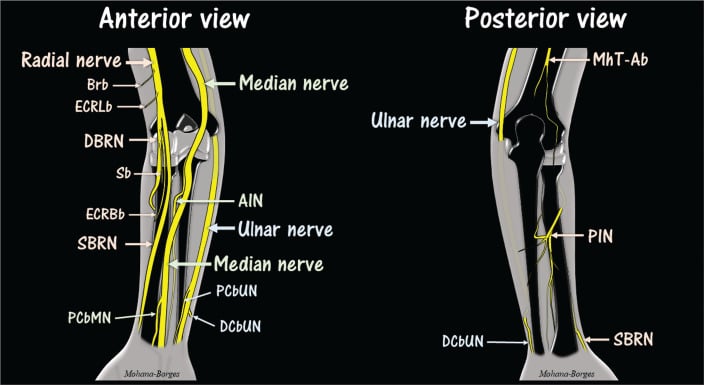
The radius. The radial head articulates with the capitellum and forms the PRUJ, and the radial tuberosity carries the biceps insertion. The lateral surface is covered by the wrist extensors; the volar surface gives origin to FPL and is where a plate sits.
The radial bow is the normal lateral convexity of the radius. Maximum bow is at the junction of proximal and middle thirds, at the level of the bicipital tuberosity. Loss of even 10% of radial bow can result in loss of supination.
The ulna. The olecranon takes the triceps insertion and the coronoid acts as the anterior buttress. The shaft is relatively straight with a triangular cross-section, its medial subcutaneous border palpable throughout, and the dorsal surface - carrying the ECU groove - is the plate surface.
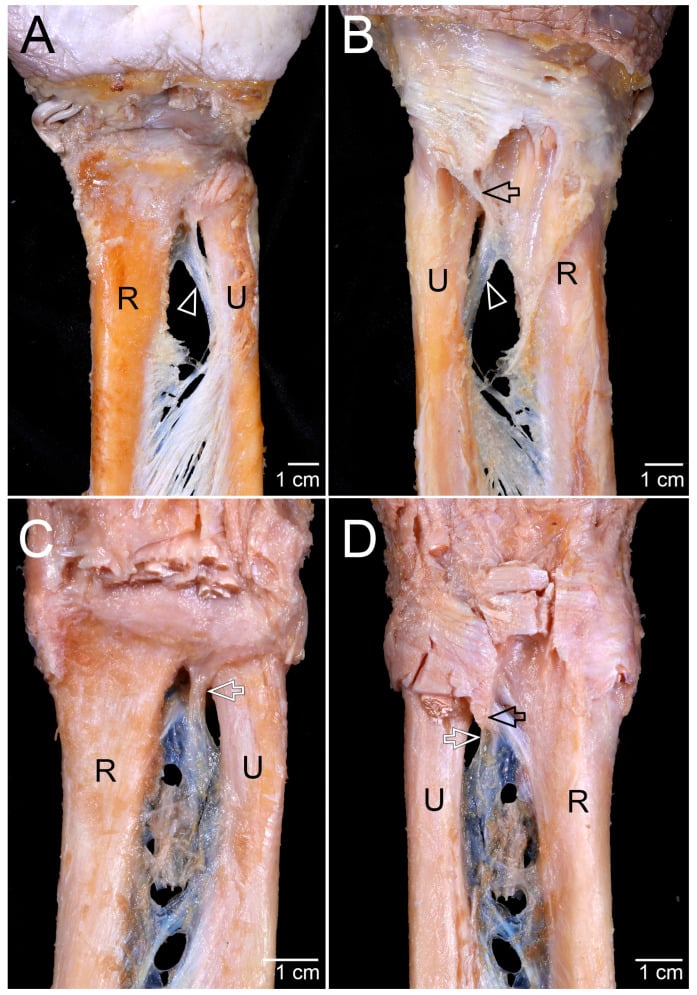
What links them. The interosseous membrane connects radius to ulna, with the PRUJ above and the DRUJ below. The interosseous space between the two bones has to be maintained if the radius is to rotate.
Deforming forces. Each fragment sits where the muscles attached to it put it:
- Proximal radius: supinated and flexed by the supinator and biceps
- Middle radius: pronated by pronator teres, if the fracture is distal to its insertion
- Distal radius: pronated by pronator quadratus
How exact does the reduction have to be? Non-anatomic reduction impairs rotation: the forearm is a joint as much as a strut, so malalignment costs function rather than appearance. The figure usually quoted is that 10° of angular or rotational malalignment produces significant functional loss, but the angle at which rotation is meaningfully lost is genuinely debated, and what predicts rotation is the restored radial bow, the direction of any residual deformity and a preserved interosseous space rather than any single number. Anatomic reduction remains the goal precisely because it makes the question moot.
Classification Systems
Four systems, each answering a different question: location decides the approach and the implant, pattern decides the fixation, the AO/OTA code standardises documentation, and the Gustilo-Anderson grade governs the open wound.
- Radius
- Near radial head/tuberosity
- Ulna
- Near olecranon/coronoid
- Radius
- Shaft - most common
- Ulna
- Shaft
- Radius
- Near wrist
- Ulna
- Near DRUJ
Location determines the surgical approach and the implant, and each third brings its own question:
- Proximal: the PIN is at risk, and the approach changes accordingly
- Middle: standard Thompson and ulnar approaches
- Distal: consider an associated DRUJ or wrist injury
Clinical Presentation and Assessment
History. Take the mechanism and its energy, the time of injury, and whether there was a wound - assume the fracture is open until proven otherwise. Record hand dominance and occupation, and ask about associated injuries.
Examination. Examine for the findings that change the timetable rather than confirm the obvious:
- Significance
- Displaced fracture
- Action
- Document, assess NV, reduce
- Significance
- Open fracture
- Action
- Antibiotics, urgent surgery
- Significance
- Compartment syndrome
- Action
- Emergency fasciotomy
- Significance
- Impending compartment syndrome
- Action
- Serial monitoring or fasciotomy
- Significance
- Arterial injury
- Action
- Urgent reduction, angiography/repair
- Significance
- Nerve injury/compression
- Action
- Document pre-op, may resolve with reduction
- Significance
- Floating segment
- Action
- Address all injuries
Document the function of the PIN, median and ulnar nerves and both the radial and ulnar pulses before any reduction; a deficit may resolve once the fracture is reduced, and the pre-reduction record is what shows that it did. Note the degree of soft-tissue swelling, which predicts complications.
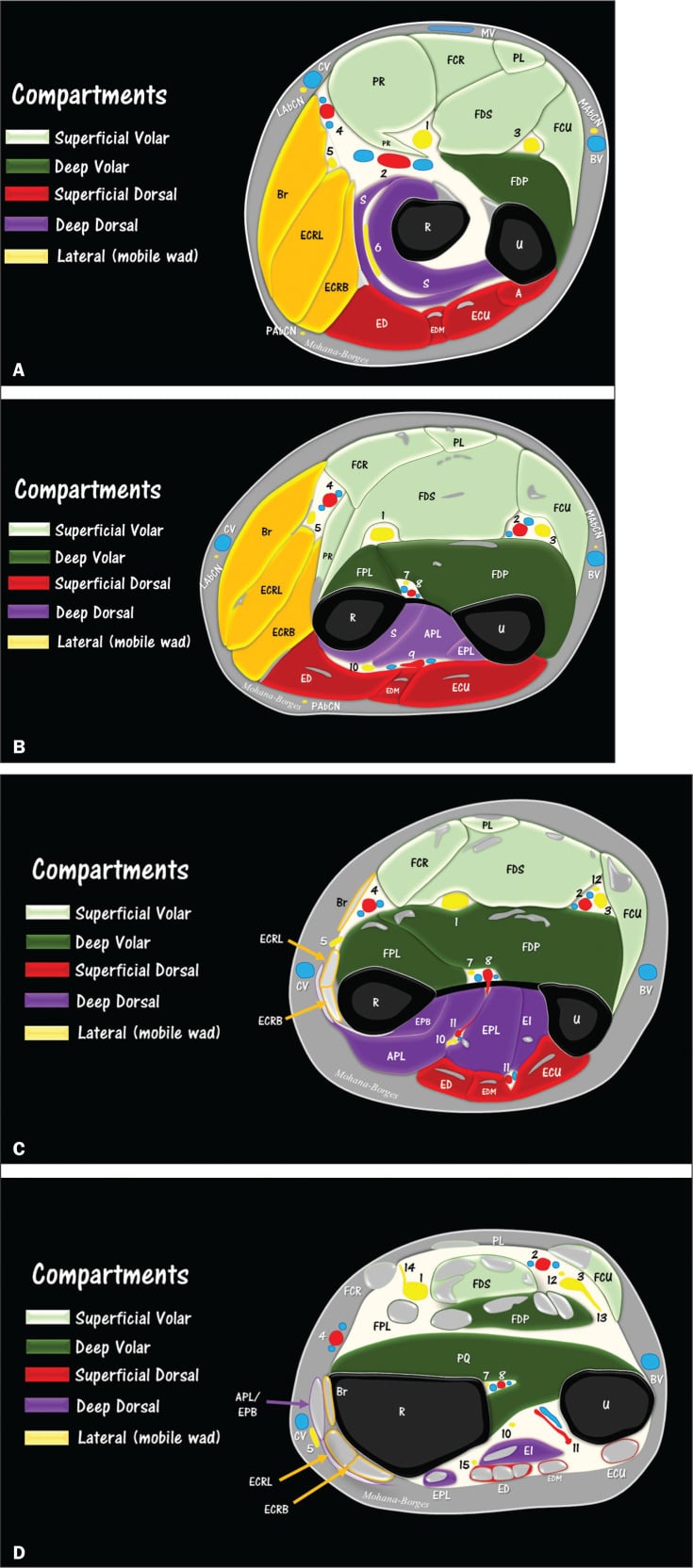
Compartment syndrome. This is a clinical diagnosis and does not wait on a pressure reading. The forearm is tense and swollen, and the pulses are often still present, so their presence is no reassurance. High-energy injuries need serial checks of both the volar and dorsal compartments, with the timing and findings of each check recorded, which matters medicolegally.
The classic 5 Ps (Pain, Pallor, Pulselessness, Paralysis, Paresthesia) are late signs. Early compartment syndrome: Pain out of proportion and pain with passive stretch of fingers. Don't wait for all 5 Ps - fasciotomy needed urgently.
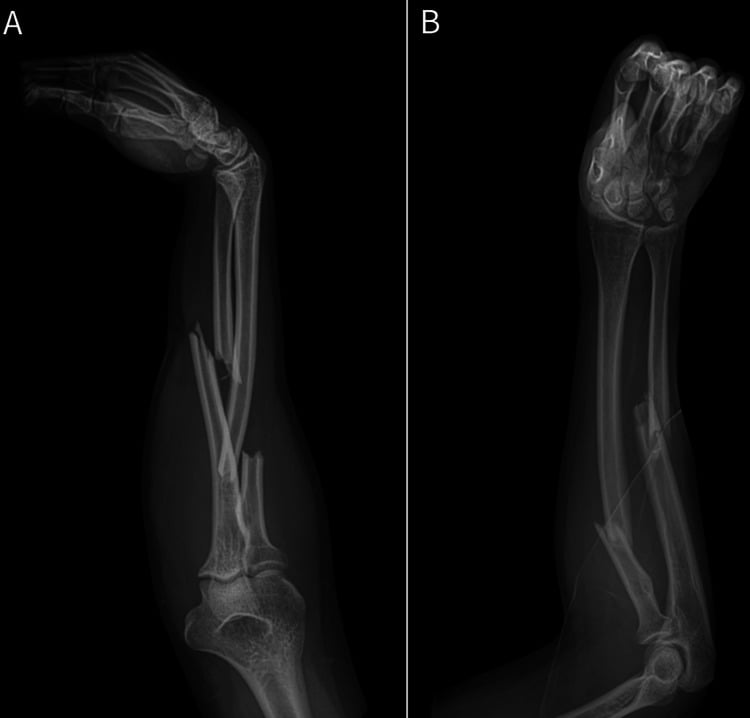
Definition. Ipsilateral fractures of the forearm - one or both bones - and the humerus, so that the elbow is "floating", disconnected from both the proximal and the distal skeletal segments. The analogous floating wrist is an ipsilateral forearm and distal radius or carpal injury.
Why it matters. It marks a high-energy limb and carries a markedly increased rate of compartment syndrome, open injury, neurovascular injury and polytrauma. Have a very low threshold for fasciotomy and a full secondary survey.
What it commits you to. Stabilise both fractures operatively so that the elbow can be mobilised early; non-operative management of either component leaves the elbow unstable and stiff. That is why a floating elbow turns an otherwise brace-able humeral shaft fracture into an operative both-segment fixation. Fixation commonly runs proximal to distal, or takes the more accessible or urgent injury first, but the goal is a stable construct top to bottom.
Investigations
Radiographs. The imaging must show both ends of both bones, so the request is a series rather than a single film:
- AP forearm - the entire forearm including elbow and wrist
- Lateral forearm - a true lateral
- Dedicated elbow views - AP and lateral if the injury is proximal
- Dedicated wrist views - AP and lateral if the injury is distal
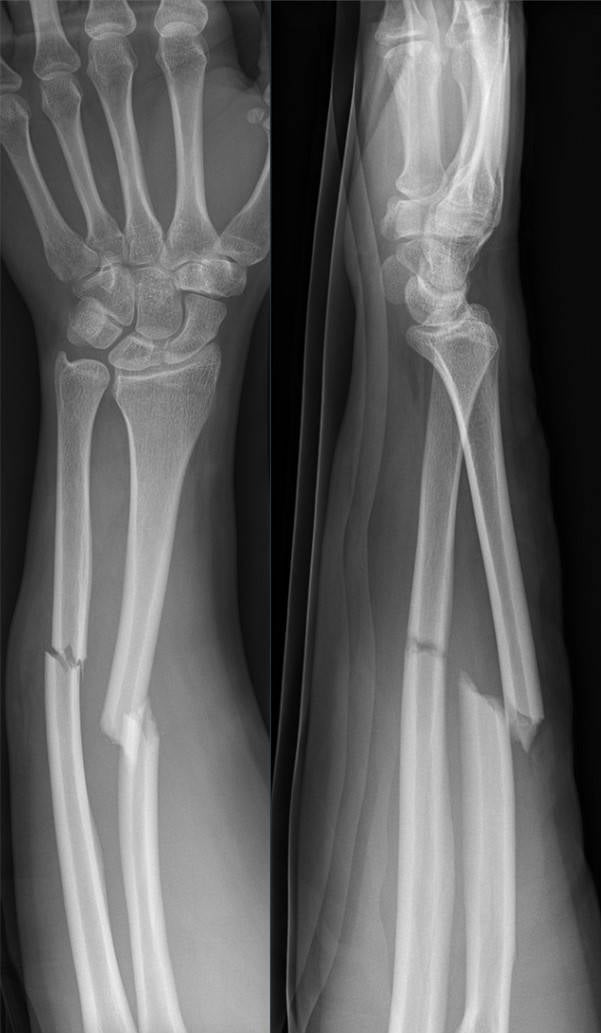
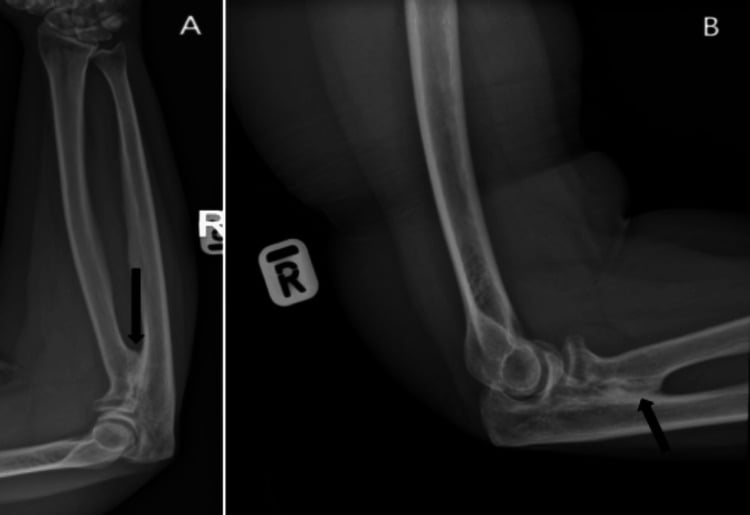
Always image the joint above and below. A forearm fracture series must include adequate views of the elbow and wrist to exclude Monteggia (proximal) or Galeazzi (distal) variants.
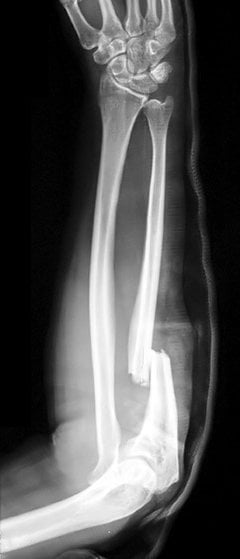
What to read off the films. Work through the same six questions every time:
- Fracture location and pattern, in both bones
- Degree of comminution
- Angulation and displacement
- Is the radial head congruent with the capitellum?
- Is the DRUJ congruent?
- Is there shortening?
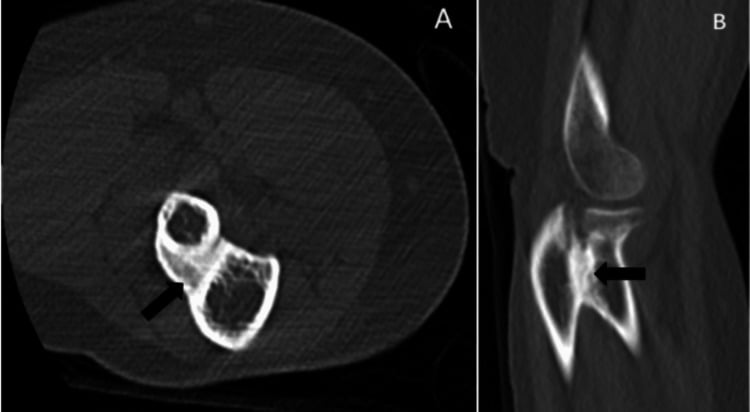
CT. Rarely indicated for a shaft fracture. It helps where there is complex articular extension, with 3D reconstruction for the difficult pattern.
Compartment pressure monitoring. Measure where there is clinical suspicion and the picture is equivocal. An absolute pressure over 30mmHg is concerning, and a delta pressure - diastolic minus compartment pressure - under 30mmHg is an indication for fasciotomy.
Differential Diagnosis
A "both-bone forearm fracture" on a single film can be a fracture-dislocation in disguise. Distinguishing these patterns changes the operation.
- Key Feature
- Fractures of radial AND ulnar shafts; PRUJ and DRUJ congruent
- Pitfall / Distinguishing Test
- Confirm radial head aligns with capitellum and DRUJ is reduced
- Key Feature
- Proximal/mid ulna fracture with radial head dislocation
- Pitfall / Distinguishing Test
- Radiocapitellar line must pass through capitellum on every view
- Key Feature
- Distal-third radius fracture with DRUJ disruption
- Pitfall / Distinguishing Test
- Assess DRUJ widening/instability; the 'fracture of necessity' needing ORIF
- Key Feature
- Radial head fracture + IOM rupture + DRUJ disruption
- Pitfall / Distinguishing Test
- Check wrist pain/DRUJ in any radial head fracture; longitudinal instability
- Key Feature
- Single ulnar shaft fracture, no radial injury
- Pitfall / Distinguishing Test
- Exclude radial head dislocation before calling it isolated
- Key Feature
- Bowing or incomplete cortical break
- Pitfall / Distinguishing Test
- Different management - often closed reduction; not adult ORIF principles
Management Algorithm
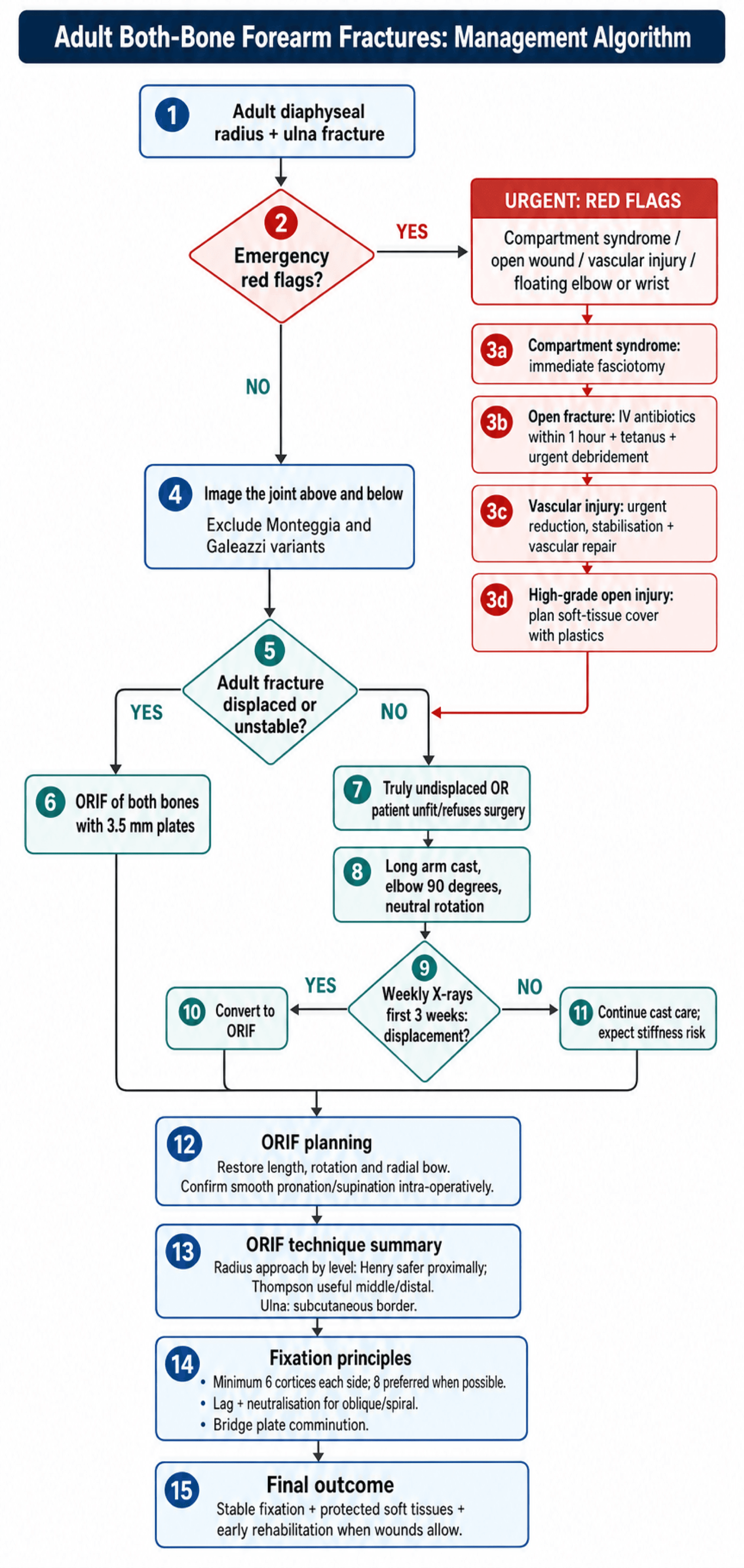
- Exclude emergencies first - compartment syndrome (clinical diagnosis), open wound, vascular injury. Treat these before definitive fixation.
- Image the joint above and below to exclude Monteggia (proximal) and Galeazzi (distal) variants.
- Default to ORIF of both bones with 3.5mm plates; conservative management is reserved for the rare truly undisplaced fracture or the patient unfit for surgery.
- Restore length, rotation and the radial bow, then confirm smooth pronation/supination intra-operatively.
- Plan soft-tissue cover with plastics input for high-grade open injuries.
- Key Consideration
- Standard displaced fracture
- Treatment
- ORIF both bones with 3.5mm plates
- Key Consideration
- Compression achievable
- Treatment
- LC-DCP with lag and compression
- Key Consideration
- Cannot compress
- Treatment
- Bridge plating, may need longer construct
- Key Consideration
- Soft tissue compromise
- Treatment
- Urgent debridement, internal or external fixation
- Key Consideration
- Multiple fractures one bone
- Treatment
- Long plate spanning all fractures
- Key Consideration
- Floating elbow/wrist
- Treatment
- Prioritise forearm stability
- Key Consideration
- Growth plate considerations
- Treatment
- Often closed reduction, casting acceptable
Definitive Management
When it is chosen. Rarely, and usually for a reason other than the fracture. Non-anatomic healing costs rotation, so a cast is a decision to accept prolonged immobilisation and stiffness in a patient who cannot have, or will not have, surgery.
- Isolated, undisplaced fractures (rare)
- Non-ambulatory patients
- Significant medical comorbidities precluding surgery
- Patient refusal
- Long arm cast, elbow 90°, neutral rotation
- Weekly X-rays for first 3 weeks
- Any displacement = convert to operative
- Expect prolonged immobilisation and stiffness
Surgical Technique
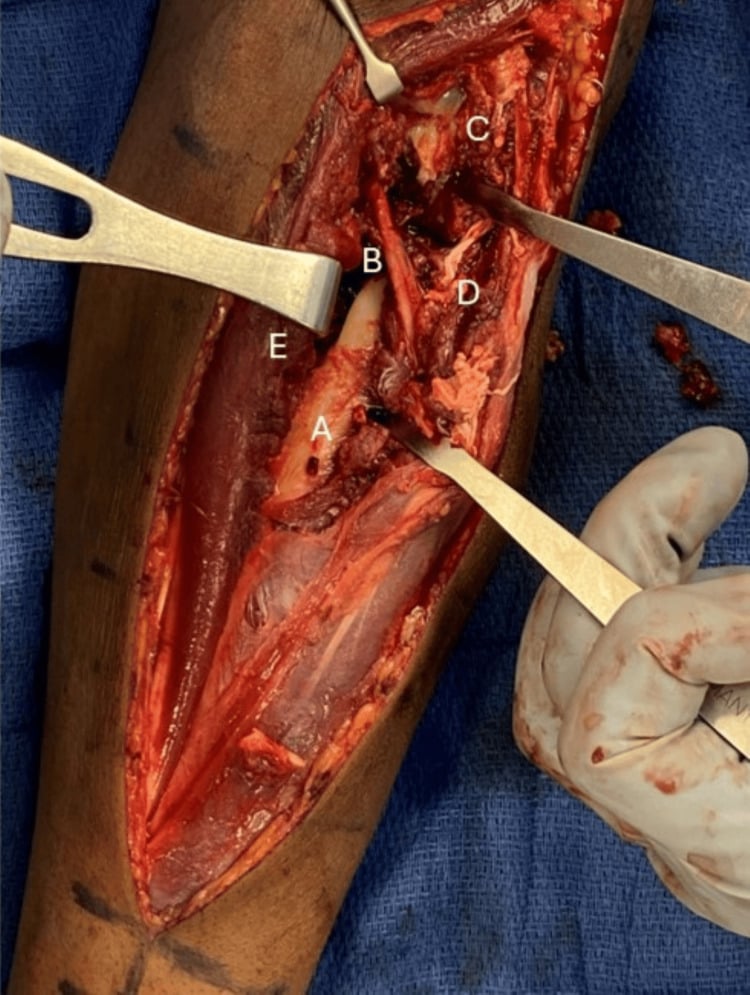
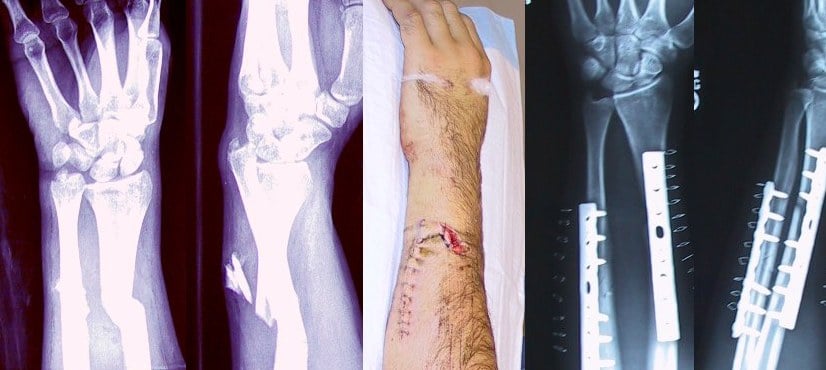
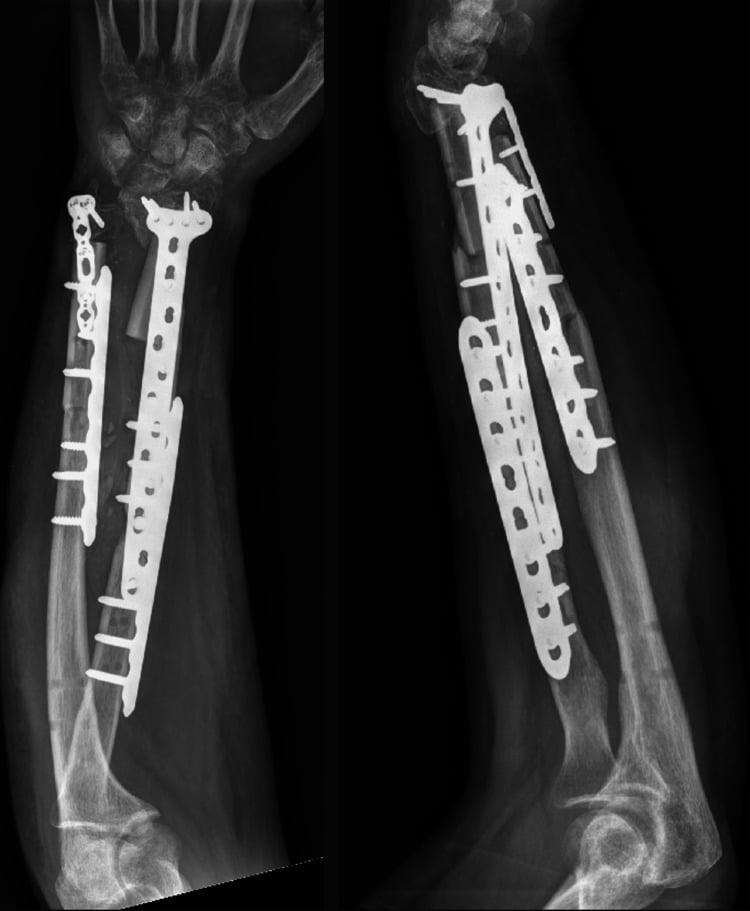
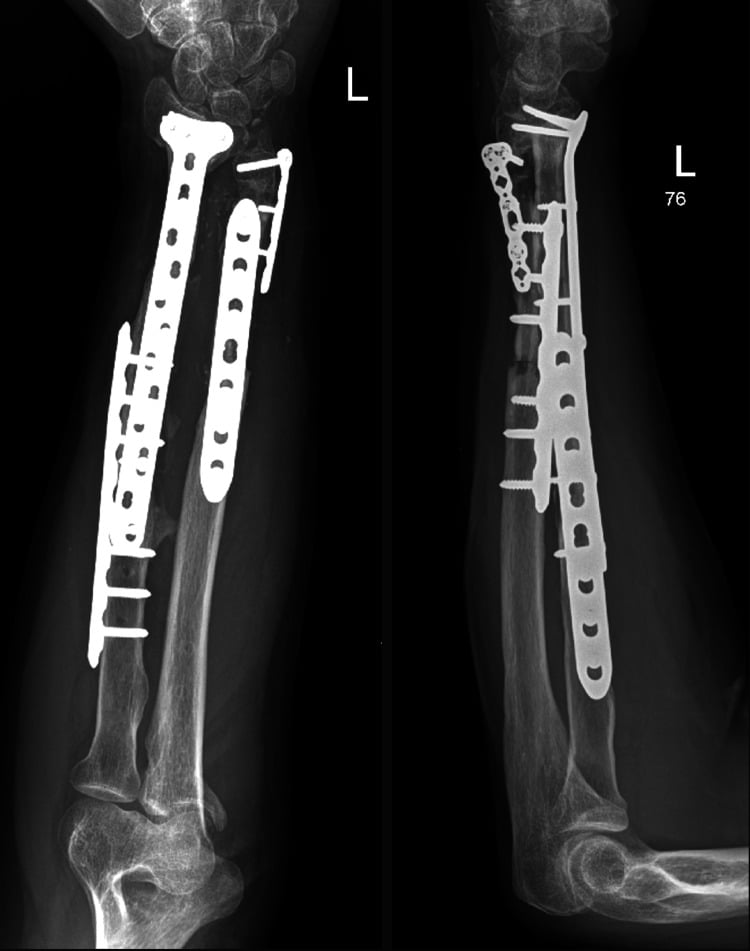
Radius - Thompson (dorsolateral). The incision runs from the lateral epicondyle to Lister's tubercle, through the interval between ECRB and EPL proximally and EPB/APL distally. It gives excellent visualisation and a less symptomatic plate, which makes it the choice for the middle and distal radius. Its danger is the PIN, which crosses at the level of the radial head.
Radius - Henry (volar). From lateral to the biceps tendon down to the radial styloid, between BR and PT and then FCR with the radial artery. It is the safer exposure for the proximal third, where the PIN is protected as it crosses deeper in the supinator; the trade-off is a plate that may be more prominent.
Ulna. A direct incision along the subcutaneous border, onto bone through the ECU/FCU interval with minimal soft-tissue dissection.
The posterior interosseous nerve (PIN) is at risk with the Thompson approach. It crosses at the level of the radial head, approximately 4cm distal to the lateral epicondyle. Supinate the forearm and stay anterior to the supinator; for a proximal fracture, see the nerve directly.
Complications
- Incidence
- 2-5%
- Management
- Emergency fasciotomy
- Incidence
- 5-10%
- Management
- Corrective osteotomy if symptomatic
- Incidence
- 2-5%
- Management
- Revision fixation, bone graft
- Incidence
- 3-5%
- Management
- Excision if mature, interposition
- Incidence
- 1-3% closed, higher open
- Management
- Debridement, antibiotics
- Incidence
- 2-5%
- Management
- Usually neurapraxia, observation
- Incidence
- 2-3%
- Management
- Revision with bone graft
- Incidence
- 5-10%
- Management
- Protected activity, avoid early removal
Compartment syndrome. The most critical early complication, and high-energy injuries carry the highest risk. Fasciotomy is an emergency and must release both the volar and the dorsal compartments.
Malunion. Loss of rotation is the functionally limiting result, and corrective osteotomy with bone graft is the answer if it is symptomatic.
Nerve injury. The PIN is the nerve most often injured and most deficits are neurapraxias that recover with observation. The exception is the palsy that appears or progresses after the injury, which is assessed urgently for a focal compressive lesion rather than watched.
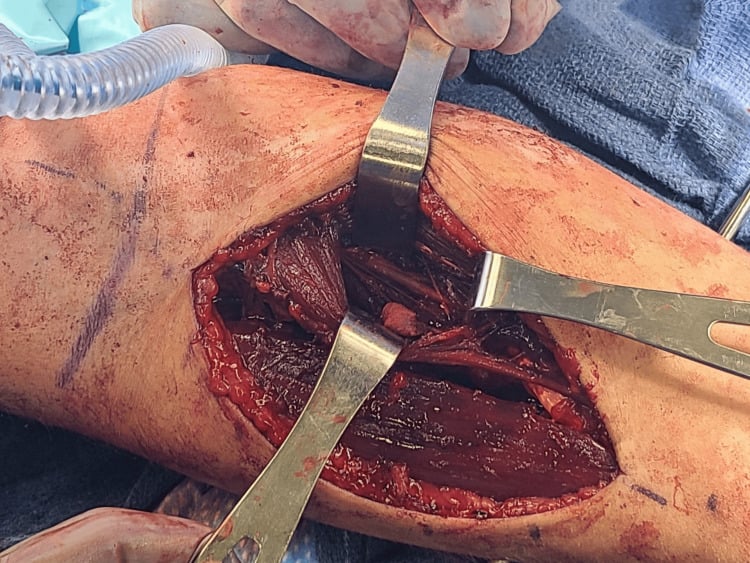
Refracture can occur after plate removal, especially if removed early. Recommend leaving plates in place unless symptomatic. If removal needed, wait 18-24 months post-op, and protect with splint and activity restriction for 6-8 weeks after removal.
Postoperative Care and Rehabilitation
- Posterior splint for comfort
- Elevation
- Finger motion immediately
- Monitor for compartment syndrome
- Wound check day 2 and 5-7
- Begin active ROM elbow and wrist
- Gentle active supination/pronation
- Wean from splint
- Light functional use
- Progressive active ROM
- Expect near full ROM by 6 weeks
- No resistance/lifting
- Light activities of daily living
- Begin gentle strengthening
- Progressive loading
- Return to light work
- X-ray at 6 weeks to confirm union
- Full strengthening
- Return to sport/heavy work
- Full union expected
- Final ROM assessment
Stable fixation is what permits early motion, and early motion is what prevents stiffness; rotation is the arc to chase. Load progressively once union is confirmed, and make the final assessment of range at 6 months.
Both-bone forearm fractures typically unite in 12-16 weeks. Confirm radiographic union before allowing heavy activities. Delayed union more common with comminution, open fractures, and smoking.
Outcomes and Prognosis
Reported outcomes after anatomic fixation:
- Expectation
- 90-95% primary union
- Expectation
- Less than 10-20° loss supination/pronation
- Expectation
- 85-95% of contralateral
- Expectation
- DASH scores typically excellent
- Expectation
- 3-6 months most patients
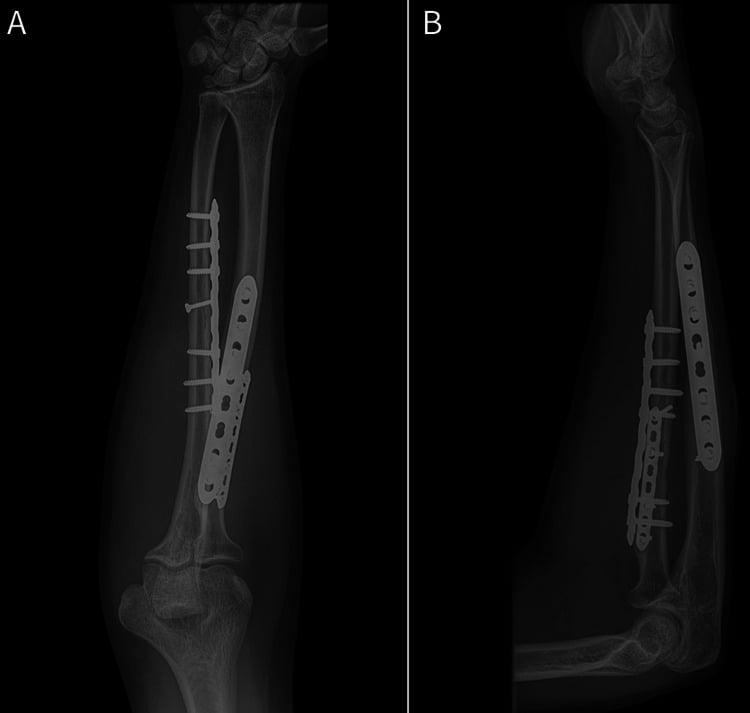
What changes the outcome. The energy of the injury, whether it was open, the quality of the bone, the quality of the reduction, patient compliance and smoking status. Open fractures do worse than closed ones.
Most activities of daily living require approximately 50° supination and 50° pronation. Loss of rotation up to 20° is often well-tolerated functionally. Greater loss typically symptomatic and may warrant corrective surgery.
Guidelines, Registries & Global Practice
Global epidemiology:
- Forearm shaft fractures account for roughly 1-2% of all adult fractures; both-bone patterns are the high-energy subset.
- Bimodal distribution: young men from high-energy trauma (road traffic, especially motorcycles, industrial machinery, falls from height, contact and wheeled sport) and older adults from lower-energy falls.
- Male predominance in the high-energy group; rising motorcycle use makes these injuries disproportionately common in low- and middle-income countries.
Guideline and society positions (areas of genuine agreement and difference):
- Position on adult both-bone forearm fractures
- Anatomic open reduction and compression/neutralisation plating (3.5mm) of both bones is the reference standard; bridge plating for comminution.
- Position on adult both-bone forearm fractures
- Operative fixation for displaced adult diaphyseal forearm fractures; plate fixation favoured over intramedullary nailing for restoring rotation and bow.
- Position on adult both-bone forearm fractures
- Open fractures follow BOAST open-fracture standards: IV antibiotics within 1 hour, combined ortho-plastic care, early definitive fixation with soft-tissue cover.
- Position on adult both-bone forearm fractures
- Endorse anatomic plate fixation; recognise locking plates mainly for osteoporotic or comminuted bone rather than routine use.
- Unlike arthroplasty, forearm shaft fractures are not tracked by a dedicated implant registry; the evidence base is institutional cohorts and trauma databases rather than national joint registries.
- Across cohorts, plate fixation delivers union rates of roughly 90-98%, with locking and conventional 3.5mm constructs performing comparably.
- Well-resourced settings: routine ORIF with 3.5mm plates, intra-operative imaging, on-site plastic surgery for Gustilo IIIB/C, and compartment-pressure monitoring where the diagnosis is equivocal.
- Limited-resource settings: square or Hackethal intramedullary nailing and external fixation are used more often when plating implants or image intensifiers are unavailable; transfer pathways may be limited, so compartment syndrome is frequently managed at the presenting hospital.
Be prepared to discuss surgical approaches, fixation principles (especially radial bow restoration), compartment syndrome recognition and management, and open fracture protocols. Both-bone fractures are common viva topics testing fundamental principles.
Controversies and Areas of Uncertainty
Locking versus conventional plates. Locking plates have not shown superior union or function over conventional 3.5mm DCP/LC-DCP in standard diaphyseal bone (Iacobellis and Biz; Hertel). Their clearest role is osteoporotic bone and bridge plating of comminution, not routine use.
Plate versus intramedullary nailing. Modern locked forearm nails achieve good union, but restoring the radial bow and rotation is harder than with plates. Nailing is most attractive in segmental fractures, poor soft tissues, or limited-resource settings; plating remains the default where anatomic reduction is the priority.
Routine implant removal. Removing plates exposes the patient to refracture - around 4% in long-term cohorts - and to a second operation. Most surgeons leave asymptomatic plates in situ; if removal is undertaken, delay it and protect the limb afterwards.
Compartment pressure thresholds. The diagnosis remains clinical. Absolute and delta-pressure cut-offs guide equivocal cases but should never delay fasciotomy when the clinical picture is clear.
Single versus separate incisions. A single incision for both bones increases synostosis risk, so orthogonal plating through separate approaches is preferred - though high-energy injury itself is the dominant non-modifiable risk factor.
MCQ Practice Points
Q: Why is anatomic reduction essential in both-bone forearm fractures? A: The forearm is a paired rotational joint - radius rotates around ulna. Even 10° of angulation or rotational malunion significantly reduces supination and pronation. Unlike other diaphyseal fractures, the forearm does not tolerate malunion.
Q: What is the minimum fixation for both-bone forearm fractures? A: 3.5mm plates with minimum 6 cortices (3 screws) each side of the fracture for each bone. Eight cortices (4 screws) provides more security and is often preferred.
Q: Where is the maximum radial bow and why is it important? A: Maximum bow is at the junction of proximal and middle thirds of the radius. The bow is critical for supination - loss of radial bow results in loss of supination. Must restore with contoured plate.
Q: What is the danger with Thompson (dorsolateral) approach to the radius? A: The posterior interosseous nerve (PIN) crosses at the level of the radial head (approximately 4cm from lateral epicondyle). Protect by supinating forearm and staying anterior to supinator. Consider Henry approach for very proximal fractures.
Q: How do you reduce the risk of radioulnar synostosis? A: Use orthogonal plating (plates 90° apart), avoid single incision for both bones, meticulous soft tissue handling, preserve interosseous membrane, and avoid high-energy mechanisms (not modifiable).
Clinical Decision Scenarios
Practise clinical reasoning and management decisions out loud
“A 35-year-old man falls from a motorcycle at low speed. He has a closed both-bone forearm fracture in the mid-shaft. X-rays show transverse fractures of both radius and ulna with 100% displacement. How would you manage this injury?”
“A 28-year-old construction worker has his forearm caught in machinery. He has a Gustilo Type II open both-bone forearm fracture with a 3cm wound over the volar forearm. The fractures are at different levels. What is your management?”
“Six hours after plating a both-bone forearm fracture, the nurse calls you because the patient is in severe pain despite adequate analgesia. His fingers are swollen and he has severe pain with passive finger extension. What do you do?”
KEY PRINCIPLES
- Anatomic reduction essential - non-anatomic = loss of rotation
- Plate both bones in adults
- Restore radial bow (max at proximal-middle junction)
- Orthogonal plating (90° apart) reduces synostosis
FIXATION STANDARD
- 3.5mm LC-DCP or locking plates
- Minimum 6 cortices (3 screws) each side
- 8 cortices (4 screws) preferred
- Bicortical screw purchase
SURGICAL APPROACHES
- Radius: Thompson (dorsolateral) for mid/distal
- Radius: Henry (volar) safer for proximal (PIN protected)
- Ulna: Direct over subcutaneous border
- PIN danger zone: 4cm from lateral epicondyle
PLATE POSITIONING
- Radius: volar surface
- Ulna: dorsal tension surface
- 90° apart to reduce synostosis risk
- Contour plate to restore radial bow
COMPARTMENT SYNDROME
- Pain with passive finger stretch = early sign
- 5 Ps are LATE signs - don't wait
- Emergency fasciotomy if clinical suspicion
- Release volar AND dorsal compartments
OPEN FRACTURES
- Antibiotics within 1 hour
- Thorough debridement
- Type I/II: internal fixation appropriate
- Type III: consider external fixation initially
Evidence Base
Compression-plate fixation of forearm diaphyseal fractures
- 330 acute diaphyseal radius/ulna fractures (244 patients) treated with ASIF compression plates; union rate 97.9% radius and 96.3% ulna over up to 9 years follow-up.
- Established compression plating as the benchmark for adult forearm shaft fractures with restoration of function.
Effect of malunion (radial bow) on functional outcome after plating
- 55 adults followed mean 6 years; restoration of the normal amount and location of the maximum radial bow correlated with good functional rotation (more than 80% of normal) and grip strength recovery.
- Failure to restore the radial bow was associated with loss of forearm rotation.
Immediate internal fixation of open forearm diaphyseal fractures
- 50 open forearm fractures (Gustilo I-III) with immediate plate fixation; excellent/good function in 85%, deep infection in only 2 patients and 6 non-unions.
- Outcomes tracked the severity of the initial soft-tissue injury and surgical technique.
Locking compression plate (LCP) fixation of forearm shaft fractures
- 47 patients (64 segments) with 3.5mm titanium LCPs; union 91.5%, non-union 4 segments, 37 excellent/6 satisfactory by Anderson criteria, mean DASH 13.5.
- Locking plates reproduce the high union rates of conventional compression plates when technique is meticulous.
Long-term outcome and refracture after plate osteosynthesis of forearm shafts
- 133 patients, 3.5mm DCP, mean 10.2-year follow-up; 96.2% united before 6 months, one superficial infection in closed fractures.
- After plate removal in 70 patients there were 3 refractures (4.3%), occurring a mean of 8.7 months later.