Zone III Extensor Tendon Injury
- Caused by rupture of the Central Slip insertion (Zone III).
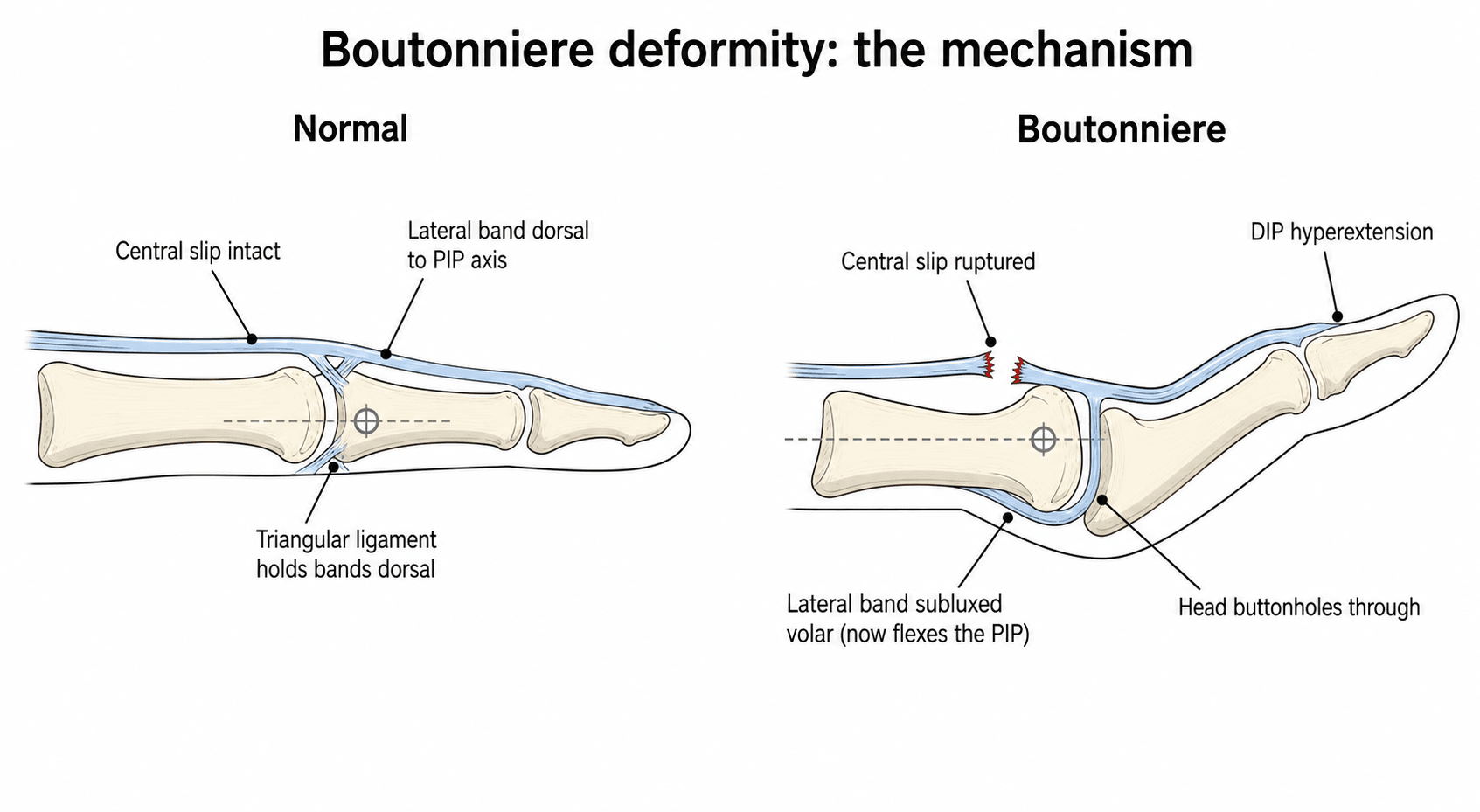
- Lateral bands subluxate volarly (below axis of rotation) to become PIPJ flexors.
- The Triangular Ligament must stretch/fail to allow band subluxation.
- Elson's Test is the most sensitive clinical sign for acute central slip injury.
- Treatment requires splinting the PIPJ in extension while allowing the DIPJ to flex (this pulls lateral bands dorsal).
- Chronic deformities (Type II/III) are very difficult to treat surgically.
- “Elson's test, the right way round: with the PIPJ held at 90 degrees, a FLOPPY DIPJ means the central slip is INTACT; a DIPJ that goes rigid and extends means it is RUPTURED (Elson 1986).
- “The deformity is progressive; acute injuries may not show deformity immediately.
- “The 'Buttonhole' refers to the head of the proximal phalanx popping through the lateral bands.
Overview
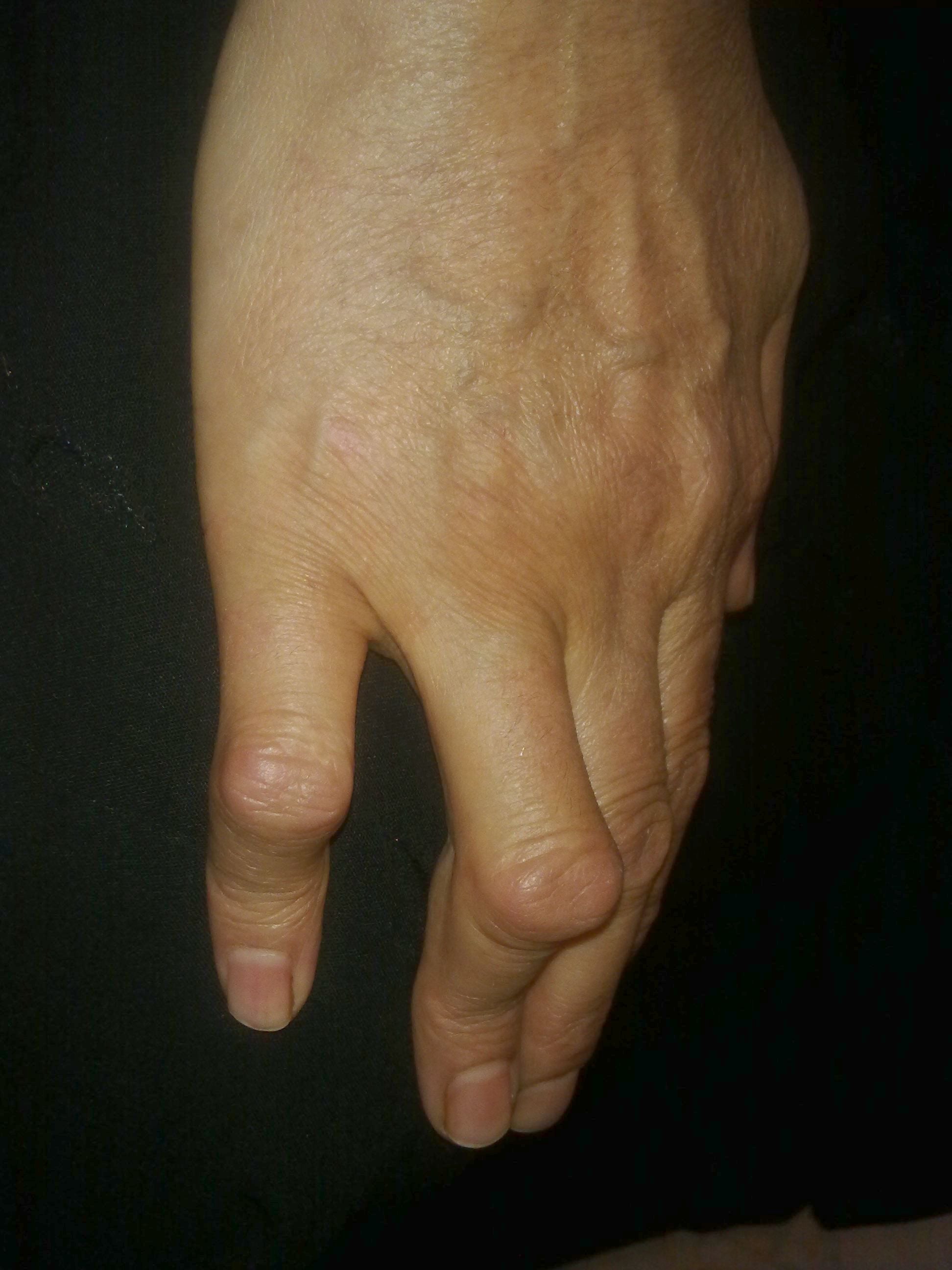
Boutonniere deformity is a flexion deformity of the PIP joint coupled with hyperextension of the DIP joint, and it follows dysfunction of the central slip of the extensor mechanism. "Boutonniere" is French for buttonhole: the condyles of the proximal phalanx protrude dorsally through the defect between the lateral bands.
Where it sits. Zone III central-slip rupture belongs to the wider account of extensor tendon injuries, and it is worth learning beside swan-neck deformity, which is its mirror image - there the lateral bands ride dorsal to the PIP axis and hyperextend it, here they slip volar to it and flex it, and the same triangular-ligament and retinacular anatomy explains both. Mallet finger is the terminal-tendon equivalent one joint distal, producing the DIP droop that a boutonniere cannot, and the joint destroyed by an untreated deformity ends up as PIP joint arthritis.
Pathophysiology and Mechanisms
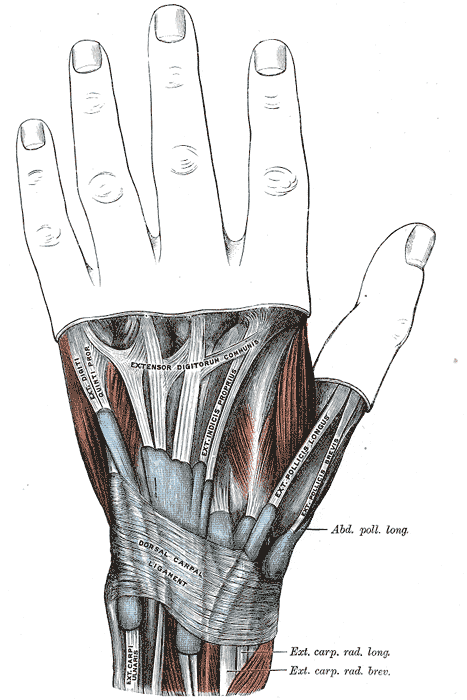
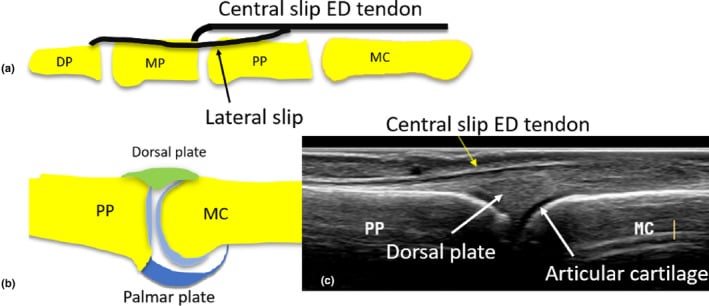
Normal anatomy. Over zone III the extensor mechanism divides, and what each part does depends on where it lies relative to the axis of rotation of the PIP joint.
- Central slip - inserts into the dorsal base of the middle phalanx and extends the PIP joint
- Lateral bands - run either side of the joint and join distally to form the terminal tendon
- Triangular ligament - connects the two lateral bands dorsally over the middle phalanx and prevents them falling volar
- Transverse retinacular ligament - connects the lateral bands to the volar plate and pulls them volar
- Oblique retinacular ligament (ORL, ligament of Landsmeer) - arises from the volar flexor sheath and proximal phalanx, passes volar to the PIP axis but dorsal to the DIP axis, and joins the terminal tendon
The triangular and transverse retinacular ligaments pull the lateral bands in opposite directions, and the interplay between them is what keeps the bands stable. The ORL links PIP and DIP motion - the tenodesis coupling, in which PIP extension passively assists DIP extension - and it is the structure that, when it contracts in a chronic deformity, drives the fixed DIP hyperextension.
Pathomechanics. The deformity develops in a set sequence, and each step explains the next.
- The central slip ruptures or avulses
- PIP extension is weakened, though the lateral bands can still extend the joint weakly at first
- The triangular ligament attenuates or tears
- The transverse retinacular ligament pulls the lateral bands volarly
- The bands drop below the axis of rotation of the PIP joint and become PIP flexors
- All extensor force is transmitted to the DIP joint, which hyperextends
The axis shift. Once the bands lie volar to the axis, the tendons that extended the PIP joint shorten across it as flexors, and the head of the proximal phalanx buttonholes dorsally between them. The same bands go on extending the DIP joint, harder than before, because the extensor force has nowhere else to go.
The secondary contracture. The volarly displaced lateral bands and the chronically extended DIP joint cause the oblique retinacular ligament to shorten. A tight ORL fixes the DIP in hyperextension and, late, contributes to the fixed PIP flexion, converting a supple Stage I into a fixed Stage II deformity. That is why a chronic boutonniere is reconstructed only after passive extension has been regained, and why terminal-tendon (Fowler or Dolphin) tenotomy or ORL release addresses the DIP component.
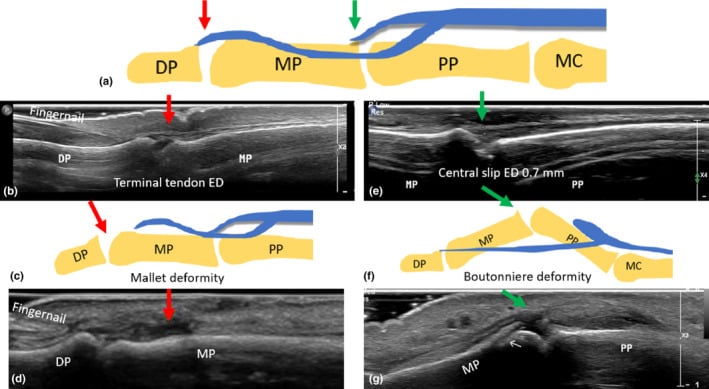
"Zone III" is shorthand from the Verdan extensor zone classification, and examiners expect you to place the injury in the system. The odd-numbered zones lie over joints and the even-numbered zones over the bones between them.
- Zone I - DIP joint (terminal tendon; injury = mallet finger)
- Zone II - middle phalanx
- Zone III - PIP joint (central slip; injury = boutonniere)
- Zone IV - proximal phalanx
- Zone V - MCP joint (sagittal band; injury = extensor subluxation / "fight bite")
- Zone VI - metacarpal, Zone VII - wrist/extensor retinaculum, Zone VIII - distal forearm
- The thumb has its own zones (TI to TV)
So boutonniere is the Zone III lesion, sitting between mallet finger (Zone I) and the sagittal-band injuries (Zone V) - a common spot-the-zone viva.
Classification Systems
Burton stages the deformity by what the PIP joint will do passively, and the stage chooses the treatment.
- Stage I - supple; passive correction of the PIP joint is possible
- Stage II - fixed deformity, with contracture of the lateral bands
- Stage III - fixed deformity with arthritis
Stage I is treatable with splinting. Stage II requires surgical release or serial casting.
Clinical Assessment
The acute injury looks like nothing. Initially only the central slip is ruptured and the lateral bands have not yet subluxed, so the finger looks straight or only slightly swollen. The classic deformity takes 10 to 14 days to develop as the triangular ligament stretches, and the injury missed in that window comes back as a fixed deformity.
Perform Elson's test on any "jammed" finger with dorsal PIP tenderness, and assume the central slip is ruptured until proven otherwise.
If you are unsure, treat it as a rupture and splint it. Splinting is safe; missing the injury is not.
Examination. Look for PIP flexion with DIP hyperextension, check for a dorsal laceration, and palpate for tenderness over the dorsal base of the middle phalanx. Early changes can be subtle, so compare with the other hand.
Elson's test. Place the PIP joint in 90 degrees of flexion over the edge of a table and ask the patient to extend the finger against resistance. With the central slip intact it is tight, the patient generates significant power, and the DIP joint stays loose and floppy because PIP flexion has slackened the lateral bands. With the slip gone, the lateral bands are pulled tight to bypass the PIP joint: PIP extension is weak and the DIP joint becomes rigid and extends forcefully. A rigid DIP joint during resisted PIP extension is a ruptured central slip.
Boyes test. Hold the PIP in full extension and passively flex the DIP joint. Limited DIP flexion with the PIP extended that improves when the PIP is flexed means a tight oblique retinacular ligament - the chronic secondary contracture that has to be released for the DIP to regain motion. Elson's test diagnoses the central slip rupture itself; Boyes' test finds what the deformity has done since.
Passive correctability. Can the PIP be brought passively to full extension? If it can, the deformity is supple (Burton I) and splinting is the treatment. If it cannot, it is fixed (Burton II), and extension has to be regained before anything else is attempted.
- Pathology
- Central Slip Rupture
- PIPJ
- Flexed
- DIPJ
- Hyperextended
- Pathology
- Volar Plate Laxity
- PIPJ
- Hyperextended
- DIPJ
- Flexed
- Pathology
- Volar Plate Injury
- PIPJ
- Flexed
- DIPJ
- Normal/Stiff
- Pathology
- Terminal Tendon
- PIPJ
- Normal
- DIPJ
- Flexed
The lateral bands that subluxate in boutonniere are not separate structures: they are largely the continuation of the intrinsic muscles, the interossei and lumbricals, which insert into the extensor hood and lateral bands. The intrinsics therefore flex the MCP joint and extend the IP joints through this mechanism, and because the bands carry intrinsic force, a chronically subluxated band and a tight intrinsic system both contribute to the deformity and to limited PIP motion.
The intrinsic tightness (Bunnell) test. Flex the PIP passively, first with the MCP held in extension so the intrinsics are on stretch, then with the MCP flexed so they are relaxed. Less PIP flexion with the MCP extended means intrinsic tightness; equal flexion in both positions points instead to a capsular or extrinsic PIP joint cause. That separates an intrinsic contracture from a true PIP joint contracture - a different problem from the central-slip lesion, and the one that determines whether release targets the intrinsics or the joint.
Investigations
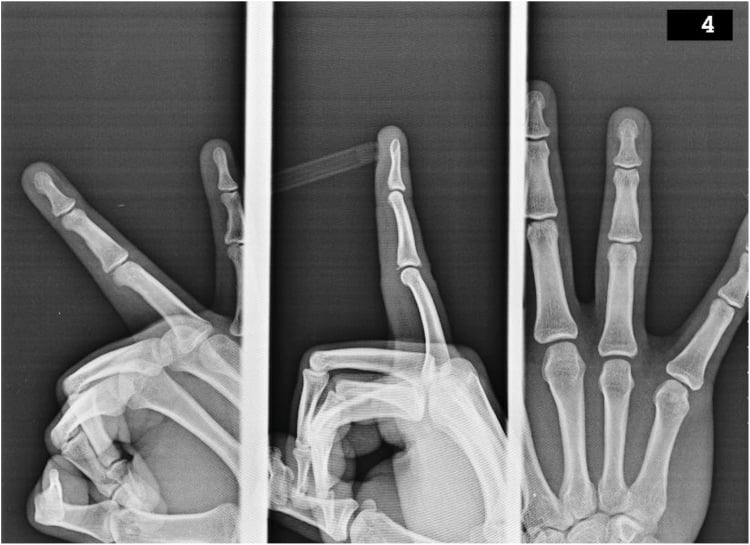
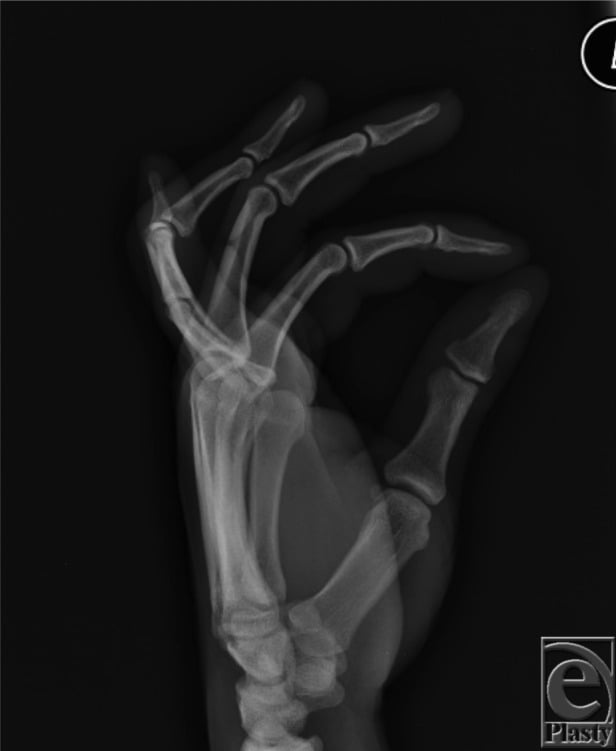
Radiographs. AP and lateral views, read for:
- A bony fleck avulsed from the dorsal base of the middle phalanx
- Osteoarthritis, which makes the deformity Stage III
- Volar subluxation of the middle phalanx, which may be visible
- Soft-tissue swelling dorsal to the PIP joint
A bony avulsion is treated much as a tendinous rupture is, with splinting, unless the fragment is large and displaced.
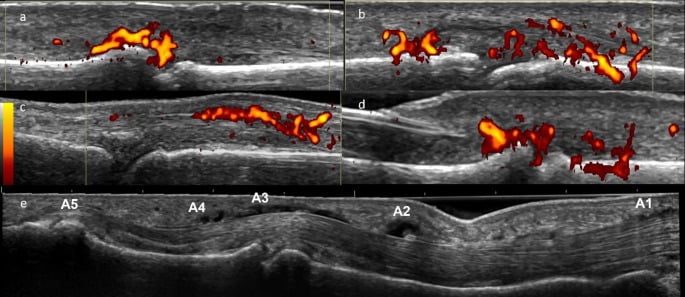
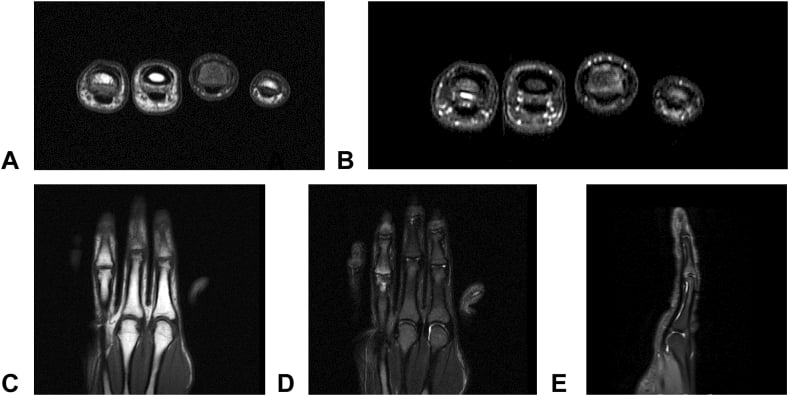
Ultrasound can show the integrity of the central slip dynamically, and discontinuity of the tendon fibres is the finding to look for. It earns its place when the examination is equivocal because swelling masks the slip, and it is operator dependent.
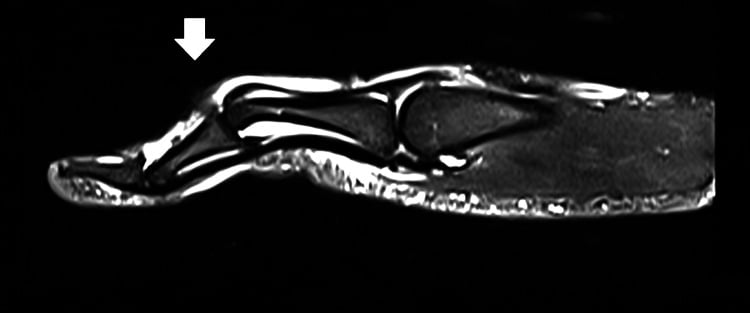
MRI is the gold standard for soft tissue and is rarely needed. Reserve it for the genuinely equivocal soft-tissue case or a complex avulsion pattern, typically in a high-demand athlete, where oedema and disruption at the central slip insertion settle the question; axial and sagittal T2-weighted sequences show the slip best. It is expensive and usually unnecessary where clinical acumen is high.
Management Algorithm
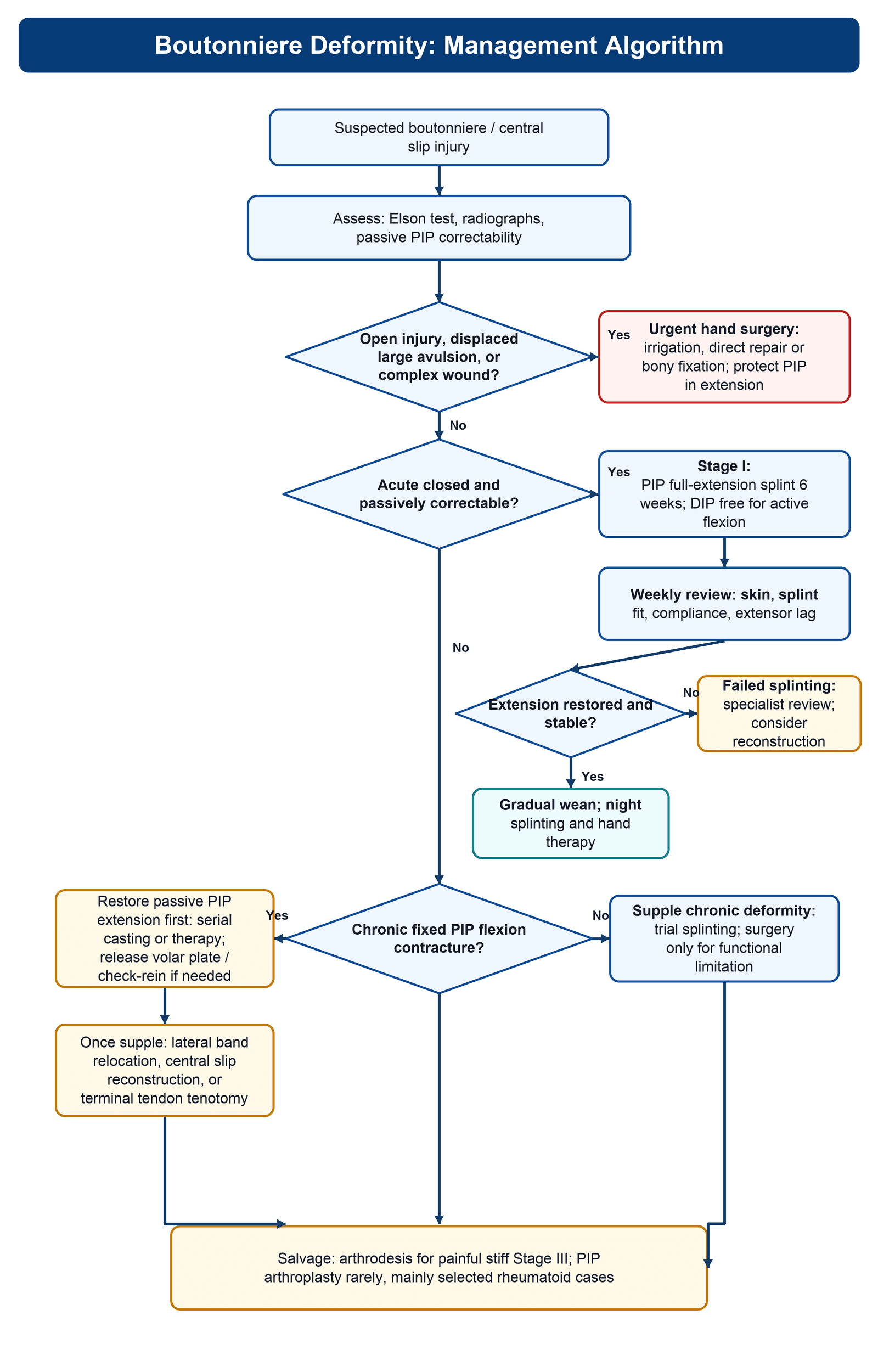
The decision. Assess with the Elson test, radiographs and passive PIP correctability, and three routes open. An open injury or a displaced bony avulsion goes to urgent surgery. An acute closed injury that corrects passively is splinted. A chronic fixed contracture has to be made supple before anything is reconstructed.
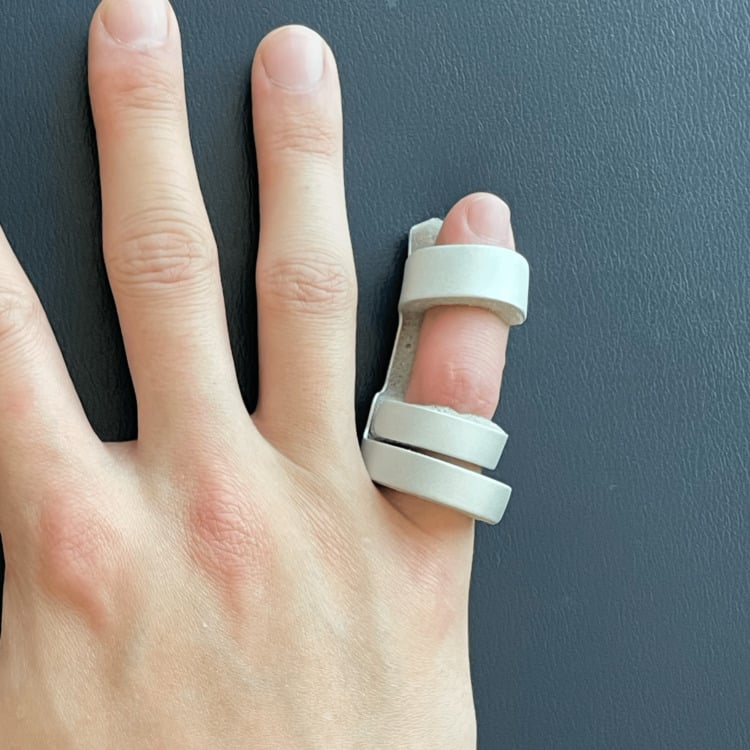
The splint. Stage I is treated by holding the PIP joint in full extension continuously for 6 weeks while the DIP joint is left free and actively flexed. This is the safety splint position, and the goal is two-fold: restore central-slip continuity, and bring the lateral bands back dorsally. Active DIP flexion with the PIP held straight pulls the bands distally and dorsally through the triangular ligament, reducing them. Review weekly, for compliance and for splint fit.
FREEManagement Goals
Hook:FREE the DIPJ to fix the PIPJ.
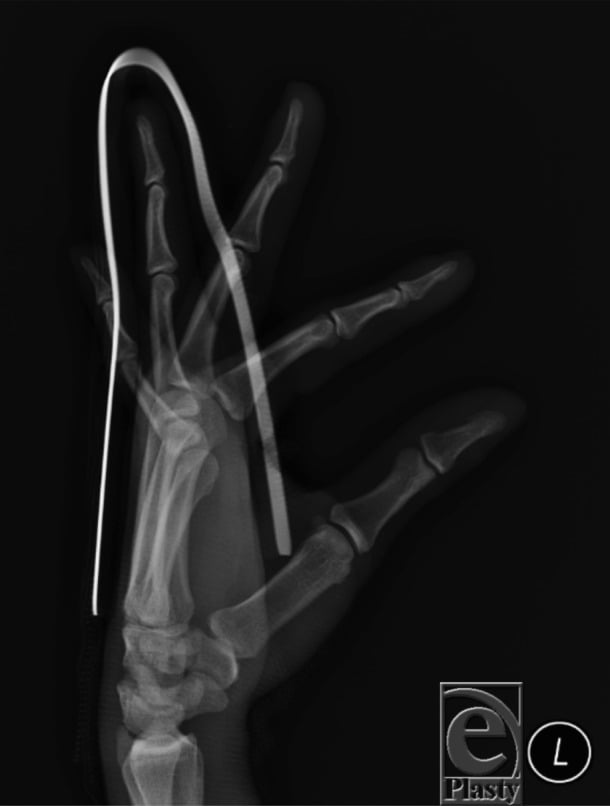
When to operate. An open injury, a large bony avulsion, and splinting that has failed (Stage II or III). Surgery is difficult because restoring the delicate balance of the extensor mechanism is hard.
Surgical Considerations
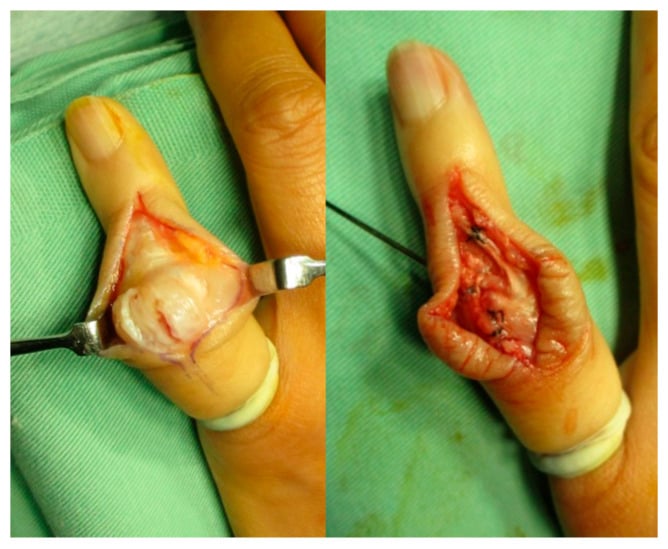
Acute repair. A dorsal zig-zag incision centred over the PIP joint, a 4-0 non-absorbable mattress suture into the central slip, and a K-wire across the PIP joint in extension for 3 to 4 weeks. The triangular ligament must be repaired as well, or the lateral bands subluxate again; the skin closes over buried sutures.
Do not overtighten the central slip. The goal is to appose the tendon ends, not to create tension. An overtightened slip leaves a DIP extension lag.
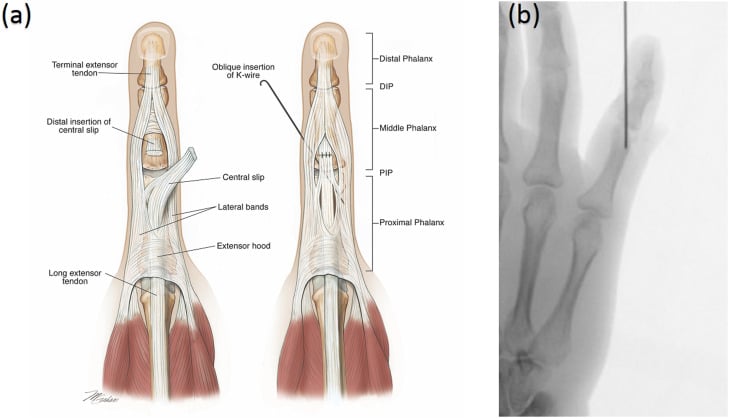
Chronic reconstruction is notoriously unreliable, and the named operations each move something different.
- Modified Littler - isolate the lateral bands, release them from the volar tissues, and sew them together dorsally over the middle phalanx
- Fowler tenotomy - release the terminal tendon distally to give the lateral bands slack, so they can shift dorsal and extend the PIP joint; in practice the tenotomy corrects the DIP hyperextension and leaves the PIP contracture where it was
- Matev reconstruction - central slip reconstruction using a slip of the lateral band
- Staged approach - release the contracture first, reconstruct the tendon second
Stage II comes first. A fixed deformity needs release of the volar plate and the check-rein ligaments before any reconstruction, and serial casting may convert a Stage II into a Stage I, which makes the reconstruction easier.
Salvage. Arthrodesis for the Stage III joint. PIP arthroplasty is rarely indicated and is reserved for rheumatoid patients.
Complications
What goes wrong divides between the splint and the repair.
- Stiffness - loss of PIP flexion is common after prolonged splinting
- DIP extension lag - tight lateral bands, or a central slip overtightened at repair
- Recurrence - an incompetent triangular ligament
- Skin necrosis - from a tight splint
- Hypersensitivity - often managed with desensitisation
- Quadriga effect - a tethered FDP
- Infection - postoperative, or from the injury itself, a human bite included
Rehabilitation
Immobilisation, weaning, then strengthening. The extensor lag is the number watched throughout, and a lag that returns as the splint comes off sends the finger straight back into it.
- Active DIP flexion, 20 reps every hour while awake
- Splint off 1-2 times daily for skin care, holding the PIP extended
- Oedema control with a Coban wrap and elevation
- Start gentle active PIP flexion, 20-30 degrees initially
- Increase the arc 10 degrees per week, guided by the extensor lag
- An extensor lag greater than 10 degrees that recurs means back to full-time splinting
- Night splinting for a further 4 weeks
- Active assisted and passive range of motion
- Gradual return to full activity by 12 weeks
- Grip strengthening with Theraputty
- Night splinting may continue for 3-6 months in some patients
- Return to sport- and work-specific activities
The splints. Each construct has its own job.
- Cylinder splint - simple, inexpensive, good for initial immobilisation
- Capener splint - dynamic, with a spring mechanism, for the chronic deformity
- Safety pin splint - low profile, allows more function
- Serial casting - for the fixed Stage II deformity, to gain passive extension
Red flags during rehabilitation. Any of these means the finger is losing ground and needs review, not reassurance.
- Extensor lag greater than 15 degrees on weaning
- Increasing flexion contracture
- Pain at terminal extension, suggesting a problem with tendon healing
- Skin breakdown under the splint
Prognosis
The acute injury does well. Splinted early, within 3 weeks of injury, the prognosis is excellent, and a bony avulsion unites given adequate reduction of the fragment.
The chronic deformity does not. Reconstruction often swaps deformity for stiffness, and arthritis is the long-term consequence of uncorrected subluxation.
What the patient actually minds. Cosmesis is the main complaint for many, and chronic pain is rare unless secondary arthritis develops. Hand function can remain good with some residual deformity as long as range is preserved, and satisfaction is often higher with a slightly deformed but mobile finger than with a straight but stiff one.
Prognostic factors:
- Stage at presentation - Stage I has superior outcomes compared to Stage II and III
- Compliance - poor splint compliance leads to recurrence
- Age - younger patients heal better but may be less compliant
- Occupation - manual workers may require longer rehabilitation
Guidelines, Registries & Global Practice
Global Epidemiology
- Traumatic: Closed central slip injury is a ball-sport and contact-sport injury worldwide (basketball, volleyball, football/soccer, rugby, Australian football, cricket, handball) from forced PIP flexion against an actively extending finger, plus axial-load "jamming". Peak incidence in active adults aged 20–40.
- Open: Lacerations over the dorsal PIP (knife, glass, machinery, bites) account for the open subgroup and are at high risk of being missed.
- Inflammatory: Rheumatoid arthritis is the leading non-traumatic cause and is typically bilateral and multi-digit; psoriatic arthritis and SLE contribute. With modern biologic disease control the incidence of advanced rheumatoid boutonniere has fallen.
Side-by-Side Guidance (where emphasis differs)
There is no single randomised-trial-based society guideline for boutonniere; the consensus across hand-surgery bodies is convergent.
- Core recommendation
- Acute closed: PIP extension splint, DIP free for active flexion; surgery for open / displaced bony avulsion / failed conservative
- Practical emphasis
- Evidence-based reviews caution that surgery trades PIP extension for flexion
- Core recommendation
- Same splinting principle; emphasises early diagnosis with Elson test and hand-therapy-led splinting
- Practical emphasis
- Hand therapists fabricate and supervise relative-motion / PIP extension orthoses
- Core recommendation
- Clinical diagnosis (Elson), splint non-displaced injuries, restore passive extension before reconstructing fixed deformity
- Practical emphasis
- Staged approach to chronic / fixed deformity
- Core recommendation
- Central-slip-protective splinting; reserve reconstruction for selected chronic cases
- Practical emphasis
- Realistic goal-setting; function over cosmesis
Registry and Outcome Notes
- No implant registry applies — boutonniere management is soft-tissue and splint-based, so arthroplasty/implant registries (NJR, AJRR, AOANJRR) do not capture it. Evidence is drawn from cadaveric biomechanical work and surgical case series rather than registry data.
- Surgical series (e.g. Towfigh & Gruber, 172 patients) report roughly two-thirds excellent/good results after reconstruction, with a consistent minority of satisfactory/poor outcomes — a pattern echoed across the literature.
High- vs Limited-Resource Practice Variation
- High-resource settings: Custom thermoplastic and relative-motion orthoses fabricated by certified hand therapists; ultrasound or MRI available for equivocal cases; structured graded rehabilitation.
- Limited-resource settings: Prefabricated splints, low-cost aluminium-foam (Zimmer-type) or plaster cylinder casts, and serial casting deliver equivalent biomechanics — the central slip does not "know" what the splint is made of. Early, correctly positioned, consistently worn immobilisation matters far more than splint cost.
- Universal barrier: Compliance with 6 weeks of continuous PIP extension splinting (heat, skin maceration, manual-work demands) is the dominant determinant of success in every health system; patient education and review drive outcomes more than any device.
Controversies and Areas of Uncertainty
There are no randomised controlled trials comparing splinting regimens or operative techniques in boutonniere deformity. Recommendations rest on cadaveric biomechanics, case series, and expert consensus — a frequent examiner probe.
- Optimal splint position and type: Static PIP extension splinting is standard, but relative-motion (yoke) splinting and serial casting all have advocates. There is no high-level evidence that any one orthosis is superior, and the construct material (thermoplastic vs aluminium-foam vs cast) is far less important than position and compliance.
- Bony avulsion threshold for surgery: The fragment size or articular involvement that mandates fixation over splinting is not precisely defined; most non-displaced or small avulsions do well with extension splinting, mirroring tendinous injury.
- Surgery for chronic deformity: Reconstruction reliably trades PIP extension for flexion. Whether to operate at all in a functional but cosmetically displeasing finger is genuinely debated — many authorities advise against surgery when the hand is functional.
- Choice of reconstruction: Anatomical central slip reconstruction, lateral band relocation (Littler), terminal/Dolphin tenotomy (Fowler-type), and tendon transfer/graft each have proponents; comparative data are limited and largely retrospective.
- Imaging role: Ultrasound and MRI can demonstrate the central slip, but the diagnosis remains clinical (Elson test). Whether imaging changes management in equivocal closed cases is unproven.
MCQ Practice Points
Q: What is the hallmark finding of a positive Elson's test? A: Rigid extension of the DIPJ when PIPJ is flexed (due to lateral band over-pull).
Q: Which structure limits the dorsal migration of the lateral bands? A: The Transverse Retinacular Ligament.
Q: In splinting for Boutonniere deformity, what is the position of the DIPJ? A: Free / Flexed. (Active flexion recruits lateral bands).
Q: What defines a Stage II deformity? A: Fixed flexion contracture (not passively correctable).
Q: Why do the lateral bands become PIPJ flexors in Boutonniere? A: They subluxate volar to the axis of rotation of the PIPJ, converting their pull from extension to flexion.
Q: How long should a Boutonniere splint be worn continuously? A: 6 weeks continuous, then progressive weaning with night splinting for months.
Q: Which structure, when contracted in a chronic boutonniere, produces the fixed DIP hyperextension, and which test detects it? A: The oblique retinacular ligament (of Landsmeer); a positive Boyes test (DIP flexion limited with the PIP held extended, improving with PIP flexion).
Viva Scenarios
Practise clinical reasoning and management decisions out loud
“A basketball player presents with a swollen PIPJ. X-ray is normal. The finger looks straight. What is your exam?”
“A patient presents 3 months post injury with a fixed 45 degree flexion deformity of the PIPJ and hyperextended DIPJ. Management?”
“A patient has a deep laceration over the dorsal PIPJ. Tendon is visible. Mechanism is a glass cut.”
“A 55-year-old female with known rheumatoid arthritis presents with bilateral Boutonniere deformities affecting the index and middle fingers of both hands. Her PIP joints are passively correctable. How do you manage her?”
Classification
- Stage I: Supple (Splint)
- Stage II: Fixed (Cast/Release)
- Stage III: Arthritis (Fuse)
- Pseudo: Volar plate injury
Management
- Splint PIP Extension
- DIP Free (Exercise)
- 6 Weeks Continuous
- Elson's Test is Key
Anatomy
- Central Slip Rupture
- Lateral Bands Volar
- Triangular Lig Failure
- Zone III
Evidence Base
Elson's Test — Original Description (Landmark)
- Closed central slip rupture is easily missed until the late buttonhole deformity appears, by which time Boyes' test (DIP flexion with PIP held extended) is already positive
- New test: with the PIP flexed 90° over a table edge, the patient extends against resistance — absence of PIP extension force PLUS fixed (rigid) DIP extension signals complete central slip rupture
- Allows diagnosis in the acute phase, before deformity develops, when treatment outcomes are best
Biomechanics of the Acute Boutonniere (Cadaveric)
- Central slip detachment alone produced only loss of PIP extension — NOT a boutonniere deformity
- A boutonniere developed only when the central slip, the triangular ligament, AND the transverse/oblique interosseous hood fibres were all divided
- Lateral band subluxation volar to the PIP axis of rotation is required to generate the deformity
Extensor Tendon Injuries at the PIP Joint (Zone III)
- Acute closed central slip injuries are a clinical diagnosis (Elson test) after bony injury is excluded radiographically
- Non-displaced avulsions and lacerations can be splinted; displaced avulsions and complex injuries are surgical
- Fixed deformities must have full passive PIP extension restored (hand therapy or release) BEFORE any tendon reconstruction