Blood Supply of the Forearm
Overview
The forearm is supplied by the two terminal branches of the brachial artery, which bifurcates in the cubital fossa opposite the neck of the radius. The radial artery runs down the lateral border and the ulnar artery down the medial border, and the two meet again in the vascular arches of the hand.
Where this anatomy is cashed in. Three clinical situations turn on it, and each has its own page. The deep volar supply is the anatomy behind forearm compartment syndrome and its late consequence, Volkmann's contracture. The vessels are put at risk by the injuries that break the two bones they run between - adult forearm shaft fractures, both-bone forearm fractures and their paediatric equivalents. And the nerves that travel with these arteries have their own syndromes: the anterior interosseous nerve accompanies the anterior interosseous artery (AIN syndrome), and the posterior interosseous nerve its posterior counterpart (PIN syndrome).
Neurovascular
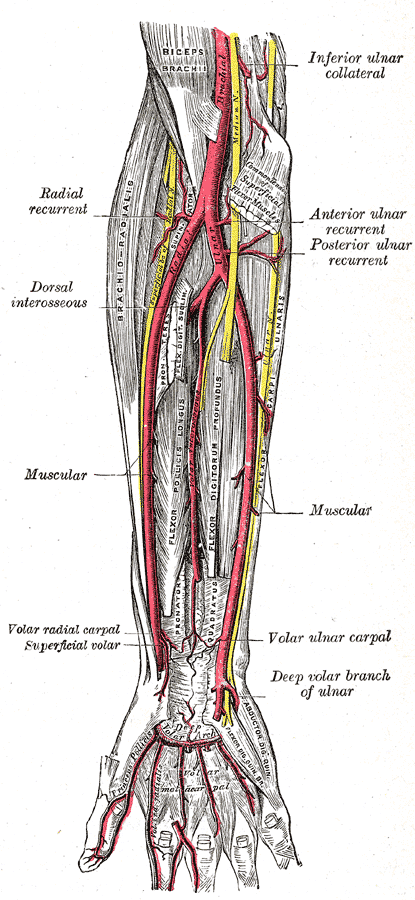
Origin and course. The radial artery is the smaller terminal branch of the brachial artery, though it continues the line of the parent vessel. It runs distally on the lateral side of the forearm, covered by the belly of brachioradialis, its satellite muscle, for the proximal two-thirds; in the distal third it becomes superficial, which is where it is palpated and punctured for a blood gas or arterial line, and it then winds around the lateral aspect of the wrist through the anatomical snuffbox.
The superficial radial nerve. In the middle third the artery is closely accompanied by the superficial radial nerve, which runs lateral to it and is at risk during harvest or dissection. The nerve leaves the artery in the distal third to pass dorsally, so by the wrist the two have parted.
Branches.
- Radial recurrent - ascends to anastomose with the radial collateral artery
- Muscular - to the lateral extensors and flexors
- Superficial palmar branch - completes the superficial palmar arch
Anastomoses and the Arches of the Hand
At the elbow. The recurrent and collateral vessels form a network that ensures collateral circulation around the joint:
- Radial recurrent joins the radial collateral
- Anterior and posterior ulnar recurrent join the inferior and superior ulnar collateral
- Interosseous recurrent joins the middle collateral
The network is rich enough that the brachial artery can be ligated distal to the profunda in an emergency, though this is not a recommended manoeuvre.
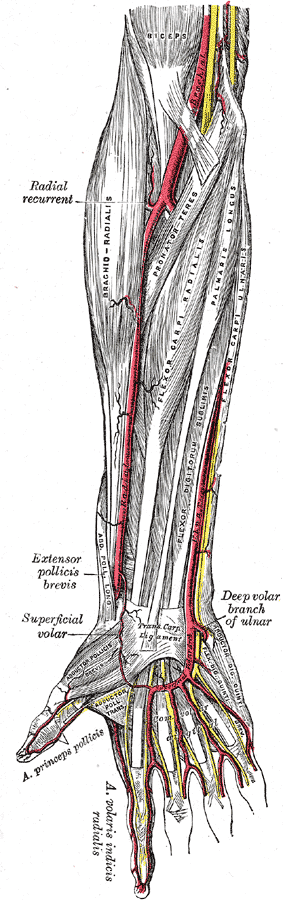
At the wrist. The palmar carpal branches of the radial and ulnar arteries form the palmar carpal arch, which supplies the carpal bones, and the dorsal carpal branches form the dorsal carpal arch, which supplies the dorsal wrist. Both are small compared with the palmar arches of the hand. Dorsally, the dorsal carpal arch gives the dorsal metacarpal arteries; the first dorsal metacarpal artery is the basis of the kite flap and of the dorsal scaphoid and snuffbox supply.
The superficial palmar arch. The more distal of the two palmar arches, at the level of the outstretched thumb (Kaplan's cardinal line). It is mainly the continuation of the ulnar artery, completed laterally by the superficial palmar branch of the radial artery, and it is complete in roughly 70 per cent of hands. It gives the common palmar digital arteries, which split into the proper palmar digital arteries: the dominant supply to the fingers.
The deep palmar arch. About a finger-breadth proximal to the superficial arch. It is mainly the continuation of the radial artery, which reaches it after crossing the snuffbox and diving between the heads of the first dorsal interosseous, and is completed by the deep branch of the ulnar artery. It gives the palmar metacarpal arteries and, importantly, princeps pollicis and radialis indicis, so the radial artery is the dominant supply to the thumb and the radial side of the index.
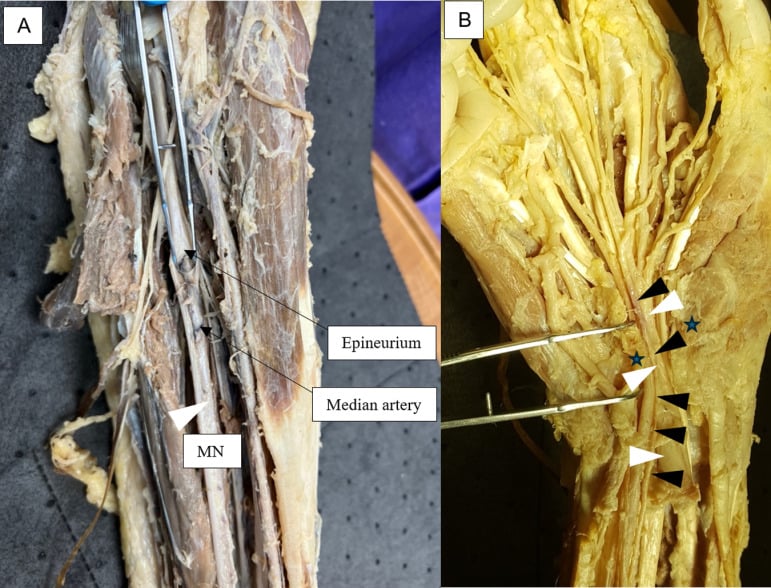
The persistent median artery. The embryonic median artery, the original axial artery of the forearm, usually regresses, but it persists in a minority, running with the median nerve, often through the carpal tunnel, and sometimes contributing to the superficial arch. It is a recognised cause of carpal tunnel syndrome, acute if it thromboses, a structure to avoid injuring at carpal tunnel release, and a confounder of Allen-test interpretation; its prevalence appears to be rising across generations.
Pathology: Ischaemia
Volkmann's ischaemia. Oedema within the deep volar compartment occludes the microcirculation of the anterior interosseous artery; the deep volar muscles, FDP and FPL, and the anterior interosseous territory are hit first and hardest. The muscles infarct and fibrose, and the result is a flexion contracture of the wrist and fingers, the claw. The sign to elicit is pain on passive extension, the stretch test.
Raynaud's. Vasospasm of the digital arteries. The problem is primarily digital, but severe proximal disease in the ulnar or radial arteries (Buerger's, hypothenar hammer syndrome) can mimic or exacerbate it.
Differential diagnosis of the ischaemic or painful hand
- Key Feature
- Pain on passive stretch, tense compartment
- Vessel / Level
- Microcirculation (AIA territory first)
- Distinguishing Test
- Clinical; compartment pressure if obtunded
- Key Feature
- Pulseless, expanding haematoma
- Vessel / Level
- Radial or ulnar artery
- Distinguishing Test
- CT angiography / on-table exploration
- Key Feature
- Repetitive palm trauma, ulnar-sided digital ischaemia
- Vessel / Level
- Distal ulnar artery (Guyon's canal)
- Distinguishing Test
- Duplex / angiography of ulnar artery
- Key Feature
- Bilateral, cold-triggered, fully reversible
- Vessel / Level
- Digital arteries (no fixed lesion)
- Distinguishing Test
- Normal large-vessel imaging
- Key Feature
- Young smoker, distal segmental occlusions
- Vessel / Level
- Distal radial/ulnar and digital arteries
- Distinguishing Test
- Angiography (corkscrew collaterals)
- Key Feature
- Recent arterial line, cool finger
- Vessel / Level
- Radial artery at wrist
- Distinguishing Test
- Doppler / duplex of radial artery
The compartments, fasciotomy and Volkmann's grading
The compartments. "Release all compartments" needs the anatomy first:
- Volar (flexor) - a superficial group (pronator teres, FCR, palmaris longus, FCU, FDS) and a deep group (FDP, FPL, pronator quadratus)
- Dorsal (extensor)
- Mobile wad - brachioradialis, ECRL, ECRB
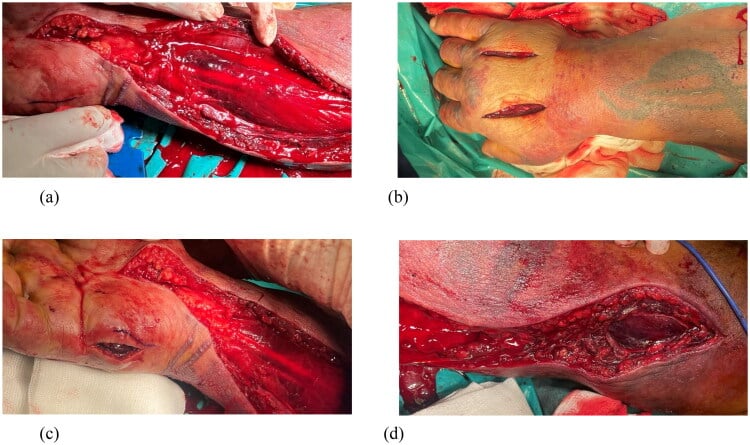
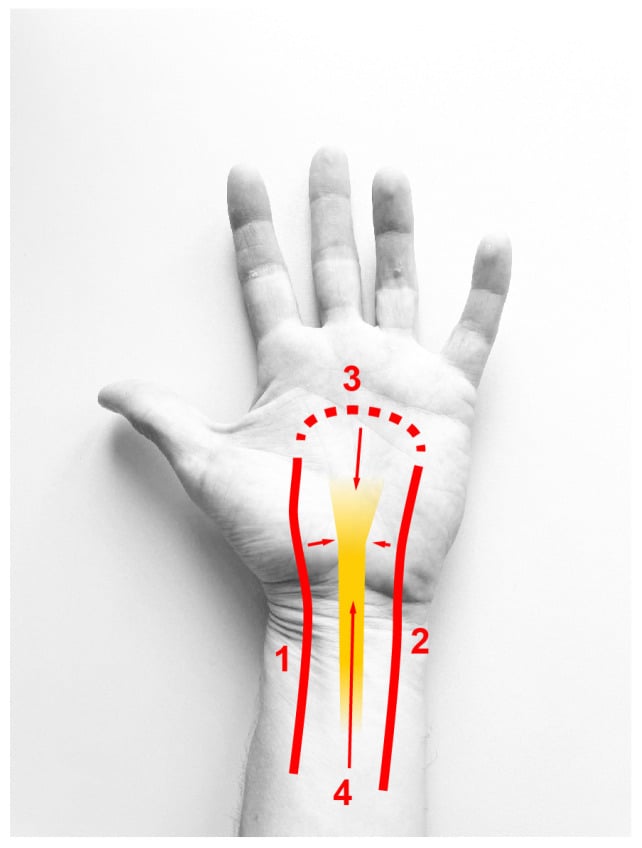
Fasciotomy. A volar curvilinear incision of the extended Henry or McConnell type begins medial to the biceps tendon, crosses the elbow crease obliquely to avoid a contracture, runs down the forearm and curves to the thenar crease. It releases both the superficial and the deep volar compartments and is carried across the carpal tunnel, decompressing the median nerve and Guyon's canal. Then re-assess: if the dorsal compartment and the mobile wad are still tense, add a separate straight dorsal incision. The wounds are left open for delayed primary closure or skin graft, and therapy afterwards is directed at preventing contracture.
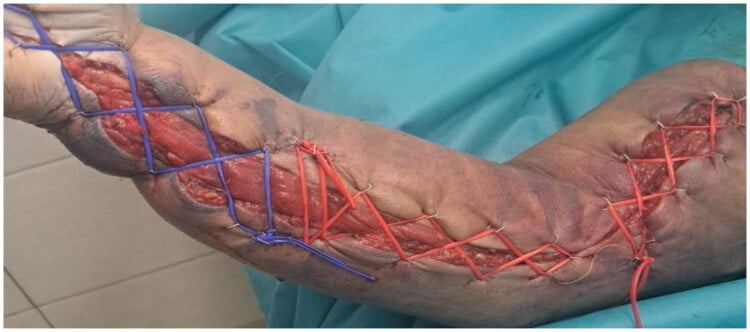
Volkmann's ischaemic contracture. The end stage of a missed forearm compartment syndrome, graded by Tsuge:
- Mild - part of FDP/FPL (a few digits), little or no nerve deficit; splinting, tendon lengthening or slide
- Moderate - all the long finger flexors with median, with or without ulnar, nerve involvement; flexor-origin muscle slide, tendon transfers, neurolysis
- Severe - flexors and extensors with marked neurological loss; excise the infarcted muscle and reconstruct with a free functioning muscle transfer (e.g. gracilis) plus nerve reconstruction
Classification Systems
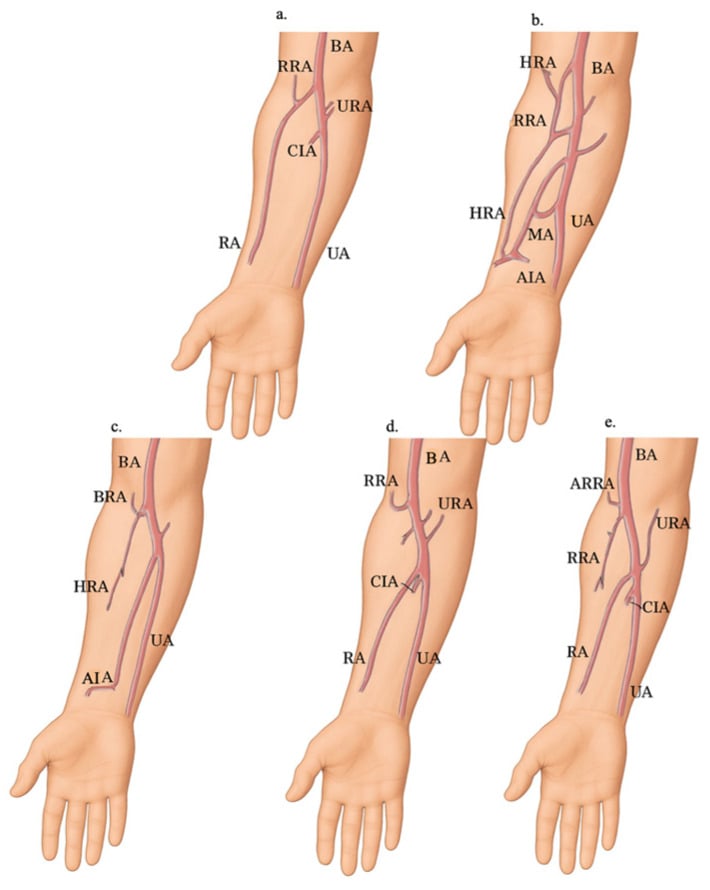
Classification systems for arterial anatomy are rare; the one referenced is the Adachi classification of radial artery origin:
- Type I - normal, bifurcation in the cubital fossa
- Type II - high origin from the axillary artery
- Type III - high origin from the brachial artery
The brachioradial artery. A high-takeoff radial artery often runs superficial to the fascia, and is then called the brachioradial or superficial radial artery. It is the commonest arterial variant of the upper limb and can be mistaken for a vein.
Clinical Assessment
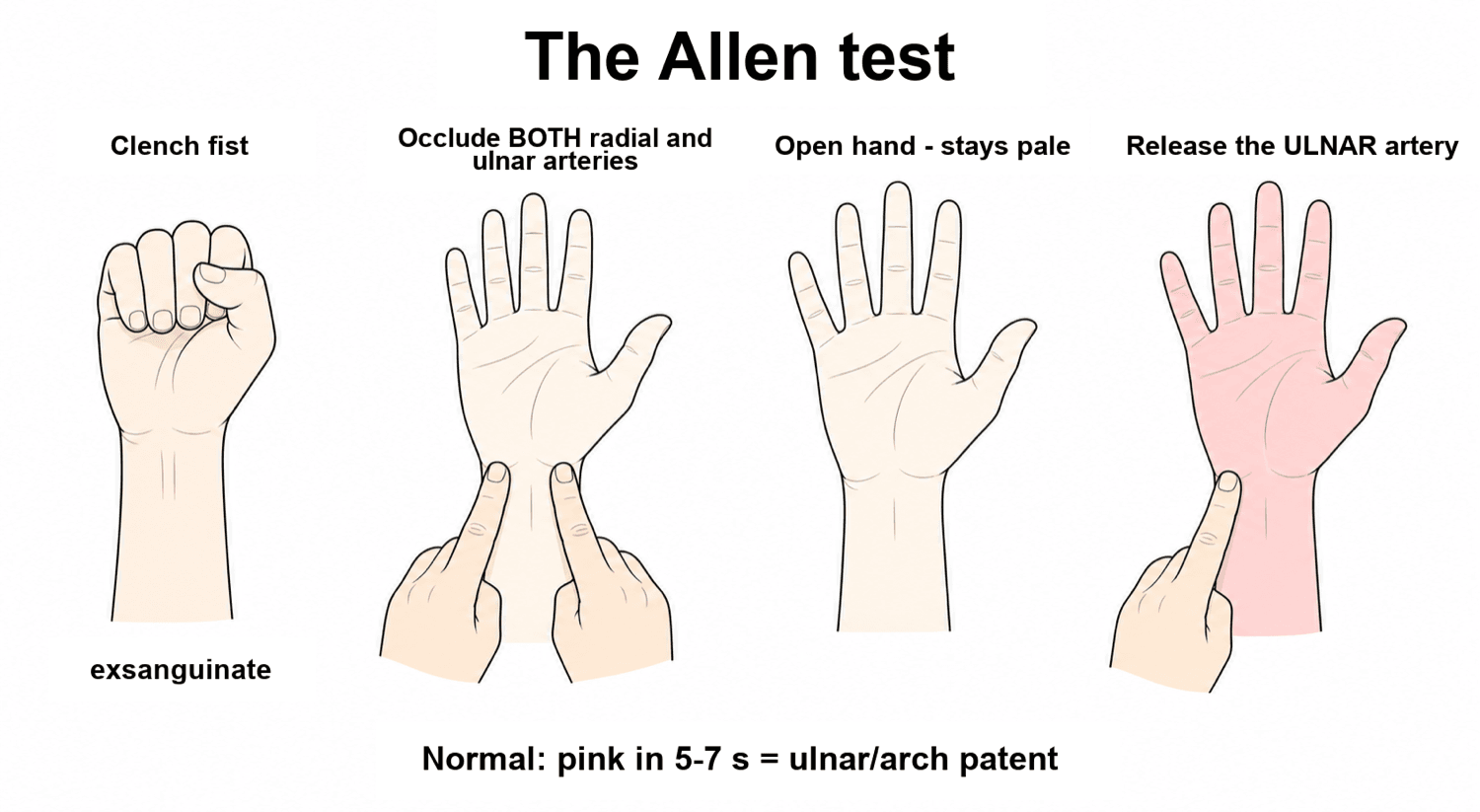
The Allen test. It asks whether the ulnar artery and the palmar arch can carry the hand on their own, and so it precedes harvest of the radial artery, whether for a blood gas, a CABG conduit or a flap.
- The patient clenches the fist to exsanguinate the hand
- Occlude both the radial and the ulnar artery
- The patient opens the hand, which should be pale
- Release the ulnar artery
Reading the result. Describe the finding, never the label. If the hand flushes, conventionally within about 5-7 seconds, the ulnar artery and palmar arch carry the hand. If it stays pale, the ulnar supply is insufficient and the radial artery must not be sacrificed. The refill cut-off is a convention rather than a validated threshold, and quoted values differ between sources.
Some call a normal flush "positive" (the test found what you wanted); others call the pale, abnormal hand "positive" (the test found pathology). A candidate who says "a negative Allen test contraindicates harvest" will be understood to mean the exact opposite by half the room. Say what the hand did.
Pulses. The radial pulse is felt lateral to the FCR tendon, the ulnar pulse lateral to the FCU tendon, where the overlying fascia makes it harder to feel. Only the radial pulse is routinely palpated, but the ulnar pulse is vital in vascular trauma.
How much can the Allen test actually carry?
Less than its prominence suggests, and the examinable point is where the evidence applies and where it does not.
Reliability and validity of the modified Allen test: a systematic review and meta-analysis
- 14 studies reviewed; against Doppler ultrasound as reference, pooled sensitivity 77% and specificity 93% for a palmar collateral-circulation deficit
- Four studies found NO ischaemic hand event after arterial puncture in patients whose Allen test was abnormal
- Inter-observer agreement was only 71.5% in the single study that measured it
- Concluded that the test lacks adequate diagnostic validity as a screening tool and does not predict hand ischaemia after arterial puncture
The asymmetry is what to say in a viva, and it runs the opposite way to intuition. A hand that stays pale is the more trustworthy result: specificity 93% means the test seldom cries wolf, so an abnormal Allen usually reflects a genuine collateral deficit. A hand that flushes is the weaker reassurance: sensitivity 77% means roughly a quarter of real deficits still flush normally, so a normal test does not clear a patient for permanent radial sacrifice on its own - and with interobserver agreement of only 71.5%, whose hands performed it matters. A normal flush earns imaging before a free flap; it does not replace it.
Clinical Significance: Vascular Injury
The decisions. Whether the hand is warm and perfused, and which vessels are injured, decide the management:
- Action
- Ligate (if hand perfused)
- Rationale
- Redundancy is sufficient
- Action
- Repair Dominant (Ulnar) or Both
- Rationale
- Create Shunt first
- Action
- Explore + Papaverine
- Rationale
- Relieve kinking/spasm
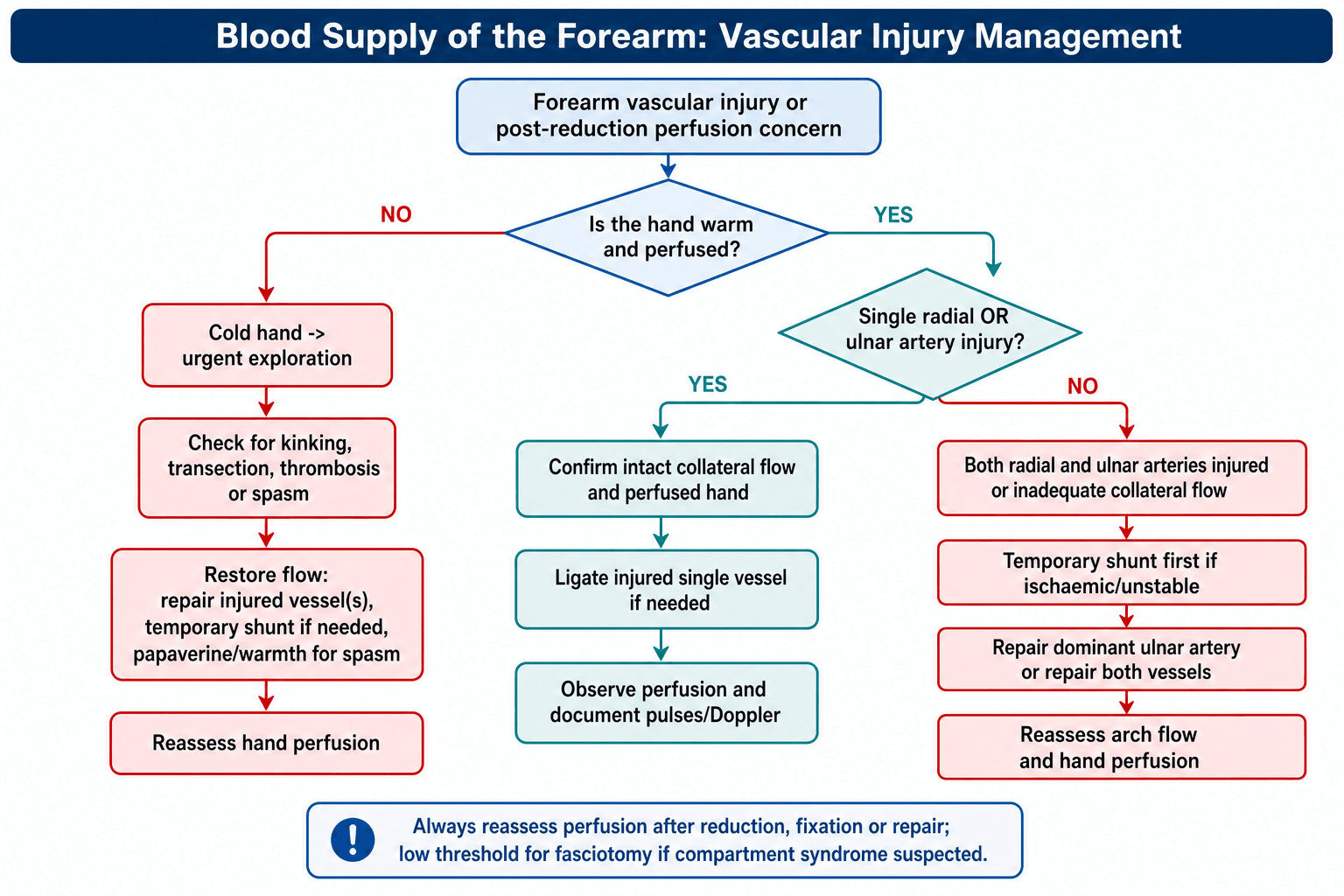
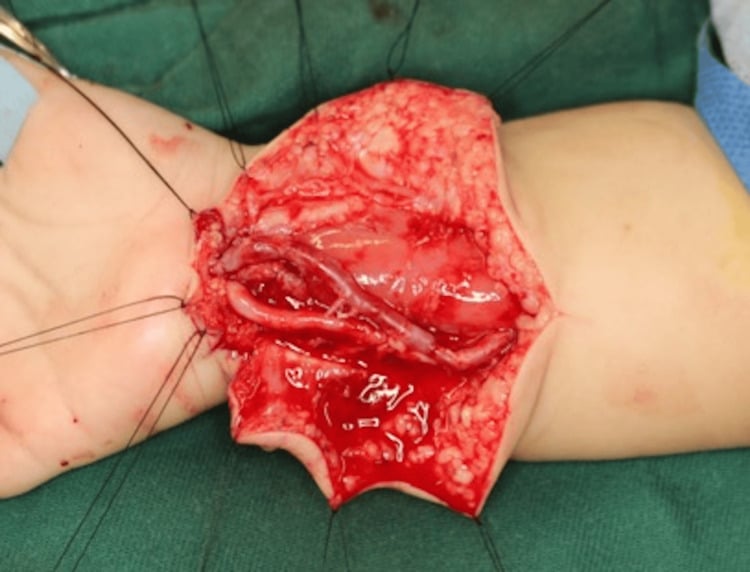
Collateral perfusion is what counts. The median nerve at the wrist receives longitudinal inflow from radial and ulnar vessels, with recurrent flow completing the intraneural network, which is why collateral perfusion, not a single named vessel, determines the effect of arterial occlusion or sacrifice.
Investigations
Hand-held Doppler. Used to assess flow in trauma or before harvest, with a standard 8 MHz vascular probe. A triphasic signal is normal flow; a monophasic signal indicates proximal stenosis or collateral flow. It can also confirm the Allen test, the signal changing audibly during compression.
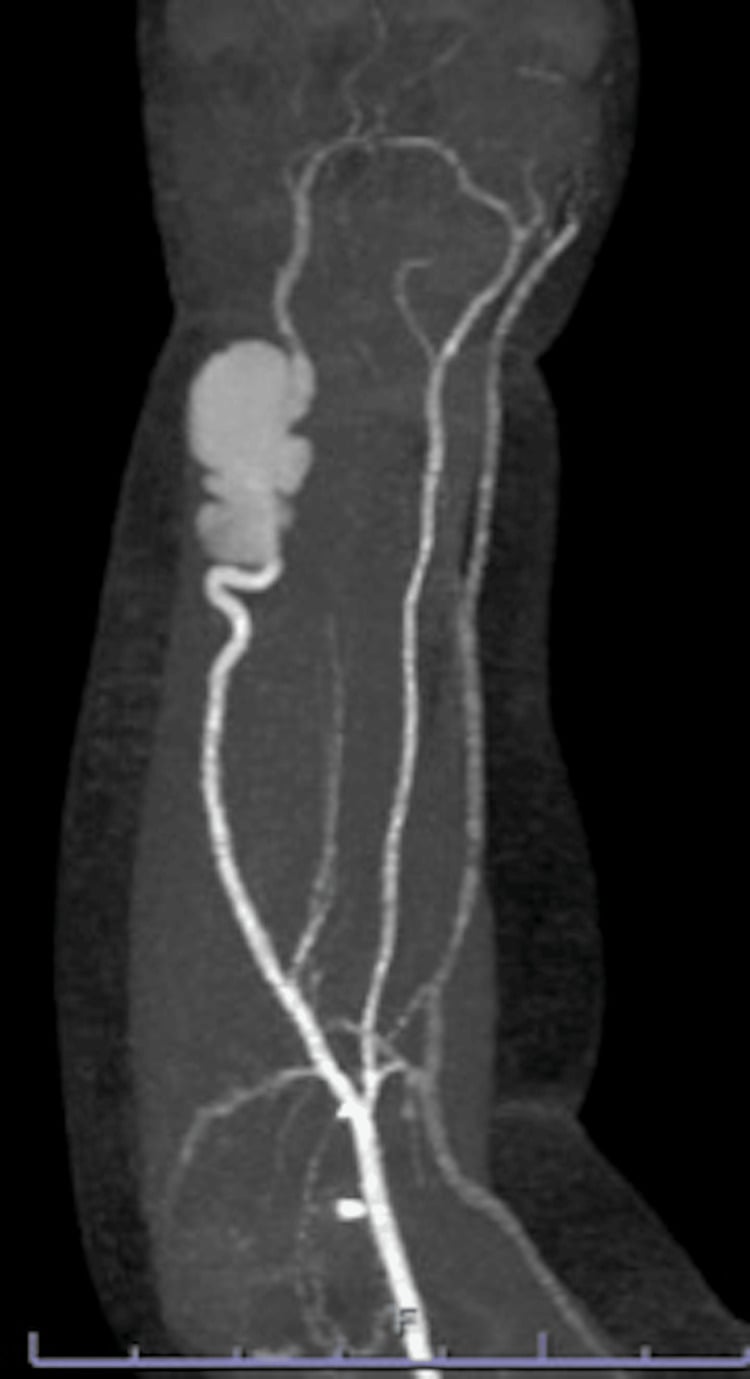
CT angiography. The gold standard for vascular trauma. It maps the vessels for free-flap planning (radial forearm or ALT perforators), for which it is essential, and assesses the run-off in the distal vessels and the hand arches; 3D reformats help surgical planning.
Surgical Considerations
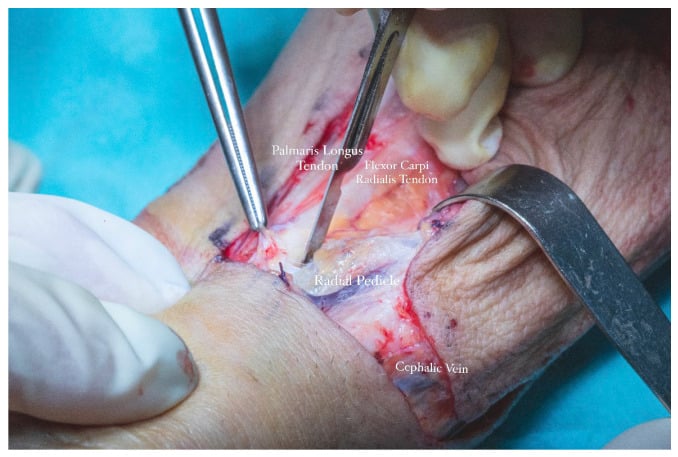
The radial forearm free flap. A fasciocutaneous flap (Type B) supplied by septocutaneous perforators from the radial artery, which pass in the septum between brachioradialis and FCR; venous drainage is via the venae comitantes or the cephalic vein. The harvest raises the artery with the flap, so ulnar competency is confirmed beforehand with the Allen test. It is the workhorse flap for head and neck reconstruction.
The Henry approach. The volar approach uses the interval between brachioradialis (radial nerve) and pronator teres and FCR (median nerve), and the vessel at risk is the radial artery. The "recurrent leash" of radial recurrent vessels must be ligated proximally to mobilise the muscle belly laterally; failure to ligate them results in troublesome bleeding and an obscured view.
Complications, Rehabilitation and Prognosis
Arterial lines. Thrombosis in 5-10%, pseudoaneurysm and AV fistula.
Harvest and ligation. Hand ischaemia follows harvest if the collateral flow is inadequate. When the Allen test was normal, single-artery ligation has an excellent prognosis with minimal subjective cold intolerance. The radial forearm donor site is less forgiving: 20-30% report cold intolerance, and aesthetic dissatisfaction is common. After a flap, monitor its colour and turgor and the Doppler signals.
Vascular repair. Patency rates of 80-90% for clean lacerations.
Guidelines, Registries & Global Practice
Global epidemiology of relevant anatomy
- A complete superficial palmar arch is present in only about 70-80% of hands across CT-angiographic and cadaveric series, so ulnar-dependent perfusion of the hand cannot be assumed before radial sacrifice.
- The brachioradial (high-origin, superficial radial) artery is the commonest major arterial variant of the upper limb, reported in roughly 10-15% of limbs in cadaveric and embryological series.
Side-by-side society guidance
- Domain
- Radial conduit for CABG
- Recommendation
- Radial artery preferred over saphenous vein as a second arterial graft in suitable patients with high-grade stenoses
- Domain
- Vascular trauma & flaps
- Recommendation
- Document dual-vessel patency and collateral flow before harvesting or ligating a forearm artery
- Domain
- Both-bone forearm & compartment syndrome
- Recommendation
- Low threshold for fasciotomy; clinical diagnosis takes priority over pressure thresholds
- Domain
- Hypothenar hammer / entrapment
- Recommendation
- Image distal vessels (duplex or CTA) before attributing digital ischaemia to vasospasm
Registry & trial signal
- The radial artery's standing as a CABG conduit rests on the RADIAL pooled randomised data (lower graft occlusion and adverse cardiac events versus vein), which is the main reason forearm collateral assessment matters in cardiac as well as hand practice.
High- vs limited-resource practice variation
- Well-resourced settings: Duplex ultrasound, CT angiography and continuous-wave Doppler routinely supplement the Allen's test before harvest or in vascular trauma.
- Limited-resource settings: The clinical Allen's test and hand-held Doppler remain the mainstay; awareness of its false-positive (~50%) and false-negative rates is essential to avoid both unnecessary conduit exclusion and iatrogenic hand ischaemia.
Controversies & Areas of Uncertainty
The clinical Allen's test has poor sensitivity and specificity (false-positive rates around 50%) for predicting hand ischaemia after radial harvest. Many vascular labs now mandate Doppler or digit-pressure confirmation, yet a normal bedside Allen's test remains the most widely taught pre-harvest screen worldwide.
Classic teaching permits ligating one forearm artery if the hand is well perfused, relying on arch redundancy. Increasing data on cold intolerance and the ~30% incidence of incomplete arches has prompted some surgeons to repair both vessels whenever feasible, especially in young or manual-working patients.
The ulnar artery is usually described as the larger terminal branch and dominant arch contributor, but codominance is common and radial-dominant arches exist. Dominance should be confirmed by imaging in the individual patient rather than assumed from textbook averages.
Absolute (greater than 30 mmHg) versus delta-pressure (less than 30 mmHg) thresholds for fasciotomy remain debated. Most authorities, including AO teaching, regard compartment syndrome as a clinical diagnosis, with pressure measurement reserved for the obtunded or equivocal patient.
MCQ Practice Points
Q: The Common Interosseous Artery is a branch of which vessel? A: Ulnar Artery.
Q: Which artery is the primary contributor to the Deep Palmar Arch? A: Radial Artery.
Q: The Ulnar Artery passes deep to which head of Pronator Teres? A: Deep Head. (The Median Nerve passes between the heads).
Q: The Radial Artery lies just lateral to which tendon at the wrist? A: Flexor Carpi Radialis (FCR).
Q: Which vessel does the Radial Recurrent artery anastomose with? A: Radial Collateral Artery (from Profunda Brachii).
Viva Scenarios
Practise clinical reasoning and management decisions out loud
“You have just performed a prolonged forearm fracture fixation under tourniquet. On release, the hand remains white. What is your algorithm?”
“Describe the anomaly of the 'High Bifurcation' of the radial artery.”
“A patient with a both-bone forearm fracture complains of increasing pain despite casting. Steps?”
Anatomy
- Ulnar Artery: Larger, Medial, Deep to Pronator
- Radial Artery: Smaller, Lateral, Deep to Brachioradialis
- Common Interosseous: From Ulnar
- Deep Arch: Radial / Superficial Arch: Ulnar
Key Relations
- Radial Nerve: Lateral to Radial Artery (Middle 1/3)
- Ulnar Nerve: Medial to Ulnar Artery (Distal 2/3)
- Median Nerve: Between heads of Pronator (Artery is deep)
- AIA/PIA: On Interosseous Membrane
- Posterior Interosseous: Pierces Supinator Muscle
Clinical
- Allen's Test: Collateral Flow (Essential pre-op test)
- Compartment Syndrome: AIA Ischemia (First affected)
- RFFF: Fasciocutaneous Flap (Allen's negative required)
- Anastomoses: Carpal arches protect hand perfusion
- Radial Flap: Most common free forearm flap
Evidence Base
The RADIAL pooled analysis explains why the radial artery (and therefore forearm collateral assessment) matters in cardiac as well as hand surgery; the anatomical and CT-angiography series quantify variant anatomy and the ~30% incomplete-arch rate; and the Allen-test studies show why the bedside test alone is neither sensitive nor specific.
Radial-Artery or Saphenous-Vein Grafts in Coronary-Artery Bypass Surgery (RADIAL pooled analysis)
- Patient-level pooled analysis of 6 randomised trials (1036 patients: 534 radial, 502 vein)
- Radial-artery grafts had lower adverse cardiac events at mean 60 months (HR 0.67, 95% CI 0.49-0.90)
- Radial grafts had a significantly lower risk of graft occlusion (HR 0.44, 95% CI 0.28-0.70)
- No difference in all-cause mortality (HR 0.90, 95% CI 0.59-1.41)
Variations of the arterial pattern in the upper limb revisited: a morphological and statistical study, with a review of the literature
- Morphological study of 192 embalmed cadavers with meta-analysis of prior series
- Brachioradial (high-origin, superficial radial) artery is the commonest major variant
- Variant patterns unified into a 12-category classification of arm and forearm arteries
Outcomes of Radial Forearm Free Flap Closure With Split-Thickness Skin Graft Versus Primary Closure
- 198 radial forearm free flap donor sites; 81 with patient-reported outcomes
- Split-thickness skin graft gave better scar quality but higher tendon-exposure rates than hatchet flap
- Hand outcome (MHOQ) scores were similar between closure techniques