Axial Load Injury | Middle Column Involved | Load-Sharing Score
- Burst = middle column involvement (retropulsed posterior body wall)
- PLC status determines stability more than canal compromise
- Load-sharing classification (LSC) predicts need for anterior column support
- LSC 7 or more = anterior reconstruction needed (high failure rate with posterior alone)
- Neurologically intact with intact PLC can often be managed non-operatively
- “Burst fractures involve both anterior AND middle columns (posterior vertebral body wall)
- “Canal compromise alone does NOT mandate surgery
- “McCormack LSC: comminution + fragment apposition + kyphosis correction
- “Short segment posterior-only has a high failure rate if LSC 7 or more (36% broken screws in original McCormack series)
Overview and Epidemiology
Where this sits. The burst fracture is the middle-column injury within thoracolumbar fractures, and it is most often confused with the flexion-distraction Chance fracture, where the posterior column fails in tension rather than the middle column in compression, and where the abdominal viscera must be cleared. The two things that decide management here are the posterior ligamentous complex and the neurology, which is why spinal cord injury and cauda equina syndrome carry the deficit side of the decision. The osteoporotic vertebral fracture that mimics a burst on a plain film is managed entirely differently, on vertebroplasty and kyphoplasty.
The definition. A burst fracture is a vertebral body fracture involving both the anterior and the posterior cortex, with retropulsion of bone into the spinal canal: failure of the anterior and middle columns together. A compression fracture involves the anterior column only, wedging the body while the posterior wall stays intact. Middle column involvement is the distinction that matters, because it indicates higher instability and different treatment considerations.
Mechanism. Axial loading, the commonest mechanisms being falls from height and motor-vehicle accidents with a vertical load. Energy is transmitted through the disc into the vertebral body, which explodes outward - hence "burst" - and the posterior wall fragment retropulses into the canal.
Who and where. The fracture peaks at the thoracolumbar junction (T12-L2), and L1 is the commonest level. The distribution is bimodal: young patients with high-energy trauma, with a male predominance in that group, and elderly patients with osteoporotic fractures.
The differential. What else produces a fractured or abnormal thoracolumbar vertebra:
- Distinguishing feature
- Anterior column only; posterior body wall intact, no retropulsion
- Key discriminator
- Intact posterior vertebral wall on CT (AO type A1/A2)
- Distinguishing feature
- Tension-band failure through bone and/or PLC; seat-belt mechanism
- Key discriminator
- Posterior element distraction, interspinous widening (AO type B)
- Distinguishing feature
- Translation/rotation, three-column failure, usually a neurological deficit
- Key discriminator
- Vertebral translation/facet dislocation (AO type C)
- Distinguishing feature
- Low energy, elderly; may still burst with canal compromise
- Key discriminator
- DEXA, low-energy mechanism, marrow oedema pattern on MRI
- Distinguishing feature
- Atypical level, pedicle/posterior-element destruction, soft-tissue mass
- Key discriminator
- Lytic lesion, pedicle erosion, abnormal marrow signal on MRI
Before calling a vertebral fracture a "burst", confirm a traumatic mechanism proportionate to the injury. A low-energy or atypical fracture demands MRI to exclude a pathological cause: posterior-element or pedicle destruction, or a soft-tissue mass, points to metastasis or myeloma, and that changes the entire pathway to staging, biopsy and an oncological MDT.
Anatomy and Biomechanics
The three columns. Denis divides the vertebra into three columns, and a burst fracture is defined by which of them fail. The middle column is the one that makes the diagnosis.
- Structures
- Anterior 2/3 vertebral body, disc, ALL
- Burst Involvement
- Always involved in burst
- Structures
- Posterior 1/3 body, posterior annulus, PLL
- Burst Involvement
- By definition involved (key feature)
- Structures
- Pedicles, facets, laminae, PLC
- Burst Involvement
- May or may not be involved
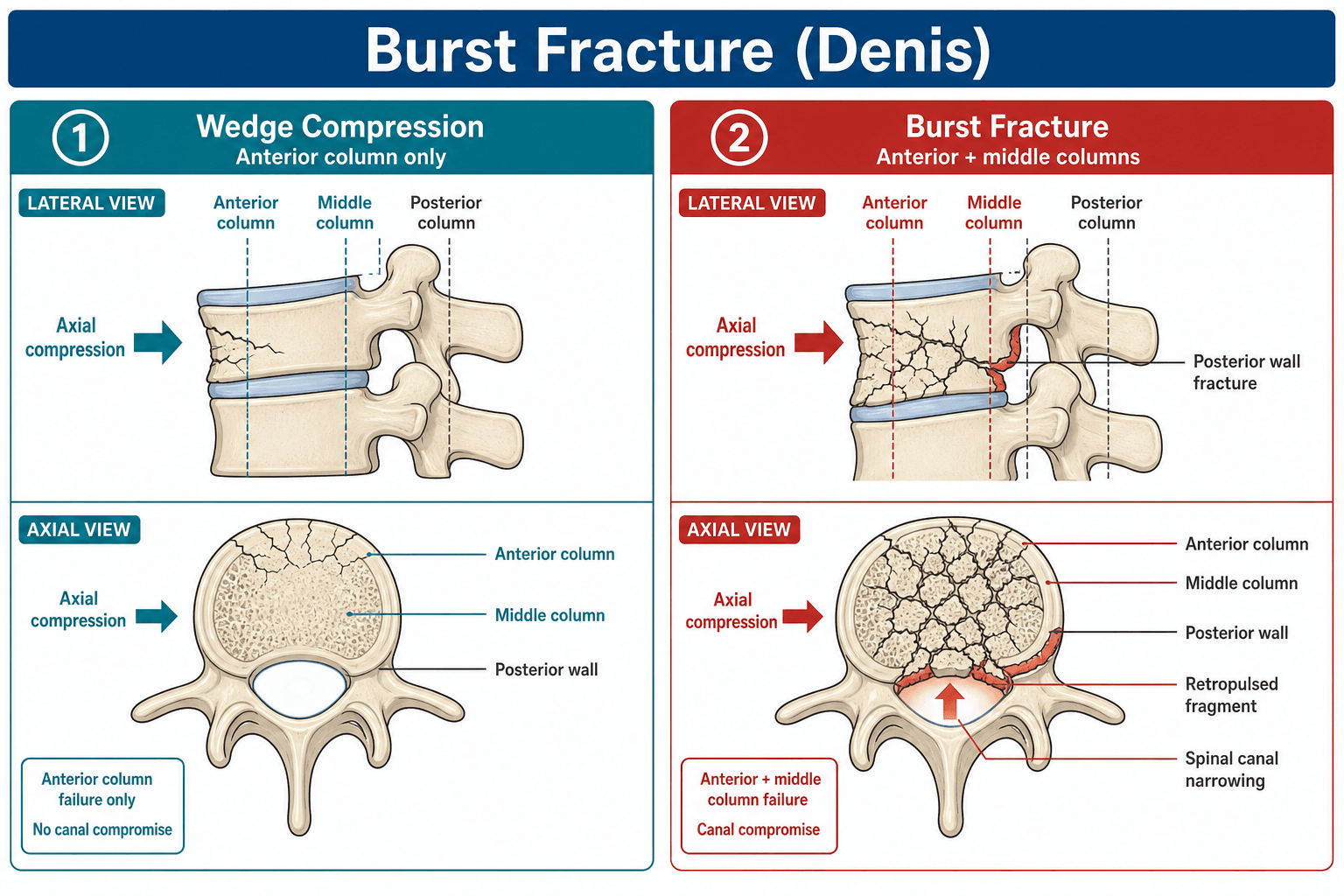
The thoracolumbar junction. T12-L2 is the transition zone where load transfers from the rigid thoracic spine to the mobile lumbar spine. Stress concentrates there, and L1 bears a significant axial load.
Stability. A burst is by definition a middle column failure, but the posterior column may be untouched, and it is the PLC that decides stability rather than the appearance of the canal. An intact PLC makes this a stable burst, which can often be braced; a disrupted PLC makes it an unstable burst, which needs surgery.
Classification Systems
Four systems are in play and they answer different questions. McCormack's load-sharing score asks whether the anterior column can still take load, Denis describes the fracture pattern, TLICS decides whether to operate, and AO Spine supplies the morphological label.
McCormack Load-Sharing Classification (LSC)
The score predicts failure of posterior-only fixation by grading what is left of the anterior column's load-bearing capacity. Three parameters each score 1 to 3, so the total runs from 3 to 9.
- 1 Point
- Little (less than 30%)
- 2 Points
- Moderate (30-60%)
- 3 Points
- Severe (more than 60%)
- 1 Point
- Good (minimal displacement)
- 2 Points
- Partial (fragments still touch)
- 3 Points
- None (gross displacement)
- 1 Point
- Little (less than 3 degrees)
- 2 Points
- Moderate (4-9 degrees)
- 3 Points
- Severe (more than 9 degrees)
Reading the score. A total of 3-6 means posterior-only fixation is acceptable. 7-9 carries a high risk of posterior-only failure, and the anterior column needs support.
LSC 7 or more predicts a high failure rate with short-segment posterior-only fixation. In McCormack's original series, 10 of 28 (36%) short-segment constructs developed broken screws, clustered in the most comminuted bodies. These patients need anterior column reconstruction (corpectomy + cage) OR a longer posterior construct OR a combined approach.
CAKLoad-Sharing Score Components
Hook:CAK: Count the Comminution, Apposition, and Kyphosis - 7+ needs anterior column support!
Clinical Assessment
History. Take the mechanism in detail - the height of the fall, the type of collision - because it is an axial loading mechanism that suggests a burst. Then ask about weakness, numbness and bladder function.
Examination. What to look for, and what to record:
- Inspection: bruising, kyphotic deformity
- Palpation: step-off, interspinous gap, tenderness
- Neurological: a complete lower limb examination
- Log-roll: examine the entire spine
Associated injuries. A burst from a fall from height keeps company with calcaneal fractures, and with femoral and pelvic injuries; high-energy mechanisms bring abdominal visceral injury. Another spinal level is injured in 10-15%, non-contiguous with the first.
- Significance
- Good prognosis, consider non-op if stable
- Level Suggestion
- N/A
- Significance
- L1-L2 level
- Level Suggestion
- Conus/high cauda
- Significance
- L3-L4 level
- Level Suggestion
- Cauda equina
- Significance
- L4-L5 level
- Level Suggestion
- Cauda equina
- Significance
- Sacral involvement
- Level Suggestion
- Cauda equina syndrome
Most burst fractures occur below the conus, which ends at L1-L2, so the deficit is typically a cauda equina (LMN, lower motor neurone) injury rather than a cord (UMN, upper motor neurone) one. A burst at T11 or T12 sits above the conus, where it is the cord that is at risk. Cauda equina syndrome - bladder and bowel dysfunction - is a surgical emergency.
Investigations
Two studies decide the treatment. CT defines the fracture and MRI defines the ligaments, and the decision needs both: CT supplies the load-sharing score, MRI supplies the PLC component of TLICS.
Imaging Algorithm
First-line imaging. Defines fracture morphology, canal compromise, comminution. Essential for LSC scoring. 3D reconstruction helpful.
For PLC assessment. STIR sequences show ligament injury. Also shows cord/cauda compression. Essential for TLICS scoring.
CT or MRI of the entire spine in high-energy trauma, to find the non-contiguous injury.
What to measure on the CT. Four numbers come off the scan and feed the decision:
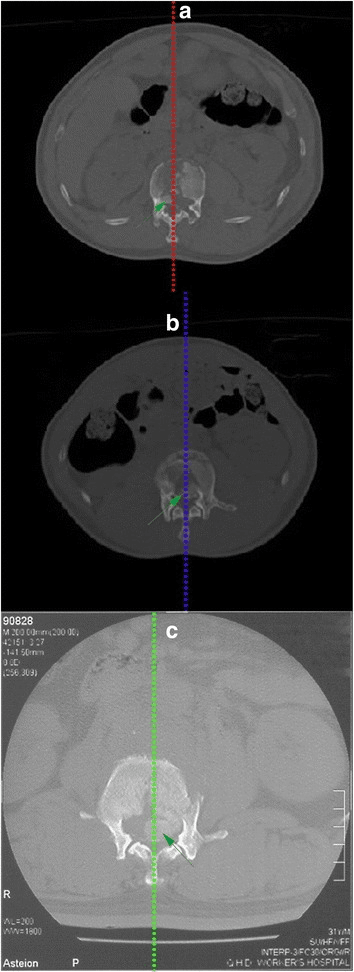
- Canal compromise percentage: (1 - fractured canal/normal canal) x 100
- Vertebral body comminution: percentage of the body involved
- Fragment apposition: contact between fragments
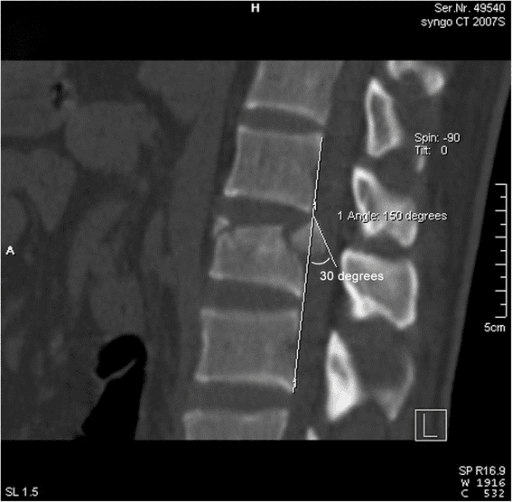
- Kyphosis: local or regional sagittal angle
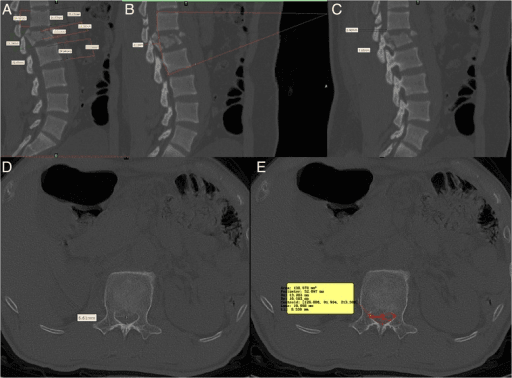
Canal compromise alone does NOT mandate surgery. A patient with 60% canal compromise but intact PLC and no neurological deficit can often be managed non-operatively, and the canal remodels over time with up to 50% spontaneous improvement. The contrast to hold onto: a 50% canal compromise with an intact PLC can be braced, while a 20% compromise with a disrupted PLC needs surgery.
What to read on the MRI. STIR sequences show ligament injury directly, and the same study shows any compression of the cord or cauda equina. The structures that carry the PLC verdict, and what injury looks like in each:
- Normal
- Dark line on T2
- Abnormal
- High signal, discontinuity
- Normal
- Intermediate signal
- Abnormal
- High T2 signal, widened
- Normal
- Dark on T2
- Abnormal
- Signal change, buckling
- Normal
- Congruent joint
- Abnormal
- Widened, fluid signal
Management
Two decisions, two tools. TLICS decides whether to operate; McCormack's load-sharing score decides what to build.
- TLICS
- 2
- LSC
- N/A
- Treatment
- TLSO brace 8-12 weeks
- TLICS
- 5
- LSC
- Assess
- Treatment
- Posterior fixation +/- anterior
- TLICS
- 5+
- LSC
- 3-5
- Treatment
- Short segment posterior fixation
- TLICS
- 7+
- LSC
- 7+
- Treatment
- Anterior corpectomy + posterior fixation
Conservative Treatment
Who. Bracing is for the burst that is stable and is going to stay that way, and it needs a patient who will keep the brace on:
- TLICS 2-3 - burst morphology with an intact PLC and intact neurology
- Kyphosis less than 30 degrees
- No progressive neurological deficit
- A compliant patient
The evidence behind it. The Wood et al RCT (2003) found no significant difference in functional outcomes between operative and non-operative treatment for stable burst fractures, which is what supports conservative management in appropriate patients.
Non-Operative Protocol
Pain management, bed rest as tolerated, log-roll precautions. May begin standing with TLSO if pain controlled.
TLSO brace full-time except when supine. Serial X-rays at 2, 6, 12 weeks. Monitor for kyphosis progression.
Gradual brace weaning. Core strengthening. Return to activity based on symptoms and stability.
What ends non-operative treatment. Serial radiographs are there to catch kyphosis progression: an increase of more than 10-15 degrees is a reason to consider surgery, and neurological deterioration is a reason to operate urgently.
A neurologically injured burst fracture raises the perennial question of high-dose methylprednisolone. The NASCIS II and III trials suggested a marginal motor benefit if a 24-48 hour high-dose methylprednisolone infusion was started within 8 hours of injury - but the effect was small, derived from post-hoc subgroup analysis, and came with a real increase in complications (wound infection, pneumonia, GI bleeding, hyperglycaemia, sepsis).
On that basis most contemporary guidance (AANS/CNS, and the spinal-trauma community broadly) no longer recommends routine high-dose steroids for acute SCI; some bodies (e.g. AOSpine) regard a 24-hour infusion within 8 hours as an option to be discussed, not a standard. Exam-safe answer: steroids are not a substitute for timely decompression and stabilisation, their routine use is not recommended, any use is an individualised time-limited decision weighed against significant complication risk, and they are contraindicated in penetrating injury and the high-infection-risk polytrauma patient.
The open posterior fusion above is not the only construct. For the neurologically intact but mechanically unstable burst (e.g. AO A4/B not needing decompression), two modern options are examinable.
Percutaneous (minimally invasive) pedicle screw fixation places the same short-segment construct through small stab incisions under fluoroscopy or navigation. It gives less blood loss, less muscle stripping and faster mobilisation, at the cost of no formal posterolateral fusion bed.
Fixation without fusion, or internal bracing, uses posterior instrumentation to stabilise the fracture while the body heals, after which the implants are removed - typically around 9-12 months - to restore segmental motion and reduce adjacent-segment stress. It is attractive in younger patients with good bone and a healable fracture and avoids fusion morbidity, but it requires a second operation for removal and is unsuitable when the disc is destroyed, because the segment will collapse once the hardware is out.
The principle: match the invasiveness and the fusion/no-fusion decision to whether decompression is needed, the bone quality, the disc integrity and the patient's age - an MIS no-fusion construct can over-treat a brace-able injury and under-treat a high-LSC one.
Surgical Technique
Consent. The numbers to quote, and the risks to name even where there is no number:
- Neurological injury: less than 1% if no pre-operative deficit
- Infection: 1-3%
- Need for revision: 5-10%
- Hardware failure: higher with a posterior-only construct when the LSC is 7 or more
- Adjacent segment disease: a long-term risk
- Anterior approach: adds ileus and vascular injury
Equipment. Polyaxial pedicle screws in a range of lengths, fluoroscopy or navigation, and a lamina spreader for distraction. An anterior reconstruction adds a structural cage and an anterior plate, and a cell saver is worth having for the major reconstructions.
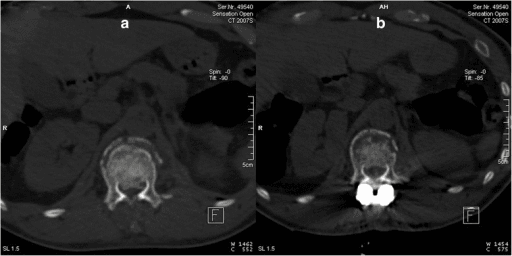
Complications
What goes wrong. Ignoring the load-sharing score is a common cause of failure, and the rest is bone quality, fusion biology and the specific risks of the anterior approach.
- Incidence
- 5-15% (higher if LSC 7+ posterior-only)
- Prevention/Management
- Respect LSC, add anterior if 7+
- Incidence
- 10-20%
- Prevention/Management
- Index screws, cement augmentation in osteoporosis
- Incidence
- 5-10%
- Prevention/Management
- Bone graft, smoking cessation, stable fixation
- Incidence
- Up to 30% long-term
- Prevention/Management
- Short segment when appropriate
- Incidence
- Less than 1%
- Prevention/Management
- Careful technique, avoid over-distraction
- Incidence
- 10-20%
- Prevention/Management
- Gentle handling, early mobilization
- Incidence
- 1-2%
- Prevention/Management
- Vascular surgery backup, careful dissection
Postoperative Care
Rehabilitation Timeline
DVT prophylaxis, pain management, wound care. Mobilize with physio if stable.
Continue mobilization. TLSO if additional support desired. Wound check. X-ray to confirm position.
Progressive activity. Serial X-rays. Core strengthening program. Wean brace if used.
CT at 6-12 months to confirm fusion. Return to activity based on imaging and symptoms. Long-term surveillance for adjacent disease.
Outcomes and Prognosis
Without surgery. Outcomes for the stable burst are good. Some kyphosis progression is accepted, and most patients return to normal function.
After surgery. Fusion rates are high with adequate fixation, and constructs matched to the load-sharing score fail less often. Neurological recovery depends on the initial injury, and a cauda equina injury carries a better prognosis than a cord injury.
Guidelines, Registries & Global Practice
Global epidemiology
- Burst fractures cluster at the thoracolumbar junction (T11-L2), which acts as the transition from the rigid kyphotic thoracic spine to the mobile lordotic lumbar spine; in cohorts of conservatively treated thoracolumbar fractures the junction is the commonest site and an independent risk factor for late kyphotic collapse (Guzey et al, Turk Neurosurg 2018, DOI).
- Rates of neurological deficit vary enormously with WHO IS COUNTED, and the two figures on this page are not in conflict once that is stated. Across unselected burst fractures a deficit is present in roughly 15-25%. By contrast, in a tertiary referral series of 105 thoracolumbar/lumbar bursts only 18% were neurologically INTACT - 82% had a deficit and 26 had complete paraplegia - because severe injuries are what get referred (Mohanty et al, J Orthop Surg (Hong Kong) 2008, DOI). In that series mean canal compromise was 50% in those with a deficit versus 36% in those intact, and the correlation held at T11/T12 (p=0.007) but not at L1 (p=0.42). Quote the population before quoting the percentage.
- Bimodal distribution: high-energy injuries (falls from height, motor-vehicle collisions) in younger men, and low-energy osteoporotic/fragility bursts in older patients - the latter behaving more like an AO type A injury at higher risk of progressive collapse.
Classification systems are the global common language - the AO Spine thoracolumbar system (type A3 incomplete / A4 complete burst) reached substantial reliability (kappa 0.72) in an international consensus study (Vaccaro et al, Spine 2013, DOI) and TLICS provides the cross-board decision threshold (operative at a score of 5 or more; Vaccaro et al, Spine 2005, DOI).
- Stance on the neurologically intact burst
- Type A3/A4 with intact PLC and no deficit: non-operative is acceptable; operative if tension-band (B) or translation (C) component
- Evidence level
- Consensus + cohort
- Stance on the neurologically intact burst
- Score 3 or less non-operative, 4 surgeon discretion, 5 or more operative; burst alone scores 2
- Evidence level
- Consensus (Level 5)
- Stance on the neurologically intact burst
- No benefit of surgery for the stable, neurologically intact burst; fewer complications without surgery
- Evidence level
- Level 1
- Stance on the neurologically intact burst
- If operating, LSC 7 or more favours anterior column support or a longer/index-screw construct
- Evidence level
- Level 4
The big international controversy is the neurologically intact burst with an indeterminate PLC. Reliance on MRI for the PLC, the weight given to canal compromise, and the threshold for early posterior-only stabilisation vary between units and resource settings. High-resource centres increasingly favour MRI-guided non-operative care (supported by the Wood RCT); limited-resource settings may stabilise earlier to allow upright mobilisation and reduce nursing burden. There is no implant registry for spinal trauma comparable to the arthroplasty joint registries (NJR, AOANJRR, AJRR), so trauma evidence rests on RCTs and cohorts rather than registry survival data.
- Complete neurological examination (and a digital rectal/perianal exam where cauda equina is possible)
- TLICS and AO Spine type with rationale
- LSC assessment when operating
- MRI for PLC integrity (especially the indeterminate PLC)
- Informed consent covering hardware failure and the option of non-operative care
failing to calculate LSC (hardware failure), inadequate consent on failure rates, not documenting PLC assessment, and missing non-contiguous fractures (10-15% of cases).
MCQ Practice Points
Q: What defines a burst fracture and differentiates it from a compression fracture? A: Involvement of the posterior vertebral body wall (middle column) with retropulsion into the canal. Compression fractures only involve the anterior column.
Q: What are the three components of the McCormack Load-Sharing Classification? A: Comminution (1-3), fragment Apposition (1-3), and Kyphosis correction needed (1-3). Score 7+ predicts posterior-only failure.
Q: At what LSC score should anterior column reconstruction be considered? A: LSC 7 or more - short segment posterior-only constructs have a high failure rate at this threshold (36% broken screws in McCormack's original series).
Q: A patient has 50% canal compromise but is neurologically intact with intact PLC. Does this require surgery? A: No - canal compromise alone does not mandate surgery. It remodels spontaneously. TLICS would be 2 (non-operative).
Q: What is the most common type of burst fracture in the Denis classification? A: Type B (superior endplate) - accounts for 70% of burst fractures.
Q: When is ligamentotaxis most effective for reducing retropulsed fragments? A: When PLL is intact and surgery is performed within 72 hours. Beyond this, fragments become adherent.
Exam Viva Scenarios
Practise clinical reasoning and management decisions out loud
“A 30-year-old falls from 3 meters and lands on his feet. CT shows an L1 burst fracture with 40% canal compromise. He is neurologically intact. MRI shows intact PLC. How do you manage this?”
“A 45-year-old woman falls from a roof and has an L1 burst fracture with severe comminution (more than 60%), poor fragment apposition, and 15 degrees of kyphosis. She has incomplete cauda equina syndrome. What is your surgical plan?”
“A 50-year-old male with diabetes had short segment posterior fixation (T12-L2) for an L1 burst fracture 8 weeks ago. He now presents with increasing back pain and X-rays show screw pullout with kyphosis of 30 degrees. How do you manage this failure?”
What Makes It a Burst?
- Posterior vertebral body wall fractured (middle column)
- Retropulsion of fragment into canal
- Anterior AND middle column failure
- Different from compression (anterior only)
Load-Sharing Classification
- Comminution: Little=1, Moderate=2, Severe=3
- Apposition: Good=1, Partial=2, None=3
- Kyphosis correction: Little=1, Moderate=2, Severe=3
- Score 7+ = anterior column support needed
Treatment Algorithm
- TLICS less than 4 + intact PLC: TLSO brace
- TLICS 5+: Posterior pedicle screw fixation
- LSC less than 7: Short segment (with index screws)
- LSC 7+: Anterior corpectomy + posterior
Surgical Pearls
- Index level screws reduce failure
- Ligamentotaxis works if PLL intact and less than 72h
- Canal compromise alone doesn't mandate surgery
- Cement augmentation in osteoporosis
Complications
- Hardware failure: 5-15% (much higher if LSC 7+ posterior-only; 36% in McCormack series)
- Non-union: 5-10%
- Adjacent segment disease: up to 30%
- Risk factors: diabetes, smoking, osteoporosis
Evidence Base
McCormack Load-Sharing Classification (landmark)
- Consecutive series of 28 three-column fractures fixed with short-segment Steffee screws and plates; 10 of 28 (36%) developed broken screws
- 9-point scale grading damaged vertebral body, fragment spread, and corrected traumatic kyphosis (each 1-3)
- Screw breakage clustered in patients with the greatest vertebral body comminution
- Tool to predict posterior short-segment failure and select fractures for anterior strut reconstruction
Canal Compromise vs Neurological Deficit
- 105 thoracolumbar/lumbar burst fractures; 19 (18%) were neurologically intact, and 26 of the 86 with a deficit had COMPLETE paraplegia
- Mean canal compromise 50% in patients with a deficit vs 36% in those intact
- Denis burst type did not correlate with severity of deficit (p=0.835)
- LEVEL-DEPENDENT: the correlation was SIGNIFICANT at T11 and T12 (p=0.007) but NOT at L1 (p=0.42) - which is the paper's actual headline conclusion, that T11/T12 must be analysed separately from L1
TLICS - Thoracolumbar Injury Classification and Severity Score (landmark)
- Consensus system scoring three characteristics: injury morphology, integrity of the posterior ligamentous complex, and neurological status
- Burst morphology scores 2; PLC scores 0 (intact), 2 (indeterminate) or 3 (injured); neurology 0-3
- A composite score stratifies to non-operative (3 or less), surgeon discretion (4), or operative (5 or more)
- Also guides the optimum operative approach for surgical patterns
AO Spine Thoracolumbar Injury Classification (landmark)
- International consensus morphological system: type A (compression), type B (tension-band disruption), type C (translation/displacement)
- Burst fractures are type A3 (incomplete, single endplate) and A4 (complete, both endplates)
- Substantial reliability for identifying the main injury type (kappa = 0.72)
- Adds neurological grade (N) and patient-specific modifiers (e.g. M1 indeterminate PLC)