The Neurological Emergency
- Type I is CRITICAL: Failure of anterior formation leads to progressive kyphosis and cord compression.
- Neurology is the Priority: Unlike scoliosis, paraplegia is a real and common threat.
- Early Fusion is Acceptable: Unlike EOS, early fusion is often the safest option.
- Bracing is Ineffective: Rigid deformity does not respond to bracing.
- MRI Mandatory: Assess cord compression and intraspinal anomalies.
- “Look for cutaneous stigmata (hairy patch)
- “Full neurological exam is critical
- “Assess for associated VACTERL anomalies
- “Check for scoliosis (often coexists)
Overview/Epidemiology
Congenital kyphosis is a rigid sagittal-plane deformity caused by abnormal vertebral development: failure of formation or failure of segmentation of the anterior vertebral body. It is rare, much less common than congenital scoliosis, and affects males and females equally. The apex often lies at the thoracolumbar junction (T10-L2), which puts the cord at maximum risk.
Why it is treated differently from congenital scoliosis. Congenital kyphosis carries a high risk of spinal cord compression and paraplegia if untreated, so neurology takes priority over growth. That changes the answer on bracing and on the timing of fusion.
- Congenital Kyphosis
- HIGH (25-50%)
- Congenital Scoliosis
- Low (unless severe)
- Congenital Kyphosis
- Ineffective
- Congenital Scoliosis
- Occasionally useful
- Congenital Kyphosis
- Early Fusion
- Congenital Scoliosis
- Observation / Growing Rods
- Congenital Kyphosis
- Less important than neurology
- Congenital Scoliosis
- Critical (TIS prevention)
Natural history. Type I progresses relentlessly, at 5-10 degrees a year, and untreated it progresses to more than 100 degrees, with a 25-50% risk of paraplegia. Type II progresses more slowly and is often less severe; it may remain stable or progress, and its paraplegia risk is lower but still significant. Type III is unpredictable and behaves like whichever component dominates. Deterioration can be rapid during growth spurts, even in normal infants.
Pathophysiology and Spinal Development
Failure of formation (Type I). The anterior part of one or more vertebral bodies fails to form, leaving a posteriorly based wedge vertebra or complete aplasia of the body. The spine is forced into a sharp angular kyphosis at that level. The spinal cord is stretched over the apex, and as the kyphosis progresses the cord is progressively compressed against the posterior body.
Failure of segmentation (Type II). An anterior unsegmented bar forms, like a stalactite of bone connecting adjacent vertebrae anteriorly, and tethers anterior growth across several levels. The posterior elements remain normally segmented and keep growing, so the result is a more gradual kyphosis that usually progresses more slowly than Type I.
Classification Systems
The Winter classification (1973) is the standard classification, and its three types follow the two failures above. Type I has the worst prognosis, with high risk of both progression and neurological injury.
- Type I, failure of formation: partial aplasia of the anterior body (wedge vertebra) or complete aplasia of the anterior body (aplastic vertebra)
- Type II, failure of segmentation: an anterior unsegmented bar
- Type III, mixed: a combination of Type I and Type II defects
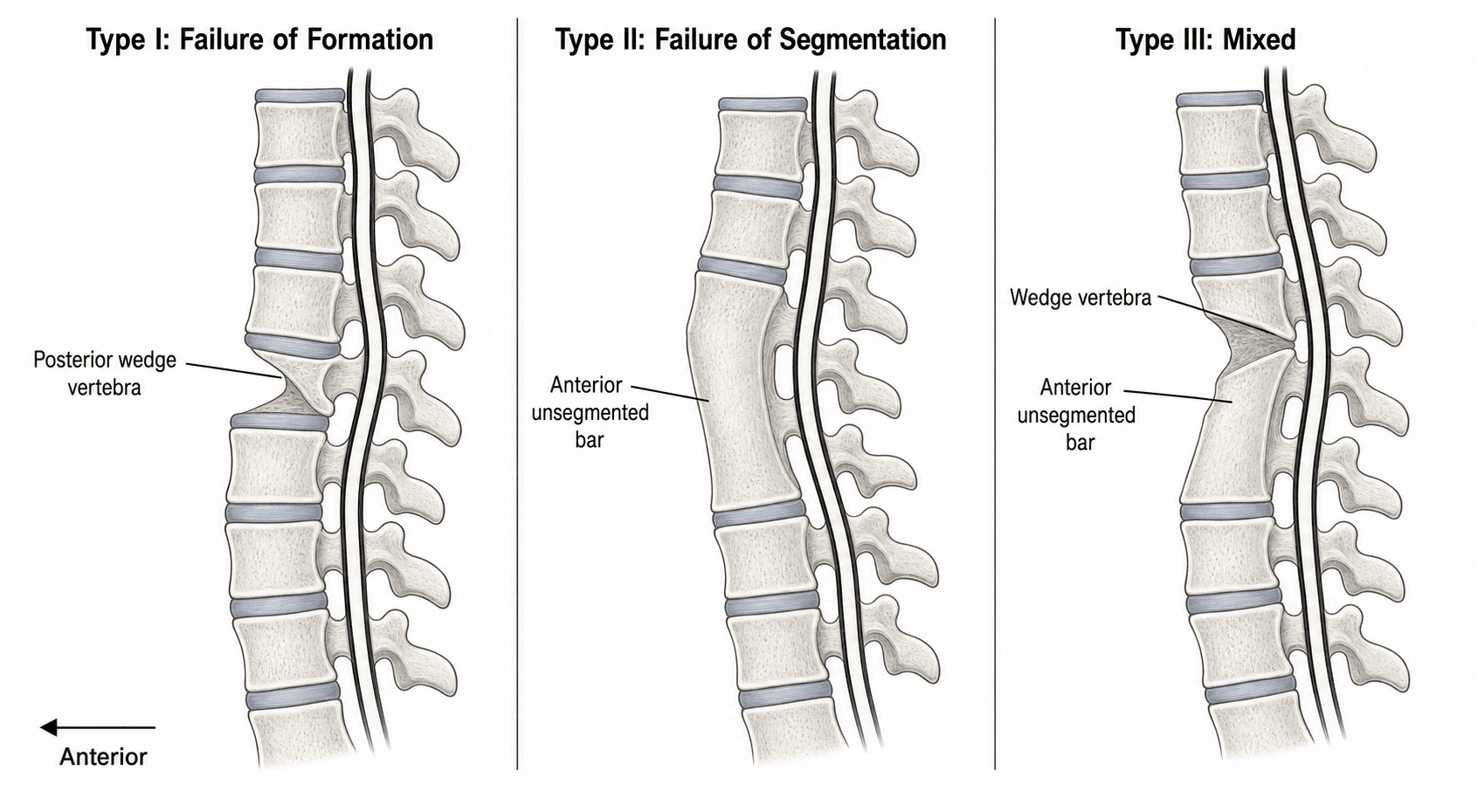
Type II is two prognoses. McMaster's natural-history series separates Type II by where the bar sits, and the distinction changes surveillance.
- Midline anterior bar, producing pure kyphosis (15 patients): usually progresses slowly
- Anterolateral unsegmented bar, producing kyphoscoliosis (9 patients): much more severe, and behaves closer to Type I
So the first clinic visit asks where the bar sits as well as which Winter type it is. A bar off the midline adds a coronal deformity and a worse trajectory.
McMaster classification. McMaster's system is primarily for congenital scoliosis but can overlap with kyphosis. It describes:
- Hemivertebra (fully segmented, semi-segmented or incarcerated)
- Block vertebra
- Wedge vertebra
- Unilateral bar, with or without a hemivertebra
Clinical Assessment
History. Start with the birth history: was the anomaly diagnosed antenatally, and has VACTERL screening been done? Walking and continence tell you about cord function. Ask whether the parents have noticed any worsening.
Neurology comes first. A full upper and lower limb examination is critical. Look for spasticity and clonus, hyperreflexia, and an ataxic or scissoring gait. The red flags for cord compression are:
- Ankle clonus
- Opisthotonus, hyperextension in an infant
- Hyperreflexia
- Delayed walking
The spine and skin. The classic finding is a sharp angular kyphosis, a gibbus, which is usually rigid when flexibility is assessed. Check for scoliosis, which often coexists, and for cutaneous stigmata such as a hairy patch or dimple, which point to concurrent spinal dysraphism.
Investigations
Radiographs and CT. PA and lateral whole-spine radiographs identify the anomaly and measure the kyphosis. CT with 3D reconstruction defines the bony anatomy and is essential for surgical planning.
MRI. MRI is mandatory before surgery. It shows whether the cord is compressed, with myelomalacia or signal change, and rules out intraspinal anomalies: diastematomyelia, tethered cord and syrinx.
Systemic screening. Screening for the VACTERL association means an echocardiogram, a renal ultrasound and a GI and anorectal examination.
VACTERLAssociated Anomalies (VACTERL)
Hook:Screen for ALL these before surgery.
Differential Diagnosis of Paediatric Kyphosis
A sharp, rigid, angular kyphosis (gibbus) in a child is congenital until proven otherwise. Several other conditions produce a kyphotic spine, and they must be distinguished because the management and the neurological risk differ sharply.
- Curve character
- Short, sharp, rigid angular gibbus
- Key discriminator
- Vertebral malformation (failure of formation/segmentation) on CT
- Cord risk
- HIGH (Type I)
- Curve character
- Smooth, round, thoracic; partly flexible
- Key discriminator
- 3+ adjacent wedged vertebrae over 5 degrees, endplate irregularity, Schmorl nodes; adolescent onset
- Cord risk
- Low
- Curve character
- Smooth, fully correctable on extension
- Key discriminator
- Normal vertebrae, corrects on prone hyperextension
- Cord risk
- None
- Curve character
- Angular gibbus, can mimic congenital
- Key discriminator
- Constitutional symptoms, vertebral body destruction/abscess, disc involvement on MRI
- Cord risk
- HIGH
- Curve character
- Thoracolumbar, often with platyspondyly
- Key discriminator
- Mucopolysaccharidosis, achondroplasia, NF1 (dystrophic) features systemically
- Cord risk
- Variable
- Curve character
- Progressive after posterior element loss
- Key discriminator
- Surgical history; loss of posterior tension band
- Cord risk
- Moderate
Management Algorithm
Bracing does not work. The deformity is rigid, so bracing is ineffective, and casting is not used as it is in scoliosis. Observation may be considered in mild Type II with no progression, but that is rare.
Fuse early. In early-onset scoliosis fusion is delayed; in congenital kyphosis early fusion is often recommended to prevent paraplegia, and it is often the safest option even at age 1-2. The lethal endpoint here is paraplegia rather than trunk-height loss, so arresting a progressive Type I curve takes priority and the crankshaft phenomenon is an accepted, managed risk rather than a reason to delay. Fusion is better than paralysis.
Choosing the operation. The operative options and their indications:
- Posterior fusion in situ: for mild cases or young infants; stops progression
- Posterior fusion with compression instrumentation: the modern standard; screws or hooks apply posterior shortening
- Combined anterior and posterior fusion: for severe or rigid cases, with access from both sides
- Vertebrectomy or vertebral column resection (VCR): for severe fixed deformity with neurological compromise
Surgical Techniques
The principle is posterior shortening. Scoliosis correction lengthens the concavity; kyphosis correction requires shortening the convexity, the posterior spine.
Posterior Fusion In Situ / With Instrumentation
The goal is to stop progression and prevent paraplegia. Fusion halts progression, but correction is limited in young children.
- Posterior midline approach.
- Expose the levels to be fused (usually 2 levels above and below the apex).
- Pedicle screws (if pedicle anatomy allows) or laminar hooks.
- Apply compression across the kyphotic apex.
- Decorticate and bone graft.
Cantilever correction. Screws are anchored at the proximal and distal ends, and a rod pre-bent to the desired lordosis is cantilevered into them, progressively reducing the kyphosis. The risk is screw pull-out, especially proximally, so the construct needs strong anchors.
Compression correction. A rod is placed in situ and a compressor applied across the kyphotic apex. It is safer, but the correction is less powerful.
The Crankshaft Phenomenon: The Cost of Fusing a Toddler's Spine
The mechanism. In a skeletally immature child a solid posterior fusion tethers the back of the spine, but the anterior vertebral bodies keep growing because the anterior growth plates are still open. Anchored posteriorly, that growth has nowhere to go but to bend and rotate around the posterior tether like a crankshaft, so the deformity recurs and rotates despite a radiographically solid fusion mass.
Who is at risk. The markers of remaining spinal growth identify the child:
- Open triradiate cartilage, the classic high-risk marker
- Risser 0, with no iliac apophysis ossification
- Young chronological age and Tanner stage, and the peak-height-velocity window
These are exactly the patients in whom congenital kyphosis pushes the surgeon to fuse early, which is why crankshaft is a real concern here and not a theoretical one. When early fusion is unavoidable, the strategies below mitigate it.
- Rationale
- Arrests anterior growth as well, removing the growth that drives the crank
- Trade-off
- Adds anterior approach morbidity (thoracotomy)
- Rationale
- Three-column control may resist the rotational crank better than hooks/wires alone
- Trade-off
- Tiny immature pedicles; screw pull-out and neurological risk
- Rationale
- Removing the malformed segment treats the deformity at its origin before secondary curves form
- Trade-off
- Technically demanding in a small child
General growth-modulating and growing-rod strategies for non-congenital early-onset deformity are covered in the early-onset-scoliosis topic.
Intraoperative Neuromonitoring and the Response to a Signal-Loss Alert
Why the stakes are high. The cord is draped over the kyphotic apex and supplied by a watershed anterior spinal artery, so correction can both kink it and devascularise it. Multimodal SSEP and MEP monitoring is the standard of care, and vertebral column resection requires it.
Why both modalities. SSEP monitors the dorsal columns of the posterior cord. It is good for global cord integrity, but it can stay normal while the motor tracts are injured. Transcranial motor-evoked potentials (MEP) monitor the corticospinal tracts in the anterolateral cord, the territory of the anterior spinal artery, which is exactly what anterior-apex kyphosis correction puts at risk. MEP is the more sensitive alarm for the ischaemic anterior cord, and SSEP alone is insufficient.
Responding to a true alert. A real, reproducible loss, not artefact, calls for action in parallel rather than watching and waiting. The goal is to act before a transient monitoring change becomes a fixed deficit: in large series most monitoring changes occur before or during the correction and, if addressed promptly, do not result in permanent injury.
- Action
- Check leads, anaesthetic depth, paralysis, hypothermia, technical artefact
- Why
- Avoid reacting to a false alarm
- Action
- Raise mean arterial pressure (target MAP up), correct anaemia/hypovolaemia, warm the patient
- Why
- The apical cord is on a watershed blood supply
- Action
- Release/back off the last correction or distraction; remove or loosen the offending hardware
- Why
- Correction can kink and devascularise the apical cord
- Action
- Lighten anaesthesia and ask the patient to move the legs
- Why
- Direct functional confirmation when evoked potentials are equivocal
Complications
Neurological Complications
- Incidence
- 10-20% (VCR)
- Risk Factors
- Severe deformity, rapid correction
- Prevention and Management
- Neuromonitoring, staged correction, wake-up test
- Incidence
- 5-10%
- Risk Factors
- Osteotomy sites
- Prevention and Management
- Meticulous technique, decompression
- Incidence
- Rare
- Risk Factors
- Post-op haematoma, swelling
- Prevention and Management
- Close monitoring first 48 hours
- Incidence
- 25-50% (Type I)
- Risk Factors
- Progressive stenosis
- Prevention and Management
- Early surgical intervention
Surgical Complications
- Rate
- 10-30%
- Prevention
- Combined anterior/posterior fusion
- Treatment
- Revision with bone graft augmentation
- Rate
- 15-30%
- Prevention
- Avoid stopping at apex, adequate proximal anchors
- Treatment
- Extension of fusion if symptomatic
- Rate
- 5-15%
- Prevention
- Strong constructs, dual rods, cross-links
- Treatment
- Revision and reinforcement
- Rate
- 3-10%
- Prevention
- Muscle coverage, meticulous technique
- Treatment
- Debridement, antibiotics, VAC therapy
- Rate
- 5-8%
- Prevention
- Careful dissection around vertebrae
- Treatment
- Primary repair, fibrin sealant
Long-term problems. Besides crankshaft, the curve can add on above or below the fusion, which is monitored with serial radiographs. Chronic pain may develop at the fusion ends and is managed with physiotherapy and pain management. Functional limitations include a short trunk and reduced spinal mobility, and occupational therapy helps with adaptation.
Postoperative Care
- ICU care for 24-48 hours after complex cases (VCR, severe deformity)
- Neurological checks hourly for the first 24 hours, then 4-hourly - the cord draped over the apex is the structure at risk
- Multimodal analgesia, PCA if appropriate for age; DVT prophylaxis mechanical and pharmacological as appropriate
- Mobilisation, wound care and pain control in the first 2 weeks
- Gentle range of motion and core stability from 2-6 weeks
- Custom-moulded TLSO worn full-time except for bathing (the Crostelli series braced for 3-5 months after hemivertebra resection); compliance is essential for fusion success
- 2 weeks: wound check and neurological examination; 6 weeks: radiograph to assess healing
- Progressive strengthening and graded return to activities
- Gradual brace weaning guided by imaging and clinical stability
- 3 months: CT if there are fusion concerns
- Sports restriction while the fusion consolidates; clinical and radiographic review at 6 months
- Annual surveillance during growth - secondary curves and junctional problems declare themselves with remaining growth, and late neurological deterioration is the complication to exclude
Outcomes/Prognosis
Surgical results. With early intervention, neurological function is preserved in more than 90%. Correction of 50-70% is achievable, the fusion rate is greater than 90% with a combined approach, and patient satisfaction is high when cosmesis is improved.
Prognostic factors. The untreated natural history by type is set out in the Overview; the factors that shape the result of treatment are these.
- Better Prognosis
- Early intervention
- Worse Prognosis
- Delayed surgery with neurological deficit
- Better Prognosis
- Type II
- Worse Prognosis
- Type I
- Better Prognosis
- Young (before puberty)
- Worse Prognosis
- After growth complete
- Better Prognosis
- Isolated
- Worse Prognosis
- Multiple congenital anomalies
Long-term function. Most patients are independent in activities of daily living, and quality of life is generally good with successful treatment. Low-impact sport is possible once the fusion has consolidated, and a wide range of careers is open, though heavy labour is best avoided.
Guidelines, Registries & Global Practice
Global epidemiology. Congenital kyphosis is rare and substantially less common than congenital scoliosis. It affects males and females roughly equally, the apex lies at the thoracolumbar junction (T10-L1) in about two-thirds of cases, and roughly 60 percent of patients have at least one associated anomaly within the VACTERL spectrum. There is no high-quality population registry for congenital kyphosis; the evidence base is built from single-centre series, so practice is consensus-driven rather than registry-driven.
Side-by-side guidance. No single society publishes a dedicated congenital-kyphosis pathway, so principles are drawn across bodies:
- Position relevant to congenital kyphosis
- Early diagnosis and prophylactic posterior fusion for progressive Type I; whole-spine MRI mandatory before any deformity surgery to exclude intraspinal anomaly
- Position relevant to congenital kyphosis
- Posterior-based correction (osteotomy/VCR) for rigid angular deformity; multimodal intraoperative neuromonitoring (SSEP + MEP) as standard of care
- Position relevant to congenital kyphosis
- Screen for cord-tethering and dysraphism; treat the neurological threat ahead of cosmetic concerns
- Position relevant to congenital kyphosis
- Combined SSEP/MEP monitoring and a documented stop/checklist protocol for monitoring loss during correction
The genuine point of difference between regions is not whether to operate but which technique (in-situ vs instrumented posterior fusion vs anterior release vs VCR) and how early, driven by deformity rigidity, magnitude and neurological status rather than geography.
High- vs limited-resource practice variation.
- Well-resourced centres: routine multimodal neuromonitoring, 3D-CT planning, single-stage posterior VCR, cell salvage and paediatric intensive care — enabling aggressive correction of severe deformity at acceptable risk.
- Limited-resource settings: later presentation with established neurology and larger curves is common; monitoring may be unavailable, pushing surgeons toward safer in-situ posterior fusion, the wake-up test, and staged rather than single-stage correction. Early prophylactic posterior fusion of a small progressive curve is the highest-value, lowest-cost intervention and should be prioritised wherever follow-up is reliable.
Controversies & Areas of Uncertainty
The literature is entirely retrospective Level IV, so several management questions remain genuinely unsettled, and they are favourite viva discussion points.
Timing of fusion in the very young. Early posterior fusion arrests progression and prevents paraplegia, but it sacrifices growth and risks the crankshaft phenomenon. How small a curve justifies fusing a toddler's spine is unresolved: most accept fusing a documented progressive Type I, but the threshold is judgement, not evidence.
In situ or instrumented posterior fusion. Modern pedicle-screw constructs allow correction and shortening, but instrumentation in tiny pedicles carries pull-out and neurological risk. Some still advocate simple in situ posterior fusion to halt progression in the youngest patients.
Whether anterior surgery is still needed. Combined anterior and posterior fusion historically reduced pseudarthrosis and addressed the crankshaft. Posterior-only osteotomy or VCR now achieves correction without thoracotomy morbidity in many hands, and whether anterior support still adds value in severe rigid curves is debated.
VCR or a lesser osteotomy. VCR gives the most powerful correction but carries its neurological complication risk and high blood loss. The boundary at which a PSO or an anterior release is enough is not defined by trials.
Decompression for an established deficit. When the cord is compressed with T2 signal change, the relative roles of anterior decompression and posterior shortening, and the neurological recovery that can be achieved, are uncertain. The prognosis with established myelomalacia is guarded.
Deep Dive: MRI Cord Signal
T2 Hyperintensity at the Apex
- Indicates cord edema, gliosis, or myelomalacia.
- Edema: Potentially reversible if decompressed urgently.
- Myelomalacia: Established damage. Irreversible.
Clinical Correlation
- Patients with MRI signal change and neurological deficit have a worse prognosis even after surgery.
- The goal is to intervene BEFORE signal change develops.
MCQ Practice Points
Q: Which type of congenital kyphosis has the worst prognosis? A: Type I (Failure of Formation). It progresses the fastest and has the highest neurological risk.
Q: What is the mechanism of cord injury in congenital kyphosis? A: Mechanical compression of the cord over the kyphotic apex and vascular ischemia of the anterior spinal artery territory.
Q: Is bracing effective for congenital kyphosis? A: No. The deformity is rigid. Bracing does not alter progression.
Q: What is the most common level for congenital kyphosis? A: Thoracolumbar junction (T10-L2). This puts the conus medullaris at risk.
Q: What is the neurological risk with Type I congenital kyphosis? A: 25-50% risk of paraplegia if untreated due to progressive cord compression.
Q: What imaging is mandatory before surgery for congenital kyphosis? A: MRI to assess cord compression, intraspinal anomalies (tethered cord, diastematomyelia).
Self-Assessment Quiz
Viva Scenarios
Practise clinical reasoning and management decisions out loud
“1-year-old infant. Angular kyphosis at T12. MRI shows no cord compression. Neurologically normal.”
“10-year-old presents with bilateral lower limb weakness. Kyphosis of 80 degrees at T11. MRI shows cord compression and T2 signal change.”
“Neonate with imperforate anus and radial club hand. Spine X-ray shows a vertebral anomaly at T10.”
CLASSIFICATION
- Type I (Formation)
- Type II (Segmentation)
- Type III (Mixed)
- Type I is WORST
RISK
- Paraplegia 25-50%
- Progression Certain
- Bracing Fails
- Early Fusion Indicated
WORKUP
- MRI Cord
- CT Anatomy
- Echo (VACTERL)
- Renal US
SURGERY
- Posterior Fusion
- Anterior Release
- VCR (Severe)
- Neuromonitoring
Evidence Base
Winter RB
- Foundational description of congenital spine deformity natural history and treatment
- Established the framework distinguishing failure of formation from failure of segmentation
- Emphasised that congenital kyphosis carries a real risk of paraplegia and that bracing is ineffective
McMaster MJ, Singh H
- Largest natural-history series: 112 patients (68 Type I, 24 Type II, 12 Type III, 8 unclassifiable)
- Apex was thoracolumbar (T10-L1) in 66 percent; progression was most rapid during the adolescent growth spurt
- Spontaneous cord compression occurred in 10 patients (7 of them Type I); Type III and two-level Type I anomalies progressed fastest
Zeng Y, Chen Z, Qi Q, et al
- PSO or posterior VCR selected by deformity severity in 23 congenital kyphosis/kyphoscoliosis patients (mean kyphosis 74.3 degrees)
- Mean kyphosis fell to 20 degrees (73.7 percent correction); most of the 11 patients with preoperative deficit improved
- No permanent neurological damage; 91.3 percent satisfaction at mean 34 months
Chang DG, Yang JH, Suk SI, et al
- Posterior VCR with pedicle-screw fixation in 45 patients with congenital SCOLIOSIS under 18, mean follow-up 12.8 years — the correction figures are coronal, and are borrowed here for the complication burden of the operation
- Main curve corrected 46.5 to 13.7 degrees and maintained at 17.6 degrees long term
- Overall complication rate 48.9 percent, highlighting major-complication and blood-loss risk
Crostelli M, Mazza O, Mariani M, et al
- Single-stage posterior hemivertebra resection and pedicle-screw arthrodesis in 82 children (20 kyphoscoliosis), mean age 8.6 years
- Mean kyphosis reduced to 20 degrees Cobb at 9.6-year follow-up
- No major complications (infection, instrumentation failure, severe neurological injury, severe blood loss)
Kamerlink JR, Errico T, Schwab F, et al
- Consecutive deformity series with SSEP/MEP monitoring; sensitivity and specificity both 100 percent
- Overall new neurological deficit rate 1.1 percent; sagittal-plane and neuromuscular cases had the highest monitoring-change rates
- Most monitoring changes occurred before correction and did not result in permanent deficit