Second Toe Plantar Plate Tear | Dorsal Dislocation | Flexible vs Rigid
- Plantar plate tear at second MTP is the primary pathology - loss of plantar restraint allows dorsal subluxation
- Hallux valgus is the underlying cause in 80% - great toe pushes second toe dorsally and medially
- Crossover occurs over the hallux - second toe crosses medially over great toe in severe cases
- Flexible vs rigid determines treatment: flexible = soft tissue repair, rigid = bone procedure
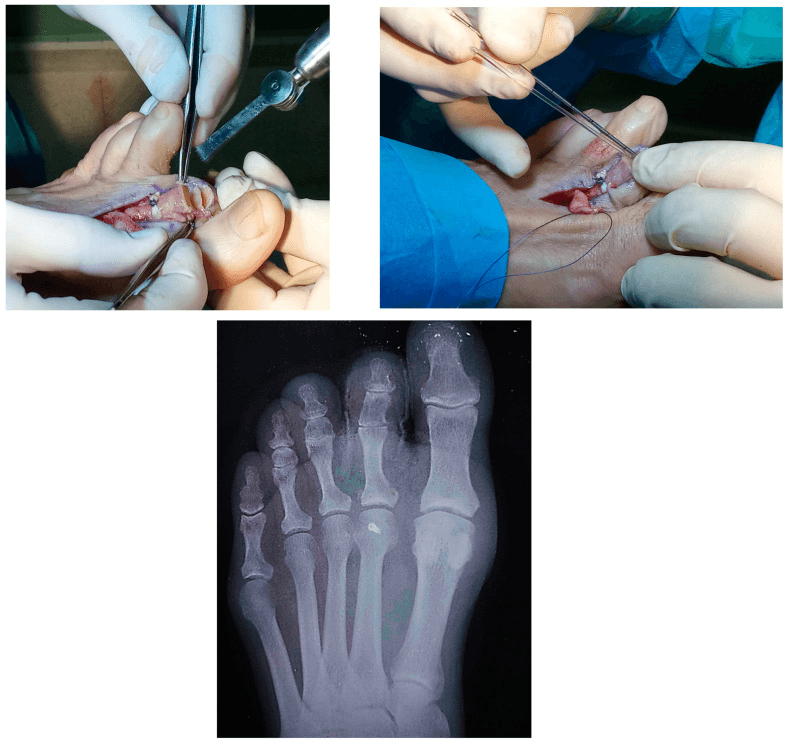
- Weil osteotomy shortens metatarsal to reduce tension, combined with plantar plate repair
- “Long second metatarsal (Morton foot) is a plausible contributor to plantar plate overload, but the largest crossover cohort found no correlation with metatarsal length
- “Paper pull-out test: inability to grip paper with toe indicates plantar plate incompetence
- “Lachman test of MTP: dorsal translation over 2mm suggests plantar plate rupture
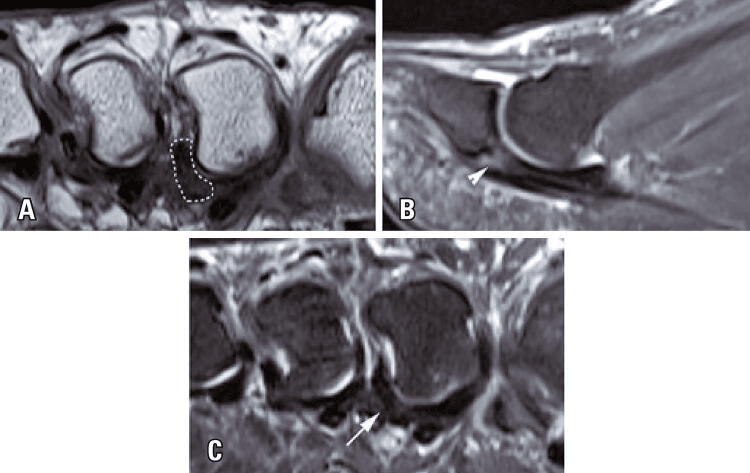
- “MRI shows plantar plate tear as high T2 signal at insertion on proximal phalanx base
Overview and Epidemiology
Crossover toe deformity is a transverse-plane malalignment of the second toe, which deviates medially and dorsally to lie over the hallux. It is the end stage of lesser metatarsophalangeal (MTP) joint instability, driven by attritional failure of the plantar plate, the principal static stabiliser of the MTP joint. Podiatric authors describe the earlier, pre-deformity inflammatory stages as "predislocation syndrome".
Who. The patient is typically an older woman. In the largest surgical cohort 86% were women, the mean age at surgery was about 59, and incidence peaked in women over 50. The associations to ask about are hallux valgus, degenerative arthritis of the first MTP joint, inflammatory arthropathy such as rheumatoid arthritis, and high heels or other constrictive footwear.
Which toe. The second MTP joint is affected most commonly. The second is the longest lesser ray and carries the greatest plantar load.
Pathophysiology and Mechanism
The plantar plate. The plate is the primary plantar restraint of the lesser MTP joint, and its tear is the primary lesion. It inserts on the base of the proximal phalanx, and that distal insertion is its weakest point and the usual site of tearing.
The two stabilisers. The plantar plate holds the joint in the sagittal plane and the lateral collateral ligament, with the capsule, holds it in the transverse plane. The toe drifts medially once both have failed; the end result is dorsal subluxation, then dislocation, with the extensor digitorum longus (EDL) as the deforming force.
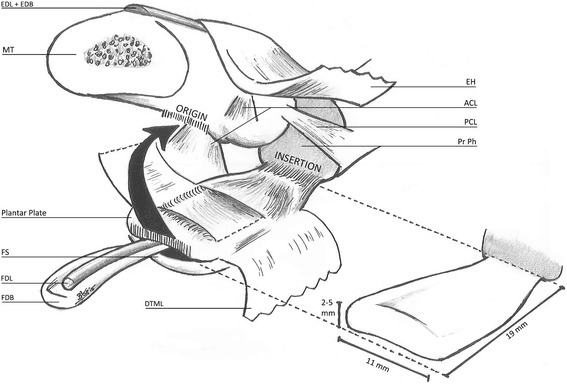
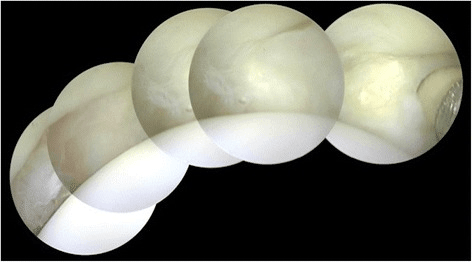
80% of crossover toes occur with hallux valgus. The deviated great toe exerts medial and dorsal force on the second toe and removes the lateral buttress, allowing medial drift. Over time the chronic pressure overloads the second MTP plantar plate until it tears. Repair the crossover toe without correcting the hallux valgus and the deformity will recur.
The sequence. The deformity develops in order:
- The great toe deviates laterally into valgus and pushes against the second toe, increasing the mechanical stress on the second MTP plantar plate.
- Chronic overload causes microtrauma in the fibrocartilaginous plate, and partial tears develop, usually at its insertion on the proximal phalangeal base.
- The plate ruptures full-thickness. With the plantar restraint lost, the proximal phalanx subluxes dorsally and the EDL overpowers the plantar structures.
- The hallux pushes medially and the EDL pulls dorsally, so the second toe crosses medially over the great toe. Without treatment, capsular contracture makes it rigid in this position.
Other contributors. Three further factors add to the load or the imbalance:
- EDL overpull - the extensor overpowers the weakened plantarflexors and drives the dorsal subluxation; it requires lengthening
- Long second metatarsal - an anatomical variant that increases stress on the second MTP plantar plate and may need Weil shortening, though its causal role is disputed (below)
- Intrinsic muscle atrophy - the lumbricals and interossei lose function with age, weakening plantarflexion; an FDL transfer restores the balance
Aetiology Debate - Metatarsal Length vs the Hallux Buttress
A recurring examiner trap is the causal role of a long second metatarsal (Morton foot). The biomechanical argument is intuitive: a relatively protruding second ray bears greater and more prolonged plantar load through late stance, chronically stressing the plate at its distal insertion. This is why metatarsal length is emphasised in generic metatarsalgia, and why a Weil shortening osteotomy is used to decompress the ray.
Why length explains little in crossover. Absolute length on a static radiograph is a weak predictor in crossover specifically. Relative dynamic loading and the integrity of the plate's insertion matter more, and overload during gait is not captured by a length measurement. The dominant transverse-plane driver is the loss of the hallux buttress, present in the majority of cases, and length alone cannot explain the medial drift it allows.
In practice. Do not rely on a long second metatarsal to make the diagnosis or to justify surgery. Diagnose from the drawer sign and the deformity, correct the hallux valgus, and shorten the metatarsal only to decompress the joint for the repair, not because length by itself caused the deformity.
Asked "does a long second metatarsal cause crossover toe?", answer with nuance: an overloaded second ray is a plausible contributor to plantar-plate overload in lesser-MTP instability generally, but the largest crossover-toe cohort (Kaz and Coughlin) found no radiographic correlation with metatarsal length or the intermetatarsal angle.
Classification - Coughlin Clinical Staging
Coughlin's clinical staging turns on reducibility, and the stage selects the treatment.
- Deformity Characteristics
- Medial deviation, mild dorsal subluxation
- Reducibility
- Fully flexible, passively reducible
- Treatment
- Conservative: taping, orthotics, wide toe box shoes
- Deformity Characteristics
- Moderate crossover, partial dislocation
- Reducibility
- Semi-rigid, partially reducible
- Treatment
- Surgical: plantar plate repair + flexor transfer + Weil osteotomy
- Deformity Characteristics
- Severe crossover, complete dislocation
- Reducibility
- Rigid, irreducible
- Treatment
- Surgical: arthrodesis or resection arthroplasty
The flexibility of the deformity determines the surgical approach. In Stages 1 and 2 the toe still corrects, fully or partly, with passive manipulation and the joint is congruent or subluxed rather than dislocated, so the soft tissues can be rebalanced (plantar plate repair, flexor transfer, Weil osteotomy) to restore balance and alignment. In Stage 3 the deformity is fixed, the joint surfaces are incongruent or arthritic, soft-tissue repair is insufficient, and a bone procedure is required: arthrodesis or resection arthroplasty.
Staging at the bedside. Ask the patient to straighten the toe, then try to reduce it yourself:
- Stage 1 (flexible) - the patient can actively straighten the toe, passive reduction fully corrects it, and there is no fixed contracture of the capsule or EDL
- Stage 2 (semi-rigid) - active correction is lost and passive reduction is only partial; there is some capsular contracture, and the tight EDL needs forced plantarflexion to reduce
- Stage 3 (rigid) - the toe will not reduce even with passive force, the dorsal capsule is severely contracted, and there may be secondary arthritis
Associated pathology. Assess and address all of it:
- Hallux valgus - corrected by a bunionectomy performed with the crossover repair
- Second MTP synovitis - chronic inflammation from the plate injury adds pain and swelling; a synovectomy is performed at surgery
- Transfer metatarsalgia - if the third or fourth MTP joint becomes symptomatic, additional Weil osteotomies may be needed
- A widened first-second intermetatarsal angle - addressed by the hallux valgus correction
Anatomic grading. The tear itself is graded 0 to IV on the anatomy found at operation (Coughlin's cadaveric grading, below). The anatomic grade complements, but does not replace, the clinical assessment of reducibility and joint congruity.
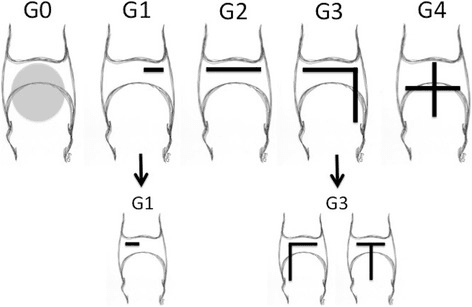
Clinical Presentation and Examination
History. The pain is plantar, at the second MTP joint, and worse with walking, and the deformity comes on gradually over months to years. Ordinary shoes become difficult because the toe rubs dorsally, and push-off and balance suffer. The patient often reports a bunion and has usually tried pads and wider shoes without relief.
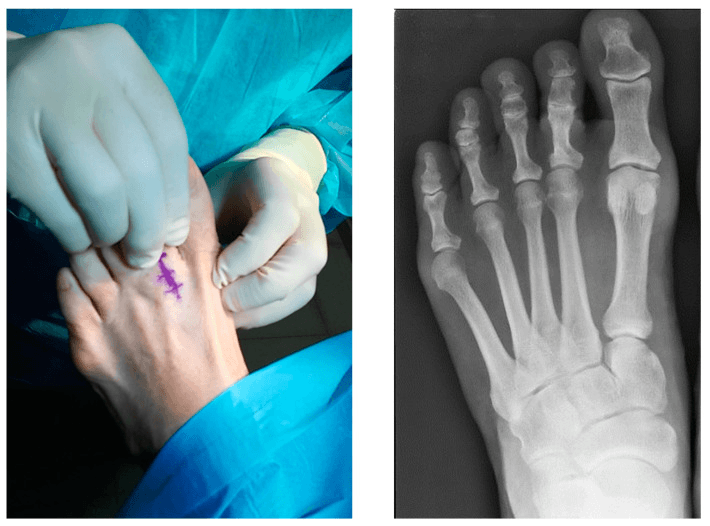
Examination. Look for the second toe crossing medially over the hallux with dorsal subluxation, and assess the severity of the hallux valgus and the intermetatarsal angle. Attempt passive reduction to stage the deformity, and ensure there is no digital nerve compression.
- Technique
- Place paper under toe, ask patient to grip, pull paper out
- Positive Finding
- Unable to hold paper (slips out)
- Significance
- Plantar plate incompetence - loss of plantar flexion strength
- Technique
- Stabilise metatarsal head, dorsally translate proximal phalanx
- Positive Finding
- Greater than 2mm dorsal translation
- Significance
- Plantar plate rupture - loss of plantar restraint
- Technique
- Apply plantar and lateral force to reduce toe alignment
- Positive Finding
- Flexible: fully reducible. Rigid: irreducible
- Significance
- Determines stage and surgical approach
- Technique
- Inspect plantar surface of second MTP
- Positive Finding
- Bruising present
- Significance
- Acute or subacute plantar plate tear
The single most useful examination finding is the dorsal drawer (Lachman) test of the second MTP joint, with a reported specificity approaching 100% for plantar plate insufficiency, although that figure comes from patients who all went on to surgery (see the evidence below). Gradually progressive forefoot pain with a positive drawer in an older woman is a plantar plate tear until proven otherwise, even before any crossover is visible. Examine the drawer in any older woman with unexplained forefoot pain. Missing it leads to delayed referral and progression to a rigid, dislocated joint; once the joint dislocates and becomes rigid, soft-tissue repair fails and the patient needs a fusion rather than reparable soft-tissue surgery.
- Key Features
- Older woman, second MTP plantar pain, medial/dorsal crossover, positive drawer
- Discriminators from Crossover Toe
- Positive drawer sign, gradual deformity, hallux valgus association
- Key Features
- Burning interdigital pain, Mulder click, numbness of adjacent toes
- Discriminators from Crossover Toe
- No fixed toe deformity, no drawer instability, sensory symptoms predominate
- Key Features
- Adolescent/young adult, second metatarsal head osteonecrosis, joint flattening on X-ray
- Discriminators from Crossover Toe
- Osteochondral collapse on radiograph, painful dorsiflexion, no plantar plate drawer
- Key Features
- Bilateral, symmetric, multiple MTPs, raised inflammatory markers
- Discriminators from Crossover Toe
- Systemic features, serology positive, multi-joint involvement
- Key Features
- Activity-related dorsal pain, focal bony tenderness, callus on X-ray
- Discriminators from Crossover Toe
- Bony (not plantar) tenderness, no instability, history of overuse
- Key Features
- PIP flexion deformity without MTP crossover
- Discriminators from Crossover Toe
- Deformity at PIP not MTP, no medial drift, drawer negative
Early surgical intervention is indicated for:
- Rapid progression despite conservative treatment (under 3 months)
- Severe pain limiting daily activities
- Stage 2 (semi-rigid) deformity, because delay allows progression to a rigid Stage 3 with worse outcomes
- Skin breakdown over the dorsal toe from shoe pressure
- A patient who is motivated and medically fit for surgery
Predislocation Syndrome - the Early, Reparable Window
The visible crossover is a late event. The reparable phase is the predislocation syndrome, the inflammatory, pre-deformity precursor, and catching it here is what separates a soft-tissue repair from a salvage fusion.
Definition and natural history. Predislocation syndrome is an acute, subacute or chronic inflammatory process of a lesser MTP joint, characteristically the second, that if untreated progresses to plantar plate and capsular attenuation, MTP instability, and ultimately dorsal subluxation and crossover (Mendicino 2001). It is the clinical face of an early, still-repairable plantar plate lesion, before any override of the hallux.
How it presents, before any crossover.
- Plantar second-MTP pain and swelling, worse on push-off and barefoot walking, often with a boggy synovitis palpable just distal to the metatarsal head
- A positive dorsal drawer sign, the earliest and most specific instability finding, often before radiographs show anything
- Loss of toe purchase on the paper pull-out test
- Frequent coexisting hallux valgus (seven of eight patients in Mendicino's series), reinforcing that the first ray must be assessed even at this early stage
Early management. Offloading, taping the toe into plantarflexion, stiff-soled footwear and activity modification come first, with a low threshold for surgery if instability progresses. Corticosteroid injection around an already-attenuated plate is avoided because it risks completing the rupture. A flexor-to-extensor (FDL) transfer reliably stabilises late-stage predislocation instability, albeit with a risk of residual MTP stiffness.
Predislocation Syndrome - Definition and Flexor Transfer
- Defined predislocation syndrome as an acute, subacute or chronic inflammatory process of a lesser MTP joint that, untreated, leads to plantar plate and capsular attenuation and MTP instability
- Retrospective series of eight patients treated with a flexor digitorum longus tendon transfer for second-toe instability
- All had a painful second MTP joint; seven of eight had an associated hallux valgus deformity
- Excellent results in six patients; residual MTP stiffness was the main complaint in two, a recognised downside of FDL transfer
A painful, swollen but still-aligned second toe with a positive drawer test should raise strong suspicion for early lesser-MTP instability and plantar-plate injury. Confirm the pain source, reducibility, hallux and first-ray mechanics and imaging before treatment. Early recognition preserves non-operative and direct-repair options, while an established crossover deformity may still be reconstructed according to tissue quality and joint congruity rather than automatically fused.
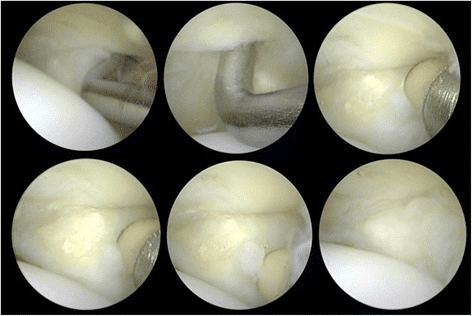
Investigations
Most cases are diagnosed clinically. Imaging confirms the severity and guides treatment.
Radiographs. Weight-bearing films are essential to assess the true deformity:
- AP weight-bearing - hallux valgus angle and second MTP alignment
- Lateral weight-bearing - dorsal subluxation of the second toe
- Oblique - additional detail of the MTP joints
What to measure. The hallux valgus angle (normally under 15°), the first-second intermetatarsal angle (normally under 9°), second MTP alignment (subluxation or dislocation) and the relative metatarsal lengths. The films also show the stage:
- Stage 1 - minimal subluxation, joint congruent
- Stage 2 - partial subluxation, joint surfaces losing contact
- Stage 3 - complete dislocation, the proximal phalanx dorsal to the metatarsal head
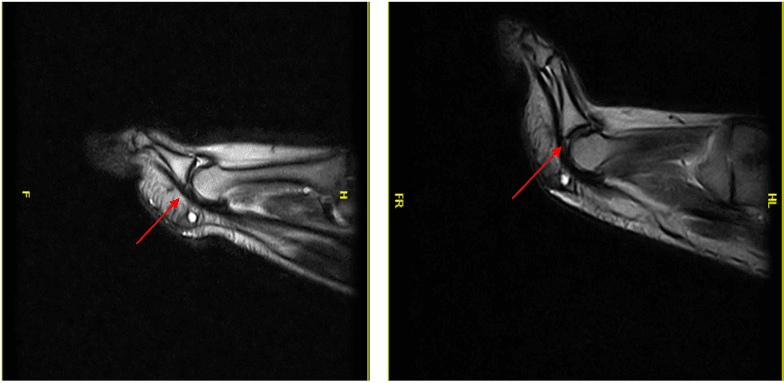
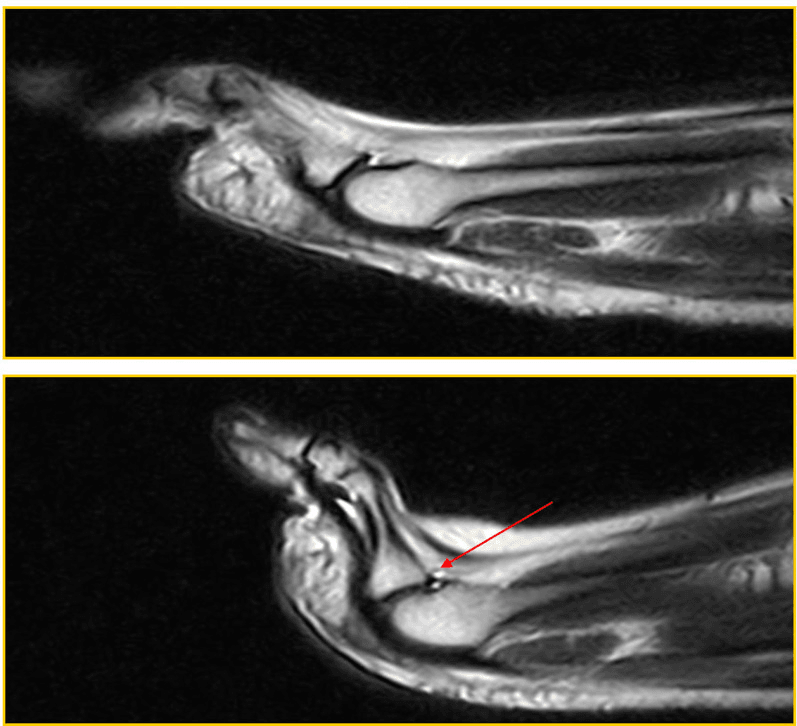
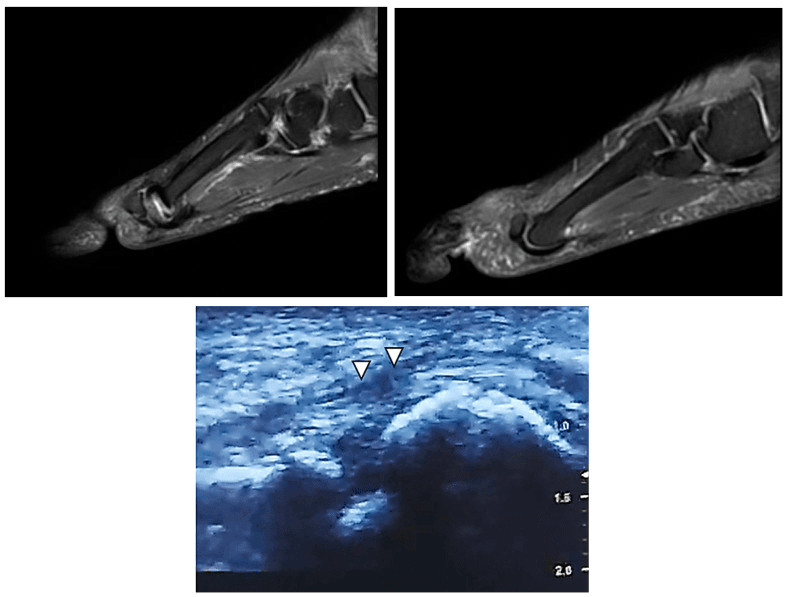
MRI. MRI is the imaging modality of choice for the soft tissues. A tear shows as high T2 signal at the insertion on the proximal phalangeal base, with discontinuity of the plate substance, surrounding oedema and inflammation, and sometimes retraction of the torn fibres. It may also show second MTP synovitis, collateral ligament injury and bone marrow oedema from stress reaction. The protocol uses T1, T2 and STIR sequences in axial, sagittal and coronal planes, with a small field of view on the forefoot. The indications:
- An uncertain diagnosis, to rule out other causes of pain
- Pre-operative planning for plantar plate repair
- Assessing the extent of a tear
Reading the scan. MRI confirms a tear in an uncertain case and guides surgical planning, but tears are also seen in asymptomatic feet (Gregg, below), so a reported tear is interpreted alongside the examination, not in isolation. Stress positioning can accentuate a true tear, but it can also miss a joint that is unstable on examination.
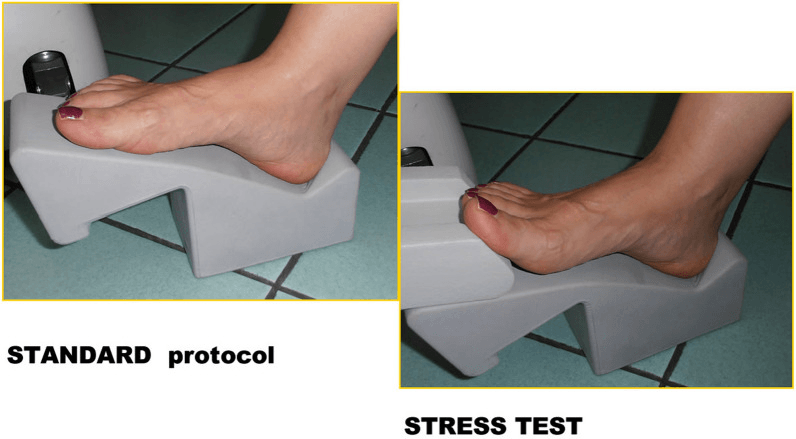
Ultrasound. In experienced hands ultrasound can assess the plate and allows dynamic assessment during toe motion. It is less detailed than MRI and operator dependent.
CT. Rarely indicated. It is useful for assessing bone quality before arthrodesis and gives better detail of arthritic change.
Management Algorithm
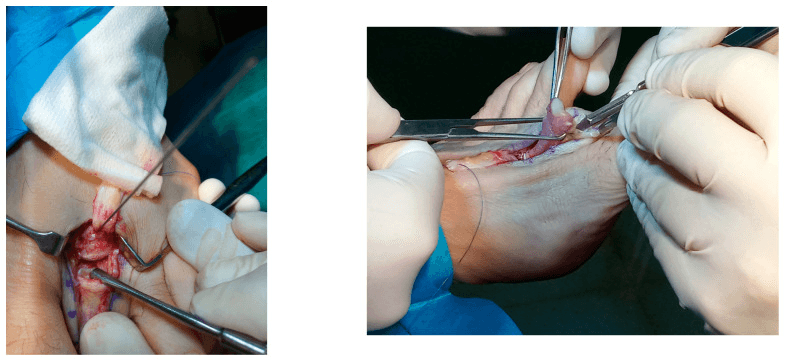
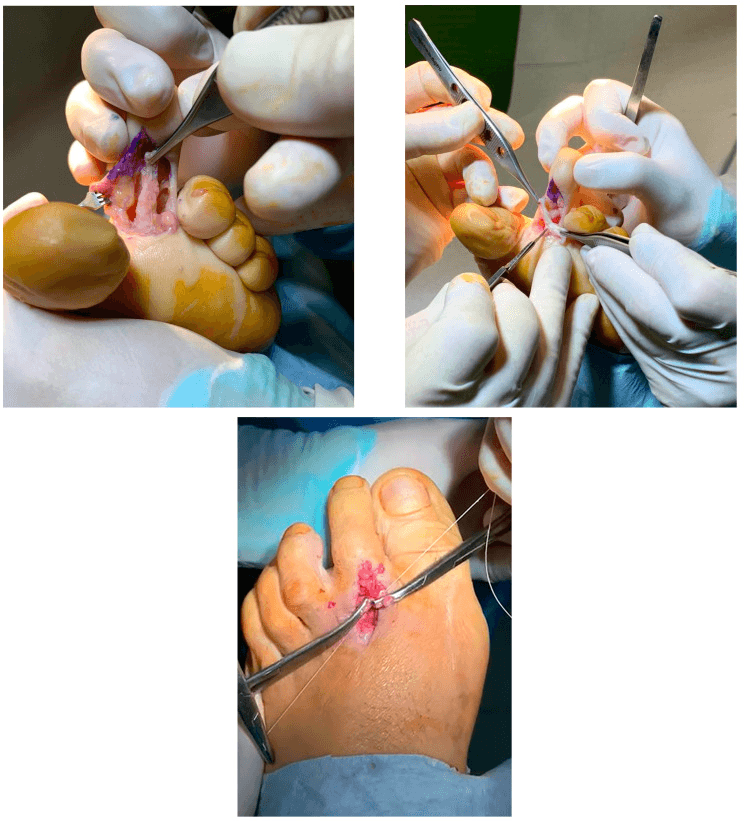
The goal is to restore a plantigrade, shoe-tolerant toe while treating each demonstrated driver. Flexible disease may respond to taping, footwear and offloading. Operative selection is pathology-based: plantar-plate repair, metatarsal shortening, tendon balancing, hallux correction and PIP procedures are combined only when the corresponding instability, overload, deformity or rigidity is present. Arthrodesis or resection is reserved for selected rigid, arthritic or salvage situations; hallux valgus is corrected when it contributes materially to recurrence risk.
Who. Stage 1 (flexible) deformity, mild symptoms with little functional limitation, or a patient who is not a candidate for surgery.
What.
- Buddy taping of the second toe to the third, to prevent medial deviation
- Wide toe-box shoes to reduce dorsal pressure on the toe
- Metatarsal pads to offload the second MTP joint
- Custom orthotics to support the metatarsal arch
- NSAIDs for pain and inflammation
What it achieves. 30-40% achieve symptom control. Conservative care does not correct the deformity, and most patients progress to Stage 2 and require surgery, so for most it is temporising.
Complications
- Incidence
- 10-20%
- Risk Factors
- Hallux valgus not corrected, overcorrection avoided
- Prevention/Management
- Always correct hallux valgus concomitantly
- Incidence
- 15-25%
- Risk Factors
- Excessive metatarsal shortening (Weil osteotomy)
- Prevention/Management
- Limit shortening to 3-5mm, assess adjacent MTP joints
- Incidence
- 10-15%
- Risk Factors
- Arthrodesis, aggressive soft tissue dissection
- Prevention/Management
- Expected with fusion, ROM exercises if soft tissue repair
- Incidence
- 5-10%
- Risk Factors
- Excessive EDL lengthening, overcorrection
- Prevention/Management
- Balanced lengthening, avoid overcorrection
- Incidence
- 5%
- Risk Factors
- Poor bone quality, smoking, inadequate fixation
- Prevention/Management
- Rigid fixation, smoking cessation, revision if symptomatic
- Incidence
- Rare
- Risk Factors
- K-wire fixation, poor hygiene
- Prevention/Management
- Pin care, early removal at 2-3 weeks
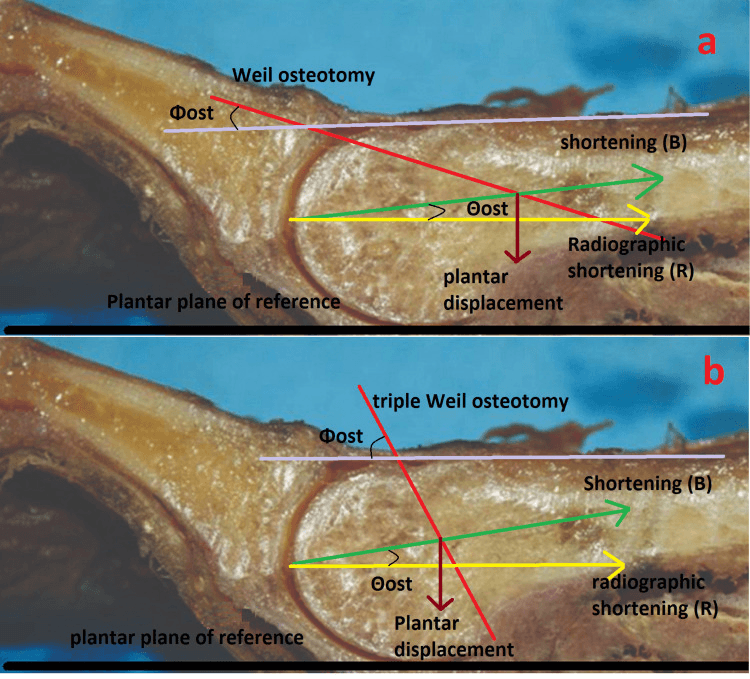
Transfer metatarsalgia. Excessive shortening at the Weil osteotomy transfers pressure to the adjacent third and fourth MTP joints. A patient who develops new pain at an adjacent joint after surgery may need further Weil osteotomies at those rays.
Outcomes and Prognosis
What predicts a good result. Flexible or semi-rigid disease (Stages 1-2) treated early, before it becomes rigid, with the hallux valgus corrected at the same operation. Good bone quality for fixation, a non-smoker who complies with rehabilitation, and normal body weight all help.
What predicts a poor one. A rigid Stage 3 deformity, hallux valgus left unaddressed, inflammatory arthritis, previous failed toe surgery, obesity, smoking, and excessive metatarsal shortening.
- Surgery Type
- Conservative or soft tissue repair
- Expected result
- Best of the three - the plate is reparable and the joint reduces
- Key Outcome Measures
- Pain relief, deformity correction, return to shoes
- Surgery Type
- Plantar plate repair + flexor transfer + Weil
- Expected result
- Good pain relief; alignment reliably improved, stability and toe purchase less so
- Key Outcome Measures
- Alignment restoration, functional improvement
- Surgery Type
- Arthrodesis or resection arthroplasty
- Expected result
- Least predictable for function; fusion is reliable for PAIN rather than for restoring a working toe
- Key Outcome Measures
- Pain relief (fusion reliable), stability
No published series reports good-to-excellent rates stratified by clinical stage in this way, so none is given here. What the evidence on this page does support is a GRADIENT rather than a set of figures: the original soft-tissue series reported 90 per cent satisfactory in fifteen operated toes assessed by the operating surgeon, and the prospective grade-directed series found that higher anatomic grades finished with proportionally fewer stable joints, less normal toe purchase and - for grade IV - only a fair AOFAS of 72. Counsel a patient on that gradient, not on a number.
Guidelines, Registries & Global Practice
- Female predominance ~86%; peak in women over 50, mean age ~59 at surgery
- Strongly associated with hallux valgus and first MTP arthritis
- Higher prevalence in populations with high rates of constrictive/high-heeled footwear
- Inflammatory arthropathy (rheumatoid) a recognised cause worldwide, often multi-ray
- High-resource: MRI/ultrasound, suture-anchor plantar plate repair, dorsal Weil approach, day-case surgery
- Limited-resource: Clinical drawer-sign diagnosis, flexor-to-extensor transfer or resection arthroplasty (no implants required), buddy taping and footwear advice as first line
- Lesser-toe procedures are not tracked in implant joint registries (no prosthesis), so registry evidence is absent — evidence base is case series and small comparative studies
- Position
- Anatomic tear-grade-directed treatment; combine with Weil shortening and correct hallux valgus
- Practical Implication
- Internationally adopted operative algorithm
- Position
- Emphasise plantar plate as primary lesion; favour direct repair where reparable
- Practical Implication
- Supports anatomic repair over indirect rebalancing alone
- Position
- Clinical diagnosis with drawer test; staged conservative then surgical care
- Practical Implication
- Reserve imaging for atypical cases
- Position
- No randomised trial defines a single best technique; treatment individualised to tear grade and rigidity
- Practical Implication
- Counsel patients that evidence is largely Level III-IV
For Orthopaedic fellowship examination, be prepared to discuss the five components of flexible (Stage 2) crossover toe repair (Weil osteotomy, plantar plate repair, FDL transfer, EDL lengthening, hallux valgus correction), explain why correcting the underlying hallux valgus is essential to prevent recurrence, and recognise that there is no single-society randomised guideline — management is grade- and rigidity-directed and based on case-series evidence.
Controversies and Areas of Uncertainty
- Arguments
- Direct repair restores native anatomy and toe purchase; flexor transfer is reliable but causes stiffness and may not restore purchase
- Current Position
- Direct repair preferred for repairable (Grade II-III) tears; flexor transfer reserved for irreparable Grade IV (Nery/Coughlin protocol)
- Arguments
- Dorsal approach (with Weil osteotomy) gives joint access without plantar scar; plantar approach gives direct plate visualisation but risks painful plantar scar
- Current Position
- Dorsal/Weil approach now most widely adopted; plantar approach less common due to scar morbidity
- Arguments
- MRI sensitive (87%) but poor specificity - tears seen in asymptomatic feet; clinical drawer sign is highly specific
- Current Position
- Diagnosis is primarily clinical; MRI reserved for atypical presentations or pre-operative grading uncertainty
- Arguments
- Some shortening alone relieves pain; comparative data show added repair improves quality-of-life and pain scores
- Current Position
- Repair the plate when a Weil is performed for instability (Fleischer 2020)
- Arguments
- Early synovitis may respond to offloading and taping; injection risks plate rupture
- Current Position
- Avoid intra-articular/peri-plate corticosteroid; early activity modification and orthoses, low threshold for surgery if instability progresses
MCQ Practice Points
Q: What is the primary pathology in crossover toe deformity? A: Plantar plate tear at the second MTP joint. The tear (usually at insertion on proximal phalanx base) removes the plantar restraint, allowing dorsal subluxation driven by the extensor digitorum longus.
Q: What is the underlying cause in 80% of crossover toe cases? A: Hallux valgus (bunion deformity). The deviated great toe pushes the second toe dorsally and medially, overloading the plantar plate and causing it to tear.
Q: How do you differentiate Stage 2 from Stage 3 crossover toe? A: Reducibility: Stage 2 is semi-rigid (partially reducible with passive force). Stage 3 is completely rigid (irreducible even with passive force). This determines treatment - Stage 2 gets soft tissue reconstruction, Stage 3 gets arthrodesis.
Q: What are the five components of soft tissue reconstruction for Stage 2 crossover toe? A: (1) Weil osteotomy (shorten second metatarsal), (2) Plantar plate repair (suture anchors), (3) FDL transfer (flexor-to-extensor), (4) EDL lengthening, (5) Hallux valgus correction (bunionectomy).
Q: What is the most important factor to prevent recurrence of crossover toe after repair? A: Correct the hallux valgus concomitantly. Failure to address the underlying hallux valgus results in continued pressure on the second toe and inevitable recurrence.
Exam Viva Scenarios
Practise clinical reasoning and management decisions out loud
“A 55-year-old female presents with progressive second toe deformity and pain. She has moderate hallux valgus and the second toe crosses medially over the great toe. The deformity is partially reducible passively. Weight-bearing X-rays show second MTP partial subluxation and hallux valgus angle of 30 degrees. What is your diagnosis and management?”
“A 62-year-old female with long-standing hallux valgus and crossover second toe presents after failed conservative treatment. On examination, the second toe is completely dislocated dorsally and medially over the hallux and is completely rigid - it will not reduce even with passive force. X-rays show complete MTP dislocation and early arthritis. How do you manage this?”
“A 58-year-old female presents with recurrent crossover toe deformity 18 months after soft tissue reconstruction (plantar plate repair, FDL transfer, Weil osteotomy). Her hallux valgus was NOT corrected at the initial surgery. The second toe has gradually drifted back into crossover position. What is the cause and how do you manage this?”
DEFINITION
- Second toe crosses medially OVER hallux
- Primary pathology: plantar plate tear at 2nd MTP
- Underlying cause: hallux valgus (80%)
- Dorsal subluxation from loss of plantar restraint
- Progressive deformity: flexible to rigid
COUGHLIN STAGING
- Stage 1: Flexible, fully reducible - conservative
- Stage 2: Semi-rigid, partial reducible - soft tissue repair
- Stage 3: Rigid, irreducible - arthrodesis
- Flexibility determines surgical approach
- X-ray: subluxation (Stage 2) vs dislocation (Stage 3)
CLINICAL TESTS
- Paper pull-out test: cannot grip = plantar plate incompetence
- MTP Lachman: over 2mm dorsal translation = rupture
- Passive reducibility: determines stage
- Plantar ecchymosis: suggests acute tear
STAGE 2 SURGERY (5 COMPONENTS)
- 1. Weil osteotomy (shorten 2nd MT 3-5mm)
- 2. Plantar plate repair (suture anchors)
- 3. FDL transfer (flexor-to-extensor)
- 4. EDL lengthening (release contracture)
- 5. Hallux valgus correction (ESSENTIAL)
STAGE 3 SURGERY
- Arthrodesis (fusion) of 2nd MTP - gold standard
- Position: 15-20° plantar flexion, neutral alignment
- Fixation: plate/screws or K-wires
- Still need hallux valgus correction
- Resection arthroplasty = salvage (less stable)
KEY POINTS
- MUST correct hallux valgus or recurs (80% have HV)
- Outcomes: no stage-specific rates published - counsel on the grade gradient
- Transfer metatarsalgia: excessive Weil shortening
- Recurrence 10-20%, mostly from uncorrected HV
Evidence Base and Key Studies
Read this section knowing whose work it is. Coughlin is an author on five of the nine studies below — the 1987 description, the demographic review, the cadaveric grading study, the diagnostic-accuracy paper and the prospective protocol — and two of the remaining four come from the Weil Foot and Ankle Institute. So the description of the deformity, the grading system, the examination test, the treatment algorithm and the outcome data are substantially one investigator's programme and one closely linked practice, not a converging literature. The work is careful and it is the best available; a reader who counts nine citations should simply not infer nine independent confirmations.
Original Crossover Second Toe Description
- Coined the term crossover second toe and described the deformity sequence: medial deviation progressing to dorsal subluxation crossing over the hallux
- 17 patients (22 toes); 11 patients (15 toes) treated operatively
- 90% satisfactory result at mean 42-month follow-up after soft-tissue correction
- Attributed the deformity to deterioration of the lateral collateral ligament and capsule of the second MTP joint
Demographics, Etiology and Radiographic Assessment
- 169 operatively treated patients: 86% women, mean age 59 years (peak incidence in women over 50)
- Increased incidence of hallux valgus and first MTP degenerative arthritis in the cohort
- Positive drawer (Lachman) sign was the most reliable and consistent physical examination finding
- Medial deviation of the second relative to third MTP angle was the most reliable radiographic indicator; no correlation with second metatarsal length or 1-2 intermetatarsal angle
Plantar Plate Anatomic Grading (Cadaveric)
- 16 cadaveric crossover-toe specimens dissected — largest such series
- Consistent transverse plantar plate tears immediately proximal to the proximal phalangeal insertion
- With greater deformity: wider distal transverse tears extending lateral-to-medial, then midsubstance and collateral ligament tears
- Basis for the anatomic (intra-operative) grading system 0-IV used to guide surgical technique
Clinical Examination Diagnostic Accuracy
- 90 patients (109 feet) with intra-operatively confirmed plantar plate tears
- Drawer (Lachman) sign: sensitivity 80.6%, specificity 99.8% — the single most useful test
- Crossover toe specificity 88.9% for an underlying plantar plate tear
- 95% presented with gradual-onset forefoot pain plus second metatarsal-head edema