First Dorsal Compartment | APL and EPB | Finkelstein Test | Injection
- First dorsal compartment contains APL and EPB
- Finkelstein/Eichhoff supports the diagnosis but is NOT pathognomonic
- Injection success 70-80% is conventional, from observational data; lower with a septum
- Watch for aberrant EPB septum
- Common in new mothers (repetitive lifting)
- “Finkelstein: fist over thumb, ulnar deviate wrist
- “New mothers: repetitive baby lifting
- “Superficial radial nerve at risk during surgery
- “Separate septum for EPB in 30-50%
Overview and Epidemiology
De Quervain tenosynovitis is a stenosing tenovaginitis of the first dorsal extensor compartment: the abductor pollicis longus (APL) and extensor pollicis brevis (EPB) tendons become entrapped beneath a thickened extensor retinaculum at the radial styloid. The name is historical. The dominant histological finding is myxoid degeneration and fibrocartilaginous thickening of the retinaculum with little true inflammatory infiltrate, so this is a degenerative, mechanical overload process rather than a primary inflammatory synovitis.
Who. Population prevalence is roughly 0.5 to 1.3 percent, with a female predominance of around 4 to 6 : 1 and a peak in the fourth to sixth decades. Postpartum and lactating women, occupational repetitive users and heavy smartphone users are over-represented.
Risk factors. The reported associations:
- Repetitive thumb abduction and extension with ulnar wrist deviation (lifting an infant, texting, gripping)
- Postpartum hormonal change plus repetitive lifting (often bilateral)
- Female sex, age 40 to 60
- Associations reported with diabetes and inflammatory arthropathy
The classic patient. A new mother, lifting her baby repeatedly with the thumb extended and the wrist ulnar-deviated; it is frequently bilateral in this group. The same repetitive-loading mechanism explains the rising incidence among heavy smartphone and digital-device users.
Anatomy and Pathophysiology
The compartment. The first dorsal compartment lies over the radial styloid and carries APL and EPB. It is the first of the six dorsal compartments of the wrist, whose neighbours are set out in dorsal wrist extensor compartments:
- First: APL and EPB, the thumb abductor and extensor
- Second: ECRL and ECRB, the radial wrist extensors
- Third: EPL
- Fourth: EDC and EIP, the finger extensors
- Fifth: EDM, the small finger extensor
- Sixth: ECU, the ulnar wrist extensor
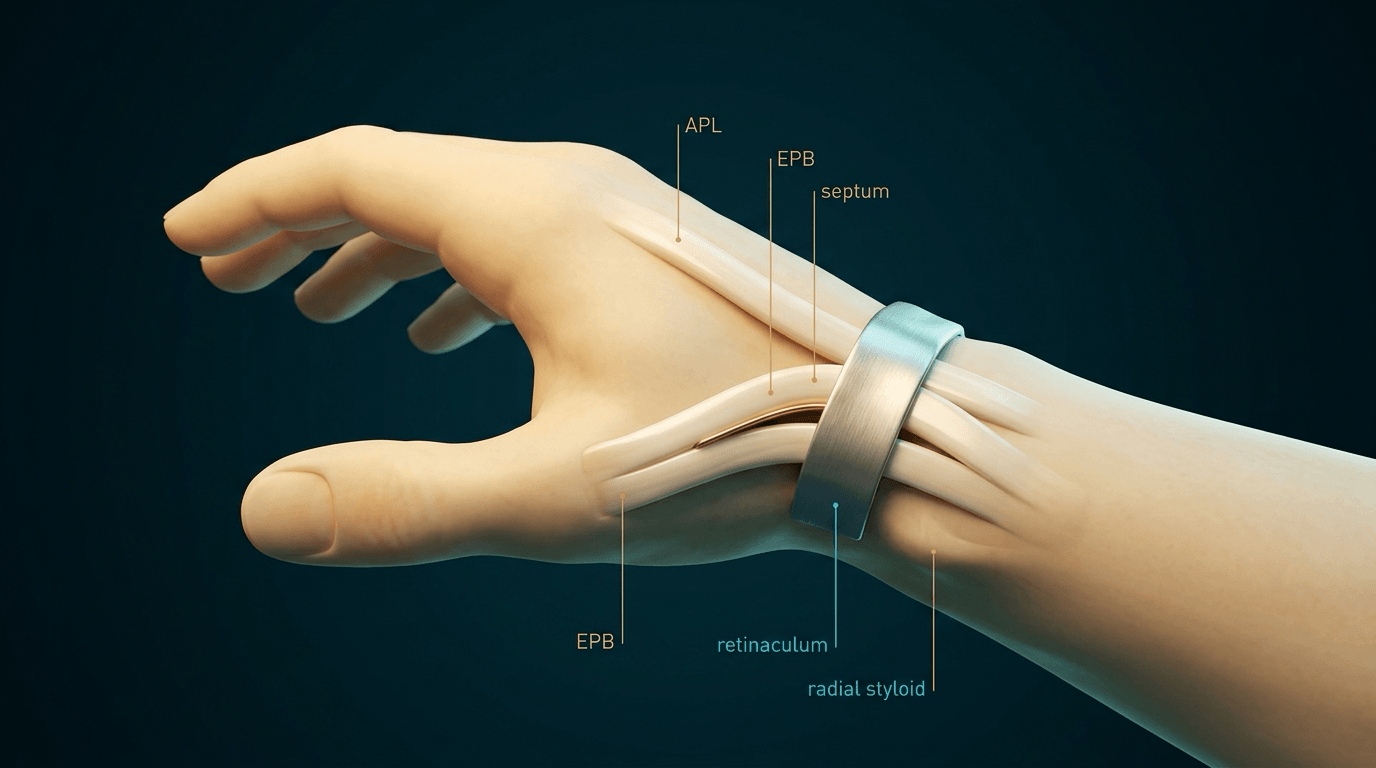
The septum. The figure everyone quotes is a separate EPB subcompartment in 30-50%, but be precise about which septum you mean. In 87 cadaveric wrists a complete intracompartmental septum was present in 17.2% and an incomplete one in a further 42.5%: roughly 60% had some septation, while only about one in six had the fully separate EPB tunnel that defeats a single release, and a single blind injection with it.
The superficial radial nerve. The same cadaveric series found the nerve crossing over the compartment in 59.5% of wrists, which is why its branches are the structure at risk in this small operative field. Injury to it produces a neuroma or numbness over the dorsal thumb web, Wartenberg's syndrome; handle the nerve gently if it is encountered and protect it throughout.
Classification Systems
Clinical staging maps the symptoms onto the treatment ladder.
- Description
- Intermittent pain with activity
- Management
- Splinting, activity modification
- Description
- Constant pain, positive Finkelstein
- Management
- Corticosteroid injection
- Description
- Failed injection, chronic symptoms
- Management
- Surgical release
Clinical Assessment
History. Radial wrist pain, worse with thumb use and gripping, with swelling over the radial styloid, in a new parent or someone whose work is repetitive. Ask specifically about repetitive thumb and wrist activities.
Examination. Tenderness over the first dorsal compartment is the finding that matters. Swelling may be visible, with crepitus on movement. The provocative test is the one most clinicians call Finkelstein.
Finkelstein and Eichhoff. The test most clinicians perform and call "Finkelstein" is technically the Eichhoff manoeuvre: the patient makes a fist over a flexed thumb and the examiner ulnar-deviates the wrist. The true Finkelstein test has the examiner grasp the thumb and pull longitudinally while ulnar-deviating the wrist. Both stretch APL and EPB over the radial styloid, and reproduction of radial wrist pain is positive.
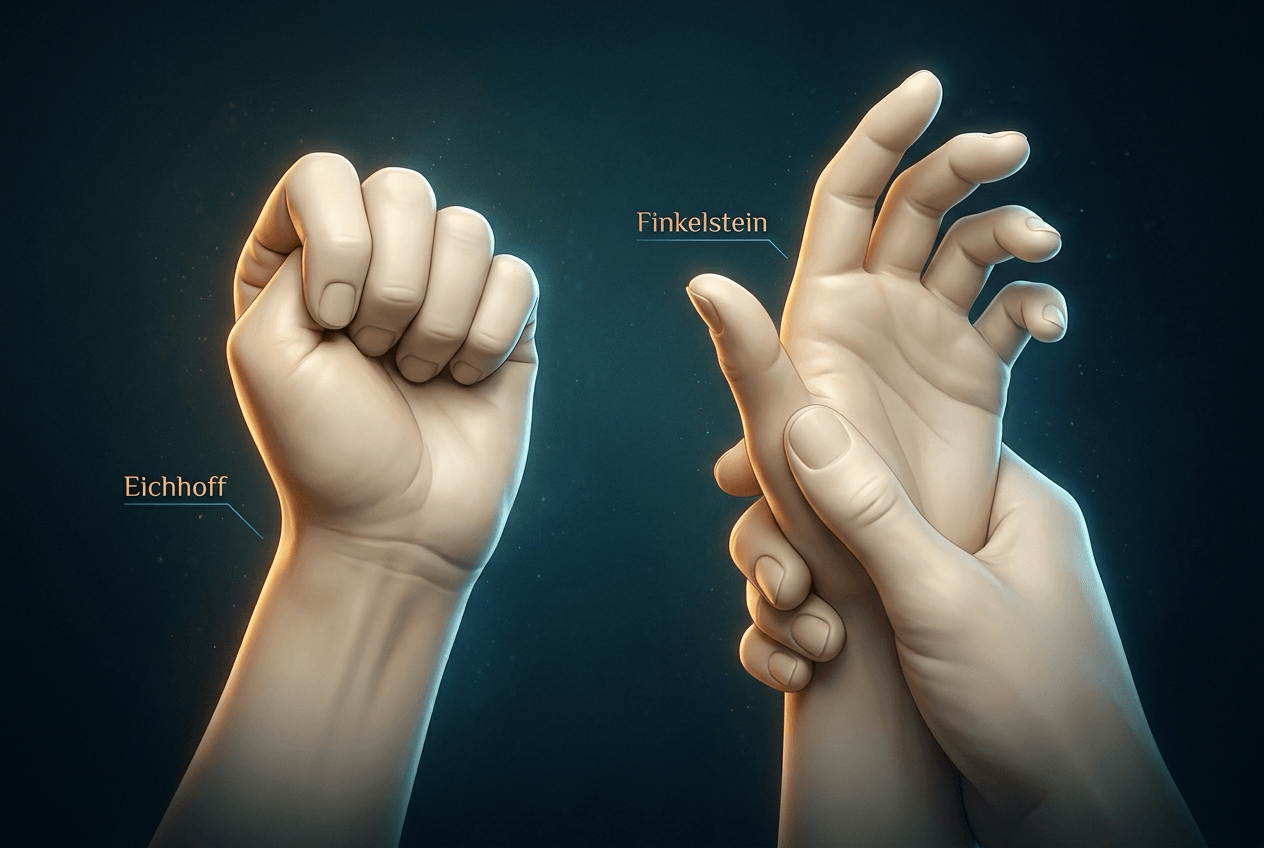
Not pathognomonic. In a cross-sectional study of 508 university students, 36.8% had a positive Finkelstein test, rising from 12.5% in those using devices under two hours a day to 46.2% at eight hours or more. A sign present in over a third of a general young population cannot be pathognomonic of anything. The Eichhoff version is explicitly prone to false positives, because forcing the thumb into the palm and levering the wrist stresses structures beyond the first compartment.
How to use it. Treat a positive test as supportive in the right clinical context, meaning focal tenderness over the radial styloid and the first dorsal compartment. It does not distinguish APL from EPB, nor de Quervain from intersection syndrome or first CMC arthritis. The WHAT test (resisted thumb extension/abduction with the wrist in hyperflexion) has been proposed as more specific.
Investigations
A clinical diagnosis. Imaging is usually not required. A positive Finkelstein with radial styloid tenderness is sufficient, and imaging is rarely needed unless the diagnosis is uncertain.
Radiographs. Rule out osteoarthritis or other bony pathology.
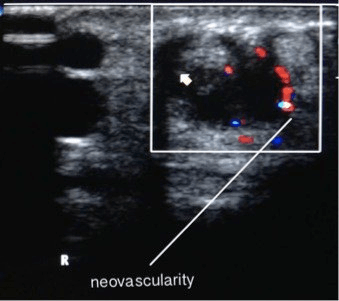
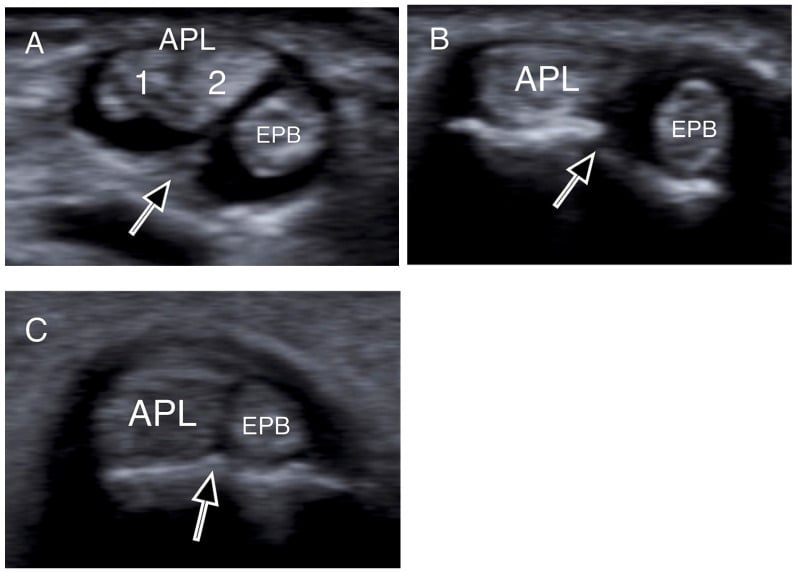
Ultrasound. Shows tendon thickening and a separate EPB compartment where one exists, and power Doppler may show neovascularity; it helps identify anatomical variants. Hyperaemia supports active tenosynovitis when the diagnosis is not purely clinical, but does not by itself prove a septum.
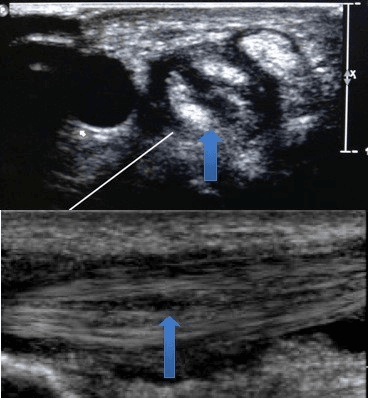
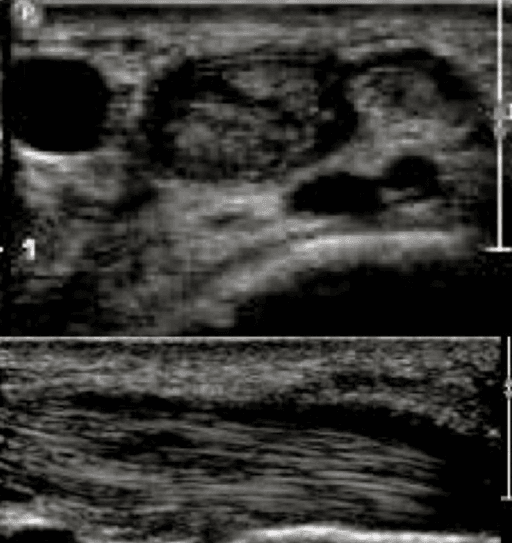
The split tendon. Structural tendon injury can present as de Quervain. The figures below are from a kettlebell case with a split EPB: inject into a split at your peril, which is the argument for ultrasound before steroid, and ultrasound is also how healing is documented when you have chosen not to inject.
Differential Diagnosis
Radial-sided wrist pain has several owners, and the discriminator is where exactly it hurts. Pain at the radial styloid supports first-compartment disease; pain at the thumb base is CMC arthritis until a grind test says otherwise.
- Distinguishing features
- Pain/tenderness over radial styloid, swelling of first dorsal compartment
- Discriminating test
- Finkelstein / Eichhoff positive; WHAT (wrist hyperflexion and abduction of thumb) test
- Distinguishing features
- Pain at base of thumb, more distal and volar; squaring of thumb base
- Discriminating test
- Grind test positive; radiographs show CMC joint OA
- Distinguishing features
- Pain and crepitus roughly 4 cm proximal to wrist where second compartment crosses first
- Discriminating test
- Tenderness proximal to the radial styloid, not over it
- Distinguishing features
- Dorsoradial numbness/paraesthesia, no true tendon swelling
- Discriminating test
- Positive Tinel over the nerve; sensory not tendon-stretch pain
- Distinguishing features
- History of trauma, anatomic snuffbox tenderness
- Discriminating test
- Snuffbox tenderness, axial thumb load pain; radiographs/MRI
- Distinguishing features
- Pain at the STT joint, just distal to scaphoid
- Discriminating test
- Localised STT tenderness; radiographs
Clinically Predicting a Separate EPB Compartment
Because a separate EPB sub-compartment is the dominant cause of injection and surgical failure, it is worth trying to detect it before treatment rather than only on ultrasound or at operation. Finkelstein and Eichhoff cannot do this, because they stress both tendons at once; selective provocative testing can.
- What it isolates
- Stresses APL and EPB together (passive ulnar deviation, thumb in palm)
- Interpretation
- Confirms first-compartment disease but does not localise to one tendon
- What it isolates
- Resisted thumb MCP extension with the wrist slightly flexed - isolates EPB
- Interpretation
- Pain reproduced suggests EPB involvement in a separate sub-compartment
- What it isolates
- Isolates APL
- Interpretation
- Pain mainly here points to APL-dominant disease
What a positive EPB test changes. Pain on resisted thumb MCP extension with the wrist slightly flexed raises the probability of a septated compartment, which predicts failure of a single blind injection. It is therefore a reason either to inject under ultrasound guidance into both sub-compartments or to counsel the patient earlier about surgical release.
Management
The sequence. Conservative treatment comes first and is effective in the majority of cases. A thumb spica splint rests the first dorsal compartment, and activity modification means avoiding the aggravating activities, with ergonomic advice. Surgery is for those who fail.
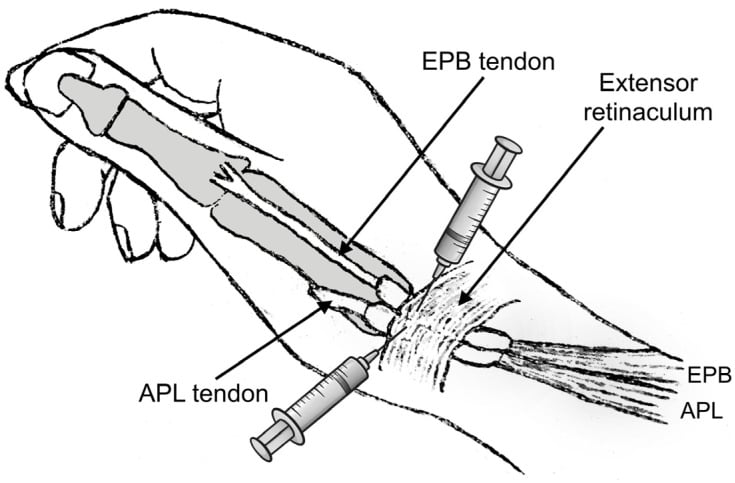
Injection. Corticosteroid into the tendon sheath, not the tendon, is the first-line treatment, ideally ultrasound-guided and followed by 3-4 weeks of thumb spica; it may be repeated once for a partial response. Guidance ranked highest for pain relief in the network meta-analysis, but blind injection remains effective and far cheaper, and the trade-off is set out under Controversies below. The conventionally quoted 70-80% success rate comes from observational cohorts rather than trial data, and it falls where an intracompartmental septum is present: in an ultrasound cohort 30% had recurred by six weeks, the septum carrying an adjusted OR of 18.4 and each additional tendon slip an OR of 24.7.
When ultrasound shows a septum. Do not put the whole dose in one tunnel. Split the injectate, half along APL and half along EPB, starting at the point of maximum tenderness; a single blind shot into the APL subsheath is a common reason the 70-80% figure collapses.
Surgery. First dorsal compartment release is the definitive treatment for refractory cases. The indications:
- Failed conservative treatment (two injection trials)
- Recurrent symptoms
- Patient preference
Surgical Technique
Incision. Transverse or longitudinal over the first dorsal compartment.
The steps. Six, in this order:
- Protect the superficial radial nerve branches
- Identify the first dorsal compartment
- Release the retinaculum longitudinally
- Check for a separate EPB septum
- Release the EPB compartment if present
- Confirm both APL and EPB glide freely
Always look for a separate EPB compartment. If only the APL compartment is released, EPB remains stenosed and symptoms persist: the most common cause of failed surgery.
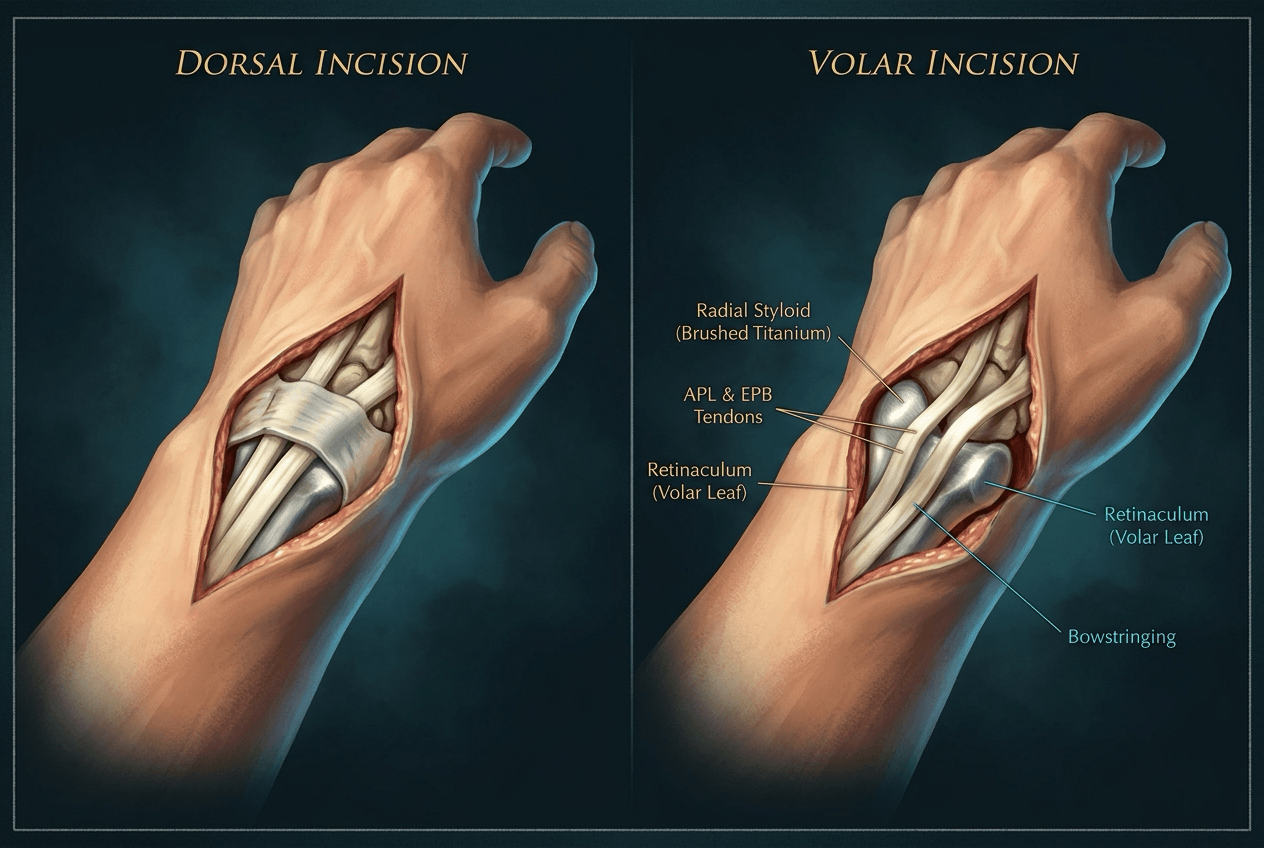
Where to divide the retinaculum. A specific pitfall of the release is volar (palmar) subluxation of the tendons: if the retinaculum is divided in the wrong place, APL and EPB can bowstring across the radial styloid when the wrist flexes, causing painful snapping. The preventive principle is where you incise:
- Divide the retinaculum along its dorsal (dorso-ulnar) margin, not its volar edge, leaving the bulk of it as a volar leaf against which the tendons rest, so they cannot fall palmar-ward
- Avoid a complete circumferential release; some surgeons additionally preserve or reconstruct a retinacular sling (a step-cut or Z-lengthening, for example) in patients judged at higher risk of subluxation
- After release, take the wrist through flexion-extension and radial-ulnar deviation to confirm both tendons stay seated and glide freely
Complications
- Incidence
- 5-10%
- Prevention/Management
- Careful dissection and protection
- Incidence
- 5-10%
- Prevention/Management
- Check for EPB septum
- Incidence
- Rare
- Prevention/Management
- Divide the retinaculum along its dorsal margin, leaving a volar leaf
- Incidence
- Variable
- Prevention/Management
- Proper incision placement
Postoperative Care
Recovery Timeline
Soft dressing. Gentle ROM immediately. Avoid forceful gripping.
Remove sutures. Progressive thumb use. Return to light duties.
Full activity as tolerated. Complete recovery expected.
Outcomes and Prognosis
Outcomes are better with a shorter symptom duration, a successful response to injection and a complete surgical release. They are worse with a missed EPB septum at surgery, with nerve injury, and with delayed treatment.
Guidelines, Registries & Global Practice
- Overall population prevalence is roughly 0.5 to 1.3 percent, with a female-to-male ratio of about 4 to 6 to 1 and a peak in the fourth to sixth decades.
- High-risk groups consistently identified across studies: postpartum and lactating women, occupational repetitive thumb/wrist users, and a newer cohort of high-intensity smartphone and digital-device users.
- Reported prevalence in infant caregivers reached 26.8 percent in one cross-sectional study, and a positive Finkelstein test was found in 36.8 percent of heavy device users among university students - far higher than the general population, underlining the role of repetitive loading.
No single orthopaedic society publishes a dedicated, named de Quervain guideline, so practice is anchored by high-level synthesis rather than a formal guideline document.
- Position
- Corticosteroid injection (ideally ultrasound-guided) plus 3-4 weeks thumb spica
- Notes
- Strongest current evidence base; 30 trials, 1663 patients
- Position
- Stepwise: splint and activity modification, then injection, then release
- Notes
- Emphasis on counselling re repeat injection and surgical anatomy
- Position
- Conservative first; injection in primary or secondary care; release if refractory
- Notes
- Pragmatic, primary-care-led injection pathways common in the NHS
- Position
- Conservative-first, surgery reserved for failed injection
- Notes
- Consistent with above; mini-open release widely taught
De Quervain release is a soft-tissue decompression and is not captured by joint-replacement registries (NJR, AJRR, AOANJRR). Outcome data therefore come from RCTs, systematic reviews and institutional series rather than national implant registries.
- In well-resourced settings ultrasound-guided injection is increasingly standard, improving accuracy and allowing both subcompartments to be targeted when a septum is seen.
- In limited-resource settings landmark-guided (blind) injection remains the norm and is effective; the diagnosis is clinical (Finkelstein test) so no imaging is required to start treatment.
- Surgical release is a low-cost, high-yield day-case procedure under local or regional anaesthesia, making it feasible across resource levels.
Know the Finkelstein test technique, the injection approach (sheath not tendon), and the importance of the separate EPB septum. Be able to describe surgical release with superficial radial nerve protection, and cite that injection plus short thumb-spica immobilisation is the best-supported first-line strategy.
Controversies and Areas of Uncertainty
Ultrasound-guided versus landmark injection. The 2023 network meta-analysis ranked ultrasound-guided injection highest for pain. However, blind injection remains effective and far cheaper, and no adequately powered head-to-head RCT has shown a clinically meaningful functional difference. It is reasonable to reserve guidance for a failed blind injection or a known septum.
Role and timing of splinting. Adding 3-4 weeks of thumb spica to injection improves function statistically, but the difference may not reach a clinically important threshold, and splints are poorly tolerated by caregivers. The optimal duration, and whether splinting alone has any durable role, remain unsettled.
Open versus minimally invasive release. Mini-open, percutaneous and ultrasound-guided releases report fewer wound issues, but the evidence is largely low-level (case series). Open release with direct visualisation of any EPB septum and protection of the superficial radial nerve remains the reference standard.
The injection success figure. Commonly quoted single-injection cure rates of 70 to 80 percent derive from observational and mixed cohorts; the only included trial in the Cochrane review was tiny and confined to pregnant or lactating women. True durable single-injection success is likely lower when a septum is present.
MCQ Practice Points
Q: What tendons are in the first dorsal compartment? A: APL (abductor pollicis longus) and EPB (extensor pollicis brevis).
Q: What is the Finkelstein test? A: Fist over thumb, ulnar deviate wrist. Positive when this reproduces radial wrist pain.
Q: What is the most common cause of failed surgical release? A: Missed separate EPB septum. Present in 30-50%; both compartments must be released.
Q: What is the success rate of corticosteroid injection for de Quervain? A: 70-80% is the conventionally quoted figure, and it is worth knowing where it comes from before you quote it. It derives from observational and mixed cohorts, not from high-level evidence: the Cochrane review found only one eligible trial, of 18 pregnant or lactating women. What the better evidence supports is the strategy rather than the number - the 2023 network meta-analysis of 30 trials and 1663 patients ranks ultrasound-guided injection plus 3-4 weeks of thumb spica as the best first-line option. And the figure is not uniform: where ultrasound shows an intracompartmental septum or multiple tendon slips, 30% had recurred by six weeks. So: quote 70-80% as conventional, say it is anatomy-dependent, and name the septum as the reason it fails. May be repeated once if partial response.
Q: What nerve is at risk during de Quervain release? A: Superficial radial nerve. Branches cross the surgical field. Injury causes numbness over dorsal thumb web or painful neuroma.
Additional Quiz Questions
Exam Viva Scenarios
Practise clinical reasoning and management decisions out loud
“A 32-year-old new mother has 2 months of radial wrist pain. It is worse when lifting her baby. Finkelstein test is positive. There is tenderness over the radial styloid. What is your diagnosis and management?”
“A 45-year-old woman had surgical release for de Quervain 6 weeks ago but her symptoms have not improved. The wound healed well. Finkelstein test remains positive. What is the most likely cause and how would you manage?”
“You are about to perform a corticosteroid injection for de Quervain tenosynovitis. Describe your technique and what complications you would warn the patient about.”
Anatomy
- First dorsal compartment
- APL and EPB
- Over radial styloid
- Separate EPB septum 30-50%
Clinical
- Radial wrist pain
- New mothers classic
- Finkelstein test positive
- Tender over radial styloid
Conservative Treatment
- Injection: 70-80% conventional, anatomy-dependent
- Thumb spica splint
- Activity modification
- May repeat injection once
Surgery
- Release first dorsal compartment
- Check for EPB septum
- Protect superficial radial nerve
- Confirm both tendons glide
Complications
- Superficial radial nerve injury
- Missed EPB septum (failure)
- Tendon subluxation (rare)
- Scar sensitivity
- Recurrence: usually missed septum
Key Points
- Finkelstein/Eichhoff is supportive, not pathognomonic
- Injection first-line
- EPB septum is key at surgery
- 90%+ success with proper release
- New mothers: postpartum hormones
Evidence Base and Key Studies
Challoumas et al. - Network Meta-Analysis (landmark)
- 30 randomised trials, 1663 patients (mean age 46 years, 80% female)
- Adding 3-4 weeks of thumb spica immobilisation to corticosteroid injection (CSI) gave statistically (not clinically) significant short- and mid-term functional benefit (Q-DASH mid-term mean difference 9.4 points)
- Ultrasound-guided CSI ranked highest for pain relief in the network analysis
- CSI plus thumb spica had the highest probability of being the most effective option for short- and mid-term function
Peters-Veluthamaningal et al. - Cochrane Review
- Only one small controlled trial met inclusion criteria (18 pregnant or lactating women)
- All patients given methylprednisolone plus bupivacaine injection achieved complete pain relief (9/9) versus none with thumb spica splinting alone (0/9), number needed to treat = 1
- No injection side effects or local complications observed
- Authors stressed limited applicability owing to the single small, methodologically weak trial
Huisstede et al. - Best-Evidence Systematic Review
- Reviewed 15 randomised controlled trials in de Quervain disease (plus trigger finger and Dupuytren)
- Moderate evidence for very-short-term benefit of corticosteroid injection
- A thumb splint added to corticosteroid injection was effective at short and mid term (moderate evidence)
- Called for more high-quality RCTs to support evidence-based practice
Pasiphol et al. - Cadaveric Anatomy of the First Extensor Compartment
- 87 embalmed cadaveric wrists dissected (Thai population)
- Complete intracompartmental septum in 17.2% and incomplete septum in 42.5% (roughly 60% had some septation)
- Superficial radial nerve crossed over the first extensor compartment in 59.5% of specimens
- Two APL tendon slips were most common (54%); a single EPB slip in 97.7%, with EPB absent bilaterally in one cadaver
Kitridis et al. - Anatomical Predictors of Injection Success
- 50 consecutive patients given a single ultrasound-assessed corticosteroid injection
- Symptom recurrence in 15 patients (30%) within six weeks
- An intracompartmental septum (adjusted OR 18.4) and a greater number of tendon slips (adjusted OR 24.7 per slip) independently predicted recurrence
- Mean DASH improved from 74.1 to 19.3 and VAS pain from 8.5 to 2.0
Jamil et al. - Digital Device Use and Incidence
- Cross-sectional study of 508 university students
- 36.8% had a positive Finkelstein test, 95.6% in the dominant hand
- Positivity rose with screen time, from 12.5% at under 2 hours/day to 46.2% at 8 hours/day or more
- Wrist ulnar deviation during device use was strongly associated with a positive test
Manzoor et al. - Prevalence in Infant Caregivers
- Cross-sectional study of 190 infant caregivers screened with Finkelstein test
- 26.8% prevalence of de Quervain disease
- Infant age, lifting frequency and hand dominance were significant risk factors
- Caregiver age, infant weight and relationship to the infant were not significant