Most Common Fracture | Volar Plate | Restore Alignment | Watch for Instability
- Normal radiographic parameters: Volar tilt 11-15°, radial inclination 22°, radial length 11-12mm
- Instability criteria: Over 20° dorsal tilt, over 5mm shortening, intra-articular involvement
- Volar locking plate is gold standard for unstable fractures
- Median nerve at risk - monitor for acute carpal tunnel
- EPL rupture late complication - avoid prominent dorsal hardware
- “DRUJ stability crucial - assess after fracture fixation
- “Volar Barton = shear fracture, needs buttress plate
- “Die-punch = lunate facet, associated with DRUJ injury
- “Elderly osteoporotic - consider augmentation techniques
Overview and Epidemiology
The distal radius is the most common fracture treated by orthopaedic surgeons, over 640,000 a year in the USA, and the number is rising as the population ages.
Who. The age distribution is bimodal. Young adults fracture through high-energy trauma, sport and motor vehicle accidents; those over 50 fracture through low-energy falls onto osteoporotic bone, and the peak incidence is in women aged 60-69.
Risk factors. Osteoporosis is the major patient factor. The rest are worth knowing because the modifiable ones should be addressed to prevent the next fracture.
- Patient: female sex, previous fracture, low BMI, vitamin D deficiency
- Environmental: icy conditions, poor lighting, trip hazards, sporting activity
Mechanism. The position of the wrist at impact sets the pattern, and the pattern sets the treatment.
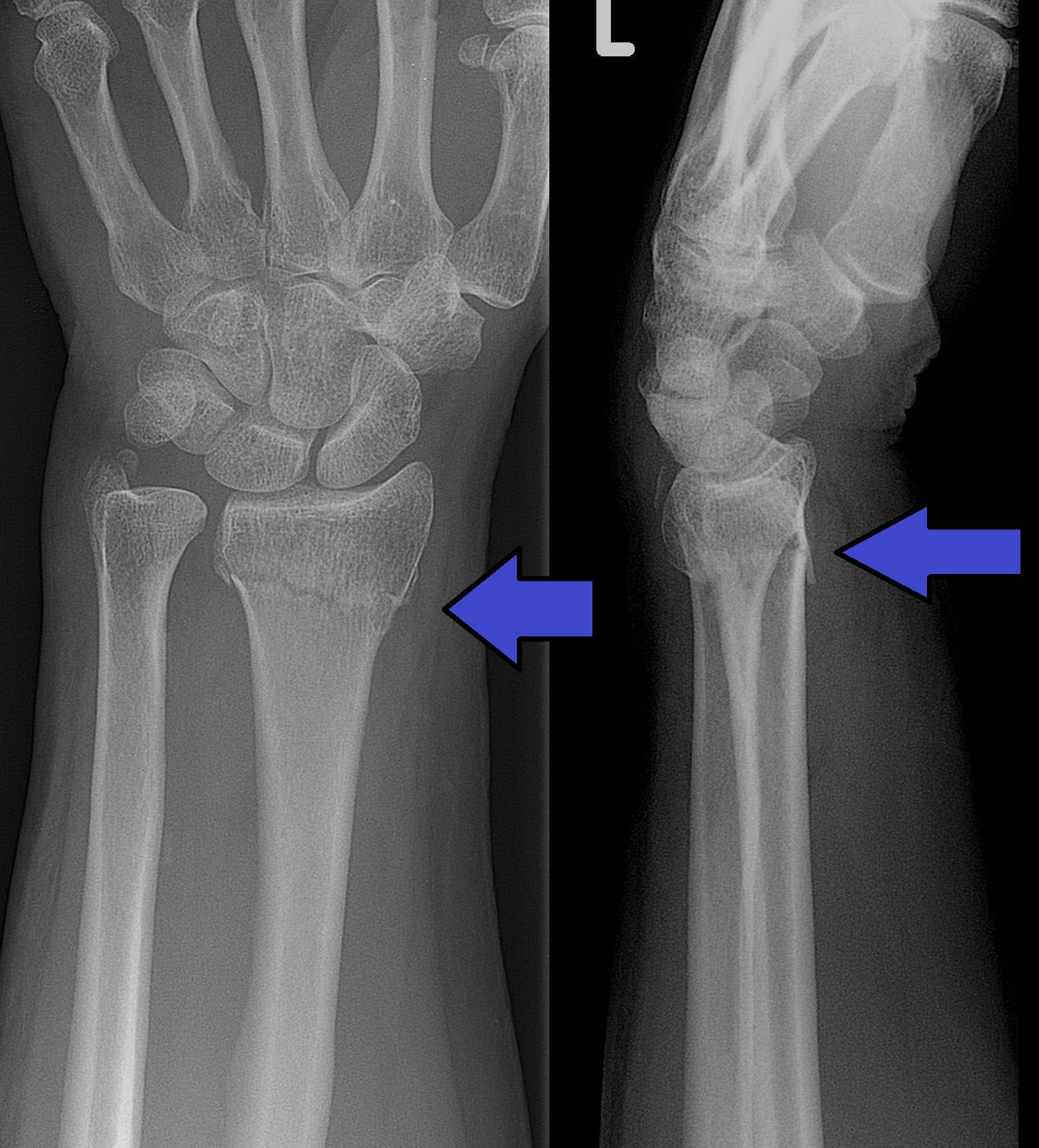
- Colles, the most common: a fall on the outstretched hand with the wrist in dorsiflexion, producing dorsal angulation
- Smith: a fall with the wrist in flexion, or a direct blow to the dorsum, producing volar angulation
- Barton: a shear mechanism producing a rim fracture, volar or dorsal lip, with the carpus subluxing along with the rim
Anatomy
The bone. The distal radius carries two articular surfaces for the carpus, the scaphoid fossa and the lunate fossa, and a third, the sigmoid notch, for the ulnar head at the distal radioulnar joint (DRUJ). The radial styloid is its most radial projection, and Lister's tubercle is the dorsal prominence around which extensor pollicis longus (EPL) turns. Both the radiocarpal joint and the DRUJ must be addressed in treatment, because anatomic restoration of these articulations is essential for optimal function.
What lies on it. The soft tissues that matter sit on either face of the bone.
- Volar: pronator quadratus, the flexor tendons, the median nerve in the carpal tunnel and the radial artery
- Dorsal: the six extensor compartments, EPL around Lister's tubercle and the terminal branch of the posterior interosseous nerve
The TFCC. The triangular fibrocartilage complex stabilises the DRUJ and may be injured with a distal radius fracture, so its integrity is assessed whenever the DRUJ is unstable.
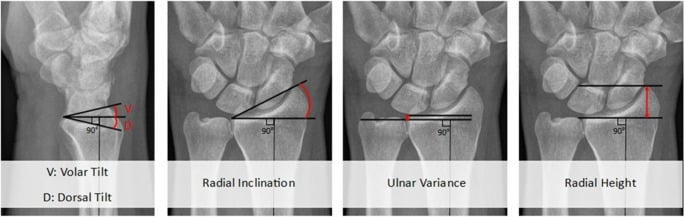
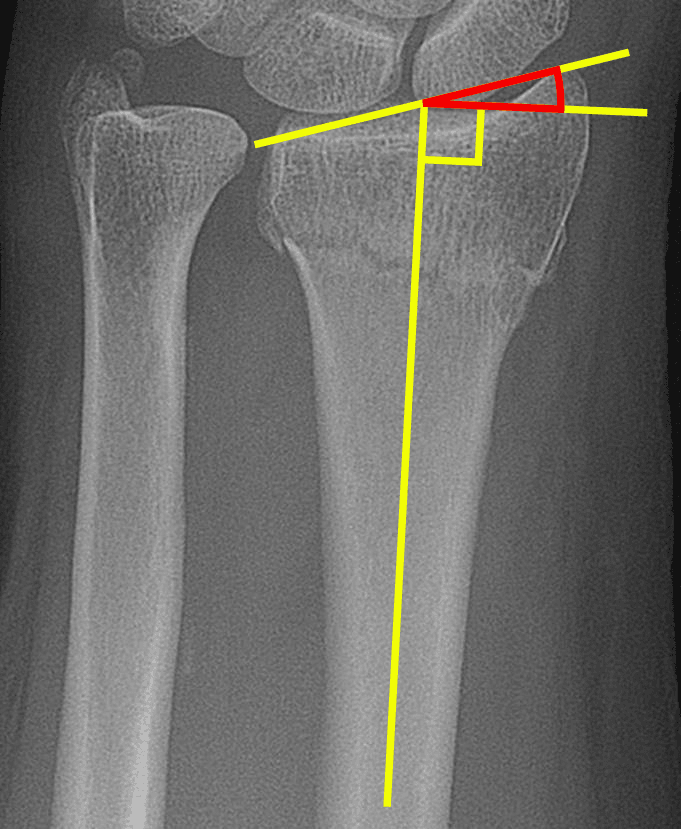
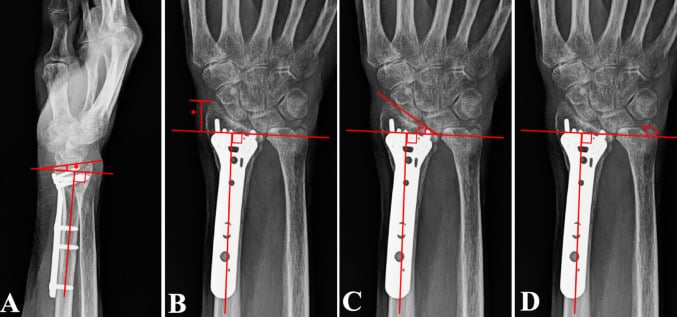
Radiographic anatomy. A set of measurements describes the distal radius, and displacement is described as the loss of them.
- Normal Value
- 11-15°
- Significance
- Loss indicates dorsal displacement
- Normal Value
- 22° (15-25°)
- Significance
- Loss indicates impaction/shortening
- Normal Value
- 11-12mm
- Significance
- Shortening affects DRUJ
- Normal Value
- Neutral (0 ± 2mm)
- Significance
- Positive variance = ulnar impaction risk
- Normal Value
- Under 2mm
- Significance
- Over 2mm = increased OA risk
Classification
The three common systems answer different questions. The eponyms describe the deformity, AO/OTA describes articular involvement and comminution, and Frykman counts the joints involved and the ulnar styloid.
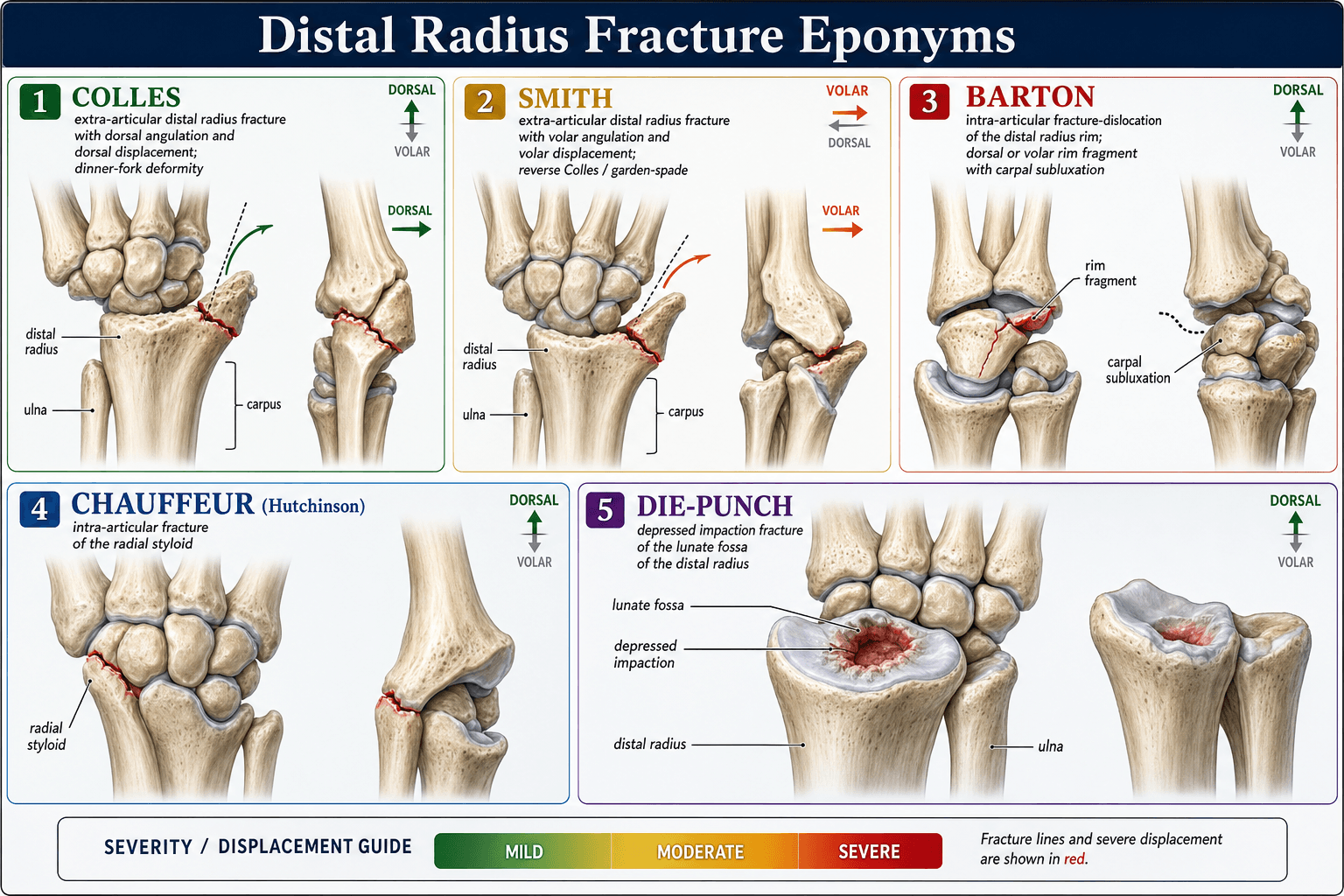
The eponyms are shorthand for the direction of displacement and whether the joint is involved; Barton and chauffeur's are the shear patterns. The decision table in Management is organised by them.
- Description
- Dorsal angulation, extra-articular
- Key Feature
- Dinner fork deformity
- Description
- Volar angulation (reverse Colles)
- Key Feature
- Garden spade deformity
- Description
- Volar lip with carpal subluxation
- Key Feature
- Shear mechanism
- Description
- Dorsal lip with carpal subluxation
- Key Feature
- Less common
- Description
- Radial styloid fracture
- Key Feature
- Intra-articular, ligament avulsion
- Description
- Lunate facet depression
- Key Feature
- Associated DRUJ injury
Clinical Presentation and Assessment
History. A fall on the outstretched hand (FOOSH) is the classic mechanism; ask whether the energy was high or low and whether the hand struck in extension or flexion, since that predicts the pattern. The patient reports pain and swelling, a dinner fork deformity, numbness in the median nerve distribution or weakness. Age, hand dominance, occupation and hobbies, functional demands and any history of osteoporosis strongly influence the treatment decision, so they belong in the first conversation.
Inspection and palpation. Look for the deformity, a dorsal dinner fork or a volar garden spade, the extent of swelling, ecchymosis and the integrity of the skin, because an open fracture changes the timetable. Palpate the fracture site, the carpal bones and the scaphoid especially, the DRUJ, where tenderness means injury, and the ulnar styloid.
Neurovascular examination. Test the median nerve (thenar sensation, thumb opposition), the ulnar nerve (small finger sensation, the interossei), the radial artery pulse and capillary refill. Document all of it before and after any reduction attempt.
- Open fracture - requires urgent debridement
- Acute carpal tunnel - may need emergent release
- Vascular compromise - rare but devastating
- Compartment syndrome - forearm compartments at risk
- Severe deformity - may need urgent reduction
Differential diagnosis. A painful, swollen wrist after a fall is not always a distal radius fracture, and the mimics change management.
- Key Distinguishing Feature
- Anatomical snuffbox and scaphoid tubercle tenderness; may be radiographically occult
- Why It Matters
- Missed fracture risks non-union and AVN; needs dedicated views or MRI
- Key Distinguishing Feature
- Disrupted carpal arcs and 'spilled teacup' on lateral; high-energy mechanism
- Why It Matters
- Surgical emergency; commonly missed on initial films
- Key Distinguishing Feature
- Salter-Harris pattern at the open physis
- Why It Matters
- Growth-arrest risk; different management from the adult fracture
- Key Distinguishing Feature
- Radial shaft fracture with DRUJ disruption
- Why It Matters
- DRUJ must be addressed; not an isolated wrist injury
- Key Distinguishing Feature
- Ulnar-sided pain, DRUJ instability, normal radius
- Why It Matters
- Stability and TFCC, not bone, drive treatment
- Key Distinguishing Feature
- No fracture line, focal soft-tissue tenderness
- Why It Matters
- Diagnosis of exclusion after occult fracture ruled out
Investigations
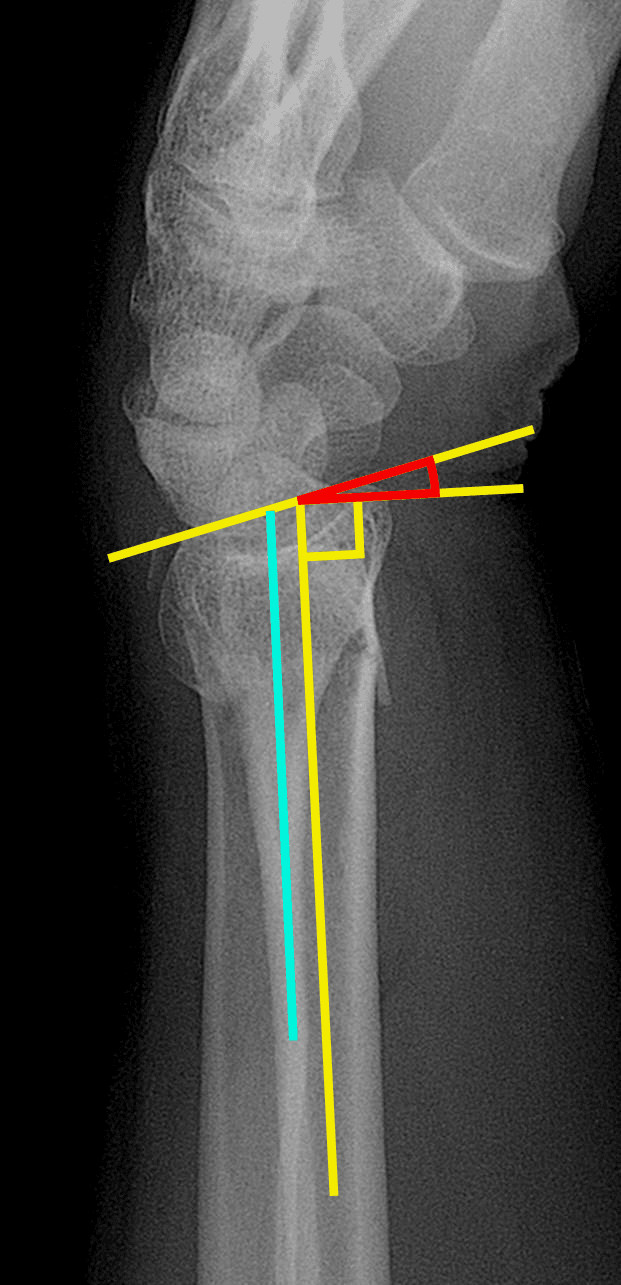
Radiographs. A PA and a true lateral of the wrist, with oblique views if needed, are sufficient for most treatment decisions. Each view answers a different question, so measure systematically:
- Volar tilt on the lateral
- Radial inclination on the PA
- Radial length and ulnar variance on the PA
- Articular step-off
- DRUJ congruity
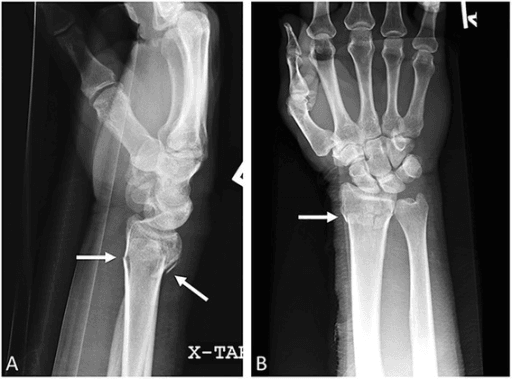
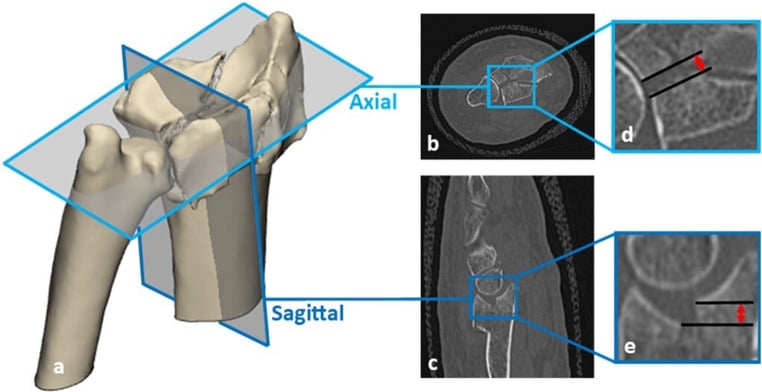
CT. Order it for the complex intra-articular fracture, for die-punch assessment, for pre-operative planning of a comminuted fracture and to assess the articular fragments. It provides the fragment number and size, quantifies the articular step, identifies a central depression and shows sigmoid notch involvement, which is why it is particularly useful for surgical planning in complex cases.
MRI is rarely needed acutely. It is the test for the TFCC, the scapholunate ligament and the occult scaphoid fracture.
Before surgery, request bone density if osteoporosis is a concern, and blood tests as the anaesthetist requires.
Management
The decision. Three things decide it: whether the fracture is stable, whether the alignment after reduction is acceptable, and who the patient is. A stable, well-aligned fracture goes in a cast; an unstable or malaligned one is discussed for fixation; and in an older patient the millimetres count for less than the demand placed on the wrist.
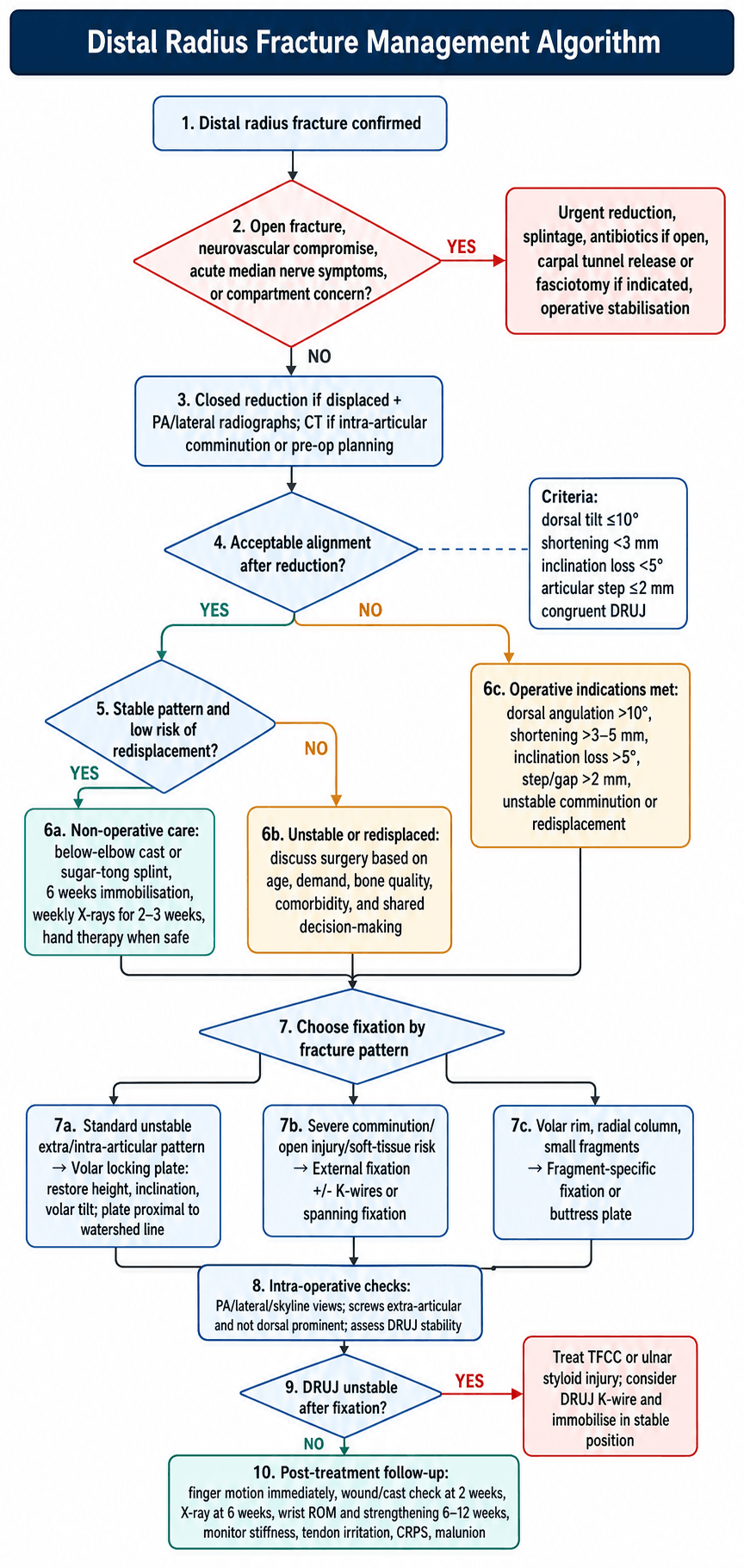
Acceptable alignment after reduction. These are the criteria a closed reduction must meet for cast treatment to continue:
- Volar tilt loss under 10° (slight dorsal tilt is acceptable)
- Radial shortening under 3mm
- Radial inclination loss under 5°
- No articular step over 2mm
- Congruent DRUJ
The named, examinable rule for predicting that a fracture will redisplace after a closed reduction is the Lafontaine classification of instability - quote it by name:
- Five Lafontaine risk factors: (1) initial dorsal angulation greater than 20 degrees; (2) dorsal metaphyseal comminution; (3) intra-articular involvement (radiocarpal); (4) associated ulnar (styloid) fracture; (5) age over 60 years.
- The rule: the presence of three or more of these factors predicts secondary displacement / loss of reduction in a cast, and should prompt closer surveillance or a lower threshold for primary surgical fixation.
- How it relates to the RADIUS mnemonic below: the in-house RADIUS list is essentially the Lafontaine factors; the exam expects the eponym - "this fracture has [X] Lafontaine criteria, so it is at high risk of redisplacement."
RADIUSInstability Criteria
Hook:RADIUS fracture instability - if any of these, consider fixation!
Two lists, two questions. The acceptance criteria describe the alignment after reduction. The Lafontaine factors are read on the initial radiograph and predict secondary displacement in a cast; three or more should prompt closer surveillance or a lower threshold for primary surgical fixation.
Non-operative treatment. It is the treatment for the stable, minimally displaced fracture with acceptable alignment, for the patient with low functional demand, and for the patient with a contraindication to surgery. Reduce under haematoma block, immobilise in a below-elbow cast or sugar-tong splint for 6 weeks, and take weekly radiographs for the first 2-3 weeks, because loss of reduction has to be caught early to be corrected.
Acceptance criteria are usually taught as if they applied to every patient. They do not, and in the age group that sustains most of these fractures the evidence points the other way.
A secondary analysis of the WRIST multicentre randomised trial in adults aged 60 years and over (DOI) examined 166 participants at 12 months (mean age 70.9, 87% women) randomised to volar locking plate, percutaneous pinning or external fixation, with those declining surgery casted. Of 84 correlation coefficients calculated between radiographic measures and functional or patient-reported outcomes, only 2 reached statistical significance — and both sat in the 70-and-over subgroup and did not carry through to Michigan Hand Outcomes Questionnaire total or function scores. The authors' conclusion is blunt: precise restoration of wrist anatomy is not associated with better patient outcomes in older adults, and surgeons should prioritise patient preference and efficient use of resources over exact realignment.
Direction: OVER-treatment. Operating on an older patient to convert 25 degrees of dorsal tilt into 5 degrees buys a better radiograph, not a demonstrably better wrist. That matters because the operation carries real risk in exactly this group.
What survives, and it is most of it. The parameters remain the language of assessment and the way instability is described; they still matter in younger and higher-demand patients, in whom this trial says nothing since it enrolled nobody under 60; and no one is arguing for accepting gross deformity, an intra-articular step in a young manual worker, or a fracture that threatens the median nerve or tendons.
What to do differently. In a patient over 60, let hand dominance, functional demand, comorbidity and stated preference outweigh millimetres, and present well-moulded cast treatment as a legitimate equal option rather than the fallback for those unfit for surgery.
When to operate. The thresholds are the acceptance criteria failed, plus the situations that are operative whatever the alignment.
- Threshold
- Over 10° (vs normal volar tilt)
- Threshold
- Over 3-5mm
- Threshold
- Over 5°
- Threshold
- Over 2mm
- Threshold
- Any
- Threshold
- Acute median symptoms
- Threshold
- Dorsal comminution, redisplacement
By pattern. The quick decision guide, pattern by pattern.
- Stable?
- Yes
- Treatment
- Cast immobilisation 6 weeks
- Stable?
- No
- Treatment
- Volar locking plate
- Stable?
- No
- Treatment
- ORIF - restore articular surface
- Stable?
- No
- Treatment
- Volar buttress plate
- Stable?
- No
- Treatment
- Volar plate (buttress mode)
- Stable?
- No
- Treatment
- ORIF, elevate fragment, check DRUJ
- Stable?
- Emergency
- Treatment
- Urgent debridement, fasciotomy, fixation
Choosing the fixation. The volar locking plate is the gold standard for the unstable fracture, and its technique has its own section below. The alternatives each have a place:
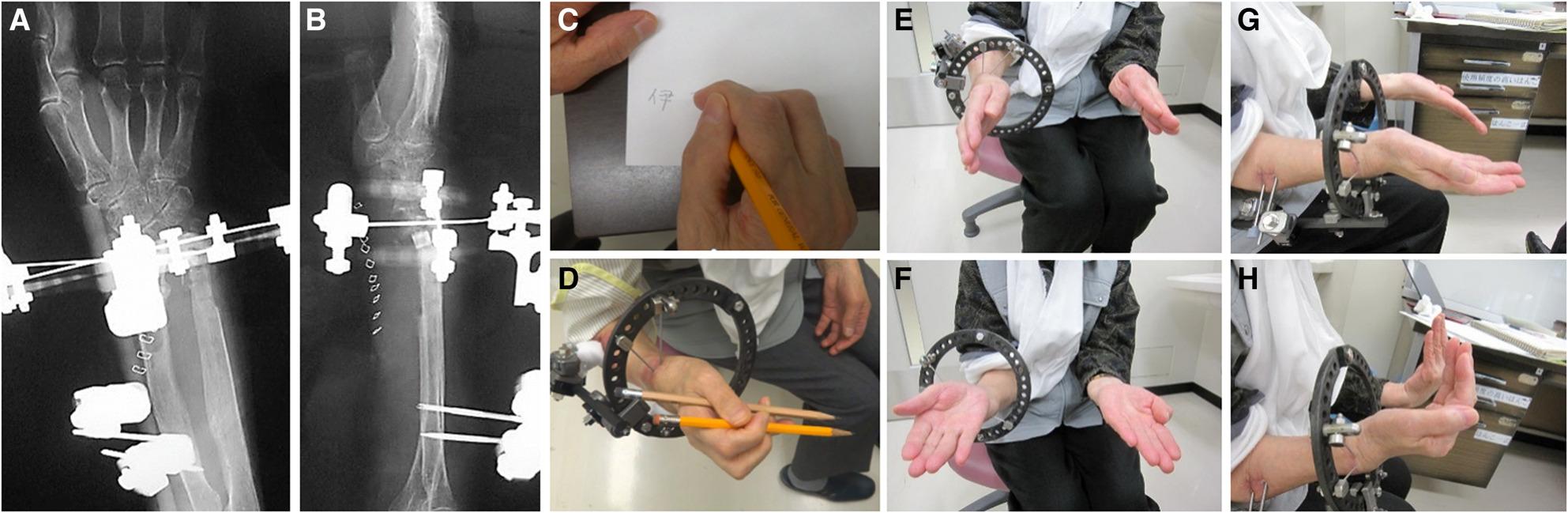
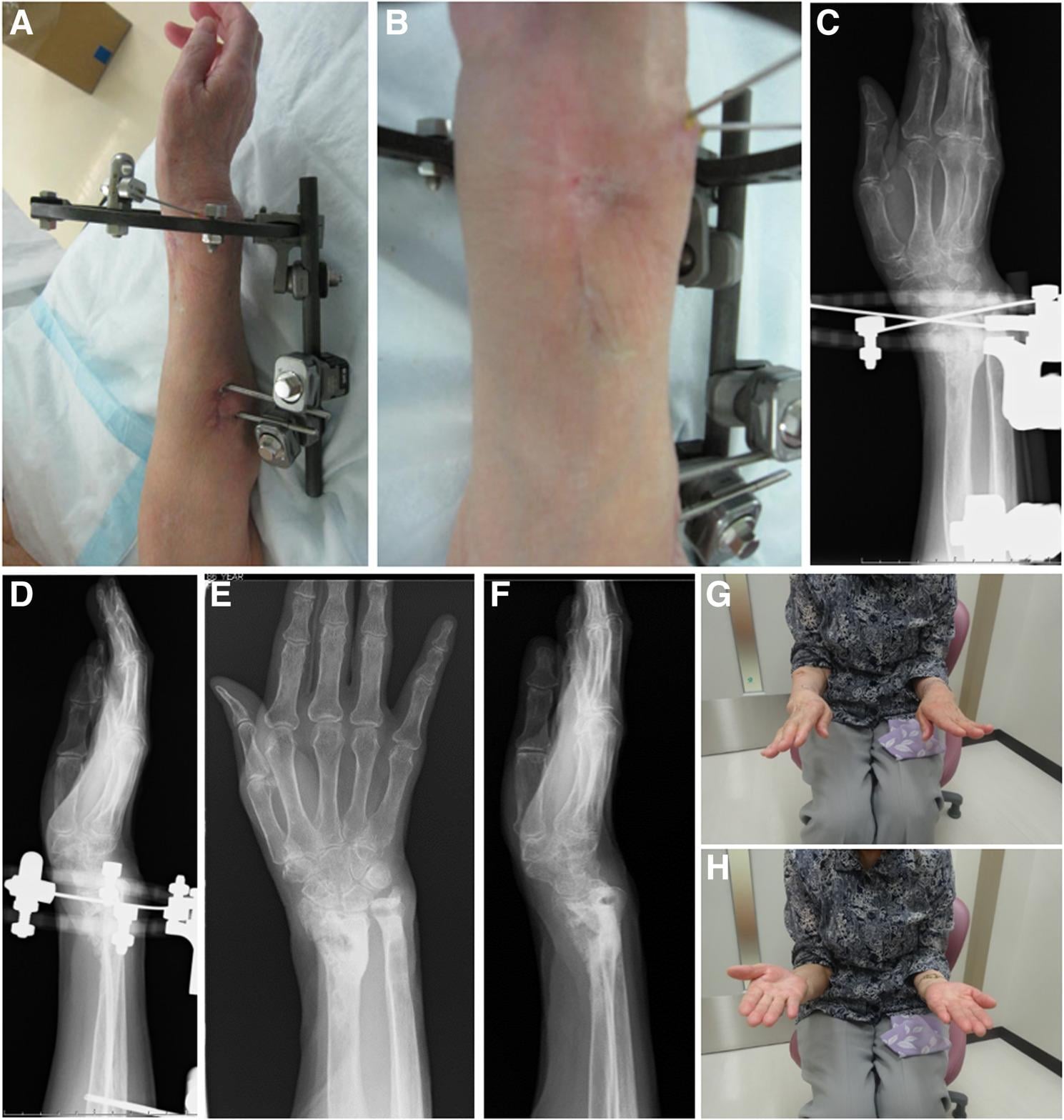
- External fixation: reduction by ligamentotaxis; for open fractures and severe comminution; bridging (wrist-spanning) or non-spanning
- Fragment-specific fixation: multiple small plates for specific fragments, a volar ulnar corner plate, a radial column plate; useful for complex patterns
- K-wires: the Kapandji intrafocal technique, supplemental fixation, and low-demand patients; the wires must be protected
What the trials add. Gold standard does not mean only option, and the evidence cards below should shape the conversation with the patient. In DRAFFT, for fractures the surgeon judged could be held by either method, K-wires matched the volar plate on PRWE at 12 months and were cheaper. In DRAFFT2, a moulded cast after manipulation matched K-wires at one year, but 13% of the cast group needed surgery for loss of position within six weeks, which is the reason for the weekly films above. In Arora's trial of patients aged 65 or older, cast matched plate on PRWE, DASH, motion and pain at 12 months despite better alignment with plating; grip strength was better with the plate, and complications were significantly more frequent. Against external fixation for unstable fractures, QuickDASH did not differ at one year, but the plate gave a higher Mayo wrist score, better supination and less radial shortening, most of all in AO type C2/C3 patterns.
Surgical Technique
The volar locking plate through the FCR approach is the operation to be able to describe from consent to closure. The flexor carpi radialis (FCR) approach gives excellent exposure while protecting the dorsal structures.
Step-by-Step Surgical Technique
Consent: Infection (1-2%), nerve injury (median at risk), tendon problems (flexor irritation, EPL if dorsal approach), CRPS (2-5%), malunion, hardware removal. Equipment: 2.4mm or 2.7mm anatomic distal radius plate, C-arm, reduction clamps, K-wires, power drill.
Supine on radiolucent table. Arm on hand table. Tourniquet on upper arm (250mmHg). C-arm from head of table or opposite side. Prep entire forearm and hand.
FCR approach: 5-6cm longitudinal incision along FCR tendon. Retract FCR ulnarly, flexor pollicis longus radially. Incise pronator quadratus in L-shape at radial border and elevate subperiosteally ulnarly to expose fracture.
Clear fracture site of hematoma. Ligamentotaxis by longitudinal traction. Reduce volar tilt: Use freer elevator or bone tamp to elevate dorsal cortex. Provisional K-wire fixation to hold reduction. Check on C-arm PA and lateral.
Position volar locking plate on volar surface. Plate must be proximal to watershed line (volar lip of radius). Insert proximal cortical screw first to attach plate. Check alignment. Insert distal locking screws - aim for subchondral bone.
Critical views: PA - screws not in joint, radial inclination restored. Lateral - volar tilt restored, screws not beyond dorsal cortex. Skyline view (20° tilted lateral) - confirm no dorsal screw prominence.
Release tourniquet before assessing DRUJ. Test stability in supination, neutral, pronation. Compare to opposite side. If unstable: consider TFCC repair, ulnar styloid fixation, or K-wire across DRUJ.
Repair pronator quadratus over plate if possible (protects flexor tendons). Absorbable deep sutures, skin closure with nylon or staples. Volar splint in neutral.
The technical points that decide the result. Complete the reduction before plating, then use the plate itself as a reduction aid to restore volar tilt. The distal screws belong in subchondral bone and not in the joint, every fluoroscopic view is checked before closing, and the DRUJ is tested once the radius is fixed. Meticulous attention to plate position and screw length is what prevents the tendon complications.
- Plate position: Must be proximal to watershed line or flexor tendons will rupture
- Screw length: Check skyline view - dorsal prominence causes EPL irritation
- Articular penetration: Tilt beam 20° proximal to see joint line
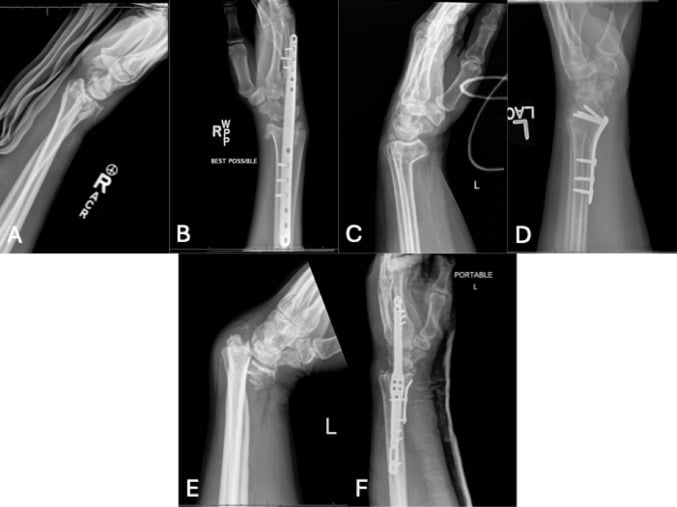
The post-operative radiograph should confirm anatomic restoration of every parameter measured on the injury film.
Assessing the DRUJ. Release the tourniquet before testing. Test stability in supination, neutral and pronation and compare the translation to the opposite side; increased translation indicates a TFCC injury. An unstable DRUJ may reflect a TFCC tear or an ulnar styloid base fracture and may need treatment of its own, so stability must be confirmed before leaving theatre:
- Consider ulnar styloid base fixation
- TFCC repair may be needed
- K-wire across the DRUJ, removed at 6 weeks
- Immobilise in supination if stable after pinning
Complications
Acute carpal tunnel syndrome. Swelling or haematoma compresses the median nerve, and it may occur at presentation or after reduction. Median nerve symptoms in a swollen, severely painful wrist need urgent attention: release the carpal tunnel if the symptoms are progressive, and consider emergent release at the time of fracture fixation.
Compartment syndrome. The forearm compartments are at risk, so monitor closely after the injury and perform fasciotomy if it is diagnosed.
Loss of reduction. Common in unstable patterns, which is why the weekly radiographs matter; a fracture that redisplaces may need operative stabilisation.
Malunion. Dorsal tilt and shortening are the common residuals and they limit function; a symptomatic malunion may need a corrective osteotomy.
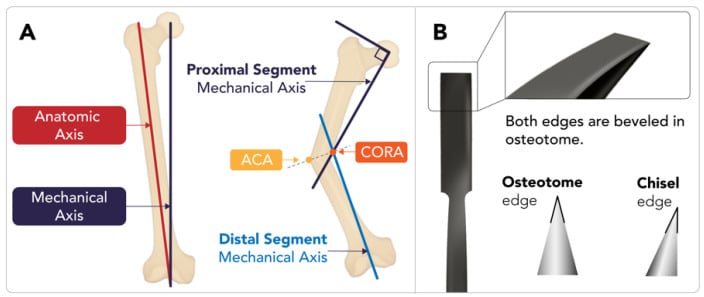
A specific, examinable late consequence of a malunited distal radius fracture is ulnar impaction (ulnocarpal abutment) syndrome - distinct from DRUJ instability:
- The mechanism: radial shortening (and loss of radial inclination) leaves the ulna relatively long - positive ulnar variance - so the ulnar head abuts and overloads the ulnar carpus (lunate and triquetrum) and the TFCC.
- The presentation: ulnar-sided wrist pain, worse with gripping and ulnar deviation/pronation; X-rays show positive ulnar variance with cystic/sclerotic change in the ulnar lunate and ulnar head; MRI shows TFCC wear and lunate oedema (the Palmer degenerative TFCC spectrum).
- The management: address the variance - a distal radius corrective osteotomy (to re-lengthen the radius) when the malunion is the driver, or an ulnar-shortening osteotomy (or arthroscopic wafer procedure) to offload the ulnocarpal joint; TFCC debridement as an adjunct.
- The prevention message: this is exactly why restoring radial length at the index operation matters - tolerating shortening to "save an operation" can convert a healed fracture into a painful ulnocarpal abutment.
EPL rupture. It presents 2-6 weeks after the injury, from irritation of the tendon at Lister's tubercle. Dorsal screw prominence causes the same irritation, so avoid prominent dorsal hardware. Treatment is an EIP-to-EPL tendon transfer.
Post-traumatic arthritis. It follows articular incongruity and is more likely with a step over 2mm; it may need wrist fusion or arthroplasty late.
CRPS. Complex regional pain syndrome presents as burning pain, swelling and colour change. Early therapy is crucial for prevention, and patient education and early mobilisation help prevent the late complications generally.
Post-traumatic stiffness. Range of motion is lost at the fingers as well as at the wrist.
Hardware. Prominent hardware damages tendons: on the volar side the flexor tendons, rarely; on the dorsal side EPL is most at risk. Intra-articular screws must be excluded on intra-operative fluoroscopy and removed and revised if present, because left alone they cause arthritis. Hardware failure is rare with modern locking plates, which have significantly reduced hardware-related complications, more common in osteoporotic bone, and may call for augmentation techniques. Modern implants have significantly reduced hardware-related complications.
Postoperative Care
The aim after a locked plate is to move early under protection. Fingers move at once; the wrist starts at 2 weeks; grip strengthening begins at 4 weeks; full range is expected by 8-12 weeks.
Rehabilitation After Volar Plate Fixation
- Volar splint in neutral, elevation and ice
- Finger range of motion exercises immediately, active finger exercises hourly
- Shoulder and elbow range of motion to prevent stiffness
- No lifting with the affected hand
- Dressing check at 2-3 days, sutures out at 10-14 days, watch for infection
- Active wrist range of motion from 2 weeks, removable splint for comfort
- Formal hand therapy referral; wound check and start of therapy at the 2-week visit
- Progressive wrist flexion and extension, supination and pronation
- Full finger range of motion
- Grip strengthening from 4 weeks
- Radiograph at 6 weeks and progress activity
- Full range of motion expected by 8-12 weeks; strengthening 6-12 weeks
- Return to work at 6-8 weeks for light work, 10-12 weeks for heavy work; sport at 3-4 months
- Final clinical assessment at 3 months
- Hardware removal rarely needed, and only if symptomatic
Most patients achieve excellent functional outcomes with structured rehabilitation, and early finger movement is what prevents stiffness.
Outcomes and Prognosis
Union is the rule with either treatment; what separates them is how reliably alignment is held and what the complications look like.
- Conservative
- 95%
- Volar Plate
- 98%
- Conservative
- Variable
- Volar Plate
- 85-90% of normal
- Conservative
- 8-12 weeks
- Volar Plate
- 6-8 weeks
- Conservative
- Higher malunion
- Volar Plate
- Hardware related
- Conservative
- Good (stable)
- Volar Plate
- Excellent
What predicts the result. The favourable fracture is extra-articular and stable, anatomically reduced, in a young patient with good bone who complies with therapy. The unfavourable one has intra-articular comminution or an articular step over 2mm, osteoporotic bone, a malunion or an associated DRUJ injury.
Guidelines, Registries & Global Practice
Global Epidemiology
The distal radius is among the most commonly fractured bones worldwide, with a bimodal age distribution: a peak in children and adolescents from sport and play, and a second osteoporotic peak in older adults (predominantly women). Population data over the past 40 years show a rising prevalence in both the paediatric and elderly groups, driven by ageing populations and activity patterns. [Nellans, Hand Clin 2012, PMID 22554654]
Major Guidelines Side by Side
- Core Recommendation
- Operative fixation suggested when post-reduction radial shortening over 3mm, dorsal tilt over 10°, or intra-articular step/gap over 2mm; rigid immobilisation if non-operative; supplemental vitamin C does not reliably prevent CRPS
- Evidence Basis
- Multiple RCTs; many recommendations limited/moderate strength
- Core Recommendation
- Manipulate displaced fractures promptly; offer surgery only if alignment unacceptable after reduction; K-wire or plate both acceptable; rehabilitation without routine formal physiotherapy for most
- Evidence Basis
- Informed by DRAFFT and DRAFFT2 RCTs
- Core Recommendation
- Classify by 2R3 (AO/OTA); reduction and stable fixation to restore articular congruity and alignment; volar locking plate as workhorse for unstable patterns
- Evidence Basis
- Expert consensus + comparative trials
- Core Recommendation
- Individualise by fracture pattern, bone quality and patient demand; anatomical reduction less critical in low-demand elderly
- Evidence Basis
- Arora RCT and pooled data
Registry & Trial Evidence
- Best Evidence
- Arora RCT (PMID 22159849)
- Bottom Line
- No functional difference at 12 months; more complications with surgery
- Best Evidence
- DRAFFT RCT (PMID 25716883)
- Bottom Line
- Equivalent PRWE; K-wire cheaper
- Best Evidence
- DRAFFT2 RCT (PMID 35045969)
- Bottom Line
- Equivalent at 1 year, but 13% of casts redisplace and need surgery
- Best Evidence
- Williksen RCT (PMID 23890493)
- Bottom Line
- Plate better for C2/C3 patterns; similar complication rates
Practice Variation
Management genuinely differs by region and resource setting. In high-resource systems, volar locking plate use has risen steeply over two decades despite trial data showing no consistent functional advantage over cast or K-wires in older patients. In limited-resource settings, closed reduction and casting or K-wire fixation remain mainstays because they are effective and low cost. Day-case surgery and wide-awake local anaesthetic no tourniquet (WALANT) technique are expanding internationally as cost-conscious options. The recurring exam message is that radiographic restoration does not equal functional benefit in the low-demand elderly.
- Document neurovascular status before and after reduction
- Explain that anatomy may not equal function in older patients
- Consent for CRPS, stiffness and need for therapy
- Warn about EPL rupture even after minor fractures
- Infection, nerve injury, tendon irritation/rupture
- Hardware removal possibility
- Loss of reduction if treated in cast
- Stiffness requiring hand therapy
MCQ Practice Points
Q: What are the normal radiographic parameters of the distal radius?
A: VRI - Volar tilt 11-15°, Radial inclination 22° (15-25°), radial length (Index) 11-12mm. Ulnar variance should be neutral.
Q: What parameters indicate an unstable distal radius fracture?
A: RADIUS - Radial shortening over 5mm, Angulation over 20°, Dorsal comminution, Intra-articular step over 2mm, Ulnar fracture, Sixty and older.
Q: What is a volar Barton fracture and how is it treated?
A: A shear fracture of the volar lip of the distal radius with carpal subluxation. Treated with volar buttress plate - the plate prevents the fragment (and carpus) from displacing.
Q: A patient presents 5 weeks after distal radius fracture unable to extend their thumb IP joint. What is the diagnosis and treatment?
A: EPL rupture from attritional wear at Lister's tubercle. Treatment is EIP-to-EPL tendon transfer.
Q: What structures stabilize the DRUJ and how is stability assessed?
A: Primary stabilizer is the TFCC. Assess by stabilizing the radius and translating the ulna dorsally and volarly. Compare to opposite side. Increased translation = instability.
Exam Viva Scenarios
Practise clinical reasoning and management decisions out loud
“A 72-year-old woman fell on her outstretched hand. X-rays show a dorsally angulated distal radius fracture with 20° dorsal tilt, 4mm shortening, and no intra-articular extension. She is otherwise healthy and lives independently.”
“A 45-year-old male motorcyclist has a distal radius fracture with volar rim involvement. The X-ray shows the carpus subluxed volarly with the volar rim fragment.”
“A 58-year-old woman had a minimally displaced distal radius fracture treated in cast 6 weeks ago. She now presents unable to extend her thumb at the IP joint. The fracture has healed.”
Normal Parameters (VRI)
- Volar tilt: 11-15°
- Radial inclination: 22° (15-25°)
- Radial length: 11-12mm
- Ulnar variance: Neutral
Instability Criteria (RADIUS)
- Radial shortening over 5mm
- Angulation over 20°
- Dorsal comminution
- Intra-articular step over 2mm
- Ulnar fracture
- Sixty and older
Fracture Types
- Colles: Dorsal angulation (dinner fork)
- Smith: Volar angulation (reverse Colles)
- Barton: Rim fracture + carpal subluxation
- Die-punch: Lunate facet depression
- Chauffeur: Radial styloid
Treatment Principles
- Stable, aligned: Cast 6 weeks
- Unstable: Volar locking plate
- Barton: Buttress plate
- Check DRUJ after fixation
Key Complications
- Acute carpal tunnel: Urgent release
- EPL rupture: EIP transfer
- Malunion: Corrective osteotomy
- CRPS: Early therapy
DRUJ Assessment
- Always test after fixation
- Compare translation to opposite side
- TFCC is primary stabilizer
- Ulnar styloid base fracture = instability marker
Evidence Base
K-wires vs Volar Locking Plate (DRAFFT Trial)
- Multicentre RCT of 461 adults with a dorsally displaced distal radius fracture requiring surgery. No clinically relevant difference in PRWE score at 12 months between percutaneous K-wire fixation and volar locking-plate fixation (difference -1.3, 95% CI -4.5 to 1.8). K-wire fixation was cheaper and quicker.
Volar Locking Plate vs Cast in the Elderly (Arora RCT)
- 73 patients aged 65 or older with displaced, unstable fractures randomised to volar locking plate or cast. No difference in PRWE, DASH, range of motion or pain at 12 months despite better radiographic alignment with plating. Grip strength was better with plating but complications were significantly higher in the operative group (13 vs 5).
Cast vs K-wire Fixation (DRAFFT2 Trial)
- 500 adults with a manipulated dorsally displaced distal radius fracture randomised to moulded cast or K-wire fixation. No difference in PRWE at 12 months (mean difference -0.34, 95% CI -4.33 to 3.66). However, 13% of the cast group required surgery for loss of position within six weeks versus less than 1% of the K-wire group.
Articular Step-off and Osteoarthritis (Knirk & Jupiter)
- 43 intra-articular fractures in 40 young adults (mean age 27.6). Post-traumatic arthritis developed in 91% of joints that healed with residual radiocarpal incongruity versus 11% of congruous joints. Accurate articular restoration was the single most critical factor in outcome.
External Fixation vs Volar Plate (Williksen RCT)
- 111 unstable fractures randomised to external fixation with adjuvant pins or volar locking plate. No significant difference in QuickDASH at one year, but plating gave a higher Mayo wrist score (90 vs 85), better supination and less radial shortening; the advantage was greatest for AO type C2/C3 patterns. Complication rates were similar (29% vs 30%).
EPL Rupture After Distal Radius Fracture
- EPL rupture is a recognised delayed complication of distal radius fracture with reported incidence ranging from 0.07% to 5%, more commonly seen in adults after nondisplaced fractures (attritional rupture at Lister's tubercle) than displaced ones.
Associated Intra-articular Soft-tissue Lesions (Lindau)
- Arthroscopy of 50 displaced fractures in young adults found TFCC tears in 78% (correlated with ulnar styloid fractures), scapholunate ligament tears in 54% and chondral lesions in 32%. Associated soft-tissue injury may explain poor outcomes after radiographically well-healed fractures.