Benign Fibroelastic Pseudotumour | Subscapular Tip | Classic Sarcoma Mimic on Imaging
- Location is the diagnosis - an ill-defined mass deep to serratus anterior at the inferior scapular angle is almost always elastofibroma dorsi
- Fat strands within muscle-like tissue on CT and MRI are the key imaging feature - biopsy is not needed when the appearance is classic
- Often bilateral and asymmetric - the contralateral side should always be checked
- Completely benign pseudotumour - it is widely regarded as a reactive lesion from repetitive friction, not a true neoplasm
- A 'wait and see' approach is appropriate - surgery is reserved for symptomatic lesions, not for diagnosis
- “Examiners use this lesion to test whether you panic and call every back mass a sarcoma - the location and fat strands let you diagnose it confidently
- “It is an incidental finding on chest CT and FDG-PET/CT - mild FDG uptake (SUVmax roughly 2) must not be mistaken for metastasis
- “Strong association with repetitive shoulder use and manual labour supports the reactive (pseudotumour) theory
- “Postoperative haematoma and seroma are the main surgical hazard - marginal excision, not radical resection, is the operation
Overview and Epidemiology
Elastofibroma dorsi is a benign fibroelastic pseudotumour arising in the connective tissue between the lower scapula and the posterior chest wall, deep to the serratus anterior. Its importance lies in its appearance rather than its biology, which is entirely benign: it is a classic mimic of a soft-tissue sarcoma and a frequent incidental finding on chest imaging.
Why examiners like it. A back mass in an older patient that mimics a sarcoma is a perfect viva trap. The candidate who defaults to "this is a sarcoma until proven otherwise" without recognising the pathognomonic location and fat strands looks unsafe at one extreme, while the candidate who biopsies or radically excises every classic lesion looks over-aggressive at the other. The examiner is testing whether you can be confident and conservative when the picture is classic, yet appropriately cautious when it is not.
Who gets it. Predominantly older adults, with a peak in the sixth to seventh decades (mean around 60 years) and a female predominance in most surgical series. There is a strong association with repetitive shoulder use and manual labour. Lesions are frequently bilateral and asymmetric, so both sides are always imaged.
Pathophysiology and Anatomy
Where it sits. The lesion occupies the space between the inferomedial border of the scapula and the underlying ribs, lying deep to the serratus anterior and latissimus dorsi. Part of the mass is typically firmly attached to the periosteum of the ribs and the intercostal fascia, while its free surface blends with the surrounding fat.
Why the plane matters. This relationship explains both the mechanical symptoms, since the mass is compressed and displaced as the scapula glides, and the surgical challenge of a deep, poorly defined plane.
The location is the diagnosis. In the imaging literature roughly 98% sit deep to serratus anterior at the inferior scapular angle. The location alone is almost diagnostic, and it is the single most testable fact about the lesion.
A reactive lesion, not a true tumour. The most widely accepted theory is that elastofibroma is a reactive pseudotumour caused by repetitive mechanical friction between the scapula and the chest wall, rather than a true clonal neoplasm. On this account chronic friction between scapula and ribs triggers fibroblastic proliferation and abnormal elastic fibre production, and degeneration and abnormal accumulation of elastic fibres follow the chronic microtrauma.
The theory fits the association with manual labour and repetitive overhead activity, the older age at presentation and the frequent bilaterality. Familial clustering and recurrent chromosomal changes complicate it, and are taken up in the next section.
Gross appearance. A poorly circumscribed, unencapsulated, firm, grey-white mass admixed with yellow mature fat.
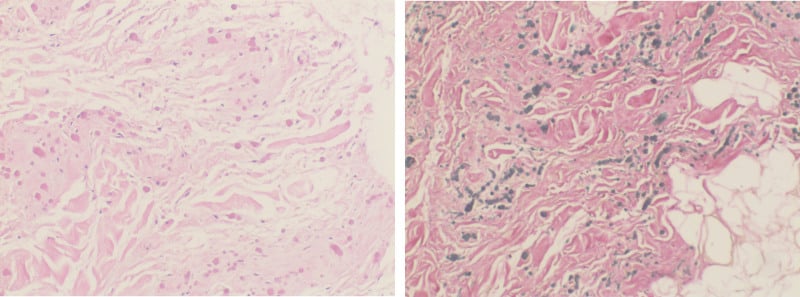
Microscopy. The diagnostic feature is abnormal, coarse, branched and unbranched elastic fibres of variable thickness within a collagenous and fibrofatty stroma, with interspersed mature fat and vascular elements. Elastin stains such as Weigert or Verhoeff-van Gieson highlight the fibres, which often have a beaded or globular ("chenille body") appearance. Immunohistochemistry typically shows CD34 and vimentin positivity, supporting a fibroblastic origin.
A reassuring histological point: elastofibroma shows no nuclear atypia, no high mitotic activity and no necrosis. The presence of any of these features should make the pathologist - and you - question the diagnosis and consider a true sarcoma.
Molecular Pathogenesis: Reactive Hyperplasia or Clonal Neoplasm?
The reactive friction account is the majority view, but two observations sit in tension with it: familial clustering and recurrent chromosomal copy-number changes. Both suggest that in some patients an intrinsic predisposition adds to mechanical wear, and reconciling them is a favourite deeper viva probe.
The Okinawa endemic cluster. The most striking evidence for a constitutional (genetic) contribution comes from Okinawa, Japan, where Nagamine and colleagues documented an extraordinarily high local frequency. In their landmark clinicopathological study of 170 cases (Cancer 1982;50(9):1794-805, PMID 7116305), many lesions arose on small offshore islands (Tonaki-jima, Aguni-jima).
Familial occurrence. A substantial proportion occurred within the same family lines: the 21 lesions from Tonaki Island showed clear familial occurrence, and 55 of the total cases clustered in related individuals.
What the Okinawa authors concluded. Elastofibroma was a reactive hyperplasia occurring against a constitutional predisposition: mechanical friction acting on a genetically susceptible background, rather than friction alone.
Genomic findings and clonality. Later molecular work has partly blurred the "purely reactive" label. Recurrent, non-random chromosomal copy-number changes and chromosomal instability have been described, and X-chromosome inactivation analyses have suggested that at least some lesions may be clonal. That would argue for a genuine, if extremely indolent, benign neoplasm rather than a pure reaction.
CD34 and vimentin positivity is consistent with a fibroblastic proliferation but does not settle the question.
If an examiner presses on "reactive or neoplastic?", do not commit dogmatically. The safe, defensible position is that elastofibroma is best regarded as a benign fibroblastic pseudotumour driven by repetitive friction on a predisposed background, with the debate still unresolved. The dominant view is reactive (friction, manual labour, older age, bilaterality); a genetic or constitutional element is real (the Okinawa familial cluster); and recurrent chromosomal changes with possible clonality keep a low-grade neoplastic origin on the table. Naming the Okinawa familial series is a high-level touch that signals reading beyond the basics.
Extrascapular Elastofibroma: When It Is NOT Under the Scapula
The subscapular location is pathognomonic, and an atypical site is a red flag for sarcoma. The nuance is that elastofibroma itself is not exclusively subscapular: rare, histologically identical lesions occur at other pressure and friction points. Recognising them prevents both a missed benign diagnosis and an over-called sarcoma.
Documented sites. Reported extrascapular locations follow the same logic, sites subjected to chronic mechanical friction or pressure over a bony prominence:
- Infraolecranon (elbow) region - notably common in the Okinawa series
- Lateral thoracic wall and ischial tuberosities - multiple lesions described in the same series
- Greater trochanter, foot, hand, deltoid region and even the gastrointestinal tract - isolated case reports
Friction over a bony point is exactly what the reactive theory predicts, so the very existence of these lesions is an argument for that mechanism.
A lower threshold for biopsy. An extrascapular mass with elastofibroma-type imaging (muscle-like tissue interlaced with fat) does not automatically become a sarcoma. But away from the subscapular plane the pretest probability of elastofibroma falls sharply and you lose the location-based confidence that lets you skip biopsy, so the threshold for tissue diagnosis is lower.
Keep elastofibroma on the differential for a friction-site mass, and confirm histology by planned image-guided biopsy through a sarcoma service before assuming benignity.
Classification and Staging
No malignancy staging. Elastofibroma has no formal malignancy-based staging system because it is benign. In practice it is categorised by symptom status and laterality, which is what actually drives management (see Management).
The Enneking framework. Using the Enneking system for benign musculoskeletal tumours, elastofibroma behaves as a latent (Stage 1) benign lesion: slow-growing, well tolerated and without aggressive local behaviour. Framed this way in a viva, it is a clean, examiner-pleasing justification for a "wait and see" approach in an asymptomatic patient.
- Behaviour
- Static or very slow growth, self-limiting
- Elastofibroma Fit
- Best fit - indolent and well tolerated
- Implication
- Observation is appropriate
- Behaviour
- Steady growth, may cause symptoms
- Elastofibroma Fit
- Symptomatic lesions may behave this way
- Implication
- Marginal excision if symptomatic
- Behaviour
- Local invasion, breaches barriers
- Elastofibroma Fit
- Does NOT apply - reconsider diagnosis
- Implication
- Aggressive features mean refer and biopsy
Clinical Presentation
History. Most patients are older adults, often with a history of manual or repetitive overhead work. The typical complaint is a slowly enlarging lump at the lower part of the shoulder blade, sometimes noticed by chance or by a partner. Many lesions are found incidentally, on chest CT or FDG-PET/CT done for another reason, and in surgical cohorts roughly half of patients are symptomatic.
Symptoms. Symptomatic patients describe snapping, clunking, stiffness or mild discomfort as the arm is raised, because the mass is compressed between the scapula and ribs during movement. Pain, if present, is usually mild. Severe or rapidly progressive pain is atypical and should raise concern, and rapid growth should likewise prompt a rethink.
Examination. A firm, ill-defined mass at the inferior pole of the scapula, often non-tender, with normal overlying skin. It becomes more prominent when the arm is adducted across the body or elevated, as the scapula slides over it. Shoulder range of movement is usually preserved but may feel mechanically restricted.
The dynamic sign. A deep scapular elastofibroma changes shape and becomes palpable with shoulder movement, the clue that distinguishes it from a superficial lump. Ask the patient to elevate and lower the arm and listen and feel for the snapping: a simple manoeuvre examiners like to see. Then examine the contralateral scapula, because bilateral lesions are common.
Investigations
Imaging is the key test. The diagnosis is made by combining the clinical picture with cross-sectional imaging, on which the lesion is a lenticular (lens-shaped) mass. Plain radiographs are usually unhelpful and may simply show a vague soft-tissue density.
Ultrasound. A layered (fibrillar) mass deep to serratus anterior. It is cheap and dynamic and a good first test, but it is operator dependent and the lesion can be mistaken for a lipoma.
CT. A poorly encapsulated soft-tissue mass with attenuation like muscle, interlaced with strands of fat. CT shows the diagnostic fat strands in most cases but misses them in a minority.
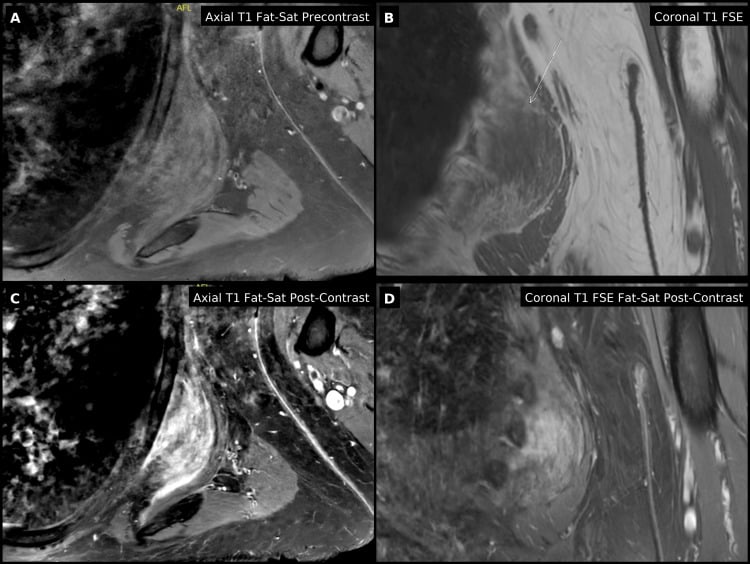
MRI. The best soft-tissue characterisation: a mass deep to serratus, with heterogeneous muscle-like signal interlaced with fat on T1. Interspersed fat is seen in around 90% of cases on MRI, and MRI confirms the diagnosis, though it is less available and more costly than CT or ultrasound.
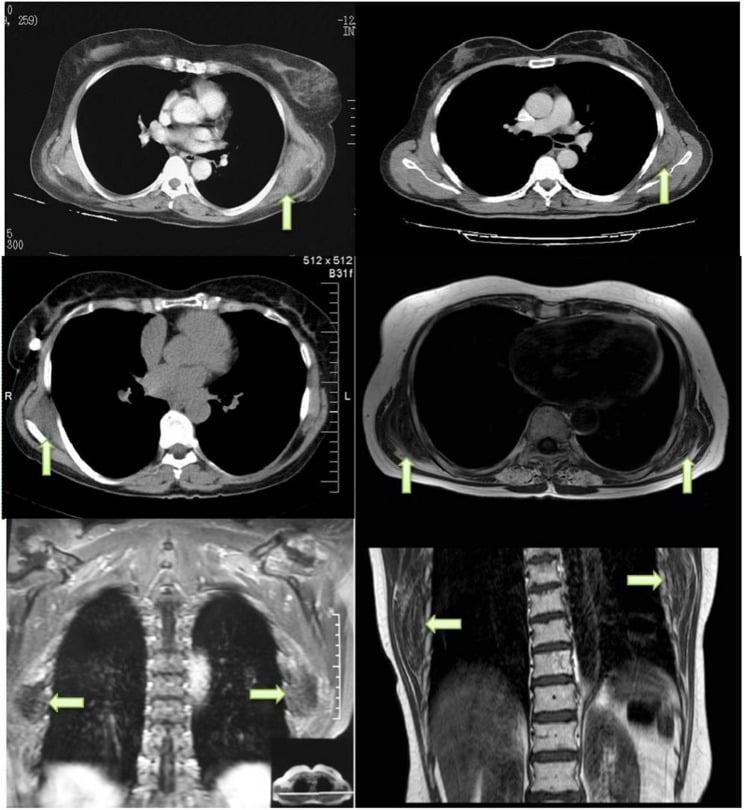
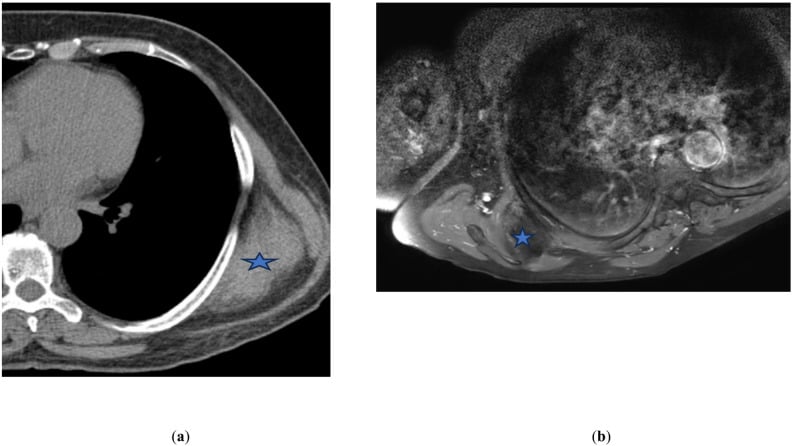
The combination of a mass deep to serratus anterior at the inferior scapular angle with strands of fat interlaced through muscle-like tissue is, in the right clinical context, sufficient to diagnose elastofibroma dorsi without biopsy.
How confident is the imaging? A useful informal grading of an infrascapular lesion:
- Definite - classic site deep to serratus anterior plus interspersed fat strands on CT or MRI, often bilateral. The diagnosis can be made with confidence and the patient reassured; no biopsy is needed
- Probable - classic site but fat strands not clearly seen on CT. Consider follow-up imaging: MRI frequently demonstrates the fat that CT missed and confirms the diagnosis
- Indeterminate - any of the atypical features in the alert below. Abandon the benign assumption, treat it as a possible sarcoma, and refer to a specialist bone-and-soft-tissue tumour unit for assessment and image-guided biopsy before any surgery
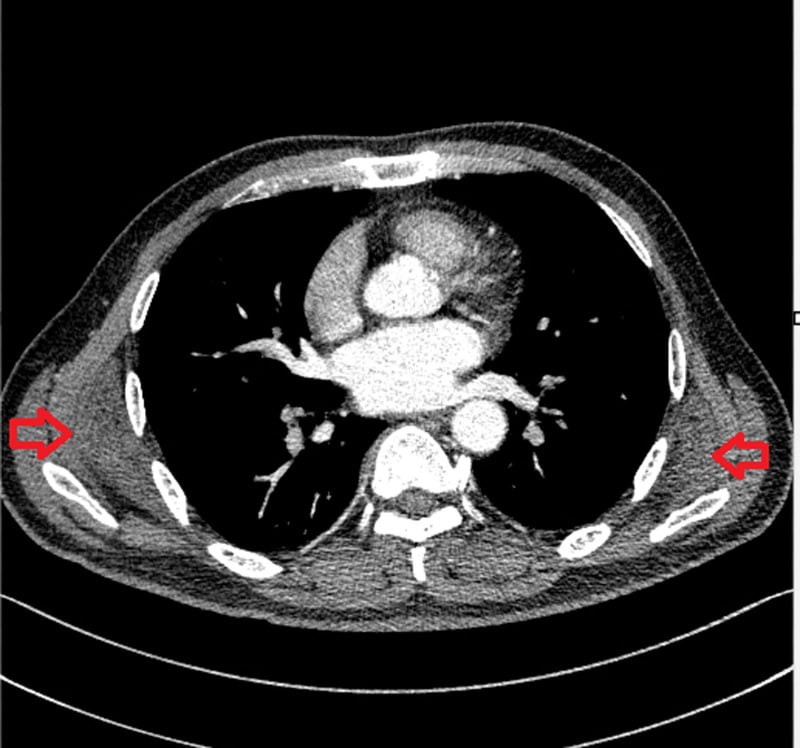
FDG-PET/CT. On FDG-PET/CT series the reported prevalence of elastofibroma dorsi is around 1.7%, and the lesions are usually bilateral with mild-to-moderate FDG uptake, SUVmax roughly 2 (roughly 1 to 4). That metabolic activity can be misread as nodal or metastatic disease. Knowing the typical appearance lets you recognise it as an incidental benign finding and prevents a cancer scare and unnecessary intervention.
Why it is not a sarcoma. A true soft-tissue sarcoma rarely sits deep to serratus, rarely contains interspersed fat, and is far less likely to be bilateral.
SAFEWhy It Is NOT a Sarcoma
Hook:SAFE - the four reassuring features that make elastofibroma a SAFE diagnosis rather than a sarcoma.
When the location and imaging are classic, biopsy is unnecessary and most major series and reviews advise against it. Biopsy (image-guided core, performed through a planned route by a sarcoma service) is reserved for atypical lesions - wrong location, absent fat strands, rapid growth, severe pain, or invasion of muscle or bone - where a true sarcoma cannot be excluded on imaging alone.
Other fat-containing masses. The internal fat in elastofibroma is arranged as thin strands through muscle-like tissue at the characteristic subscapular site. A homogeneous fatty mass with only thin, non-enhancing septa supports lipoma; thick or nodular enhancing septa are atypical and require specialist tumour assessment.
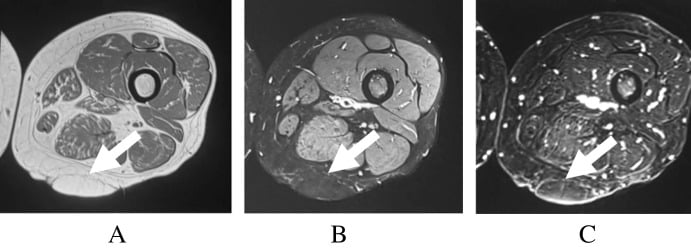
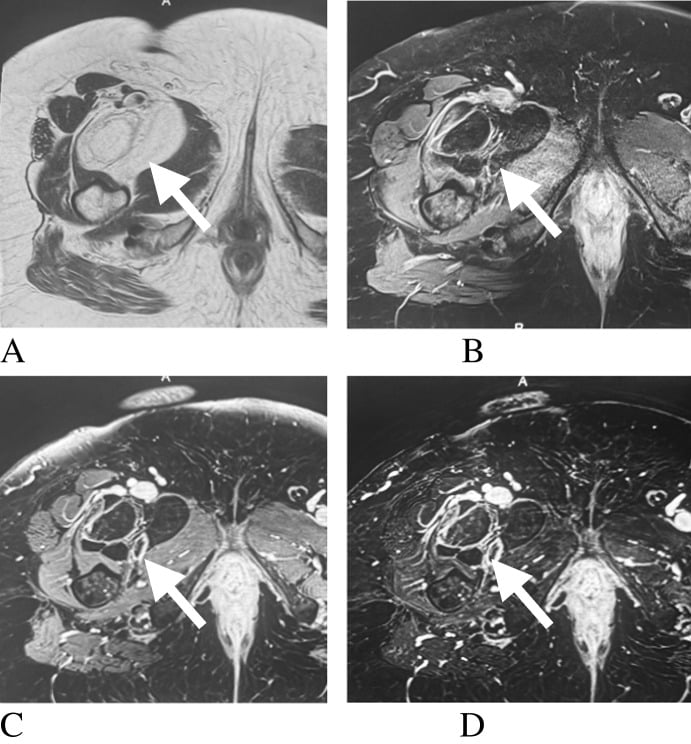
The differential. Other masses to consider beneath the scapula include:
- Lipoma or fibrolipoma - pure fat signal, well defined, no muscle-like component
- Liposarcoma - thick septa, nodular non-fatty areas, atypical site
- Other soft-tissue sarcoma - aggressive features, invasion, rapid growth
- Haematoma - history of trauma
- Desmoid - infiltrative fibromatosis
Management
The principle. Because elastofibroma is benign with no malignant potential, the modern default is a "wait and see" approach: confirm the diagnosis on imaging, reassure the patient, and reserve surgery for symptoms that interfere with daily life. Immediate surgery is no longer considered the standard treatment.
- Imaging Features
- Classic site plus fat strands on CT/MRI
- Management
- Reassure and observe - no biopsy
- Key Pearl
- Location and fat strands are diagnostic
- Imaging Features
- Classic site, lesion enlarges with arm elevation
- Management
- Discuss marginal excision if it limits function
- Key Pearl
- Mechanical symptoms drive the decision to operate
- Imaging Features
- No fat strands, invasion of muscle or bone, rapid growth
- Management
- Refer to a sarcoma unit for biopsy
- Key Pearl
- Atypical features mean do not assume elastofibroma
Observation. Asymptomatic or minimally symptomatic lesions need no biopsy and no surgery: reassure the patient that the lesion is benign and offer clinical follow-up. In bilateral disease, often asymmetric, treat the symptomatic side and observe the other.
The operation. Lesions causing pain, mechanical snapping or functional limitation are offered marginal excision through the deep subscapular plane; radical wide resection is unnecessary and increases morbidity.
Exposure. The patient is prone or in the lateral position, and the deep plane lies beneath serratus and latissimus. The lesion is often adherent to rib periosteum and must be carefully freed. When there was any diagnostic doubt, the excisional biopsy confirms the histology.
Haematoma and seroma. The large dead space left after excision is the main reason for fluid collections, and larger tumour size is associated with a higher complication rate. Suction drainage is often kept beyond 7 days, alongside quilting or other obliteration of the dead space, and a compression dressing and early review help manage seroma conservatively. The prevention and treatment of each complication are tabulated under Complications.
Postoperative haematoma or seroma is the dominant complication, reported in up to 43% of cases (Nagano 2014, 9 of 20). Most resolve with conservative treatment, but patients must be warned preoperatively, because this risk is a key reason to reserve surgery for genuinely symptomatic lesions.
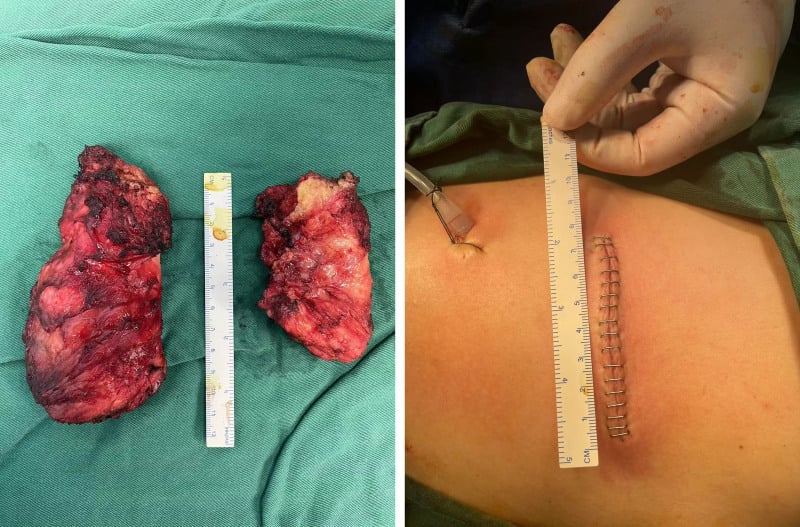
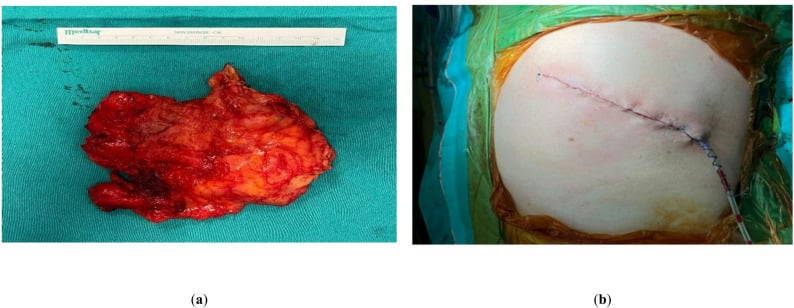
Image-guided cryoablation. Percutaneous cryoablation has been described in a single case as a minimally invasive option for a symptomatic lesion. It is not established standard treatment and should not replace observation or marginal excision on the strength of one report.
If cryoablation is considered for a patient who wishes to avoid surgery, selection, biopsy strategy and thermal protection should be agreed by a specialist musculoskeletal tumour and interventional radiology team.
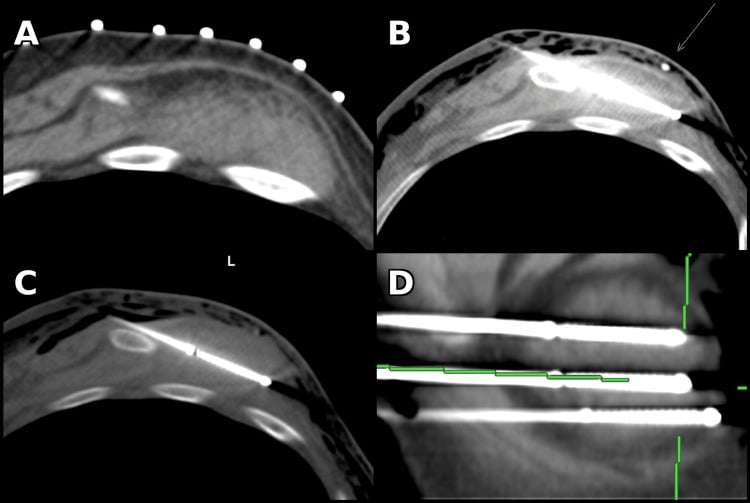
Prognosis. Excellent. After complete marginal excision recurrence is rare, and most patients gain durable relief of mechanical symptoms with improved shoulder comfort and movement. Malignant transformation has not been established.
Complications
- Why It Happens
- Vascular deep bed and large dead space
- Management
- Usually conservative; evacuate if large or expanding
- Prevention
- Meticulous haemostasis, suction drainage
- Why It Happens
- Persistent dead space after excision
- Management
- Needle aspiration or compression; rarely re-drainage
- Prevention
- Dead-space obliteration, prolonged drainage, compression
- Why It Happens
- Collection or deep wound in an older patient
- Management
- Antibiotics; drainage if collection becomes infected
- Prevention
- Aseptic technique, avoid persistent collections
- Why It Happens
- Incomplete removal (uncommon)
- Management
- Re-excision if symptomatic recurrence is confirmed
- Prevention
- Complete marginal excision; the lesion rarely recurs
- Why It Happens
- Failure to recognise classic site and fat strands
- Management
- Review imaging; refer to sarcoma unit if truly uncertain
- Prevention
- Know the pathognomonic features - avoid needless biopsy and alarm
Guidelines, Registries & Global Practice
Global Epidemiology
Elastofibroma dorsi is reported worldwide with a consistent profile: it predominantly affects older adults (peak in the sixth and seventh decades), shows a female predominance in most surgical series, and arises almost exclusively in the subscapular region. Although historically called rare, autopsy and cross-sectional imaging work shows it is far commoner than once thought - incidental imaging series report a prevalence of roughly 1.7% on FDG-PET/CT, with bilateral lesions in a large proportion of those patients. There is no dedicated tumour registry for this benign entity; epidemiology derives from radiology, pathology and orthopaedic-oncology case series rather than national implant registries.
Guideline Framework (Side-by-Side)
- Relevant guidance
- Listed among benign fibroblastic/fibrohistiocytic lesions
- Practical implication
- Confirms benign biology; histology not required when imaging is classic
- Relevant guidance
- Indeterminate or aggressive-appearing soft-tissue masses should be referred to a sarcoma unit before biopsy
- Practical implication
- Refer only atypical lesions; classic elastofibroma needs no referral
- Relevant guidance
- Diagnostic uncertainty or aggressive features trigger sarcoma-unit referral
- Practical implication
- A confidently diagnosed elastofibroma is managed locally
- Relevant guidance
- Latent benign soft-tissue lesions (Enneking stage 1) may be observed
- Practical implication
- Excision reserved for symptomatic lesions
No major society mandates routine biopsy or specialist referral for a radiologically classic elastofibroma dorsi.
- MRI readily available to characterise the lesion and confirm fat strands
- CT and PET/CT commonly identify it as an incidental finding during cancer staging
- Histology easily obtained when a symptomatic lesion is excised
- Ultrasound is an excellent, inexpensive first-line test for a subscapular mass
- The classic location plus a layered (fibrillar) appearance supports a confident working diagnosis
- Marginal excision with careful dead-space management treats symptomatic lesions where surgery is needed
Be ready to describe the pathognomonic subscapular location and the fat strands within muscle-like tissue on CT and MRI, to explain why this is a benign reactive pseudotumour rather than a sarcoma, and to justify a symptom-led approach - observation for quiet lesions versus marginal excision (with counselling about haematoma and seroma) for symptomatic ones.
MCQ Practice Points
Q: Where does elastofibroma dorsi characteristically arise? A: Deep to the serratus anterior at the inferior angle of the scapula, between the lower scapula and the posterior chest wall. This location is almost pathognomonic.
Q: What imaging feature allows a confident diagnosis without biopsy? A: Strands of fat interlaced through muscle-like soft tissue at the classic subscapular site, seen on CT or MRI (interspersed fat present in around 90% of cases on MRI).
Q: How often is elastofibroma dorsi bilateral? A: Frequently - a large minority of cases (and a high proportion of incidental PET/CT cases) are bilateral and asymmetric, so always check the other side.
Q: What is the most accepted cause of elastofibroma dorsi? A: A reactive pseudotumour from repetitive mechanical friction between the scapula and chest wall, supported by the strong association with manual labour - it is not regarded as a true neoplasm.
Q: What is the dominant complication after surgical excision? A: Postoperative haematoma or seroma, reported in up to 43% (Nagano 2014), related to the large dead space; most resolve with conservative treatment.
Q: When is surgery indicated for elastofibroma dorsi? A: For symptomatic lesions (pain, snapping, functional limitation). Asymptomatic lesions are observed; immediate surgery for diagnosis alone is no longer standard.
Exam Viva Scenarios
Practise clinical reasoning and management decisions out loud
“A 63-year-old retired carpenter is referred with a slowly growing firm lump under his right shoulder blade. It snaps when he reaches across his body. On examination there is an ill-defined mass at the inferior pole of the scapula that becomes more obvious when he elevates the arm. How would you approach this?”
“A 68-year-old woman being staged for breast cancer has a chest CT that reports bilateral soft-tissue masses deep to the serratus anterior at the scapular tips, with mild FDG uptake on her subsequent PET/CT. The oncology team is worried about metastases. How do you interpret this?”
“A 55-year-old man has a rapidly enlarging, painful mass near the lower scapula. Imaging shows a mass that is partly superficial to serratus anterior, contains no fat strands, and appears to invade adjacent muscle. A trainee suggests this is just an elastofibroma. How do you respond and what do you do?”
Key Facts
- Benign fibroelastic pseudotumour of the subscapular region
- Older adults (peak 6th-7th decade), female predominance
- Frequently bilateral and asymmetric - check both sides
- No malignant potential - reactive friction lesion
Pathognomonic Features
- Location: deep to serratus anterior at the inferior scapular angle (~98%)
- Imaging: muscle-like tissue interlaced with strands of fat (~90% on MRI)
- Dynamic mass - snapping or clunking with shoulder movement
- Mild-to-moderate FDG uptake (SUVmax roughly 2) - not metastasis
Clinical Presentation
- Often incidental on chest CT or PET/CT
- Symptomatic in roughly half - swelling, snapping, stiffness, mild pain
- Strong association with manual labour and repetitive shoulder use
- Mass more prominent on arm elevation or adduction across the body
Investigations
- MRI is the key test - confirms classic site and fat strands
- CT shows fat strands in most cases; MRI rescues CT-negative cases
- Ultrasound is a good inexpensive first test
- Biopsy only for atypical lesions (wrong site, no fat, rapid growth)
Management
- Asymptomatic: reassure and observe (wait and see)
- Symptomatic: marginal excision (not radical resection)
- Anticipate haematoma and seroma - drainage and dead-space control
- Excellent prognosis; recurrence rare after complete excision
Exam Pearls
- Location plus fat strands = diagnosis without biopsy
- Classic sarcoma mimic - be confident yet cautious
- Always check the contralateral scapula (often bilateral)
- Postoperative haematoma/seroma is the dominant complication
Evidence Base and Key Studies
Current Update on the Diagnosis, Management and Pathogenesis of Elastofibroma Dorsi
- Comprehensive review framing elastofibroma dorsi as an uncommon benign fibroblastic pseudotumour of the subscapular region in middle-aged and older adults
- MRI is the recommended first-line investigation, showing a lenticular soft-tissue mass with signal similar to skeletal muscle interlaced with strands of fat
- Biopsy is not necessary when all pathognomonic criteria are present
- A conservative wait-and-see approach is reasonable - immediate surgery is no longer the standard treatment
Imaging Diagnosis of Thoracic Elastofibroma Dorsi
- Retrospective review over 12 years identifying 409 suspected cases; typical imaging analysed in 310 lesions
- Classic location was a mass deep to the serratus anterior (98%) near the scapular tip (98%)
- Interspersed intralesional fat was present in 87% of CT and 90% of MRI studies; MRI showed fat in 88% of CT cases that lacked it
- True tumours were rarely deep to serratus (17%) or at the scapular tip (25%) and almost never contained interspersed fat