Ipsilateral Clavicle + Glenoid/Scapula Neck | Double Disruption SSSC | Operative if Displaced
- Double disruption of SSSC creates floating shoulder (potentially unstable)
- SSSC ring: clavicle → AC joint → acromion → spine → glenoid neck → CC ligaments → clavicle
- Fix the clavicle first - may restore alignment without direct scapula fixation
- Glenoid medialization over 1cm or angular deformity over 40° indicates instability
- High-energy mechanism - always assess for associated injuries (pulmonary, brachial plexus)
- “True floating shoulder requires TWO disruptions of the SSSC
- “Clavicle fixation alone may restore scapula alignment (indirect reduction)
- “GPA (Glenopolar Angle) under 20° indicates significant deformity
- “Associated with high-energy trauma - 80% have additional injuries
Overview and Epidemiology
A floating shoulder is the combination of ipsilateral clavicle and scapular neck (or glenoid) fractures that results in the loss of the bony connection between the axial skeleton and the upper extremity. The term was coined by Ganz and Noesberger in 1975.
Mechanism. High-energy direct trauma to the shoulder: a motor vehicle accident, a fall from height or a motorcycle accident. The force is applied to the lateral aspect of the shoulder or as axial loading through the humeral head, and the components of the superior shoulder suspensory complex (SSSC) fail in sequence.
True floating shoulder requires disruption of BOTH superior AND inferior limbs of the SSSC. The biomechanical floating shoulder described by Goss requires disruption at two points creating instability. Not all combined clavicle-scapula fractures are unstable - intact CC ligaments may maintain stability.
Associated injuries. With a high-energy mechanism, 80% have additional injuries and the patient often presents in the polytrauma setting, so a complete trauma work-up is mandatory. The injuries to look for:
- Pulmonary: rib fractures (50%), pneumothorax, pulmonary contusion
- Neurological: brachial plexus injury (5-10%), head injury
- Vascular: subclavian or axillary injury, rare but devastating
- Other: spine injuries, abdominal trauma
Anatomy and Biomechanics
The superior shoulder suspensory complex. The SSSC is a bone-soft tissue ring that suspends the upper extremity from the axial skeleton, and understanding it is fundamental to managing the floating shoulder. Its components, in order round the ring:
- Clavicle - medial strut
- AC joint - connects clavicle to acromion
- Acromion process - superior link
- Scapula spine - posterior connection
- Scapula body and glenoid neck - lateral strut, supporting the humeral head
- Coracoid process - inferior link
- Coracoclavicular ligaments - complete the ring back to the clavicle
- Components
- Clavicle, AC joint, acromion
- Function
- Primary link to axial skeleton
- Components
- Coracoid, CC ligaments, glenoid neck
- Function
- Secondary support, vertical stability
Two breaks, not one. Like a pelvic ring, the SSSC requires two disruptions to create instability. A single break, an isolated clavicle or an isolated scapular neck fracture, typically remains stable. Two breaks create a floating segment that can displace under the pull of the attached muscles.
The deforming forces. Once the segment floats, these act on the scapula:
- Serratus anterior protracts the scapula
- Pectoralis minor tilts the glenoid inferiorly
- Gravity and the weight of the arm cause medialisation
- Trapezius and levator scapulae elevate the medial scapula, if intact
Why the clavicle matters. The clavicle is the only bony connection between the upper limb and the axial skeleton. Fixing it restores the strut function supporting the shoulder, and through intact CC ligaments it can indirectly reduce the scapula.
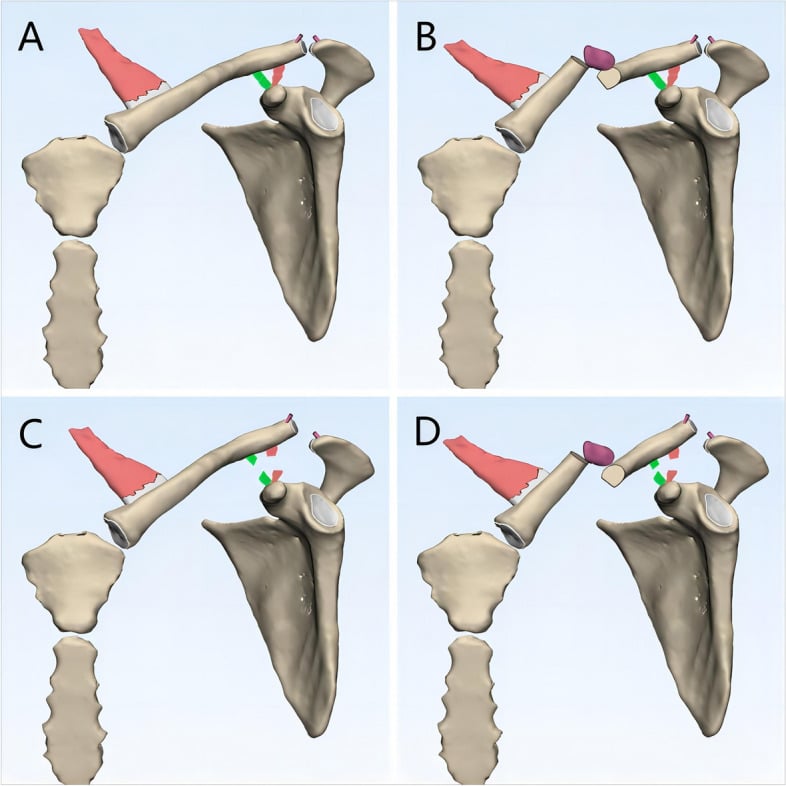
Classification Systems
Goss (1993) classifies the injury by the number of breaks in the SSSC ring.
- Description
- One break in SSSC ring
- Stability
- Stable
- Description
- Two breaks in ring (floating shoulder)
- Stability
- Potentially unstable
- Description
- Three or more breaks
- Stability
- Unstable
The count is only the start. The degree of instability depends on the number of disruptions, the displacement at each site and the integrity of the remaining structures.
- Clavicle fracture + scapula neck fracture (most common)
- Clavicle fracture + AC dislocation + glenoid fracture
- AC dislocation + coracoid fracture + scapula neck fracture
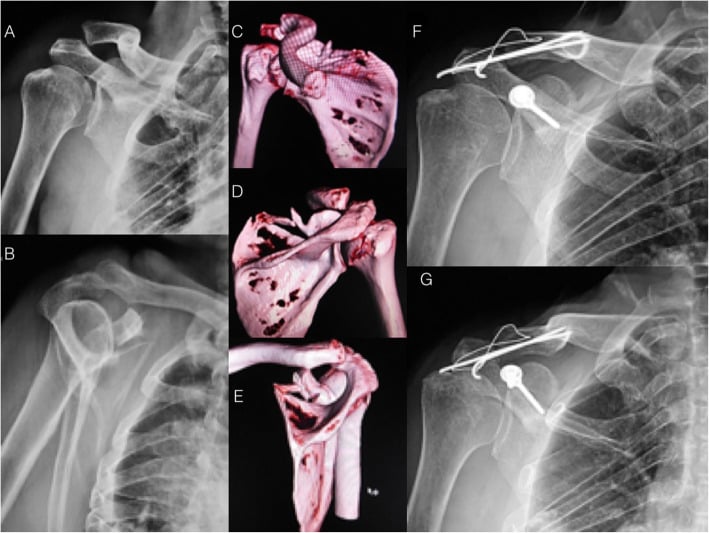
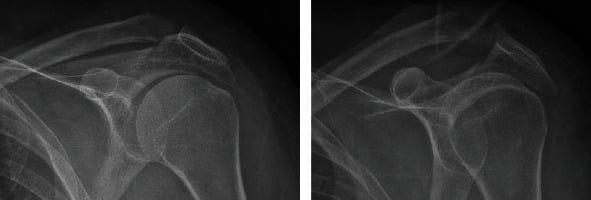
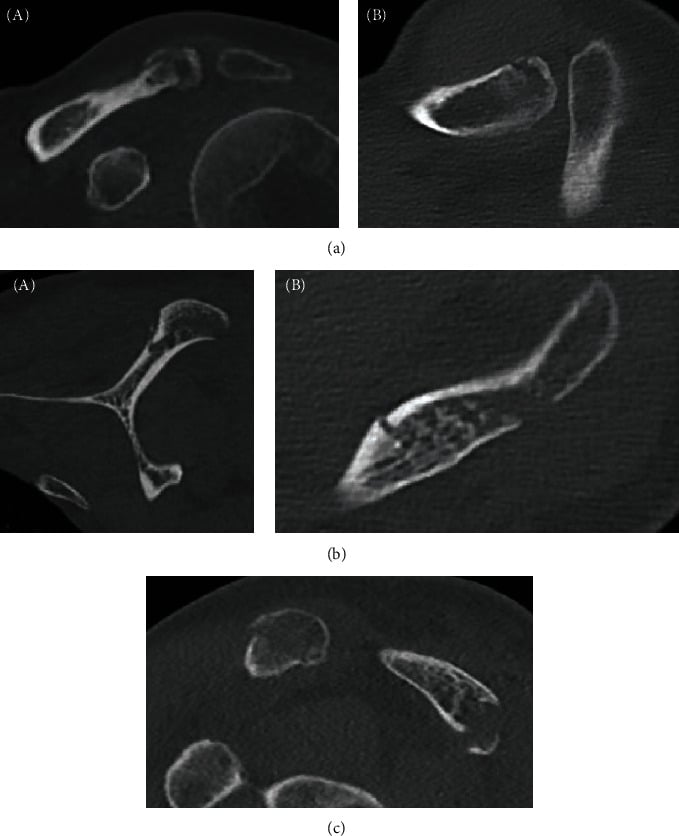
Variants of the double disruption. The second break need not be in the scapular neck. Capsule and AC-ligament failure followed by a clavicle fracture can create a second SSSC break even when the coracoclavicular ligament is intact, and a midshaft clavicle fracture with a high-grade AC disruption creates an unstable lateral segment. A basal (Ogawa type I) coracoid fracture interrupts the coracoclavicular link and must be assessed for an associated AC or clavicular injury. Simultaneous distal-clavicle and acromion or spine fractures, the uncommon floating-acromion variant, are a lateral double disruption that can destabilise the shoulder girdle.
Clinical Assessment
History. The mechanism is high-energy trauma, a motor vehicle accident or a fall from height. Ask about chest pain, dyspnoea and head injury for the associated injuries, and record hand dominance, occupation and functional demands, and comorbidities that affect healing.
Examination. Inspect for swelling, deformity and skin tenting: the shoulder looks shortened and drooping, with a visible or palpable clavicle deformity and ecchymosis over the shoulder girdle. Palpate the clavicle, acromion and scapular spine; the scapular body may be palpable posteriorly. Range of motion is usually severely limited by pain, and the patient cannot actively elevate the arm.
Screening the associated injuries. The chest, the plexus and the circulation are examined as part of the trauma assessment:
- Chest: breath sounds, auscultation for pneumothorax, chest wall tenderness
- Neurology: a complete brachial plexus examination is essential
- Vascular: pulses, capillary refill, expanding haematoma
Test the brachial plexus root by root, and the axillary nerve:
- C5: shoulder abduction, biceps
- C6: wrist extension, brachioradialis
- C7: elbow extension, triceps
- C8/T1: finger flexion and intrinsics
- Axillary nerve: regimental badge sensation, deltoid
Differential diagnosis. The table separates the floating shoulder from the patterns that mimic it.
- SSSC Disruptions
- Two (clavicle + scapular neck)
- Key Distinguishing Feature
- Ipsilateral clavicle AND scapular neck fracture on imaging
- Stability / Treatment
- May be unstable - decide on displacement / GPA
- SSSC Disruptions
- One
- Key Distinguishing Feature
- Intact scapula on CT; SSSC broken in one place only
- Stability / Treatment
- Stable - selective fixation by clavicle criteria
- SSSC Disruptions
- One
- Key Distinguishing Feature
- Intact clavicle and CC ligaments
- Stability / Treatment
- Usually stable - nonoperative, early ROM
- SSSC Disruptions
- Two or more + soft tissue
- Key Distinguishing Feature
- Lateral scapular displacement on non-rotated chest film, vascular/plexus injury
- Stability / Treatment
- Limb-threatening - urgent vascular and neuro assessment
- SSSC Disruptions
- Two
- Key Distinguishing Feature
- AC widening / CC distance increase rather than scapular neck break
- Stability / Treatment
- Double disruption variant - assess displacement
- SSSC Disruptions
- Two
- Key Distinguishing Feature
- Coracoid base fracture on axillary/CT, not scapular neck
- Stability / Treatment
- Double disruption - fix medial-to-lateral if displaced
The most dangerous mimic is scapulothoracic dissociation - a closed forequarter amputation equivalent. Look for lateral scapular displacement on a non-rotated chest radiograph, an absent pulse, a flail/anaesthetic limb, and massive swelling. This is a vascular and brachial plexus emergency, not a fixation decision.
Investigations
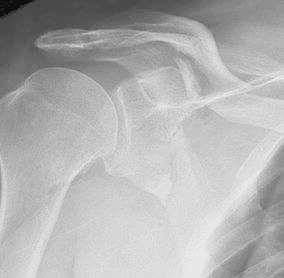
Radiographs. The initial series covers the chest as well as the shoulder girdle:
- AP chest - pulmonary injury, rib fractures
- AP clavicle - shortening, displacement
- Scapular Y view - glenoid position, GPA measurement
- Axillary lateral - glenoid articular surface
- AP shoulder - glenohumeral relationship
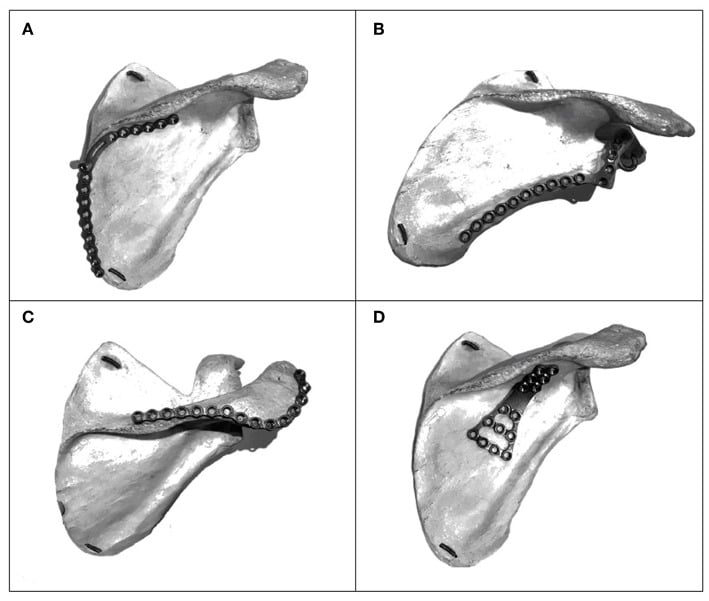
CT is the definitive study. With 3D reconstruction it shows the fracture pattern and displacement, the size and displacement of any glenoid articular involvement, and the medialisation of the scapular neck, and it is the basis of surgical planning: plate contouring and screw trajectories.
Further studies, if indicated.
- CT angiography, if vascular injury is suspected
- MRI for brachial plexus injury, in the subacute phase
- EMG and nerve conduction studies for delayed brachial plexus assessment
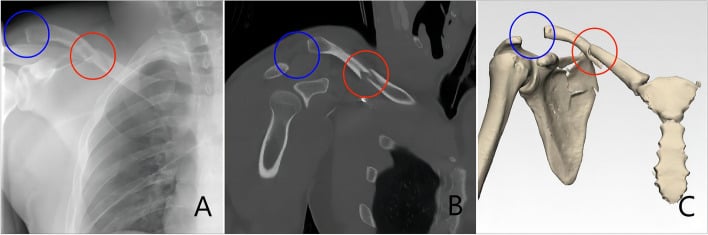
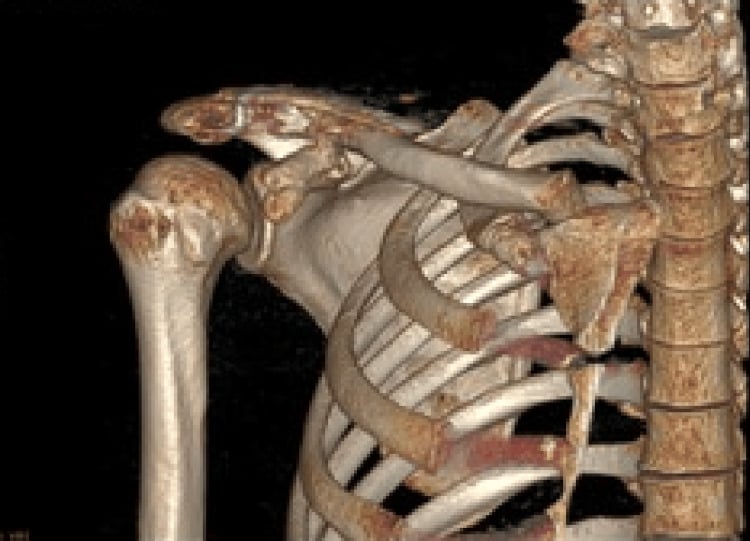
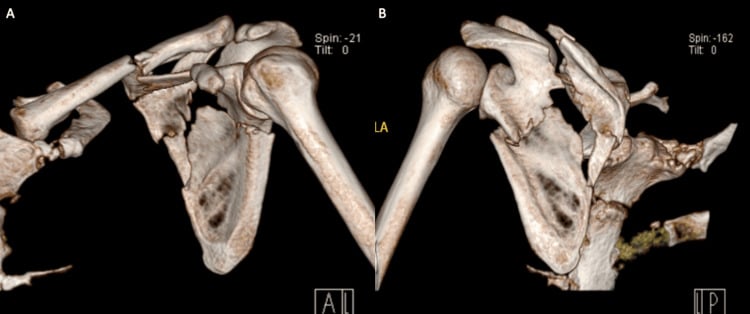
The measurements. Four measurements decide how displaced the injury is. The thresholds below are the working ones used on this page; published cut-offs vary, as discussed under Controversies.
- Normal
- 30-45°
- How it is measured
- See the next section
- Threshold
- Under 20°: significant deformity
- Normal
- 0
- How it is measured
- Distance the glenoid has shifted medially, on CT
- Threshold
- Over 1cm: operative indication
- Normal
- 0
- How it is measured
- Angulation of the glenoid neck relative to the body
- Threshold
- Over 40°: instability
- Normal
- 0
- How it is measured
- Compare with the contralateral side, or measure displacement
- Threshold
- Over 25mm: consider fixation
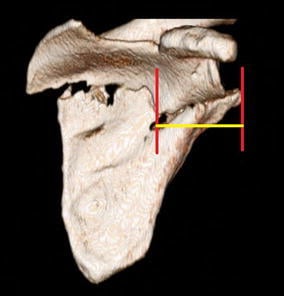
The Glenopolar Angle: How to Measure the Decision Metric
The glenopolar angle (GPA) is the single most-cited number in this topic, yet candidates routinely fumble when asked how it is actually measured. Being able to draw it on demand separates a confident answer from a vague one.
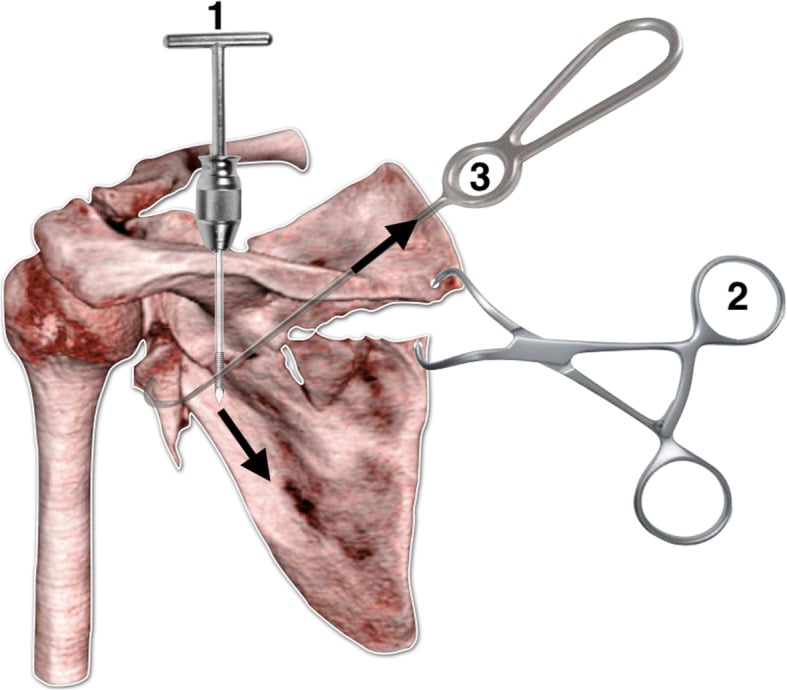
Technique. As originally described by Bestard:
- Obtain a true AP (Grashey) or scapular Y view. A rotated film distorts the angle, so a reproducible projection, or CT or a 3D reconstruction, is preferred
- Line 1 connects the most cranial and most caudal points of the glenoid cavity (the glenoid rim line)
- Line 2 connects the most cranial point of the glenoid to the most caudal point of the scapular body (the inferior angle)
- The GPA is the angle subtended between these two lines
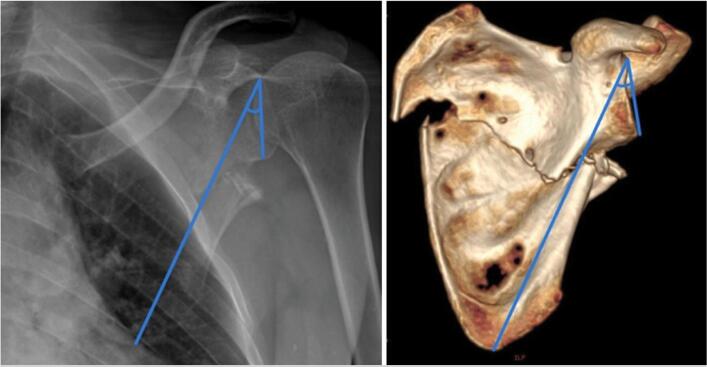
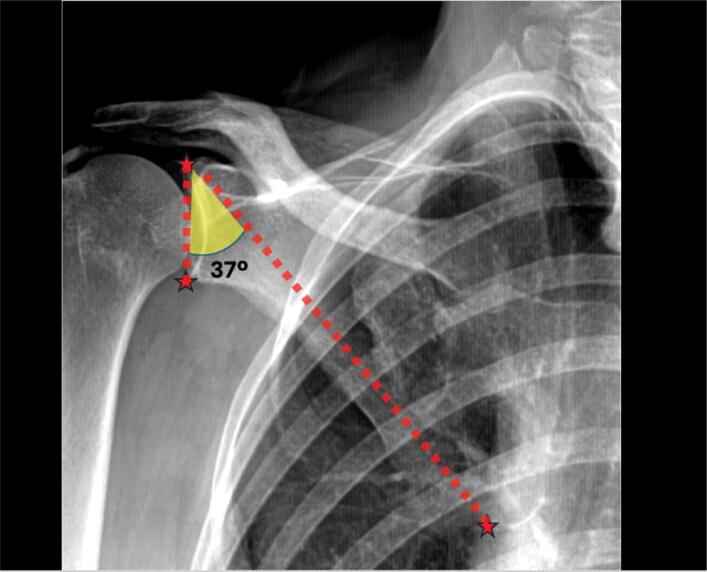
Interpretation. Normal is 30-45°, with a mean around 40°. Under 20° signifies significant caudal tilt, or inferior angulation, of the glenoid and is the classic operative threshold. A falling GPA reflects the glenoid rotating and dropping away from the scapular body, the deformity that impairs the concavity-compression and the abduction lever arm of the glenohumeral joint.
Why it drives the decision. The GPA is the parameter that best tracks function. In the Lin randomised study the GPA after bony consolidation correlated strongly with both DASH and Constant scores, and combined clavicle-plus-scapula fixation restored it best. In van Noort's series it was the caudally dislocated glenoid, a low-GPA equivalent, that produced the worst results (Constant 42 versus 85). Restoring glenoid position and GPA, by clavicle fixation and, if the GPA stays low, scapular ORIF, is therefore the true goal of treatment, not simply counting SSSC breaks.
A practical caveat. GPA measurement is projection-dependent and carries genuine interobserver variability on plain films. An isolated borderline value should be confirmed on a reproducible view or on CT before it is used to justify, or to refuse, surgery.
Management Algorithm
The decision. Count the disruptions, then measure the displacement. A single disruption is usually stable and treated nonoperatively. A double disruption is judged on its displacement: minimally displaced injuries are considered for nonoperative treatment or clavicle fixation alone, and significantly displaced ones for surgical stabilisation.
- SSSC Disruptions
- One
- Stability
- Stable
- Treatment
- Nonoperative or selective fixation
- SSSC Disruptions
- One
- Stability
- Stable
- Treatment
- Nonoperative (sling, early ROM)
- SSSC Disruptions
- Two
- Stability
- Borderline
- Treatment
- Consider clavicle fixation alone
- SSSC Disruptions
- Two
- Stability
- Unstable
- Treatment
- Clavicle fixation, reassess scapula
- SSSC Disruptions
- Two or more
- Stability
- Grossly unstable
- Treatment
- Fix clavicle AND scapula
Clavicle first. Once surgery is chosen, the clavicle is fixed before any decision on the scapula:
- Plate the clavicle
- Reassess scapular alignment on intraoperative fluoroscopy
- If alignment is restored, stop
- If displacement persists, proceed to scapular ORIF
This stepwise approach avoids unnecessary scapula surgery in most cases.
What the evidence says about clavicle-first. Fixing the clavicle restores the strut function of the SSSC, and through intact CC ligaments this can indirectly reduce the scapula. Be honest about the evidence: no cited study on this page gives a rate for acceptable alignment after clavicle fixation alone. The Dombrowsky systematic review compared operative with nonoperative treatment, and the Lin RCT found that combined fixation restored the GPA best. The clavicle-first strategy is a way of finding out, intraoperatively, which group the patient belongs to; it is not a proven 60-70% answer.
Who. A single SSSC disruption, a minimally displaced double disruption, the patient medically unfit for surgery, and the low-demand patient with acceptable alignment.
Protocol.
- Sling immobilisation for 2-4 weeks
- Early pendulum exercises
- Progressive range of motion after 3-4 weeks
- Strengthening after 6-8 weeks
- Return to activity at 3-4 months
What to expect. Some malunion and shortening are expected, but functional results are often acceptable. The patient may be left with residual weakness and cosmetic deformity.
Displaced floating shoulder treated nonoperatively risks:
- Glenoid malposition affecting shoulder mechanics
- Scapulothoracic dysfunction
- Reduced strength (especially overhead activities)
- Chronic pain
Timing of Fixation and the Polytrauma Decision
Because roughly 80% of these injuries occur in a polytrauma patient, when to operate is often a harder question than whether to operate. The shoulder girdle must never be prioritised over the resuscitation.
The girdle injury is rarely the emergency. With two exceptions, an open fracture and a vascular injury requiring repair, the floating shoulder itself is not time-critical. The life-threatening companions take priority: tension or simple pneumothorax and haemothorax, flail chest and pulmonary contusion, closed head and cervical-spine injury, and the dangerous mimic, scapulothoracic dissociation with subclavian or axillary disruption. ATLS priorities and the trauma team lead the first hours; the girdle is addressed once the patient is stabilised.
Damage control versus early appropriate care. In the physiologically deranged or borderline patient (persistent acidosis, high lactate or base deficit, coagulopathy, ongoing transfusion requirement, or a severe chest or head injury), definitive shoulder-girdle fixation is deferred. There is no physiological cost to waiting, and a prolonged lateral or prone scapular approach is poorly tolerated by an unstable patient. Once resuscitation endpoints normalise, early appropriate care applies and fixation proceeds.
The practical window. Clavicle-first fixation, and scapular ORIF if needed, is best performed while reduction is still straightforward, typically within the first one to two weeks, before early callus makes an indirect clavicle-led reduction of the scapula harder to achieve. Later fixation remains possible but is technically more demanding. In a marginal patient the two-stage option is legitimate: fix the clavicle acutely, reassess the scapula on imaging over the following one to two weeks, and add scapular fixation only if the glenoid stays displaced, which shortens the initial anaesthetic.
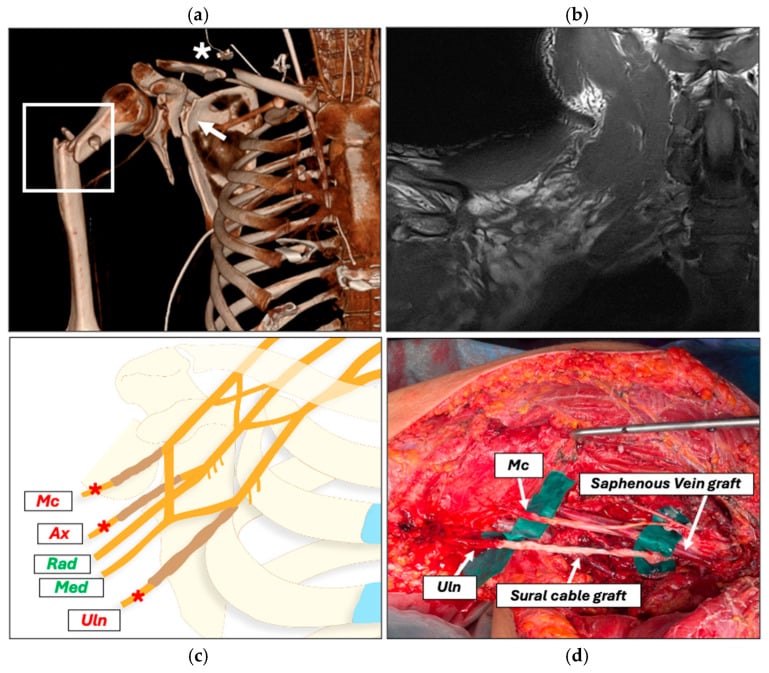
When the plexus is injured. In the case shown below, CT demonstrated clavicle, scapular-neck and proximal-humerus injury, and MRI showed an infraclavicular haematoma obscuring plexus assessment, which emphasises staged orthopaedic and nerve planning in polytrauma.
Surgical Technique
Set-up. Beach chair, or supine with a bump, with the entire shoulder girdle in the field and an image intensifier available to assess the scapula.
Approach. A standard anterior or superior approach to the clavicle, protecting the supraclavicular nerves, and identify the fracture pattern.
Fixation. Superior plating uses a 3.5mm reconstruction or precontoured plate. Anteroinferior plating is biomechanically superior for clavicle shaft fractures: it resists bending forces better, and its lower profile reduces hardware prominence. Place a minimum of three screws each side of the fracture, with lag screws for butterfly fragments.
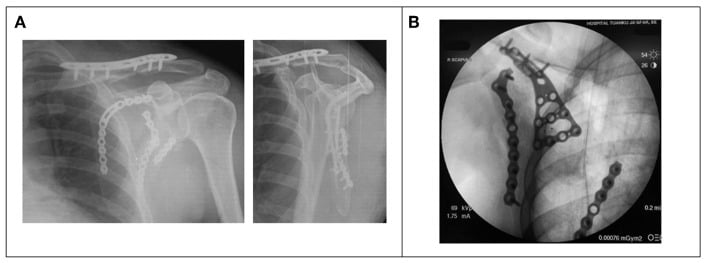
Check the scapula before closing. Take a fluoroscopic scapular Y view after clavicle fixation and measure the GPA and medialisation. If they are acceptable, close; if displacement persists, proceed to the scapula.
Complications
- Incidence
- 10-20%
- Risk Factors
- Nonoperative displaced, inadequate fixation
- Management
- Osteotomy if symptomatic
- Incidence
- 5-10%
- Risk Factors
- Smoking, comminution, inadequate fixation
- Management
- Revision ORIF with bone graft
- Incidence
- 15-25%
- Risk Factors
- Prolonged immobilization, adhesive capsulitis
- Management
- Physiotherapy, manipulation, arthroscopy
- Incidence
- 5-10%
- Risk Factors
- High-energy mechanism, severe displacement
- Management
- Observation, exploration if no recovery
- Incidence
- 10-20%
- Risk Factors
- Superior plate position, thin patients
- Management
- Hardware removal after union
- Incidence
- Less than 5%
- Risk Factors
- Surgical approach, direct injury
- Management
- Observation, nerve release if no recovery
Prognostic factors. Good prognostic factors are an anatomic reduction, a single operation (clavicle alone), early mobilisation, a younger patient and an isolated injury without polytrauma. Poor ones are persistent glenoid malposition, intra-articular involvement, an associated brachial plexus injury, delayed treatment, and polytrauma with ICU admission.
Postoperative Care
Rehabilitation Protocol
- Sling immobilization
- Wound care
- Gentle pendulum exercises
- Elbow, wrist, hand ROM
- Passive and active-assisted ROM
- Forward flexion, external rotation in plane of scapula
- Avoid combined abduction/external rotation
- Continue sling when not exercising
- Discontinue sling
- Full active ROM progression
- Begin isometric strengthening
- Scapular stabilization exercises
- Progressive resistance exercises
- Rotator cuff strengthening
- Sport-specific training if applicable
- Return to non-contact activities
- Full strength and ROM
- Contact sports cleared
- Manual labor cleared
- Hardware removal if symptomatic (after 1 year)
Outcomes and Prognosis
The union-rate figures below are conventional teaching ranges rather than single-study measurements. The verified outcome data on this page are the Dombrowsky systematic review, the Lin RCT and the van Noort series, set out under the glenopolar angle and Controversies.
- Union Rate
- 85-90%
- Functional Outcome
- Fair to good
- Complications
- Malunion, weakness common
- Union Rate
- 95%
- Functional Outcome
- Good to excellent
- Complications
- Hardware prominence
- Union Rate
- 95%
- Functional Outcome
- Good to excellent
- Complications
- Longer surgery, nerve risk
Studies show operatively treated floating shoulder patients achieve Constant scores of 80-90% of contralateral side. Most return to pre-injury activity level. Residual weakness is more common with nonoperative treatment of displaced injuries.
Guidelines, Registries & Global Practice
Global epidemiology
- Scapular fractures account for under 1% of all fractures; the floating shoulder (ipsilateral clavicle + scapular neck) is a small subset, reported in roughly 0.1% of fractures.
- No source cited on this page quantifies how often a scapular neck or body fracture has an associated ipsilateral clavicle fracture; the combination is uncommon enough that the largest synthesis available pooled only 371 shoulders from 17 studies.
- Predominantly young men (mean age late 30s) injured in motor vehicle and motorcycle crashes and falls from height; the high-energy mechanism explains the high rate of associated thoracic and neurovascular injury worldwide.
- Position on the Floating Shoulder
- Operate the displaced double disruption; clavicle-first then reassess
- Practical Emphasis
- Glenopolar angle, lateral border displacement, angulation as operative triggers
- Position on the Floating Shoulder
- Selective surgery; many isolated-looking patterns do well nonoperatively
- Practical Emphasis
- Polytrauma-led care, early mobilisation, individualised decision
- Position on the Floating Shoulder
- Surgery for medialisation over 20mm, angulation over 45°, GPA under 22°, intra-articular step
- Practical Emphasis
- Reproducible radiographic thresholds drive the decision
- Position on the Floating Shoulder
- No mandatory fixation; restore glenoid position and GPA
- Practical Emphasis
- Function tracks glenoid position more than the number of disruptions
Registry note: There is no dedicated implant registry for the floating shoulder (it is a fracture-fixation, not an arthroplasty, problem), so evidence rests on small series and a single small RCT rather than registry data - a key reason equipoise persists.
High- vs limited-resource practice variation
- High-resource: routine CT with 3D reconstruction for planning, precontoured clavicle and scapular plates, intraoperative fluoroscopy to confirm GPA, single-stage combined fixation when needed.
- Limited-resource: reliance on plain films (scapular Y plus axillary), conservative management for all but grossly displaced injuries, and clavicle-only fixation favoured to minimise theatre time and the morbidity of the posterior Judet approach.
- Across settings the converging principle is the same: reduce the glenoid/restore GPA and treat the patient's overall trauma burden first.
Controversies and Areas of Uncertainty
The floating shoulder is a classic viva topic precisely because the evidence is thin and genuine equipoise exists. Be ready to argue both sides.
Is the injury inherently unstable? Goss's biomechanical concept predicts instability from any double disruption, yet van Noort's multicentre series found the injury is not inherently unstable and that good function follows conservative care unless the glenoid is caudally dislocated. The modern view is that instability depends on displacement, not on the count of disruptions.
Operate or not? Dombrowsky's systematic review found comparable mean Constant scores (≈80% of ideal) for the operative and nonoperative groups, but the small RCT (Lin et al.) favoured fixation for GPA and DASH/Constant. Selection, not a blanket rule, drives outcome.
Clavicle alone or combined? Clavicle-first with intraoperative reassessment is widely taught, but indirect reduction of the scapula through intact CC ligaments is unreliable. Some surgeons argue that a displaced scapular neck should be addressed directly rather than hoping the clavicle plate corrects the GPA.
Which radiographic threshold? Cited GPA cut-offs vary (under 20° vs under 22°), as do medialisation (over 10mm vs over 20mm) and angulation (over 40° vs over 45°) thresholds. These numbers are expert-derived, not validated prospectively; treat them as guides, not absolutes.
State the controversy explicitly: "There is no high-level consensus. I would individualise based on the degree of glenoid displacement and GPA, the patient's physiological status and demands, and the overall trauma burden - reserving combined fixation for the displaced, physiologically stable patient." This shows judgement rather than dogma.
MCQ Practice Points
Q: Which structure is NOT part of the Superior Shoulder Suspensory Complex?
A) Clavicle B) Coracoacromial ligament C) Coracoclavicular ligaments D) Acromion
A: B - The coracoacromial ligament connects coracoid to acromion but is not part of the SSSC ring. The SSSC includes: clavicle, AC joint, acromion, scapula spine, glenoid neck, coracoid, and CC ligaments.
Q: What glenopolar angle represents a surgical threshold in floating shoulder?
A) Less than 40° B) Less than 30° C) Less than 20° D) Less than 10°
A: C - GPA under 20° indicates significant angular deformity and is a surgical indication. Normal GPA is 30-45°.
Q: In the management of floating shoulder, the recommended initial surgical strategy is:
A) Fix scapula first, then assess clavicle B) Fix clavicle first, then assess scapula C) Always fix both clavicle and scapula D) Fix whichever has more displacement
A: B - Clavicle-first strategy is recommended. Fixing the clavicle restores the strut function and through intact CC ligaments often reduces the scapula indirectly. Assess scapula position after clavicle fixation.
Q: Which nerve is at risk during posterior approach to the scapula?
A) Axillary nerve B) Long thoracic nerve C) Suprascapular nerve D) Musculocutaneous nerve
A: C - The suprascapular nerve is at risk at the spinoglenoid notch during posterior scapula approaches. Injury causes infraspinatus weakness.
Q: What percentage of floating shoulder injuries have associated injuries due to high-energy mechanism?
A) 40% B) 60% C) 80% D) 95%
A: C - Approximately 80% of floating shoulder injuries have associated injuries including rib fractures, pneumothorax, brachial plexus injury, or head trauma due to the high-energy mechanism.
Q: What degree of glenoid medialization is considered a surgical indication in floating shoulder?
A) Greater than 5mm B) Greater than 1cm C) Greater than 2cm D) Greater than 3cm
A: B - Glenoid medialization greater than 1cm is a surgical indication. Other thresholds include GPA under 20° and angular deformity over 40°.
Exam Viva Scenarios
Practise clinical reasoning and management decisions out loud
“A 35-year-old male motorcyclist presents after high-speed accident. X-rays show a displaced mid-shaft clavicle fracture and an ipsilateral scapula neck fracture. He has no neurovascular deficit. How would you assess and manage this patient?”
“A 55-year-old female falls from standing height onto her shoulder. X-rays show a minimally displaced mid-shaft clavicle fracture (10mm shortening) and an ipsilateral scapula neck fracture with GPA of 32°. She is a low-demand patient. How would you manage this?”
“You have fixed a displaced clavicle fracture as part of a floating shoulder. Intraoperative fluoroscopy shows the GPA is now 15° and there is 15mm glenoid medialization. How do you proceed?”
Definition & SSSC
- Double disruption of SSSC = floating shoulder
- SSSC ring: clavicle → AC joint → acromion → spine → glenoid → CC ligaments
- Single disruption = stable, double = potentially unstable
- 15% of scapula fractures have ipsilateral clavicle fracture
Key Measurements
- GPA normal 30-45°, surgical threshold under 20°
- Medialization surgical threshold over 1cm
- Angular deformity surgical threshold over 40°
- Clavicle shortening threshold over 25mm
Management Algorithm
- Step 1: Assess SSSC disruptions and displacement
- Step 2: Fix clavicle first (plate fixation)
- Step 3: Intraop fluoro to reassess scapula
- Step 4: If persistent displacement → scapula ORIF
- Clavicle alone may restore alignment - 60-70% is not a proven rate
Surgical Approaches
- Clavicle: anterior/superior approach, plate fixation
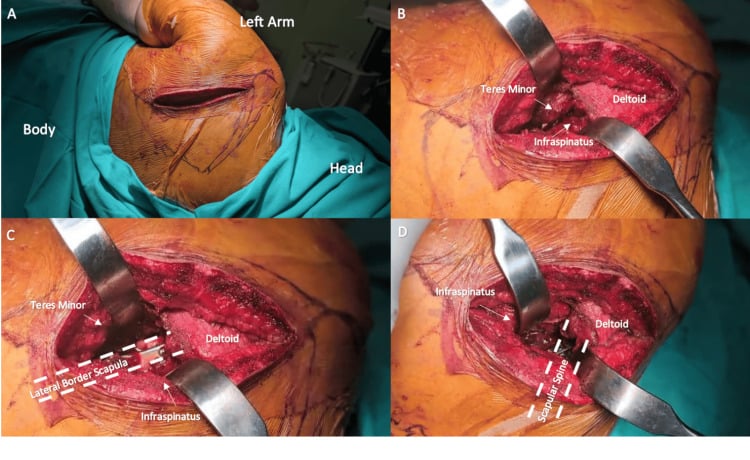
- Scapula: Judet posterior approach
- Judet: between deltoid and infraspinatus
- Protect suprascapular nerve at spinoglenoid notch
Complications
- Malunion 10-20% (especially nonoperative)
- Stiffness 15-25%
- Brachial plexus injury 5-10%
- Hardware prominence with clavicle plate
- Suprascapular nerve injury with scapula surgery
Evidence Base
Goss: Double Disruptions of the SSSC (concept paper)
- Defined the superior shoulder suspensory complex as a bone-soft tissue ring
- Introduced the 'double disruption' principle - two breaks create instability
- Unified previously isolated injury descriptions under one framework
- Surgical reduction/stabilisation indicated when displacement is unacceptable
Systematic Review: Conservative vs Surgical Floating Shoulder
- 17 studies, 371 shoulders; mean follow-up 49 months
- 58% treated surgically, 42% nonoperatively
- Mean Constant-Murley score 80% of ideal in BOTH operative and nonoperative groups
- Significant scapular neck displacement may benefit from combined fixation
RCT: Combined vs Clavicle-Alone vs Conservative (GPA correlation)
- Prospective randomised study, 39 patients, 3 arms, over 2 year follow-up
- Combined clavicle + scapula fixation gave the best post-union GPA (p=0.015)
- Combined group had best DASH and Constant scores (p=0.008 and 0.002)
- DASH and Constant scores strongly correlated with GPA after consolidation (p under 0.001)
The Floating Shoulder: A Multicentre Study (van Noort)
- 46 patients; 35 followed up, mostly treated conservatively
- Mean Constant 76 (conservative) vs 71 (operative) at 35 months
- Caudal glenoid dislocation was the key driver of poor results (Constant 42 vs 85)
- The injury is NOT inherently unstable
Coracoid (Type I) Fractures as SSSC Double Disruption
- 36 surgically treated type I coracoid fractures; double disruption in 94%
- Reduction proceeded medial-to-lateral, fixing the coracoid last
- Bone union in all fractures with no additional operations
- Mean Constant score ratio 93% of the normal side