Rim vs Body | Bone Loss Assessment Critical | Fix If Unstable
- Separate acute fracture from chronic attritional bone loss - percentage thresholds from instability cohorts do not automatically dictate acute-fragment treatment
- Describe rim versus fossa morphology, fragment viability, articular step/gap, comminution and scapular extension
- Ideberg-Goss and AO/OTA classifications describe patterns but do not replace treatment assessment
- CT is valuable for complex or operative patterns, while radiographs may suffice for clearly minor stable injuries
- Glenoid track applies to bipolar instability lesions; an off-track Hill-Sachs interval exceeds the track and may engage
- “A centred humeral head and stable clinical shoulder may permit non-operative care despite a sizeable acute rim fragment
- “On-track means the Hill-Sachs interval remains within the glenoid track; off-track means it extends medially beyond it and may engage
- “Do not convert a chronic bone-loss percentage directly into a mandatory Latarjet for an acute bony Bankart
- “Posterior/inferior fossa fractures require explicit assessment of articular congruity and posterior approach anatomy
Overview and Epidemiology
Glenoid fractures range from acute rim fragments to fossa fractures extending into the scapular neck or body. Rim fractures are often discussed in the instability literature, but an acute bony fragment is not biologically equivalent to chronic attritional glenoid loss, which is a different mechanical problem as well.
Rim fractures. A bony Bankart is an avulsion of the anteroinferior glenoid rim with the labrum and capsule attached; with the posterior rim fracture it makes up the rim group, where the key issue is instability. Assess humeral-head centring, fragment displacement and viability, labral attachment and instability.
Fossa fractures. Body fractures (Ideberg II-V) are articular fractures, where joint congruity and stability both matter and treatment turns on displacement and the joint surface. Assess articular congruity, comminution and extension into the scapular neck or body.
Mechanism. Rim fractures most often follow an anterior dislocation. The other mechanisms are:
- Direct trauma - high-energy impact to the shoulder
- FOOSH - a fall with axial loading through the shoulder
- Sports injury - contact sports, rugby, American football
Anatomy and Biomechanics
The glenoid. A shallow articular surface, approximately 25mm wide inferiorly and 35mm from superior to inferior, retroverted 5-7° relative to the scapular body. Its inferior tilt varies but affects stability.
The normal glenoid is pear-shaped (wider inferiorly). Loss of anterior bone changes this to an inverted pear - a sign of significant bone loss causing instability.
What holds the head. Bony congruity with the glenoid provides 50% of stability, and the labrum deepens the socket by 50%. The capsule and ligaments are the static restraints; the rotator cuff provides the dynamic stabilisers.
The acute fragment. An acute rim fragment may retain viable bone and its attached labrum, and it may remodel when the humeral head is centred. Centring and stability are assessed before deciding on repair.
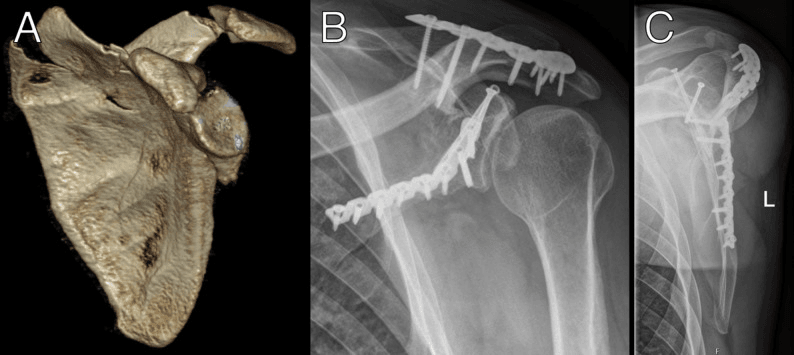
The fossa. A step, gap or comminution in the fossa alters articular congruity and load distribution. The plan comes from the CT morphology and the reduction that can be achieved.
Chronic loss. With attritional loss and a Hill-Sachs lesion, the risk of bipolar instability increases continuously. The percentage thresholds from these shoulders cannot be imported uncritically into acute fracture care, and even here the glenoid track and the patient's context guide treatment rather than one percentage alone.
Classification Systems
Ideberg's classification (1984) describes glenoid fossa fractures; Type VI was added later. The AO/OTA scheme separates rim, simple fossa and multifragmentary articular patterns. Both describe morphology rather than prescribing treatment.
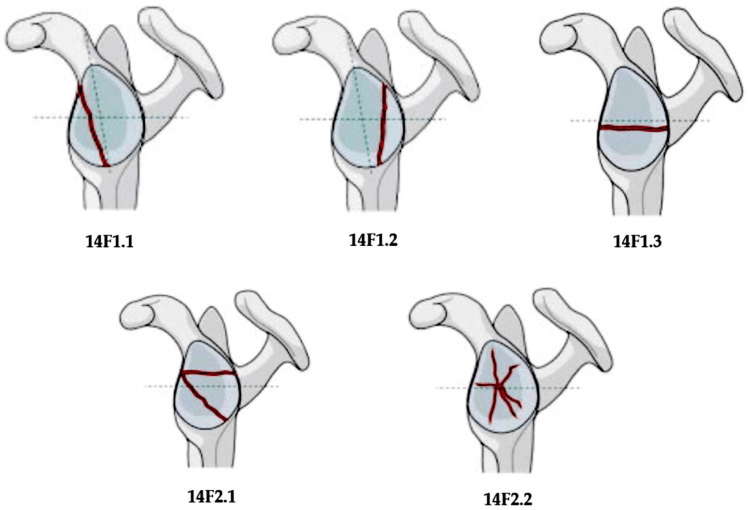
- Description
- Anterior rim fracture
- Fracture Line
- Avulsion anteroinferior
- Description
- Posterior rim fracture
- Fracture Line
- Avulsion posterior
- Description
- Transverse through glenoid
- Fracture Line
- Exits lateral scapula border
- Description
- Oblique through superior glenoid
- Fracture Line
- Exits suprascapular notch area
- Description
- Horizontal through body
- Fracture Line
- Exits medial scapula border
- Description
- Combination Type I + Type IV
- Fracture Line
- Combined rim and body
- Description
- Comminuted (added later)
- Fracture Line
- Severe comminution
Type I rim fractures are fundamentally about instability; Types II-V are about articular congruity.
Clinical Assessment
History. Establish the mechanism (dislocation, direct trauma, sport), then ask about:
- Number of prior dislocations
- Hand dominance and sport level
- Prior shoulder surgery
- Occupation and functional demands
Examination. Inspect the contour, swelling and bruising, and palpate the bony landmarks; a bony defect is sometimes palpable. Range of motion is usually limited acutely.
Instability tests. The apprehension test is positive with anterior instability, and the load-and-shift test may demonstrate increased translation. Look for associated rotator cuff weakness, especially over the age of 40.
Associated injuries. Assess the direction of dislocation, a Hill-Sachs lesion, cuff and labral injury, a scapular-neck or body fracture, chest injury, and axillary or suprascapular nerve function.
The axillary nerve is at risk with anterior dislocations and glenoid fractures. Test:
- Sensation: regimental badge area (lateral shoulder)
- Motor: deltoid function (when pain allows) Document neurovascular status clearly before and after any manipulation.
Investigations
Radiographs. The initial films identify the injury. Each view has its target:
- AP in internal rotation - Hill-Sachs
- Axillary - glenoid rim, anterior bone loss
- West Point - anteroinferior glenoid
- Stryker notch - Hill-Sachs
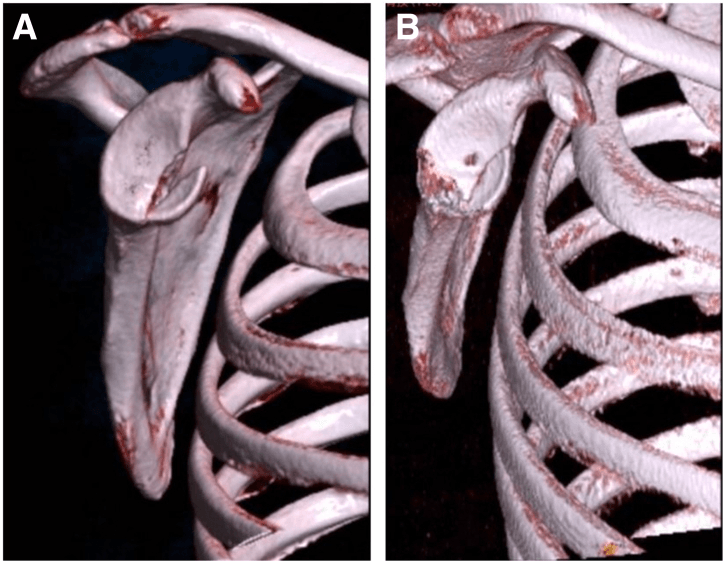
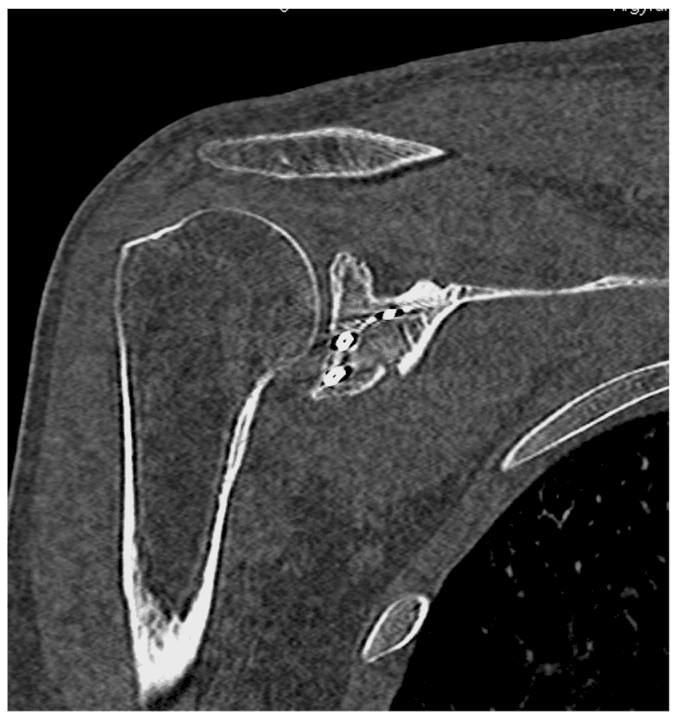
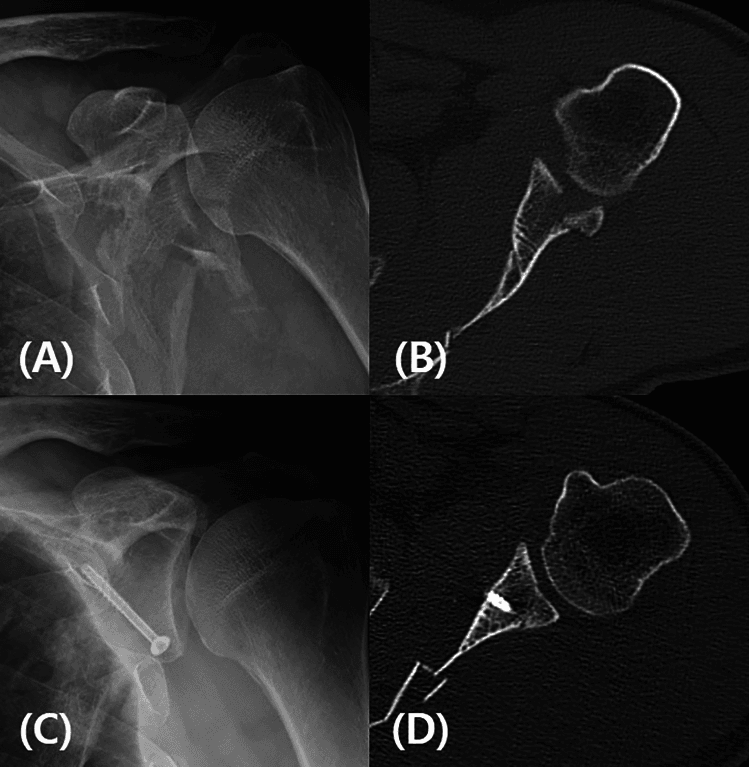
CT. CT is valuable for complex or operative patterns, while radiographs may suffice for clearly minor stable injuries. Multiplanar and three-dimensional CT define fragment orientation, step, gap, comminution and scapular extension when plain films are insufficient or surgery is considered.
- 3D reconstruction - the gold standard for bone loss
- En-face glenoid view - bone loss quantification
- Humeral subtraction - removes overlap
- Axial cuts - fracture pattern and displacement
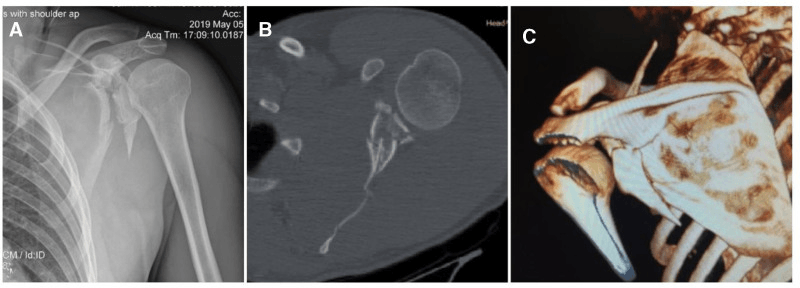
Plain X-rays underestimate glenoid bone loss by up to 50%. Whenever bone loss is to be measured, obtain CT with 3D reconstruction and humeral head subtraction. This determines whether soft tissue repair or bone augmentation is needed.
MRI. MRI shows the labral pathology of a Bankart lesion, rotator cuff tears (especially in older patients) and capsular damage such as HAGL and ALPSA lesions. Bone marrow oedema confirms the injury location.
CIRCLEGlenoid Fracture Assessment
Hook:CIRCLE: CT, Identify, Relationship, Congruity, Look, Examine.
Differential Diagnosis
- Distinguishing Features
- Anteroinferior rim defect, instability after dislocation
- Key Investigation
- 3D CT with humeral subtraction (quantify bone loss)
- Distinguishing Features
- Labral avulsion without bony fragment
- Key Investigation
- MR arthrogram
- Distinguishing Features
- High-energy, articular step, often scapular involvement
- Key Investigation
- CT (articular gap/step, fracture pattern)
- Distinguishing Features
- Humeral head impaction, may engage in abduction-ER
- Key Investigation
- CT (Hill-Sachs interval) + glenoid track
- Distinguishing Features
- Weakness, night pain, age over 40 after dislocation
- Key Investigation
- MRI / ultrasound
- Distinguishing Features
- Tuberosity tenderness, fracture line on plain film
- Key Investigation
- AP and axillary radiographs, CT if displaced
- Distinguishing Features
- Locked internal rotation, seizure/electrocution history
- Key Investigation
- Axillary view / CT
Management Algorithm
The aim. Treatment aims for a centred, stable humeral head and acceptable articular congruity. Fragment size is one variable among morphology, displacement, the patient and associated injury.
Management follows the acute fracture and the instability phenotype, in three steps.
Define the fragment. Assess its size, displacement, comminution, labral attachment and viability, and whether the humeral head is concentrically reduced.
Test stability. Consider first episode versus recurrence, sport, laxity, neurological status and any associated Hill-Sachs or cuff injury.
Select the strategy. This is a shared decision. A centred stable shoulder may be observed, a displaced viable fragment may be fixed arthroscopically or open, and chronic attritional loss may require a separate bone-augmentation strategy.
Latarjet, free bone graft, fragment fixation, Bankart repair and remplissage solve different problems. Choose among them from fragment biology, centring, track interaction, prior surgery and patient demand.
- Assess
- Humeral-head centring, stability, fragment position
- Possible Strategy
- Sling then early motion or arthroscopic fixation
- Decision Constraint
- Size alone does not mandate surgery
- Assess
- Centring, instability, fragment viability and comminution
- Possible Strategy
- Arthroscopic or open reduction/fixation; selected bone reconstruction
- Decision Constraint
- Acute fragment differs from chronic bone loss
- Assess
- Step, gap, comminution, neck/body extension
- Possible Strategy
- Non-operative care or ORIF according to congruity and stability
- Decision Constraint
- No universal millimetre threshold
- Assess
- Best-fit circle, bipolar track, prior surgery and demand
- Possible Strategy
- Instability-specific repair or augmentation
- Decision Constraint
- Use chronic-instability evidence only in this context
Surgical Technique
Indications. A first-time dislocation with a bony Bankart and under 15% bone loss, or recurrent instability with minimal bone loss.
Set-up. Beach chair or lateral decubitus, with standard posterior and anterior portals; an accessory 5 o'clock portal may be needed.
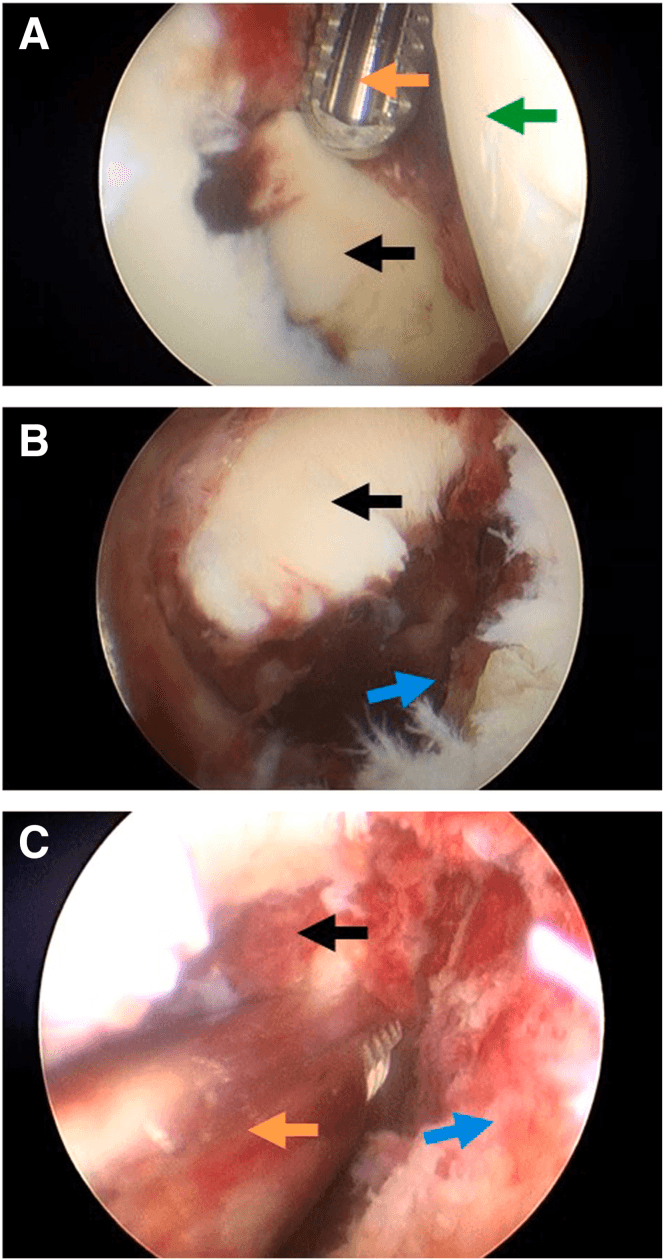
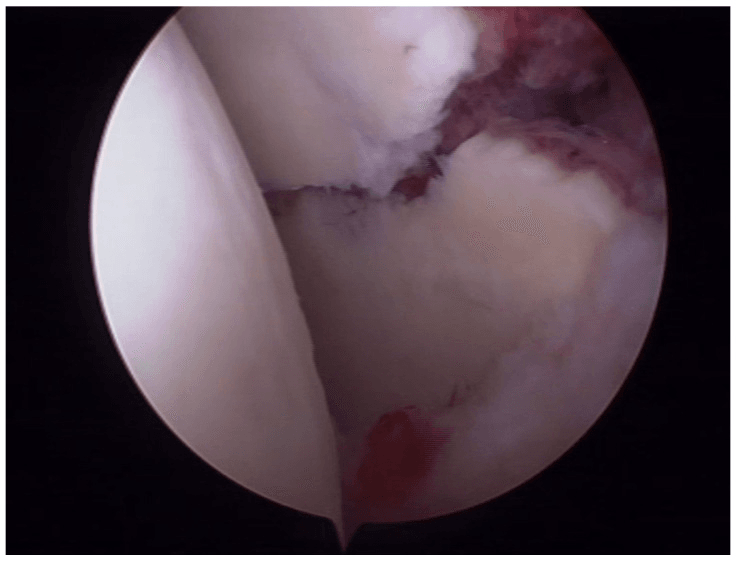
- Diagnostic arthroscopy - assess bone loss and labrum
- Prepare the glenoid rim (decorticate)
- Place anchors at the 5, 4 and 3 o'clock positions
- Pass sutures through the labrum
- Tie knots to restore the labral bumper
- A small bony fragment may be incorporated
Anchors should be placed on the glenoid face, not the neck. This restores the labral bumper effect. At least 3 anchors typically needed for adequate repair.
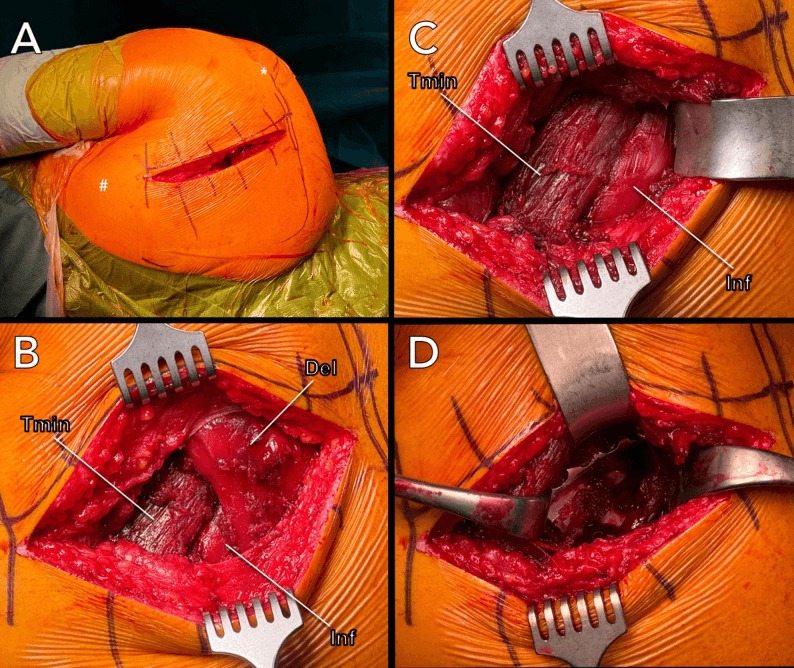
Protecting the Suprascapular Nerve in the Posterior (Judet) Approach
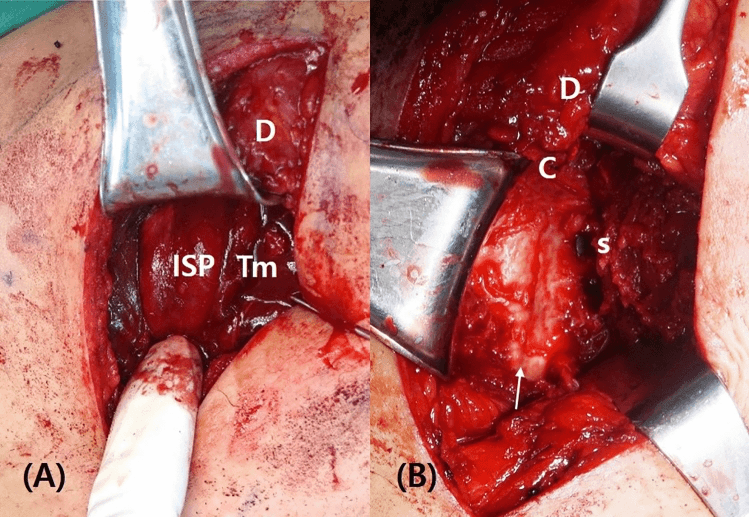
A traction neurapraxia of the suprascapular nerve is the classic avoidable complication of glenoid fossa ORIF through the posterior approach.
Course. The nerve arises from the upper trunk of the brachial plexus (C5-C6), passes deep to trapezius and omohyoid, and enters the supraspinatus fossa through the suprascapular notch, beneath the superior transverse scapular ligament. It then curves around the base of the scapular spine through the spinoglenoid (great scapular) notch to reach the infraspinatus fossa, giving motor branches to supraspinatus and infraspinatus and sensory branches to the posterior capsule.
The danger points. At the spinoglenoid notch the nerve lies only approximately 2 cm medial to the posterior glenoid rim, the point most at risk during exposure of the posterior glenoid neck and infraspinatus retraction. At the suprascapular notch it lies approximately 2.5 to 3 cm medial to the superior glenoid rim, at risk with superior dissection and medial retraction toward the base of the coracoid.
Protecting it. The nerve is tethered at both notches, so over-medial retraction, not laceration, is the usual mechanism of injury.
- Keep subperiosteal dissection on the posterior scapular neck within roughly 1.5 to 2 cm of the glenoid rim
- Develop the infraspinatus-teres minor interval carefully and avoid forceful medial traction on the infraspinatus and on the medial (body) fragment
- Watch plate and screw position along the lateral scapular pillar: an over-medially directed screw or a medially placed retractor at the spinoglenoid notch endangers the nerve
- Document deltoid and infraspinatus/external-rotation function before and after surgery
Complications
- Incidence
- 5-25%
- Risk Factors
- Bone loss over 25%, soft tissue repair
- Management
- Revision with bone augmentation
- Incidence
- 10-30%
- Risk Factors
- Malreduction, excessive lateralisation
- Management
- Activity modification, arthroplasty
- Incidence
- 5-15%
- Risk Factors
- Prolonged immobilisation, capsular repair
- Management
- Physiotherapy, manipulation, arthroscopy
- Incidence
- Less than 5%
- Risk Factors
- Surgical approach, retraction
- Management
- Observation, exploration if no recovery
- Incidence
- 5-10%
- Risk Factors
- Poor technique, smoking
- Management
- Observation if stable, revision if unstable
- Incidence
- Less than 5%
- Risk Factors
- Poor bone quality, early motion
- Management
- Revision fixation
Factors increasing recurrence after instability surgery:
- Bone loss over 25% not addressed
- Off-track Hill-Sachs not addressed
- Young age (under 20)
- Contact sport athlete
- Connective tissue disorder
Postoperative Care
Rehabilitation Protocol - Instability Surgery
- Sling immobilisation
- Pendulum exercises only
- No external rotation beyond neutral
- Elbow, wrist, hand ROM
- Passive to active-assisted ROM
- Begin external rotation to 30°
- Forward flexion to 120°
- Wean from sling
- Full ROM goal
- Isometric then isotonic strengthening
- Rotator cuff programme
- Scapular stabilisation
- Sport-specific training
- Plyometrics
- Contact sports at 6 months
- Full clearance after strength testing
After ORIF. Weight-bearing is restricted until union, and range of motion is set by the stability of the fixation, with earlier motion when fixation is stable.
Outcomes and Prognosis
- Recurrence
- 5-15% (higher with bone loss)
- Return to Sport
- 85-95%
- Arthritis Risk
- Low
- Recurrence
- 5-10%
- Return to Sport
- 85-90%
- Arthritis Risk
- Low
- Recurrence
- 2-5%
- Return to Sport
- 90-95%
- Arthritis Risk
- 10-30% (long-term)
- Recurrence
- N/A
- Return to Sport
- 80-90%
- Arthritis Risk
- Depends on reduction
The Comminuted Fossa: Managing the Ideberg Type VI Fracture
Ideberg Type VI, comminution of the glenoid fossa, is the highest-energy and hardest-to-fix pattern, and the one most likely to appear in a senior viva.
The injury. Multifragmentary comminution of the articular fossa, almost always from the highest-energy injuries (motor vehicle trauma, falls from height), frequently extending into the scapular neck and body with associated chest-wall, rib or clavicle injury. Rigid anatomic fixation of every articular fragment is often impossible, so the surgical decision is different from the reconstructable II-V patterns.
What decides. Concentricity and reducibility, not fragment count. The key question is whether the humeral head remains concentric and stable beneath a reconstructable articular surface; a centred head under a congruent, even if imperfect, reconstruction predicts a good outcome. CT with 3D reconstruction shows the size and reducibility of the major peripheral fragments, and these, not the small central pieces, dictate whether fixation is feasible.
Management. Three situations:
- Reconstructable major fragments, concentric head - ORIF aimed at restoring the articular arc and rim stability: small-fragment or reconstruction plates buttressing the lateral scapular pillar, with peripheral rim screws or suture anchors capturing the key articular fragments. The goal is a congruent, stable surface, not the reduction of every tiny fragment.
- Unreconstructable fossa, concentric head, low-demand patient - nonoperative treatment with early protected motion can give an acceptable result when the head stays centred
- Unsalvageable articular surface, incongruent or unstable head - delayed reconstruction or, rarely, arthroplasty may be required, as a salvage rather than a primary decision
Even complex, displaced fossa fractures with scapular involvement unite reliably and function well when the reconstructable surface is restored, which supports an attempt at fixation of the major fragments where feasible.
Guidelines, Registries & Global Practice
Global epidemiology:
- Anterior shoulder dislocation incidence is highest in young males (peak in the second to third decades) and in contact/collision athletes (rugby, American football, ice hockey).
- A bony Bankart (anteroinferior rim fracture) is present in a substantial minority of first-time dislocations; some degree of glenoid bone loss accumulates with recurrent dislocations.
- Isolated glenoid body (Ideberg II-VI) fractures are uncommon, usually high-energy, and frequently associated with scapular and chest-wall injury.
Side-by-side society/expert guidance:
- Bone Loss / Imaging
- 3D CT for bone loss; quantify before stabilisation
- Procedure Emphasis
- Individualised; bone augmentation for significant loss
- Bone Loss / Imaging
- Risk stratification (e.g. ISIS); CT if bone loss suspected
- Procedure Emphasis
- Arthroscopic Bankart for low-risk; Latarjet for bone loss/high-risk
- Bone Loss / Imaging
- CT mandatory for articular fractures; assess displacement/step
- Procedure Emphasis
- ORIF for displaced (4mm or more) body fractures, congruity-driven
- Bone Loss / Imaging
- Glenoid track and bipolar loss assessment routine
- Procedure Emphasis
- Track-based: remplissage vs Latarjet for off-track lesions
- Instability and stabilisation procedures are not as systematically captured as arthroplasty in joint registries; most evidence is from institutional series and meta-analyses (e.g. An 2016).
- Where shoulder instability registries exist (e.g. regional and national instability databases in Europe), they reinforce that recurrence rises with glenoid bone loss, younger age, and contact sport — mirroring the ISIS risk factors.
- Where 3D CT is readily available, bone loss is quantified preoperatively and the glenoid track guides surgery.
- In limited-resource settings, plain radiographs (West Point, Stryker notch) and intra-operative arthroscopic assessment of the bare-spot/inverted-pear may substitute, accepting that plain films underestimate bone loss.
- Open Bankart and open Latarjet remain reliable, equipment-light options where advanced arthroscopic capability is limited.
Controversies & Areas of Uncertainty
The classic 20-25% threshold is challenged by 'subcritical' data (Shaha 2015) showing functional decline above ~13.5%. The exact cut-off, and how it interacts with the glenoid track, remains debated.
For off-track lesions with subcritical glenoid loss, arthroscopic Bankart plus remplissage competes with Latarjet. Comparative trials are ongoing and the optimal indication boundary is unsettled.
Arthroscopic Latarjet offers visualisation advantages but a steep learning curve and graft-positioning concerns. Whether it matches open results in routine practice is not established.
For a bony Bankart, whether to incorporate and fix the fragment versus excise it and repair soft tissue (and the size threshold for doing so) varies by surgeon and remains an area of practice variation.
MCQ Practice Points
Q: Does one percentage of glenoid bone loss mandate bone augmentation for every glenoid fracture?
A: No. Chronic instability data show a continuous relationship between loss and outcome, modified by Hill-Sachs interaction, demand and prior surgery. Acute rim-fragment viability and humeral-head centring must be assessed separately.
Q: An Ideberg Type III glenoid fracture is:
- A) Anterior rim avulsion
- B) Transverse fracture exiting lateral border
- C) Oblique fracture exiting superiorly
- D) Horizontal fracture exiting medially
A: C - Type III is an oblique fracture through the superior glenoid exiting near the suprascapular notch.
Q: The glenoid track is calculated as:
- A) 0.5 x glenoid width + bone loss
- B) 0.83 x glenoid width - bone loss
- C) 1.0 x glenoid width - bone loss
- D) 0.83 x glenoid width + Hill-Sachs interval
A: B - Glenoid track = 0.83 x inferior glenoid width - glenoid bone loss (d).
Q: What does Latarjet provide stability through all EXCEPT?
- A) Bone block effect
- B) Sling effect of conjoint tendon
- C) Capsular repair
- D) Rotator cuff augmentation
A: D - Latarjet provides bone block, sling effect (conjoint tendon), and capsular repair. It does not augment the rotator cuff.
Q: What does an inverted pear glenoid indicate? A: Significant anterior-inferior bone loss (greater than 25%). Normal glenoid is pear-shaped with wider inferior portion. An inverted pear indicates loss of inferior width, causing recurrent instability.
Q: Why is CT with 3D reconstruction essential for glenoid fractures? A: Plain X-rays underestimate bone loss by up to 50%. CT with humeral head subtraction and en-face glenoid view allows accurate quantification of bone loss for surgical planning.
Exam Viva Scenarios
Practise clinical reasoning and management decisions out loud
“A 24-year-old rugby player has had 5 anterior dislocations over 2 years. MRI shows Bankart lesion. CT shows 22% anteroinferior glenoid bone loss. How would you manage this patient?”
“A 45-year-old woman presents after motor vehicle accident with severe shoulder pain. X-rays show a glenoid fracture. CT reveals an Ideberg Type III fracture with 5mm articular step. How would you manage this?”
“A 28-year-old presents after first-time dislocation. CT shows 18% glenoid bone loss and a large Hill-Sachs lesion measuring 25mm (medial to lateral). How do you decide on treatment?”
Classification
- Type I = rim avulsion (bony Bankart)
- Type II = transverse (exits laterally)
- Type III = oblique (exits superiorly)
- Type IV = horizontal (exits medially)
- Type V = combined I + IV
- Type VI = comminuted
Bone Loss Interpretation
- Distinguish acute rim fragment from chronic attritional loss
- Report measurement method and bipolar Hill-Sachs interaction
- Risk changes continuously rather than at one universal threshold
- Patient, sport, laxity, prior surgery and fragment biology modify treatment
Glenoid Track
- Track estimate depends on intact width and anterior loss
- Compare with the Hill-Sachs interval
- Interval within track = on-track; beyond track = off-track
- Off-track lesions may engage but do not mandate one operation
- Choose humeral- and glenoid-sided treatment from the full instability phenotype
Surgical Options
- Acute viable rim fragment: observe or fix according to centring and stability
- Chronic attritional loss: instability-specific repair or bone augmentation
- Fossa fracture: non-operative care or ORIF according to congruity and stability
- Remplissage: selected humeral-sided treatment for relevant Hill-Sachs lesions
Complications
- Recurrence 5-15% (higher with bone loss)
- Arthritis 10-30% (especially post-Latarjet)
- Stiffness 5-15%
- Nerve injury under 5%
Evidence Base
Redefining Critical Bone Loss (Subcritical Loss)
- Cohort of 72 patients (73 shoulders) after isolated arthroscopic Bankart repair, mean follow-up 48 months
- WOSI and SANE scores worsened progressively with each quartile of increasing bone loss
- Bone loss above 13.5% led to clinically unacceptable WOSI scores even without recurrence
- Overall failure 12.3%; bone loss higher in failures (24.7% vs 12.8%, p less than 0.01)
Glenoid Track Concept (On-Track / Off-Track)
- Introduced on-track/off-track paradigm for bipolar (glenoid plus humeral) bone loss
- Off-track Hill-Sachs engages the anterior rim and risks recurrence
- For glenoid loss of 25% or more (inverted-pear), glenoid bone grafting is recommended
- Provided a quantitative treatment paradigm for all anterior instability patterns
3D CT Glenoid Index for Bone Loss
- 25 instability patients had bilateral 3D CT with humeral subtraction vs arthroscopic measurement
- Glenoid index = injured/uninjured inferior diameter; cut-off 0.75 (about 25% loss)
- 3D CT predicted the arthroscopic decision (Bankart vs open Latarjet) in 24/25 (96%)
- Glenoid index of 0.75 or less predicted need for bone grafting