Articular Surface | Head Split | Impression | High AVN Risk
- Head split - a fracture line traversing the articular surface of the humeral head
- Blood supply - disruption of the arcuate artery (ascending branch of the anterior circumflex) leads to AVN
- Impression fractures - often associated with dislocations (Hill-Sachs or reverse Hill-Sachs)
- Surgical dilemma - reconstruct (high failure rate) or replace (activity restrictions)
- Examination - often indistinguishable from other proximal humerus fractures without CT
- “Head-splitting fractures are non-reconstructable in the elderly
- “Headless compression screws (Herbert) are used for articular fixation
- “Reverse total shoulder arthroplasty is preferred for the elderly with cuff dysfunction
- “Monitor for post-traumatic arthritis
Overview
Humeral head fractures involve the articular surface of the proximal humerus, which sets them apart from extra-articular tuberosity and surgical neck fractures. They are difficult for three reasons: the risk of avascular necrosis (AVN), post-traumatic arthritis, and the technical difficulty of reduction.
Mechanism. In the young the injury is high energy: an axial load, a fall from height or a motor vehicle accident. In the elderly a low-energy fall is enough. Osteoporotic bone collapse and seizures complete the list, and a seizure should make you think of a posterior dislocation with an impression fracture.
Prognosis. Complication rates are high and AVN is the primary concern. Stiffness is common. Arthroplasty is reliable for pain relief, but function after it is variable.
Anatomy and Pathophysiology
The head. The articular surface is spheroid, retroverted 20-30 degrees and inclined at 130 degrees.
Bone quality. The subchondral bone is dense, but the centre of the head is cancellous and porous and gives poor screw hold, so fixation relies on subchondral purchase. That poor central bone stock is what makes fixation difficult in the elderly.
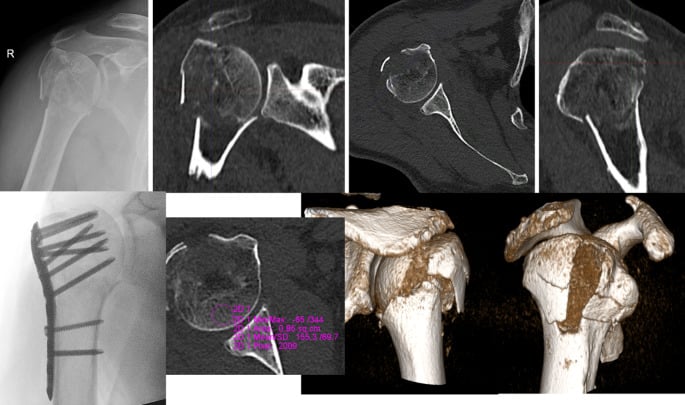
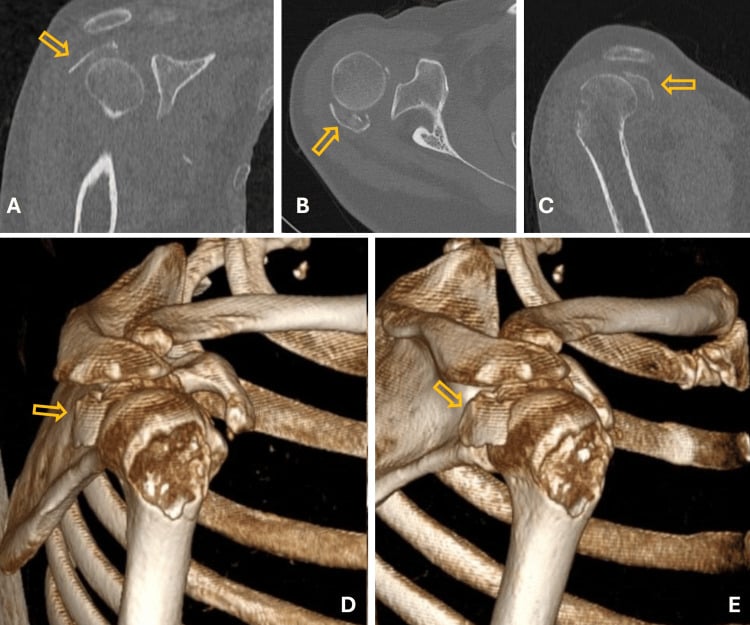
Head-splitting fractures. A vertical fracture line runs through the articular surface and separates the head into anterior and posterior, or medial and lateral, segments. A true head split has a very poor prognosis for AVN and is difficult to fix reliably.
Impression fractures. The articular surface is compressed, an indent made by impact against the glenoid rim. The Hill-Sachs lesion is posterolateral and follows anterior dislocation; the reverse Hill-Sachs is anteromedial and follows posterior dislocation. Reverse Hill-Sachs impressions affecting more than 40% of the head surface are often caused by missed posterior dislocations.
The fracture pattern dictates whether the head can be reconstructed.
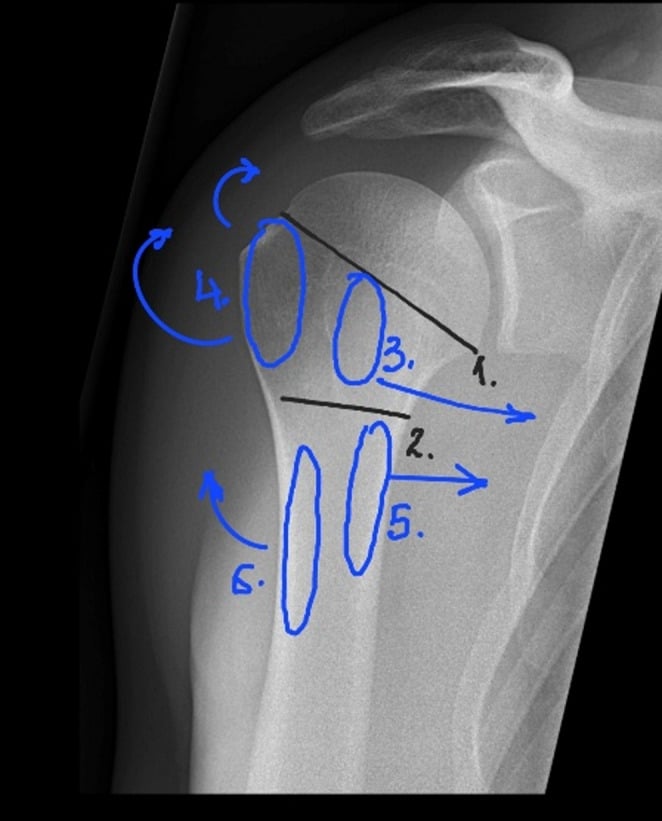
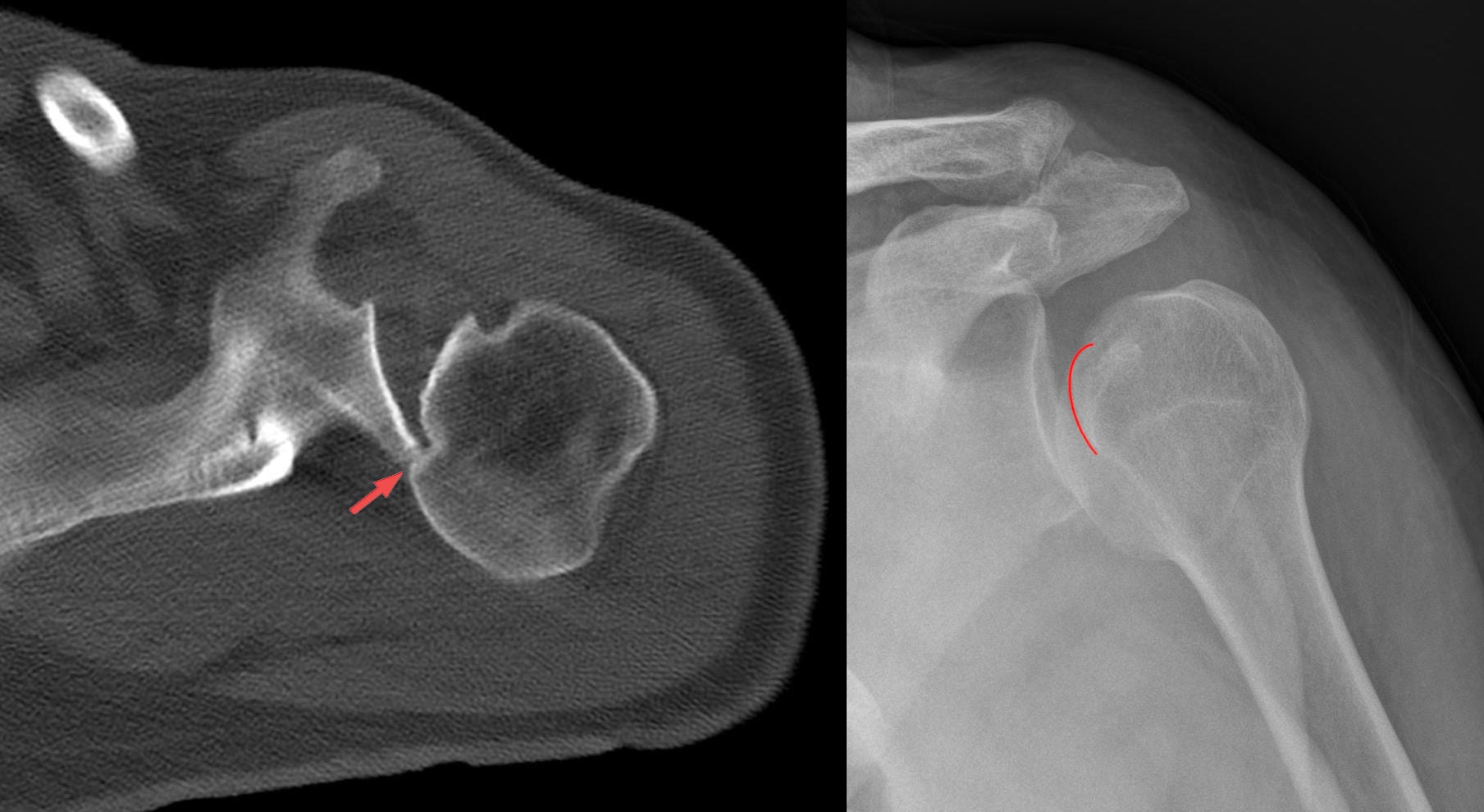
Blood Supply of the Humeral Head: Classic vs Current
AVN is the complication that defines this topic, and the account of the head's blood supply has been revised.
The classic teaching. The anterior humeral circumflex artery (AHCA) is the dominant supplier, through its ascending branch, the arcuate artery ("Laing's arcuate"). It runs up the lateral bicipital groove and enters the head at the ligamentous insertion to perfuse most of it. Anatomical-neck fractures sever it as it enters the head, which is why they carry the highest AVN risk and why the classic exam answer to "which artery is most at risk?" remains the AHCA and its arcuate branch. The surgical lesson drawn was to protect the arcuate artery in the groove.
The modern revision. Quantitative perfusion studies, contrast-enhanced MRI and cadaveric injection work, have shown that the posterior humeral circumflex artery (PHCA), classically a minor contributor, supplies the majority of the head, on the order of two-thirds. It enters posteromedially, by way of the posterior cuff. The anterior circumflex remains a real but smaller contribution.
Why the calcar matters. An intact dorsomedial metaphyseal segment, the Hertel "calcar", preserves the posterior circumflex contribution, and preserving the medial hinge protects that supply. This is why a short calcar predicts ischaemia, and why disruption of the medial calcar often compromises perfusion. Medial periosteal disruption is a further risk factor for AVN.
Name the arcuate branch of the anterior circumflex as the classic vessel "at risk" in an anatomical-neck fracture, then score the higher mark by adding that modern perfusion studies show the posterior circumflex supplies most of the head, which is why preserving the medial calcar/hinge (Hertel, under ~8 mm = high ischaemia risk) is the single most important vascular consideration in fixation.
Classification
Neer's classification focuses on displacement and AVN risk. For the articular segment it recognises:
- Anatomical neck fracture - rare, with a high AVN risk
- Impression fracture - graded less than 20%, 20-40% and greater than 40%
- Head splitting - a comminuted articular surface
Clinical Assessment
History. The patient has severe pain, global swelling and crepitus with any motion. Severe crepitus suggests intra-articular comminution.
Inspection. Look for extensive ecchymosis over the chest wall and arm, and for deformity.
Neurovascular status. Always assess the axillary nerve, by deltoid tone and patch sensation: its proximity to the surgical neck puts it at risk. Check the distal pulses to ensure the vascular tree is intact.
Do not test range of motion. Aggressive motion can displace the fragments further, so allow gentle pendulum movement only if the fracture is stable. The aim is to protect the soft tissues and the neurovascular structures.
Investigations
Radiographs. The trauma series is a screening tool only:
- AP (Grashey) - joint space narrowing, fragmentation
- Scapular Y - dislocation check
- Axillary - key for head shape and tuberosity position
Plain films often underestimate articular involvement, and overlapping shadows obscure split lines. They cannot accurately characterise the percentage of articular involvement or the number of head fragments.
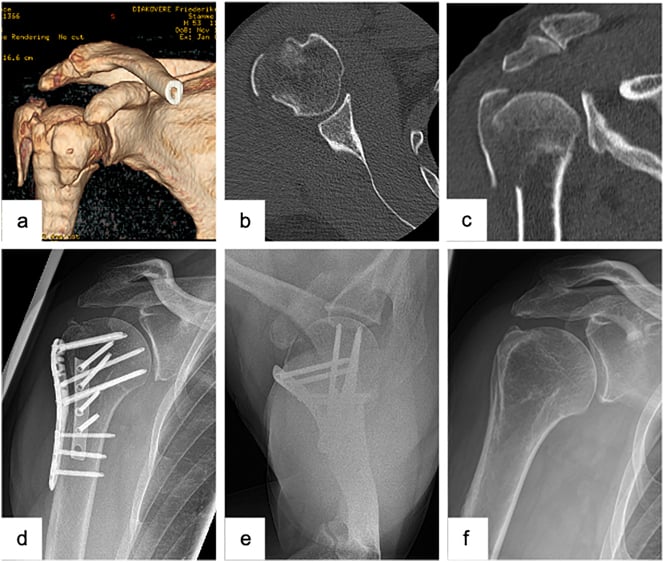
CT is mandatory. Order it whenever articular involvement is suspected. The two-dimensional cuts show fracture lines through the cartilage, CT quantifies the impression as a percentage of surface area, and three-dimensional reconstruction with the scapula subtracted is vital for surgical planning.
Angiography and MRI. Angiography is rarely indicated unless pulses are absent, and MRI is not typically used in the acute fracture setting.
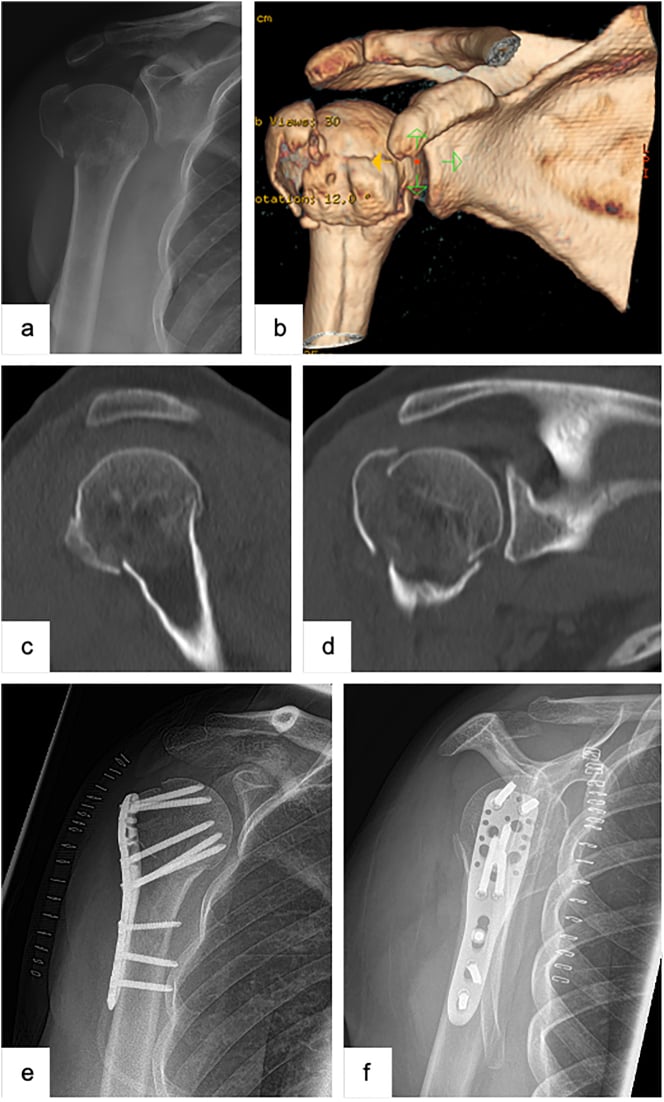
Differential Diagnosis
A head-splitting or impression fracture must be distinguished from the more common proximal humeral injuries and from non-fracture causes of acute shoulder pain, because management diverges sharply.
- Distinguishing features
- Vertical line through articular surface; high AVN risk; intra-articular fragments
- Key investigation
- CT (mandatory)
- Management contrast
- ORIF in young, arthroplasty in elderly
- Distinguishing features
- Extra-articular; metaphyseal; tuberosities and head intact
- Key investigation
- AP and axillary radiographs
- Management contrast
- Often non-operative (PROFHER)
- Distinguishing features
- Extra-articular avulsion; superior displacement; cuff at risk
- Key investigation
- Axillary view, MRI for cuff
- Management contrast
- Fix if displaced over 5mm
- Distinguishing features
- Light-bulb sign; reverse Hill-Sachs impression; arm fixed in internal rotation
- Key investigation
- Axillary view / CT
- Management contrast
- Reduction then defect-size-based repair
- Distinguishing features
- Squared-off shoulder; posterolateral impression; recurrent instability
- Key investigation
- AP/axillary, CT for bone loss
- Management contrast
- Reduction; address engaging lesion
- Distinguishing features
- Chronic pain, no acute trauma, osteophytes
- Key investigation
- Radiographs
- Management contrast
- Non-operative or elective arthroplasty
Management Algorithm
The decision. Whether to fix or replace turns on age and comminution. Whichever is chosen, the goals are the same: an anatomic reduction that restores the articular surface, tuberosities that heal (critical for cuff function), and early motion to prevent stiffness.
- Population
- Young (less than 55)
- AVN risk
- High
- Key factor
- Bone stock good; reconstruction difficult but possible
- Treatment
- ORIF (Headless screws) - attempt salvage
- Population
- Elderly (greater than 65)
- AVN risk
- Very high
- Key factor
- Poor bone stock; poor reconstructability
- Treatment
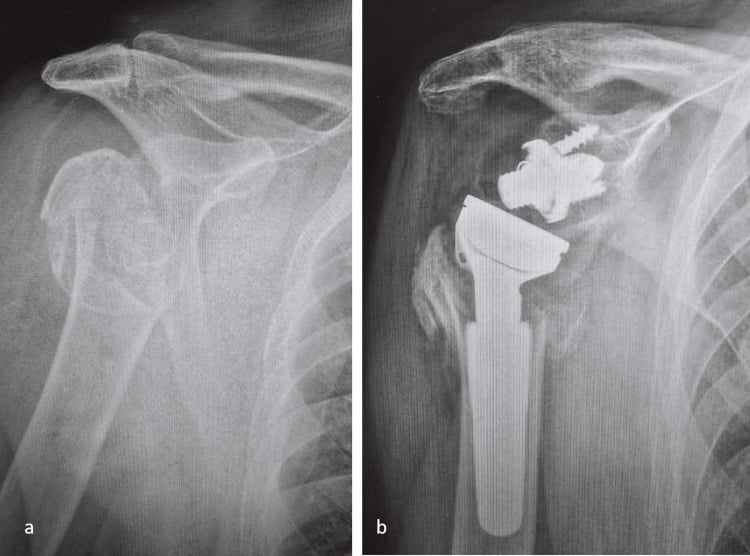
- Hemi or Reverse Arthroplasty
- Population
- Any
- AVN risk
- Low
- Key factor
- Less than 20%
- Treatment
- Non-operative
- Population
- Active
- AVN risk
- Variable
- Key factor
- Greater than 40%; poor reconstructability
- Treatment
- Allograft / Arthroplasty
Impression fractures by size. The size of the defect sets the treatment, together with its zone of contact: does it engage in function?
- Less than 20% - non-operative; the defect can be ignored
- 20-40% - disimpaction, grafting or transfer
- Greater than 40% - arthroplasty or allograft
Non-operative treatment suits:
- Non-displaced fractures
- Minimally displaced head splits, though they rarely stay reduced
- Impression fractures less than 20%
- Low-demand patients and those with medical contraindications
Protocol. A sling for 2-4 weeks, early passive motion to prevent stiffness, and weekly radiographs to watch for displacement. The price is an accepted risk of post-traumatic arthritis.
The "Head Split" is the most feared pattern. In an elderly patient, it is an automatic indication for arthroplasty as fixation failure and AVN are almost guaranteed.
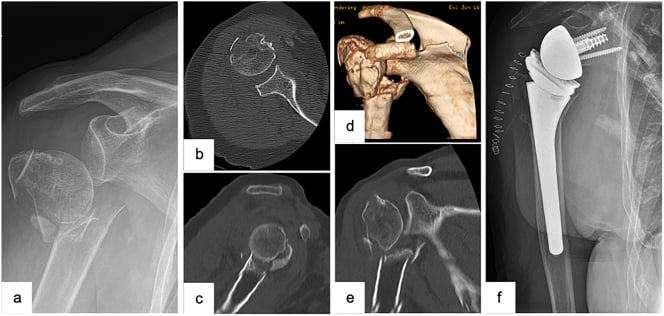
Surgical Technique
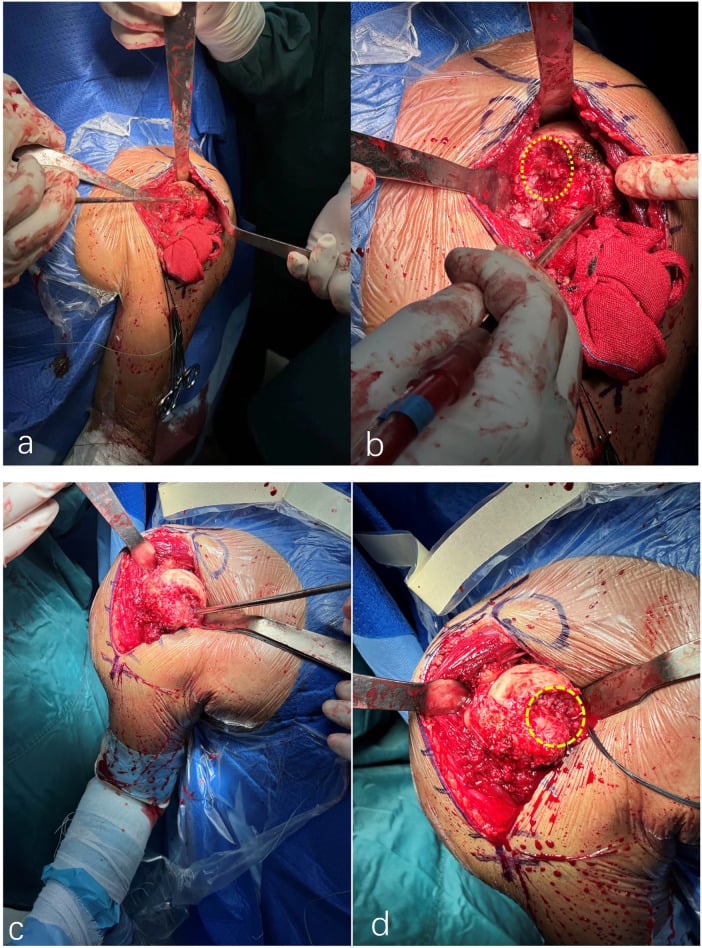
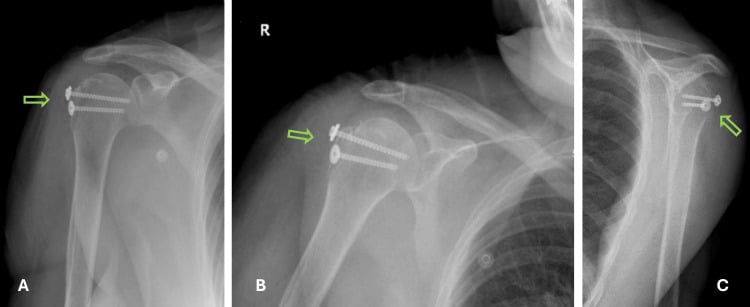
For the young patient with a head split. Meticulous technique is required to avoid screw cut-out.
- Deltopectoral approach
- Open-book the tuberosities to see the joint, and clamp the head fragments
- Fix with 3.0mm or 4.0mm headless compression (Herbert) screws, buried beneath the articular cartilage; they must sit sub-flush
- Repair the tuberosities and cuff over the construct
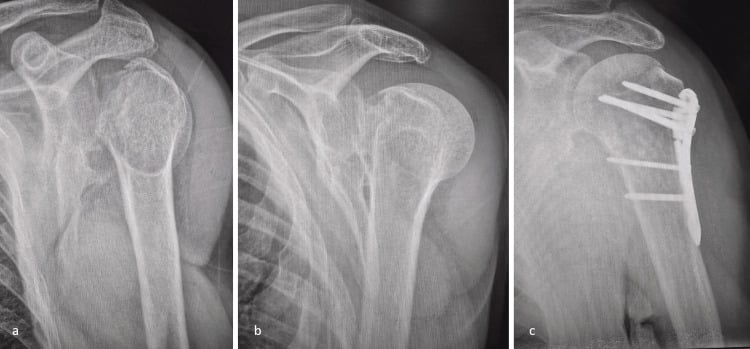
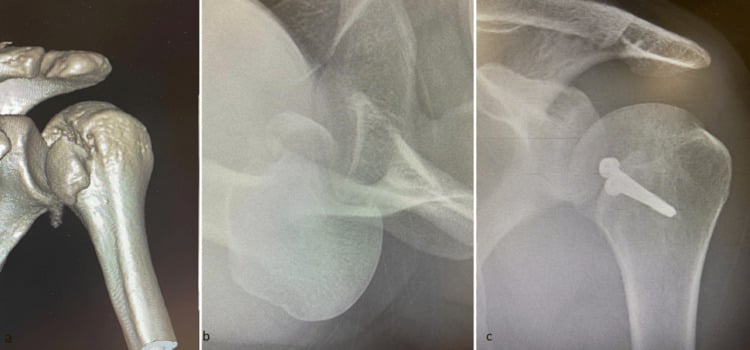
Tuberosity Reconstruction in Fracture Arthroplasty
Why it matters. When the head is replaced for a comminuted fracture, the greater and lesser tuberosities, carrying the rotator cuff, are free fragments that must be reattached and must heal as bone for the cuff to work. In the randomised data cited here (Sebastia-Forcada), only about 57-65% of tuberosities healed.
Why reverse has overtaken hemiarthroplasty. The functional outcome of a hemiarthroplasty depended on tuberosity healing, whereas a reverse arthroplasty performed well even when the tuberosities failed, because its deltoid-driven mechanics do not rely on the cuff. That contrast is the decisive advantage, and the core reason RTSA has overtaken hemiarthroplasty for the elderly fracture.
- Detail
- A low-profile, often porous/grafted metaphysis lets the tuberosities sit against bone-friendly metal at the correct height and version
- Detail
- Greater tuberosity posterolateral and lesser tuberosity anteromedial, both BELOW the head/articular margin and reduced to the shaft - restore height and retroversion
- Detail
- Horizontal sutures encircling the stem PLUS vertical sutures from the shaft through the tuberosities and cuff ('tension-band' style) - a cable/suture cage
- Detail
- Autogenous cancellous bone graft (from the resected head) packed behind the tuberosities to promote union
- Detail
- Too-high a head or malreduced tuberosities prevents healing and blocks rotation
When they fail. Tuberosity nonunion or resorption gives a poor result: loss of active external rotation and elevation and, in a hemiarthroplasty, anterosuperior escape of the prosthetic head. RTSA tolerates this far better, so it is the safer choice when the tuberosities are badly comminuted or osteoporotic. Generic RTSA technique and complications such as notching are covered in reverse-total-shoulder-arthroplasty.
Complications
Avascular necrosis. Ischaemia leads to head collapse, screw cut-out and joint destruction. Displaced head-split fractures are widely regarded as carrying a high AVN risk, and once split the articular surface cannot be preserved, which is why arthroplasty dominates the pattern. No series cited on this page quantifies the rate, so do not quote one.
Post-traumatic arthritis. Even when the fracture heals, the articular damage leads to rapid arthrosis, and conversion to arthroplasty may be needed later.
Tuberosity nonunion. After ORIF or hemiarthroplasty, tuberosities that do not heal leave poor function, with loss of active elevation and rotation. Reverse arthroplasty is the exception described above.
Stiffness and frozen shoulder. Scarring and pain limit motion. Early rehabilitation has to be balanced against the stability of the fixation.
Postoperative Care
- Sling immobilisation
- Pendulums only
- Elbow, wrist and hand range of motion
- Supine passive forward elevation
- External rotation restricted to protect subscapularis and tuberosities
- Pulley exercises
- Wean the sling
- Active-assisted range of motion (wand exercises)
- Hydrotherapy
- Radiograph to check for AVN or collapse
- Cuff strengthening
- Scapular stabilisers
- Return to non-contact activity
Outcomes
ORIF. Function is good if the reduction is maintained and AVN avoided. Reoperation is roughly twice as likely after operative than after non-operative treatment of proximal humeral fractures (Handoll & Brorson, RR 2.06, 95% CI 1.18-3.60), though that is a surgical-neck cohort, not head splits. Solberg's plate arm still outscored hemiarthroplasty in three-part fractures, despite six osteonecroses and six screw perforations in 38 patients.
Reverse arthroplasty. In the one cited RCT (Sebastia-Forcada, over-70s), RSA gave a mean forward elevation of 120 degrees and a Constant score of 56.1, against 79.8 degrees and 40.0 for hemiarthroplasty. Rotation is the persistent limitation of reverse designs.
Hemiarthroplasty. Pain relief is variable and depends on glenoid wear. It is a good option if the glenoid is pristine, but RTSA is surpassing it for reliability.
Guidelines, Registries & Global Practice
Head-splitting and impression fractures are rare, so almost no dedicated guideline addresses them directly; recommendations are extrapolated from the broader proximal humeral fracture literature, which is dominated by surgical-neck patterns.
Global epidemiology
- Proximal humeral fractures are the third most common fragility fracture after hip and distal radius, with a strongly bimodal distribution (young high-energy, elderly low-energy osteoporotic).
- True head-splitting fractures represent a small minority of proximal humeral injuries; isolated impression fractures are usually a feature of locked dislocations (anterior dislocation produces a Hill-Sachs lesion; posterior dislocation produces a reverse Hill-Sachs).
- Position relevant to head fractures
- Inconclusive/limited evidence for most operative vs non-operative decisions; emphasises shared decision-making and individualized care
- Position relevant to head fractures
- Early senior assessment, CT for intra-articular or complex patterns, and timely referral of reconstructable injuries to specialist upper-limb units
- Position relevant to head fractures
- Classifies articular involvement as 11-C; recommends CT for surgical planning and head-preserving fixation only where vascularity and bone stock permit
- Position relevant to head fractures
- Supports reverse arthroplasty over hemiarthroplasty in elderly non-reconstructable fractures, reflecting RCT and registry data
Registry evidence
- Multiple national arthroplasty registries (AOANJRR, NJR, the Nordic registries) document a marked shift from hemiarthroplasty to reverse total shoulder arthroplasty for fracture indications in patients over 65, with better implant survivorship and lower revision rates for RSA than fracture hemiarthroplasty.
- Registry data consistently show that fracture is a higher-risk arthroplasty indication than elective osteoarthritis, reinforcing careful patient selection.
High- vs limited-resource practice variation
- High-resource settings: routine CT with 3D reconstruction, ready access to headless compression screws, osteoarticular allograft, and modular reverse arthroplasty systems.
- Limited-resource settings: reliance on plain radiographs, greater use of non-operative management or hemiarthroplasty where reverse systems or allograft are unavailable, and selective referral of young reconstructable head splits to tertiary centres.
- Long-term surveillance for AVN and post-traumatic arthritis (clinical and radiographic, typically to 2 years) is recommended wherever feasible.
Controversies and Areas of Uncertainty
No randomized data exist for head-splitting fractures. Joint preservation is favoured in patients under 50 to avoid lifelong arthroplasty constraints, but reported AVN and reoperation rates after ORIF are high. The threshold of age, comminution and bone quality at which replacement becomes preferable is undefined.
RCT (Sebastia-Forcada) and registry data favour reverse arthroplasty for elderly non-reconstructable fractures, yet hemiarthroplasty may still suit younger patients with intact cuff and reconstructable tuberosities. Long-term durability of reverse implants in this group remains uncertain.
The classic cut-offs (under 20% ignore, 20-40% transfer/graft, over 40% arthroplasty/allograft) are based on small series and biomechanical reasoning, not high-level evidence. Engagement during functional motion may matter more than absolute percentage.
Hertel criteria predict intraoperative ischemia, but ischemia does not always progress to symptomatic collapse, and revascularization can occur. Whether a high Hertel score alone should mandate primary replacement is debated.
MCQ Practice
Self-Assessment Questions
Q: Which artery provides the primary blood supply to the humeral head and is most at risk in anatomical neck fractures?
- A) Posterior Humeral Circumflex artery
- B) Anterior Humeral Circumflex artery (Arcuate branch)
- C) Suprascapular artery
- D) Thoracoacromial artery
- E) Subscapular artery
A: B - The arcuate branch of the Anterior Humeral Circumflex Artery ascends in the bicipital groove and enters the head intra-articularly. It is most commonly disrupted in anatomical neck fractures.
Q: According to Hertel, which factor is the strongest predictor of humeral head ischemia?
- A) Age greater than 60
- B) Medial hinge less than 8mm
- C) 4-part fracture pattern
- D) Head split component
- E) Tuberosity displacement greater than 1cm
A: B - A medial metaphyseal head extension (medial hinge) of less than 8mm is the strongest predictor of ischemia due to disruption of the posterior circumflex contribution.
Q: What is the preferred treatment for a displaced head-splitting fracture in a 75-year-old active patient?
- A) Non-operative treatment
- B) ORIF with locking plate
- C) Hemiarthroplasty
- D) Reverse Total Shoulder Arthroplasty
- E) Resection Arthroplasty
A: D - RTSA is preferred in the elderly with head-splitting fractures due to the high failure rate of ORIF (AVN/Cutout) and the unreliability of Hemiarthroplasty (tuberosity healing/cuff function).
Q: A 'Reverse Hill-Sachs' lesion is associated with which direction of shoulder instability?
- A) Anterior
- B) Posterior
- C) Inferior (Luxatio Erecta)
- D) Multidirectional
- E) Superior
A: B - A Reverse Hill-Sachs lesion is an impression fracture on the anteromedial aspect of the humeral head, caused by impaction against the posterior glenoid rim during a Posterior dislocation.
Q: When fixing a head-split fracture in a young patient, which implant minimizes articular damage?
- A) 4.5mm Cortical Screws
- B) 3.5mm Locking Screws
- C) Headless Compression Screws (Herbert)
- D) K-wires
- E) Suture Buttons
A: C - Buried Headless Compression Screws are designed to be sunk below the cartilage surface, providing compression across the split without prominence that would damage the glenoid.
Viva Scenarios
Practise clinical reasoning and management decisions out loud
“You see a 75-year-old female with a comminuted humeral head splitting fracture. The tuberosities are also fractured. What is your management plan?”
“A 30-year-old male has a 40% impression fracture of the anterior humeral head (Reverse Hill-Sachs) after a seizure. It engages. Options?”
“Explain the Hertel Criteria for predicting AVN.”
Key Facts
- Def: Articular involvement (Split/Impression)
- Risk: AVN (Arcuate artery)
- Predictor: Hertel less than 8mm hinge
- Assoc: Posterior dislocation (Impression)
- Salvage: RTSA in elderly
Surgical Steps (ORIF)
- Deltopectoral approach
- Open book tuberosities
- Reduce head fragments (Clamps)
- Buried Headless Screws
- Reattach Tuberosities
Common Pitfalls
- Missing the head split on X-ray (Get CT)
- Prominent hardware in joint
- Using Hemi in cuff-deficient elderly
- Ignoring posterior instability
Examiner Favorites
- Hertel criteria for AVN
- Blood supply to head
- Reverse vs Hemi decision
- Management of missed posterior dislocation
Evidence Base
Key Studies
Hertel et al. - Predictors of Humeral Head Ischemia
- Prospective study of 100 intracapsular proximal humerus fractures with intraoperative perfusion assessment
- Best predictors: metaphyseal head extension under 8mm (accuracy 0.84), disrupted medial hinge (0.79), and basic fracture pattern (0.70)
- Combination of anatomical neck fracture, short calcar and disrupted hinge gave positive predictive value up to 97% for ischemia
Sebastia-Forcada et al. - RSA vs Hemiarthroplasty (RCT)
- Blinded RCT of 62 patients over 70 years with complex fractures: reverse arthroplasty (n=31) vs hemiarthroplasty (n=31)
- RSA gave significantly higher UCLA (29.1 vs 21.1) and Constant (56.1 vs 40.0) scores and better forward elevation (120 vs 80 degrees)
- RSA had a lower revision rate; 6 hemiarthroplasties needed revision to RSA for proximal migration, and HA function depended on tuberosity healing
Gerber and Lambert - Allograft Reconstruction for Locked Posterior Dislocation
- Four chronic locked posterior dislocations with anteromedial head defects over 40% reconstructed with femoral head allograft
- Stability restored and maintained in all four at mean 68 months; three reported little or no pain
- Lesser tuberosity transfer (McLaughlin) is recommended for smaller defects; arthroplasty traditionally preferred for very large defects
Solberg et al. - Locked Plating vs Hemiarthroplasty
- Comparative series of 3- and 4-part fractures in patients 55 years and older: locked plate (n=38) vs hemiarthroplasty (n=48)
- Locked plating gave higher Constant scores (68.6 vs 60.6) despite a higher complication rate, with the advantage greatest in 3-part fractures
- Osteonecrosis (6) and screw perforation (6) were common; loss of fixation occurred only with over 20 degrees of initial varus angulation
PROFHER Trial - Surgery vs Non-operative Treatment
- Multicentre RCT of 250 adults with displaced surgical-neck fractures: surgery vs sling immobilisation
- No significant difference in Oxford Shoulder Score over 2 years (39.1 vs 38.3) and no difference in complications or secondary surgery
- Results do not support the trend toward increased surgery; the trial explicitly excluded head-splitting fractures
Handoll and Brorson - Cochrane Review
- Systematic review of 31 RCTs (1941 participants) of proximal humeral fracture management
- High/moderate-quality evidence of no benefit of surgery over non-operative care for most displaced neck fractures, with more reoperations after surgery
- Explicitly notes the evidence does NOT cover head-splitting fractures, fracture-dislocations, or fractures in young patients