Systematic radiographic evaluation of joint replacements - component position, fixation, wear and the recognition of loosening, instability, periprosthetic fracture and adverse tissue reaction
- Progressive lucency greater than 2mm suggests loosening
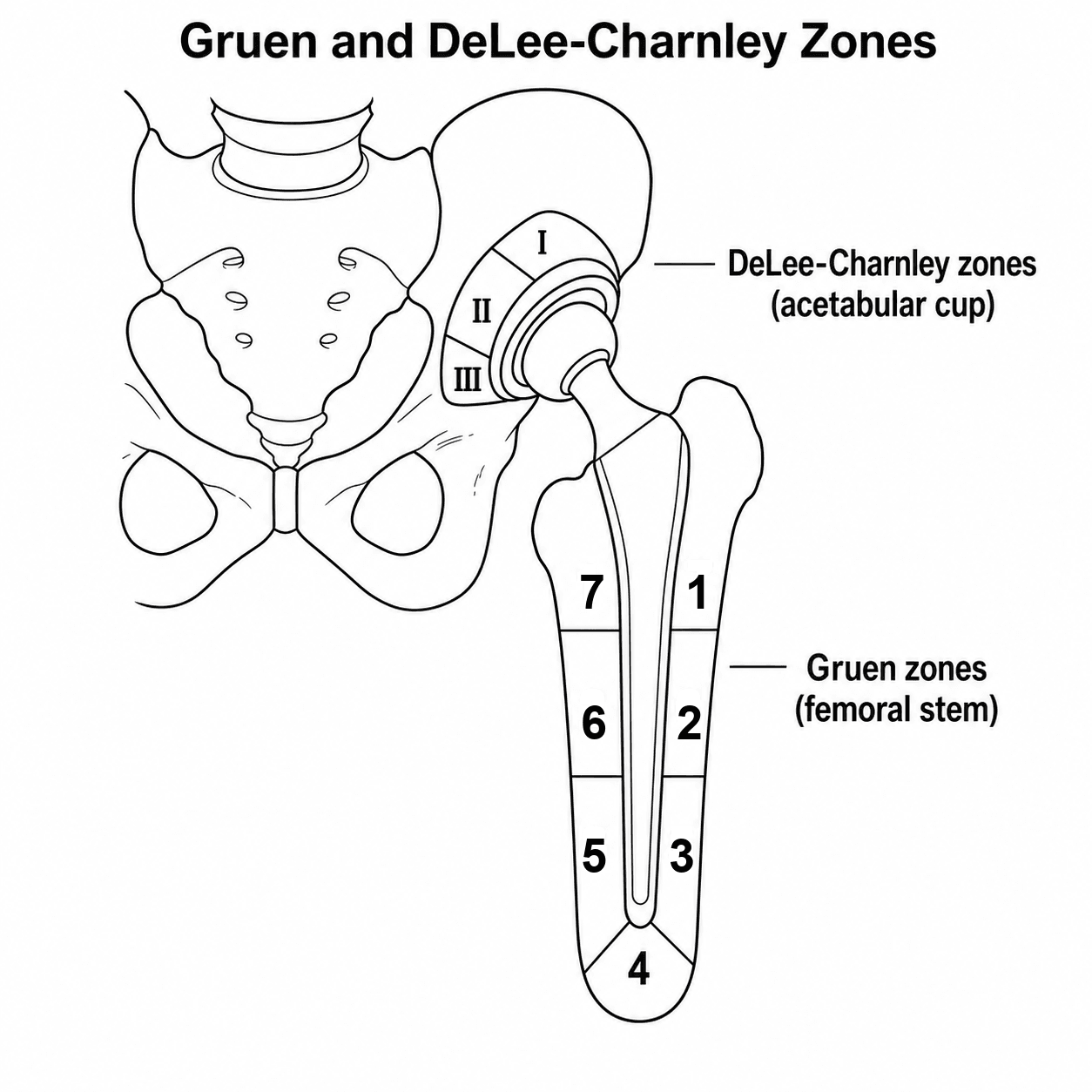
- DeLee-Charnley zones (acetabulum), Gruen zones (femur)
- Component migration is most specific sign of loosening
- Heterotopic ossification: Brooker classification (I-IV)
- Polyethylene wear: eccentric head position, osteolysis
- “Serial X-rays essential - single film cannot confirm loosening
- “All 3 acetabular zones or all femoral zones = definite loosening
- “PE wear precedes osteolysis by years
- “Varus/valgus stem: risk for periprosthetic fracture
- “CT with MARS for metal artefact reduction
Overview & Imaging Principles
Arthroplasty is among the highest-volume elective procedures in orthopaedics, and reading the follow-up film is a skill in its own right. The plain radiograph remains the first-line and most informative single investigation: it shows component position, fixation, polyethylene wear, periprosthetic bone and fracture, and, through serial comparison, it is the principal tool for diagnosing loosening. Cross-sectional imaging is reserved for the specific questions a film cannot answer, set out under Metal Artefact Reduction below.
Why serial films dominate. The diagnosis of aseptic loosening rests on demonstrating change over time: migration, subsidence or progressive lucency. A single film captures a snapshot; the previous films supply the trajectory. Always request and compare priors before committing to a diagnosis of loosening.
How good is the film? In a meta-analysis of imaging for femoral aseptic loosening, plain radiography achieved a sensitivity of about 82% and a specificity of about 81%, comparable to arthrography and scintigraphy and with lower morbidity. Plain films and bone scintigraphy are the preferred initial work-up (Temmerman et al., JBJS Br 2005).
A-B-C-D-E-FSystematic Read of Any Arthroplasty Film
Hook:A single radiograph rarely confirms loosening - migration or progressive lucency on serial films is what counts. State this explicitly in the viva.
Systematic Approach: Zone Classification Systems
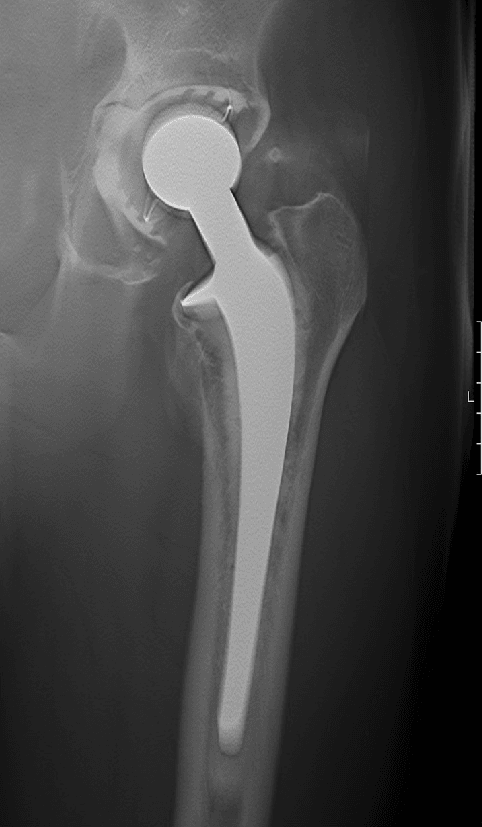
Why zones. Describing a lucent line or an area of osteolysis by its zone makes loosening assessment systematic and reproducible. The femoral stem is divided into seven Gruen zones and the acetabular component into three DeLee-Charnley zones.
- Location
- Lateral proximal (greater trochanter)
- Clinical Significance
- High stress area, loosening indicator
- Location
- Lateral middle
- Clinical Significance
- Cemented mantle assessment
- Location
- Lateral distal
- Clinical Significance
- Cement-bone interface
- Location
- Stem tip
- Clinical Significance
- End-bearing stress, pedestal formation
- Location
- Medial distal
- Clinical Significance
- Cement-bone interface
- Location
- Medial middle
- Clinical Significance
- Calcar region assessment
- Location
- Medial proximal (calcar)
- Clinical Significance
- High stress, loosening indicator
Reading the femoral zones. For a cemented stem, lucency in zones 1 and 7, proximal lateral and proximal medial, is the classic loosening pattern, and complete lucency in all zones is definite loosening. A pedestal of cement at zone 4 suggests that load is being transferred distally while the stem loosens proximally.
Reading the acetabular zones. Lucency in all three zones is definite loosening, and progressive lucency greater than 2 mm in any zone is concerning. Migration of the cup, superiorly (wear through) or medially (protrusion), indicates failure.
Loosening Assessment
- Description
- Radiolucent line increasing over time
- Significance
- Greater than 2mm or progressive = loosening
- Description
- Change in position over serial films
- Significance
- Most specific sign of loosening
- Description
- Break in cement mantle
- Significance
- Cemented component failure
- Description
- Focal lucent areas around component
- Significance
- Wear debris-induced resorption
- Description
- Lucent line with distal sclerosis
- Significance
- Distal load transfer, proximal loosening
- Description
- Distal migration of stem
- Significance
- Measure from tip to fixed landmark
What a line means. A thin line under 2 mm, parallel to the implant, non-progressive and confined to a single zone is usually a stable fibrous membrane rather than loosening. Incomplete lucency in one or two zones is monitored closely. Lucency that is thicker on the newer film than on the older one, lucency in every zone (all three DeLee-Charnley zones, or a complete Gruen envelope) and any change in component position are the findings that mean loosening, and migration is the most specific single sign. Width and progression together raise concern, and the fourth question is whether the radiographic change correlates with the patient's symptoms.
Cemented and uncemented stems fail differently. A cemented stem loosens with lucency at the cement-bone interface, fracture of the cement mantle and component migration. An uncemented stem shows lucency at the implant-bone interface, a lack of bone ongrowth, shedding, and stem subsidence greater than 3 mm in the first 2 years.
Stress shielding is not loosening. Reduced bone density in the proximal femur around an uncemented stem is due to load bypass. It is not true loosening but indicates altered biomechanics, and it is more common with extensively coated stems.
Cement Mantle Grading (Barrack)
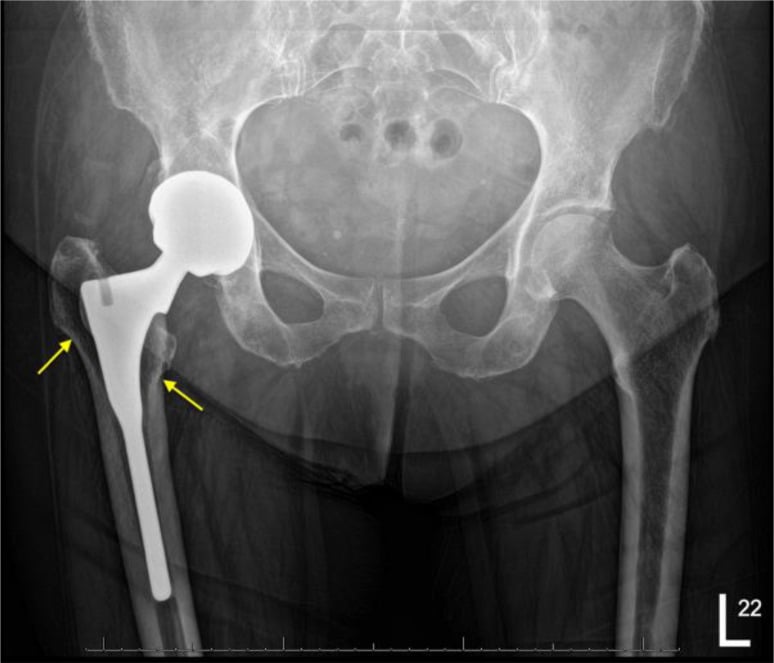
Grade the mantle, do not just describe the line. The systematic read includes grading the femoral cement mantle, the "C" of the A-B-C-D-E-F read, on the immediate post-operative radiograph. The Barrack classification grades the quality of a cemented femoral mantle and is a recognised predictor of subsequent loosening: a uniform, complete mantle of adequate thickness with cement-bone "white-out" is the radiographic signature of good cementing technique, whereas a deficient or incomplete mantle predisposes to debonding and early failure. Barrack's original work linked inadequate (Grade C-D) mantles to markedly higher early femoral loosening than Grade A-B.
- Radiographic Appearance
- Complete 'white-out' at the cement-bone interface; canal fully filled by cement with no discernible lucency
- Significance
- Best fixation; lowest loosening risk
- Radiographic Appearance
- Near-complete mantle with a thin radiolucency at part of the cement-bone interface
- Significance
- Acceptable mantle
- Radiographic Appearance
- Radiolucency at 50-99% of the cement-bone interface
- Significance
- Poorer mantle; higher loosening risk
- Radiographic Appearance
- Deficient mantle - stem abuts cortex with the mantle thinner than about 1mm or absent in places
- Significance
- Mantle defect predisposing to debonding
- Radiographic Appearance
- Gross deficiency - failure to fill the canal, a mantle defect, or no cement distal to the stem tip; air at the interface
- Significance
- Worst grade; strongly associated with early loosening
Polyethylene Wear
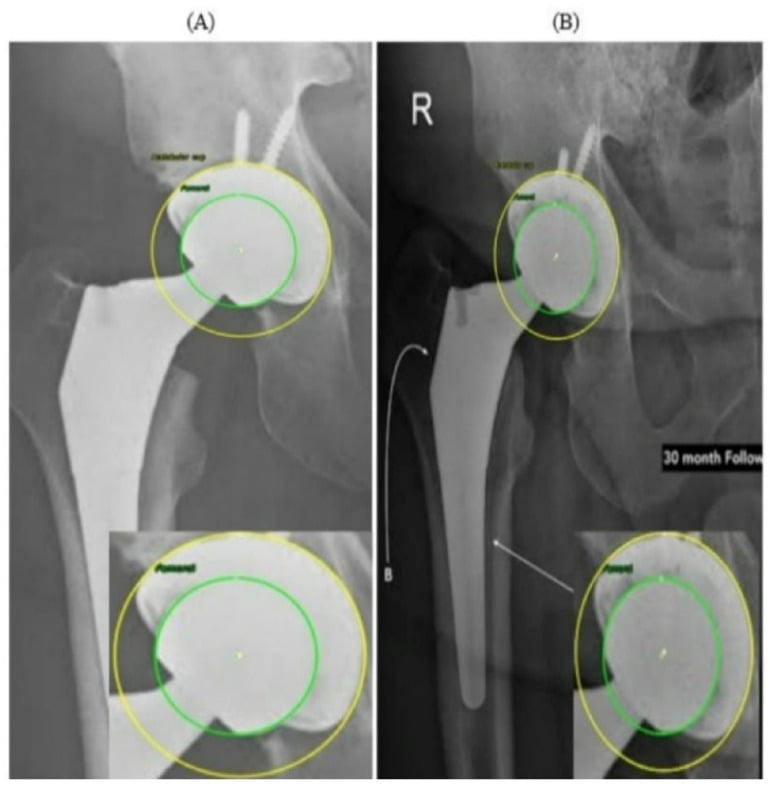
How to measure it. Compare the position of the femoral head with the centre of the cup and measure the minimum distance from head to cup margin. Serial films allow the wear rate to be calculated, and CT can assess volumetric wear more accurately. Wear precedes osteolysis by years and becomes clinically important before gross component migration, so inspect the same films for the lucencies of particle disease.
- Description
- Femoral head not centred in cup
- Clinical Implication
- Direct wear measurement possible
- Description
- Head moves toward dome of cup
- Clinical Implication
- Most common wear direction
- Description
- Measure head-cup distance on serial films
- Clinical Implication
- Greater than 0.2mm/year = excessive for conventional PE
- Description
- Lucent areas around components
- Clinical Implication
- Wear debris-induced bone resorption
- Description
- Balloon lesions expanding from joint
- Clinical Implication
- Requires revision to halt progression
Heterotopic Ossification
- Description
- Islands of bone within soft tissue
- Clinical Significance
- Usually asymptomatic
- Description
- Bone spurs from pelvis or proximal femur, greater than 1cm gap
- Clinical Significance
- Mild limitation
- Description
- Bone spurs with less than 1cm gap
- Clinical Significance
- Moderate limitation
- Description
- Apparent bony ankylosis
- Clinical Significance
- Severe limitation, may need excision
Who is at risk. The recognised risk factors:
- Male sex
- Post-traumatic osteoarthritis
- Hypertrophic osteoarthritis
- Previous heterotopic ossification
- Ankylosing spondylitis
Prevention and excision. Prophylaxis is an NSAID (indomethacin 75 mg daily for 6 weeks) or radiation (a single dose of 700 cGy within 72 hours). Excision waits 12-18 months for the bone to mature.
Instability and Dislocation
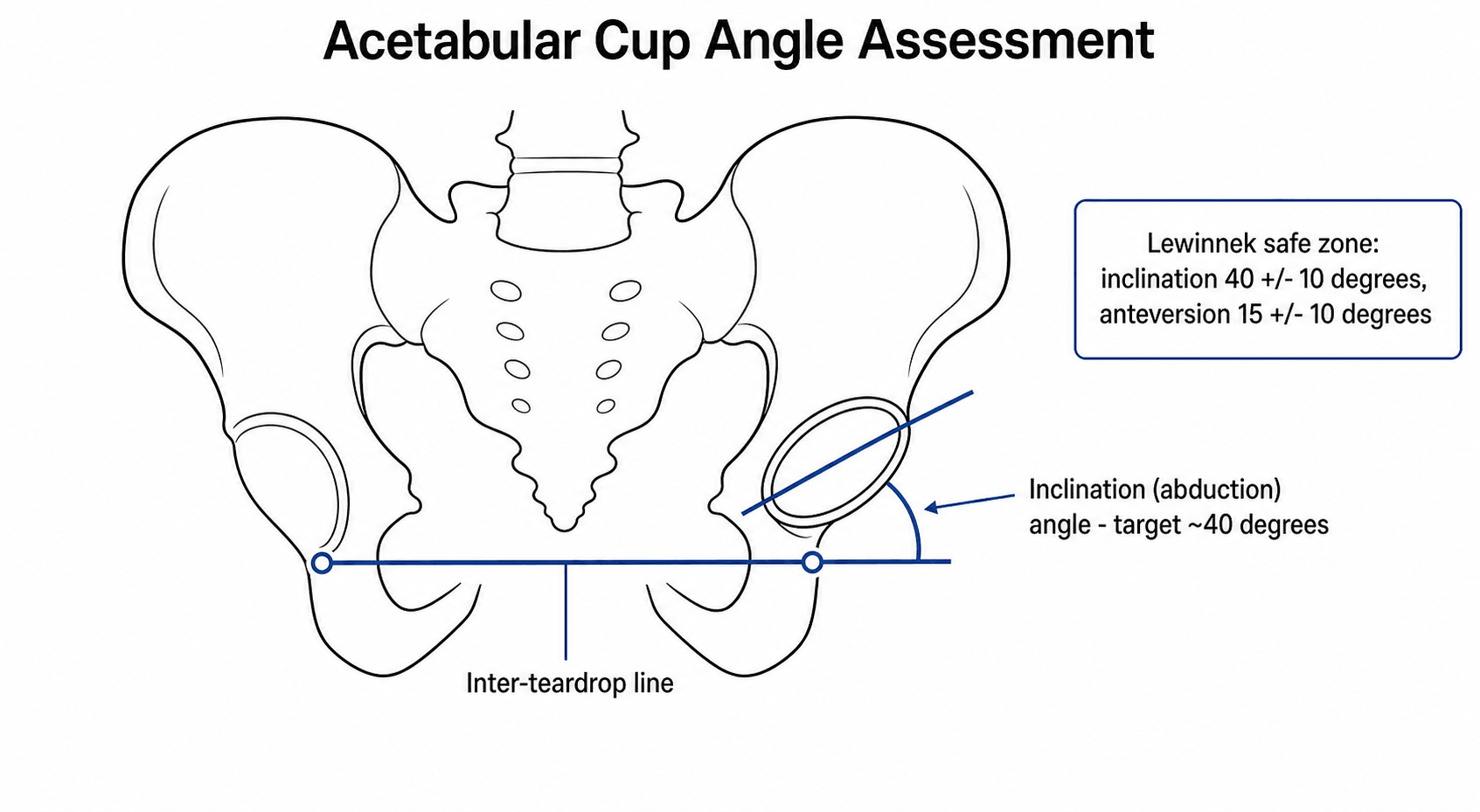
Cup position. Inclination (abduction) is measured between the plane of the cup opening and the horizontal inter-teardrop line on the AP pelvis, with a target of about 40°; anteversion is best quantified on a cross-table lateral or CT. The Lewinnek safe zone is inclination 40° ± 10° and anteversion 15° ± 10°, and a cup outside it (abduction over 55°, or mal-anteversion) carries higher dislocation and edge-loading risk.
What the zone does not mean. In 9,784 THAs, 58% of the hips that dislocated had a cup inside the zone. Being outside the zone is a problem; being inside it is not a guarantee, and the rest of the answer lies in the other risk factors tabulated below.
- Risk Contribution
- Abduction greater than 55° or less than 30°
- Radiographic Assessment
- Measure cup inclination on AP
- Risk Contribution
- Combined less than 25° or greater than 50°
- Radiographic Assessment
- CT for accurate measurement
- Risk Contribution
- Reduced offset decreases stability
- Radiographic Assessment
- Compare to contralateral
- Risk Contribution
- Smaller heads higher dislocation risk
- Radiographic Assessment
- Less than 32mm higher risk
- Risk Contribution
- Bone or soft tissue blocking motion
- Radiographic Assessment
- Look for osteophytes, HO
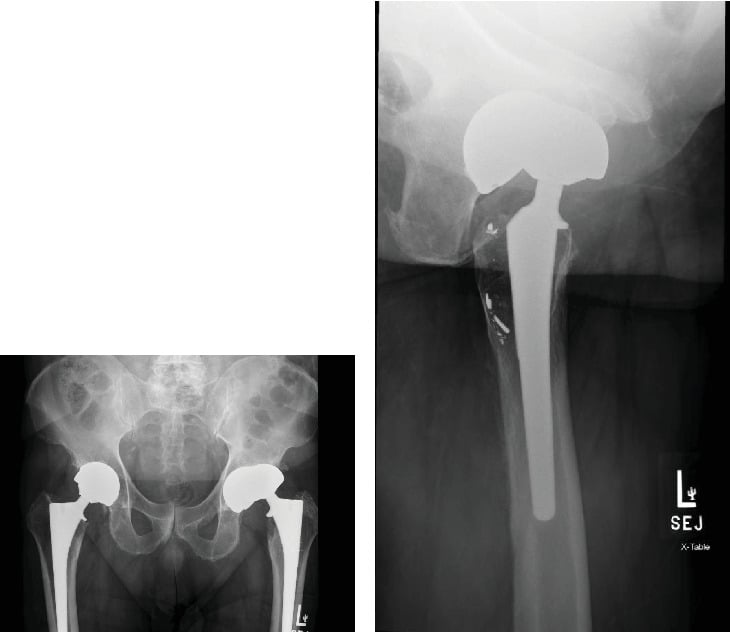
Periprosthetic Fracture
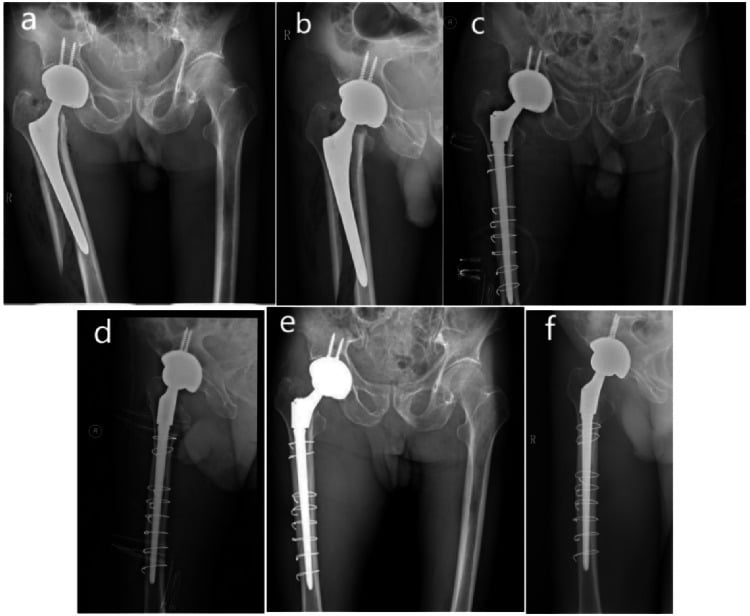
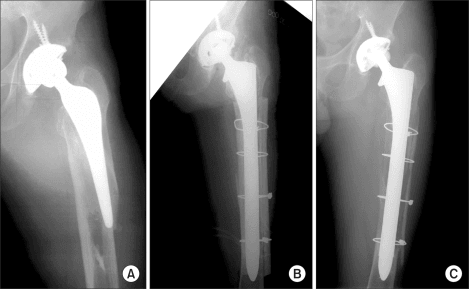
The decision is the stem. Around a hip stem, the question that separates B1 from B2 and B3 is whether the stem is loose, because that determines whether it is kept or revised. On the film, look for pre-existing lucencies, a change in component position and subsidence. If uncertain, obtain prior films for comparison or proceed to intra-operative assessment.
- Location
- Trochanteric region
- Subtype
- AG: Greater troch, AL: Lesser troch
- Treatment Principle
- Often non-operative if stable
- Location
- Around/below stem
- Subtype
- Stem WELL FIXED
- Treatment Principle
- ORIF, keep stem
- Location
- Around/below stem
- Subtype
- Stem LOOSE
- Treatment Principle
- Revision stem + ORIF
- Location
- Around/below stem
- Subtype
- Stem LOOSE + poor bone
- Treatment Principle
- Revision with structural allograft
- Location
- Below stem tip
- Subtype
- Stem unaffected
- Treatment Principle
- Treat as standard fracture
Metal Artefact Reduction
Choose the test by the question. Each modality answers a different question around a metal implant:
- Plain radiograph - first line, and the least artefact
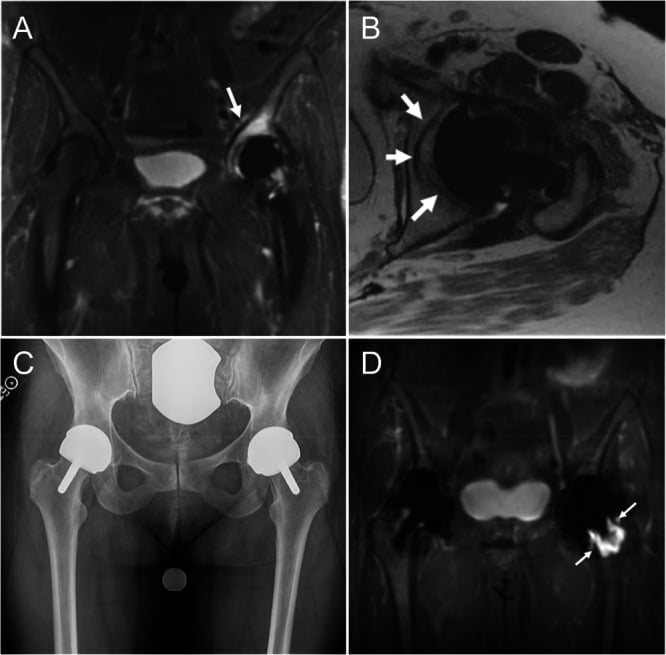
- CT with metal artefact reduction - bone detail: osteolysis volume, component version and mapping of bony defects
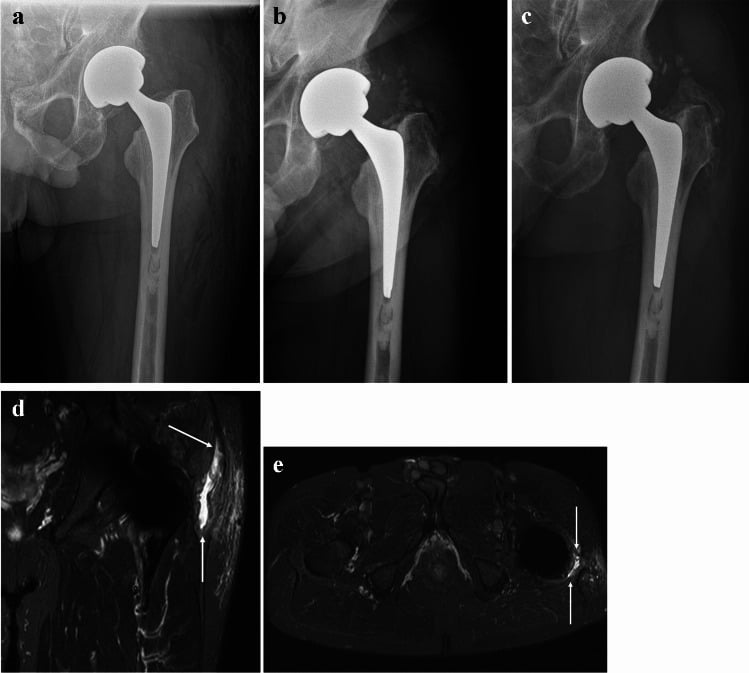
- MRI with metal artefact reduction (including STIR) - soft tissue: adverse local tissue reaction, abductor and tendon integrity, soft-tissue masses
- Ultrasound - no metal artefact; fluid collections and tendons
- Nuclear medicine - WBC/marrow scan or three-phase bone scan when prosthetic joint infection is suspected
Adverse local tissue reaction. In metal-on-metal bearings, MRI with metal artefact reduction is the gold standard. Look for pseudotumour, solid or cystic masses, fluid collections, muscle atrophy and tendon damage. Ultrasound is useful for fluid-predominant lesions, and blood metal ion levels guide surveillance frequency.
Differential Diagnosis of the Painful Arthroplasty
Read the film with the bloods. A painful joint replacement is a common clinic scenario, and the imaging must be interpreted alongside the clinical picture and the inflammatory markers, because the single most important diagnosis to exclude, prosthetic joint infection, can produce radiographs that look identical to aseptic loosening.
- Typical Pain Pattern
- Start-up / activity-related, deep
- Key Imaging Features
- Progressive lucency in all zones, migration, subsidence, no aggressive periostitis
- Confirmatory Test
- Serial radiographs; intra-operative findings
- Typical Pain Pattern
- Constant rest pain, early onset, stiffness
- Key Imaging Features
- Lucency that can be indistinguishable from aseptic loosening; periostitis or rapid osteolysis raise suspicion
- Confirmatory Test
- Aspiration (cell count, culture), CRP/ESR, alpha-defensin
- Typical Pain Pattern
- Often painless until late
- Key Imaging Features
- Eccentric head position, expansile balloon lucencies (particle disease)
- Confirmatory Test
- Serial wear measurement, CT for osteolysis volume
- Typical Pain Pattern
- Mechanical, positional, giving way
- Key Imaging Features
- Cup mal-orientation, eccentric head, impingement; combined version outside target
- Confirmatory Test
- CT for version; dynamic/stress views
- Typical Pain Pattern
- Acute, post-fall, unable to weight-bear
- Key Imaging Features
- Cortical break (Vancouver/Su); assess stem fixation
- Confirmatory Test
- Orthogonal radiographs; CT if occult
- Typical Pain Pattern
- Groin/thigh ache, swelling, clicking
- Key Imaging Features
- Effusion, pseudotumour, muscle/tendon damage on MARS-MRI
- Confirmatory Test
- MARS-MRI, serum cobalt/chromium ions
- Typical Pain Pattern
- Usually asymptomatic
- Key Imaging Features
- Proximal femoral bone loss with cementless stems, no migration
- Confirmatory Test
- Serial radiographs (not true loosening)
- Typical Pain Pattern
- Variable, non-mechanical
- Key Imaging Features
- Normal implant; look at spine, vessels, abdomen
- Confirmatory Test
- Targeted imaging of source
Never report progressive lucency around an implant as "aseptic loosening" without considering low-grade infection. Radiographs cannot reliably separate the two; the work-up of a painful arthroplasty must include inflammatory markers and a low threshold for joint aspiration.
Guidelines, Registries & Global Practice
Arthroplasty surveillance is informed by national joint registries and society guidance worldwide. Imaging recommendations converge on serial plain radiographs as the backbone, with risk-stratified cross-sectional imaging for specific failure modes.
- Focus
- THA/TKA surveillance & PJI
- Imaging-Relevant Guidance
- Plain radiographs first-line; standardised work-up for the painful arthroplasty including ESR/CRP and aspiration before attributing pain to aseptic loosening
- Focus
- Joint replacement follow-up
- Imaging-Relevant Guidance
- Risk-stratified radiographic follow-up (e.g. at defined intervals for higher-risk implants); registry-linked surveillance
- Focus
- Metal-on-metal & modular tapers
- Imaging-Relevant Guidance
- Risk-based surveillance using symptoms, serum cobalt/chromium ions and cross-sectional imaging (MARS-MRI or ultrasound) for adverse local tissue reaction
- Focus
- Outcome reporting & follow-up
- Imaging-Relevant Guidance
- Harmonised radiographic outcome measures; emphasis on registry data for implant performance
- Focus
- Implant identification
- Imaging-Relevant Guidance
- Underpins component traceability that aids radiographic implant recognition
- Contribution
- Large primary & revision volumes
- Imaging Relevance
- Implant- and bearing-specific revision rates flag designs warranting closer radiographic surveillance
- Contribution
- Detailed revision-by-diagnosis data
- Imaging Relevance
- Early identification of poorly performing implants (e.g. certain MoM hips) prompting targeted imaging
- Contribution
- Growing national dataset
- Imaging Relevance
- Benchmarking revision causes including loosening, instability and PJI
- Contribution
- Long-term implant survival
- Imaging Relevance
- Decades-long survivorship informing follow-up intervals and revision-risk imaging
Special Circumstances
Unicompartmental knee. Assess component alignment, progression of osteoarthritis in the opposite compartment, and overhang, because a medial tibial component that overhangs may irritate the MCL. The common failures are progression of arthritis in the unreplaced compartments and tibial loosening.
Reverse shoulder arthroplasty. The key measurements are the glenosphere position relative to the inferior glenoid, which should be low, and baseplate inclination. Watch for scapular notching, graded in the next section, acromial fractures and component loosening.
Revision arthroplasty. Classify the bone loss (Paprosky for the hip, AORI for the knee) and assess the remaining bone stock. Look for previous cement and hardware, and plan for longer stems, augments or structural grafts.
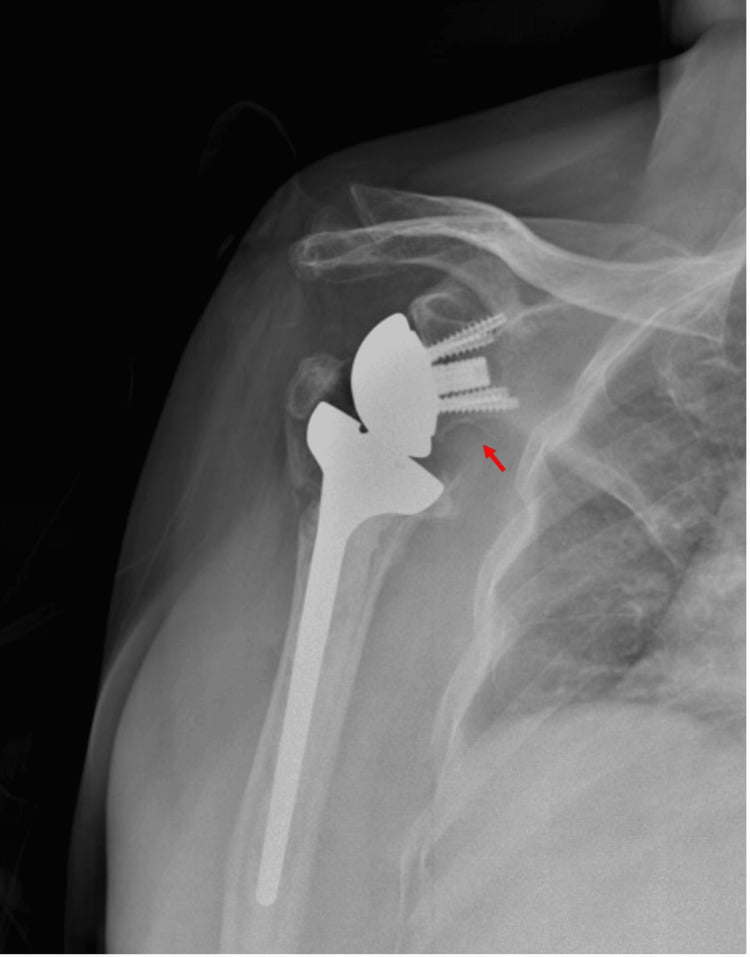
Scapular Notching Grading (Reverse Shoulder)
What notching is. Scapular notching is impingement wear: the polyethylene humeral cup contacts the inferior scapular neck in adduction, a feature of the medialised Grammont design, and erodes it. It is graded, not just described, with the Sirveaux-Nerot classification on a true AP (Grashey) view.
- Extent of Inferior Scapular Erosion
- Defect confined to the scapular pillar (inferior neck)
- Implication
- Minor; often asymptomatic
- Extent of Inferior Scapular Erosion
- Erosion reaching (in contact with) the inferior baseplate screw
- Implication
- Progressive impingement wear
- Extent of Inferior Scapular Erosion
- Erosion extending beyond/over the inferior screw
- Implication
- Concern for baseplate fixation over time
- Extent of Inferior Scapular Erosion
- Erosion extending under the baseplate towards the central peg/fixation
- Implication
- Threatens glenoid component fixation
Why the grade matters. Higher grades (3-4) are associated with poorer functional outcomes and possible glenoid component loosening. The radiographic strategies that reduce notching, inferior glenosphere positioning, inferior tilt, and a larger or lateralised glenosphere, are the things to mention alongside the grade.
Areas of Uncertainty & Controversy
MCQ & Exam Practice Points
Q: A radiolucent line is seen in only DeLee-Charnley zone III on a single post-operative pelvis film. Does this confirm acetabular loosening? A: No. A thin, non-progressive line in one zone is usually a stable fibrous membrane. Loosening requires lucency in all three zones, progression on serial films, or definite cup migration - a single film cannot confirm it.
Q: A dislocated THA has a cup measured at 42 degrees inclination and 14 degrees anteversion. The cup is 'within the Lewinnek safe zone' - so cup position cannot be the problem, correct? A: Incorrect. Abdel et al. (CORR 2016) showed 58% of dislocating THAs had cups inside the Lewinnek zone. Stability is multifactorial - consider spinopelvic mobility, head size, soft-tissue tension, offset and approach.
Q: Which single radiographic sign is the most specific for component loosening? A: Component migration (a change in position on serial films). Progressive lucency over 2 mm is supportive, but migration is the most specific single sign - which is why prior films are essential.
Clinical Imaging: Standard Radiographic Assessment
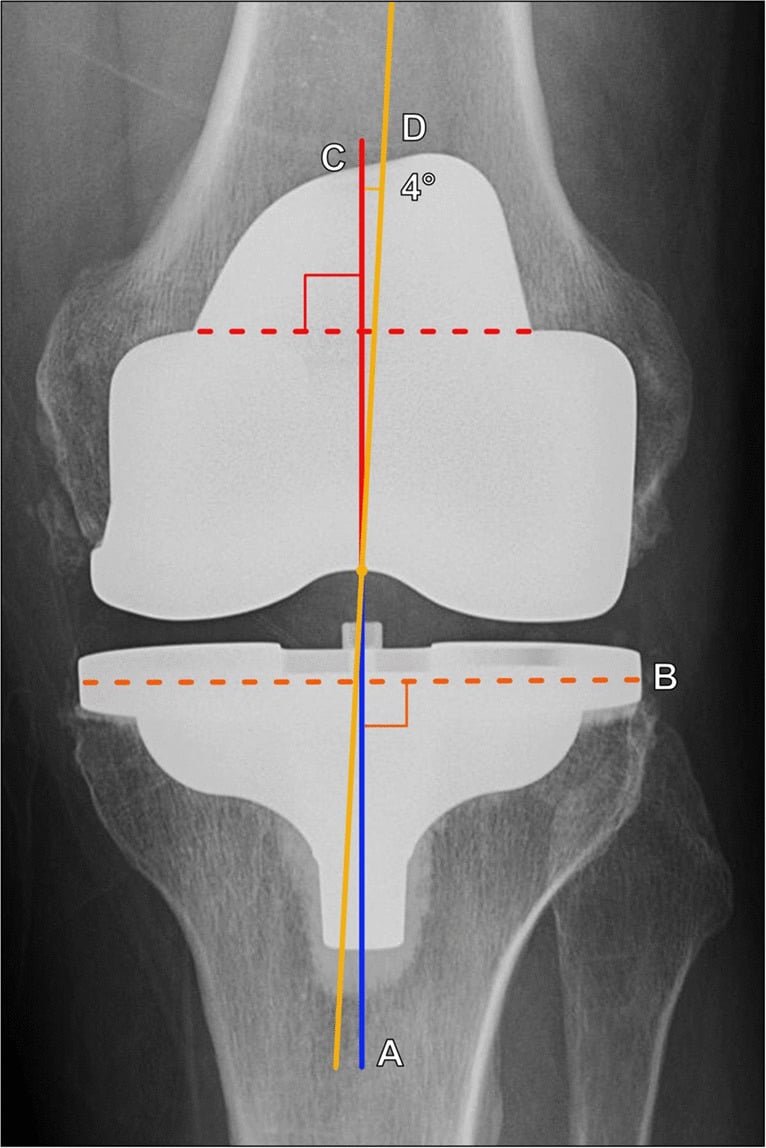
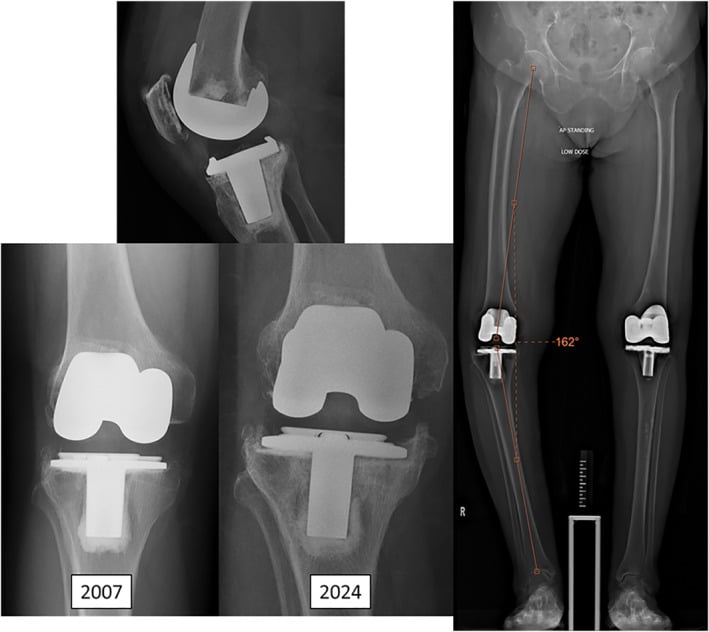
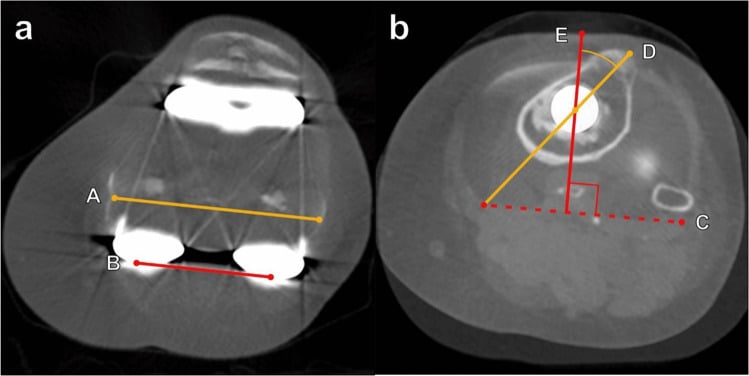
Measure, do not eyeball. Every parameter in the checklists below is a construction on the film: a line drawn, an angle measured, a distance compared with the other side or with the previous film. The tables give the measurement and the range taken as optimal; the figures that follow show the constructions being made.
- Measurement
- Angle between cup face and inter-teardrop line
- Normal/Optimal Range
- 40° ± 10° (30-50°) — a target, not a guarantee (see Instability and Dislocation)
- Measurement
- Lateral view or CT
- Normal/Optimal Range
- 15° ± 10° (5-25°)
- Measurement
- Superolateral cup covered by bone
- Normal/Optimal Range
- Greater than 80%
- Measurement
- Compare lesser trochanter to teardrop line
- Normal/Optimal Range
- Within 10mm of contralateral
- Measurement
- Centre of head to femoral shaft axis
- Normal/Optimal Range
- Restore native offset ± 5mm
- Measurement
- Varus/valgus relative to shaft
- Normal/Optimal Range
- Neutral to 3° valgus
- Measurement
- Distance from stem tip to fixed landmark
- Normal/Optimal Range
- Less than 2-3mm stable
Clinical Decision Scenarios
Practise clinical reasoning and management decisions out loud
“A 72-year-old presents with thigh pain 8 years after cemented total hip arthroplasty. You are shown an AP pelvis X-ray.”
“A 60-year-old falls at home 3 years after cementless THA. X-ray shows a periprosthetic femoral fracture at the level of the stem.”
“A patient 2 years post TKR presents with anterior knee pain and difficulty with stairs. X-rays including skyline view are shown.”
Optimal Component Position
- Cup inclination: 40° ± 10° — but 58% of dislocating THAs are INSIDE the Lewinnek zone, so never conclude cup position is innocent from angles alone
- Cup anteversion: 15° ± 10°
- Combined anteversion: 25-50°
- Stem: Neutral to 3° valgus
- Leg length: Within 10mm
Zone Systems
- Gruen (femur): 7 zones (1-3 lateral, 4 tip, 5-7 medial)
- DeLee-Charnley (acetabulum): 3 zones (I superior, II medial, III inferior)
- All zones lucent = definite loosening
- Zones 1 and 7 = high stress loosening pattern
Loosening Signs
- Progressive lucency greater than 2mm
- Component migration (most specific)
- Cement fracture
- Subsidence greater than 3mm
- Serial films essential
Vancouver Classification (PPF)
- A: Trochanteric (AG/AL) - often non-op
- B1: Stem fixed - ORIF, keep stem
- B2: Stem loose, good bone - revision stem
- B3: Stem loose, poor bone - revision + graft
- C: Below stem - treat as standard fracture
Evidence Base & Landmark Classifications
The radiographic frameworks used at the viva table - Gruen and DeLee-Charnley zones, the Lewinnek safe zone, the Brooker grade and the Vancouver classification - each originate from a specific paper. Knowing the source, the cohort and the modern caveats demonstrates depth.
Gruen Zones - 'Modes of Failure' of Cemented Femoral Stems
- Defined the 7-zone femoral analysis still used today
- Loosening is a zonal, mode-specific process - not random
- Proximal (calcar) and distal (tip) patterns reflect different failure mechanics
- Serial radiographs distinguished progressive from static lucency
DeLee-Charnley Zones - Acetabular Radiolucency
- Established the 3-zone (I superior, II medial, III inferior) acetabular system
- Demarcation is common and usually benign; migration is the worrying sign
- Progressive migration - not the mere presence of a line - predicts failure
- Technical/surgical factors and low-grade sepsis explained most migrating cases
Lewinnek Safe Zone - Cup Orientation and Dislocation
- Origin of the classic 40 deg plus or minus 10 inclination and 15 deg plus or minus 10 anteversion targets
- Roughly four-fold higher dislocation outside the zone
- Greatest dislocation risk in the first 30 days and after prior surgery
- Defined cup orientation as a measurable, modifiable radiographic target
Contemporary Caveat - The Lewinnek 'Safe Zone' Is Not Truly Safe
- The majority of dislocating THAs were inside the 'safe zone'
- Cup position is necessary but not sufficient for stability
- Spinopelvic mobility, soft tissues, head size and approach all contribute
- Targets are a guide, not a guarantee
Brooker Classification - Heterotopic Ossification after THA
- Standard radiographic grading of HO around the hip
- Higher grades correlate with reduced range of motion
- Grade IV (ankylosis) may warrant excision after maturation
- Provides a reproducible language for follow-up films
Imaging Accuracy for Aseptic Femoral Loosening (Meta-analysis)
- Plain radiography performs as well as more invasive tests
- No single modality is clearly superior for femoral loosening
- Plain films plus bone scintigraphy are the preferred first-line work-up
- Specificity is imperfect - correlate with symptoms and serial films
Vancouver Classification - Periprosthetic Femoral Fractures
- Treatment hinges on whether the stem is well-fixed or loose
- B1 - retain stem with ORIF; B2 - revise the stem; B3 - revise plus reconstruct bone
- Radiographic assessment of pre-existing lucency is essential to subtype
- Fractures around loose/malaligned stems do poorly with fixation alone