Comprehensive analysis of hip joint biomechanics including joint reaction forces, muscle moment arms, gait mechanics, stability mechanisms, and clinical applications in total hip arthroplasty and hip pathology.
- Take moments about the hip centre to eliminate the joint reaction force and solve for abductor force
- Abductor moment arm (~5 cm) is half the body weight lever arm (~10 cm), so abductors must pull ~2× BW
- Hip joint reaction force is the vector sum of body weight and abductor force (~2.5-3× BW walking)
- Reduced femoral offset shortens the abductor moment arm, increasing required force and risking weakness/instability
- Contact stress = joint reaction force / contact area; reduced area (dysplasia, AVN, malunion) drives early arthritis
- “Cane in the CONTRALATERAL hand reduces the body-weight moment, cutting abductor and joint force by ~20-40% (more the harder the cane is loaded)
- “Trendelenburg lurch shifts the trunk over the affected hip, halving the body-weight moment arm
- “Lewinnek safe zone is a guide only - spinopelvic/functional positioning matters in stiff or hypermobile spines
- “Combined anteversion (acetabular + femoral) target ~35-45° (Ranawat)
Overview
The hip is a ball-and-socket (spheroidal) synovial joint that must combine a wide range of motion with the stability and load capacity that bipedal gait demands. Because the body's centre of mass sits medial to the supporting hip in single-leg stance, the joint is loaded far in excess of body weight: in vivo telemetric implant studies record hip contact forces around 238% of body weight during level walking, rising further with stair climbing and stumbling.
Body weight alone does not set that load; the muscle forces required for equilibrium do, principally the abductors. Understanding why the force is so high, and how anatomy, pathology and surgery change it, is the foundation of hip-preservation and arthroplasty surgery. The page builds from the single-leg-stance free body diagram to contact mechanics, stability and the biomechanics of total hip arthroplasty, linking each to the clinical decisions and landmark evidence that flow from it.
Single-Leg Stance: The Free Body Diagram
Single-leg stance is the most examined scenario because it is the peak loading condition of normal walking and exposes the fundamental mechanical relationships at the hip. During right single-leg stance, three major forces act on the pelvis:
- Body weight minus the stance leg, acting downward through the centre of mass of the head, arms, trunk and swing leg. For a 70 kg person this is approximately 55 kg (539 N).
- Hip abductor force, acting upward and laterally on the ilium where gluteus medius and minimus insert, with a resultant about 30° from vertical.
- Hip joint reaction force, transmitted between acetabulum and femoral head at the hip centre.
For the pelvis to be in equilibrium, neither rotating nor accelerating, the vertical forces, the horizontal forces and the moments about any point must each sum to zero.
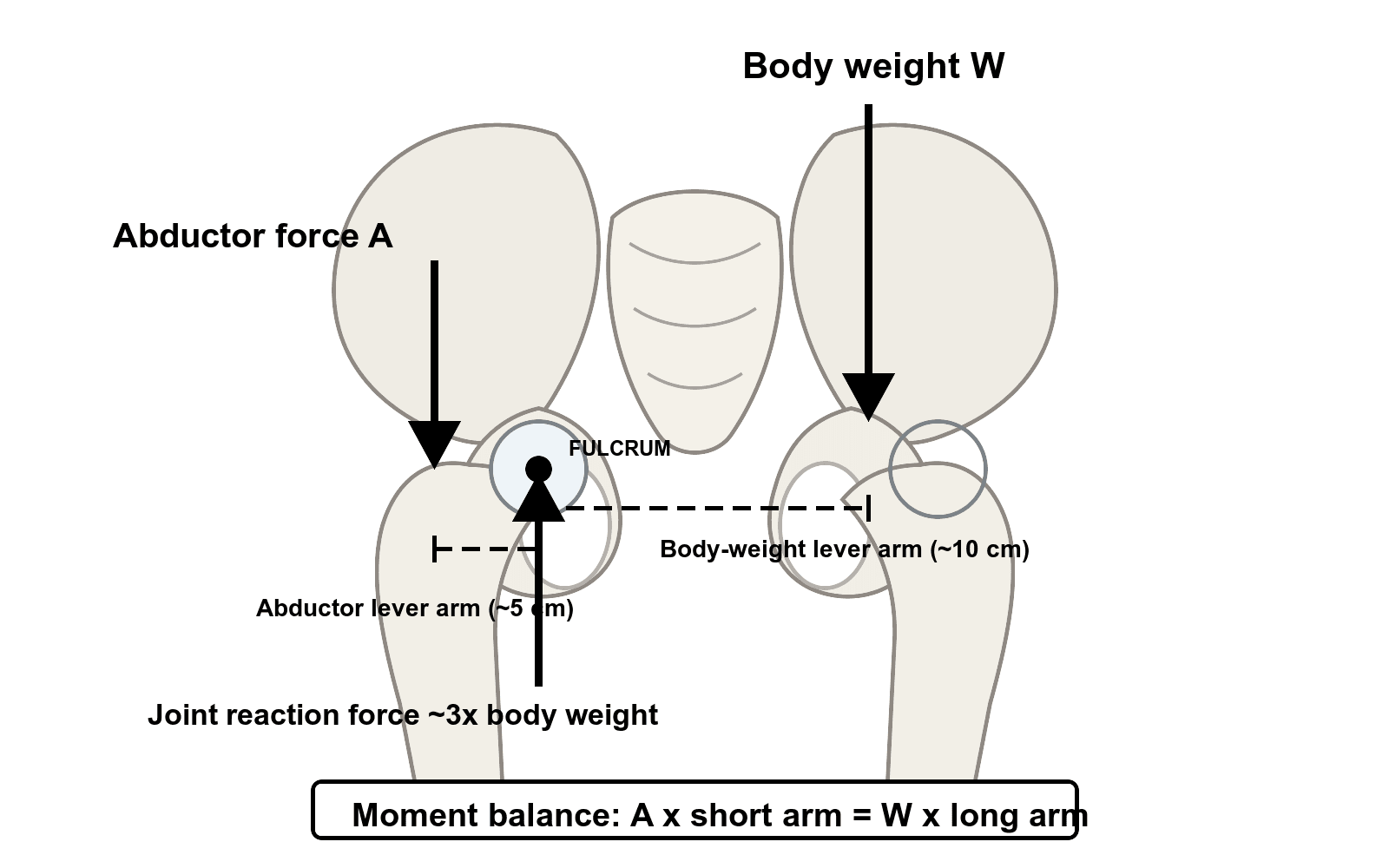
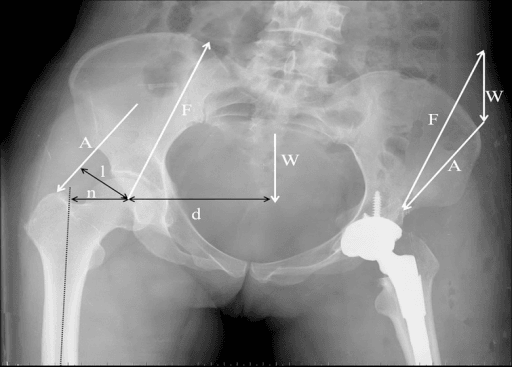
Moments about the hip centre. Taking moments about the hip joint centre removes the joint reaction force from the equation, because its moment arm is zero, and leaves the abductor force as the only unknown. Body weight acts about 10 cm from the hip centre, tending to drop the unsupported side of the pelvis: 539 N × 0.10 m = 53.9 N·m. The abductor resultant acts at only 5 to 6 cm, so to balance that moment the abductors must pull with 53.9 N·m / 0.05 m = 1078 N (about 110 kg): roughly twice the effective body weight, or about 1.5 times total body weight.
Mechanical advantage. The ratio of abductor moment arm to body-weight lever arm is 5 cm / 10 cm = 0.5. The abductors work as a third-class lever with a mechanical advantage below 1, generating a force twice the load they balance. That looks inefficient, but it is what gives the hip the range and speed of movement that gait and function require.
The joint reaction force. Body weight is vertical and the abductor force is about 30° from vertical, so they add as vectors, not as numbers:
- Abductor vertical component: 1078 N × cos 30° = 933 N, upward
- Abductor horizontal component: 1078 N × sin 30° = 539 N, medial
- Vertical equilibrium: 539 + 933 = 1472 N (upward on the pelvis, and equal and opposite on the femoral head)
- Horizontal equilibrium: 539 N
- Resultant: the square root of (1472² + 539²) = 1567 N, about 160 kg, or 2.3× total body weight (1567 / 686 N)
More detailed analyses that account for other muscle forces, ligamentous tension and inertial effects during walking give peak joint reaction forces of 2.5 to 3 times body weight in the stance phase of gait.
Forces Through the Gait Cycle
Walking loads the hip cyclically. Stance, when the foot is on the ground, occupies about 60% of the cycle and generates the highest forces; swing occupies the remaining 40%, and with the limb unloaded the joint reaction force falls below body weight.
Stance phase. The load through its four sub-phases:
- Initial contact (heel strike): about 1.5 to 2× body weight. The hip is extended and the ground reaction force passes posterior to the hip centre, creating a flexion moment that the extensors (gluteus maximus and hamstrings) resist
- Midstance (single-leg support): the peak, 2.5 to 3× body weight. The whole body weight minus the stance leg is carried on one hip and the abductors work maximally to hold the pelvis level
- Terminal stance: forces begin to fall as the contralateral leg prepares to land; the ground reaction vector moves anterior, creating an extension moment, and the flexors begin to activate
- Pre-swing (toe-off): forces fall rapidly as weight transfers to the other limb and the flexors accelerate the leg into swing
Swing phase. With the limb non-weight-bearing, the demands are hip flexion to advance the limb (iliopsoas, rectus femoris), knee flexion for toe clearance, and subtle abductor activation to keep the foot from contacting the ground.
Speed and impact. Faster walking raises the peak force because greater accelerations raise the ground reaction force. Running produces up to 4 to 5× body weight and impact activities such as jumping can exceed 8 to 10×. Slowing down helps only modestly, because the quasi-static single-leg-stance force of 2.5 to 3× body weight still occurs; complete unloading needs non-weight-bearing status or aquatic therapy, where buoyancy supports body weight.
Muscle Moment Arms and Function
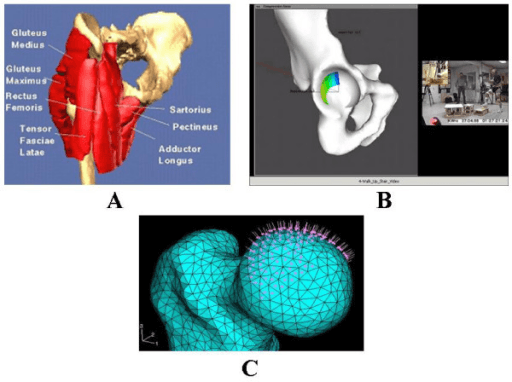
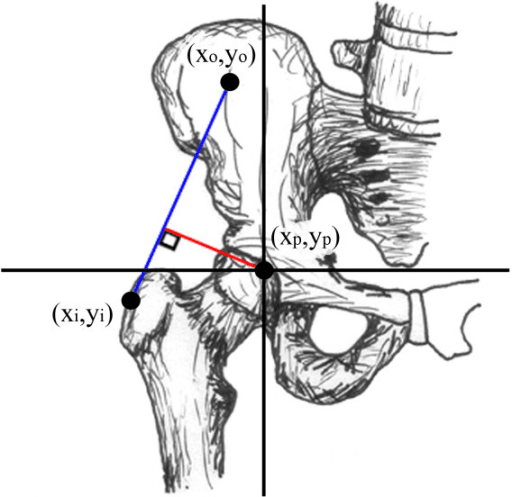
The abductors. Gluteus medius and gluteus minimus insert on the greater trochanter, and their resultant acts about 5 to 6 cm lateral to the hip centre in the coronal plane; the moment arm is the perpendicular distance from the hip centre to that line of pull. Gluteus medius has three functionally distinct regions:
- Anterior fibres: abduction and internal rotation
- Middle fibres: pure abductors, with the largest cross-sectional area
- Posterior fibres: abduction and external rotation
Gluteus minimus lies deep to medius with similar fibre architecture and function, and together the two provide the majority of abduction strength. Tensor fasciae latae also abducts, particularly in early range, and assists internal rotation and flexion, but its abduction moment arm is smaller, about 3 to 4 cm.
What the abductors do. In single-leg stance they prevent the contralateral pelvis from dropping, which is what lets the swing leg clear the ground. They control frontal-plane motion during walking, preventing excessive lateral trunk sway and keeping forward progression efficient. And eccentric abductor contraction during initial loading attenuates impact and protects the articular cartilage.
The surgical approach. The lateral approaches (direct lateral, Hardinge) split or detach the abductor mechanism and risk denervation or muscle damage; abductor dysfunction after arthroplasty produces a Trendelenburg gait, instability and poorer functional outcomes. The anterior and posterior approaches spare the abductors, potentially improving functional recovery.
The flexors. Iliopsoas (iliacus and psoas major) is the strongest hip flexor, with a moment arm about 5 to 6 cm anterior to the hip centre, and is essential for stair climbing, running and any activity requiring forceful flexion. It passes anterior to the capsule, so contracture causes anterior hip pain and limited extension, and it can be impinged by anterior arthroplasty components or retractors, causing postoperative pain. Rectus femoris is biarticular, flexing the hip and extending the knee, with a hip moment arm of about 4 to 5 cm; it is vulnerable to strain in sprinting, when rapid hip flexion coincides with knee extension. Tensor fasciae latae and sartorius are secondary flexors.
The extensors. Gluteus maximus is the largest and strongest extensor, acting about 5 to 7 cm posterior to the hip centre, and is essential for rising from sitting, stair climbing, running and jumping. Its upper fibres insert on the iliotibial band and its lower fibres on the gluteal tuberosity; denervation through the inferior gluteal nerve makes stairs and rising from a chair difficult. The hamstrings (semimembranosus, semitendinosus and the long head of biceps femoris) are biarticular, extend the hip with a moment arm of about 6 to 8 cm, contribute significantly to extension during gait, and suffer proximal strains in sprinting athletes.
Sagittal moment arms change with position. At neutral, standing, the flexor and extensor moment arms are near their maximum. As the hip flexes the extensor moment arms increase while the flexor moment arms may decrease, which is why the extensors generate their greatest torque from a flexed position, useful when rising from a chair or sprinting.
The rotators. The deep external rotators (piriformis, obturator internus and externus, superior and inferior gemellus, quadratus femoris) form a muscular cuff behind the joint. Their moment arms are small, 2 to 4 cm, but collectively they generate substantial torque; they externally rotate the hip during gait and stance, provide dynamic posterior stability, and feed back proprioception from a dense mechanoreceptor population. Gluteus maximus and the posterior fibres of gluteus medius also externally rotate, with larger moment arms. Internal rotation comes from the anterior fibres of gluteus medius and minimus, with contributions from tensor fasciae latae and adductor longus. Internal-rotation moment arms are generally smaller than external-rotation ones, which is why external rotation strength typically exceeds internal rotation strength in most individuals; the asymmetry contributes to common rotational alignment patterns and may influence injury mechanisms.
Trendelenburg Gait and the Contralateral Cane
Trendelenburg gait. When the abductors cannot generate the force the moment balance demands, the pelvis drops on the contralateral swing side. The causes are:
- Superior gluteal nerve injury, iatrogenic during surgery, or L5 radiculopathy from root compression
- Muscle damage: the lateral approach to the hip, a gluteal tear, atrophy
- Pain inhibition: arthritis, bursitis, tendinopathy
- Structural: reduced femoral offset after arthroplasty
The lurch. The patient compensates by shifting the trunk over the affected hip. That brings the centre of mass toward the hip centre, shortening the body-weight moment arm from about 10 cm to about 5 to 6 cm, and the moment balance does the rest: 539 N × 0.05 m = 27.0 N·m instead of 53.9 N·m, so the abductor force required falls from 1078 N to about 540 N, a 50% reduction. The gait is abnormal, but it allows the patient to walk.
Assessment. In the Trendelenburg test the patient stands on the affected leg and the examiner watches the contralateral pelvis: it drops when the test is positive and stays level or rises slightly when negative. A single-leg stance time under 30 seconds suggests weakness, and the trunk lurch over the affected side is visible during the stance phase of gait.
Treatment. Physiotherapy for abductor strengthening (side-lying abduction, resistance bands), reduced impact activity, and a cane in the contralateral hand. Where the cause is structural, an offset deficiency after arthroplasty, revision with offset restoration may be required.
The cane. Held in the contralateral hand, a cane provides an upward force on the side opposite the stance hip, shifting the effective centre of mass of the superincumbent weight laterally toward the stance limb. With the cane taking 15% of body weight (10.5 kg, 103 N):
- Effective body weight on the pelvis: 539 − 103 = 436 N
- Moment arm still about 10 cm, with a modest reduction to about 8 to 9 cm from the change in weight distribution
- Body-weight moment: 436 N × 0.09 m = 39.2 N·m, a 27% reduction
- Required abductor force: 39.2 / 0.05 = 784 N, a 27% reduction, and the joint reaction force falls in proportion
In practice a contralateral cane cuts the abductor requirement by about 20 to 30%, and by up to 40% the harder it is loaded, with a proportional fall in joint reaction force: less pain in arthritis, better stability with abductor weakness, and longer walking distances. Patients often prefer the cane in the ipsilateral hand, the side of the painful hip, for psychological comfort; that is biomechanically incorrect and gives minimal benefit, and they need to be taught to use the other hand.
Acetabular Coverage, Contact Area and Contact Stress
The normal joint. The acetabulum covers about 170 to 180° of the femoral head's circumference, giving inherent bony stability, and the adult head measures about 48 to 52 mm in diameter. The weight-bearing contact area is roughly 1000 to 1400 mm², varying with load and position, and the primary loading zone is the superior and anterior acetabulum, the dome, where contact stress is highest in stance. The labrum enlarges the contact area further; its contribution is quantified with the other soft-tissue stabilisers below.
The centre-edge angle of Wiberg measures lateral coverage in the coronal plane and is normally 25 to 40°. Under 20° the acetabulum is dysplastic and coverage inadequate, predisposing to instability and early arthritis; over 40° may indicate overcoverage or pincer-type femoroacetabular impingement.
Contact stress is force divided by contact area, and it is the route by which high joint forces become cartilage damage and arthritis. For a 70 kg person in single-leg stance, a joint reaction force of about 1600 N (roughly 2.3× body weight, from the analysis above) spread over a normal 1200 mm² gives 1600 / 1200 = 1.33 MPa, within the 1 to 3 MPa that articular cartilage tolerates chronically. The force is roughly fixed for a given activity and body weight; what pathology changes is the area, and stress rises as area falls:
- Contact area
- ~1200 mm²
- Worked stress
- 1600 / 1200 = 1.33 MPa
- Consequence
- Within chronic tolerance
- Contact area
- 50-70% of normal (~600-850 mm²)
- Worked stress
- 1600 / 600 = 2.67 MPa, doubled
- Consequence
- Exceeds tolerance; arthritis typically in the third to fifth decade
- Contact area
- Reduced 20-40% by loss of spherical congruity (~700-950 mm²)
- Worked stress
- 1600 / 960 = 1.67 MPa at a 20% loss; 1600 / 800 = 2.0 MPa
- Consequence
- Stress concentration at the collapse margin which, with compromised cartilage nutrition and subchondral bone weakness, accelerates degeneration
- Contact area
- 30-50% of normal (~300-600 mm²) from incongruity and step-off
- Worked stress
- 1600 / 400 = 4.0 MPa, tripled or quadrupled; 3-5 MPa or higher
- Consequence
- Rapidly progressive arthritis within months to a few years
Femoroacetabular impingement damages the joint by a different route. A cam lesion (aspherical head-neck junction) or pincer morphology (acetabular overcoverage or retroversion) causes repetitive focal loading and shear at the rim, damaging labrum and cartilage; the damage is motion-driven rather than purely load-driven, but the end result is the same loss of contact area and rise in stress.
Reducing contact stress. The formula has two levers, and when neither is enough the joint is replaced:
- Increase the area: periacetabular osteotomy reorients the acetabulum and increases coverage in dysplasia; anatomic reduction of an acetabular fracture restores congruity; joint-preserving surgery for impingement removes the source of damage and prevents progression
- Reduce the force: weight loss, where the free-body model predicts that every kilogram lost removes roughly 2.5 to 3 kg of force across the joint at midstance, because body weight enters the calculation twice, as the load and as the driver of abductor force; a contralateral cane; avoiding high-impact activities such as running and jumping; and strengthening, which may modestly reduce force through better muscle efficiency
- Replace the joint when preservation fails: arthroplasty resurfaces the joint with spherical congruity, a large head (36 to 40 mm) maximises contact area and stability, and highly cross-linked polyethylene and ceramic bearings resist wear under high stress
Lubrication
The hip uses several lubrication mechanisms at once, each suited to a different combination of load and speed.
Boundary lubrication. Lubricin (PRG4) and other boundary lubricants adsorb to the cartilage surfaces and keep friction low even under high load, when the fluid film is thinnest. It is the critical mechanism under high load at low velocity.
Fluid-film lubrication. During motion, synovial fluid is entrained between the surfaces and forms a load-bearing film that holds them apart. It works best at moderate load and higher velocity.
Weeping lubrication. Under load, fluid is expressed from the porous cartilage matrix and forms a fluid layer at the contact interface. This continues to work under very high loads, where a fluid film would otherwise fail.
Boosted lubrication. Hyaluronic acid and other large molecules are excluded from the contact zone and concentrate in low-pressure regions, while the smaller molecules and water form the lubricating layer in the loaded contact.
When it fails. Loss of normal lubrication contributes to the progression of osteoarthritis: inflammatory arthritis degrades hyaluronic acid and lubricin, cartilage injury exposes collagen fibres with higher friction coefficients, and synovial inflammation changes the composition and viscosity of the fluid. Viscosupplementation with intra-articular hyaluronic acid attempts to restore fluid-film lubrication; its clinical efficacy remains controversial and the effect is generally modest and temporary.
Bony Architecture and Version
Acetabular orientation. The acetabulum covers the femoral head anteriorly, superiorly and posteriorly, and its depth and orientation set the force needed to dislocate the hip. Normal acetabular anteversion is about 15 to 25° (anterior opening): excessive anteversion predisposes to anterior instability, retroversion to posterior instability. Normal inclination (abduction angle) is about 35 to 45° from horizontal: excessive inclination reduces superior coverage and predisposes to superior migration and dysplastic arthritis, while insufficient inclination, an excessively horizontal socket, may cause impingement and reduced range of motion.
Head and neck. A larger femoral head, relative to the neck diameter, increases the arc of motion before impingement and increases resistance to dislocation (jump distance), but also increases frictional torque. Adequate head-neck offset lets the hip move further before the neck meets the acetabular rim; reduced offset, the pistol-grip deformity of cam-type impingement, causes early impingement and labral damage. Normal femoral anteversion in the adult is about 10 to 15°: excessive anteversion, common in cerebral palsy, predisposes to anterior instability and an in-toeing gait, and retroversion to posterior impingement and out-toeing.
Neck-Shaft Angle and Femoral Geometry: The Determinant of Offset
The angle. Offset, the abductor moment arm and ultimately the joint reaction force are all set by the geometry of the femoral neck, and the variable that controls them is easy to overlook. The neck-shaft (caput-collum-diaphyseal, CCD) angle between the neck axis and the shaft axis is normally about 125 to 130° in the adult; it is more valgus in infancy, around 150°, and declines toward the adult value with weight-bearing.
How it sets offset. Offset is the perpendicular distance from the centre of the femoral head to the shaft axis, and it is a direct function of both neck length and neck-shaft angle. A more horizontal (varus) neck carries the head further lateral to the shaft and increases offset; a more vertical (valgus) neck brings the head closer to the shaft axis and reduces it. Because the abductor force required is inversely proportional to its moment arm, and the joint reaction force tracks the abductor force, neck geometry directly scales the loads derived above.
- Neck-shaft angle
- Decreased (e.g. less than ~120°)
- Femoral offset
- Increased
- Abductor moment arm
- Lengthened
- Abductor force / JRF
- Decreased (mechanically efficient)
- Principal trade-off
- Limb shortening; a more vertical neck loaded in shear/bending → stress fracture and nonunion risk; severe varus limits abduction and causes impingement
- Neck-shaft angle
- ~125-130°
- Femoral offset
- Normal
- Abductor moment arm
- Normal
- Abductor force / JRF
- Normal
- Principal trade-off
- Balanced range of motion and abductor efficiency
- Neck-shaft angle
- Increased (e.g. greater than ~135°)
- Femoral offset
- Decreased
- Abductor moment arm
- Shortened
- Abductor force / JRF
- Increased (abductors work harder; JRF and contact stress rise)
- Principal trade-off
- Reduced abductor efficiency and higher contact stress; associated with dysplasia, instability and superior femoral migration
Surgical relevance. Reproducing the neck-shaft angle and neck length is how total hip arthroplasty restores native offset. Deliberate alteration of the angle is also therapeutic: a valgus intertrochanteric osteotomy rotates a vertical, high-shear femoral neck nonunion line toward the horizontal so that compressive forces aid union (the Pauwels principle), while a varus osteotomy can improve head coverage and containment in selected paediatric and dysplastic hips. The clinical entity of developmental or acquired coxa vara has its own topic; the point here is that neck-shaft angle and neck length are the levers that set offset, abductor mechanics and joint load.
Trabecular Architecture and Load Transmission in the Proximal Femur
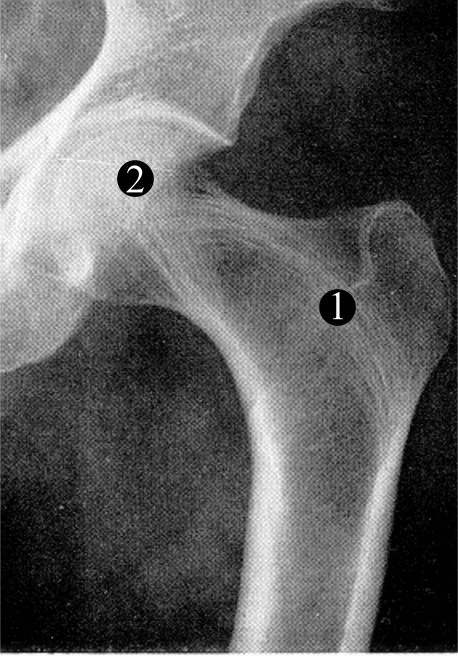
Wolff's law in the neck. The forces derived above, roughly 2.5 to 3 times body weight in walking and far more in running, pass through the proximal femur along cancellous bone organised according to Wolff's law: trabeculae align along the lines of principal stress. Recognising these systems explains both fragility-fracture patterns and radiographic osteoporosis grading. Two principal groups carry the load:
- Principal compressive group: dense vertical trabeculae sweeping from the medial cortex of the neck (the calcar region) up into the weight-bearing superomedial head, resisting the compressive component of the joint reaction force
- Principal tensile group: trabeculae arching from the lateral cortex, below the greater trochanter, across the neck to the inferomedial head, resisting the tensile and bending forces generated because the load is applied eccentrically through the offset neck
Secondary compressive and tensile groups and the greater-trochanteric group complete the pattern. The eccentric, offset loading of the head is exactly why a tensile system is needed at all.
The weak zone and the strut. Where the principal groups diverge in the femoral neck lies Ward's triangle, a relatively trabecula-poor zone that is mechanically weak and a common site of fragility fracture. Reinforcing the inferomedial neck is the calcar femorale, a dense vertical plate of bone extending from the posteromedial cortex toward the greater trochanter; it is the key internal strut transmitting load to the neck and a critical buttress for fracture fixation and stem support.
Singh index. The trabecular groups resorb in a predictable order with osteoporosis: the secondary groups and then the principal tensile group disappear before the principal compressive group. The Singh index uses that order to grade proximal-femoral bone quality from the visible pattern on a plain radiograph, a quick, if observer-dependent, marker of osteoporotic bone stock relevant to implant choice and fracture risk.
Soft Tissue Stabilisers
The labrum. The fibrocartilaginous rim does four things. It deepens the acetabulum by about 5 mm, increasing coverage and resistance to dislocation. It contributes 20 to 30% of the contact area, lowering cartilage stress. It seals the joint, maintaining a negative intra-articular pressure of about −3 to −7 mmHg whose suction resists distraction and contributes to stability alongside fluid-film lubrication. And its dense population of mechanoreceptors and free nerve endings feeds proprioception for neuromuscular control. Labral tears, common in impingement, trauma and dysplasia, compromise all of these and contribute to instability, raised cartilage stress and progression to arthritis; MR arthrogram shows labral morphology, tears and cartilage damage, and repair preserves the joint but requires correction of the underlying impingement.
The capsule and its ligaments. The hip capsule is the strongest joint capsule in the body, reinforced by three ligaments:
- Iliofemoral ligament (Y-ligament of Bigelow): the strongest ligament in the body, resisting forces up to 350 kg; runs from the anterior inferior iliac spine to the intertrochanteric line; prevents hyperextension and external rotation in extension, which is what allows upright posture with minimal muscle activation
- Pubofemoral ligament: reinforces the capsule inferiorly; prevents hyperabduction and external rotation; may be released during the anterior approach to arthroplasty
- Ischiofemoral ligament: reinforces the capsule posteriorly; prevents hyperextension and internal rotation; an important restraint to anterior translation in flexion
Capsular laxity, as in Ehlers-Danlos syndrome, produces instability and excessive tightness produces impingement; range of motion and ligamentous laxity tests (the Beighton score) assess it. Surgical capsulotomy reduces stability and requires repair in high-risk patients.
The ligamentum teres runs from the fovea of the femoral head to the acetabular notch. It carries blood vessels of variable importance to the vascularity of the head, contributes minimally to mechanical stability in adults, and may provide proprioceptive feedback.
Neuromuscular control. The muscles stabilise the joint in three ways: dynamic compression, because muscle force raises the joint reaction force and presses the head into the socket; reflexive stabilisation, in which proprioceptive feedback from capsule, labrum and muscle triggers muscle activation against excessive motion or instability; and coordinated motion control, balanced activation that keeps the head centred through the range of motion and prevents subluxation or impingement. Abductor weakness leads to a Trendelenburg gait and instability, rotator weakness to microinstability, and rehabilitation after injury or surgery is essential because weakness predisposes to dislocation; manual muscle testing, the Trendelenburg test and single-leg stance time measure it.
The layers together. Bony architecture is the primary determinant of stability, measured on the AP pelvis radiograph by the centre-edge angle, the acetabular index and Shenton's line; dysplasia causes instability and its surgical correction is the periacetabular osteotomy, while acetabular retroversion causes posterior impingement. The labrum, the capsule and the muscles add their layers in turn, and pathology at any one of them, inadequate bone, a torn labrum, a lax capsule or weak abductors, degrades the whole.
Differential Diagnosis of Mechanical Hip Pain
The biomechanical abnormalities described above present as hip or groin pain in the young-to-middle-aged adult. Distinguishing the underlying mechanical lesion matters because management diverges sharply between joint preservation, arthroplasty and extra-articular treatment.
- normalAnatomy
- Undercoverage: CE angle less than 20°, increased Tönnis angle
- stabilityMechanism
- Reduced contact area raises contact stress; anterolateral instability
- pathologicalStates
- Activity-related groin pain, sense of instability, fatigue
- clinicalSignificance
- PAO if young with congruent joint and minimal arthritis; THA if arthritic
- measurementTechnique
- AP pelvis (CE angle, Tönnis angle), false-profile view, MR arthrogram
- normalAnatomy
- Cam: reduced head-neck offset (high alpha angle); Pincer: overcoverage/retroversion
- stabilityMechanism
- Motion-driven abutment with labrochondral shear damage
- pathologicalStates
- Groin pain with flexion/internal rotation; positive FADIR/impingement test
- clinicalSignificance
- Arthroscopic/open osteochondroplasty and labral repair if pre-arthritic
- measurementTechnique
- Alpha angle, crossover/posterior-wall signs, Dunn view, MR arthrogram
- normalAnatomy
- Discontinuity of labral seal (usually anterosuperior)
- stabilityMechanism
- Loss of suction seal and contact-area contribution
- pathologicalStates
- Mechanical clicking/catching, groin pain, positive impingement test
- clinicalSignificance
- Repair/refixation usually combined with correction of underlying FAI/dysplasia
- measurementTechnique
- MR arthrogram (gold standard for labral morphology)
- normalAnatomy
- Subchondral collapse with loss of spherical congruity
- stabilityMechanism
- Stress concentration at collapse margin; reduced contact area
- pathologicalStates
- Insidious groin/buttock pain; risk factors (steroids, alcohol, trauma)
- clinicalSignificance
- Core decompression pre-collapse; THA after collapse
- measurementTechnique
- MRI (most sensitive, double-line sign), radiograph (crescent sign)
- normalAnatomy
- Gluteus medius/minimus tendinopathy or tear; trochanteric bursitis
- stabilityMechanism
- Abductor dysfunction reduces effective abductor force/moment arm
- pathologicalStates
- Lateral hip pain, tenderness over trochanter, Trendelenburg if torn
- clinicalSignificance
- Mostly non-operative; tendon repair for symptomatic full-thickness tears
- measurementTechnique
- Clinical exam, single-leg-stance test, ultrasound/MRI
Total Hip Arthroplasty: Femoral Offset and Leg Length
Offset. Femoral offset is the perpendicular distance from the centre of the femoral head to the long axis of the femoral shaft, normally 40 to 50 mm depending on size. It is measured preoperatively on an AP pelvis radiograph with the femur in neutral rotation: draw the line bisecting the canal and measure the perpendicular distance to the centre of the head. Because it sets the abductor moment arm, every millimetre changes the force the abductors must produce and the force the joint carries.
Reduced offset shortens the abductor moment arm, and the consequences follow from the moment balance:
- Shorter abductor moment arm, so more abductor force is required: weakness, fatigue and a Trendelenburg gait
- Higher joint reaction force, because the larger abductor force raises the resultant, and therefore more polyethylene wear
- Instability from reduced abductor and capsular tension
- Impingement if the femoral neck meets the pelvis or cup at the extremes of motion
- A subjective sense of a short leg even when length is preserved, because the greater trochanter has shifted medially
Increased offset lengthens it, with the opposite effects and its own trade-offs:
- Longer abductor moment arm, so less force for a given task: better strength and endurance
- Lower joint reaction force and less polyethylene wear, the principal wear benefit of restoring or increasing offset
- Greater range of motion before impingement
- Trochanteric bursitis from iliotibial band tension
- Higher torsional stress on the femoral component and its fixation interface, the main trade-off
- Abductor moment arm
- Decreased ~10%
- Abductor force required
- Increased ~10%
- Joint reaction force
- Increased
- Clinical effect
- Weakness, Trendelenburg tendency, higher wear
- Abductor moment arm
- Decreased ~20%
- Abductor force required
- Increased ~25%
- Joint reaction force
- Increased
- Clinical effect
- Weakness, instability risk, limp, higher wear
- Abductor moment arm
- Normal
- Abductor force required
- Normal
- Joint reaction force
- Normal
- Clinical effect
- Optimal function
- Abductor moment arm
- Increased ~10%
- Abductor force required
- Decreased ~10%
- Joint reaction force
- Decreased
- Clinical effect
- Improved strength, less wear; mild iliotibial band tension
- Abductor moment arm
- Increased ~20%
- Abductor force required
- Decreased ~20%
- Joint reaction force
- Decreased
- Clinical effect
- Less wear, but trochanteric bursitis and stem torsional stress
The target is native offset: deviations of 5 mm or more correlate with inferior functional outcomes and patient satisfaction. Preoperative templating measures the native offset, the stem size and offset option are chosen to reproduce it, modular components (dual-modular or metaphyseal-fitting designs) are used when standard stems cannot, and the result is verified intraoperatively with calipers or fluoroscopy.
Leg length. Discrepancy after arthroplasty is a common source of dissatisfaction and litigation. Lengthening increases abductor tension, which is beneficial at first but painful when excessive; may stretch the sciatic nerve, particularly if it exceeds 3 to 4 cm acutely; is perceived as a long leg, affecting gait and balance; and can partly compensate for reduced offset. Shortening reduces abductor tension and moment arm, may cause instability through laxity, is perceived as a discrepancy, and is difficult to compensate fully with a shoe lift beyond 2 cm. The target is native length, with slight lengthening of up to 5 to 8 mm acceptable; discrepancies over 10 to 15 mm are typically symptomatic.
Offset and length together. The two interact, and four combinations are possible:
- Length restored, offset restored: the ideal, reproducing native mechanics
- Length restored, offset reduced: weak abductors despite equal legs, with instability risk
- Length increased, offset restored: acceptable if the lengthening is under 8 to 10 mm, and abductor function is maintained
- Length increased, offset reduced: a common compensation that gives functional leg-length equality with biomechanical inferiority
Increasing both proportionally keeps abductor tension and moment arm closest to native anatomy.
Checking it. Intraoperatively: caliper measurement from a fixed reference (anterior superior iliac spine to medial malleolus), calibrated radiographs, trial reduction to assess stability and range of motion, fluoroscopy if available, and the shuck test, where under 1 cm of translation is acceptable and over 2 cm indicates instability risk. Postoperatively: the AP pelvis radiograph measures offset against the contralateral hip and leg length by the height of the lesser trochanters, the Trendelenburg test and leg-length measurement confirm it clinically, and the patient's satisfaction with leg length and function is the outcome that matters. Deviations should be minimised and accepted only when bone loss, instability or other technical considerations make them unavoidable.
Total Hip Arthroplasty: Acetabular Component Position
Cup orientation governs range of motion, stability and wear.
Inclination (abduction angle). The traditional Lewinnek safe zone is 30 to 50° from horizontal (40 ± 10°); modern practice favours 35 to 45°. A vertical cup loads its superior edge, accelerating wear and reducing stability. A horizontal cup limits range of motion, impinges, and can squeak in ceramic bearings.
Anteversion. The Lewinnek safe zone is 5 to 25° (15 ± 10°); modern practice favours 15 to 25°. Excessive anteversion risks anterior instability; insufficient anteversion, a retroverted cup, risks posterior instability. Lewinnek's zone was derived from an analysis of dislocated against stable hips, and it reduces but does not eliminate the dislocation risk.
Combined anteversion. The sum of acetabular and femoral anteversion determines the functional arc of motion and the impingement risk. The Ranawat safe zone is a combined anteversion of 35 to 45°, so the cup is adjusted to the femur:
- Cup anteversion
- 30°
- Cup anteversion
- 20°
- Cup anteversion
- 15-20°
- Cup anteversion
- 10-15°
Spinopelvic mobility. Pelvic tilt changes between standing and sitting, and with it the functional orientation of the cup; some patients change a great deal between positions. Lateral spinopelvic radiographs taken standing and sitting identify the patients who need a non-standard cup position:
- Stiff spine (ankylosed lumbar spine, prior fusion): the pelvis cannot tilt posteriorly on sitting and keeps its standing orientation, so the cup is positioned for standing, with anteversion reduced to 10 to 15° to prevent anterior dislocation when sitting, and inclination possibly increased to 45 to 50°
- Hypermobile pelvis: excessive posterior tilt on sitting increases the functional cup anteversion, with posterior dislocation risk when standing, so anteversion is increased to 25 to 30° and inclination kept at 35 to 45°
Targets. Inclination 35 to 45°, individualised to spinopelvic mobility, and anteversion 15 to 25°, adjusted for femoral version and pelvic mobility.
Dysplasia: From Contact Stress to Joint Preservation
Pathomechanics. In developmental dysplasia the undercovered acetabulum reduces the contact area, and contact stress doubles or more, from about 1.3 MPa to 2.5 to 3.5 MPa, beyond what cartilage tolerates chronically.
Natural history. The hip is asymptomatic in childhood and adolescence while the cartilage tolerates the stress; symptoms emerge in the third to fifth decade from cumulative damage, and progressive arthritis then develops over 5 to 15 years. The more severe the dysplasia, the earlier the onset and the faster the progression.
Joint preservation: periacetabular osteotomy. The Bernese PAO is a multifocal osteotomy that reorients the acetabulum and increases coverage, raising contact area by 30 to 50% and returning stress to the physiological range. It is indicated in the young patient (under 40) with minimal arthritis (Tönnis grade 0 to 1) and adequate joint congruence. In the Bern series, cumulative hip survivorship is 80 to 90% at 10 years with optimal reorientation and a spherical femoral head, and in the earliest 75-patient cohort about 60% at 20 years and 30% at 30 years.
Arthroplasty. Once arthritis is established (Tönnis 2 to 3), in the older patient (over 40 to 50) or with severe deformity, the answer is replacement. The shallow acetabulum, small dysplastic femur and version abnormalities make it technically demanding, and restoring anatomy may need a high hip centre (controversial) or bone grafting. Pain relief is good, but dislocation and loosening rates are higher than for primary arthroplasty for other aetiologies. The contact-stress model explains the prognosis and guides counselling on the timing of intervention.
Hip contact forces and gait patterns from routine activities
- In vivo level-walking hip contact force averaged 238% body weight
- Stair ascent 251% and stair descent 260% body weight
- Implant inward torsion (critical for stem fixation) ~23% higher on stair ascent than level walking
- Implants should be tested mainly under walking and stair-climbing loads (plus stumbling peaks)
Femoroacetabular impingement: a cause for osteoarthritis of the hip
- FAI proposed as a leading mechanism for non-dysplastic early hip osteoarthritis
- Cam (aspherical head-neck offset) and pincer (acetabular overcoverage/retroversion) morphologies
- Damage is motion-driven (abutment) rather than purely axial-load driven
- Rationale for joint-preserving osteochondroplasty/rim trimming to halt degeneration in young patients
The acetabular labrum: a review of its function
- Labrum maintains pressurised intra-articular fluid film for lubrication and load distribution
- Labral seal creates suction effect that resists femoral head distraction (stability)
- Labrum increases contact area and reduces peak cartilage contact stress
- Preserving/restoring labral function is an explicit goal of modern hip-preservation surgery
Effect of femoral offset on range of motion and abductor muscle strength after total hip arthroplasty
- Reduced femoral offset decreases abductor moment arm, requiring greater muscle force
- Offset restoration within 5 mm of native anatomy optimizes abductor function
- Leg length discrepancy greater than 10 mm associated with patient dissatisfaction
- Combined offset and leg length restoration improves outcomes vs. either alone
Dislocations after total hip-replacement arthroplasties
- Safe zone: cup anteversion 15 ± 10° and inclination 40 ± 10°
- Dislocation 1.5% inside the safe zone versus 6.1% outside
- Increased anteversion associated with anterior dislocation
- NO significant correlation was found between cup orientation and POSTERIOR dislocation - the commonest direction, and the one the safe zone is most often invoked to prevent
- Greatest dislocation risk in the first 30 days and in revision/previously-operated hips
Bernese periacetabular osteotomy: indications, technique and results 30 years after the first description
- PAO is the standard surgical treatment for symptomatic acetabular dysplasia
- Posterior column preserved, improving fragment stability and rehabilitation
- 10-year hip survivorship 80-90% with optimal reorientation and spherical head
- Original cohort: ~60% survivorship at 20 years, ~30% at 30 years
Guidelines, Registries & Global Practice
Global Burden and Epidemiology
Hip osteoarthritis is among the leading global causes of years lived with disability, and total hip arthroplasty (THA) is one of the most successful and cost-effective elective operations performed worldwide, with several million procedures performed each year across high-volume registries. Hip biomechanical principles (joint reaction force, abductor mechanics, contact stress, component positioning) underpin the surgical decisions captured by these registries.
Registry Evidence
Large national joint replacement registries provide the strongest real-world evidence on how biomechanical restoration translates into implant survival. Although registries differ in detail, several findings are consistent internationally:
- AOANJRR (Australia): Larger femoral head sizes (36 mm and dual-mobility constructs) are associated with lower revision for dislocation; restoration of offset and leg length correlates with better patient-reported outcomes.
- NJR (England, Wales, Northern Ireland, Isle of Man) and the Swedish Hip Arthroplasty Register (SHAR): Both report that malpositioned acetabular components and reduced offset are associated with higher rates of dislocation and revision, reinforcing the importance of biomechanical restoration.
- Across registries, the leading early failure mode is instability/dislocation, which is directly governed by component orientation, offset, head size and soft-tissue tension — the biomechanical levers discussed in this topic.
Guideline and Standards Comparison
- normalAnatomy
- Evidence-based clinical practice guidelines on hip OA management and THA
- stabilityMechanism
- Recommends restoration of hip mechanics (offset, length) and appropriate component positioning to reduce instability
- pathologicalStates
- Acknowledges Lewinnek safe zone as a guide while recognising its limitations
- clinicalSignificance
- Moderate-to-strong evidence supports THA for end-stage hip OA
- measurementTechnique
- Preoperative templating; AP pelvis radiograph
- normalAnatomy
- NG157 (osteoarthritis) and joint replacement guidance
- stabilityMechanism
- Supports THA for disabling hip OA refractory to non-operative care; emphasises implants with strong registry survivorship (ODEP ratings)
- pathologicalStates
- Directs implant selection toward components meeting benchmark revision thresholds
- clinicalSignificance
- Cost-effectiveness and registry-validated implant survival central to recommendations
- measurementTechnique
- NJR-linked outcome benchmarking (ODEP/Beyond Compliance)
- normalAnatomy
- British Orthopaedic Association / British Hip Society standards
- stabilityMechanism
- Promote offset and leg-length restoration, accurate cup orientation, and spinopelvic assessment in at-risk patients
- pathologicalStates
- Hip-preservation pathways (PAO, FAI surgery) for dysplasia and impingement in young adults
- clinicalSignificance
- Standards drive surgeon-level and unit-level outcome monitoring
- measurementTechnique
- Templating, intraoperative measurement, standing/sitting lateral radiographs
- normalAnatomy
- Pan-European consensus and instructional content
- stabilityMechanism
- Endorse combined-anteversion and functional/spinopelvic cup-positioning concepts beyond the static Lewinnek zone
- pathologicalStates
- Recognise stiff-spine and hypermobile-pelvis phenotypes as dislocation risks
- clinicalSignificance
- Shift toward patient-specific functional targets
- measurementTechnique
- Functional radiographs; navigation/robotics where available
- normalAnatomy
- ISO 7206 series (hip-implant mechanical testing); ISO 14242 (wear simulation)
- stabilityMechanism
- Standardise endurance, fatigue and wear testing reflecting in vivo loading (informed by Bergmann-type force data)
- pathologicalStates
- Define test loads approximating walking/stair-climbing forces
- clinicalSignificance
- Regulatory prerequisite for implant market approval
- measurementTechnique
- Bench testing under physiological load profiles
Practice Variation and Modern Trends
- Cup positioning philosophy: International practice is moving from the static Lewinnek safe zone toward functional/spinopelvic targets and combined anteversion, particularly for patients with prior lumbar fusion or a stiff spine.
- Bearing and head size: Larger heads and dual-mobility constructs are increasingly used for instability-risk patients, with regional variation in adoption.
- Fixation: Cemented fixation predominates for elderly osteoporotic bone in several European/registry settings, whereas uncemented fixation is favoured in younger patients; practice varies markedly between countries.
- Hip preservation: PAO for dysplasia and arthroscopic/open FAI correction are concentrated in specialist centres, with referral thresholds differing internationally.
Exam Relevance
Hip biomechanics is a core basic-science viva and MCQ topic. Candidates are expected to draw the single-leg-stance free body diagram, derive the abductor and joint reaction forces, and link the mechanics to clinical decisions: Trendelenburg gait, contralateral cane use, offset and leg-length restoration, cup safe zones and combined/functional anteversion, and the contact-stress basis of dysplastic, post-traumatic and avascular-necrosis arthritis.
MCQ Practice Points
Q: What is the hip joint reaction force during single-leg stance and how is it calculated?
A: Approximately 2.5-3× body weight. Calculated by moment equilibrium: Body weight (minus stance leg, ~55kg for 70kg person) acts 10cm from hip center. Hip abductors must generate ~2× BW force through their 5cm moment arm to balance. Joint reaction force is vector sum of body weight and abductor force, directed superolaterally into the acetabulum.
Q: How does using a walking stick in the contralateral hand reduce hip joint force?
A: A walking stick creates an additional moment arm on the contralateral side. Using just 10-15% body weight through the stick significantly reduces the moment that abductors must counter. This can reduce hip joint reaction force by 20-30%. The stick works by reducing the effective body weight lever arm, not by directly offloading weight.
Q: What is the effect of reducing femoral offset in THA on hip biomechanics?
A: Reducing femoral offset decreases the abductor moment arm, requiring the abductors to generate greater force to maintain pelvic stability. This increases hip joint reaction force, accelerates polyethylene wear, and causes abductor weakness and Trendelenburg gait. Offset restoration is critical - every 1 mm reduction increases abductor force required.
Q: Explain the biomechanical basis of the Trendelenburg gait compensation (abductor lurch).
A: When abductors are weak, the patient lurches the trunk over the affected hip during stance phase. This shifts the body's center of gravity closer to the hip center, reducing the body weight moment arm by approximately 50%. With a shorter lever arm, less abductor force is needed for balance, compensating for weakness.
Q: How does hip dysplasia affect contact stress in the hip joint?
A: Hip dysplasia causes reduced acetabular coverage and decreased contact area. Since Stress = Force/Area, the same joint reaction force is distributed over a smaller area, causing increased contact stress. This leads to accelerated cartilage degeneration and early osteoarthritis. Center-edge angle less than 20° indicates insufficient coverage. Periacetabular osteotomy improves coverage.
Clinical Decision Scenarios
Practise clinical reasoning and management decisions out loud
“An examiner asks you to analyze the forces acting on the hip during single-leg stance. You are expected to draw a free body diagram, identify all forces and moment arms, calculate the required hip abductor force, and explain the clinical significance of this biomechanical relationship.”
Single-Leg Stance Forces - Most Examined Topic
- Body weight (minus stance leg): 55 kg (539 N) for 70 kg person, acting ~10 cm from hip center
- Hip abductor force: ~1078 N (110 kg, 2× body weight), moment arm ~5 cm
- Hip joint reaction force: ~1600 N (2.3× body weight), vector sum of BW + abductor force
- Mechanical advantage: 0.5 (abductor moment arm / BW lever arm = 5/10)
- Moment equilibrium: BW × 10 cm = Abductor force × 5 cm
- Clinical: During walking, peak force reaches 2.5-3× BW at midstance
Hip Abductor Biomechanics
- Primary muscles: Gluteus medius (largest), gluteus minimus, tensor fasciae latae
- Moment arm: 5-6 cm from hip center to muscle resultant
- Function: Pelvic stabilization (prevent Trendelenburg), frontal plane balance
- Weakness causes: Superior gluteal nerve injury (L5 root, surgical), muscle damage, pain inhibition
- Trendelenburg test: Pelvis drops on contralateral side during single-leg stance
- Compensation: Abductor lurch (trunk shift over affected hip reduces BW moment arm by 50%)
Contact Stress - Key Concept
- Contact stress = Joint reaction force / Contact area
- Normal hip: ~1600 N / 1200 mm² = 1.33 MPa (within cartilage tolerance 1-3 MPa)
- Dysplasia: Area reduced to 600 mm² → Stress = 2.67 MPa (doubled) → Early arthritis
- Fracture malunion: Area reduced to 400 mm² → Stress = 4.0 MPa (tripled) → Rapid arthritis
- CE angle: Normal 25-40°, dysplasia less than 20° (inadequate coverage)
- Labrum: Increases contact area by 20-30%, seals joint (negative pressure ~-5 mm Hg)
Gait Cycle Forces
- Stance phase (60% of cycle): Weight-bearing, peak forces at midstance (2.5-3× BW)
- Initial contact: 1.5-2× BW, hip extended, extensors active (glut max, hamstrings)
- Midstance: 2.5-3× BW, single-leg support, abductors maximally active
- Toe-off: Forces decrease, hip flexors activate for swing
- Swing phase (40% of cycle): Non-weight-bearing, minimal joint force (less than BW)
- Faster walking/running: Forces increase to 4-5× BW; Jumping: 8-10× BW
THA Femoral Offset - Critical for Function
- Definition: Perpendicular distance from femoral canal axis to center of head (normal 40-50 mm)
- Reduced offset: Decreased abductor moment arm → Increased force requirement → Weakness, Trendelenburg
- Increased offset: Increased moment arm → Improved strength, lower joint force, but trochanteric pain
- Target: Restore native offset ± 5 mm (deviations greater than 5 mm = inferior outcomes)
- Measurement: AP pelvis radiograph, compare to contralateral side
- Clinical: Combined with leg length restoration optimizes biomechanics and satisfaction
THA Acetabular Position - Lewinnek Safe Zone
- Inclination: 30-50° from horizontal (40° ± 10°), modern target 35-45°
- Anteversion: 5-25° (15° ± 10°), modern target 15-25°
- Too vertical (high inclination): Edge loading, accelerated wear, instability
- Too horizontal (low inclination): Impingement, reduced ROM
- Excessive anteversion: Anterior instability; Insufficient: Posterior instability
- Combined anteversion: Acetabular + femoral version = 35-45° (Ranawat safe zone)
Spinopelvic Considerations - Modern Concept
- Pelvic tilt changes between standing and sitting affect functional cup orientation
- Normal: Posterior pelvic tilt ~20° when sitting (increases functional anteversion)
- Stiff spine: Minimal tilt change → Risk anterior dislocation sitting → Reduce cup anteversion to 10-15°
- Hypermobile: Excessive tilt (greater than 30°) → Posterior dislocation risk standing → Increase anteversion to 25-30°
- Assessment: Lateral spinopelvic radiographs standing and sitting
- High-risk: Prior lumbar fusion, flat-back syndrome, severe spinal deformity
Assistive Device Biomechanics
- Cane in CONTRALATERAL hand: Reduces BW moment arm, decreases abductor force ~20-40% (scales with cane load)
- Example: 15% BW cane support → Abductor force drops from 1078 N to 784 N (27% reduction)
- Hip joint reaction force reduces proportionally (less pain, improved function)
- Common error: Ipsilateral cane (same side as painful hip) provides minimal benefit
- Bilateral support (walker, crutches): Symmetric loading, reduces single-leg phase forces
- Weight loss: every kg lost removes ~2.5-3 kg of peak force across the joint (BW enters the model twice)
Stability Mechanisms - Four Components
- Bony: Acetabular coverage 170-180°, CE angle 25-40°, version 15-25° (primary stability)
- Labral: Deepens socket 5 mm, increases contact area 20-30%, creates negative pressure seal
- Capsular: Iliofemoral (strongest, 350 kg), pubofemoral, ischiofemoral ligaments
- Muscular: Dynamic compression, reflexive stabilization, coordinated motion control
- Pathology: Dysplasia (inadequate bone), labral tear (loss of seal), capsular laxity, abductor weakness
High-Yield Numbers for MCQs
- Hip abductor moment arm: 5-6 cm; Body weight lever arm: 10-12 cm; MA = 0.5
- Single-leg stance forces: Abductor 2× BW (~110 kg), Joint reaction 2.3-3× BW (~160-210 kg)
- Walking peak force: 2.5-3× BW; Running: 4-5× BW; Jumping: 8-10× BW
- Normal contact area: 1000-1400 mm²; Normal stress: 1-2 MPa (tolerance up to 3 MPa)
- CE angle: Normal 25-40°, dysplasia less than 20°, overcoverage greater than 40°
- THA safe zone: Inclination 35-45°, Anteversion 15-25°, Combined version 35-45°
Evidence Base
The biomechanical claims in this topic rest on a small number of landmark sources: in vivo telemetric force measurement (Bergmann), the femoral-offset clinical correlation (McGrory), the acetabular safe-zone description (Lewinnek), labral function reviews (Bsat), the FAI disease concept (Ganz) and long-term joint-preservation outcomes (Bernese PAO). The verified EvidenceCards below summarise these, and each quantitative figure in the text is anchored to one of them or to standard radiographic reference ranges.