Commonest SA/OM Under 4 Years | Indolent Presentation | Blood-Culture-Bottle + PCR Diagnosis
- Gram-negative coccobacillus; oropharyngeal commensal in young children
- Commonest cause of septic arthritis and osteomyelitis in children aged 6-48 months in regions where PCR is used
- Indolent presentation: low-grade or absent fever, child may still weight-bear, modest CRP elevation
- Inoculate joint aspirate into blood culture bottles (dramatically increases yield vs standard agar)
- Specific real-time PCR on the aspirate is the diagnostic test that finds it - assays target the RTX toxin genes (rtxA) or cpn60; Gram stain and solid-media culture miss these cases
- Usually susceptible to beta-lactams, but NOT uniformly - Yagupsky records that beta-lactamase production is CLONAL and its local prevalence VARIABLE, so know your unit's rate. Vancomycin and clindamycin are useless (all isolates resistant), so MRSA-oriented empiric cover leaves this organism untreated
- “Any child under 4 with septic arthritis or osteomyelitis: think Kingella kingae first
- “Lower CRP and ESR than Staph aureus: do not let normal inflammatory markers reassure you
- “Blood culture bottle inoculation of joint aspirate increases culture yield substantially
- “PCR is gold standard but not universally available: high clinical suspicion must drive treatment
- “Preceded by upper respiratory infection or oral ulcers in up to half of cases
Overview and Epidemiology
Why it matters. Kingella kingae is the commonest bacterial cause of osteoarticular infection in children under 4 years in regions where PCR-based diagnosis is used. Before PCR it was missed because it is fastidious and difficult to culture on standard agar, so many cases labelled "culture-negative septic arthritis" were likely Kingella. Its indolent presentation is easily confused with transient synovitis, and delayed diagnosis is common.
Who. Peak age is 6-24 months and over 80% of cases are in children under 4, with a male preponderance of approximately 60-65%. Cases peak in autumn and winter, correlating with respiratory illness.
- Risk factors: daycare attendance, recent upper respiratory infection, oral ulcers or stomatitis
- Transmission is by respiratory droplets, and outbreaks in daycare centres have been documented
Microbiology and Pathogenesis
The organism. A Gram-negative coccobacillus and facultative anaerobe in the family Neisseriaceae. It is fastidious: it grows poorly on standard agar media but thrives in enriched media, in the liquid of blood culture bottles and on chocolate agar or blood agar with haemin.
From carriage to infection. K. kingae is an oropharyngeal commensal, carried by 10-30% of healthy children under 4. Invasive disease follows when mucosal integrity is breached, by a viral upper respiratory infection, oral ulceration or teething: a transient bacteraemia seeds the metaphyseal bone or synovium by haematogenous spread, and a local infection with an indolent clinical course follows. The RTX (repeats-in-toxin) toxin and the type IV pilus are the key virulence factors, facilitating epithelial adherence and invasion. The organism's affinity for synovial and osseous tissue in toddlers is well established, but the precise molecular mechanisms remain under investigation.
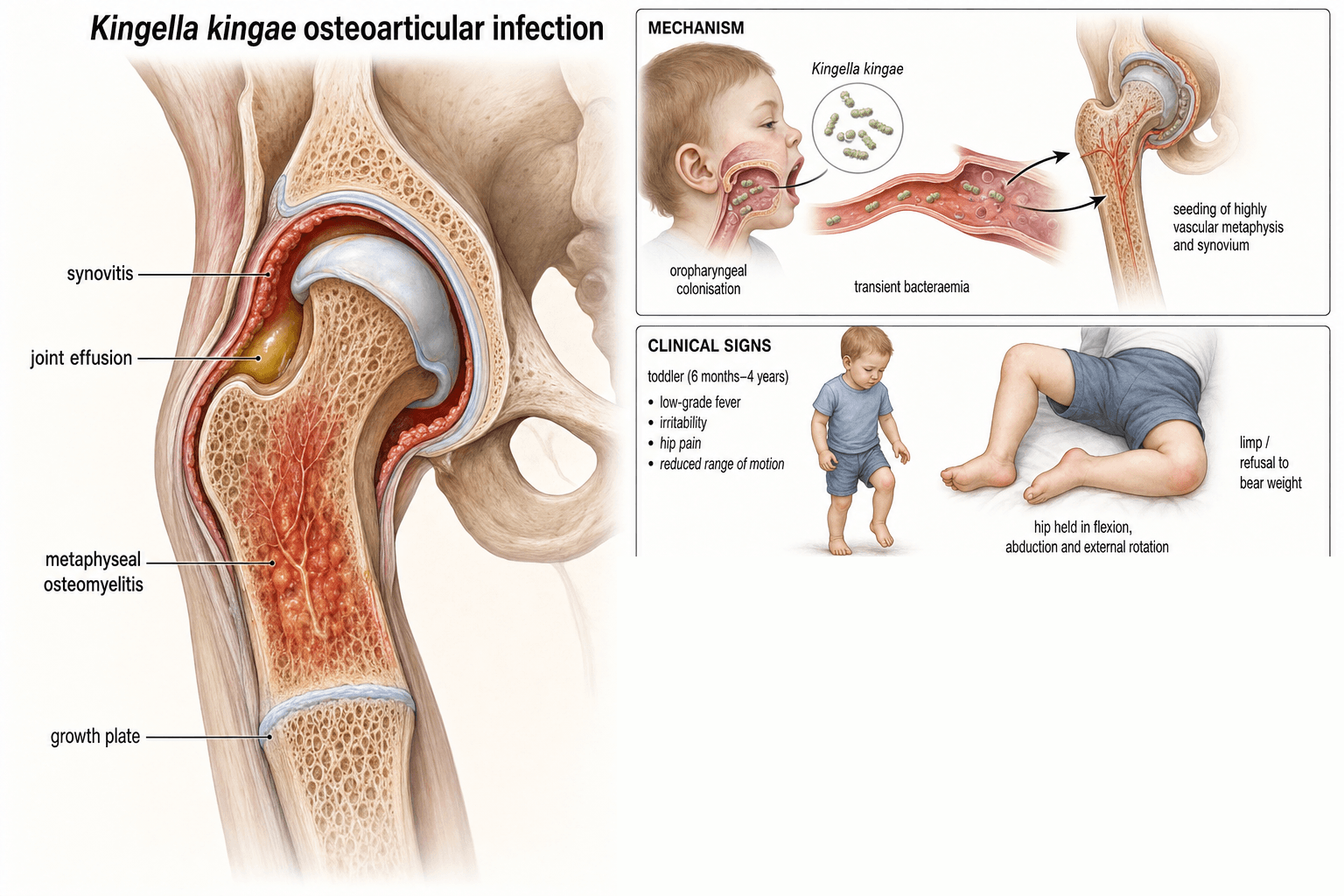
Why toddlers. The 6-24 month window is where the risks stack up:
- Immune: waning maternal antibodies and an immature adaptive immune system
- Behavioural: mouthing objects, frequent respiratory infections and daycare exposure
- Anatomical: the rich vascular supply to the growth plates creates favourable conditions for bacterial seeding
- Colonisation pressure: oropharyngeal carriage peaks in this age group
The K of HACEK. Kingella belongs to the HACEK group of fastidious Gram-negative oropharyngeal flora that cause subacute endocarditis:
- H - Haemophilus species (and Aggregatibacter aphrophilus, formerly Haemophilus aphrophilus)
- A - Aggregatibacter actinomycetemcomitans
- C - Cardiobacterium hominis
- E - Eikenella corrodens
- K - Kingella kingae (and Kingella species)
Like the joint infections, HACEK organisms are fastidious and grow slowly, so they were historically a cause of "culture-negative" endocarditis, and the same diagnostic lesson applies: prolonged incubation, enriched or automated blood-culture systems and molecular methods improve yield. In children, Kingella endocarditis is rarer than its osteoarticular disease but carries far higher morbidity and mortality, can affect previously normal valves, and may present with embolic phenomena. That is the rationale for echocardiography in a child with Kingella bacteraemia, set out under Complications.
Classification and Types
The syndromes. Septic arthritis is by far the most common manifestation and the one most likely to appear in examinations. Tenosynovitis is a distinctive feature, more common with Kingella than with other pathogens.
- Frequency
- 50-65 percent of cases
- Common Sites
- Knee, hip, ankle, shoulder
- Distinguishing Features
- Indolent; lower joint aspirate WBC than Staph; may mimic transient synovitis
- Frequency
- 20-30 percent of cases
- Common Sites
- Distal femur, proximal tibia, calcaneus, talus
- Distinguishing Features
- Subacute presentation; MRI shows bone marrow oedema; lower CRP
- Frequency
- 5-10 percent of cases
- Common Sites
- Lumbar (L2-L4 most common)
- Distinguishing Features
- Refusal to walk, back stiffness, irritability; MRI shows disc and adjacent vertebra changes
- Frequency
- Reported feature
- Common Sites
- Foot and ankle tendons most common
- Distinguishing Features
- Relatively distinctive for Kingella; tendon sheath swelling with minimal joint involvement
- Frequency
- Rare but serious
- Common Sites
- Mitral and aortic valves
- Distinguishing Features
- Part of HACEK group; echocardiography for any Kingella bacteraemia; high morbidity
Age. The striking age restriction is itself a diagnostic clue.
- Frequency
- Uncommon
- Key Considerations
- Transplacental antibodies may be partially protective
- Differential Diagnosis
- Group B Streptococcus, Gram-negative organisms
- Frequency
- Very common
- Key Considerations
- The dominant osteoarticular pathogen in this age group where PCR is used
- Differential Diagnosis
- Transient synovitis, trauma, toddler's fracture
- Frequency
- Unusual
- Key Considerations
- Colonization rates decline; Staph aureus becomes dominant
- Differential Diagnosis
- Staph aureus osteoarticular infection
Clinical Assessment
History. The child is typically 6-48 months old, and daycare attendance is an important clue. Onset is gradual, over days to a week, and an upper respiratory infection or oral ulcers precede it in up to 50% of cases. The complaint is a limp, refusal to walk, irritability or reduced use of the limb; fever is low-grade or absent, unlike the high fever of Staphylococcus aureus, and the child may partially weight-bear, limping but walking.
Examination. The child may appear well or mildly unwell, not toxic. Look for:
- Joint: effusion, warmth and restricted range of motion, especially at the hip, knee and ankle
- Tenderness localised to the affected joint or the metaphyseal region
- Spine: refusal to sit or walk, back stiffness and paravertebral muscle spasm point to spondylodiscitis
- Tendon sheaths: swelling along a tendon sheath suggests Kingella
- Oropharynx: oral ulcers or signs of a recent upper respiratory infection
The transient synovitis trap. Kingella septic arthritis is frequently misdiagnosed as transient synovitis because the child is afebrile or has a low-grade fever, may still weight-bear and has modest inflammatory markers. The distinction matters: transient synovitis is self-limiting, whereas untreated Kingella septic arthritis can cause joint destruction. A child already treated for transient synovitis whose limp persists and whose standard cultures are negative should be retested with blood culture bottles and PCR, and started on an empiric beta-lactam if clinical suspicion is high.
Any child under 4 with a joint effusion and limp who is not improving within 24-48 hours should have joint aspiration with inoculation into blood culture bottles and PCR sent. Do not be falsely reassured by normal or mildly elevated inflammatory markers in this age group.
Against Staphylococcus aureus. The contrast in presentation, side by side:
- Kingella kingae
- 6-48 months (toddlers)
- Staphylococcus aureus
- All ages; bimodal (neonates and adolescents)
- Kingella kingae
- Indolent (days to weeks)
- Staphylococcus aureus
- Acute (hours to days)
- Kingella kingae
- Low-grade or absent
- Staphylococcus aureus
- High fever, toxic-appearing child
- Kingella kingae
- Modest elevation (CRP often under 50)
- Staphylococcus aureus
- Marked elevation (CRP often over 80)
- Kingella kingae
- May partially weight-bear
- Staphylococcus aureus
- Usually completely non-weight-bearing
- Kingella kingae
- Frequently negative (fastidious)
- Staphylococcus aureus
- Usually positive on standard media
- Kingella kingae
- Rapid (24-48 hours), excellent prognosis
- Staphylococcus aureus
- Variable; depends on abscess and MRSA status
The limping toddler. The differential:
- Age
- 6-48 months
- Fever
- Low-grade or absent
- Key Discriminator
- Indolent; blood culture bottle aspirate + PCR positive
- Age
- Any age
- Fever
- High, toxic
- Key Discriminator
- Acute onset, high CRP/ESR, positive standard cultures
- Age
- 3-8 years (can occur younger)
- Fever
- Low-grade or absent
- Key Discriminator
- Self-limiting; follows URI; all cultures negative; resolves in days
- Age
- 1-3 years
- Fever
- Afebrile
- Key Discriminator
- X-ray shows spiral tibial fracture; no joint effusion; trauma history may be absent
- Age
- 4-8 years (unusual under 3)
- Fever
- Afebrile
- Key Discriminator
- Insidious onset hip limp; X-ray shows femoral head changes; chronic course
- Age
- Any age
- Fever
- Afebrile
- Key Discriminator
- Multiple fractures in different stages; metaphyseal corner fractures; inconsistent history
The classic picture. In a child under 4 with a limp, recent upper respiratory symptoms or oral ulcers should specifically raise suspicion for Kingella. Unlike Staphylococcus aureus, the child looks relatively well; unlike transient synovitis, the symptoms persist or worsen. Toddler age, indolent onset, a preceding upper respiratory infection and persistent joint findings together make up the classic presentation.
Investigations
Blood tests. The markers are unimpressive, and that is the trap. CRP is often only modestly elevated, frequently under 50 mg/L, and may be normal initially; ESR is mildly to moderately elevated, less than with Staphylococcus aureus; the white cell count is frequently normal or only mildly elevated. Normal inflammatory markers do not exclude Kingella osteoarticular infection, so clinical suspicion must guide investigation.
Blood cultures. Positive in approximately 60% of bacteraemic Kingella cases when drawn before antibiotics, a higher yield than a joint aspirate on standard media.
Joint aspiration. Aspirate under sterile conditions, ultrasound-guided for a deep joint such as the hip. The critical step is to inoculate the aspirate directly into blood culture bottles (BACTEC or similar) rather than onto agar plates: the fastidious organism thrives in liquid enrichment media, and the yield rises from near zero on standard agar to substantially improved detection. Send synovial fluid for real-time PCR as well, where available.
- Synovial fluid WBC is often lower than the classical 50,000/mL threshold for septic arthritis; counts of 10,000-40,000/mL are common
- Gram stain is usually negative, the organism being difficult to visualise
Real-time PCR. The gold standard, targeting the cpn60 (chaperonin) gene or other Kingella-specific sequences. Its sensitivity is far superior to culture and it detects the organism even after antibiotics have started, with a turnaround of hours to days depending on the laboratory. Studies using PCR have shown Kingella to be responsible for the majority of osteoarticular infections in children under 4, replacing "culture-negative" as the most common category; combined with blood culture bottle inoculation, diagnostic accuracy approaches 100%. It is not universally available, and where it is not, bottle inoculation remains the most practical strategy.
Imaging. Each modality answers a different question:
- X-ray: often normal early; may show soft tissue swelling, joint space widening, or a late periosteal reaction in osteomyelitis, and in spondylodiscitis disc space narrowing with adjacent endplate changes
- Ultrasound: detects joint effusion (hip, knee, ankle), guides aspiration, and demonstrates synovial thickening and tenosynovitis
- MRI: most sensitive for osteomyelitis and spondylodiscitis; shows bone marrow oedema (T2/STIR hyperintensity), soft tissue involvement and joint effusion, and is essential for surgical planning if an abscess is present
- Bone scan: rarely needed if MRI is available; may be used when multiple sites are suspected
The single most important investigation step for Kingella is inoculating joint aspirate into blood culture bottles. In exam scenarios, always mention this step when discussing paediatric joint aspiration.
Management Algorithm
Empiric antibiotics. Start at presentation and do not wait for culture results: IV cefazolin or ampicillin/sulbactam. Once Kingella is confirmed, usually on days 2-5 when the PCR or blood culture bottle result arrives, narrow to high-dose ampicillin or cephalexin, guided by susceptibility testing of the isolate because a minority of strains produce a beta-lactamase (below). Fever should resolve within 24-48 hours, CRP should trend downward, and pain and range of motion should improve.
Oral step-down and duration. Switch to high-dose oral ampicillin or cephalexin once the child is clinically improving and the inflammatory markers are trending down, around days 5-7 for septic arthritis. Total duration, IV and oral combined, is 3-4 weeks, shorter than for Staphylococcus aureus; some protocols use 4-6 weeks for osteomyelitis.
Septic arthritis. The goal is to eradicate the infection and preserve joint function. At presentation aspirate the joint, ultrasound-guided for the hip, inoculate the aspirate into blood culture bottles, send it for PCR if available, and draw CRP, ESR, WBC and blood cultures. Surgical washout is indicated for hip septic arthritis, to protect the femoral head, and for any joint with a purulent effusion under pressure; the knee and ankle may be managed with aspiration alone if early and the child responds rapidly.
- If not improving on days 2-5: repeat aspiration and consider MRI for adjacent osteomyelitis or abscess
- Monitoring: weekly clinical review, with repeat CRP at 1 week to confirm the downward trend
- Weeks 2-6: ensure full return of range of motion and normal gait; follow-up X-ray or ultrasound if the initial imaging showed significant changes; physiotherapy may be needed for residual stiffness, but most children recover full mobility spontaneously
Hip septic arthritis always warrants surgical washout regardless of the organism, because increased intracapsular pressure threatens the femoral head blood supply. For knee and ankle septic arthritis caused by Kingella, if the child is clinically improving after aspiration and antibiotics, repeat aspiration or washout may not be necessary; if there is persistent effusion or an inadequate clinical response, formal washout remains appropriate.
Osteomyelitis. The goal is to eradicate the infection and prevent chronic osteomyelitis and growth disturbance. MRI defines the extent of bone involvement and identifies any abscess or subperiosteal collection; draw CRP, ESR and blood cultures, put any tissue or aspirate obtained into blood culture bottles, and drain a subperiosteal collection or soft tissue abscess with the specimen sent for culture and PCR. Most Kingella osteomyelitis does not require surgery: drainage is indicated only if MRI shows an abscess, a subperiosteal collection or a sequestrum. A splint or cast is for comfort, not for prolonged periods.
- Oral step-down once afebrile, CRP trending down and clinically improving
- Monitoring: serial CRP at 48-72 hours and weekly, with clinical review for resolution of pain and restoration of function
- Follow-up X-ray at 6-8 weeks to confirm healing if the initial film was abnormal
- Check for physeal disturbance at 6 months if the infection was near the growth plate
- Return to activity typically by 4-6 weeks, with no long-term restrictions
Kingella osteomyelitis generally runs a more benign course than Staphylococcus aureus osteomyelitis, with faster resolution and fewer complications.
Spondylodiscitis. Kingella is a recognised cause of spondylodiscitis in toddlers and should be considered specifically in a child under 4 with refusal to walk and back stiffness; irritability, refusal to sit and an increased lumbar lordosis complete the picture. MRI is the gold-standard imaging, showing disc space narrowing with adjacent vertebral endplate oedema (T2/STIR hyperintensity), the lumbar spine (L2-L4) being the most common location. Send blood cultures and PCR from blood; a disc aspirate is rarely needed, and biopsy is reserved for atypical presentations or failure of empiric treatment.
- IV cefazolin or ampicillin until clinical improvement and CRP trending down, then oral step-down for a total of 3-4 weeks
- Bed rest or a brace for comfort in the acute phase; not typically required long-term
- Surgery is rarely needed, and only for neurological compromise, spinal instability or an abscess requiring drainage
- Follow-up MRI at 6-8 weeks if symptoms persist; otherwise clinical monitoring
The goal is to prevent vertebral collapse or neurological compromise, and most children recover fully. Spontaneous fusion of the disc space is common and generally well tolerated in the lumbar spine of a young child.
Kingella's beta-lactam susceptibility is often taught as absolute - "uniformly susceptible, no resistance issues." That is the general rule and the prognosis is excellent, but the nuanced, examinable truth is that a minority of K. kingae strains produce a beta-lactamase (TEM-type), and Yagupsky's review records that production is clonal with a variable local prevalence. A beta-lactamase-positive strain can render plain penicillin or ampicillin ineffective.
Practical consequences:
- This is a major reason many centres choose a beta-lactamase-stable cephalosporin (e.g. cefazolin / cefuroxime) for empiric and definitive therapy, or amoxicillin-clavulanate, rather than plain ampicillin - the cephalosporin covers the organism whether or not it produces the enzyme.
- Susceptibility testing should still be performed when the organism is isolated; do not assume penicillin will work in a slow or non-responding case.
- Kingella is not merely less susceptible to the anti-staphylococcal agents - it is resistant to them. In the 62-child invasive series, every isolate tested was resistant to both vancomycin and clindamycin, stated without qualification. An MRSA-oriented empiric regimen of vancomycin or clindamycin alone therefore does not under-treat a Kingella infection so much as fail to treat it at all, in precisely the 6-to-36-month age band where Kingella is the likeliest organism. Beta-lactam cover is not an optional addition in that group.
Complications
The pattern. Complications are rare, but the indolent presentation means diagnosis is often delayed, and vigilance is needed above all for the septic hip, where avascular necrosis is the risk, and for endocarditis.
- Incidence
- Mild and transient in most cases
- Risk Factors
- Delayed treatment, inadequate physiotherapy
- Management
- Physiotherapy; usually resolves spontaneously in young children
- Incidence
- Rare with Kingella
- Risk Factors
- Osteomyelitis adjacent to physis; delayed treatment
- Management
- Monitor growth with serial clinical and radiographic assessment; epiphysiodesis if significant discrepancy
- Incidence
- Very rare with Kingella
- Risk Factors
- Delayed diagnosis, inadequate antibiotic duration
- Management
- Prolonged antibiotics; surgical debridement if sequestrum
- Incidence
- Reported but uncommon
- Risk Factors
- Hip septic arthritis with delayed washout
- Management
- Similar to any septic hip: proximal femoral osteotomy or reconstruction if deformity
- Incidence
- Rare but life-threatening
- Risk Factors
- Bacteraemia with cardiac involvement
- Management
- Prolonged IV antibiotics (4-6 weeks); cardiac surgery if valve destruction
Endocarditis. Uncommon overall but not rare among bacteraemic children: 4 of 42 (10%) in the largest invasive series, and 2 of those 4 required emergency cardiac surgery. Echocardiography should therefore be triggered by the bacteraemia itself, not by hearing a murmur; a murmur or persistent positive cultures strengthen the case but are not the filter. The same series found inflammatory markers only mildly raised in Kingella infection except in endocarditis or prolonged arthritis, so unexpectedly high markers are a reason to image the heart.
Outcomes and Prognosis
Prognosis. Excellent when the diagnosis is made and appropriate antibiotics are given: rapid improvement within 24-48 hours in septic arthritis, full recovery typical, and long-term sequelae rare. This is a stark contrast to Staphylococcus aureus, which carries a higher rate of complications including chronic osteomyelitis, growth disturbance and joint destruction. The spontaneous disc fusion that follows spondylodiscitis is rarely symptomatic. Endocarditis is the exception: the outcome is variable and depends on valve involvement, valve destruction is possible, and cardiac surgery may be required.
Timing. Children who start appropriate antibiotics within the first week of symptoms have near-universal excellent outcomes. Delayed diagnosis beyond 2-3 weeks modestly increases the risk of residual joint stiffness, but significant long-term morbidity remains uncommon. Early recognition is the key: any child under 4 with an indolent joint or bone presentation should have Kingella specifically investigated using blood culture bottle inoculation and PCR.
Guidelines, Registries & Global Practice
- Israel, Switzerland, France: Highest reported Kingella rates (pioneers of PCR-based diagnosis)
- North America: Increasingly recognized; studies from US centres show Kingella as a dominant pathogen in toddlers when PCR is used
- Australia and New Zealand: Emerging data; the organism is recognized in paediatric orthopaedic guidelines
- Resource-limited settings: Kingella is likely under-diagnosed globally because PCR and blood culture bottle inoculation are not universally available
- High-resource (PCR available): Kingella confirmed as the dominant osteoarticular pathogen under 4 years; PCR-guided targeted therapy with short beta-lactam courses
- Moderate-resource (blood culture bottles available): Bottle inoculation provides good culture yield; PCR may be limited to reference laboratories
- Limited-resource: Standard agar cultures miss Kingella; many cases treated empirically as "culture-negative septic arthritis" with broad-spectrum antibiotics; clinical outcomes often still good because beta-lactams cover the organism
- Universal principle: The clinical response to beta-lactams is excellent regardless of whether the organism is formally identified
- Organism Emphasis
- Kingella kingae is the commonest osteoarticular pathogen under 4 years
- Diagnostic Approach
- Joint aspirate into blood culture bottles; PCR where available; MRI for osteomyelitis/spondylodiscitis
- Treatment
- IV beta-lactam followed by oral step-down; 3-4 weeks total
- Organism Emphasis
- Recognized as a leading cause in toddlers; included in paediatric musculoskeletal infection guidance
- Diagnostic Approach
- Blood culture bottle inoculation recommended; PCR increasingly available in UK paediatric centres
- Treatment
- IV cefazolin or ampicillin empirically; narrow to beta-lactam once confirmed
- Organism Emphasis
- Swiss and French groups pioneered Kingella recognition; European guidelines increasingly specific
- Diagnostic Approach
- PCR recommended as first-line investigation in children under 4 with osteoarticular infection
- Treatment
- Short-course IV then oral beta-lactam; excellent outcomes
- Organism Emphasis
- Focuses on surgical management of paediatric osteoarticular infections
- Diagnostic Approach
- Joint aspiration into blood culture bottles; biopsy if atypical or failing treatment
- Treatment
- Surgical washout for hip; aspiration may suffice for other joints if early response
There is no specific arthroplasty or implant registry for paediatric osteoarticular infections, as these are medical rather than implant-related conditions. However, multicentre surveillance networks in Europe and North America have tracked Kingella epidemiology. The key global message is that Kingella kingae is underdiagnosed in regions where PCR and blood culture bottle inoculation are not routine practice. The clinical principle is universal: in any child under 4 with an osteoarticular infection, beta-lactam empiric therapy will cover Kingella, and the prognosis with appropriate antibiotics is excellent worldwide.
The dramatic difference in reported Kingella rates between PCR-using and non-PCR-using centres illustrates a fundamental principle: the apparent epidemiology of paediatric osteoarticular infections depends on diagnostic methodology. In exam answers, always specify that Kingella kingae is the commonest cause under 4 years in regions where sensitive detection methods (PCR, blood culture bottles) are employed. In regions relying on standard agar cultures, Staphylococcus aureus may still be reported as the most common pathogen because Kingella is missed.
Controversies & Areas of Uncertainty
Real-time PCR for Kingella kingae is the gold-standard diagnostic test but is not universally available, particularly in resource-limited settings. Blood culture bottle inoculation is a pragmatic and widely accessible alternative that substantially improves yield over standard agar. The global gap in diagnostic capacity means Kingella remains underdiagnosed in many regions.
Most protocols recommend 3-4 weeks total for Kingella osteoarticular infections, but the precise minimum duration has not been defined by randomized trials. Some centres use shorter courses (2-3 weeks) for uncomplicated septic arthritis with good results. The excellent susceptibility profile and rapid clinical response support the trend toward shorter durations, but evidence is limited.
Hip septic arthritis universally requires washout to protect the femoral head. However, for Kingella septic arthritis of the knee, ankle, or other joints, the role of formal washout versus aspiration-alone is debated. Many centres now manage responding cases with aspiration and antibiotics alone, reserving washout for inadequate clinical response. No randomized data exist.
Kingella kingae is a member of the HACEK group and can cause endocarditis. The indication for routine echocardiography in children with Kingella osteoarticular infection is debated. Some experts recommend echocardiography for all bacteraemic Kingella cases, while others reserve it for children with cardiac murmurs or persistent bacteraemia. No consensus guideline exists.
MCQ Practice Points
Q: What is the most common bacterial cause of septic arthritis in children aged 6-48 months (in regions where PCR is used)? A: Kingella kingae. PCR-based studies have shown that Kingella kingae surpasses Staphylococcus aureus as the leading cause of osteoarticular infections in this specific age group. Before PCR, many of these cases were labelled "culture-negative" because the fastidious organism was missed on standard agar.
Q: What is the most important laboratory technique for improving Kingella kingae culture yield from joint aspirate? A: Inoculation into blood culture bottles (liquid enrichment media) rather than plating on standard agar. Kingella kingae is a fastidious Gram-negative coccobacillus that grows poorly on conventional solid media but thrives in the enriched liquid environment of blood culture bottles. This simple technique dramatically increases diagnostic yield.
Q: How does the clinical presentation of Kingella kingae septic arthritis differ from Staphylococcus aureus? A: Kingella presents indolently: low-grade or absent fever, less toxic child, modest CRP elevation (often under 50 mg/L), and the child may still partially weight-bear. Staph aureus presents acutely with high fever, toxic appearance, markedly elevated inflammatory markers, and complete refusal to weight-bear. This distinction is a common exam question.
Q: What is the antibiotic of choice for confirmed Kingella kingae osteoarticular infection? A: A beta-lactam. Because a minority of strains produce a TEM-type beta-lactamase, the safer choice is a beta-lactamase-stable cephalosporin such as cefazolin or cefuroxime (or co-amoxiclav) rather than plain ampicillin, with oral step-down once the child is improving and a total duration of about 3-4 weeks. Say explicitly that susceptibility is usual but not uniform and that the isolate should be tested - and that Kingella is resistant to vancomycin and clindamycin, so an MRSA-oriented regimen does not cover it at all.
Q: What molecular target is used in real-time PCR for Kingella kingae detection? A: The cpn60 gene (chaperonin gene). Real-time PCR targeting cpn60 is the gold-standard diagnostic test for Kingella kingae, with sensitivity far exceeding standard culture methods. It can detect the organism even after antibiotics have been started.
Exam Viva Scenarios
Practise clinical reasoning and management decisions out loud
“A 2-year-old boy presents with a 4-day history of right knee swelling and limp. He has had a mild cold for the past week. He is afebrile, looks well, and is partially weight-bearing on the right leg. Examination reveals a moderate right knee effusion with restricted flexion and extension. CRP is 28 mg/L, ESR is 35 mm/h, and WBC is 11.2. X-ray shows soft tissue swelling only. How would you investigate and manage this child?”
“An 18-month-old girl presents with a 2-week history of irritability, refusal to walk, and increased lumbar lordosis. She has been afebrile throughout. She attends daycare. Blood tests show CRP 22 mg/L, ESR 40 mm/h. MRI of the spine shows disc space narrowing at L3-L4 with adjacent endplate oedema and paravertebral soft tissue swelling. How would you investigate and manage this child?”
Microbiology
- Gram-negative coccobacillus, Neisseriaceae family, fastidious organism
- Oropharyngeal commensal in 10-30 percent of children under 4 years
- Hematogenous spread after mucosal breach (URI, stomatitis, teething)
- Member of HACEK group (rare endocarditis risk)
Clinical Features
- Commonest bacterial cause of SA/OM in children under 4 (where PCR used)
- Indolent: low-grade or absent fever, less toxic child, may partially weight-bear
- CRP and ESR often only mildly elevated; WBC frequently normal
- Preceding URI or oral ulcers in up to 50 percent of cases
Diagnosis
- Joint aspirate into BLOOD CULTURE BOTTLES (not standard agar)
- Real-time PCR targeting cpn60 gene is gold standard
- Blood cultures positive in approximately 60 percent of bacteraemic cases
- MRI for osteomyelitis and spondylodiscitis; ultrasound for joint effusion
Treatment
- Empiric: IV cefazolin or ampicillin; narrow to beta-lactam once confirmed
- Usually but NOT uniformly beta-lactam susceptible (TEM beta-lactamase is clonal, locally variable) - prefer a beta-lactamase-stable cephalosporin; resistant to vancomycin and clindamycin
- Total duration 3-4 weeks (IV then oral); shorter than Staph aureus protocols
- Hip SA always needs surgical washout; other joints may be aspiration-only if responding
Prognosis & Pitfalls
- Excellent prognosis with appropriate antibiotics; long-term sequelae rare
- Most commonly misdiagnosed as transient synovitis (indolent presentation)
- Do NOT be falsely reassured by normal inflammatory markers in toddlers
- Endocarditis is rare but life-threatening: consider echo if bacteraemic
Evidence Base and Key Trials
Specific real-time polymerase chain reaction places Kingella kingae as the most common cause of osteoarticular infections in young children
- Prospective study of 131 osteoarticular specimens from children admitted 2004-2005. THE YIELD LADDER IS THE POINT: culture alone identified a pathogen in 45% (S. aureus 25, K. kingae 17, others 18); adding 16S rDNA PCR to culture-negative samples raised documentation to 61%; the K. kingae-specific real-time PCR then found 6 further cases and confirmed all 16 universal-PCR positives, reaching 66%
- On that combined footing Kingella kingae became the LEADING cause at 39 cases (45%), ahead of Staphylococcus aureus at 25 (29%) - a reversal produced entirely by the detection method, not by any change in the disease
- The specific assay confirmed every case the broad 16S assay had found and added to them, so the gain over universal PCR is one of sensitivity rather than a different set of organisms
Kingella kingae: carriage, transmission, and disease
- The definitive review. Establishes K. kingae as the LEADING agent of osteomyelitis and septic arthritis in children aged 6 to 36 months, carried asymptomatically in the oropharynx and spread by close interpersonal contact
- The pathway is colonisation then invasion: the colonised epithelium is the source of bloodstream entry and dissemination, and CERTAIN CLONES are significantly associated with bacteraemia, with osteoarticular disease, or with endocarditis - the clone partly determines the syndrome
- The RTX (repeat-in-toxin) toxin has broad-spectrum cytotoxicity and probably enables both mucosal colonisation and persistence in blood and deep tissue - which is also why it is the target of the most specific PCR assays
- BETA-LACTAM SUSCEPTIBILITY IS NOT UNIFORM: Yagupsky states that beta-lactamase production is CLONAL and that the local prevalence of beta-lactamase-producing strains is VARIABLE. The organism is 'generally susceptible' to the agents used for paediatric bone and joint infection, which is not the same claim
- Prognosis is conditional, and the condition is the heart: adequately and promptly treated invasive infection WITH NO ENDOCARDIAL INVOLVEMENT usually runs a benign course - the reassurance does not extend to endocarditis
Kingella kingae osteoarticular infections in young children: clinical features and contribution of a new specific real-time PCR assay
- 43 children under 4 admitted with suspected osteoarticular infection; an organism was identified in 28 (65%), and Kingella accounted for 23 of those 28 (82%). Mean age 19.6 months
- DIRECT GRAM STAIN AND CLASSICAL ISOLATION WERE NEGATIVE IN EVERY CASE later identified as Kingella by specific real-time PCR. Conventional microbiology did not merely underperform here - it detected none of them
- The inflammatory picture is the trap: fewer than 15% were febrile on admission (though 46% reported a fever spike above 38.5C beforehand), 39% had a completely NORMAL CRP, and the white cell count was raised in only 2 of the 23. ESR and platelets were the more often abnormal
- The authors' own conclusion is the examinable line: these children 'present few criteria evocative of osteoarticular infection'