Orthopaedic Emergency | Multiligamentous Injury | Vascular Catastrophe
- VASCULAR EMERGENCY - Rule out popliteal artery injury in ALL cases with ABI and CTA
- Immediate reduction reduces vascular compromise - perform in ED under sedation
- Serial neurovascular exams - Document before and after reduction, every 2 hours
- Multiligamentous repair - Staged approach: ACL/PCL first, then collaterals at 3-6 weeks
- 20% missed initially - High suspicion if spontaneous reduction before arrival
- “Popliteal artery injury occurs in 30-40% - Normal pulses do NOT exclude intimal tear
- “ABI less than 0.9 = Mandatory CTA - Sensitivity 95% for arterial injury
- “Peroneal nerve injury (25%) - Check foot dorsiflexion and eversion before/after reduction
- “Schenck Classification (KD I-V) grades injury severity based on ligaments torn
Overview and Epidemiology
Knee dislocation is rare, about 0.02% of knee injuries, and it is an orthopaedic emergency because the popliteal artery is stretched or torn as the tibia leaves the femur. The consequence of a missed arterial injury is the limb, which is why every dislocated knee, however it presents, goes down the vascular pathway on this page.
The knee that has already reduced. 20% of dislocations reduce spontaneously before arrival (estimates run as high as 50%), so the diagnosis is easy to miss unless suspicion stays high. A swollen, grossly unstable knee after a high-energy mechanism deserves that suspicion whatever the radiographs show.
Mechanism. Most are high-energy, but the low-energy dislocation in the obese patient is increasingly common:
- High-energy trauma (60%): motor vehicle collision, fall from height
- Low-energy in the obese (40%): simple fall, hyperextension
- Dashboard injuries and contact sports (football, rugby)
- Ultra-low velocity in the morbidly obese (BMI greater than 40)
What travels with it. Four associated injuries to look for:
- Popliteal artery injury in 30-40%, most often an intimal tear
- Common peroneal nerve palsy in 25-30%, lateral dislocations carrying the highest risk
- Compartment syndrome, especially after a vascular repair
- Meniscal tears in 50%, often a peripheral detachment
The 30-40% is the classic, often-repeated figure. The largest pooled series (Medina 2014, in the Evidence Base) found vascular injury in 18% and nerve injury in 25%; the classic numbers come from older, selected series, so know both.
Anatomy
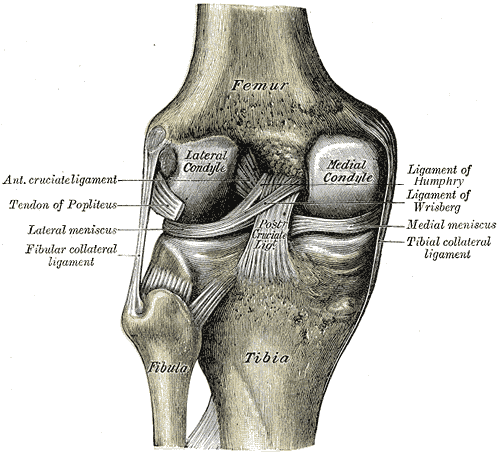
The ligaments. The Schenck grade is defined by the number and combination of these four stabilisers that fail, so know their parts:
- ACL: anteromedial and posterolateral bundles
- PCL: anterolateral and posteromedial bundles
- MCL: superficial (tibial attachment) and deep (meniscal) layers
- LCL: fibular attachment, part of the posterolateral corner
The posterolateral corner. Four components:
- LCL: primary lateral stabiliser
- Popliteus tendon: dynamic posterolateral stabiliser
- Popliteofibular ligament: resists external rotation
- Lateral capsule: secondary restraint
Together they are critical for rotatory stability, and a missed posterolateral corner injury is a risk factor for persistent instability after reconstruction.
Pathophysiology
The popliteal artery. The artery is tethered proximally at the adductor hiatus and distally at the soleus arch, so when the tibia displaces, as in an anterior dislocation, the vessel is stretched over its fixed points. The commonest lesion is an intimal tear without complete disruption: the pulses are normal at first and the vessel thromboses 6-24 hours later. That is the whole reason normal pulses do not exclude an arterial injury.
The common peroneal nerve. The nerve wraps around the fibular neck and is stretched there as a traction injury in lateral and posterolateral dislocations. Recovery after this injury is poor.
The cruciates. Both are intracapsular with minimal blood supply, and both are torn in 80% of dislocations. Both need reconstruction to restore stability.
The sequence. A high-energy force (a motor vehicle accident, a sports collision, a fall from height) tears the cruciates and capsule and the tibiofemoral joint displaces. The artery is stretched over its fixed points and the intima dissects, thromboses or the vessel transects outright; the nerve is dragged around the fibular head. The joint may then reduce itself, which masks the severity of what has happened.
Classification Systems
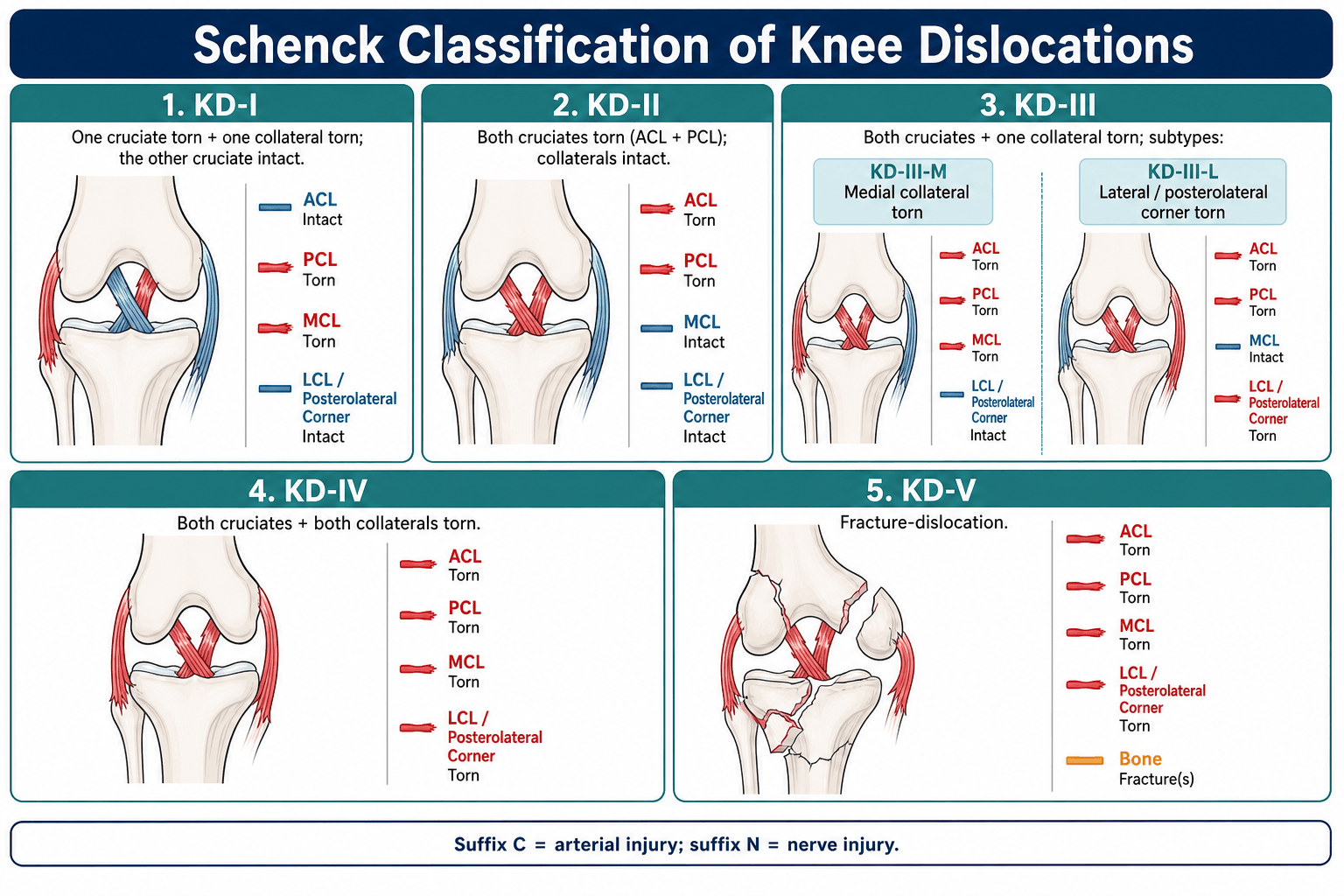
Schenck's anatomic classification counts the ligaments torn and is the most widely used. The direction of dislocation is the other way of describing the injury, and it predicts which ligaments have failed and guides the surgical plan.
- Ligaments Injured
- One cruciate (ACL or PCL) with a collateral, the other cruciate intact
- Frequency
- 5-10%
- Prognosis
- Good with reconstruction
- Ligaments Injured
- Both cruciates (ACL + PCL), collaterals intact
- Frequency
- 15-20%
- Prognosis
- Moderate, requires both repairs
- Ligaments Injured
- Cruciates + MCL
- Frequency
- 25%
- Prognosis
- Fair, staged repair needed
- Ligaments Injured
- Cruciates + LCL/PLC
- Frequency
- 30%
- Prognosis
- Fair, PLC critical for rotatory stability
- Ligaments Injured
- All four major ligaments (no M/L subtype - both collaterals are torn by definition)
- Frequency
- 20%
- Prognosis
- Poor, high stiffness risk
- Ligaments Injured
- Periarticular fracture + ligament
- Frequency
- 10%
- Prognosis
- Variable, fracture healing affects timing
The grade tells you severity: the higher the grade, the worse the outcome. KD III is named for the side involved, III-M or III-L; KD IV has no M or L because both collaterals are gone. The suffix C marks an arterial injury and N a nerve injury.
The numeral counts the ligaments: I = one cruciate torn (the other intact), II = two cruciates, III = three ligaments (add one collateral), IV = four (all of them), V = a fracture added to the ligament injury.
Clinical Assessment
History. The mechanism is high-energy trauma, a dashboard injury or hyperextension. Ask specifically whether the knee "popped out", with the spontaneously reduced dislocation in mind. Immediate haemarthrosis and inability to bear weight are expected; foot numbness suggests a nerve or vascular injury.
Look. Gross deformity if the knee is still dislocated, with swelling and ecchymosis.
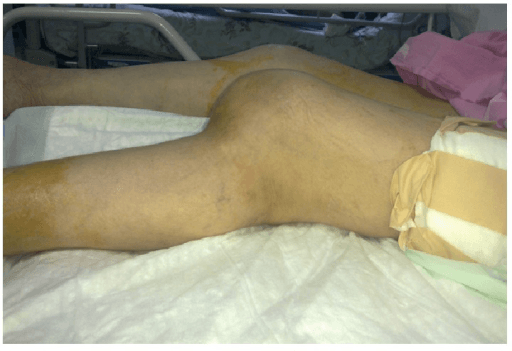
The dimple sign. A fixed pucker of the medial skin means the medial femoral condyle has buttonholed through the medial capsule. That knee is irreducible: closed reduction must not be forced, and repeated forceful attempts produce the medial skin necrosis that is the commonest complication of these injuries. The sign is not always present: in the pooled irreducible dislocations of Malik and colleagues (Evidence Base) it was seen in only 70%, so a dislocation that resists one careful attempt under adequate sedation is treated as irreducible whatever the skin looks like.
The neurovascular examination. Mandatory before and after reduction, and documented each time. It has four parts:
- Pedal pulses: normal is 2+ bilaterally; diminished or absent pulses mean urgent CTA, because pulses alone cannot be relied upon
- Capillary refill: normal is under 2 seconds; over 3 seconds is an indication for immediate reduction and reassessment afterwards
- Ankle-brachial index, described under Investigations
- Common peroneal nerve: foot dorsiflexion and eversion
What not to do. Do not stress-test the ligaments acutely; it risks re-dislocation. Do palpate the compartments for tightness, particularly after a vascular repair.
The spontaneously reduced dislocation. When the history suggests a transient dislocation, keep the suspicion high and look for the clues:
- High-energy mechanism
- Severe instability on examination
- Inability to bear weight despite normal radiographs
Obtain an MRI to define the multiligament injury.
Differential Diagnosis
The spontaneously reduced dislocation and the acutely swollen, unstable knee can be confused with lesser injuries. The distinction matters because only the true (occult) dislocation mandates the full vascular pathway.
- Discriminating Features
- Multidirectional gross instability, 2 or more ligaments torn, high-energy or ultra-low-velocity in obese
- Vascular/Nerve Risk
- High - popliteal artery and peroneal nerve at risk
- Key Investigation
- ABI plus serial exam; MRI for ligament pattern
- Discriminating Features
- Single-plane anterior laxity, positive Lachman, intact PCL and collaterals
- Vascular/Nerve Risk
- Negligible
- Key Investigation
- MRI; vascular workup not required
- Discriminating Features
- Patella displaced (usually lateral), tibiofemoral joint congruent, apprehension sign
- Vascular/Nerve Risk
- Negligible
- Key Investigation
- Skyline/axial radiograph; MRI for MPFL
- Discriminating Features
- Bony deformity plus instability, articular step-off on imaging
- Vascular/Nerve Risk
- High - treat as a dislocation
- Key Investigation
- CT for fracture; ABI plus CTA
- Discriminating Features
- Lateral fibular head prominence, peroneal symptoms, tibiofemoral joint reduced
- Vascular/Nerve Risk
- Peroneal nerve at risk; artery usually spared
- Key Investigation
- AP/oblique radiograph, comparison views
Investigations
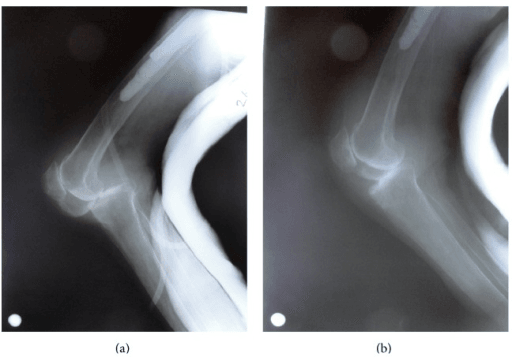
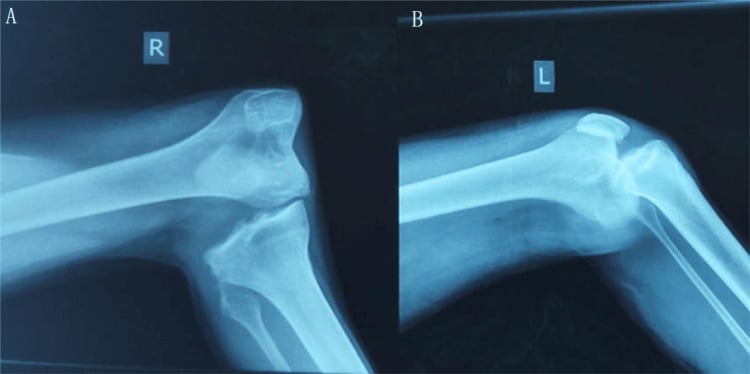
Radiographs. AP and lateral views. Before reduction they document the direction of dislocation and identify fractures (a KD V); after reduction they confirm a concentric reduction and look for occult fractures of the tibial plateau or femoral condyle. Stress views are not performed acutely.
Ankle-brachial index. Mandatory in every case. An ABI below 0.9 has 95% sensitivity for arterial injury. Measure it before and after reduction and then serially, because a normal ABI does not exclude an intimal tear.
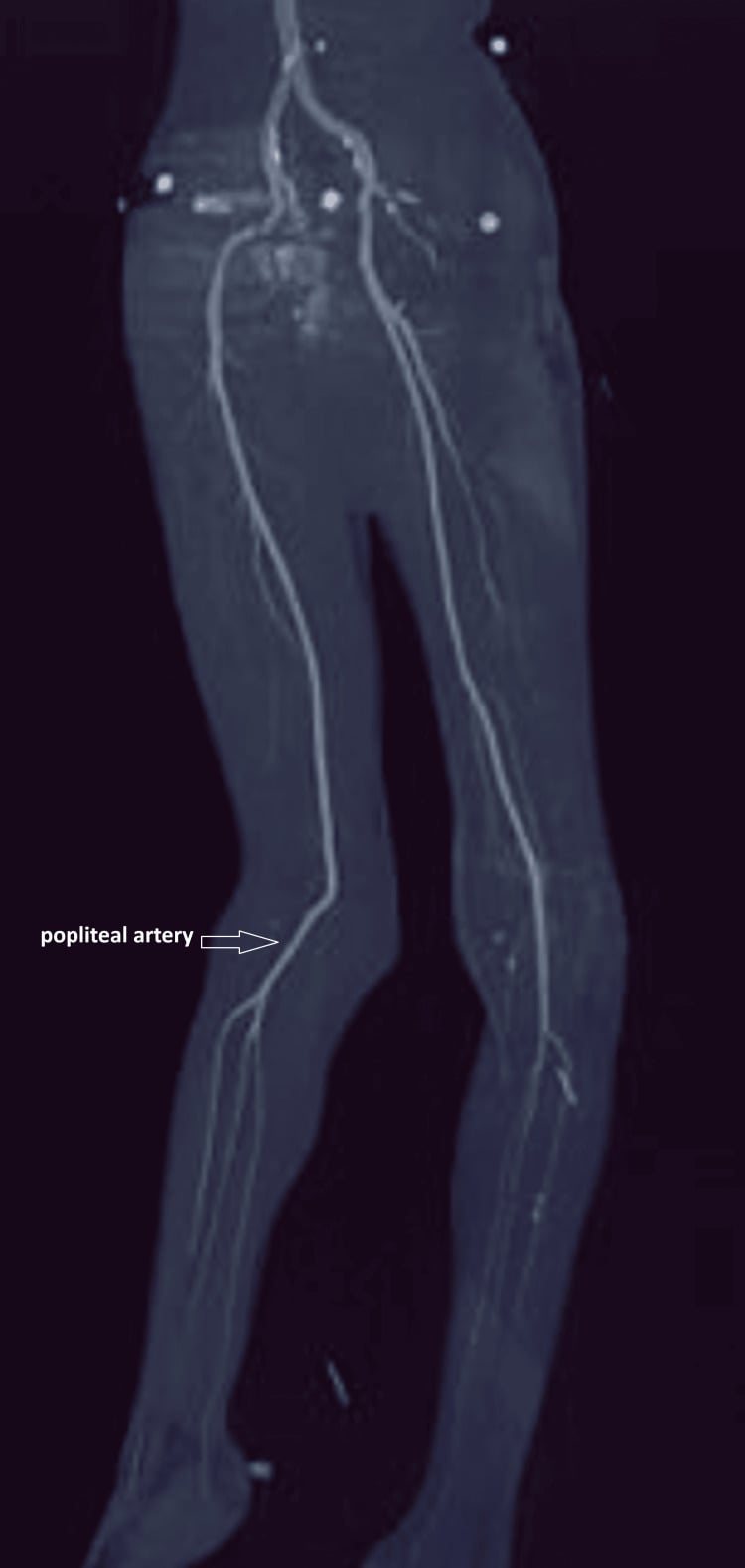
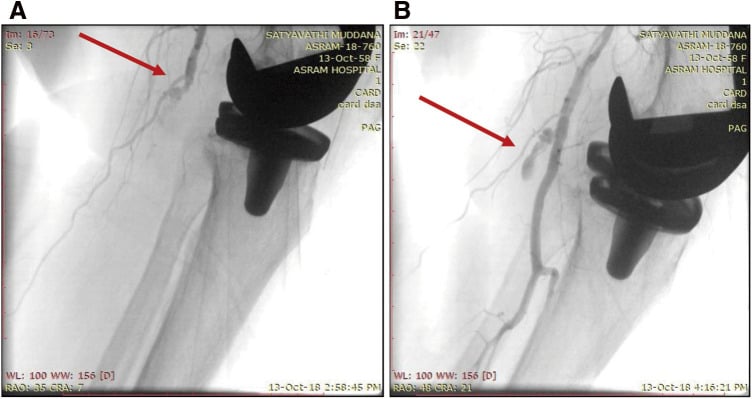
CT angiography. The gold standard once the ABI is abnormal: sensitivity 95%, specificity 99% for popliteal artery injury, showing intimal tears, pseudoaneurysms and complete disruption. Any abnormality is an urgent vascular surgery consult.
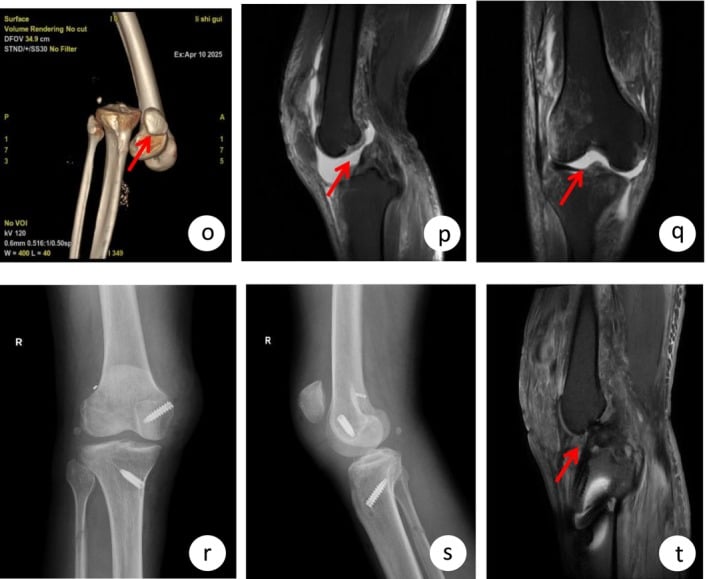
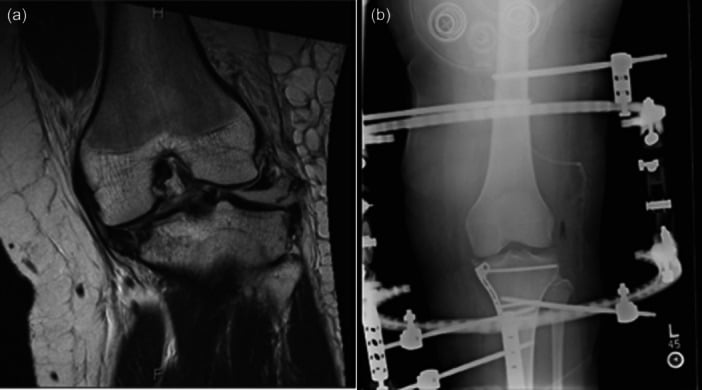
MRI. Once the vascular status is secure, typically at 5-7 days, on a 3 Tesla scanner. T2-weighted sequences show all the ligament tears, the meniscal injuries and the chondral damage, and the result is what plans the staged reconstruction.
Management Algorithm
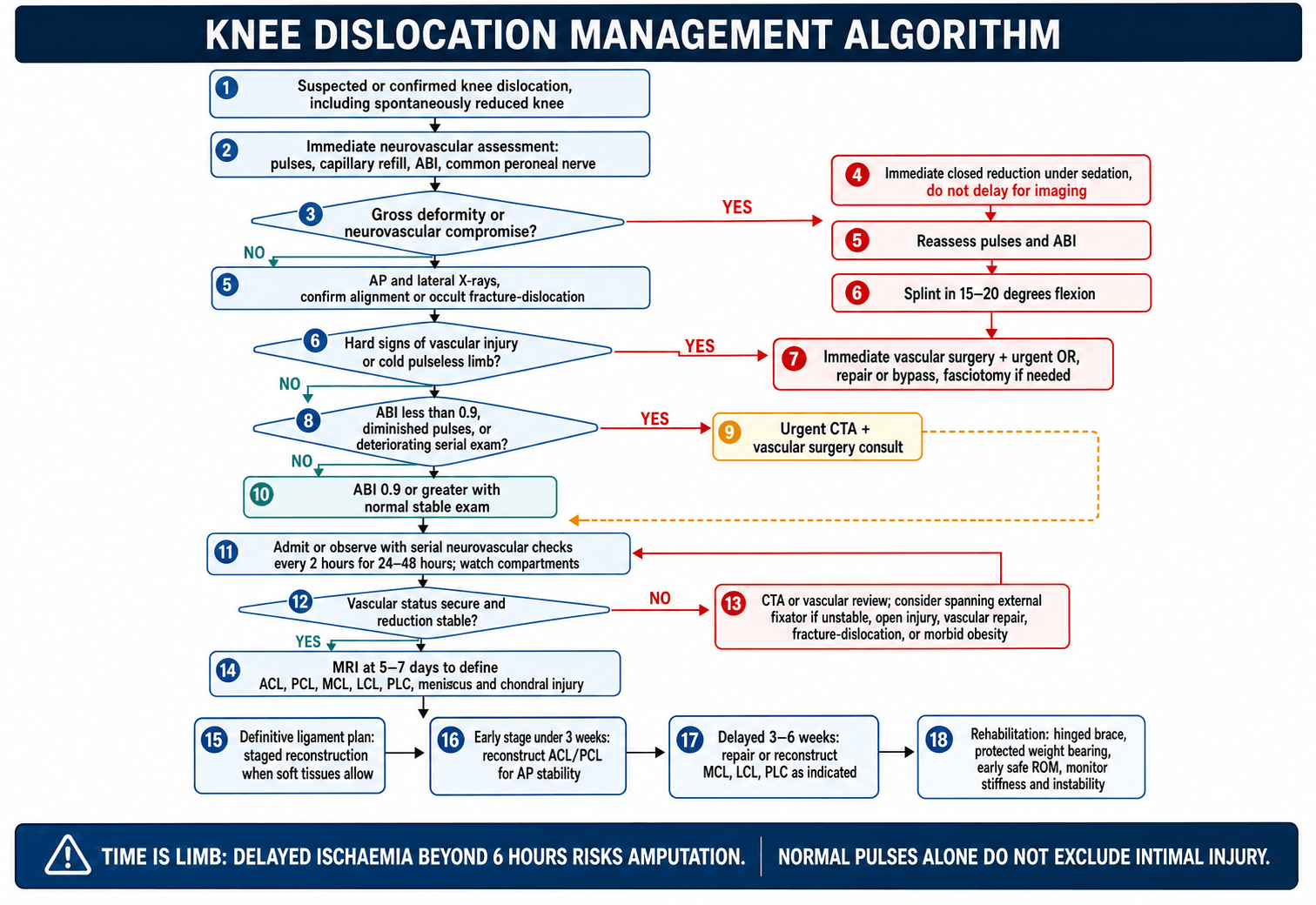
The first six hours. The goals are to restore vascular flow, prevent limb loss and document the injuries.
Recognise and document (0-15 minutes). Identify the dislocation, whether obvious or by a history of reduction, record the neurovascular status (ABI, pulses, peroneal nerve) and obtain AP and lateral radiographs if time permits. If the dislocation is obvious and there is neurovascular compromise, do not wait for radiographs or CT: reduce immediately in the emergency department under procedural sedation. Reduction improves vascular flow and reduces compartment pressure; image afterwards to confirm the alignment.
Reduce (15-30 minutes). Under procedural sedation (propofol or ketamine), apply longitudinal traction to the tibia while an assistant provides counter-traction at the thigh, and reverse the mechanism of injury. For an anterior dislocation, the most common, gently extend the knee while applying posterior pressure to the proximal tibia. For a posterior dislocation, flex the hip to 90 degrees, apply traction, then extend the knee while lifting the tibia anteriorly. Reassess the neurovascular status as soon as the knee is reduced. The exception is the knee with a medial dimple, which will not reduce closed (see Clinical Assessment).
After reduction (30-60 minutes). Repeat the ABI and pulses and document whether they have improved or deteriorated, confirm a concentric reduction on radiographs and splint the knee in 15-20 degrees of flexion, which prevents re-dislocation. An ABI below 0.9 is a vascular surgery consult.
Serial monitoring (0-24 hours). Neurovascular checks every 2 hours for 24 hours; the algorithm allows 24-48 hours, and Stannard's series (Evidence Base) argues for at least 48 hours in a KD-IV injury. Watch for compartment syndrome, especially after a vascular repair. Once the limb is safe, the MRI described above plans the reconstruction.
Vascular Injury
The finding on examination tells you the likely lesion and how fast you have to move. Of the knees presenting with diminished pulses and an ABI of 0.7-0.9, 20% progress to thrombosis.
- Injury Type
- Suspected intimal tear
- Management
- CTA + vascular surgery consult - May need exploration
- Urgency
- URGENT (within 2 hours)
- Injury Type
- Complete arterial disruption
- Management
- IMMEDIATE theatre + vascular repair (bypass or primary repair)
- Urgency
- EMERGENT (within 1 hour)
- Injury Type
- Delayed thrombosis from intimal tear
- Management
- Urgent CTA + thrombectomy or bypass
- Urgency
- URGENT (within 2 hours)
- Injury Type
- No arterial injury
- Management
- Serial exams, plan ligament reconstruction
- Urgency
- Elective
If warm ischaemia time exceeds 6 hours, the amputation rate is 86%. The figure is Green and Allen's (1977, PMID 845209), who wrote that repair must be completed "within six or at the most eight hours" - and the number people quote is only the first half of their result: of the limbs revascularised outside that window, 86% were amputated and two-thirds of the surviving 14% still had ischaemic changes, so barely one limb in twenty came through intact. This is why immediate reduction is critical - it restores some flow even if the artery is injured. If hard signs of arterial injury are present, the patient goes directly to theatre for vascular repair. Time is limb.
When the limb is ischaemic, the examiner wants the order of operations between the orthopaedic and vascular teams, not just "repair the artery."
Reduce first. Closed reduction of the joint frequently restores some flow on its own and is the immediate bedside step.
Flow before fix when ischaemia is critical. Do not let a long fracture or skeletal procedure consume the ischaemia window. The modern damage-control sequence is "shunt, fix, fix": a temporary intravascular shunt restores perfusion fast, then skeletal stability is achieved (reduction plus a spanning external fixator), then the definitive vascular repair is performed on a stable skeleton. This avoids disrupting a fresh anastomosis during later manipulation.
Conduit. The popliteal artery is usually reconstructed with a reversed saphenous vein graft from the contralateral leg, because the injured leg's vein may be damaged, and not with a prosthetic graft.
Fasciotomy at the time of revascularisation. A prophylactic four-compartment fasciotomy is performed when ischaemia has been prolonged or the compartments are tense. Reperfusion compartment syndrome is common, and a missed or late fasciotomy causes the muscle and nerve loss that defeats a technically successful repair.
Primary amputation is considered for the genuinely unsalvageable limb:
- Warm ischaemia well beyond the window with established muscle necrosis
- Extensive combined bone and soft-tissue loss
- A mangled limb
Scoring tools (e.g. MESS) inform but do not dictate the decision, and a documented insensate foot is a relative, not an absolute, factor.
Staged Ligament Reconstruction
Why staged. Early total repair, every ligament at once, carries a 50% arthrofibrosis rate. Reconstructing the cruciates early and the collaterals later brings stiffness below 20% while still achieving good stability. The cruciates go first because restoring anteroposterior stability unloads the healing collaterals.
Staged Approach (Reduces Arthrofibrosis)
- Closed reduction and splinting
- Vascular repair if indicated (emergent)
- Peroneal nerve exploration if complete palsy (controversial)
- Early range of motion once the vascular status is secure
- ACL and PCL reconstruction (both cruciates if torn)
- Autograft preferred (bone-patellar tendon-bone or hamstring)
- Timed before scar tissue forms but after the swelling subsides
- Collateral ligament repair or reconstruction
- MCL: primary repair if the tissue quality is good, otherwise allograft
- LCL + PLC: anatomic reconstruction (LCL, popliteus, popliteofibular)
- Protected range of motion 0-90 degrees for 6 weeks
- Progressive weight-bearing as tolerated
- Quadriceps and hamstring strengthening
- Return to sport at 12 months minimum, if goals are met
The Spanning External Fixator
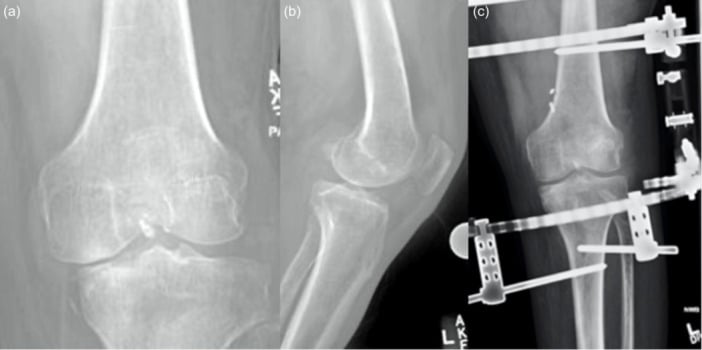
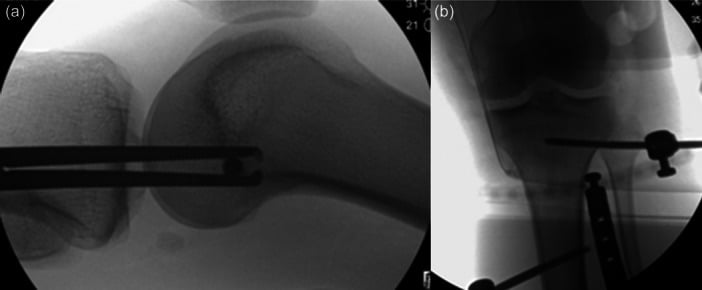
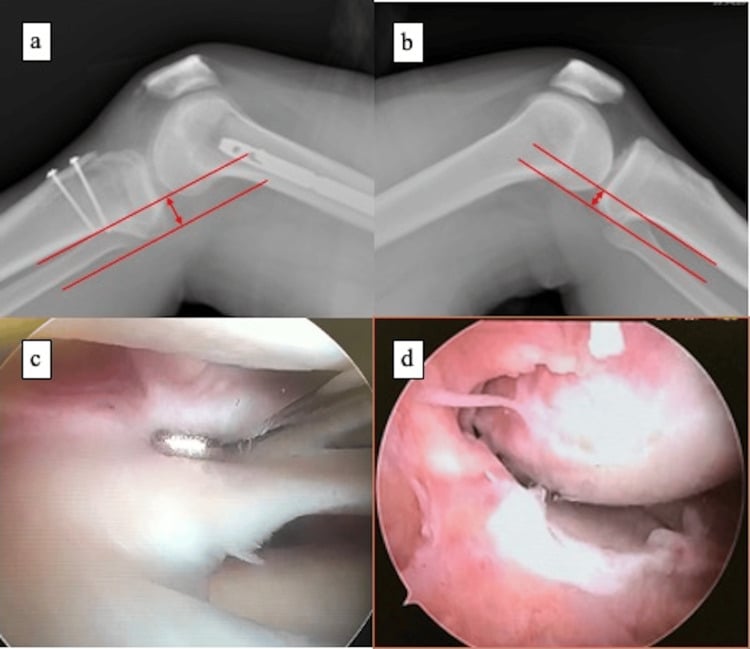
The missing middle step. Between the splint and definitive ligament surgery sits the knee-spanning (femur-to-tibia) external fixator, the intermediate option for the unstable or complex dislocation. Its indications:
- Gross instability where a splint or brace cannot hold the reduction, classically the large or obese limb after an ultra-low-velocity dislocation, where the soft tissue will not maintain alignment
- To protect a vascular repair: after popliteal artery repair or bypass, the fixator immobilises the joint so the fresh anastomosis is not stressed by knee motion
- Open dislocation, severe soft-tissue compromise, or polytrauma and damage control where definitive ligament surgery must be delayed
- KD-V fracture-dislocation, as part of staged skeletal stabilisation
Technique. Apply it with the knee in slight flexion (about 15 to 20 degrees), place the pins well away from planned ligament tunnel sites and any future surgical zones, and keep it on until the soft tissues and vascular status allow, commonly around 6 weeks, before converting to a hinged brace and proceeding to staged reconstruction.
The trade-off. Pin-site infection, and knee stiffness if it is left on too long. It is a temporising stabiliser, not a definitive treatment.
Surgical Technique
Surgical Steps (ACL + PCL)
Supine on a standard operating table with a lateral post at the thigh and the foot of the bed dropped to allow knee flexion. A thigh tourniquet is applied but usually not inflated because of the vascular concerns. Prepare for arthroscopy, and for an open procedure if needed.
Through standard anterolateral and anteromedial portals, assess the cruciate tears, meniscal injuries and chondral damage and document them with photographs. Debride the cruciate remnants only as far as needed, preserving the tibial footprint.
Bone-patellar tendon-bone autograft is preferred for the ACL because the bone blocks aid fixation. Achilles allograft is often used for the PCL for its larger diameter and lower donor morbidity. Prepare the grafts on the back table with whipstitch sutures.
The ACL femoral tunnel sits at 10:30 in a right knee or 1:30 in a left, with the tibial tunnel at the ACL footprint. The PCL femoral tunnel sits at 2:00 (right) or 10:00 (left), with the tibial tunnel made via the posteromedial portal. Ensure the tunnels do not converge.
ACL first: pass the graft, fix the femoral end with an interference screw or button, tension at 20 degrees of flexion and fix the tibia. PCL second: pass via the posteromedial portal, fix the femur, tension at 90 degrees of flexion with the posterior drawer reduced, and fix the tibia.
Check stability with a Lachman for the ACL and a posterior drawer for the PCL, and confirm a range of 0-130 degrees. Document with fluoroscopy and ensure there is no graft impingement. Close the portals and apply a hinged knee brace locked at 0-90 degrees.
When reconstructing both ACL and PCL, the femoral tunnels can converge (ACL at 10:30/1:30, PCL at 2:00/10:00). Use 3D planning on CT or intraoperative fluoroscopy to ensure an adequate bone bridge. If there is concern, stage the PCL reconstruction 6 weeks later.
Complications
- Incidence
- 5-10% overall, 86% if ischaemia greater than 6h
- Risk Factors
- Delayed vascular repair, compartment syndrome
- Management
- Prevention: Immediate reduction and vascular surgery consult
- Incidence
- 20-50% (50% if early total repair)
- Risk Factors
- Early total ligament repair, inadequate ROM
- Management
- Prevention: Staged repair. Treatment: Manipulation or arthroscopic lysis
- Incidence
- 15-30%
- Risk Factors
- Missed PLC injury, graft failure
- Management
- Revision reconstruction with attention to PLC
- Incidence
- 10-20% (25-30% have initial injury)
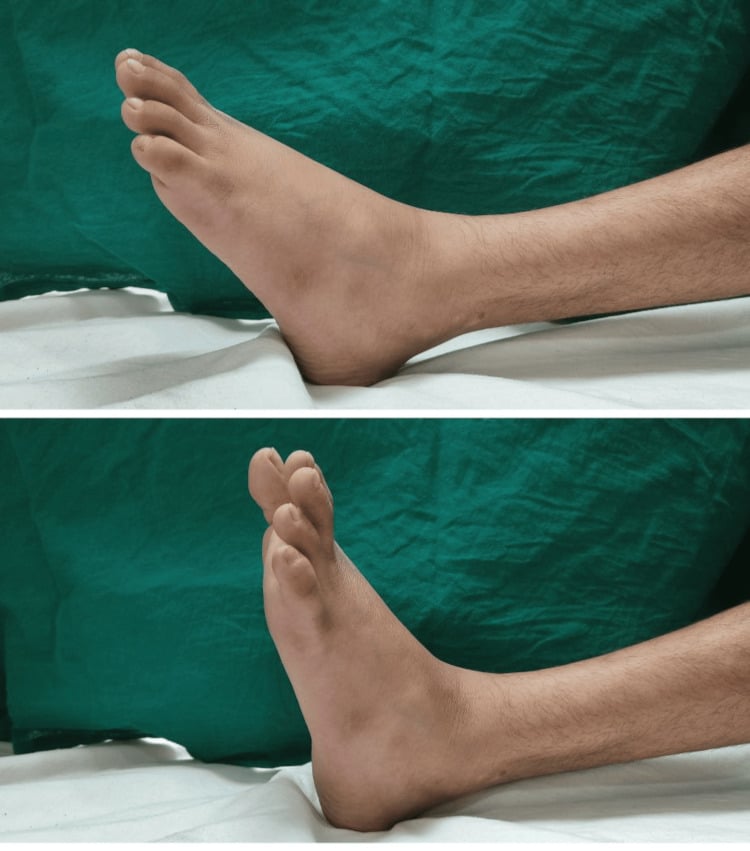
- Risk Factors
- Traction injury, compartment syndrome
- Management
- Ankle-foot orthosis, tendon transfer if no recovery at 12 months
- Incidence
- 10-15%
- Risk Factors
- Vascular repair, immobilisation
- Management
- Prophylactic anticoagulation, early mobilisation
Compartment syndrome occurs in 10-15% of patients after popliteal artery repair, from reperfusion injury. Maintain a high clinical suspicion and perform a four-compartment fasciotomy liberally if there is any concern (pain out of proportion, tense compartments). A delayed fasciotomy (greater than 6-8 hours) leads to permanent muscle and nerve damage.
Postoperative Care and Rehabilitation
ACL/PCL Reconstruction Protocol
- Hinged knee brace locked 0-90 degrees
- Weight-bearing as tolerated with crutches
- ROM exercises: passive extension to 0 degrees, flexion to 90 degrees
- Quad sets, ankle pumps, SLR (avoid hamstring contraction)
- Unlock brace, progress ROM to 0-120 degrees
- Weight-bearing as tolerated, wean crutches by week 4
- Closed-chain exercises (wall sits, mini squats)
- Avoid open-chain hamstring exercises (protect PCL)
- Full ROM expected (0-130 degrees)
- Progress strengthening (leg press, step-ups)
- Proprioception and balance training
- Stationary bike, swimming (no breaststroke)
- Jogging at 4-6 months if quad strength greater than 70%
- Sport-specific training at 6-9 months
- Return to sport at 12 months (MINIMUM)
- Functional testing before clearance
Outcomes and Prognosis
- Stability Outcome
- Good stability 70-80%
- ROM Outcome
- Stiffness 20%, full ROM 60%
- Notes
- Current gold standard approach
- Stability Outcome
- Good stability 60-70%
- ROM Outcome
- Stiffness 50%, full ROM 30%
- Notes
- Historical approach, high stiffness rate
- Stability Outcome
- Variable stability 50-70%
- ROM Outcome
- Better ROM (low stiffness)
- Notes
- Scar tissue makes reconstruction difficult
Predictors of a poor outcome. Five things in the history and the injury pattern predict a worse result:
- Vascular injury requiring repair (higher complication rate)
- KD IV or KD V injuries (all ligaments torn)
- Peroneal nerve palsy (10-20% permanent)
- Delayed reconstruction (greater than 6 months)
- High-energy mechanism (polytrauma, associated injuries)
Guidelines, Registries & Global Practice
Knee dislocation accounts for under 0.02% of orthopaedic injuries, but true incidence is under-reported because up to 50% reduce spontaneously before assessment. The epidemiological pattern is shifting worldwide from young high-energy trauma (road traffic, falls from height) toward ultra-low-velocity dislocations in obese and morbidly obese patients during everyday activity - a trend tracking rising global obesity. There is no dedicated international knee-dislocation registry; evidence comes from trauma-centre series and systematic reviews.
- Vascular Assessment
- Selective angiography driven by ABI and serial exam; ABI under 0.9 triggers CTA
- Surgical Stance
- Operative reconstruction favoured; reconstruct PLC
- Distinctive Point
- Drove the move away from routine arteriography
- Vascular Assessment
- Immediate neurovascular assessment, documented serial exams, urgent vascular input
- Surgical Stance
- Manage in or refer to a unit with combined vascular and ligament expertise
- Distinctive Point
- Embeds dislocation in major-trauma network pathways
- Vascular Assessment
- Reduce and stabilise first; spanning external fixator if unstable or vascular repair done
- Surgical Stance
- Restore bony anatomy, then staged ligament surgery
- Distinctive Point
- External fixation for the unstable or large (obese) limb
- Vascular Assessment
- Selective imaging plus 24-48h observation, longer vigilance for KD-IV
- Surgical Stance
- Early reconstruction within 3 weeks where soft tissues allow
- Distinctive Point
- Emphasises staged approach to limit arthrofibrosis
- CT angiography and MRI readily available; selective (exam/ABI-driven) vascular pathway is standard
- On-site vascular surgery enables revascularisation within the ischaemia window
- Staged arthroscopic reconstruction with allograft/autograft and hinged bracing
- 24-48h inpatient neurovascular observation routine
- Reliance on clinical exam and ABI where CTA is unavailable; low threshold to transfer
- Prompt closed reduction and a spanning external fixator stabilises the limb for transfer
- Delays to vascular care raise amputation risk - early recognition is the key modifiable factor
- Definitive ligament reconstruction may be deferred or unavailable; functional bracing used
Across every guideline and resource setting, the non-negotiable standard is a documented neurovascular assessment (pulses, ABI, peroneal nerve) before and after reduction with serial re-examination. A knee dislocation discharged on "normal pulses" alone, without ABI or an observation period, can return with a cold, pulseless limb and delayed thrombosis - the single most catastrophic and avoidable outcome of this injury.
Controversies and Areas of Uncertainty
Classic teaching quotes 30-40% popliteal artery injury and 86% amputation if ischaemia exceeds 6 hours - figures from older, selected single-centre series. The largest pooled meta-analysis (Medina 2014, 862 patients) found 18% vascular injury and 12% amputation among those injured. Know both: examiners often expect the classic numbers, but the modern, more accurate figures are lower.
Historic practice was routine arteriography in every dislocation. Prospective work (Stannard 2004; Klineberg 2004) showed a normal vascular exam plus ABI reliably excludes a limb-threatening injury, supporting a SELECTIVE pathway. CT angiography has now largely replaced catheter arteriography where available.
Acute primary repair of the posterolateral corner is attractive (single early operation) but fails far more often than reconstruction (37% vs 9% in Levy 2009). Most contemporary surgeons reconstruct, or augment repair, rather than repair alone - especially for the lateral side.
Early surgery (within 3 weeks) gives better functional scores than delayed surgery, but single-stage all-ligament reconstruction must be balanced against arthrofibrosis risk. There is no randomised evidence; decisions remain individualised by soft-tissue condition, vascular status and surgeon experience.
Whether to explore, neurolyse, graft or simply observe a complete peroneal palsy remains unresolved. There is no high-level evidence that acute exploration improves recovery, and many palsies are managed expectantly with an ankle-foot orthosis, reserving tendon transfer (posterior tibial tendon) for those without recovery by 12 months. Counsel that complete palsies recover poorly.
MCQ Practice Points
Q: What percentage of knee dislocations have associated popliteal artery injury? A: 30-40% - This high rate is why ABI measurement is MANDATORY in all knee dislocations. Normal pulses do NOT exclude intimal tear, which can thrombose 6-24 hours later.
Q: A knee dislocation with complete ACL, PCL, MCL, and PLC tears is classified as: A: Schenck KD IV - All four major ligament complexes torn. KD I (one cruciate), KD II (both cruciates), KD III (cruciate + one collateral), KD IV (all ligaments), KD V (fracture-dislocation).
Q: What is the advantage of staged ligament reconstruction over early total repair? A: Reduced arthrofibrosis rate (20% vs 50%) - Staged approach reconstructs cruciates early (2-3 weeks) then collaterals delayed (3-6 weeks). Early total repair has 50% stiffness rate with similar stability outcomes.
Q: What is the amputation rate if warm ischemia time exceeds 6 hours in knee dislocation with popliteal artery injury? A: 86% (Green and Allen 1977) - and the half of their finding that rarely gets quoted is that two-thirds of the 14% who kept the limb still had ischaemic changes, so only about 5% escaped undamaged. Note this is a 1977 figure from a selected series; modern pooled amputation risk among those WITH a vascular injury is nearer 12% (Medina 2014). Know both, and know which question is being asked - the 86% is conditional on late revascularisation, not on having a vascular injury at all.
Q: Common peroneal nerve injury occurs in what percentage of knee dislocations, and which dislocation direction has the highest risk? A: 25-30% overall, highest in lateral and posterolateral dislocations - Nerve wraps around fibular neck and is stretched during lateral displacement. Complete palsy has only 10-20% recovery rate.
Exam Viva Scenarios
Practise clinical reasoning and management decisions out loud
“A 35-year-old male presents to ED after motor vehicle collision. Paramedics report his knee was dislocated and they reduced it in the field. On arrival, knee is swollen but reduced. Pedal pulses are present but diminished. What is your assessment and management?”
“The patient from Scenario 1 has secure vascular status (ABI 1.0). MRI at 7 days shows complete ACL, PCL, MCL, and posterolateral corner (PLC) tears (Schenck KD IV). Walk me through your surgical plan.”
“The patient from Scenario 1 was admitted for observation. Initial ABI was 1.0. At 18 hours post-injury, nurse reports foot is cooler and pedal pulses are diminished. What is your management?”
Key Anatomy
- Popliteal artery = Tethered at adductor hiatus and soleus arch (vulnerable to injury)
- Common peroneal nerve = Wraps around fibular neck (25-30% injury rate)
- ACL + PCL = Both torn in 80% of dislocations
- PLC (LCL, popliteus, popliteofibular) = Critical for rotatory stability
Classification
- Schenck KD I = Single cruciate (rare)
- Schenck KD II = Both cruciates
- Schenck KD III-M/L = Cruciates + one collateral
- Schenck KD IV = All four ligaments (no M/L suffix - both collaterals are gone)
- Schenck KD V = Fracture-dislocation
Treatment Algorithm
- ED: Immediate reduction, ABI measurement, CTA if ABI less than 0.9
- Vascular injury: URGENT repair within 6 hours (amputation rate 86% if delayed)
- Staged repair: Cruciates at 2-3 weeks, collaterals at 3-6 weeks
- Serial exams: Every 2 hours for 24 hours (detect delayed thrombosis)
Surgical Pearls
- Staged approach reduces stiffness from 50% to 20%
- ACL/PCL tunnels: Avoid convergence (use fluoroscopy)
- PLC reconstruction: Protect common peroneal nerve throughout
- Collateral healing: Lock brace in extension 6 weeks
Complications
- Amputation: 5-10% overall, 86% if ischemia greater than 6h
- Arthrofibrosis: 50% if early total repair, 20% if staged
- Peroneal palsy: 25-30% initial injury, 10-20% permanent
- Persistent instability: 20-30% (often missed PLC)
Evidence Base and Key Trials
There is NO randomised controlled trial in knee dislocation - the injury is too rare and heterogeneous. The literature is dominated by systematic reviews, meta-analyses, and single-surgeon case series (Level III-IV). Be cautious of the often-repeated "30-40% vascular injury" and "86% amputation" figures, which come from older selected series - pooled modern data give lower, more accurate numbers.
Decision Making in the Multiligament-Injured Knee: Evidence-Based Systematic Review
- Systematic review (Levels I-IV) of operative vs nonoperative, repair vs reconstruction, and early vs late surgery
- Surgery outperformed nonoperative care: good/excellent IKDC 58% vs 20%, return to full sport 29% vs 10%
- Posterolateral corner REPAIR failed more often than reconstruction (37% vs 9%)
- Early surgery (within 3 weeks) gave higher Lysholm (90 vs 82) and IKDC scores than delayed surgery
Vascular Injuries in Knee Dislocations: Role of Physical Examination in Determining Need for Arteriography
- Prospective cohort: 126 patients (134 knees) with acute multiligament knee injury at a Level-1 trauma centre
- Flow-limiting popliteal artery injury in 9 patients (7% prevalence) - lower than older quoted figures
- Serial physical examination had a single false positive and no missed injury (selective, not routine, arteriography)
- All 9 vascular injuries occurred in KD-III, KD-IV or KD-V; KD-IV warrants serial exams for at least 48 hours
The Role of Arteriography in Assessing Popliteal Artery Injury in Knee Dislocations
- Retrospective review of 55 patients (57 knees) with traumatic knee dislocation over 7 years
- Vascular exam (foot pulses plus ABI of 0.80 or greater) normal in 32 knees, abnormal in 25
- NO knee with a normal vascular examination had an injury requiring treatment
- Of 25 abnormal exams, 12 had vascular injury on angiography and 7 needed reverse saphenous vein grafting
Vascular and Nerve Injury After Knee Dislocation: A Systematic Review
- Meta-analysis of 862 knee dislocations - the largest pooled vascular/nerve dataset
- Weighted vascular injury frequency 18% and nerve injury 25% (lower than classic 30-40% teaching)
- 80% of vascular injuries were repaired; 12% of vascular injuries ended in amputation
- Highest vascular prevalence in KD-IIIL (ACL/PCL/lateral, 32%) and in posterior dislocations (25%)
Incidence of Concurrent Peroneal Nerve Injury in Multiligament Knee Injuries and Outcomes
- Retrospective cohort of 357 surgically treated multiligament knee injuries (mean follow-up 35 months)
- Concurrent peroneal nerve injury in 68 patients (19%)
- Nerve-injured patients had significantly lower final ROM (121 vs 127 degrees) and trended to lower return to work
- Pain (VAS), Lysholm and IKDC scores did NOT differ significantly with or without nerve injury
Arthroscopically Assisted Combined ACL/PCL Reconstruction in the Multiple Ligament Injured Knee: 2- to 10-Year Follow-up
- Case series of 35 combined ACL/PCL reconstructions (19 acute, 16 chronic) followed 2-10 years
- Significant improvement in Lysholm (mean 91), Tegner and HSS scores and in KT-1000 side-to-side laxity
- Normal Lachman/pivot-shift in 33 of 35 (94%); restored posterolateral stability less reliable
- Conclusion: reconstructed knees are functionally stable but NOT normal
Outcomes After Multiligament Knee Injury Worsen Over Time: Systematic Review and Meta-Analysis
- Meta-analysis of 79 studies and 3571 surgically treated multiligament knee injuries (mean age 35.6 years)
- Mean Lysholm 86 and IKDC 81 at 2 years, retaining roughly 80-85% of knee function
- Knee function DETERIORATES yearly (IKDC about -2.0 points/year), not a stable plateau
- PCL-based injuries had significantly worse IKDC (75 vs 84) and Lysholm (84 vs 91) than non-PCL injuries
Management and Outcome of Irreducible Knee Dislocations: A Systematic Review
- 114 irreducible knee dislocations pooled from 60 studies - up to 4% of all knee dislocations are irreducible
- Posterolateral dislocation accounted for 85%, and EVERY case required surgery to achieve reduction
- The block was the MCL and medial soft tissues (medial retinaculum, capsule, vastus medialis obliquus) in 52.4%
- The dimple sign was present in only 70% - its ABSENCE therefore does not exclude an irreducible knee
- Medial skin necrosis and stiffness were the commonest complications; overall neurovascular injury was 9%
Knee Dislocations in the Morbidly Obese Patient (Ultra-Low-Velocity Dislocation)
- Review of the increasingly common ultra-low-velocity knee dislocation in obese, morbidly obese and super-obese patients
- These injuries occur during everyday activities yet can be as severe or worse than high-velocity dislocations
- Frequently associated with neurovascular injury - early reduction and vascular assessment are critical to avoid amputation
- Limb size usually mandates external fixation to maintain reduction; reconstruction still improves outcomes