The Neural Grid of the Lower Limb
- Lumbar Plexus forms WITHIN the substance of Psoas Major.
- Sacral Plexus forms on the ANTERIOR surface of Piriformis.
- Femoral and Obturator nerves arise from same roots (L2,3,4) but diverge (Femoral = Posterior division, Obturator = Anterior).
- Genitofemoral nerve runs ON the surface of Psoas (L1,2).
- Lateral Cutaneous Nerve of Thigh (L2,3) passes under Inguinal Ligament (ASIS compression).
- “Obturator nerve is the only branch of the Lumbar plexus to enter the thigh via the obturator foramen.
- “Furcal Nerve: The specific root (usually L4) that contributes to BOTH plexuses via the Lumbosacral Trunk.
- “Femoral Nerve is formed by POSTERIOR divisions (supplies extensors/anterior skin).
- “Obturator Nerve is formed by ANTERIOR divisions (supplies adductors/medial skin).
Overview
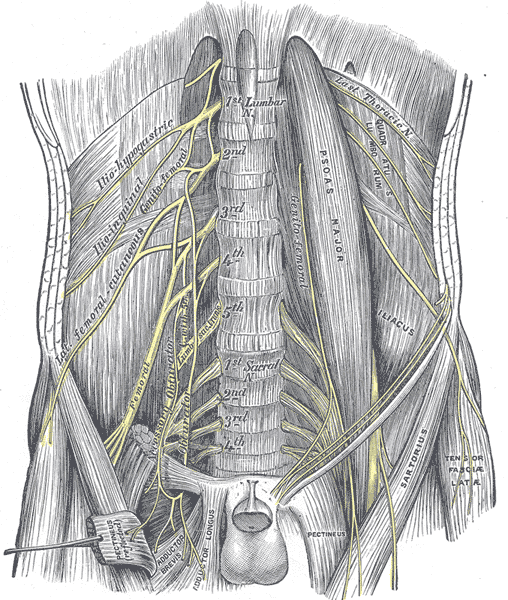
The lumbosacral plexus is the neural network supplying the lower limb, pelvis and perineum. It is functionally two plexuses, lumbar and sacral, connected by the lumbosacral trunk: the lumbar plexus forms within the substance of psoas major, the sacral plexus on the anterior surface of piriformis.
The surgeon meets it in two places: the lateral trans-psoas corridor to the lumbar spine, and the displaced pelvic-ring fracture. The anatomy below is what makes both risks predictable.
Neurovascular
Lumbar plexus
Formation. The ventral rami of L1-L4, with a contribution from T12, unite within the posterior third of psoas major, anterior to the transverse processes of the lumbar vertebrae. The muscle protects the plexus and hides it: direct trauma to psoas impacts the plexus, and the trans-psoas corridor traverses it.
Emergence. Where each branch leaves the muscle is the examiner's favourite question:
- Lateral border: iliohypogastric, ilioinguinal, lateral femoral cutaneous, femoral
- Anterior surface: genitofemoral
- Medial border: obturator, lumbosacral trunk
- Roots
- T12, L1
- Motor
- Transversus/Oblique
- Sensory
- Suprapubic/Gluteal
- Roots
- L1
- Motor
- Transversus/Oblique
- Sensory
- Groin/Scrotum
- Roots
- L1, L2
- Motor
- Cremaster
- Sensory
- Ant Thigh/Scrotum
- Roots
- L2, L3
- Motor
- None
- Sensory
- Lateral Thigh
- Roots
- L2, L3, L4
- Motor
- Quads/Iliacus/Sart
- Sensory
- Ant Thigh/Med Leg
- Roots
- L2, L3, L4
- Motor
- Adductors
- Sensory
- Medial Thigh
I Get Leftovers On FridaysLumbar Plexus Branches
Hook:The order they emerge (superior to inferior).
Femoral versus obturator. Both arise from L2, L3 and L4, and they diverge by division. The femoral nerve is formed from the posterior divisions and supplies the extensors and the anterior skin; the obturator nerve is formed from the anterior divisions and supplies the adductors and the medial skin. The obturator is the only branch of the lumbar plexus to enter the thigh through the obturator foramen.
The furcal nerve. One root, usually L4, contributes to both plexuses through the lumbosacral trunk.
Sacral plexus
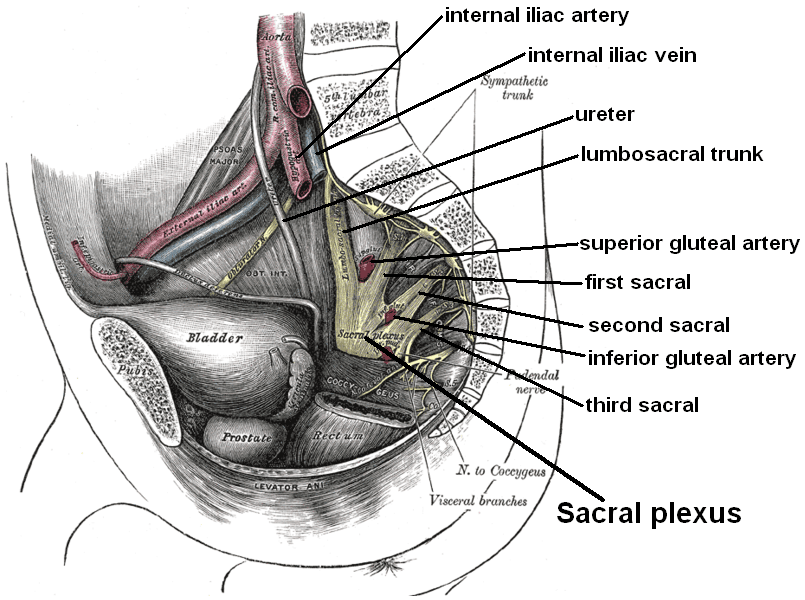
Formation. The lumbosacral trunk (L4, L5) descends over the ala of the sacrum and joins the ventral rami of S1-S4 on the anterior surface of piriformis, deep to the parietal pelvic fascia.
Exit. Most branches leave the pelvis through the greater sciatic foramen. The superior gluteal nerve passes above piriformis; the sciatic, inferior gluteal, pudendal and posterior cutaneous nerves pass below it. Between them these branches supply the gluteal region, the perineum and the entire lower limb except the anterior thigh, which belongs to the femoral nerve.
S-I-P-P-SSacral Plexus Branches
Hook:Major branches leaving the pelvis.
The small branches. Beyond the five large branches, the sacral plexus gives small muscular and autonomic branches that examiners use to separate strong candidates:
- Nerve to quadratus femoris (and inferior gemellus), L4-S1: runs deep to the sciatic nerve on the ischium and gives an articular twig to the hip joint
- Nerve to obturator internus (and superior gemellus), L5-S2: leaves the pelvis through the greater sciatic foramen, hooks around the ischial spine and re-enters through the lesser sciatic foramen
- Nerve to piriformis, S1-S2
- Pelvic splanchnic nerves (nervi erigentes), S2-S4: parasympathetic fibres to the pelvic viscera that mediate erection and bladder and bowel emptying, which is why a low sacral plexus or cauda equina lesion threatens continence and sexual function
A sacral plexus answer that stops at the sciatic nerve is incomplete. The small rotator branches matter for hip external rotation and the parasympathetic outflow for pelvic-organ control.
Relations
The great vessels. The aorta and inferior vena cava lie medial to psoas, and great vessel injury is a catastrophic risk of anterior approaches to the lumbar spine.
The sacral ala. The lumbosacral trunk crosses the ala of the sacrum and the sacroiliac joint, which makes it vulnerable in vertical-shear pelvic fractures.
Surface Anatomy
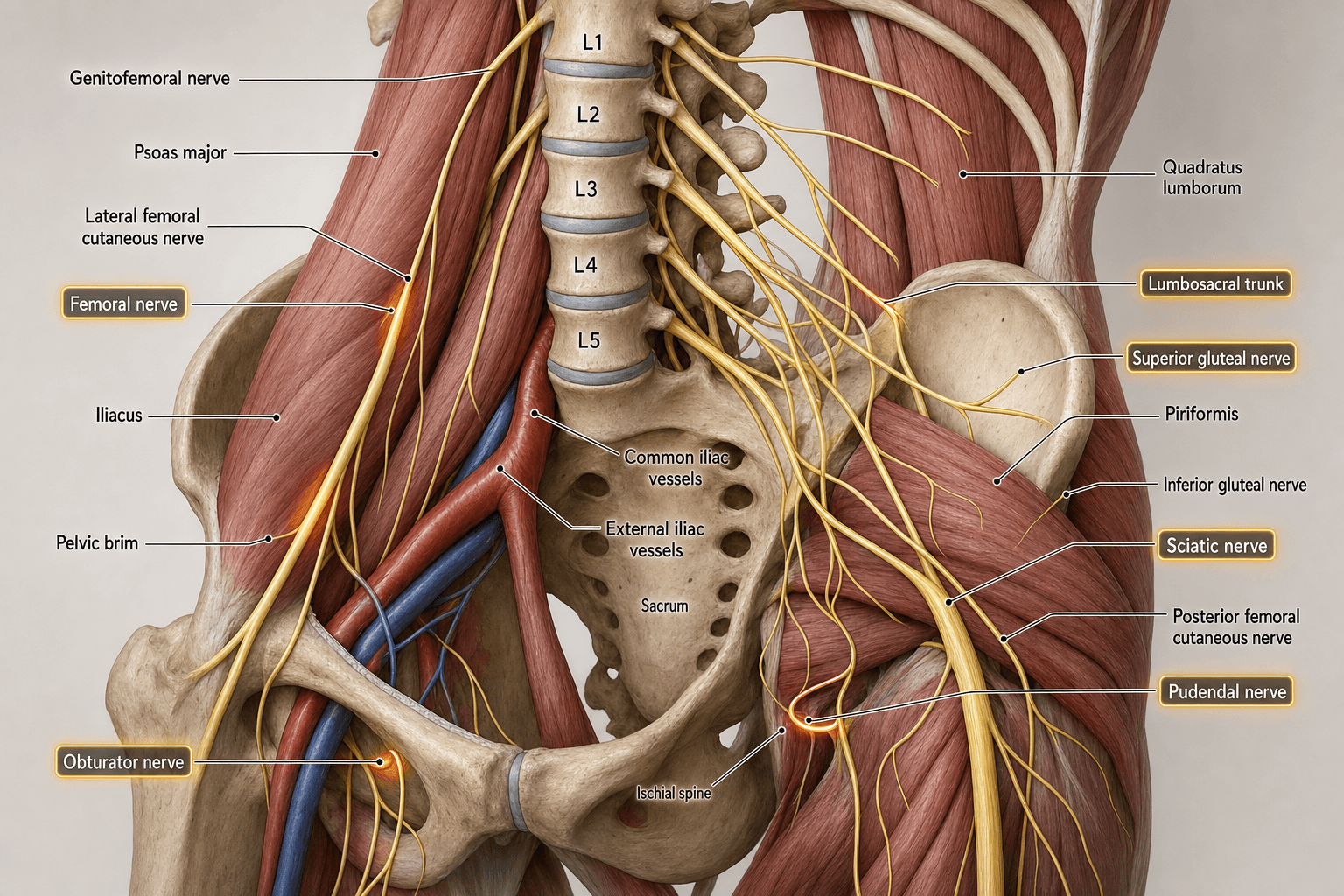
Landmarks. The inguinal ligament runs from the ASIS, its origin, to the pubic tubercle, its insertion. Psoas major is palpable in thin patients in the iliac fossa when the hip is flexed against resistance.
Nerve projections. Where each nerve comes to the surface:
- Femoral nerve: the mid-inguinal point, midway between the ASIS and the pubic symphysis, lateral to the pulse
- Lateral femoral cutaneous nerve: 2 cm medial and inferior to the ASIS (variable)
- Sciatic nerve: the midpoint between the ischial tuberosity and the greater trochanter
- Pudendal nerve: medial to the ischial spine, on trans-vaginal or trans-gluteal palpation
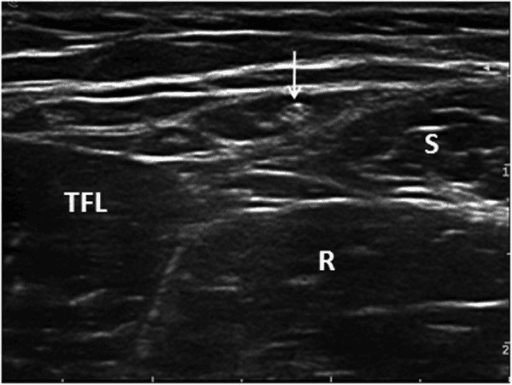
Knowledge of these landmarks facilitates targeted nerve blocks in the emergency department, the fascia iliaca block among them.
Classification Systems
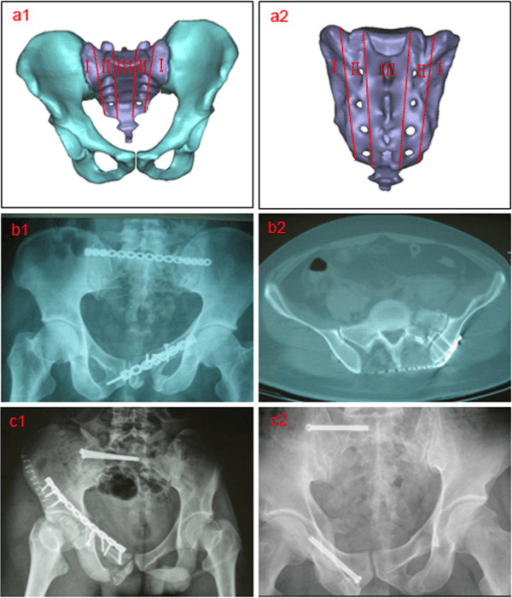
Uribe's transpsoas safe zones. For lateral trans-psoas spine surgery, Uribe divided the vertebral body into four quarters from anterior to posterior and mapped where the plexus actually lies:
- Zone I - anterior quarter
- Zone II - middle-anterior quarter
- Zone III - middle-posterior quarter, the safe docking target from L1-2 to L3-4
- Zone IV - the most posterior quarter, which contains the whole lumbar plexus within psoas and is the zone to avoid
The corridor moves. The plexus lies in the posterior quarter, so the safe corridor is just in front of it, in Zone III, and the posterior zone is the danger zone, not the safe one. As you descend from L1 to L5 the plexus migrates anteriorly: at L4-5 it has drifted far enough forward that the target shifts from the midpoint of Zone III to the Zone II-III junction (mid-vertebral body), and the corridor narrows. At L4-5 nerve roots are frequently encountered and lie anteriorly.
In practice. Pre-operative MRI is essential to map this migration in each patient. Neural monitoring is mandatory, with triggered EMG the tool used intra-operatively.
Clinical Assessment
The plexopathy pattern. Weakness spans both the femoral territory (quadriceps) and the sciatic territory (hamstrings, ankle), both the knee and the ankle jerks are lost, and sensory loss is widespread. A retroperitoneal haematoma is the trauma cause to hold in mind: fractures of the pelvis and sacrum can bleed massively, and compression of the plexus manifests as exactly this diffuse femoral-plus-sciatic weakness.
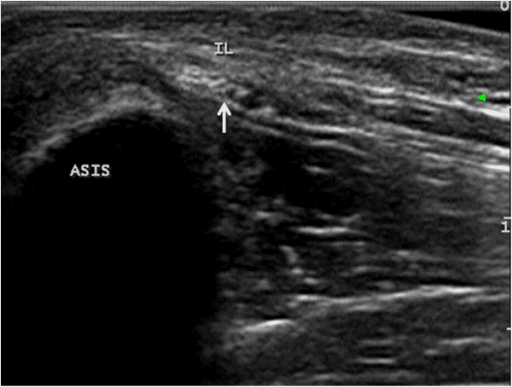
Two specific signs. The cremasteric reflex (L1-L2) tests the genitofemoral nerve: stroking the inner thigh elevates the testicle. Meralgia paraesthetica is burning pain in the lateral thigh, with a Tinel's sign on tapping over the ASIS.
Root or plexus. A single-root pattern, one myotome plus one dermatome plus one reflex, points to a radiculopathy. A multi-myotomal deficit crossing femoral and sciatic territories with spared paraspinals points to a plexopathy.
- Root (Radiculopathy)
- Dermatomal (Single strip)
- Plexus
- Multi-dermatomal / Regional
- Root (Radiculopathy)
- Myotomal (Specific muscles)
- Plexus
- Multiple muscles + compartments
- Root (Radiculopathy)
- Radiating (Electric shock)
- Plexus
- Deep, aching, poorly localised
- Root (Radiculopathy)
- Denervated (EMG positive)
- Plexus
- Normal (Sparing)
Localising a deficit to a root or to the plexus needs the segmental map. The quick myotome screen:
- L2 - hip flexion (iliopsoas)
- L3 - knee extension (quadriceps)
- L4 - ankle dorsiflexion and inversion (tibialis anterior)
- L5 - great-toe extension (EHL) and hip abduction
- S1 - ankle plantarflexion and eversion; hip extension
The two reflexes are the knee jerk, L3-L4 (femoral nerve) and the ankle jerk, S1-S2 (tibial nerve). The dermatomes run L1 groin, L2 anterior thigh, L3 medial knee, L4 medial leg and medial malleolus, L5 lateral leg and dorsum of the foot to the great toe, S1 lateral foot and sole.
Investigations
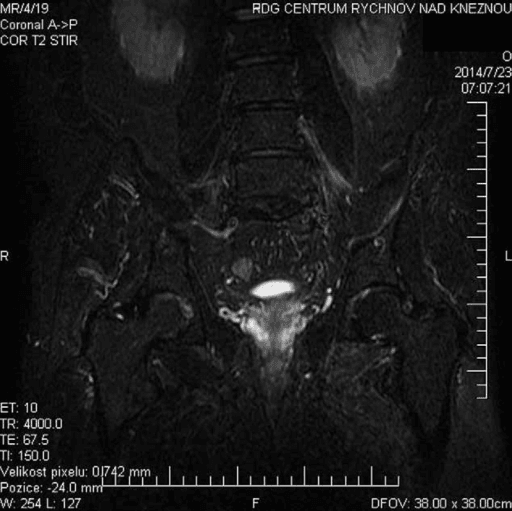
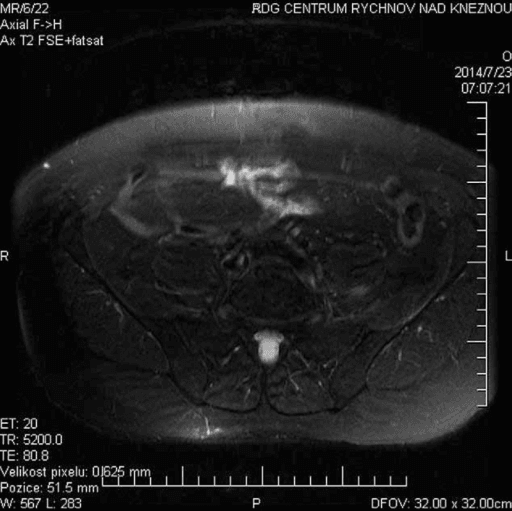
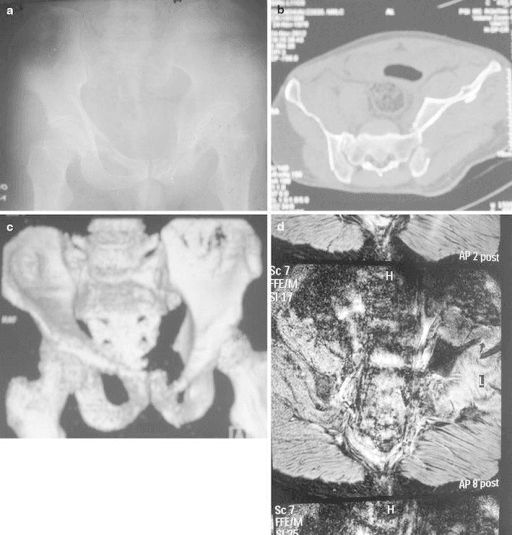
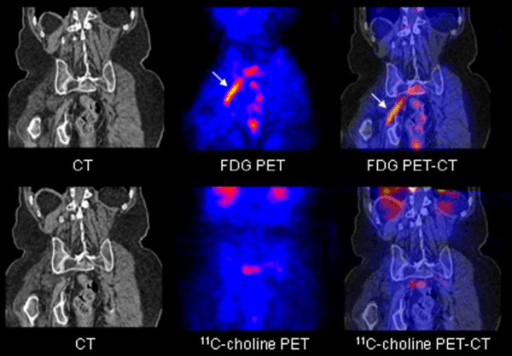
MRI. An MRI of the lumbar spine rules out disc pathology. An MRI of the pelvis, as a neurogram, is the gold standard for visualising the plexus itself and can identify tumours (neurofibroma, schwannoma), a psoas haematoma (hypointense or heterogeneous) and piriformis pathology.
CT. CT of the abdomen and pelvis is essential in trauma, to identify a retroperitoneal bleed or fractures compressing the plexus at the lumbosacral or sacroiliac joint. Contrast is required to differentiate haematoma from muscle for accurate sizing.
EMG and nerve conduction. Paraspinal sampling is the crucial differentiating step. Positive paraspinals suggest a root lesion, proximal to the plexus; negative paraspinals suggest a plexus or peripheral lesion. The sensory nerve action potential (SNAP) is reduced in plexus lesions, which are post-ganglionic, and preserved in root lesions, which are pre-ganglionic. This distinction between pre-ganglionic (avulsion) and post-ganglionic (rupture, plexopathy) injury is critical for prognosis.
Differential Diagnosis
A regional lower-limb deficit can arise at the root, the plexus or the peripheral nerve. The table separates the common mimics of a lumbosacral plexopathy.
- Distribution
- Multi-myotomal, often femoral + sciatic
- Discriminator
- Paraspinals spared; reduced SNAPs
- Key Test
- MR neurogram + EMG/NCS
- Distribution
- Multi-dermatomal, may be bilateral
- Discriminator
- Saddle anaesthesia, bladder/bowel signs; SNAPs preserved
- Key Test
- Urgent MRI lumbosacral spine
- Distribution
- Single dermatome/myotome
- Discriminator
- Denervated paraspinals; preserved SNAPs
- Key Test
- MRI + EMG paraspinal sampling
- Distribution
- Quads weak, knee jerk lost
- Discriminator
- Adductors (obturator) spared
- Key Test
- Saphenous SNAP, femoral imaging
- Distribution
- Asymmetric proximal, painful, weight loss
- Discriminator
- Subacute onset in diabetic; monophasic
- Key Test
- Clinical + EMG, glucose
- Distribution
- Lateral thigh sensory only
- Discriminator
- No motor loss; Tinel at ASIS
- Key Test
- LFCN block / nerve conduction
- Distribution
- Activity-related, relieved by rest
- Discriminator
- Pulses, ankle-brachial index abnormal
- Key Test
- ABI, duplex / angiography
Management Strategy
By cause. Management follows the aetiology, and so does the indication for surgery.
- Management
- Reverse agents, Observe
- Surgical Indication
- Progressive deficit / Compartment Syn
- Management
- Reduce fracture, Stabilise
- Surgical Indication
- Bone fragment on nerve
- Management
- Biopsy, Resect
- Surgical Indication
- Mass effect / Malignancy
- Management
- Glycaemic control, Pain mgmt
- Surgical Indication
- None
Observe or operate. Most stretch injuries and haematomas recover with time. Direct repair of plexus injuries is technically difficult and outcomes are guarded, so decompression, removing a bone fragment or a haematoma, is the more common operation. Timing depends on the progression of the neurological deficit and the stability of the patient.
Surgical Technique
Protecting the plexus. In the anterior (ilioinguinal) approach to the acetabulum, isolate the femoral nerve and protect it with a vessel loop. In lateral trans-psoas spine surgery, use EMG monitoring and, at L4-5, place the dilators at the Zone II-III junction (mid-vertebral body) to avoid the forward-migrating plexus. Strict haemostasis is vital to prevent a post-operative retroperitoneal haematoma.
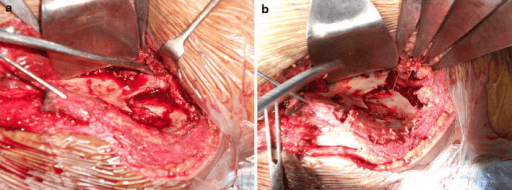
Decompressing the lateral femoral cutaneous nerve. The nerve is found 2 cm medial to the ASIS, deep to the inguinal ligament. Release it by dividing the inguinal ligament or removing the ridge of bone causing the compression. Pain relief has a high success rate, though numbness may persist, and recurrence is rare provided the decompression is adequate.
Complications
Pain and sensory loss. Chronic pain, including complex regional pain syndrome (CRPS), is a risk. Anaesthetic skin on the foot and heel is at risk of ulceration.
Motor deficit. Quadriceps weakness from a femoral lesion leads to knee instability (buckling). Adductor weakness leads to gait disturbance.
Sexual dysfunction. Pudendal nerve involvement can cause erectile dysfunction or loss of sensation.
Lumbosacral trunk injury. Often missed in pelvic fractures, it presents with a non-specific foot drop and weak glutei. When it is caused by excessive screw length during fixation, the screw must be removed.
Abdominal wall weakness. Iliohypogastric nerve injury through lateral ports causes a bulge, a pseudo-hernia, from paralysis of the conjoint tendon.
Rehabilitation Protocol
Modalities. These are selected by the deficit, not by the stage: a knee brace that locks the knee during stance for femoral neuropathy, an ankle-foot orthosis for the foot drop of a sciatic component, strengthening of the core and the unharmed limb for compensation, and desensitisation for neuropathic pain.
The timeline. Recovery, unlike the modalities, is sequential, because it is governed by axonal regeneration at roughly 1 mm per day.
Nothing has regenerated yet, so the whole task is preserving the joint and skin you will need later. Full passive range daily - a fixed equinus or a flexion contracture will defeat a nerve that recovers perfectly. Orthose the deficit now and protect anaesthetic skin. Establish the baseline examination and document it by muscle group; without it you cannot later tell recovery from wishful thinking.
Nerve conduction studies and EMG are most informative now: before about 3 weeks, denervation changes have not appeared, so an early study mainly documents a baseline. This is the window in which a conduction block that is going to recover starts to declare itself, and in which a complete lesion with no motor units is identified as such.
Regeneration advances at about 1 mm per day - roughly an inch a month - so from a plexus lesion the distance to the leg muscles is the reason recovery takes many months. Track the advancing Tinel's sign serially: a percussion point that MOVES distally between visits is the single most useful bedside evidence that axons are growing. A Tinel's sign that stays fixed for three months is the finding that should prompt reconsideration.
If a muscle has shown no clinical or electrical recovery by now, calculate whether regenerating axons could plausibly have reached it, and if they should have, treat this as failure to reinnervate rather than slow progress. Nerve reconstruction options are time-limited, so a referral made here is worth far more than one made at eighteen months.
Denervated motor endplates degenerate and muscle is progressively replaced by fibrofatty tissue, so reinnervation after roughly this point cannot restore useful motor function however successful the nerve surgery. Beyond it the honest conversation changes from recovery to reconstruction - tendon transfer, arthrodesis, orthotics - and sensory recovery may continue long after motor recovery has become impossible.
Prognosis
Stretch, compression and haematoma. A stretch or compression injury has a good prognosis if the cause is removed early. A haematoma is variable, and early decompression improves the outcome.
Avulsion. Traumatic root avulsion has a poor prognosis; avulsed roots do not recover.
Diabetic amyotrophy. It is monophasic and does eventually improve, typically over 12-18 months, but do not counsel it as benign. Dyck's series record prolonged morbidity from pain and weakness, with many patients becoming wheelchair-dependent during the illness, and recovery is often incomplete.
Guidelines, Registries & Global Practice
Global Epidemiology
- Iatrogenic plexus risk in lateral spine surgery: Transient thigh/groin sensory symptoms or psoas weakness occur in roughly a quarter of trans-psoas lateral interbody fusions, with persistent motor deficit in around 1 percent (Spiessberger et al., meta-analysis of more than 13,000 patients). Risk concentrates at L4-5.
- Traumatic lumbosacral plexus injury: Reported in approximately 10 to 25 percent of displaced pelvic ring and sacral fractures, especially vertical-shear and Denis zone III sacral patterns; the L5 root / lumbosacral trunk at the sacral ala is the classic site.
- Meralgia paresthetica: A common entrapment neuropathy, associated with obesity, pregnancy, diabetes, tight belts and prone positioning; the lateral femoral cutaneous nerve lies within 2 cm of the medial ASIS in around 90 percent of people.
Side-by-Side Guidance
- Domain
- Lateral interbody fusion
- Key Position
- Stay in posterior-mid disc at upper levels, move anterior at L4-5; intraoperative neuromonitoring recommended
- Domain
- Neuromonitoring
- Key Position
- Triggered and free-run EMG plus saphenous SSEP / quadriceps MEP to protect the femoral nerve in trans-psoas corridors
- Domain
- Pelvic ring injury
- Key Position
- Early neurological documentation, transfer of complex ring injuries to a major trauma centre with pelvic and spinal expertise
- Domain
- Peripheral nerve injury
- Key Position
- Serial examination; baseline and follow-up electrodiagnostics at 3-6 weeks; refer non-recovering lesions for nerve specialist assessment
Registry & High- vs Limited-Resource Practice
- Registry signal: Arthroplasty registries (NJR, AOANJRR, AJRR, Swedish/Norwegian) capture nerve palsy as a revision-associated complication of complex/dysplastic hip reconstruction; case complexity rather than lengthening per se drives risk (Eggli et al.).
- High-resource settings: Intraoperative neuromonitoring, MR neurography and dedicated peripheral nerve / pelvic trauma services are routinely available, enabling early targeted decompression.
- Limited-resource settings: Where neuromonitoring or neurography is unavailable, surface anatomy and the documented "safe zones" become the primary safeguard, and serial clinical examination replaces electrodiagnostics for triage. Chronic neuropathic pain and CRPS remain major causes of long-term disability worldwide and benefit from early multidisciplinary pain management.
Controversies & Areas of Uncertainty
- Neuromonitoring efficacy in trans-psoas surgery: Triggered EMG is standard, but it monitors motor roots poorly and does not reliably detect femoral nerve stretch. Saphenous SSEP and quadriceps MEP improve sensitivity, yet no randomised trial proves a reduction in permanent deficit, and limiting retraction time alone is insufficient.
- Prepsoas (ATP/OLIF) vs trans-psoas access: Lower neural morbidity favours prepsoas corridors, but they carry sympathetic chain and vascular risks and cannot reach every level. The optimal corridor at L4-5 remains debated.
- Immunotherapy for diabetic / non-diabetic radiculoplexus neuropathy: Microvasculitis suggests an immune mechanism, but controlled evidence for corticosteroids or IVIg is weak; most clinicians treat supportively given the monophasic natural history.
- Timing of decompression for compressive lesions: For retroperitoneal/iliopsoas haematoma, the threshold between reversal-and-observe versus surgical evacuation is not standardised; decisions rest on progression of deficit and haemodynamics rather than haematoma size alone.
- Surgical repair of traumatic plexus injury: Direct repair of the lumbosacral plexus is technically demanding with guarded results, and the role and timing of nerve grafting versus tendon transfers and orthotics is unresolved.
MCQ Practice Points
Q: How do you differentiate L3 radiculopathy from Femoral Neuropathy clinically? A: Adductor strength. Both supply hip flexors/knee extensors (L2/3/4), but the Adductors are supplied by the Obturator Nerve (also L2/3/4).
- If Adductors clearly spared: Femoral Neuropathy.
- If Adductors weak: Plexus or Root lesion.
Q: What is the course of the Genitofemoral Nerve? A: It pierces the Psoas Major muscle anteriorly. This makes it distinct from others that emerge from the borders.
Q: What is the 'Furcal Nerve'? A: The L4 root. It is 'forked' because it contributes to both the Lumbar Plexus (via Femoral/Obturator) and the Sacral Plexus (via Lumbosacral Trunk).
Q: What are the root values of the Lateral Cutaneous Nerve of the Thigh? A: L2, L3. Posterior divisions.
Q: Which roots form the Pudendal Nerve? A: S2, S3, S4. 'S2, 3, 4 keeps the poo off the floor'.
Viva Scenarios
Practise clinical reasoning and management decisions out loud
“A patient has severe groin pain and quadriceps weakness after an angiogram (femoral puncture). What is happening?”
“A slightly obese patient complains of burning pain in the lateral thigh, worse with standing or tight belts. Examination shows sensory loss in the lateral thigh but no motor deficit. Diagnosis?”
“High energy pelvic fracture. Vertical shear injury. Patient has a foot drop and weak glutes. Where is the lesion?”
Anatomy
- Lumbar: L1-L4 (in Psoas)
- Sacral: L4-S4 (on Piriformis)
- Trunk: L4/5 (Connects them)
- Femoral/Obt: L2/3/4
Clinical
- Femoral: Quads (Ext)
- Obturator: Adductors
- LFCN: Lat Thigh Sensory
- Sciatic: Hamstrings/Leg
Pathology
- Meralgia: Compressive (ASIS)
- Hematoma: Warfarin/Bleed
- XLIF: Iatrogenic L4/5
- Diabetes: Amyotrophy
Evidence Base
Anatomical Safe Working Zones for the Transpsoas Approach
- Cadaveric study (20 lumbar segments): all of the lumbar plexus, including roots, lay within psoas dorsal to the posterior quarter of the vertebral body (Zone IV)
- Safe disc-space target was the mid-posterior quarter (Zone III) from L1-2 to L3-4, but moved anteriorly to the Zone II/III junction (mid-vertebral body) at L4-5
- Genitofemoral nerve emerges superficially and anteriorly from the medial psoas border at L3-4 and courses along the anterior medial fourth of L4 and L5 (Zone I); it is also at risk in Zone II at L2-3
- Separately at risk in the RETROPERITONEUM - the ilioinguinal, iliohypogastric and lateral femoral cutaneous nerves run obliquely, inferiorly and anteriorly toward the iliac crest and abdominal wall, so they are threatened during the approach rather than at the disc
Transpsoas vs Prepsoas Lateral Interbody Fusion: Neural Complications
- Meta-analysis of 115 studies and 13,260 patients (2,450 prepsoas, 10,810 transpsoas)
- Transient psoas weakness or thigh/groin numbness was far higher with the transpsoas approach (26% vs 4%)
- Motor neural injury was also higher transpsoas (1.3% vs 0.4%); vascular and visceral injury rates were similar between approaches
Femoral Nerve Monitoring During Lateral Lumbar Interbody Fusion
- Multicentre series of 172 transpsoas LLIF procedures using femoral nerve evoked potentials (saphenous SSEP plus quadriceps MEP)
- In 11% the surgeon was alerted to femoral nerve deterioration during retraction; prompt countermeasures (loosen/remove retractor, raise blood pressure) restored signals with no postoperative deficit
- The two cases that ignored alerts both developed anterior thigh numbness and quadriceps weakness; limiting retraction time alone did not prevent injury
Diabetic and Nondiabetic Lumbosacral Radiculoplexus Neuropathy
- THE CENTRAL COMPARATIVE FINDING: diabetic (DLRPN) and NONDIABETIC (LRPN) lumbosacral radiculoplexus neuropathy are essentially the same illness - age at onset, course, symptom type and distribution, laboratory findings and outcomes were all similar between large cohorts. You do not need diabetes to develop it, and the nondiabetic form is the under-recognised one
- Both are subacute, painful, asymmetric lower-limb neuropathies with weight loss that begin focally and evolve into widespread BILATERAL motor-predominant paralytic disorders, with unequivocal autonomic and sensory involvement despite the motor emphasis
- Nerve biopsy shows ischaemic injury and microvasculitis, supporting an immune-mediated rather than purely metabolic mechanism
- It is a monophasic illness with prolonged morbidity but gradual recovery; immunomodulatory therapy remained under trial
Nerve Palsy and Leg Lengthening in THA for Hip Dysplasia
- 508 consecutive THAs in 370 patients for old developmental dysplasia; eight nerve palsies (six sciatic, two femoral), of which two were complete and six incomplete
- No statistical correlation between the amount of lengthening and palsy (p=0.47)
- In seven of the eight hips the surgeon had rated the case as difficult - previous surgery, severe deformity, acetabular roof defect or considerable flexion deformity - and that correlation was significant (p=0.041)
Topographic Anatomy of the LFCN in Meralgia Paresthetica
- Cadaveric study of 33 specimens mapping the lateral femoral cutaneous nerve at the inguinal ligament
- Mean ASIS-to-LFCN distance was 8.8 mm; in around 90% the nerve lay within 2 cm of the medial ASIS and in 76% within 1 cm
- The nerve crossed the inguinal ligament at a mean angle of 83 degrees, defining a consistent but variable entrapment point
Lumbosacral Plexus Injury in Pelvic Fractures (Huittinen's 1972 Companion Studies)
- TWO SEPARATE PAPERS, routinely cited as one. The postmortem radiographic and patho-anatomical study (Huittinen alone) supplies the anatomical basis; the clinical series on double vertical pelvic fractures (Huittinen and Slatis) supplies the outcome data
- The L4-L5 lumbosacral trunk crosses the sacral ala and is the classic site of injury in vertical-shear and posterior ring disruptions
- The postmortem work distinguished nerve RUPTURE from traction injury and related lesions to fracture displacement radiographically
- The clinical series documented urogenital consequences alongside the neurological ones - urinary incontinence, urethral injury and sexual dysfunction accompany the plexus lesion in double vertical fractures