Keystone Carpal Bone | Risk of AVN | Kienbock's Disease Precursor
- Lunate is keystone of proximal carpal row - central to wrist biomechanics
- Vulnerable blood supply - I-pattern lunates lack intraosseous redundancy (Gelberman)
- Kienbock's disease may follow acute fracture or develop insidiously
- Negative ulnar variance increases lunate loading and injury risk
- Body fractures (Type IV/V) have highest risk of AVN and nonunion
- “Lunate fractures are rare but frequently missed on plain radiographs
- “MRI is essential for diagnosis and assessing vascularity
- “Negative ulnar variance is major risk factor for Kienbock's
- “Displaced body fractures require ORIF to prevent AVN
Overview and Epidemiology
What it is. A fracture of the lunate, the central "keystone" of the proximal carpal row. The injuries range from minor avulsions to complete body fractures with significant implications for wrist function, and the lunate's integrity is essential for normal wrist kinematics, so an injury disrupts the biomechanics of the entire wrist.
Who. Very rare, under 3% of all carpal fractures, typically in young to middle-aged adults with a male predominance in acute trauma.
Mechanism. High-energy axial loading or hyperextension: a high-energy fall on the outstretched hand with axial loading. Direct trauma is rare because of the bone's protected position; the sporting injuries come from gymnastics and contact sports.
Kienbock's disease. Lunate avascular necrosis may develop after an acute lunate fracture, from repetitive microtrauma without an acute fracture, or from inherent vascular compromise. Most Kienbock's cases arise from repetitive microtrauma rather than acute fracture, and the relationship between the two is complex: both may represent points on a spectrum of lunate injury, and both share the common endpoint of lunate collapse and carpal arthritis.
Anatomy/Biomechanics
The bone. Crescent-shaped on the lateral view (lunate: moon-shaped), with a volar horn projecting palmarly as the attachment for the radiocarpal ligaments and a smaller dorsal horn for the dorsal intercarpal ligament. The convex proximal surface sits in the lunate facet of the radius.
Articulations. The lunate is the central link of the proximal carpal row, articulating with the radius, scaphoid, triquetrum, capitate and hamate, which is why an injury affects the whole wrist.
- Proximal: radius (70%) and TFCC (30%)
- Radial: scaphoid
- Ulnar: triquetrum
- Distal: capitate, and often the hamate
Type I and Type II lunates. A Type I lunate (35%) has a single distal facet, for the capitate only. A Type II lunate (65%) has two distal facets, for the capitate and the hamate, and may have altered biomechanics affecting injury patterns.
Blood Supply
Where the blood gets in. Two to three dorsal vessels feed a dorsal capsular plexus and three to four volar vessels feed a volar plexus, but only 1-2 nutrient vessels enter each of the dorsal and volar poles from those plexuses, and nothing penetrates from the radial or ulnar surfaces. The extraosseous supply is profuse and the intraosseous entry points are few, which is where the vulnerability actually lies: capsular stripping devascularises the bone, and a body fracture crossing the centre separates fragments from their entry points.
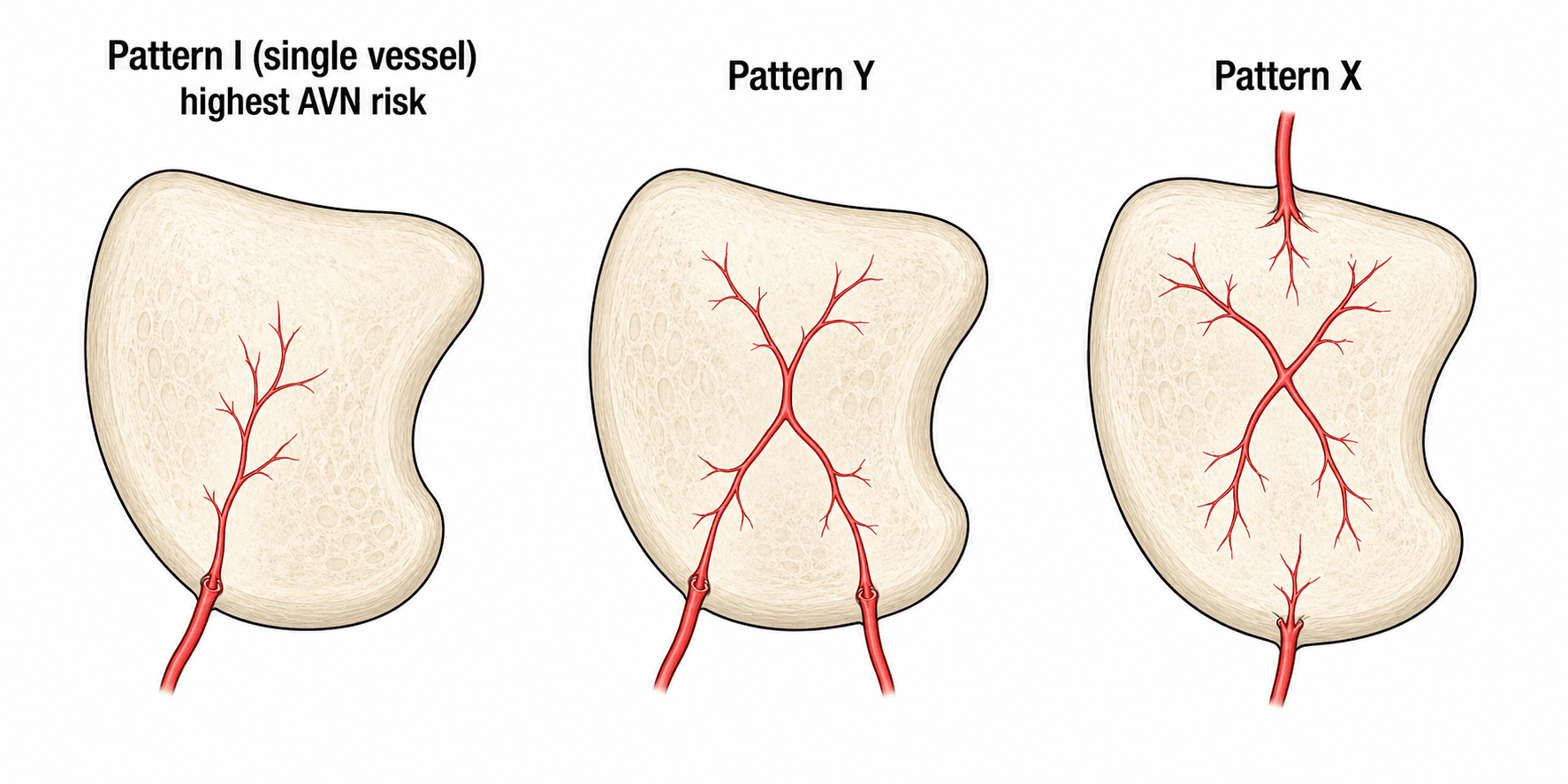
Gelberman's intraosseous patterns. The classic cadaveric study (Gelberman 1980) described three consistent intraosseous patterns, conventionally lettered Y, I and X, with a dorsal-volar anastomosis present in every one of the 35 specimens. The pattern cannot be determined before surgery.
- Y pattern: dorsal and volar vessels meet in a robust intraosseous anastomosis; the most redundant supply, more protected from AVN
- X pattern: crossed dorsal and volar vessels with an intermediate anastomosis; intermediate AVN risk
- I pattern: a single dominant intraosseous vessel with minimal anastomosis; the least redundant supply and the highest risk of AVN when a fracture crosses it
Be precise about what the paper says. No pattern is described as having a solitary vessel with no interconnection, and Gelberman's own conclusion was that Kienbock's disease follows repeated compression fracture rather than a primary vascular deficiency. What the I pattern does explain is the high overall AVN rate after body fractures crossing the central supply: the fracture line can isolate the dominant intraosseous vessel from a large part of the bone.
The micro-CT refinement. van Alphen's three-dimensional micro-CT study (2016, PMID 27782999) mapped 14 specimens: 12 had both volar and dorsal nutrient vessels and 2 had no dorsal vessels, so the often-quoted "14% have no dorsal vessel" is 2 of 14 and should be quoted with that denominator. Average vessel counts were 2.3 volar (118 micrometres) and 1.4 dorsal (136 micrometres), confirming the volar supply as the numerically dominant one. Vascularity is highest along the long axis of the lunate on both axial and lateral views, lower in the dorsoradial and volar-ulnar quadrants (axial) and in the proximal part (lateral); these are the vascular safe zones, and lunate shape did not predict vessel number or pattern.
Biomechanics
Load transmission. In Schuind's model the radio-scaphoid joint carries about 55% of the radio-ulno-carpal load, the radio-lunate joint approximately one third, and the TFCC about 10% (Schuind 1995). The normal lunate tilts volarly 10-15 degrees.
Carpal kinematics. The lunate is central to proximal row kinematics: part of the proximal row "intercalated segment" and moves with the scaphoid and triquetrum as a functional unit, so disruption leads to carpal instability patterns (DISI or VISI).
Ulnar variance. Average variance is neutral (0 +/- 1mm). With negative variance (a short ulna) the forces concentrate on the lunate, and this is a risk factor for both acute fracture and Kienbock's disease; with positive variance the load is shared with the TFCC. Ulnar lengthening may be part of treatment in select cases.
Classification Systems
Two systems. Teisen describes the acute fracture; Lichtman stages the avascular necrosis that a lunate may go on to.
Teisen classification. The most widely used system for acute lunate fractures, with five types running from the small avulsions of the poles to the body fractures whose line crosses the intraosseous supply. The type guides treatment urgency and the prognosis discussion.
Type I - volar pole. An avulsion of the volar horn by the short radiolunate ligament, often part of a perilunate injury pattern. The fragment is usually small and may not require fixation.
Type II - chip. A small dorsal or volar avulsion fragment, the most common acute lunate fracture pattern and usually of minimal clinical significance.
Type III - dorsal pole. A larger dorsal horn fragment that may involve the scapholunate ligament attachment, with a risk of dorsal intercalated segment instability, so assess for scapholunate injury.
Type IV - sagittal body. A sagittal split through the lunate body that disrupts the articular surfaces and carries a moderate-to-high risk of AVN.
Type V - transverse body. A coronal or transverse split through the body. It disrupts the dominant vessel, so it carries the highest AVN risk of the Teisen types and a poor prognosis without treatment.
- Location
- Volar pole
- AVN Risk
- Low
- Typical Treatment
- Immobilisation; ligament repair or screw if part of a perilunate injury
- Key Consideration
- Associated with perilunate injury
- Location
- Chip / avulsion (dorsal or volar)
- AVN Risk
- Very low
- Typical Treatment
- Cast; excision if persistently symptomatic
- Key Consideration
- Usually good prognosis
- Location
- Dorsal pole
- AVN Risk
- Low-moderate
- Typical Treatment
- Screw fixation if large, excision if small
- Key Consideration
- Assess for scapholunate injury
- Location
- Sagittal body
- AVN Risk
- Moderate-high
- Typical Treatment
- ORIF with headless compression screws
- Key Consideration
- Disrupts the articular surfaces
- Location
- Transverse body
- AVN Risk
- High
- Typical Treatment
- Urgent ORIF
- Key Consideration
- Needs early fixation and close monitoring for AVN
Clinical Assessment
History. An insidious onset without a clear injury may indicate developing Kienbock's disease rather than an acute fracture, and prior wrist symptoms may indicate pre-existing Kienbock's. The points that change management:
- Exact mechanism and energy of injury
- Occupational demands (manual labour, vibration exposure)
- Hand dominance
- Duration of symptoms
Examination. Swelling may be subtle because the lunate lies deep, there is no obvious deformity unless there is an associated carpal injury, and comparison with the other wrist helps. Tenderness is sought over the lunate fossa with the wrist slightly flexed and over the dorsal lunate with the wrist extended, though surrounding swelling can make it difficult to localise. Wrist flexion and extension are limited, forearm rotation is painful and grip is weak. The neurovascular status is usually preserved; check the median nerve, since swelling can produce a carpal tunnel picture, and document a baseline for comparison.
Special tests. Clinical examination is often non-specific and imaging is essential for diagnosis, but these tests pick up the associated injuries:
- Watson test (scaphoid shift) for an associated scapholunate injury; often positive with perilunate pattern injuries
- Ballottement test for lunotriquetral stability and an associated LT injury
- Grind test: axial load with rotation, positive if pain is reproduced
- Phalen's and Tinel's tests for the carpal tunnel; may be positive with acute swelling
Differential diagnosis. Dorsal central wrist pain after a fall has a wide differential, and the lunate fracture must be distinguished from injuries with overlapping tenderness and from chronic lunate pathology.
- Key Distinguishing Feature
- Lunate fossa tenderness; subtle or absent fracture line on X-ray
- Best Discriminating Investigation
- MRI (occult fracture, viability) or CT
- Key Distinguishing Feature
- Insidious onset, no clear acute injury; lunate sclerosis/collapse
- Best Discriminating Investigation
- MRI - low T1 signal; X-ray for staging
- Key Distinguishing Feature
- Anatomical snuffbox and scaphoid tubercle tenderness
- Best Discriminating Investigation
- Scaphoid-series X-ray; MRI if occult
- Key Distinguishing Feature
- Deranged carpal arcs; 'spilled teacup' or 'piece-of-pie' sign on lateral
- Best Discriminating Investigation
- PA and lateral X-ray; CT for fractures
- Key Distinguishing Feature
- Positive Watson scaphoid-shift test; SL gap on clenched-fist view
- Best Discriminating Investigation
- Stress X-ray; MRI/arthroscopy
- Key Distinguishing Feature
- Dorsal metaphyseal tenderness and deformity
- Best Discriminating Investigation
- PA and lateral X-ray
- Key Distinguishing Feature
- Diffuse tenderness, normal X-ray, settles with time
- Best Discriminating Investigation
- MRI if persistent
Investigations
Radiographs. Available and low cost, and the initial screen, but they miss early and occult fractures. The PA view may show a fracture line, sclerosis or collapse; the lateral shows the lunate's position (DISI or VISI) and dorsal fractures; a scaphoid view adds a further perspective on the carpal relationships. An acute fracture shows a fracture line that is often subtle or absent, a slight density change, or associated carpal malalignment. Kienbock's disease shows increased lunate density (sclerosis), loss of carpal height, lunate collapse and fragmentation and, late, secondary arthritis.
Ulnar variance. Measure it on a PA view in neutral rotation and compare with the other side if available, because a negative variance is the risk factor.
CT. Characterises the fracture pattern for surgical planning, assesses for an occult fracture not seen on radiographs and evaluates associated carpal injuries, with bone detail good enough for three-dimensional planning but no assessment of vascularity. Read the orientation of the fracture line (sagittal or transverse), fragment size and displacement, articular surface involvement and comminution.
MRI. The key investigation for determining treatment and prognosis, limited by cost and availability. It detects occult fractures missed on X-ray, assesses lunate vascularity, differentiates an acute fracture from Kienbock's disease and evaluates ligamentous injuries. The signal is read against the other carpal bones:
- Normal lunate: isointense to the other carpal bones
- Early ischaemia: decreased T1 signal
- Established AVN: low T1 and T2 signal
- Revascularisation: mixed signals
Gadolinium. Enhancement suggests preserved vascularity and its absence indicates AVN, which helps predict prognosis.
Bone scan. Sensitive but not specific, since the lunate is hot in any pathology, and superseded by MRI for most indications.
Management Algorithm
The decision. Fracture pattern, displacement and the patient, weighed against the high risk of AVN with body fractures. Small undisplaced pole fragments and most chip fractures are immobilised; body fractures have a higher failure rate with non-operative treatment, so a displaced body fracture is fixed.
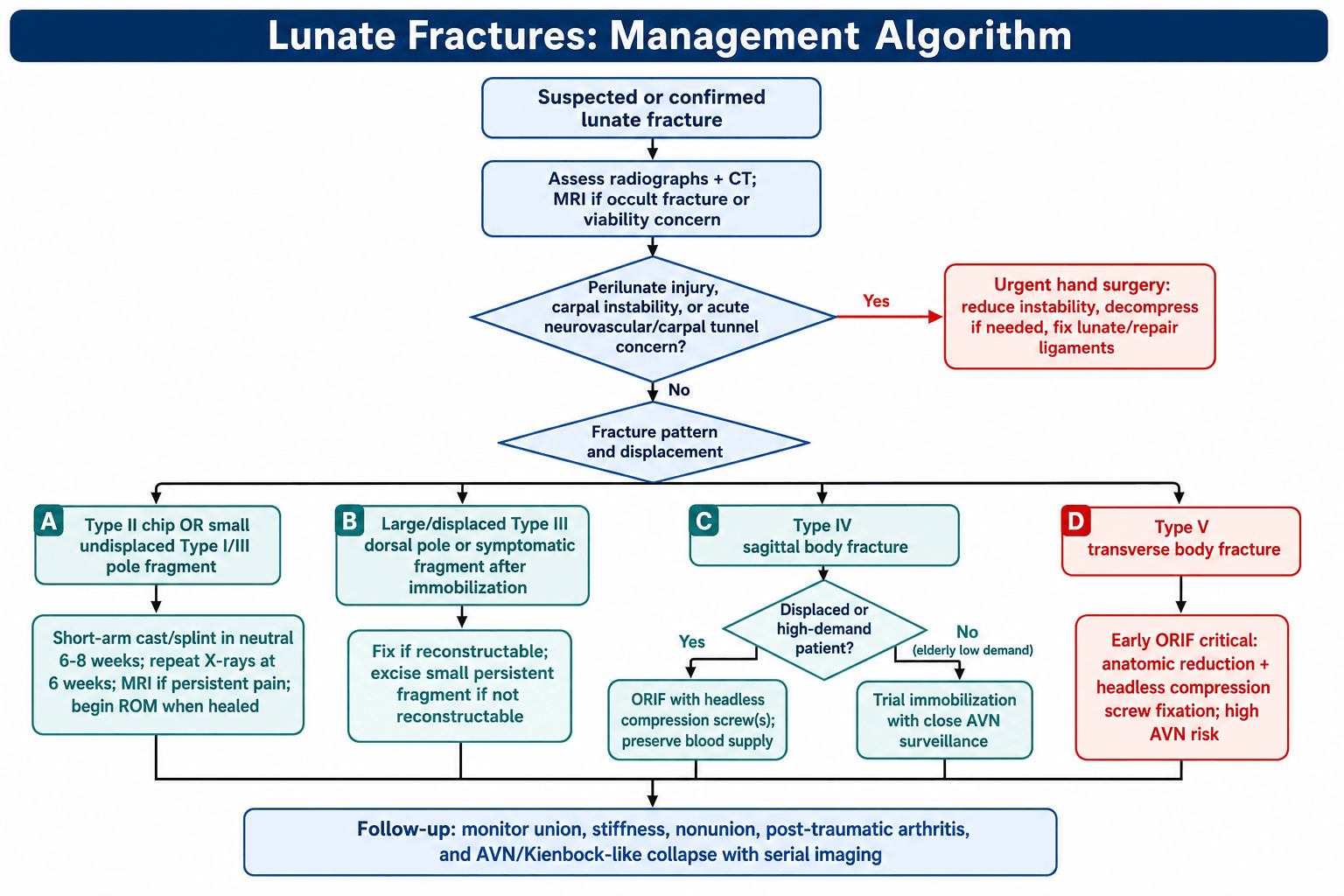
Who. Undisplaced Type I (volar pole) fractures, most Type II (chip) fractures, small undisplaced Type III (dorsal pole) fragments, and elderly, low-demand patients with body fractures.
The cast. A short arm cast or splint with the wrist in neutral, including the thumb if there is a scaphoid concern, for a minimum of 6-8 weeks. Begin range of motion when clinically healed, progress to strengthening, and keep monitoring for late complications.
Follow-up. Clinical review and a cast check at week 2, repeat radiographs at week 6, and MRI at week 8-12 if symptoms persist. Monitoring for AVN continues after the cast comes off, because it may take months to develop.
What to expect. Type II fractures have an excellent prognosis, and Types I and III do well with proper immobilisation.
Surgical Technique
Goals. Anatomic reduction of the articular surface, stable fixation that preserves the blood supply, early mobilisation to prevent stiffness, and no further vascular compromise. Every step is chosen with the tenuous supply in mind: minimise soft-tissue stripping, confirm the screw position on fluoroscopy, consider arthroscopic assistance for visualisation, and avoid compression that could compromise the vessels.
Choosing the fixation. The options:
- Headless compression screws (2.0-2.4mm), countersunk beneath the cartilage, provide compression across body fractures (Type IV/V)
- K-wires (1.1-1.25mm) for small fragments or provisional fixation; may require a supplemental cast
- Fragment excision for small chip fractures (Type II) that stay symptomatic despite immobilisation: remove the fragment and debride the bed
Choosing the approach. The dorsal approach, through the third and fourth extensor compartments with a capsulotomy that preserves the ligaments, gives the best visualisation of the dorsal lunate and is used for dorsal pole and body fractures. The volar approach, between FCR and the radial artery with a capsulotomy that preserves the radiocarpal ligaments, gives access to the volar horn for volar pole fractures, and is combined with the dorsal approach for body fractures.
The vascular consequence is the opposite of the usual instinct. Because the volar vessels are the more numerous and a minority of lunates have no dorsal supply at all, it is the volar approach that is the vascular risk: van Alphen's own conclusion is that "volar approaches to the lunate may result in localized ischemia in a subset of patients with absent dorsal nutrient vessels."
Set-up. Supine with an arm table, a tourniquet on the upper arm, and a traction tower if it helps visualisation. The incision is dorsal and longitudinal, 4-5 cm long and centred on Lister's tubercle.
Exposure
- Incise the retinaculum between the 3rd and 4th compartments
- Protect EPL and retract it radially; retract EDC ulnarly
- Capsulotomy, ligament-sparing technique preferred
- Flex the wrist to expose the dorsum of the lunate, identify the fracture pattern and assess vascularity by bleeding from the bone
Reduction and fixation
- Reduce with gentle manipulation of the fragments and hold with provisional K-wires
- Confirm the reduction and articular congruity on fluoroscopy
- Headless compression screw (2.0-2.4mm): start at the dorsal cortex, aim for the volar cortex or the far fragment, countersink beneath the cartilage and confirm the position on multiple fluoroscopy views
- Supplement with a K-wire for rotational control if needed, or a second screw for a large body fracture
Closure. Repair the capsule meticulously, close the retinaculum loosely, standard skin closure, and a splint in neutral.
Complications
Intraoperative. The lunate is small and fragile, so iatrogenic fracture during screw insertion is a real risk; careful technique and an appropriately sized implant prevent it, and additional fixation manages it if it happens. Screw malposition with joint penetration causes arthritis: check multiple fluoroscopy views, and revise a screw that is intra-articular. Vascular injury adds further compromise to a tenuous blood supply, cannot be assessed intraoperatively, and is prevented by minimising soft-tissue stripping.
Early. Infection is unusual but problematic for this small bone, and dehiscence may expose hardware; a deep infection needs IV antibiotics and debridement. A prominent screw may irritate the extensor tendons, so screws are countersunk, and a migrating K-wire is removed early, with hardware removal once the fracture has healed. Carpal tunnel syndrome may develop with the swelling and is treated with splinting and elevation, and decompression if it persists.
Avascular necrosis. This is the dominant concern. The risk is high after displaced body fractures (Type IV/V) that cross the central supply, and small case series rather than large cohorts inform the exact rates; early fixation and gentle technique are the prevention. It may present months after the injury with progressive pain and decreasing motion. Treatment depends on stage and viability, from unloading to salvage: assess the bone's vascularity on MRI, offload the lunate by radial shortening or ulnar lengthening, core decompression for early disease, which preserves bone structure, and limited intercarpal fusion for advanced disease.
- Stage I-II: core decompression or revascularisation may preserve function
- Stage IIIA: motion-preserving procedures are possible
- Stage IIIB-IV: limited wrist fusion or arthroplasty
When a post-fracture lunate becomes avascular but is still structurally reconstructable (pre-collapse or early collapse with viable cartilage), the goal shifts from simple unloading to restoring blood supply - examinable surgical options the candidate should be able to name:
- Pedicled vascularised bone grafts from the distal radius - the 4th + 5th extensor compartmental artery (4+5 ECA) graft and the 2,3 intercompartmental supraretinacular artery (2,3 ICSRA) graft are the workhorse local options, rotated into the debrided lunate.
- Free medial femoral condyle (MFC) corticoperiosteal/osteochondral flap - a microvascular option for larger defects or when local pedicles are inadequate, increasingly used in specialist centres.
- Vascular bundle implantation (Hori procedure) - a dorsal vascular bundle (e.g. a dorsal metacarpal artery and vena comitans) is implanted directly into a core-decompressed lunate to encourage neovascularisation.
- Pedicled pisiform transfer and pronator quadratus pedicled graft - historical/adjunctive vascularised options.
Key principle: revascularisation is usually combined with unloading (radial shortening / joint-levelling osteotomy) to protect the graft while it incorporates; once the cartilage shell has failed (advanced Bain grade) or the lunate has collapsed (Lichtman IIIB-IV), revascularisation is futile and the choice is salvage (proximal row carpectomy or limited/total wrist fusion).
Nonunion. More common with body fractures and related to AVN in many cases; stable fixation and bone graft prevent it, and it is treated with bone grafting and revision fixation, or a vascularised graft.
Post-traumatic arthritis and carpal instability. Arthritis is the consequence of AVN or articular malreduction, prevented by anatomic reduction, and presents as progressive wrist pain and stiffness; treatment runs from activity modification to arthrodesis. A DISI or VISI pattern may develop, related to the associated ligament injury, and may require carpal fusion.
Postoperative Care
The first two weeks. A volar or dorsal splint holds the wrist in neutral while the fingers move from the first day; the limb is elevated above heart level, with ice, multimodal analgesia, neurovascular checks and swelling assessment. The first dressing change is at 48-72 hours, with K-wire site care if wires were used and a watch for infection; sutures come out at 10-14 days and steri-strips support the wound.
Active finger motion, shoulder and elbow range, and oedema control with elevation and compression. The wrist is protected; nothing else should be allowed to stiffen.
Transition to a removable splint and begin gentle active wrist range with the splint on between exercises, continue oedema management, and refer to hand therapy. This is also the window in which loss of position declares itself, so keep the radiographic surveillance running alongside the therapy. At week 6 repeat the radiographs, consider an MRI to assess healing and vascularity, and remove any K-wires.
Discontinue the splint (usually at week 6) if stable, progress range of motion and gentle grip strengthening, then functional activities, work conditioning as needed and a return to normal activities of daily living.
Progressive strengthening, sport-specific work and work conditioning, with full recovery taking 6-12 months. The important point is that discharge from therapy is not discharge from surveillance: post-traumatic lunate osteonecrosis declares itself late, so keep imaging follow-up going and counsel the patient about the symptoms that should bring them back. In the closest comparable long-term series (Israel, perilunate injuries) osteonecrosis occurred in 7.7% and arthritis in 58.5% at a mean of 8 years - radiographic arthritis being frequent and, per Liechti, not reliably predictive of how the wrist feels.
Surveillance. An MRI at 6 months is recommended for AVN surveillance, especially after body fractures or if there is any concern, and the patient is reviewed annually for two years.
- Assessment
- Wound check, suture removal
- Imaging
- Optional
- Assessment
- ROM, healing, K-wire removal
- Imaging
- Radiographs; consider MRI
- Assessment
- Function
- Imaging
- Radiographs
- Assessment
- AVN surveillance
- Imaging
- MRI recommended
- Assessment
- Long-term outcome
- Imaging
- As needed
- Assessment
- Final review
- Imaging
- If symptomatic
Outcomes and Prognosis
By fracture type. Pole and chip fractures (Types I-III) have generally good to excellent outcomes: full range of motion is expected, return to previous activities is typical and the AVN risk is low. Type IV (sagittal body) fractures have moderate outcomes, some motion loss is common, and secondary procedures may be required. Type V (transverse body) carries the most guarded prognosis: significant motion loss is common and it often progresses to Kienbock's.
Prognostic factors. The favourable ones are a pole or chip fracture, an undisplaced pattern, early diagnosis and treatment, an MRI showing preserved vascularity, and neutral or positive ulnar variance. The unfavourable ones are a body fracture (Type IV/V), delayed diagnosis, associated carpal injuries, an MRI showing avascularity, and negative ulnar variance.
Natural history untreated. Chip fractures may remain asymptomatic, occasionally cause persistent pain, and rarely progress to AVN. Body fractures go on to a high rate of nonunion, progressive AVN, eventual carpal collapse and secondary arthritis.
Long term. Without AVN, expect good grip strength recovery (80-90% of the contralateral side), near-normal range of motion and a return to previous occupation and sport. With AVN the wrist deteriorates progressively and may need the stage-dependent procedures described under Complications, and the outcome depends on the stage at which they are done.
Guidelines, Registries & Global Practice
Global Epidemiology
Isolated lunate fractures are rare, reported as under 3% of carpal fractures, and acute lunate injury most often occurs within a high-energy perilunate pattern. In a 65-case European perilunate series, 62 of 65 injuries displaced dorsally, lunate osteonecrosis occurred in 7.7% and post-traumatic arthritis in 58.5% at a mean 8-year follow-up (Israel 2016). Kienbock's disease, the related lunate avascular necrosis, classically affects manual workers aged 20-40 and is associated with negative ulnar variance.
- Position
- Acute displaced body fractures and perilunate injuries treated by anatomic reduction and stable fixation; preserve dorsal/volar blood supply
- Evidence Level
- Expert consensus / Level V
- Position
- MRI is the key investigation for occult fracture and lunate viability; isolated chip/pole fractures usually non-operative
- Evidence Level
- Level IV-V
- Position
- Stage- and viability-based pathway: protect intact lunate, unload, reconstruct, then salvage
- Evidence Level
- Level V review
- Position
- Radial shortening / ulnar lengthening preferred for unloading - 45% radio-lunate load reduction
- Evidence Level
- Level V model
Practice Variation
- Diagnosis: high-resource settings use early MRI and CT routinely; in limited-resource settings diagnosis relies on radiographs and clinical follow-up, raising the rate of missed occult fractures.
- Kienbock's unloading: radial shortening osteotomy is the most widely adopted joint-levelling procedure internationally because it is technically reliable and avoids a separate graft site; ulnar lengthening is used less often.
- Reconstruction: vascularised bone grafting (including medial femoral condyle flaps) for the compromised but reconstructable lunate is concentrated in specialist hand-surgery and microsurgery centres.
- Registries: there is no dedicated carpal-fracture joint registry (the major arthroplasty registries such as the NJR, AJRR and AOANJRR do not capture lunate fracture or Kienbock's outcomes), so evidence rests on case series and biomechanical studies rather than registry data.
Rehabilitation through specialist hand therapy and long-term avascular-necrosis surveillance with delayed MRI are recommended internationally after body fractures and perilunate injuries.
Viva Scenarios
Clinical Decision Scenarios
Practise clinical reasoning and management decisions out loud
“A 28-year-old manual laborer presents 2 days after a fall from scaffolding. He has wrist pain, and X-rays show a possible lunate abnormality. How do you evaluate this injury?”
“CT and MRI confirm a Type V transverse lunate body fracture in a 35-year-old office worker. MRI shows intact signal on T1 sequences. How do you counsel this patient and plan treatment?”
“A patient you treated for a lunate fracture 18 months ago returns with progressive wrist pain. MRI shows Stage IIIA Kienbock's disease. How do you manage this complication?”
MCQ Practice Points
Q: What are the three intraosseous vascular patterns of the lunate, and which carries the highest AVN risk? A: Gelberman described the Y, X and I patterns. The I-pattern has a single dominant intraosseous vessel with minimal anastomosis and the least redundancy, so it carries the highest avascular necrosis risk when a body fracture crosses the central supply.
Q: Which Teisen classification type has the highest risk of avascular necrosis? A: Type V (transverse body) fractures carry the highest AVN risk because the transverse fracture line crosses and can isolate the dominant intraosseous vessel from a large part of the bone. Type IV (sagittal body) is the next highest; pole and chip fractures rarely develop AVN.
Q: What ulnar variance pattern is associated with increased lunate fracture and Kienbock's disease risk? A: Negative ulnar variance (short ulna relative to radius) concentrates axial load on the lunate. This is a major risk factor for both acute fracture and progressive AVN.
Q: How is axial wrist load shared at the radio-ulno-carpal joint? A: Schuind's biomechanical model found roughly 55% passes through the radio-scaphoid joint, about 35% (around one third) through the radio-lunate joint, and about 10% through the TFCC. The lunate is still the central "keystone" of the proximal carpal row, and negative ulnar variance shifts more load onto it.
Q: What MRI finding indicates early avascular necrosis of the lunate? A: Decreased T1 signal relative to other carpal bones indicates early AVN, as fat in the bone marrow is replaced by edema or necrotic tissue. T2 signal may be variable depending on the stage.
Q: What distinguishes Stage IIIA from Stage IIIB Kienbock's disease? A: Stage IIIA has lunate collapse but maintained carpal height and no fixed scaphoid rotation. Stage IIIB shows scaphoid rotation (ring sign on X-ray) and proximal capitate migration, indicating more advanced carpal collapse.
Understanding these key concepts will help with exam success.
Definition & Key Concepts
- Keystone of proximal carpal row
- Under 3% of all carpal fractures
- I-pattern lunate has the least redundant intraosseous supply (Gelberman)
- About one third of radio-ulno-carpal load via radio-lunate joint
- Negative ulnar variance increases risk
Teisen Classification
- Type I: Volar pole fracture
- Type II: Chip fracture (dorsal/volar)
- Type III: Dorsal pole fracture
- Type IV: Sagittal body fracture
- Type V: Transverse body - highest AVN risk
Imaging Strategy
- X-ray: May miss fracture, assess ulnar variance
- CT: Characterize fracture pattern
- MRI: Essential for vascularity assessment
- Decreased T1 signal = early AVN
Treatment Algorithm
- Type I-III: Often non-operative (cast 6-8 weeks)
- Type IV/V: ORIF with headless screws
- Dorsal approach for most fractures
- Gentle technique to preserve blood supply
AVN & Kienbock's Management
- Stage I-II: Core decompression, revascularization
- Stage IIIA: Radial shortening, limited fusion
- Stage IIIB: PRC or limited fusion
- Stage IV: Salvage fusion or arthroplasty
Complications & Outcomes
- AVN: highest with Type V transverse body fractures
- Nonunion: Related to AVN in many cases
- Long-term MRI surveillance essential
- Prognosis depends on AVN development
Evidence Base
Gelberman RH, Bauman TD, Menon J, Akeson WH. The vascularity of the lunate bone and Kienbock's disease
- 35 fresh cadaver limbs injected with latex and cleared; extraosseous supply via 2-3 dorsal and 3-4 volar vessels feeding dorsal and volar capsular plexuses
- Only ONE TO TWO nutrient vessels enter each of the dorsal and volar poles from those plexuses - the extraosseous supply is profuse but the intraosseous entry points are few, which is where the vulnerability actually lies
- Intraosseous supply formed one of three consistent patterns, conventionally lettered Y, I and X - and Gelberman reports a dorsal-volar ANASTOMOSIS IN EVERY SPECIMEN
- Findings support a compression-fracture-from-repeated-trauma theory for Kienbock's disease rather than a primary vascular one
Teisen H, Hjarbaek J. Classification of fresh fractures of the lunate
- Radiographs of 17 patients with acute lunate fractures reviewed, with long-term radiographic follow-up
- Proposed the five-group classification conventionally described as volar pole, chip, dorsal pole, sagittal body and transverse body
- Fractures were classified both by radiological appearance and by reference to the vascular anatomy of the lunate
- The inference usually drawn - that body fractures crossing the nutrient supply carry the worst prognosis - is anatomically reasonable and is NOT quantified in the abstract, so treat it as the classification's rationale rather than as a measured outcome
The evidence supports joint-levelling for lunate unloading, anatomic fixation of body and perilunate injuries, and long-term avascular necrosis surveillance.