Metacarpophalangeal Joint Degenerative and Inflammatory Arthritis
- Mechanism: Rheumatoid chronic synovitis stretches the volar plate and radial collateral ligament, causing volar subluxation and ulnar drift with ulnar extensor-tendon displacement
- Management: Optimise DMARDs (methotrexate first-line) and biologics first; operate only for established deformity with functional loss after 3-6 months of failed medical therapy
- Digit-specific surgery: silicone arthroplasty for fingers (digits 2-5), arthrodesis for the thumb MCP (pinch stability); soft-tissue rebalancing is integral to arthroplasty
- “Silicone is a flexible spacer, not a load-bearing joint replacement; fibrous encapsulation provides stability
- “Arthroplasty without extensor centralisation and radial collateral reconstruction will recur in ulnar drift
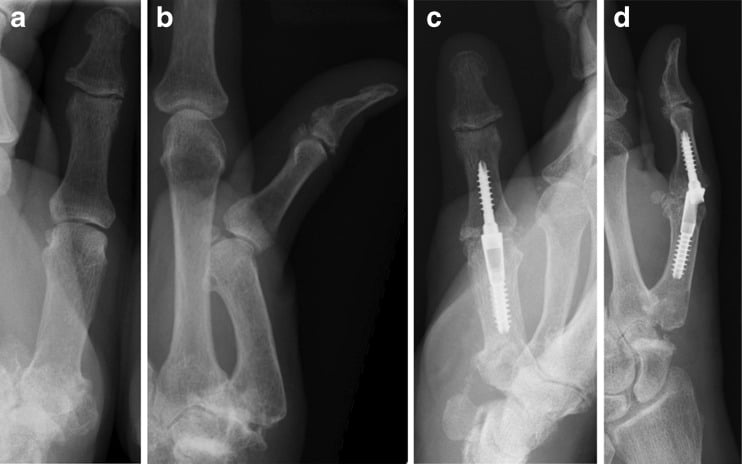
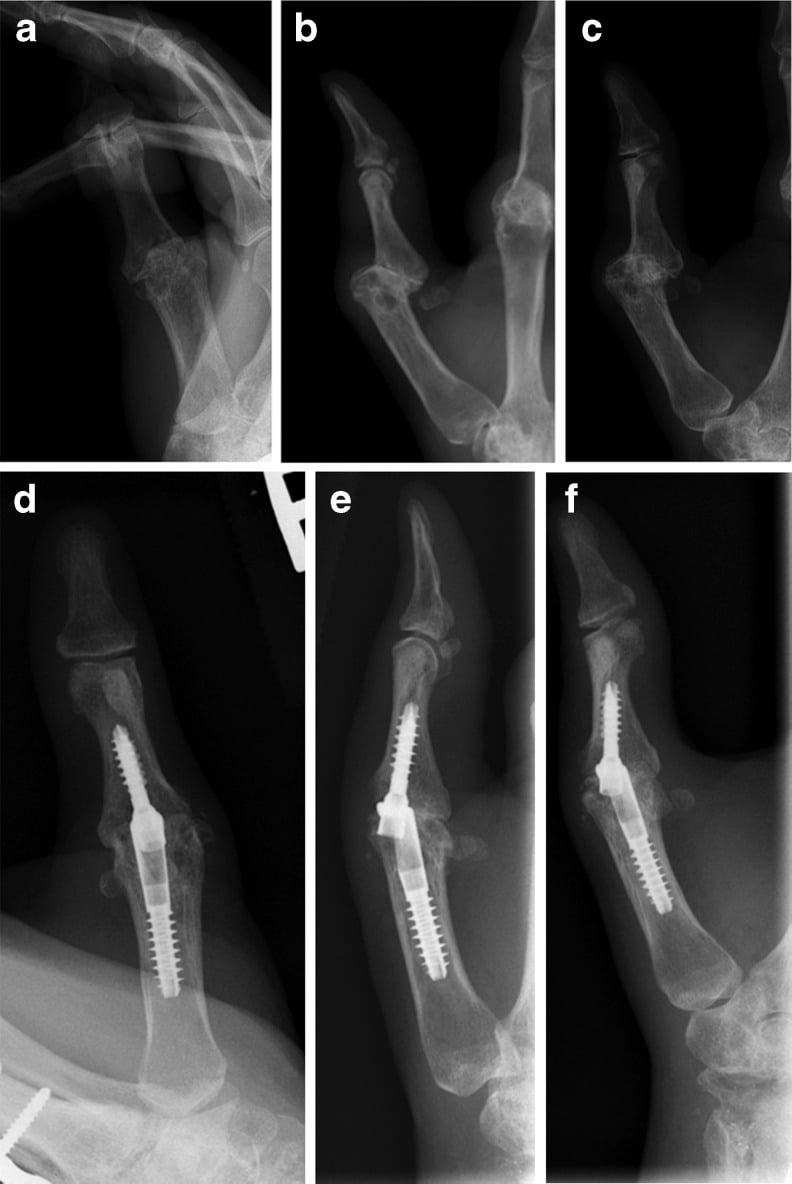
- “Thumb MCP is fused at 10-15 degrees flexion in neutral rotation; test pinch intra-operatively before fixation
Overview and Epidemiology
MCP joint arthritis is inflammation and degeneration of the metacarpophalangeal joints, presenting as pain, stiffness, deformity and functional impairment. It is predominantly a rheumatoid disease.
Rheumatoid arthritis. The most common cause. About 90% of patients with rheumatoid arthritis develop MCP involvement, bilateral and symmetric, with a female-to-male ratio of 3:1 and peak onset at 40-60 years, progressing over years to decades. The natural history runs from early synovitis, pain and morning stiffness, through ulnar drift and volar subluxation, to severe fixed deformity with extensor tendon displacement and functional disability.
Post-traumatic arthritis. Follows an MCP fracture with articular involvement, chronic MCP instability from collateral ligament injury, or a prior MCP dislocation, and is usually unilateral and confined to a single digit. The injuries that lead there are the intra-articular fracture (especially volar plate avulsion), the chronically unstable collateral ligament, the dorsal dislocation with articular damage, and the MCP injury that was inadequately treated at the outset.
Primary osteoarthritis. Rare at the MCP, unlike the first CMC, DIP and PIP joints; more common in manual labourers, and typically less severe than the rheumatoid disease. Other inflammatory causes are psoriatic arthritis (seronegative, involving DIP and MCP) and crystalline arthropathy (gout and pseudogout).
Risk factors. For rheumatoid disease: autoimmune predisposition (RF and anti-CCP antibodies), genetic factors (HLA-DR4, family history), female sex, smoking, and environmental triggers such as infections and hormonal change. Occupational risk comes from repetitive gripping and pinching, vibratory tool use and heavy manual work.
Anatomy and Biomechanics
The joint. The metacarpal head is cam-shaped, an eccentric condyle that is wider volarly than dorsally by roughly 20-30%, articulating with the shallow concave base of the proximal phalanx, the post. That articular mismatch allows increased range at the cost of inherent instability: bony congruity is minimal, and the joint is held by its soft tissues.
Collateral ligaments. The proper collateral ligament arises from the metacarpal head dorsal to the axis of rotation and inserts on the base of the proximal phalanx; the accessory collateral arises from the metacarpal and inserts on the volar plate. The collaterals are lax in extension, which permits lateral deviation, and tight in flexion, which stabilises the joint.
Volar plate. A thick fibrocartilaginous structure on the palmar side that prevents MCP hyperextension. Its distal attachment to the proximal phalanx is strong and its proximal attachment is weak, and that weak proximal attachment is where the rheumatoid joint gives way into volar subluxation.
Extensor mechanism. Extensor digitorum communis inserts on the base of the proximal phalanx through the extensor hood, and the radial and ulnar sagittal bands hold the tendon centred over the MCP joint.
Motion. MCP flexion is 80-90 degrees in the fingers and 50-60 degrees in the thumb; extension runs to 0-20 degrees of hyperextension as a normal variation. Radial-ulnar deviation is 10-20 degrees in extension, where the collaterals are lax, and minimal in flexion.
Stability. With minimal bony congruity, the static stabilisers are the collateral ligaments, the volar plate and the joint capsule, and the dynamic stabilisers are the intrinsic muscles (lumbricals and interossei) and the extensor tendons.
Load. Power grip puts high compressive loads across the MCPs, up to 5-10 times grip force, and precision pinch loads the index and thumb MCPs heavily. That is the reason the thumb MCP is fused rather than replaced: it needs stability for pinch, and an arthroplasty fails under that load.
Pathophysiology and Deformity Mechanisms
Synovitis is the primary event. Chronic inflammation of the MCP synovium produces pannus, an invasive synovial tissue, which releases inflammatory cytokines (TNF-alpha, IL-1, IL-6) and degrades cartilage enzymatically through matrix metalloproteinases.
The capsule and ligaments stretch. Synovial hypertrophy distends the joint capsule. The radial collateral ligament stretches, which allows ulnar drift; the volar plate stretches proximally, which allows volar subluxation; and the sagittal bands attenuate, which allows the extensor tendon to displace.
Volar subluxation. The proximal phalanx subluxes volarly on the metacarpal head, producing a visible dorsal step-off at the MCP and loss of the normal joint contour. It worsens with grip, because the force vector of gripping pulls the phalanx volarly.
Ulnar drift. Radial collateral laxity allows ulnar deviation, and the ulnar intrinsics (ulnar lumbricals and interossei) pull the digits ulnarly. Radial deviation at the wrist compounds the drift at the MCP, the Z-collapse described below, and gravity and grip forces perpetuate it.
Extensor tendon displacement. With the sagittal bands attenuated, the extensor falls ulnarly into the valley between the metacarpal heads. There it acts as an ulnar deviator instead of a pure extensor, creating an extensor lag and perpetuating the drift.
Progression. The biomechanical imbalance worsens with hand use until the deformity becomes fixed by contracture, abnormal loading erodes the articular cartilage, and the end stage is a mutilating arthropathy.
The zig-zag (Z-collapse). MCP ulnar drift is the distal half of a collapse of the whole ray. Rheumatoid synovitis at the wrist produces carpal supination, ulnar translocation of the carpus and radial deviation of the metacarpals on the forearm. To keep the fingers pointing forward, and because the radially deviated metacarpals shift the line of pull of the long flexors and extensors, the MCPs compensate by deviating ulnarly: radial at the wrist, ulnar at the MCP, the same collapsing-chain principle that produces the swan-neck and boutonniere zig-zags at digit level.
Why the wrist matters to MCP surgery. A radially deviated, unstable wrist is a standing deforming force on the MCPs. Correct the MCPs with arthroplasty and soft-tissue rebalancing while leaving that force alone and the ulnar drift recurs, which is one of the commonest reasons a technically sound arthroplasty re-drifts. Reconstruction therefore runs proximal to distal: assess and, where needed, realign or stabilise the wrist first or concurrently (wrist arthrodesis or arthroplasty, distal ulna or DRUJ surgery, detailed in the rheumatoid wrist topic), then the MCPs, then the IP joints. The dorsally prominent caput ulnae that accompanies this collapse also threatens the extensor tendons with attrition rupture, a further reason to address the wrist (covered in the extensor-rupture and rheumatoid-wrist topics).
Nalebuff rheumatoid hand classification. The deformity patterns, and what each asks of the reconstruction:
- Deformity Pattern
- Swan-neck (MCP flexion, PIP hyperextension, DIP flexion)
- Mechanism
- Intrinsic tightness, PIP volar plate laxity, FDS weakness
- Treatment Consideration
- Address MCP and PIP (may need PIP fusion or reconstruction)
- Deformity Pattern
- Boutonniere (MCP hyperextension, PIP flexion, DIP hyperextension)
- Mechanism
- Central slip rupture at PIP, lateral band volar displacement
- Treatment Consideration
- PIP central slip reconstruction or fusion
- Deformity Pattern
- MCP ulnar drift with swan-neck
- Mechanism
- Combined Type I and MCP pathology
- Treatment Consideration
- MCP arthroplasty with PIP management
- Deformity Pattern
- Severe MCP volar subluxation
- Mechanism
- End-stage rheumatoid destruction
- Treatment Consideration
- MCP arthroplasty or arthrodesis (if bone stock poor)
Type I, the swan-neck with MCP flexion deformity, is the most common pattern requiring MCP arthroplasty.
Clinical Presentation and Assessment
The rheumatoid history. Bilateral, symmetric hand pain and stiffness, with morning stiffness of more than an hour that improves with activity, progressive ulnar drift and visible deformity, and difficulty with both power grip (holding objects) and precision pinch. Ask about the known diagnosis and its systemic involvement (other joints, lungs, heart), the DMARD history (methotrexate, biologics), and how long the hand has been symptomatic, which is usually months to years.
The post-traumatic history. A fracture, dislocation or ligament injury of the MCP, followed after a delay of months to years by unilateral, single-digit pain and stiffness, reduced motion compared with the other side, and pain on gripping.
The osteoarthritic history. Insidious onset and gradual progression, usually in a patient over 60, often with an occupational history of manual labour or repetitive gripping, and with fewer systemic symptoms than rheumatoid disease.
Inspection. What to look for, and what each finding means:
- Ulnar drift of the fingers at the MCPs, pathognomonic for rheumatoid disease
- Volar subluxation, the proximal phalanx displaced volarly with a dorsal step-off at the MCP
- Boggy synovitis at the MCP joints in active disease, with fusiform swelling
- Swan-neck (MCP flexion, PIP hyperextension, DIP flexion) or boutonniere deformity at the IP joints
- Extensor tendons displaced ulnarly into the valleys between the metacarpal heads
- Skin: rheumatoid nodules on the extensor surfaces, olecranon and MCPs, with thinning and fragility
- Z-collapse, wrist radial deviation with MCP ulnar drift
Palpation. Joint-line tenderness is felt dorsally, and synovial thickening is boggy, compressible and warm when inflammation is active. Stress the collaterals radially and ulnarly with the joint in flexion, where they are normally tight, and in extension, where they are normally lax: excessive laxity means the ligament has attenuated. Test the volar plate for hyperextension laxity.
Motion. Active MCP flexion-extension is normally 0-90 degrees and is reduced in arthritis. Compare passive with active range to separate capsular tightness from extensor lag, the active extension deficit relative to passive extension that signals extensor tendon pathology (displacement or weakness), and compare with the other hand.
Special tests. The intrinsic tightness test: with the MCP extended, attempt PIP flexion; if the intrinsics are tight PIP flexion is limited, and it should improve with the MCP flexed, which relaxes them. Grip strength is measured by dynamometer against the other side and age-matched norms; key pinch and pulp pinch strength assess thumb MCP stability.
Function. Power grip (holding objects, opening jars), precision pinch (writing, buttoning), the activities of daily living (dressing, eating, hygiene) and the demands of work, manual or sedentary. These findings guide surgical planning and set the patient's expectations.
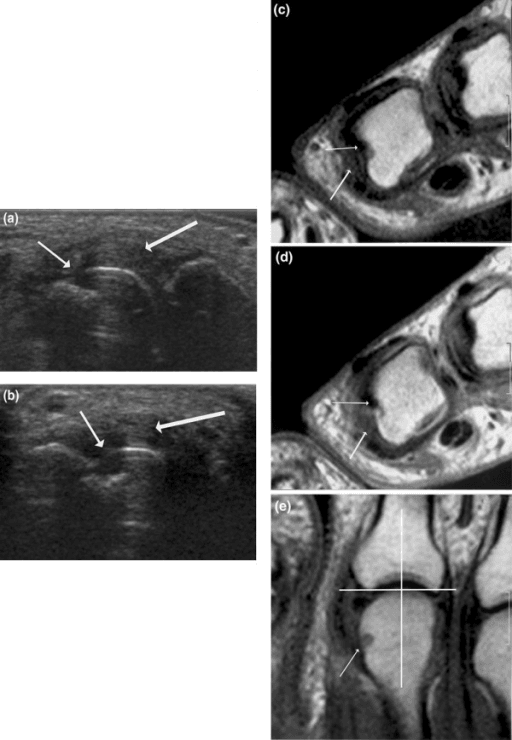
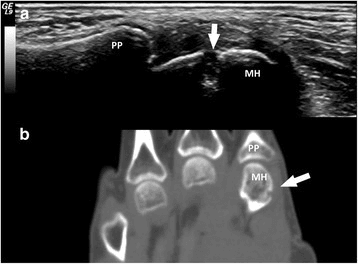
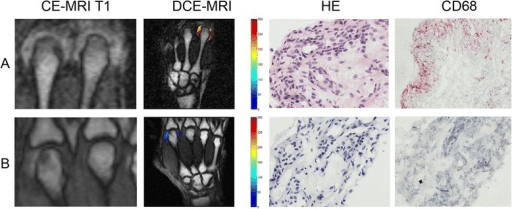
Differential diagnosis. The causes of MCP arthritis are separated by distribution, serology, the radiographic hallmark and one discriminating clue each:
- Distribution
- Bilateral, symmetric, MCP and wrist; spares DIP
- Serology / Labs
- RF positive 70-80%, anti-CCP positive 70% (specificity over 95%)
- Radiographic Hallmark
- Periarticular osteopenia, marginal erosions, ulnar drift, volar subluxation
- Discriminating Clue
- Symmetric MCP synovitis with ulnar drift and morning stiffness over 1 hour
- Distribution
- Asymmetric, ray pattern, DIP and MCP
- Serology / Labs
- RF negative, anti-CCP negative (seronegative)
- Radiographic Hallmark
- Pencil-in-cup deformity, periostitis, osteolysis, ankylosis
- Discriminating Clue
- Skin/nail psoriasis, dactylitis (sausage digit), DIP involvement
- Distribution
- Index and middle MCP, often in manual workers
- Serology / Labs
- Inflammatory markers normal, seronegative
- Radiographic Hallmark
- Osteophytes, subchondral sclerosis, preserved bone density
- Discriminating Clue
- Rare at MCP; suspect haemochromatosis if index/middle MCP OA in a younger man
- Distribution
- Unilateral, single digit
- Serology / Labs
- Seronegative, normal markers
- Radiographic Hallmark
- Focal joint-space loss, sclerosis, malunion/articular step-off
- Discriminating Clue
- Antecedent fracture, dislocation or collateral ligament injury
- Distribution
- Mono- or oligoarticular, episodic
- Serology / Labs
- Urate may be raised; aspirate shows crystals
- Radiographic Hallmark
- Tophi/erosions with overhanging edges (gout); chondrocalcinosis (CPPD)
- Discriminating Clue
- Acute hot swollen joint; negatively birefringent needles (gout) vs positively birefringent rhomboids (CPPD)
- Distribution
- Second and third MCP characteristically
- Serology / Labs
- Raised ferritin and transferrin saturation
- Radiographic Hallmark
- Hook-like osteophytes on metacarpal heads, chondrocalcinosis
- Discriminating Clue
- Square hand-grip pain; screen iron studies in atypical MCP OA
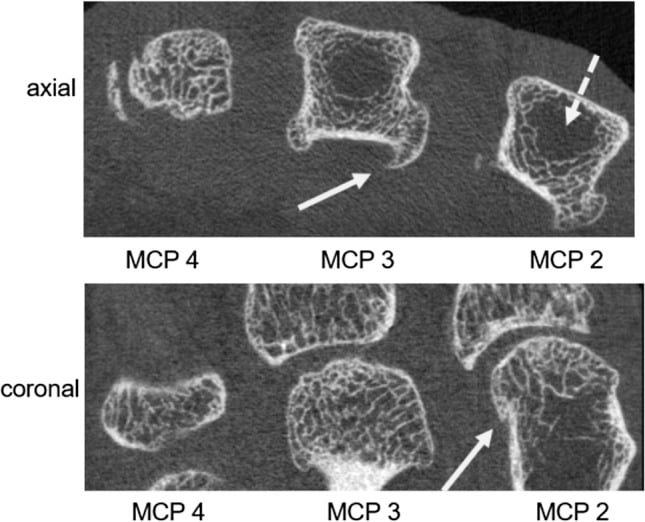
Non-Operative Management
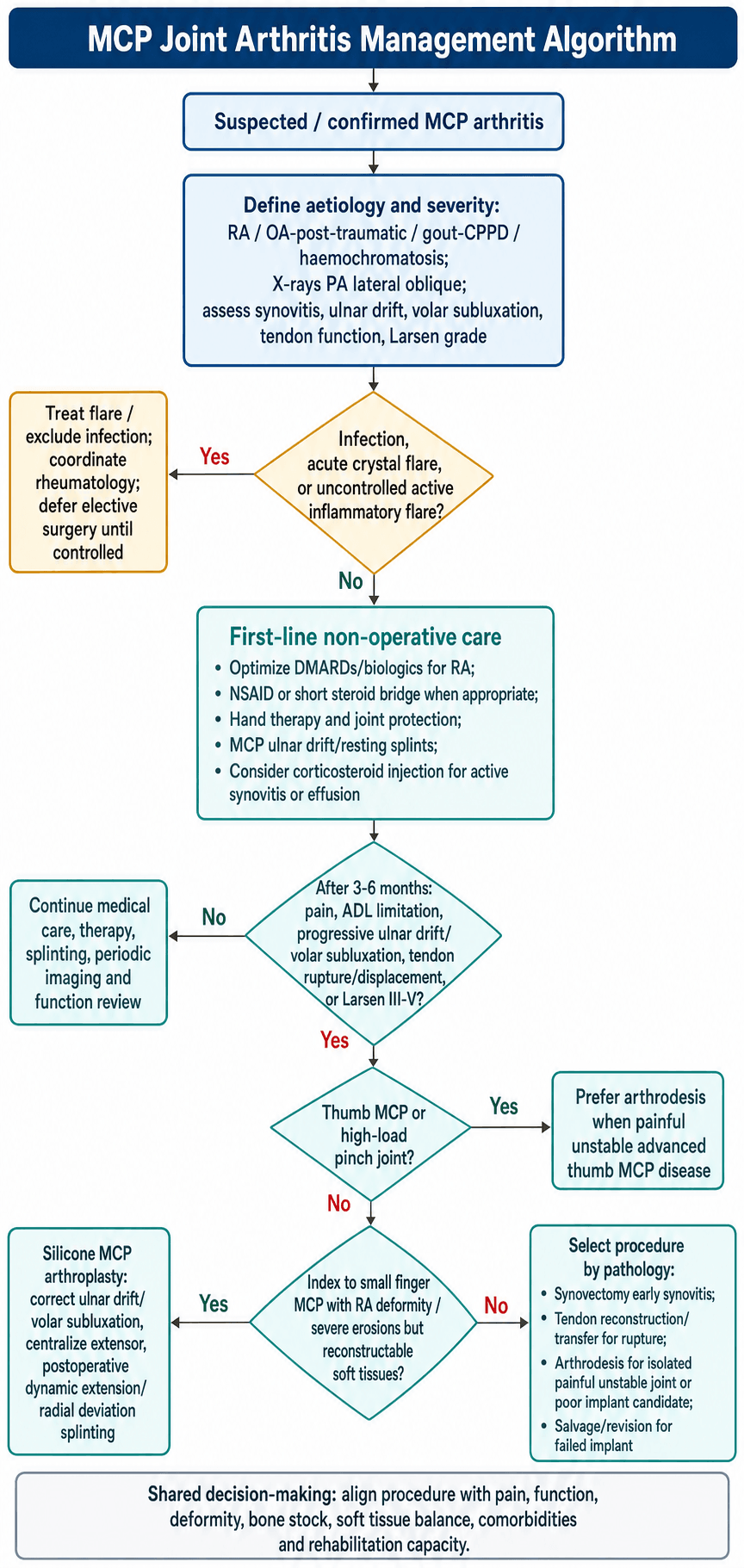
Conservative treatment aims to reduce inflammation and pain, preserve function and motion, slow progression of rheumatoid disease, and delay or avoid surgery. Medical management is optimised before surgery is considered, and for 3-6 months before it is offered.
Disease-modifying therapy is first-line for rheumatoid MCP arthritis, and surgery is reserved for the patient whose symptoms and functional impairment persist after it has failed. Methotrexate is the anchor; the rest are alternatives or additions.
- Dose
- 10-25 mg weekly, oral or subcutaneous
- Notes
- Folate antagonist, anti-inflammatory; 60-70% response; monitor CBC, LFTs and renal function every 8-12 weeks; nausea, hepatotoxicity, marrow suppression, teratogenic; folic acid 1 mg daily reduces side effects
- Dose
- 2-3 g daily in divided doses
- Notes
- Moderate efficacy, less than methotrexate; in combination or if methotrexate not tolerated
- Dose
- 200-400 mg daily
- Notes
- Mild disease; ophthalmology monitoring for rare retinal toxicity
- Dose
- 10-20 mg daily
- Notes
- Efficacy similar to methotrexate; alternative to it
Triple therapy, methotrexate with sulfasalazine and hydroxychloroquine, is used for moderate-to-severe disease and is as effective as some biologics.
Biologic and targeted DMARDs are indicated for moderate-to-severe disease uncontrolled on methotrexate monotherapy, high disease activity, or erosive disease:
- Agents and dosing
- Adalimumab (Humira) 40 mg SC every 2 weeks; etanercept (Enbrel) 50 mg SC weekly; infliximab (Remicade) 3-10 mg/kg IV every 8 weeks with methotrexate
- Mechanism, efficacy, risks
- Inhibit TNF-alpha; 60-70% ACR20 response (20% improvement); infection (TB reactivation, screen with PPD) and malignancy (lymphoma, skin cancer)
- Agents and dosing
- Tocilizumab (Actemra) 8 mg/kg IV every 4 weeks or 162 mg SC weekly; sarilumab (Kevzara) 200 mg SC every 2 weeks
- Mechanism, efficacy, risks
- Block the IL-6 receptor; efficacy similar to anti-TNF
- Agents and dosing
- Tofacitinib (Xeljanz) 5 mg orally twice daily; baricitinib (Olumiant) 2 mg orally daily
- Mechanism, efficacy, risks
- Inhibit Janus kinase signalling; efficacy similar to biologics with the advantage of oral dosing; infection and thrombosis (black box warning)
- Agents and dosing
- Rituximab (Rituxan) 1000 mg IV twice, day 0 and 14, repeated every 6 months
- Mechanism, efficacy, risks
- Depletes CD20-positive B cells; for failed anti-TNF
- Agents and dosing
- Abatacept (Orencia) IV or SC
- Mechanism, efficacy, risks
- Blocks T-cell activation
Around surgery. Hold an anti-TNF agent for 1-2 half-lives before the operation (adalimumab, for example, for 2-4 weeks) and restart it once the wound has healed, 2 weeks after surgery. The decision is made jointly with rheumatology.
NSAIDs give symptomatic relief of pain and stiffness by inhibiting cyclooxygenase and prostaglandin synthesis, and do not modify disease progression. Ibuprofen 400-800 mg three times daily, naproxen 500 mg twice daily or celecoxib 200 mg once or twice daily; the risks are GI bleeding (co-prescribe a PPI if the risk is high), renal impairment and cardiovascular events, especially with COX-2 inhibitors, so monitor renal function and the blood count.
Corticosteroids. Low-dose oral prednisone, 5-10 mg daily, covers acute flares and bridges the 8-12 weeks a DMARD takes to work. Long-term use is minimised because of osteoporosis, infection, glucose intolerance and Cushing syndrome, and the dose is tapered gradually once the DMARD is effective.
Indications for surgery. Any of the following, after conservative management has failed:
- Failed conservative management (DMARD or biologic therapy, injections, splinting) for at least 3-6 months
- Persistent pain affecting daily living and quality of life
- Progressive deformity affecting function: ulnar drift limiting grip, volar subluxation
- Severe ulnar drift or volar subluxation, for cosmetic and functional reasons
- Extensor tendon rupture or displacement with mechanical dysfunction
- The patient's wish for better alignment and function
- Larsen grade III-V radiographic change: severe erosions, subluxation
Surgical Management
The decision is digit-specific. The fingers (digits 2-5) are treated with silicone arthroplasty, which preserves motion for grip; the thumb MCP is fused, for the pinch stability described under Anatomy.
What the implant is. Alfred Swanson introduced silicone MCP arthroplasty in the 1960s-1970s and it revolutionised rheumatoid hand surgery. The implant is a flexible spacer, not a load-bearing hinge, and not a true joint replacement: it maintains the joint space, allows motion through flexion of the elastomer itself, and derives its stability from the fibrous capsule that forms around it (encapsulation). It cannot withstand high compressive loads, which is why it is contraindicated at the thumb MCP.
Indications.
- Rheumatoid MCP arthritis with ulnar drift and/or volar subluxation
- Post-traumatic MCP arthritis of digits 2-5
- Failed conservative management (DMARDs, splinting, injections for more than 3-6 months)
- A wish to preserve motion rather than fuse
- Larsen grade III-V radiographic change
- Functional impairment: difficulty with grip and daily living
Contraindications. Active infection is absolute. The others are inadequate soft-tissue cover (exposed bone, compromised skin), severe bone loss with insufficient stock for the stems, the thumb MCP (arthrodesis is preferred), an active rheumatoid flare (defer until controlled), and the patient who will not adhere to the post-operative splinting protocol.
Implants. The Swanson implant is the original design, a hinge with stems; the Sutter is similar; the NeuFlex is a newer silicone design reinforced with titanium grommets. Silicone is the standard. Pyrocarbon surface replacement is not silicone, requires intact bone stock, has a higher revision rate and is not standard.
Spacer versus surface replacement. Pyrocarbon and metal-on-polyethylene implants are unconstrained surface replacements that resurface the metacarpal head and phalangeal base and depend on the patient's own collateral ligaments and bone to stay reduced, whereas silicone generates its own fibrous-capsule stability. Because they need competent ligaments and good bone stock, surface replacements suit primary OA or post-traumatic MCP arthritis with intact ligaments, preserved bone and minimal deformity in a younger, higher-demand patient who wants to preserve more motion, and not the deformed, ligament-deficient, osteopenic rheumatoid MCP, where nothing is left to hold an unconstrained implant reduced. Pyrocarbon's elastic modulus is close to cortical bone, which limits stress shielding, and it is biocompatible, but it demands precise sizing and seating. Surface replacements carry higher rates of squeak, migration or subsidence, dislocation or instability and reoperation, and the comparative evidence (Srnec, Wagner and Rizzo) shows no survivorship advantage over silicone at the MCP, so silicone stays the standard for the rheumatoid MCP and pyrocarbon is reserved for selected non-rheumatoid joints.
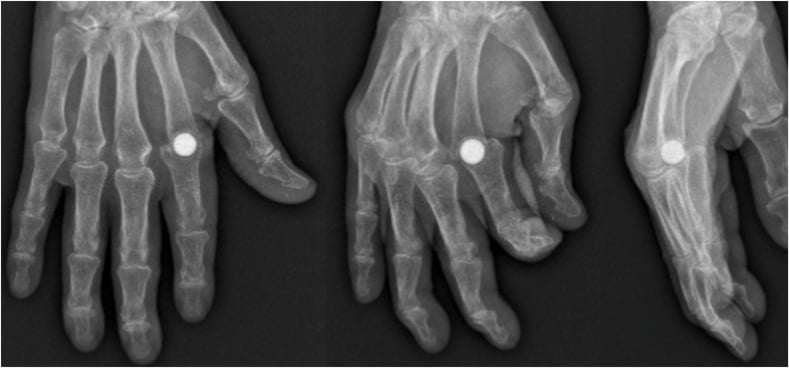
Planning. Bilateral hand radiographs (PA, lateral, oblique) to assess bone stock, the degree of erosion and metacarpal head destruction, and to template the implant size. Coordinate DMARD management with rheumatology, control active synovitis before operating, and make sure the patient understands the commitment to 6 weeks of full-time splinting afterwards.
Set-up and exposure. Supine, the arm on a radiolucent hand table, an upper-arm pneumatic tourniquet at 250 mmHg after exsanguination with an Esmarch or by elevation. A longitudinal dorsal incision of 3-4 cm centred over the MCP; for several joints, one longitudinal incision from index to small or separate incisions for each digit, without excessive undermining, to preserve venous drainage.
- Subcutaneous dissection preserving the dorsal veins and cutaneous nerves
- Identify the extensor digitorum communis tendon overlying the joint
- Develop the plane between the extensor and the joint capsule
- Elevate the extensor mechanism radially, preserving the sagittal bands if intact or raising them as a flap if ruptured
- Longitudinal capsulotomy to expose the joint
Synovectomy in the rheumatoid joint is complete: all hypertrophic, inflamed synovium is removed with rongeur, curette or electrocautery, and as much pannus as possible, because that reduces recurrent synovitis.
Bone preparation.
- Resect the metacarpal head with an oscillating saw, perpendicular to the shaft and not angled, taking minimal bone (approximately 5-10 mm) to preserve length; remove osteophytes and smooth the edges
- Ream the metacarpal and proximal phalanx canals with hand reamers or a burr to a snug fit for the stems, without over-reaming
- Insert a trial and assess the fit, which should be snug rather than loose
- Select the definitive size to match the trial
- Insert the silicone implant, stems into both canals
Sizing is the trade the surgeon makes at this point: an implant that is too large over-stuffs the joint and causes stiffness and implant fracture; one that is too small lets the deformity recur.
Soft-tissue balancing. The extensor tendon has displaced ulnarly into the valley and is acting as an ulnar deviator, so it is repositioned over the centre of the MCP and sutured to the radial capsule with 3-0 non-absorbable suture (Ethibond, Ti-Cron); if the radial sagittal band has ruptured, it is reconstructed instead. The stretched, incompetent radial collateral ligament is reefed (plicated), or reconstructed by suturing the radial capsule to the radial side of the metacarpal neck, to tighten the radial structures against ulnar drift. If the intrinsic tightness test is positive, the ulnar interosseous is released from the ulnar side of the proximal phalanx, preserving the radial intrinsics that counteract the drift. Crossed intrinsic transfer, moving the ulnar lateral band to the radial side to create an active radial deviating force, is reserved for severe recurrent ulnar drift despite ligament reconstruction and is rarely performed.
Arthroplasty without synovectomy, extensor centralisation, radial collateral reconstruction and intrinsic release where needed will fail with recurrent ulnar drift. The soft-tissue procedures are not optional.
Closure. Capsule over the implant with 2-0 absorbable (Vicryl), the extensor confirmed centralised and the sagittal bands closed if opened, subcutaneous 3-0 absorbable, skin 4-0 or 5-0 nylon, running or interrupted. Non-adherent dressing (Xeroform) and gauze, and the dynamic MCP extension splint applied immediately.
The dynamic extension splint. An outrigger custom-fabricated by a certified hand therapist, wrist in 20-30 degrees of extension, MCPs at 0 degrees with radial deviation, elastic bands pulling the MCPs into extension and radial deviation. It allows controlled passive flexion and blocks ulnar deviation. It is worn full-time (23 hours a day, off for hygiene only) for weeks 0-6, at night only for weeks 6-12, and at night as needed from months 3-6. Patient compliance with it is key to preventing recurrent ulnar drift.
Rehabilitation.
- Day 1-2: passive motion in the splint, flexion allowed and extension assisted by the bands
- Week 1: hand therapy begins with therapist-guided passive motion
- Weeks 2-6: progressive passive motion and gentle active motion within the splint
- Week 6: splint off by day; active motion begins
- Weeks 6-12: progressive active motion and gentle resisted strengthening
- Week 12: full strengthening, power grip and resistance training
What to expect. A 30-40 degree MCP flexion arc (0-40 degrees is typical), which is not the normal 0-90 but is enough for most daily activities and grip. With balanced soft tissue, 80-85% maintain the correction of ulnar drift and 85-90% maintain the reduction of volar subluxation. Pain improves significantly in 80-90%, because the operation removes painful synovium, stabilises the joint and improves alignment, and 85-90% are satisfied with pain relief and alignment. Counsel that this is a spacer, not a normal joint, and that motion is limited.
Survivorship. 80-90% of implants are in place and functioning at 10 years and 60-70% at 15 years; the failure modes are implant fracture, subsidence and recurrent deformity, detailed under Complications, and squeaking from silicone friction is an occasional complaint, a dissatisfaction rather than a mechanical failure. Read the 10-year figure against the long-term evidence on this page: at a mean of 14 years Goldfarb and Stern found 63% of implants fractured, ulnar drift recurring to 16 degrees and only 38% of hands rated satisfactory, though fracture is often well tolerated and, at 5 years, Squitieri and Chung found the patient-reported gains maintained.
Complications and Their Management
- Incidence
- 5-10%
- Prevention
- Proper implant sizing, avoid over-stuffing
- Management
- Observe if asymptomatic; revise if painful or unstable
- Incidence
- 10-15%
- Prevention
- Meticulous soft tissue balancing, dynamic splinting
- Management
- Revision with aggressive soft tissue balancing, crossed intrinsic transfer
- Incidence
- 20-30%
- Prevention
- Early passive motion, intensive hand therapy
- Management
- Dynamic splinting, manipulation (rare), tenolysis (if severe adhesions)
- Incidence
- Less than 2%
- Prevention
- Sterile technique, perioperative antibiotics
- Management
- Early: Wash out, antibiotics. Late: Implant removal, antibiotics, staged fusion
- Incidence
- 5%
- Prevention
- Proper implant sizing, avoid over-reaming
- Management
- Observe if mild; revise if severe and symptomatic
- Incidence
- 5-10%
- Prevention
- Rigid fixation (plate), smoking cessation, bone graft if poor quality
- Management
- Revision fusion with bone graft and plate fixation
Implant fracture. Fatigue failure from cyclic loading of a silicone that is flexible but not indestructible, typically 5-10 years after the operation. Many patients are asymptomatic and the fracture is found incidentally on a radiograph, as a radiolucent line through the implant, because the fibrous capsule maintains some stability even after the implant breaks; some have a return of pain, instability or crepitus, and a palpable fracture is rare. The asymptomatic fracture is observed. The symptomatic one is revised, with a new implant if the bone stock allows and an arthrodesis if it does not. Prevention is correct sizing, since over-stuffing raises the stress on the implant, and soft-tissue balancing, which reduces the abnormal forces on it.
Recurrent ulnar drift. The fingers deviate progressively at the MCPs months to years after surgery, the pre-operative deformity returning, sometimes with an extensor lag. The causes are inadequate soft-tissue balancing at the index operation (an extensor left uncentralised, a radial collateral not reconstructed), non-compliance with the dynamic splint, and persistent ulnar intrinsic tightness. Early, mild drift is treated with dynamic extension splinting and hand therapy; established moderate-to-severe drift needs revision with more aggressive balancing:
- Extensor centralisation with more aggressive suturing to the radial capsule
- Radial collateral ligament reconstruction, tightening the radial structures
- Release of the ulnar intrinsics
- Crossed intrinsic transfer of the ulnar lateral band to the radial side, creating an active radial deviating force
Prevention is meticulous balancing at the first operation, which is non-negotiable, the 6 weeks of full-time dynamic splinting with the patient's compliance, and supervision by the hand therapist.
Stiffness. Adhesions between the implant and the surrounding tissue, capsular contracture, inadequate hand therapy or non-compliance, and over-stuffing with too large an implant all limit MCP motion below the expected 30-40 degrees, so the patient has difficulty making a fist and function suffers. Prevention is passive motion from day 1-2 in the dynamic splint, intensive therapy with weekly sessions for the first 3 months, and patient education. Established stiffness is treated with dynamic splinting (a flexion splint for flexion, an extension splint for extension) and gentle manipulation by the therapist; manipulation under anaesthesia is rare, because it risks fracturing the implant, and tenolysis to release adhesions is rarely needed.
Infection. Rare, at less than 2%. An early infection, within 6 weeks, is a surgical site infection; a late one, after 6 weeks, is haematogenous seeding and rare. It presents with pain, swelling, erythema and warmth at the MCP, drainage from the incision, and uncommonly with fever and malaise. The diagnosis is clinical, supported by a raised white count, ESR and CRP, and by joint aspiration, where a synovial white cell count above 50,000 is highly suggestive and culture may be positive; the radiograph is usually normal acutely and may show loosening if the infection is chronic.
Treating the infected arthroplasty. For an acute infection of less than 3 weeks, a surgical wash-out with debridement, retaining a well-fixed implant in an attempt at salvage, and 6 weeks of culture-directed intravenous antibiotics, which salvages the implant in 50-70%. For a late infection or a failed salvage, the implant is removed, intravenous antibiotics are given for 6 weeks, and an arthrodesis is staged once the infection has cleared, at 3-6 months. Prevention is perioperative cefazolin 1-2 g intravenously within an hour of the incision, sterile technique, and DMARD management agreed with rheumatology, holding biologics around the operation to reduce the infection risk. Infection is rare, and devastating when it happens, because it often requires implant removal and fusion.
Guidelines, Registries & Global Practice
OrthoVellum is a global resource; the principles below apply to any board and the key regional differences a candidate may be examined on are flagged explicitly.
Global Epidemiology
In the GBD 2021 analysis (Ma et al, DOI), the global age-standardised prevalence and incidence of rheumatoid arthritis (the dominant cause of MCP arthritis) rose significantly from 1990 to 2021, with the disability burden (DALY rate) falling as medical management improved. Disease is consistently commoner in women, correlates with higher socio-demographic index, and is causally linked to smoking. Roughly 90% of patients with established rheumatoid disease develop MCP involvement. Primary osteoarthritis of the finger MCP joints is rare relative to the trapeziometacarpal, DIP and PIP joints.
Major Guidelines, Side by Side
There is no single dedicated surgical guideline for MCP arthritis; practice is framed by rheumatology disease-control guidelines (which determine when, and whether, surgery is needed) and by hand-surgery consensus. Recommendations are broadly concordant across regions.
- Position relevant to MCP arthritis
- Treat-to-target with conventional synthetic DMARDs (methotrexate anchor) first-line, escalating to biologic or targeted-synthetic DMARDs; tight inflammatory control reduces the deformity that drives surgery
- Evidence basis
- High-level consensus, regularly updated
- Position relevant to MCP arthritis
- Methotrexate-first, treat-to-target strategy aligned with EULAR; biologic/targeted DMARDs for inadequate response
- Evidence basis
- Systematic-review-based consensus
- Position relevant to MCP arthritis
- Early combination/methotrexate-based DMARD therapy with treat-to-target; biologics restricted to moderate-to-severe disease failing conventional DMARDs
- Evidence basis
- Health-technology appraisal
- Position relevant to MCP arthritis
- Silicone MCP arthroplasty for symptomatic rheumatoid MCP destruction with ulnar drift/volar subluxation failing medical management; arthrodesis preferred for the thumb MCP and for high-demand or bone-deficient digits
- Evidence basis
- Cohort and comparative evidence
- Position relevant to MCP arthritis
- Equivalent: silicone arthroplasty for finger MCP rheumatoid destruction, fusion for the thumb MCP; soft-tissue rebalancing integral
- Evidence basis
- Cohort-based consensus
Practical convergence: medical control of synovitis is first-line everywhere; surgery is reserved for established deformity with functional loss after optimised DMARD/biologic therapy. The arthrodesis-for-thumb / arthroplasty-for-fingers division is universal.
Registry and Comparative Evidence
Unlike hip and knee replacement, small-joint hand implants are not comprehensively tracked by the major national arthroplasty registries (NJR, AJRR, AOANJRR, Swedish/SHAR, Norwegian, NZJR), so the evidence base is institutional cohorts and comparative series rather than registry survivorship:
- Durability: at 5 years, patient-reported gains are maintained and cost-effective (Squitieri/Chung, PMID 25909303); by 14 years, motion, alignment and satisfaction decline substantially, with about 63% implant fracture (Goldfarb and Stern, PMID 14563791).
- Implant choice: silicone remains the default; pyrocarbon and metal-plastic surface replacements have not shown superior survivorship and carry comparable or higher reoperation rates (Srnec/Wagner/Rizzo, PMID 28869061).
- Thumb fusion: union approaches 95% with either tension-band or plate fixation; all-locked-screw plates raise non-union rates (Lutsky, PMID 29989437).
Global Practice Variation
- Falling surgical demand: effective treat-to-target DMARD/biologic therapy has markedly reduced the incidence of severe rheumatoid hand deformity in high-resource settings, so silicone MCP arthroplasty is performed far less often than in the pre-biologic era.
- Resource-limited settings: where early DMARDs and biologics are less accessible, candidates still present with advanced, fixed deformity, and reconstructive arthroplasty/arthrodesis retains a larger role; cost favours silicone over pyrocarbon implants.
- Perioperative DMARD management: broadly harmonised internationally — continue methotrexate through surgery in most cases, time biologics around the dosing cycle and restart once the wound is healed, and give stress-dose corticosteroid cover for patients on chronic glucocorticoids. Decisions are made jointly with rheumatology.
- Antibiotic prophylaxis: a single dose of a first-generation cephalosporin within 60 minutes of incision is standard worldwide, with a glycopeptide or clindamycin alternative for beta-lactam allergy.
Counselling and Consent (universal)
- Document failed conservative management (optimised DMARD/biologic therapy, injections, splinting) over 3 to 6 months.
- Set realistic expectations: silicone arthroplasty restores roughly 30 to 40 degrees of motion (not a normal joint), with implant fracture in 5 to 10% (often asymptomatic) and recurrent drift in 10 to 15% if soft tissues are not balanced.
- Emphasise that dynamic extension splinting for 6 weeks and certified hand-therapy supervision are integral to success, not optional.
- Counsel smoking cessation — it impairs fusion and raises infection risk — and document it.
MCQ Practice Points
Q: What is the typical deformity pattern in rheumatoid MCP joint arthritis?
A: Ulnar drift and volar subluxation of the proximal phalanges. Mechanism: Radial collateral ligament attenuation, extensor tendon ulnar subluxation, intrinsic muscle imbalance. Associated with radial deviation at wrist (zig-zag deformity). Sagittal band rupture allows extensor tendon ulnar displacement.
Q: What is the preferred surgical treatment for rheumatoid MCP arthritis?
A: Silicone MCP arthroplasty (Swanson design) remains gold standard. Provides pain relief and improved appearance. ROM typically 30-40° post-op. Requires soft tissue balancing including extensor tendon centralization, intrinsic release, and collateral ligament reconstruction. Contraindicated in manual laborers.
Q: What differentiates osteoarthritis from rheumatoid arthritis at the MCP joint?
A: OA: Index/middle finger MCP involvement, osteophytes, subchondral sclerosis, preserved bone density. RA: Symmetric polyarticular involvement, periarticular osteopenia, marginal erosions, soft tissue swelling, ulnar drift. RA rarely affects DIP (contrast with OA which commonly affects DIP).
Q: What is the role of MCP arthrodesis versus arthroplasty?
A: Arthrodesis preferred for: thumb MCP (requires stability for pinch), single-digit involvement, young laborers, post-traumatic arthritis. Arthroplasty preferred for: Multiple digit RA involvement (maintains finger cascade motion). Arthrodesis position: Index 25-30°, middle 35-40°, ring 40-45°, small 45-50° flexion.
Q: What soft tissue procedure is essential during MCP arthroplasty for rheumatoid arthritis?
A: Extensor tendon centralization - the extensor tendons must be relocated from their ulnarly subluxed position over the MCP joint center. Techniques include: radial sagittal band repair, crossed intrinsic transfer, juncturae release. Without centralization, ulnar drift recurs post-operatively.
Exam Viva Scenarios
Practise clinical reasoning and management decisions out loud
“A 55-year-old woman with rheumatoid arthritis presents with progressive ulnar drift of all four fingers bilaterally. She has failed DMARD therapy (methotrexate and adalimumab) and has persistent pain with gripping. X-rays show Larsen Grade III changes with volar subluxation and marginal erosions at MCPs. Describe your management.”
“A 60-year-old man with post-traumatic arthritis of the thumb MCP joint (old intra-articular fracture 10 years ago) has severe pain with lateral key pinch and difficulty with jar opening. He has failed conservative management including NSAIDs, activity modification, and corticosteroid injections. X-rays show joint space loss, subchondral sclerosis, and osteophytes. What is your surgical plan?”
“A 58-year-old woman had silicone MCP arthroplasty of the index and middle fingers 8 years ago for rheumatoid arthritis. She now presents with return of pain, recurrent ulnar drift of both digits, and difficulty with grip. X-ray shows fractured silicone implant in the index MCP with some bone resorption around the implant. The middle finger implant is intact but digits have drifted ulnarly. What is your approach to this failed arthroplasty?”
Etiology and Epidemiology
- Rheumatoid arthritis: 90% of RA patients have MCP involvement (most common cause)
- Post-traumatic: Following MCP fracture, dislocation, ligament injury (unilateral, single digit)
- Primary OA: Rare at MCP (unlike CMC-1, DIP, PIP)
- Psoriatic/crystalline: Seronegative spondyloarthropathy, gout, pseudogout
- Female greater than male 3:1 (RA), peak onset 40-60 years
Rheumatoid MCP Pathomechanics
- Volar subluxation: Proximal phalanx subluxes volarly from volar plate stretch
- Ulnar drift: Radial collateral ligament laxity, ulnar intrinsics pull ulnarly
- Synovitis: Primary event - chronic inflammation stretches capsule and ligaments
- Extensor displacement: Tendons displace ulnarly into valleys (sagittal band attenuation)
- X-ray: Shows volar subluxation (lateral view) and ulnar deviation (PA view)
Nalebuff Rheumatoid Hand Classification
- Type I: Swan-neck (MCP flexion, PIP hyperextension, DIP flexion) - most common
- Type II: Boutonniere (MCP hyperextension, PIP flexion, DIP hyperextension)
- Type III: Combined MCP ulnar drift with swan-neck deformity
- Type IV: Severe MCP volar subluxation (end-stage rheumatoid destruction)
Imaging and Larsen Grading
- Larsen Grade I: Periarticular swelling, osteopenia, no erosions (non-operative)
- Larsen Grade II: Erosions, joint space narrowing less than 50%
- Larsen Grade III-V: Severe erosions, narrowing greater than 50%, subluxation (SURGICAL)
- PA and lateral hand x-rays: Assess ulnar drift, volar subluxation, erosions
- Post-traumatic: Joint space narrowing, subchondral sclerosis, osteophytes
Non-Operative Management
- DMARDs: Methotrexate first-line (10-25mg weekly), sulfasalazine, leflunomide
- Biologics: Anti-TNF (adalimumab, etanercept), IL-6 inhibitors (tocilizumab), JAK inhibitors (moderate-severe RA)
- NSAIDs: Symptomatic relief only, do NOT modify disease
- Injections: Corticosteroid (triamcinolone 20mg), 50-70% relief for 3-6 months
- Splinting: MCP ulnar drift orthosis (slows progression, does NOT reverse deformity)
Silicone MCP Arthroplasty (Digits 2-5)
- Indications: Rheumatoid MCP arthritis, digits 2-5 (NOT thumb), failed medical management
- Implant: Silicone elastomer spacer (Swanson, Sutter, NeuFlex), NOT load-bearing
- Technique: Resect MC head, ream canals, insert implant with stems into MC and phalanx
- Adjuncts (ESSENTIAL): Synovectomy, extensor centralization, radial collateral ligament reconstruction, intrinsic release
- Post-op: Dynamic MCP extension splint 6 weeks full-time (CRITICAL for preventing recurrent drift)
- Outcomes: 30-40 degrees ROM, 80-90% at 10 years survivorship, 85% pain relief
MCP Arthrodesis (Preferred for Thumb)
- Indications: Thumb MCP arthritis (post-traumatic or RA), post-traumatic digits 2-5 with bone loss, failed arthroplasty
- Fusion position: Thumb 10-15 degrees flexion, Index 25-30, Middle 35-40, Ring 40-45, Small 45-50 (cascading flexion)
- Fixation: Dorsal locking plate preferred (rigid, 95% fusion rate), K-wires alternative
- Rationale for thumb: Pinch stability essential (high loads 5-10x pinch force), arthroplasty risks instability
- Outcomes: 95% fusion rate, excellent pain relief, stable pinch, high satisfaction
Soft Tissue Adjunct Procedures
- Extensor tendon centralization: Reposition extensor over MCP center, suture to radial capsule
- Radial collateral ligament reconstruction: Reef radial structures, correct ulnar drift
- Ulnar intrinsic release: Release tight ulnar interosseous from proximal phalanx
- Crossed intrinsic transfer: Transfer ulnar lateral band to radial side (severe recurrent drift)
- WITHOUT soft tissue balancing, arthroplasty WILL fail (recurrent ulnar drift)
Post-operative Protocol
- Dynamic MCP extension splint: 6 weeks full-time, then night splinting 3 months
- Immediate passive ROM: Day 1-2 with dynamic splint (flexion allowed, extension assisted)
- Active ROM: Week 6 (after splint removed during day)
- Strengthening: Week 12 (gentle grip, progressive resistance)
- Hand therapy: Certified hand therapist essential for splint fabrication and supervision
Complications
- Implant fracture: 5-10% (often asymptomatic due to fibrous encapsulation, observe if pain-free)
- Recurrent ulnar drift: 10-15% (inadequate soft tissue balancing at index surgery)
- Stiffness: 20-30% (hand therapy essential, dynamic splinting, tenolysis if severe)
- Subsidence: 5% (implant sinks into bone, observe if mild)
- Infection: Less than 2% (early: wash-out, antibiotics; late: implant removal, staged fusion)
- Nonunion (arthrodesis): 5-10% (revision with bone graft and rigid plate)
Thumb vs Fingers Decision
- Thumb MCP: Arthrodesis preferred (pinch stability, 10-15 degrees flexion)
- Digits 2-5: Silicone arthroplasty preferred (motion needed for grip function)
- DO NOT fuse multiple MCPs bilaterally (eliminates grip function)
- Thumb arthroplasty risks instability under pinch loads (silicone not load-bearing)
Exam Pearls (High Yield)
- Rheumatoid mechanism: synovitis stretches the volar plate and radial collateral ligament, giving volar subluxation, ulnar drift and ulnar extensor displacement, confirmed on X-ray
- Silicone acts as a spacer, not a load-bearing hinge: preserves 30-40 degrees of motion, restores alignment, is stabilised by fibrous encapsulation, and needs extensor centralisation and intrinsic release
- Cascading MCP fusion angles: Thumb 10-15, Index 25-30, Middle 35-40, Ring 40-45, Small 45-50
- Silicone arthroplasty REQUIRES soft tissue balancing (extensor centralization, ligament reconstruction, intrinsic release)
- Dynamic MCP extension splinting for 6 weeks is CRITICAL (prevents recurrent ulnar drift)
Outcomes and Evidence
Chung et al (landmark multicentre trial: SMPA vs medical treatment)
- Prospective study at three referral centres (USA and England), 70 surgical and 93 non-surgical rheumatoid patients with severe ulnar drift and/or extensor lag
- At one year, mean overall Michigan Hand Outcomes Questionnaire (MHQ) score improved significantly in the surgical group but did not change in the non-surgical group
- Ulnar deviation and extensor lag improved significantly after silicone arthroplasty
- Grip and pinch strength and Arthritis Impact Measurement Scales showed no significant change
- Non-surgical patients had better baseline MHQ scores and did not deteriorate over one year
Goldfarb and Stern (long-term silicone MCP arthroplasty)
- 208 silicone MCP arthroplasties in 52 hands of 36 rheumatoid patients, mean 14 years follow-up
- Mean MCP arc of motion 30 degrees pre-op, 46 degrees early post-op, declining to 36 degrees at final follow-up
- Mean ulnar drift corrected from 26 degrees to less than 5 degrees early, recurring to 16 degrees at final follow-up
- 130 implants (63%) fractured and a further 45 (22%) deformed by final follow-up; fracture associated with increased ulnar drift
- Only 38% of hands rated satisfactory and only 27% pain-free at final follow-up
Lutsky et al (thumb MCP fusion: union rates and fixation)
- 56 thumb MCP fusions (12 tension-band wiring, 44 plate-and-screw), mean follow-up 32 months
- Overall union rate 95%; mean fusion angle 12.8 degrees (plate) and 16.5 degrees (tension band)
- Twelve complications overall, the majority in the plate-and-screw group
- Use of fully locked plates specifically increased the rate of delayed or non-union
- Authors do not recommend routine use of locked plates for thumb MCP fusion
Millender and Nalebuff (reconstructive surgery in the rheumatoid hand)
- Foundational description of reconstructive priorities for the rheumatoid wrist, MCP joint and thumb
- Established indications distinguishing arthrodesis from arthroplasty in the rheumatoid hand
- Companion paper (Nalebuff and Millender, same volume) defined the four-type swan-neck classification guiding procedure selection
- Framework remains the international reference for communicating rheumatoid hand deformity patterns
Squitieri, Chung et al (5-year cost-effectiveness and durability)
- 5-year prospective cohort of 170 rheumatoid patients (73 surgical, 97 non-surgical)
- Significantly higher upper-extremity (MHQ) outcomes in the surgical group maintained at 5 years
- Observed surgical revision rate 5.5% over 5 years
- Incremental cost-effectiveness was favourable and robust to revision rates up to about 6%
- Short-term functional gains after silicone MCP arthroplasty are sustained to 5 years at relatively low cost
Srnec, Wagner and Rizzo (small-joint implant arthroplasty review)
- Reviews implant arthroplasty of the MCP, PIP and trapeziometacarpal joints across implant materials
- Hinged silicone prosthesis remains, in many cases, the gold standard despite deformity-correction loss, implant fracture and synovitis
- Alternative metal-plastic and pyrocarbon implants evolved but survivorship and reoperation rates remain a concern
- Implant arthroplasty predictably relieves pain with high satisfaction but historically high complication rates
Ma et al (Global Burden of Disease 2021: rheumatoid arthritis)
- Global age-standardised prevalence and incidence of rheumatoid arthritis rose significantly from 1990 to 2021
- Age-standardised disability-adjusted life-year (DALY) rate fell over the same period
- Females consistently showed higher rates across all metrics; burden correlates positively with socio-demographic index
- Mendelian randomisation confirmed a causal effect of smoking on rheumatoid arthritis
- Incidence is projected to rise moderately through 2050, with marked regional variation (highest in Andean Latin America)